The influence of education agents on student choice making in the canadian posts
Tìm hiểu ảnh hưởng của đại diện giáo dục đến quyết định du học. Khám phá vai trò, tác động & lời khuyên.
Michigan State University
Higher, Adult, and Lifelong Education
Luan An
Luận án tiến sĩ
Năm xuất bản
Số trang
264
Thời gian đọc
40 phút
Lượt xem
0
Lượt tải
0
Phí lưu trữ
50 Point
Tổng quan nhanh
- Chủ đề:
- Education Agents' Role in International Student Recruitment
- Số trang:
- 264 trang
- Trường:
- Michigan State University
- Chuyên ngành:
- Higher, Adult, and Lifelong Education
- Tác giả:
- Robert N.
- Năm:
- 2014
Tóm tắt nội dung luận án
I.Education Agents Role in International Student Recruitment
Globalization profoundly impacts postsecondary education worldwide. International student migration stands as one of its most visible markers. Within this dynamic environment, education agents have emerged as crucial middlemen. They operate within the international student recruitment industry. Agents mediate the complex admissions process on behalf of their institutional and student clients. This intermediary role has become increasingly central to how prospective students navigate global higher education choices. The prevalent commission-based model, where most agents operate, has prompted significant concern. Critics question whether agent profit, rather than genuine student welfare, drives decision-making in the search process. While these study abroad agents have become ubiquitous in international admissions, their precise impact on the outcomes for their student clients has remained largely unexplored. This study aimed to bridge this knowledge gap. It sought to understand the nuanced role of student choice within the agent-mediated Canadian postsecondary search process. The research delved into the mechanisms of agent influence on enrollment, providing critical insights for all stakeholders involved in international student recruitment.
1.1. Agents as intermediaries in global higher education.
Education consultants serve as vital bridges connecting aspiring international students with suitable Canadian postsecondary institutions. Their primary function involves simplifying and streamlining the often-complex application journey. This includes guidance on navigating various university choice factors, such as program selection, institutional reputation, and location. Agents alleviate much of the administrative burden for prospective students, offering services that range from initial school recommendations to assistance with application submission and even visa guidance. Their presence is instrumental in expanding access to global education for a diverse pool of students worldwide. Many international students, particularly those unfamiliar with the Canadian educational system, increasingly rely on these specialized services. The continuous growth of this sector underscores the escalating global demand for international education and the perceived value of agent support in achieving these higher education choices.
1.2. The commission based model and its concerns.
A significant characteristic of the education agent industry is its reliance on a commission-based business model. Under this system, higher education institutions compensate study abroad agents for each student they successfully recruit and enroll. This financial arrangement inherently raises questions about potential conflicts of interest, specifically concerning whether agent profit takes precedence over the best interests and welfare of the student. Concerns persist that agents might be incentivized to recommend institutions offering higher commissions, potentially leading to less-than-optimal academic or personal fits for the students they advise. Such practices challenge the principles of ethical recruitment and transparency, which are crucial for maintaining trust within the international student recruitment ecosystem. Ensuring greater transparency regarding agent commissions and their potential influence on student decision-making processes is vital for all parties involved, including prospective students, institutions, and regulatory bodies.
1.3. Widespread use in international admissions.
The involvement of education agents has become an undeniable and widespread phenomenon in international admissions globally. Their pervasive presence significantly shapes the landscape of international student recruitment strategies employed by postsecondary institutions. Many institutions heavily rely on these agents to meet ambitious international enrollment targets and diversify their student populations. Concurrently, a substantial and growing number of prospective students utilize agents for guidance and support throughout their application journeys, especially when considering higher education choices in a foreign country. Despite this widespread adoption and reliance, a comprehensive understanding of the tangible impact of agent involvement on actual student decision-making processes and enrollment outcomes has historically been limited. This study aimed to provide crucial insights into this dynamic, investigating how agent influence manifests and affects the final choices made by international students.
II.Student Choice Making Agent Influence Decision Factors
International students face a myriad of complex decisions when pursuing education abroad. The agent-mediated search process introduces a unique layer of influence on student choice making. Multiple interconnected factors drive individuals to consider studying overseas. Initial interest in international education is often shaped by a combination of personal aspirations, economic considerations, and external societal pressures. Key reference groups, including family members, friends, and community networks, play a significant role in crystallizing these initial goals. Education consultants then step in, guiding prospective students through the subsequent stages of their application journey. Understanding these underlying decision factors is paramount to comprehending the full scope of agent influence on enrollment. This study meticulously explored the student experience, identifying both the distinct affordances and the limitations students associated with hiring an agent, ultimately shedding light on their nuanced motivations.
2.1. Initial catalysts push pull factors reference groups.
Students' initial interest in pursuing education abroad is typically catalyzed by a combination of "push" and "pull" factors. Push factors might include perceived limitations within their home country's educational system, restricted domestic opportunities, or a desire for greater academic rigor or specific specializations unavailable locally. Conversely, pull factors encompass the allure of high-quality foreign education, enhanced career prospects post-graduation, cultural enrichment, and the potential for international mobility. Economic considerations, such as the perceived return on investment for international degrees, often serve as potent motivators. Furthermore, key reference groups significantly influence the construction of initial educational goals. Family members provide substantial input and often financial support, while friends and broader community leaders can shape aspirations and encourage international pursuits. These collective influences fundamentally precede and inform the subsequent engagement with education consultants, setting the stage for higher education choices.
2.2. Reasons for hiring education consultants.
Prospective students actively choose to hire study abroad agents for a multitude of practical reasons, effectively compensating for perceived deficiencies in their own resources or knowledge. Agents primarily fill critical gaps that students and their immediate reference groups often lack. These include a scarcity of time to research numerous institutions thoroughly, a lack of specialized knowledge regarding foreign educational systems, and the absence of established connections with universities. Crucially, agents possess specific expertise in navigating complex application processes, understanding visa requirements, and interpreting institutional policies. By leveraging these resources, education consultants significantly ease the burden of international applications, making the pursuit of higher education choices abroad more accessible and manageable. This support system simplifies what would otherwise be an overwhelming and intricate journey for many international students.
2.3. Prioritizing permanent residency over institutional fit.
A significant finding revealed that many international students, particularly those with a strong "migration-minded" perspective, often prioritize securing permanent residency in Canada. This overarching objective can lead them to view a postsecondary qualification primarily as a strategic pathway to achieving permanent resident status. Consequently, concerns about finding an "ideal" institutional or program fit might become secondary or even subordinated to the primary goal of obtaining any recognized postsecondary qualification. Students might, therefore, be more willing to accept programs that are less perfectly aligned with their academic interests or career aspirations, as long as the qualification provides a clear "glide path" to residency. This perspective profoundly shapes their engagement with education consultants and influences the ultimate higher education choices made. Understanding these motivations is critical for analyzing agent influence on enrollment and the broader student decision-making process.
III.Understanding Agent Mediated Higher Education Choices
The agent-mediated search process exerts a substantial and often determinative impact on students' ultimate higher education choices. Education agents frequently act as de facto gatekeepers of information, curating the options presented to prospective students. Consequently, their recommendations carry considerable weight and significantly shape the perceived universe of available choices. This study thoroughly investigated the mechanisms through which agents influence and, at times, constrain the options available to students. Findings consistently highlighted that students often receive a severely limited set of choices, which naturally restricts their ability to explore a broader range of university choice factors. This dynamic underscores the inherent power imbalances within the agent-student relationship. Despite these constraints, students demonstrated remarkable resourcefulness in actively seeking and verifying additional information independently, indicating a strong desire for informed decisions. The interplay between agent influence on enrollment and student agency is a complex and critical aspect of the international student recruitment process.
3.1. Agent influence on university choice factors.
Education agents wield significant influence over the institutional and program choices presented to international students. By selectively showcasing particular options, they effectively shape the perceived range of available university choice factors. Agents' recommendations often become the primary drivers for where prospective students ultimately apply. Students may find their exposure to alternative institutions or programs limited, depending on the agent's portfolio or relationships. This direct and often powerful influence is a core component of the services provided by study abroad agents. It profoundly impacts the initial stages of the student decision-making process, narrowing the field of potential higher education choices. The study reveals that this selective presentation is a key mechanism through which agents guide student trajectories.
3.2. Constrained program and institutional options.
A central finding of this research indicates that education agents primarily influence student choice-making by offering a severely constrained set of institutional and program options. This practice inherently limits students' ability to explore a comprehensive spectrum of higher education choices that might better align with their individual academic profiles, interests, or long-term goals. The options presented by agents may, at times, be influenced by factors such as agent commissions or pre-existing agreements with partner institutions, rather than solely by the student's best fit. This raises significant questions regarding the ethical recruitment practices within the industry and the transparency offered to prospective students. The findings unequivocally identify this constrained choice offering as a primary and impactful mechanism of agent influence on enrollment, deserving further scrutiny from institutions and policymakers alike.
3.3. Students strategies for information verification.
Despite relying on agents, international students frequently employ creative and proactive strategies to gather additional information. This independent research serves a dual purpose: to verify the information provided by their agents and to expand upon the limited options initially presented. Students commonly consult online resources, including university websites, student forums, and social media groups, to gain broader perspectives. They also actively connect with current international students studying in Canada, seeking firsthand accounts and unbiased opinions about specific institutions and programs. These self-directed methods are crucial for ensuring that students make more informed higher education choices, mitigating potential biases or limitations of agent services. This resourceful behavior highlights students' agency and their commitment to making well-considered decisions within the complex international student recruitment landscape.
IV.Key Findings on Agent Impact in Prospective Student Search
This study generated significant and nuanced insights into the actual impact of education agents on the international student search process. The research specifically explored the lived experiences of international students who utilized agent assistance for their Canadian postsecondary search. Findings reveal a complex picture, particularly concerning student satisfaction and its correlation with perceived institutional or program fit. The degree of institutional or program undermatching or mismatching experienced by students was found to be a critical factor influencing their overall satisfaction with the search outcome. This qualitative research approach provided rich, detailed data, capturing the intricate realities and individual perspectives of prospective students. The results offer valuable, actionable insights for all stakeholders—students, postsecondary institutions, and policymakers—engaged in the international student recruitment ecosystem. Understanding these dynamics is essential for fostering more equitable and effective pathways to global higher education choices.
4.1. Satisfaction with search outcome and undermatching.
A surprising finding indicated that nearly all respondents expressed satisfaction with their ultimate search outcome, despite potential discrepancies. This reported satisfaction was, intriguingly, correlated with the degree of institutional or program "undermatching" or "mismatching" they had experienced. Students who enrolled in programs or institutions that might have been considered less than ideal, based on their qualifications or initial aspirations, still reported contentment. This suggests a notable willingness among international students to adapt and find positive aspects within their chosen educational path, particularly if their primary goal, such as migration, was being facilitated. The agent influence on enrollment decisions, which might contribute to such undermatching, did not necessarily equate to dissatisfaction for these students, underscoring the complexity of their motivations and resilience.
4.2. Qualitative insights from international student experiences.
The study employed a rigorous qualitative research methodology to delve deeply into the experiences of international students. Over the course of five months, 23 currently enrolled international students were interviewed. Their narratives provided rich, descriptive insights into the nuances of their journeys to Canada. Students shared stories filled with humor, curiosity, hope, and courage, illuminating the personal challenges and triumphs encountered during their agent-assisted search process. This in-depth approach allowed researchers to capture detailed accounts of the student decision-making process, including their initial motivations, their interactions with education consultants, and their perceptions of the higher education choices presented. The qualitative design was instrumental in uncovering subtle yet powerful mechanisms of agent influence and student adaptation.
4.3. Data collection methods and study participants.
The research setting comprised eight postsecondary institutions situated within one specific Canadian province. This focused geographic scope allowed for a concentrated exploration of agent influence within a particular regional context. Data collection spanned five months, during which 23 international students were purposively selected and interviewed. While the number of respondents was specific, the qualitative approach emphasized depth over breadth, aiming to gather detailed narratives rather than statistical generalizability. The study sample provided diverse perspectives from international students. However, it is noteworthy that undergraduate students were underrepresented in the final study sample, a limitation acknowledged by the researchers. This methodology was crucial for uncovering the intricate details of the international student recruitment process and the role of study abroad agents.
V.Implications for Ethical Recruitment Policy Makers
The findings of this comprehensive study carry substantial implications for a broad spectrum of stakeholders. These include international students themselves, postsecondary institutions engaged in global outreach, and policymakers responsible for regulating the international education sector. A clear and robust understanding of the mechanisms of agent influence is not merely academic; it is vital for fostering and ensuring more ethical recruitment practices across the industry. Institutions must critically re-evaluate their current reliance on agent commissions and the potential ethical dilemmas this model presents. Policymakers, equipped with these insights, can develop more effective oversight mechanisms and regulatory frameworks to protect student welfare and ensure fair practices. Promoting transparency throughout the student decision-making process is not just an ideal but an essential requirement for building trust and integrity within international student recruitment. This research provides a solid foundational basis for informed discussions and proactive action.
5.1. Impact on students and higher education institutions.
For students, the study highlights the importance of critical engagement and independent research, even when utilizing education consultants. Greater awareness of potential agent biases or limitations can empower them to make more informed higher education choices that truly align with their academic and personal goals. Postsecondary institutions, on the other hand, must critically reassess their partnerships with study abroad agents. They need to ensure that these collaborations align strictly with their institutional values and commitments to student welfare. The findings underscore the necessity for clear, transparent communication between institutions, agents, and prospective students to manage expectations effectively. Institutions are encouraged to actively support and promote independent student research, offering resources that enable students to verify and expand upon information provided by agents, thereby fostering a more balanced student decision-making process.
5.2. Recommendations for ethical recruitment practices.
The research strongly suggests an urgent need for the development and enforcement of enhanced ethical recruitment guidelines within the international student recruitment sector. Paramount among these is the call for greater transparency regarding agent commissions. Institutions should explicitly disclose their commission structures to both agents and, indirectly, to prospective students, fostering an environment of openness. Additionally, institutions must implement robust monitoring mechanisms to closely scrutinize agent recommendations, ensuring that the advice provided serves the student's best interests rather than purely financial incentives. Prioritizing student welfare and academic fit must be the central focus of all international student recruitment efforts. Industry bodies and professional associations can play a crucial role in establishing and promoting clear best practices for education consultants, thereby enhancing trust and integrity across the entire ecosystem of international higher education choices.
5.3. Future research directions in international student recruitment.
This study lays the groundwork for several compelling avenues for future research in international student recruitment. One important direction involves investigating the experiences of students who chose not to use education agents, offering a comparative perspective on the student decision-making process. Another critical area is to explore the journeys of students who used agents but did not persist to graduation, shedding light on potential long-term impacts of agent influence on enrollment and academic success. Furthermore, inquiry into the experiences of students who used agents specifically to apply to Francophone postsecondary institutions in Canada would provide valuable cultural and linguistic nuances. Expanding research into agent influence across diverse national and institutional contexts is crucial for developing a comprehensive understanding of this global phenomenon and continually improving ethical practices for international higher education choices.
Mục lục chi tiết luận án
Tải xuống file đầy đủ để xem toàn bộ nội dung
Tải đầy đủ (264 trang)Trích đoạn nội dung luận án
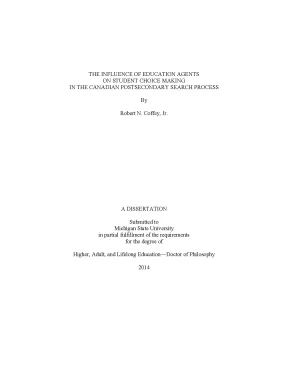
Tải xuống để đọc toàn bộTHE INFLUENCE OF EDUCATION AGENTS ON STUDENT CHOICE MAKING IN THE CANADIAN POSTSECONDARY SEARCH PROCESS By Robert N. A DISSERTATION Submitted to Michigan State University in partial fulfillment of the requirements for the degree of Higher, Adult, and Lifelong Education—Doctor of Philosophy 2014 ABSTRACT THE INFLUENCE OF EDUCATION AGENTS ON STUDENT CHOICE MAKING IN THE CANADIAN POSTSECONDARY SEARCH PROCESS By Robert N. Globalization has had an ongoing and significant impact on postsecondary education, with international student migration as one of the most visible markers. Education agents have emerged as middlemen in international student recruitment industry, mediating the admissions process on behalf of their institutional and student clients.
The commission-based model within which most agents operate has prompted concern about whether agent profit and not student welfare drives decision-making in the search process. While agents have become ubiquitous in international admissions, little is known about their impact of their involvement on the outcome for their student clients. The purpose of this study was to learn more about the role of student choice in the agent- mediated Canadian postsecondary search process. The setting of this study was eight postsecondary institutions in one Canadian province.
A qualitative research methodology was used, and 23 currently enrolled international students were interviewed over the course of five months. The central research question was: What is the experience of international students involved in an agent-assisted Canadian postsecondary search process? Study findings identified several push and pull factors (Mazzarol & Soutar, 2002) and key reference groups that catalyzed student interest in education abroad and influenced initial goal construction. Respondents readily identified both affordances and limitations that they associated with hiring an agent. Students typically hired agents to compensate for the time, knowledge, connections, and expertise they and their reference groups lacked.
Commission- based agents primarily influence student choice-making by offering a severely constrained set of institutional and program choices. Migration-minded students were frequently willing to subordinate concerns about institutional fit, as any earned postsecondary qualification provides a glide path to permanent residency. Respondents frequently employed creative strategies to gather additional information that could be used to verify or expand upon what their agents told them. Nearly all respondents indicated satisfaction with the search outcome, although this was correlated with the degree of institutional or program undermatching or mismatching they had experienced.
The results of this study have implications for students, postsecondary institutions, and policymakers, which are presented. Limitations of this research include the setting (several postsecondary institutions in one Canadian province), the number of respondents (23), the qualitative approach, and the underrepresentation of undergraduate students in the study sample. Directions for future research include inquiry into the experiences of students who did not use agents; students who used agents but did not persist to graduation; and the experience of students who used agents to apply to Francophone postsecondary institutions in Canada. Copyright by ROBERT N.
2014 This work is dedicated to the memory of Robert N., whose name I proudly bear, and to Jacquelyn Coffey, with heartfelt thanks for their love, guidance, and support. Their resilience and strength inspired my determination to complete this work. I also dedicate this to my partner, Steven Chang. Thank you for sharing this journey with me.
v ACKNOWLEDGEMENTS This study would not have been possible without the participation of the 23 international students who talked with me about their experiences in coming to Canada. It is no small feat to uproot oneself from home and family and travel thousands of miles away to live and study in a wholly unfamiliar place. Their stories resonated with humor, curiosity, hope, and courage. I am grateful for the time they took to share them with me.
I want to thank the four members of my dissertation committee, Marilyn Amey, Ann Austin, Lynn Paine, and Kristen Renn, for their encouragement, guidance, and insight. I especially want to acknowledge Ann Austin, my committee chair. She epitomizes the faculty mentor I hoped to find in returning to school. I have benefitted greatly from her advice, patience, and good cheer and have (with difficulty) learned to live with ambiguity under her tutelage.
I look forward to future opportunities for collaboration. I had the great luck to hold an assistantship with the Undergraduate Research office during my time at Michigan State. It was a privilege to work with such collegial, resourceful, talented, and kind people—the embodiment of MSU’s ethos. A very special thank you to Korine Steinke Wawrzynski, who effortlessly balanced being a supervisor, mentor, and friend while helping me to remember that “it’s kind of fun to do the impossible”.
I’m grateful for her support and encouragement. Thanks also to Doug Estry and Sandra Walther, who provided daily examples of principled administrative leadership. Generous support from the College of Education helped fund my research and provided me with a transformative educational experience. In particular, I was honored to have been the recipient of the Dr.
Taylor and Family Graduate Research Grant, intended to support doctoral candidates whose research focuses on global perspectives. I am grateful to Dr. vi Taylor for her support of the College and of my work. Thank you to Darcy Rollins, Donna Everitt, and the staff of the International Education Branch of the Government of Manitoba, who graciously hosted me for a summer internship and introduced me to education agents as a policy issue.
Thanks also to Noel Baldwin and Monica Kronfli with the Council of Ministers of Education, Canada (CMEC), who provided the opportunity to further explore this issue by selecting me to produce an environmental scan on agent use in Canada’s education systems. The experience unquestionably benefitted my dissertation research. Thank you to Clayton Smith at the University of Windsor for his support. A special thanks to William C.
Metcalfe, Karen Stites, and the Canadian Studies faculty at UVM for opening the door to a lifelong interest in Canada. Choosing HALE introduced me to a diverse, brainy, and supportive network of current and past students. Through the program I’ve expanded my professional network, found committed mentors, and made lifelong friends. A special thank you to Amy Finley and Leanne Perry.
I couldn’t have asked for better companions on this journey. I’m very grateful for their friendship. A special thanks to Kathy Bing Kusisto and Roger Allmandinger for their many kindnesses. Thanks also to Tricia Seifert, Jeff Burrow, and Wincy Li at the Ontario Institute for Studies in Education at the University of Toronto for their camaraderie, support, and hospitality.
A very special thanks to my parents, Robert and Jacquelyn Coffey, for their lifelong love, support, and encouragement. Thanks to Tim Coffey, Carson Colmore, and their children, Ryan and Maddie, for making visits home to Rhode Island such a joy. Thank you to Michael Brown and Glen Turpening for their stalwart friendship. Finally, I want to thank my partner Steven Chang, for his love, patience, understanding, and kindness.
Nội dung được bảo vệ bản quyền — Tải xuống đầy đủ
Trích dẫn luận án này
Robert N. (2014). The influence of education agents on student choice making i [Luận án tiến sĩ, Michigan State University]. LuanAn.net. https://luanan.net/giao-duc-hoc/tam-ly-hoc-giao-duc/the-influence-of-education-agents-on-student-choice-making-in-the-canadian
Câu hỏi thường gặp
Luận án "The influence of education agents on student choice making i" nghiên cứu về vấn đề gì?
Tìm hiểu ảnh hưởng của đại diện giáo dục đến quyết định du học. Khám phá vai trò, tác động & lời khuyên.
Luận án "The influence of education agents on student choice making i" được bảo vệ tại trường nào?
Luận án này được bảo vệ tại Michigan State University. Năm bảo vệ: 2014.
Luận án "The influence of education agents on student choice making i" thuộc chuyên ngành gì?
Luận án "The influence of education agents on student choice making i" thuộc chuyên ngành Higher, Adult, and Lifelong Education. Danh mục: Tâm Lý Học Giáo Dục.
Luận án "The influence of education agents on student choice making i" có bao nhiêu trang?
Luận án "The influence of education agents on student choice making i" có 264 trang. Bạn có thể xem trước một phần tài liệu ngay trên trang web trước khi tải về.
Cách tải luận án "The influence of education agents on student choice making i" về máy như thế nào?
Để tải luận án về máy, bạn nhấn nút "Tải xuống ngay" trên trang này, sau đó hoàn tất thanh toán phí lưu trữ. File sẽ được tải xuống ngay sau khi thanh toán thành công. Hỗ trợ qua Zalo: 0559 297 239.