Supplemental instruction calibration and self efficacy a path
Nghiên cứu về hiệu chuẩn hướng dẫn bổ sung và tính tự hiệu quả trong học tập. Khám phá mối liên hệ và các yếu tố ảnh hưởng.
Old Dominion University
Education – Higher Education Concentration
Luan An
Luận án tiến sĩ
Năm xuất bản
Số trang
152
Thời gian đọc
23 phút
Lượt xem
0
Lượt tải
0
Phí lưu trữ
50 Point
Tổng quan nhanh
- Chủ đề:
- Unlocking STEM Success: The Role of Supplemental Instruction (SI)
- Số trang:
- 152 trang
- Trường:
- Old Dominion University
- Chuyên ngành:
- Education – Higher Education Concentration
- Tác giả:
- Jennifer Leigh Grimm
- Năm:
- 2019
Tóm tắt nội dung luận án
I.Unlocking STEM Success The Role of Supplemental Instruction SI
Many students struggle to complete STEM degrees. Entry-level courses present significant hurdles. Higher education institutions seek effective interventions. Supplemental Instruction (SI) emerges as a prominent academic support program. SI aims to enhance student mastery of course content. It also fosters crucial self-regulated learning (SRL) behaviors. These behaviors are essential for navigating challenging academic environments. Improved learning outcomes often correlate with SI participation. The efficacy of SI in promoting student success warrants deeper investigation.
1.1. STEM Student Persistence Challenges
Persistence in science, technology, engineering, and mathematics (STEM) fields remains a critical concern. Many students do not progress past foundational courses. This attrition impacts the STEM workforce pipeline. Understanding factors that hinder or promote persistence is vital. Academic support programs are designed to address these challenges directly.
1.2. Supplemental Instruction as an Intervention
Supplemental Instruction provides a non-remedial, peer-assisted learning approach. It integrates "what to learn" with "how to learn." SI sessions target historically difficult courses. Trained peer leaders facilitate collaborative learning activities. This method supports students in developing stronger study skills. It promotes active engagement with course material.
1.3. Bridging Content Mastery and Self Regulated Learning
SI attendance has a known correlation with improved course grades. However, the influence of SI on specific self-regulated learning (SRL) behaviors is less explored. SRL behaviors include metacognitive calibration and self-efficacy. These cognitive processes are fundamental to long-term academic confidence and achievement. Examining SI's impact on these behaviors explains broader student success.
II.Examining Self Efficacy Calibration in Academic Support
This study investigates how students' self-efficacy beliefs and calibration accuracy influence their academic journey. It explores whether these pre-existing psychological constructs predict engagement with Supplemental Instruction. Furthermore, the research examines SI's direct impact on the final state of these self-regulated learning behaviors. Understanding this relationship helps optimize academic support programs. The aim is to enhance student success and learning outcomes.
2.1. Defining Self Efficacy Beliefs
Self-efficacy represents a student's belief in their capability to succeed in specific tasks or academic domains. High self-efficacy is often linked to greater persistence and effort. It plays a crucial role in academic confidence and motivation. Measuring initial and final self-efficacy provides insight into student growth. The Academic Efficacy Scale assesses these beliefs.
2.2. Understanding Metacognitive Calibration Accuracy
Metacognitive calibration refers to the accuracy of a student's self-assessment regarding their learning and performance. Accurate calibration means a student can reliably predict their exam scores. Poor calibration, either overconfidence or underconfidence, can hinder effective study strategies. Improving this self-assessment accuracy is a key aspect of effective learning.
2.3. Linking SRL Behaviors to Academic Achievement
Self-regulated learning (SRL) behaviors, including self-efficacy and calibration, are powerful predictors of academic achievement. Students who effectively manage their learning process often achieve higher grades. This study investigates the path through which these SRL components interact with Supplemental Instruction. It clarifies their collective influence on overall student success.
III.Methodology A Path Model Analysis of Student Data
A robust research design investigated the complex relationships between Supplemental Instruction, self-efficacy, calibration, and academic outcomes. The study employed a path model analysis. This statistical approach allowed for examining direct and indirect effects among variables. Data from a general biology course provided the foundation for this analysis. The methodology aimed for a comprehensive understanding of student learning dynamics.
3.1. Study Participant Selection
Students enrolled in a fall semester general biology course for science majors were invited to participate. This specific course context provided a relevant STEM environment. A total of 320 students completed both pre- and post-test surveys. This sample size offered sufficient power for the path model analysis. Participant selection focused on typical students facing challenging entry-level STEM content.
3.2. Measuring Self Efficacy and Calibration
Pre- and post-test surveys collected critical data. Self-efficacy was measured using the Academic Efficacy Scale, part of the Patterns of Adaptive Learning Scale. Calibration accuracy involved students predicting their first and final exam scores. This direct prediction method provided quantitative calibration data. Both measures captured changes over the semester.
3.3. Statistical Analysis Approach
The path model was analyzed using Mplus software. Robust maximum likelihood estimations were employed. The model integrated pre- and post-test results, total SAT scores, SI attendance records, and final course grades. This rigorous statistical method identified significant pathways. It determined how different variables influenced each other, contributing to learning outcomes.
IV.Key Findings on SI Attendance and Learning Outcomes
The path model analysis revealed important insights into the predictors and effects of Supplemental Instruction (SI) attendance. Results clarified the roles of initial self-efficacy and calibration in student decisions. The study also evaluated SI's direct impact on final course grades and self-regulated learning behaviors. These findings offer empirical evidence for improving academic support programs.
4.1. Predictors of Supplemental Instruction Attendance
Participants with lower initial self-efficacy were more likely to attend SI sessions. This suggests SI attracts students recognizing their need for support or lacking initial academic confidence. However, students' beginning calibration accuracy did not predict SI attendance. This indicates that self-assessment accuracy alone does not drive participation in SI.
4.2. Direct Effects on Final Grades
Attending Supplemental Instruction had a modest, direct positive effect on participants' final course grades. This finding reinforces SI's established value as an academic support program. It directly contributes to improved student success. This provides compelling evidence for SI's effectiveness in enhancing learning outcomes.
4.3. Impact on Final Self Efficacy and Calibration
Supplemental Instruction attendance did not directly predict final self-efficacy or calibration accuracy. This suggests SI might not directly change these specific self-regulated learning behaviors over a single semester. However, final self-efficacy and calibration accuracy did independently predict final course grades. This highlights their intrinsic importance for academic achievement.
V.Enhancing Student Success Through Strategic SI Implementation
The study's conclusions underscore the continued importance of Supplemental Instruction (SI) in higher education. Findings suggest avenues for further research and practical application. Recommendations address both program-level strategies and classroom-level interventions. The ultimate goal is to improve student success and promote STEM degree persistence.
5.1. Validating Supplemental Instruction s Value
This research validates Supplemental Instruction's effectiveness as an academic support program. Its direct positive effect on course grades is confirmed. This reinforces the investment in peer learning models. SI remains a critical tool for improving learning outcomes, especially in challenging courses.
5.2. Exploring Other Self Regulated Learning Variables
The study identified a need to explore additional self-regulated learning (SRL) variables. These might be more directly influenced by SI. Future research could investigate metacognitive strategies, study habits, or motivation. A broader understanding of SI's influence on various SRL components is beneficial for student success.
5.3. Instructional Strategies for Academic Confidence
Course-level instructional strategies are essential for improving students' self-efficacy and calibration accuracy. Educators can implement explicit metacognitive training. Providing opportunities for accurate self-assessment and feedback builds academic confidence. These strategies directly support STEM degree persistence.
Tải xuống file đầy đủ để xem toàn bộ nội dung
Tải đầy đủ (152 trang)Trích đoạn nội dung luận án
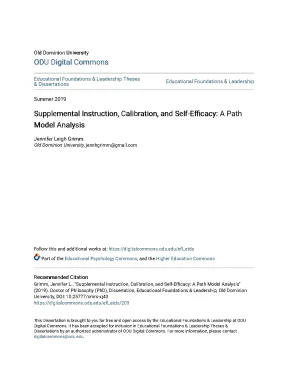
Tải xuống để đọc toàn bộOld Dominion University ODU Digital Commons Educational Foundations & Leadership Theses Educational Foundations & Leadership & Dissertations Summer 2019 Supplemental Instruction, Calibration, and Self-Efficacy: A Path Model Analysis Jennifer Leigh Grimm Old Dominion University, jennhgrimm@gmail.com Follow this and additional works at: https://digitalcommons.edu/efl_etds Part of the Educational Psychology Commons, and the Higher Education Commons Recommended Citation Grimm, Jennifer L. "Supplemental Instruction, Calibration, and Self-Efficacy: A Path Model Analysis" (2019). Doctor of Philosophy (PhD), Dissertation, Educational Foundations & Leadership, Old Dominion University, DOI: 10.25777/xmrs-xj43 https://digitalcommons.edu/efl_etds/203 This Dissertation is brought to you for free and open access by the Educational Foundations & Leadership at ODU Digital Commons. It has been accepted for inclusion in Educational Foundations & Leadership Theses & Dissertations by an authorized administrator of ODU Digital Commons.
For more information, please contact digitalcommons@odu. SUPPLEMENTAL INSTRUCTION, CALIBRATION, AND SELF-EFFICACY: A PATH MODEL ANALYSIS by Jennifer Leigh Grimm B. May 2009, Ohio University M. May 2011, Ohio University A Dissertation Submitted to the Faculty of Old Dominion University in Partial Fulfillment of the Requirements for the Degree of DOCTOR OF PHILOSOPHY EDUCATION – HIGHER EDUCATION CONCENTRATION OLD DOMINION UNIVERSITY August 2019 Approved by: Christopher R.
Glass (Director) Tony Perez (Member) Linda Bol (Member) Running Head: SI, CALIBRATION, & SELF-EFFICACY ABSTRACT SUPPLEMENTAL INSTRUCTION, CALIBRATION, AND SELF-EFFICACY: A PATH MODEL ANALYSIS Jennifer Leigh Grimm Old Dominion University, 2019 Director: Dr. Glass Many students preparing for careers in the fields of science, technology, engineering, and mathematics (STEM) are unable to persist past entry-level courses to complete their college degrees. As a result, many higher education institutions have implemented intervention programs, like Supplemental Instruction (SI), to help students master course content and gain the self-regulated learning (SRL) behaviors necessary for success in challenging STEM courses. Numerous studies have demonstrated that SI attendance is correlated with improved course grades; however, few studies have examined the effect of SI attendance on students’ SRL behaviors, like self-efficacy and calibration, which may explain students’ academic achievement throughout college.
The present study examined if students’ pre-existing self-efficacy beliefs and calibration accuracy predicted their decisions to attend SI. In addition, the study explored if SI attendance had a direct effect on students’ final self-efficacy, calibration, and course grades. Students in a fall semester general biology course for science majors were invited to participate in the study, and 320 students completed the pre- and post-test survey. The surveys measured beginning and final self-efficacy using the Academic Efficacy Scale from the Patterns of Adaptive Learning Scale, and calibration was measured by asking them to predict their first and final exam scores.
Running Head: SI, CALIBRATION, & SELF-EFFICACY A path model was analyzed in Mplus via robust maximum likelihood estimations using pre- and post-test results and students’ total SAT scores, SI attendance, and final course grades. The results indicated that participants with lower self-efficacy were more likely to attend SI; however, students’ beginning calibration accuracy did not predict their SI attendance. Findings also indicated that SI attendance did not predict final self-efficacy or calibration accuracy, but attending SI had a modest, direct effect on participants’ final course grades. Final self-efficacy and calibration accuracy also predicted final course grades.
The results of this study demonstrate a need to explore additional SRL variables that may be influenced by SI. In addition, the present study validates the value of SI as an academic support program to raise course grades. Finally, potential course-level instructional strategies are offered for improving students’ self-efficacy and calibration accuracy to support STEM degree persistence. Running Head: SI, CALIBRATION, & SELF-EFFICACY Copyright, 2019, by Jennifer L.
Grimm, All Rights Reserved. Running Head: SI, CALIBRATION, & SELF-EFFICACY ACKNOWLEDGEMENTS First and foremost, I want to thank my husband, Dr. Kevin Grimm, who has supported me every step of the way throughout my Ph. program journey and my career.
I am also thankful to our sweet son, David, whose arrival into this world gave me the perspective I needed about what really matters in life. I need to thank my parents, Richard and Rhonda Haviland, and my big brother Matt, who have always believed in my potential and told me I could do anything I set my mind to do. My parents-in-law, Ron and Nancy Grimm, have also been incredibly supportive, especially in the time they have spent with our son David on those evenings and weekends when his mom had to stay late to work on schoolwork. In addition, I could not have asked for a better dissertation committee.
Chris Glass is the best chair, advisor, professor, and graduate program director, and Old Dominion University (ODU) is immensely fortunate to have him. I want to thank Chris for taking me under his wing when I started the Higher Education Ph. program at ODU as a transfer student in fall 2015. He helped me elevate my dissertation to new heights, and he was incredibly supportive every step of the way.
My other committee members, Dr. Tony Perez and Dr. Linda Bol, taught me so much about educational psychology and research methods in their courses and offered additional, helpful guidance and feedback throughout the dissertation process. I also want to extend a sincere thank you to the anonymous Biology instructor who helped with my research.
I also need to thank my classmates and colleagues at ODU who cheered me along every step of the way. There are too many wonderful people to name, but please know that, whether you were a classmate or colleague who took an interest in my education, I appreciate you so much! Thank you also to my Executive Director, Lisa Mayes, who provided me with the professional space to pursue my Ph. while working full-time and prioritizing my family. Running Head: SI, CALIBRATION, & SELF-EFFICACY vi TABLE OF CONTENTS Page LIST OF TABLES.
x LIST OF FIGURES. xi v CHAPTER ONE: INTRODUCTION. 1 Description of the Problem. 3 Overview of Methodology.
4 Definition of Terms. 6 Significance of the Study. 7 CHAPTER TWO: REVIEW OF THE LITERATURE. 8 History of Supplemental Instruction.
8 Key Components of Supplemental Instruction. 9 Supplemental Instruction Research. 10 Impact of SI on student learning and achievement. 11 SI impact on grades and DFW rates.
11 SI impact on reenrollment and graduation rates. 13 SI impact on student motivation and SRL. 13 Methological strengths and limitations of the SI research. 13 Inconsistent SI group definitions.
14 Need for more theoretically informed research. 16 Self-Regulated Learning. 17 Bandura’s Social Cognitive Theory. 18 Zimmerman’s Three-Phase Model.
20 Running Head: SI, CALIBRATION, & SELF-EFFICACY vii Forethought phase. 20 Self-reflection phase. 21 Self-Regulated Learning and SI. 22 SRL and SI sessions.
22 SRL and SI research. 27 Self-Efficacy and SI. 28 Self-Efficacy and SI Research. 32 Calibration and SI.
34 Interventions targeting all three SRL phases. 35 Calibration and Self-Efficacy Research. 39 Prominent Themes in the Help-Seeking Literature. 39 SRL and Help Seeking.
42 Self-Efficacy, Calibration, and Help Seeking. 44 Justification for Study. 48 CHAPTER THREE: METHODOLOGY. 50 Research Design and Path Model.
56 Supplemental Instruction Program. 58 Running Head: SI, CALIBRATION, & SELF-EFFICACY viii Beginning calibration. 59 Self-Efficacy Scale. 60 Beginning self-efficacy.
60 Final self-efficacy. 61 Other Variables and Student Demographics. 61 Final course grade. 62 Total SAT score.
62 Other student demographics. 64 Checking for Assumptions. 68 CHAPTER FOUR: FINDINGS. 70 Population and Participant Characteristics.
70 Path Model Descriptive Statistics. 72 Path Model Variable Correlations. 76 RQ1: Beginning Self-Efficacy and Calibration as a Predictor of SI Attendance. 77 RQ2 and RQ3: SI Attendance as a Direct and Indirect Predictor of Final Calibration, Self- Efficacy, and Course Grades.
84 Running Head: SI, CALIBRATION, & SELF-EFFICACY ix CHAPTER FIVE: DISCUSSION. 86 Summary of Results. 87 Discussion of the Research Findings. 90 Beginning Self-Efficacy and Calibration and SI Attendance.
90 Beginning self-efficacy influences SI attendance. 90 Beginning calibration does not influence SI attendance. 92 SI Attendance and Final Calibration, Self-Efficacy, and Course Grades. 92 SI attendance does not influence final calibration.
93 SI attendance does not influence final self-efficacy. 94 SI attendance is correlated with improved final course grades. 98 The Influence of SAT, Final Calibration, and Final Self-Efficacy. 99 Exogenous variables: SAT influences most variables and students’ calibration and self-efficacy are stable.
99 Endogenous variables: Final calibration and self-efficacy predict improved final course grades. 103 Implications for Further Research. 104 Replication of Current Study. 105 Further Research on Other SRL Factors Influenced by SI.
106 Intervention Studies on SRL and SI Leader Training. 108 Additional Approaches to Similar Studies. 110 Implications for Practice. 112 Value of Supplemental Instruction for High-Risk Courses.
112 Research-Based SI Leader Training Redesign to Target SRL and Self-Efficacy. 112 Teaching Interventions for Instructional Faculty. 139 Running Head: SI, CALIBRATION, & SELF-EFFICACY x LIST OF TABLES Table Page 1. Help Seeking Process and Zimmerman’s SRL Phases.
Help Seeking & Self-Efficacy. Characteristics of Study Participants. Characteristics of General Biology Students from the Class Population and Study Participants at the End of Term. Descript Statistics for Path Model Variables.
SI Attendance Frequencies and Percentages. Path Model Variable Correlations. 74 Running Head: SI, CALIBRATION, & SELF-EFFICACY xi LIST OF FIGURES Figure Page 1. Phases and Subprocesses of Self-Regulation.
Hypothesized Path Model. Adjusted Path Model. Adjusted Path Model Results. 77 Running Head: SI, CALIBRATION, & SELF-EFFICACY 1 CHAPTER ONE INTRODUCTION To ensure that the United States (U.) remains a world leader in STEM education, educators, policymakers, and special interest groups are placing an emphasis on preparing college students for careers in the fields of science, technology, engineering, and mathematics (STEM; Koenig, Schen, Edwards, & Boa, 2012; National Science Foundation, 2011).
Regrettably, many students are unable to persist past entry-level courses in STEM fields (Hopper, 2011; Nasr, 2012; Rask, 2010), let alone successfully complete their college degrees (Complete College America, 2014; Kitsantas, Winsler, & Huie, 2008). Increased access to higher education does not necessarily translate into academic success in entry-level STEM courses (Douglas-Gabriel, 2015; Schudde & Goldrick-Rab, 2016; Smith, 2016). This is due to a variety of factors, including social and economic disparities, which often contribute to a lack of academic preparation prior to college (Douglas-Gabriel, 2015; Pew Research Center, 2014). This lack of preparation relates to poor self-regulated learning (SRL) behaviors, low self-efficacy towards challenging STEM course content, and ultimately insufficient grades to persist into upper-level STEM classes (Bembenutty, 2007; Kitsantas et al.
Background In addition to learning the content necessary to pass entry-level STEM courses, students' self-regulation of their learning activities influences their ability to succeed academically (Schunk & Pajares, 2005). As a result, many institutions of higher education have implemented intervention programs to help students review course content and gain the cognitive and metacognitive strategies for success in entry-level STEM courses like general biology (Gattis, Running Head: SI, CALIBRATION, & SELF-EFFICACY 2 2002; Mack, 2007). One such program is Supplemental Instruction (SI), which has been adopted by colleges and universities worldwide (Elam, 2016). SI is an academic support program that targets historically difficult courses, rather than at-risk students.
The goals of SI include increasing students’ final course grades, reducing attrition from difficult classes, and improving institutional retention and graduation rates (Arendale, 1997). Instructional faculty of these high-risk courses invite students who have successfully completed their class to serve as SI leaders. These students attend class lectures and follow course readings and assignments. SI leaders then use content learned in class and via course assignments to plan weekly, optional, out-of-class group study sessions to provide students with additional opportunities to review content, work in peer study groups, and develop the SRL behaviors necessary for success in their current and future courses (Arendale, 1997; Elam, 2016; Hurley, Jacobs, & Gilbert, 2006).
Nội dung được bảo vệ bản quyền — Tải xuống đầy đủ
Trích dẫn luận án này
Jennifer Leigh Grimm (2019). Supplemental instruction calibration and self efficacy a pat [Luận án tiến sĩ, Old Dominion University]. LuanAn.net. https://luanan.net/giao-duc-hoc/tam-ly-hoc-giao-duc/supplemental-instruction-calibration-and-self-efficacy-a-path
Câu hỏi thường gặp
Luận án "Supplemental instruction calibration and self efficacy a pat" nghiên cứu về vấn đề gì?
Nghiên cứu về hiệu chuẩn hướng dẫn bổ sung và tính tự hiệu quả trong học tập. Khám phá mối liên hệ và các yếu tố ảnh hưởng.
Luận án "Supplemental instruction calibration and self efficacy a pat" được bảo vệ tại trường nào?
Luận án này được bảo vệ tại Old Dominion University. Năm bảo vệ: 2019.
Luận án "Supplemental instruction calibration and self efficacy a pat" thuộc chuyên ngành gì?
Luận án "Supplemental instruction calibration and self efficacy a pat" thuộc chuyên ngành Education – Higher Education Concentration. Danh mục: Tâm Lý Học Giáo Dục.
Luận án "Supplemental instruction calibration and self efficacy a pat" có bao nhiêu trang?
Luận án "Supplemental instruction calibration and self efficacy a pat" có 152 trang. Bạn có thể xem trước một phần tài liệu ngay trên trang web trước khi tải về.
Cách tải luận án "Supplemental instruction calibration and self efficacy a pat" về máy như thế nào?
Để tải luận án về máy, bạn nhấn nút "Tải xuống ngay" trên trang này, sau đó hoàn tất thanh toán phí lưu trữ. File sẽ được tải xuống ngay sau khi thanh toán thành công. Hỗ trợ qua Zalo: 0559 297 239.