Luận án: Investigating a Relationship giữa Giao tiếp Phi Ngôn ngữ và Học Tập Sinh Viên
Nghiên cứu mối quan hệ giữa giao tiếp phi ngôn ngữ và hiệu suất học tập của sinh viên, nhằm hiểu rõ cách giao tiếp phi ngôn ngữ ảnh hưởng đến quá trình học tập.
Lindenwood University
Educational Assessment, Evaluation, and Research / Education
Luan An
Luận án
Năm xuất bản
Số trang
141
Thời gian đọc
22 phút
Lượt xem
0
Lượt tải
0
Phí lưu trữ
40 Point
Tổng quan nhanh
- Chủ đề:
- Tầm quan trọng giao tiếp phi ngôn ngữ trong học tập sinh viên
- Số trang:
- 141 trang
- Trường:
- Lindenwood University
- Chuyên ngành:
- Educational Assessment, Evaluation, and Research / Education
- Tác giả:
- Dustin York
- Năm:
- 2013
Tóm tắt nội dung luận án
I.Tầm quan trọng giao tiếp phi ngôn ngữ trong học tập sinh viên
1.1. Vai trò cốt yếu của phi ngôn ngữ trong truyền đạt kiến thức
Giao tiếp rõ ràng và hiệu quả là yếu tố thiết yếu trong xã hội hiện đại. Nó đóng vai trò nền tảng trong mọi lĩnh vực, đặc biệt là giáo dục. Giao tiếp phi ngôn ngữ giữ một vị trí quan trọng đặc biệt trong quá trình này. Nó không chỉ bổ trợ cho lời nói mà còn truyền tải nhiều thông điệp ẩn ý. Cách giảng viên trình bày, cách họ tương tác không lời, đều ảnh hưởng đến sự tiếp thu của người học. Việc hiểu và sử dụng giao tiếp phi ngôn ngữ một cách hiệu quả giúp tăng cường khả năng truyền đạt. Giảng viên có thể tạo ra một môi trường học tập hấp dẫn hơn. Điều này giúp sinh viên tiếp nhận thông tin tốt hơn và duy trì sự chú ý. Tầm quan trọng của ngôn ngữ cơ thể, biểu cảm khuôn mặt, và giao tiếp bằng mắt không thể phủ nhận. Chúng là những công cụ mạnh mẽ trong tay người giảng dạy.
1.2. Khoảng trống dữ liệu về ảnh hưởng phi ngôn ngữ của giảng viên
Mặc dù tầm quan trọng của giao tiếp phi ngôn ngữ đã được công nhận rộng rãi, vẫn tồn tại một khoảng trống đáng kể trong nghiên cứu. Dữ liệu về ảnh hưởng cụ thể của giao tiếp phi ngôn ngữ được sử dụng bởi giảng viên vẫn còn chưa nhất quán. Đặc biệt, tác động của nó đối với học tập của sinh viên trong môi trường giáo dục đại học cần được làm rõ hơn. Các nghiên cứu trước đây thường đưa ra kết quả trái ngược hoặc chưa đủ sâu sắc. Điều này đặt ra câu hỏi về mức độ thực sự mà các yếu tố phi ngôn ngữ ảnh hưởng đến hiệu suất học tập. Cần có thêm nghiên cứu định hướng để lấp đầy khoảng trống này. Việc thiếu dữ liệu rõ ràng gây khó khăn trong việc phát triển các chiến lược giảng dạy dựa trên bằng chứng. Một nghiên cứu sâu rộng có thể cung cấp cái nhìn toàn diện hơn. Nó sẽ giúp hiểu rõ hơn về ảnh hưởng của phi ngôn ngữ.
II.Mục tiêu nghiên cứu mối quan hệ phi ngôn ngữ và hiệu suất học tập
2.1. Xác định mối liên hệ giữa phi ngôn ngữ và kết quả học tập
Nghiên cứu này đặt ra mục tiêu chính là tìm kiếm các mối tương quan rõ ràng. Cụ thể là giữa giao tiếp phi ngôn ngữ của giảng viên và nhiều yếu tố liên quan đến học tập của sinh viên. Việc này bao gồm việc kiểm tra mối quan hệ giữa các phép đo tiêu chuẩn hóa về học tập của sinh viên và giao tiếp phi ngôn ngữ của giảng viên. Điều này nhằm định lượng mức độ tác động của ngôn ngữ cơ thể, biểu cảm khuôn mặt, và cử chỉ của giáo viên. Mục tiêu là cung cấp bằng chứng cụ thể về cách các yếu tố phi ngôn ngữ ảnh hưởng đến điểm số, sự hiểu bài, và khả năng ghi nhớ thông tin của sinh viên. Một sự hiểu biết sâu sắc hơn về mối liên hệ này sẽ hỗ trợ việc phát triển các phương pháp giảng dạy hiệu quả hơn. Nghiên cứu tập trung vào việc định lượng tác động này một cách khách quan.
2.2. Đánh giá nhận thức sinh viên về học tập và uy tín giảng viên
Một mục tiêu quan trọng khác của nghiên cứu là xem xét mối quan hệ giữa nhận thức của sinh viên về việc học của họ và giao tiếp phi ngôn ngữ của giảng viên. Điều này bao gồm việc khảo sát cảm nhận của sinh viên về sự hiệu quả của quá trình học tập. Ngoài ra, nghiên cứu còn đánh giá mối liên hệ giữa nhận thức của sinh viên về uy tín của giảng viên và giao tiếp phi ngôn ngữ của họ. Cách một giảng viên sử dụng giao tiếp bằng mắt, âm điệu giọng nói, hoặc khoảng cách cá nhân có thể ảnh hưởng lớn đến cách sinh viên nhìn nhận họ. Một giảng viên có uy tín cao thường được sinh viên tin tưởng hơn. Điều này có thể tác động tích cực đến mức độ tham gia và động lực học tập. Nghiên cứu cũng xem xét mối quan hệ giữa giới tính của sinh viên và giao tiếp phi ngôn ngữ của giảng viên. Điều này có thể tiết lộ các khác biệt trong cách tiếp nhận thông tin.
III.Phương pháp luận nghiên cứu giao tiếp phi ngôn ngữ giáo dục
3.1. Thiết kế nghiên cứu định lượng định tính và đối tượng tham gia
Nghiên cứu đã áp dụng một phương pháp kết hợp. Nó sử dụng cả dữ liệu định lượng và định tính. Điều này nhằm cung cấp cái nhìn toàn diện về mối quan hệ đang được điều tra. Tổng cộng 85 sinh viên đại học từ một trường đại học cỡ trung bình ở Midwestern đã tham gia. Việc lựa chọn đối tượng này đảm bảo tính đại diện cho một phần nhất định của môi trường giáo dục đại học. Dữ liệu định lượng được thu thập để đo lường các kết quả có thể định lượng được. Dữ liệu định tính bổ sung các chi tiết sâu sắc. Nó cung cấp ngữ cảnh và giải thích cho các phát hiện định lượng. Sự kết hợp này giúp tăng cường độ tin cậy và giá trị của nghiên cứu. Nó cho phép một sự hiểu biết đa chiều về tác động của giao tiếp phi ngôn ngữ.
3.2. So sánh hai loại giảng viên giao tiếp phi ngôn ngữ hiệu quả và kém
Các sinh viên tham gia đã được chia thành hai nhóm. Mỗi nhóm tham gia lớp học với một trong hai kiểu giảng viên được thiết kế đặc biệt. Nhóm thứ nhất trải nghiệm giảng viên sử dụng giao tiếp phi ngôn ngữ hiệu quả. Điều này bao gồm giao tiếp bằng mắt tốt, cử chỉ của giáo viên linh hoạt, biểu cảm khuôn mặt sống động, âm điệu giọng nói phong phú (biến đổi giọng nói), và việc di chuyển vị trí trong lớp học hợp lý (khoảng cách cá nhân). Nhóm thứ hai tham gia lớp với giảng viên sử dụng giao tiếp phi ngôn ngữ kém hiệu quả. Các đặc điểm này bao gồm giao tiếp bằng mắt kém, cử chỉ của giáo viên hạn chế, biểu cảm khuôn mặt ít, âm điệu giọng nói đơn điệu, và vị trí cố định. Để đảm bảo tính công bằng, tất cả các giảng viên đều trình bày chính xác cùng một tài liệu từ một kịch bản đã được chuẩn bị sẵn. Điều này giúp loại bỏ sự khác biệt về nội dung giảng dạy.
3.3. Công cụ thu thập dữ liệu bài kiểm tra khảo sát nhóm tập trung
Việc thu thập dữ liệu được thực hiện thông qua nhiều công cụ khác nhau. Các bài kiểm tra đã được sử dụng để đo lường kết quả học tập tiêu chuẩn hóa của sinh viên. Đây là một phương pháp khách quan để đánh giá sự tiếp thu kiến thức. Các khảo sát được thiết kế để thu thập nhận thức của sinh viên. Chúng tập trung vào việc học của họ và đánh giá về uy tín của giảng viên. Các câu hỏi trong khảo sát được xây dựng để khai thác các khía cạnh liên quan đến giao tiếp phi ngôn ngữ. Ngoài ra, các nhóm tập trung đã được tổ chức. Chúng cung cấp dữ liệu định tính phong phú. Sinh viên có thể chia sẻ sâu hơn về trải nghiệm của mình. Họ có thể nói về cách giao tiếp phi ngôn ngữ của giảng viên ảnh hưởng đến họ. Sự kết hợp các phương pháp này đảm bảo một cái nhìn toàn diện và đáng tin cậy.
IV.Phát hiện chính về ảnh hưởng của phi ngôn ngữ đến học tập sinh viên
4.1. Giao tiếp phi ngôn ngữ của giảng viên có lợi cho sinh viên
Các phát hiện từ nghiên cứu này cho thấy một kết luận rõ ràng. Giao tiếp phi ngôn ngữ được sử dụng bởi giảng viên thực sự có lợi cho thành công học tập của sinh viên. Dữ liệu định lượng và định tính đều cung cấp bằng chứng chắc chắn. Các sinh viên trong nhóm có giảng viên sử dụng giao tiếp phi ngôn ngữ hiệu quả đạt được kết quả tốt hơn. Họ cũng có nhận thức tích cực hơn về quá trình học tập. Điều này khẳng định vai trò quan trọng của ngôn ngữ cơ thể, biểu cảm khuôn mặt và giao tiếp bằng mắt. Một giảng viên có khả năng sử dụng tốt các yếu tố phi ngôn ngữ có thể tạo ra môi trường học tập kích thích hơn. Nó giúp sinh viên tập trung, ghi nhớ thông tin tốt hơn. Ảnh hưởng của phi ngôn ngữ không chỉ giới hạn ở việc truyền đạt thông tin. Nó còn tác động đến sự tương tác tổng thể trong lớp học.
4.2. Những yếu tố phi ngôn ngữ cụ thể tối ưu hiệu suất học tập
Nghiên cứu đã phác thảo các yếu tố cụ thể của giao tiếp phi ngôn ngữ mà giảng viên có thể sử dụng. Những yếu tố này đặc biệt có lợi cho việc nâng cao kết quả học tập của sinh viên. Giao tiếp bằng mắt hiệu quả tạo sự kết nối. Cử chỉ của giáo viên (như chuyển động cánh tay) giúp nhấn mạnh điểm chính. Biểu cảm khuôn mặt sống động thể hiện sự quan tâm và cảm xúc. Âm điệu giọng nói linh hoạt (paralanguage) giúp duy trì sự chú ý. Vị trí trong lớp học (khoảng cách cá nhân) cũng đóng vai trò quan trọng. Giảng viên cần di chuyển hợp lý để thu hút mọi học viên. Việc áp dụng những yếu tố này một cách có ý thức có thể cải thiện đáng kể hiệu suất học tập. Nó giúp sinh viên cảm thấy được tham gia và hiểu bài tốt hơn. Các yếu tố này tạo nên một phong cách giảng dạy năng động.
V.Ứng dụng thực tiễn của giao tiếp phi ngôn ngữ trong lớp học
5.1. Nâng cao kỹ năng giao tiếp của giáo viên để cải thiện giảng dạy
Dựa trên kết quả nghiên cứu, việc nâng cao kỹ năng giao tiếp phi ngôn ngữ là rất cần thiết cho giảng viên. Giảng viên nên được đào tạo về cách sử dụng hiệu quả ngôn ngữ cơ thể, biểu cảm khuôn mặt và giao tiếp bằng mắt. Các khóa tập huấn có thể giúp họ nhận biết và kiểm soát các tín hiệu phi ngôn ngữ của mình. Việc này sẽ trực tiếp cải thiện chất lượng giảng dạy. Giảng viên có thể truyền đạt thông điệp rõ ràng hơn. Họ cũng có thể tạo ra một môi trường học tập tích cực hơn. Khả năng điều chỉnh âm điệu giọng nói, cử chỉ của giáo viên và tư thế của sinh viên (qua cách họ tương tác) sẽ giúp tối ưu hóa hiệu suất học tập. Điều này không chỉ giúp sinh viên học tốt hơn mà còn nâng cao sự hài lòng của họ đối với buổi học.
5.2. Phát triển môi trường học tập tích cực qua ngôn ngữ cơ thể
Việc sử dụng giao tiếp phi ngôn ngữ một cách chiến lược có thể giúp phát triển một môi trường học tập tích cực. Giảng viên có thể sử dụng ngôn ngữ cơ thể cởi mở và thân thiện. Điều này khuyến khích sự tham gia của sinh viên. Giao tiếp bằng mắt thường xuyên thể hiện sự quan tâm đến từng cá nhân. Biểu cảm khuôn mặt tích cực tạo ra không khí thoải mái. Các cử chỉ của giáo viên có thể hỗ trợ việc giải thích các khái niệm phức tạp. Khoảng cách cá nhân được điều chỉnh hợp lý giúp giảng viên tiếp cận sinh viên. Tất cả những yếu tố này góp phần tạo ra một môi trường mà sinh viên cảm thấy an toàn để đặt câu hỏi. Họ cũng cảm thấy được khuyến khích để tương tác. Môi trường tích cực này là chìa khóa để nâng cao hiệu suất học tập tổng thể.
Mục lục chi tiết luận án
Tải xuống file đầy đủ để xem toàn bộ nội dung
Tải đầy đủ (141 trang)Trích đoạn nội dung luận án
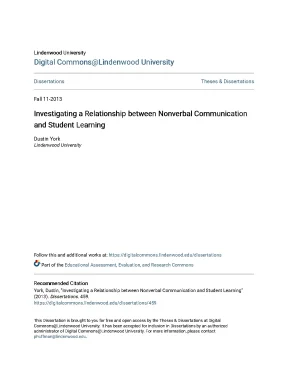
Tải xuống để đọc toàn bộLindenwood University Digital Commons@Lindenwood University Dissertations Theses & Dissertations Fall 11-2013 Investigating a Relationship between Nonverbal Communication and Student Learning Dustin York Lindenwood University Follow this and additional works at: https://digitalcommons.edu/dissertations Part of the Educational Assessment, Evaluation, and Research Commons Recommended Citation York, Dustin, "Investigating a Relationship between Nonverbal Communication and Student Learning" (2013).edu/dissertations/459 This Dissertation is brought to you for free and open access by the Theses & Dissertations at Digital Commons@Lindenwood University. It has been accepted for inclusion in Dissertations by an authorized administrator of Digital Commons@Lindenwood University. For more information, please contact phuffman@lindenwood. Investigating a Relationship between Nonverbal Communication and Student Learning by Dustin York A Dissertation submitted to the Education Faculty of Lindenwood University in partial fulfillment of the requirements for the degree of Doctor of Education School of Education i Investigating a Relationship between Nonverbal Communication and Student Learning by Dustin York This dissertation has been approved in partial fulfillment of the requirements for the degree of Doctor of Education at Lindenwood University by the School of Education ii Declaration of Originality I do hereby declare and attest to the fact that this is an original study based solely upon my own scholarly work here at Lindenwood University and that I have not submitted it for any other college or university course or degree here or elsewhere.
iii Acknowledgements The help and support I received during the completion of this dissertation process was remarkable. I will be forever grateful to everyone who played a part in the success of this document. First, I would like to thank my chair, Dr. Graham Weir, for his continual support and encouragement throughout this process.
Without his direction and knowledge, this dissertation would have faltered. Sherrie Wisdom, thank you for your quantitative expertise. You provided valued assistance to my academic journey. Thank you to Dr.
Christie Rodgers for her support from day one of my doctoral journey. Thank you Dr. Colleen Biri for assisting me in making certain this dissertation meets professional standards. My methodology would not have been possible without the help of Debbie Nicolai.
I greatly appreciate the assistance Rachel Jordan, Markus Hoff, and Kelsey Schaberg provided to this research. A large gratitude goes to my previous colleagues when I began this journey at Lindenwood University, and my colleagues during the completion of this journey at Maryville University. Last but not least, thank you to my wonderful wife, Crystal York, for her continued love and support. Thank you to my family and friends who believed in me and supported this accomplishment.
iv Abstract Clear and effective communication is essential in today’s society (Smith & Cotten, 1980; Smith & Land, 1981). Nonverbal communication specifically has a vital role in communication. There is inconsistent data on the effect of nonverbal communication used by instructors and the impact on student learning within the higher education environment. This research study sought to find distinct correlations between instructors’ nonverbal communication and a variety of elements related to student learning.
This study examined (1) the relationship between standardized measurements of student learning and instructors’ nonverbal communication, (2) the relationship between students’ perceptions of their learning and instructors’ nonverbal communication, (3) the relationship between students’ perceptions of instructor credibility based on the instructors’ nonverbal communication, and (4) the relationship between students’ gender and instructors’ nonverbal communication. Based on quantitative and qualitative data, college students (N=85) from a midsize Midwestern university reported distinct findings that progressed the study of nonverbal communication. Students attended class with one of two variable instructor- lecturing types: utilizing effective nonverbal communication (good eye contact, arm movement, facial expression, voice fluctuation, and position in the classroom), or poor nonverbal communication (poor eye contact, arm movement, facial expression, voice fluctuation, and position in the classroom). The instructors lectured the exact same material from a script.
Students provided data through tests, surveys, and focus groups v that delivered substantial evidence of the relationship between instructors’ nonverbal communication and student learning. Findings in the research study suggest that instructors’ nonverbal communication is beneficial to students’ academic success. This study outlined which elements of nonverbal communication an instructor could use to benefit student learning. Using the results of this study, university administrators, faculty, and professional development officials could find beneficial information for the success of higher education instruction.
vi Table of Contents List of Tables. vii List of Appendices. viii Chapter One: Introduction .1 Background of the Study .2 Purpose of the Study .11 Definition of Terms.14 Chapter Two: Literature Review .16 Nonverbal Communication and Student Learning, a Historical Perspective .16 Nonverbal Communication’s Effect on Perceptions of Learning .23 Nonverbal Communication’s Effect on Standardized Measurements of Learning27 Nonverbal Communication’s Effect on Perceived Credibility .34 Gender Differences in Response to Nonverbal Communication .36 Learning Effective Nonverbal Communication .41 Chapter Three: Methodology .44 Population and Description of Participating University .45 Sample of Study .45 Developing the Lecture .60 Focus Group Data Analysis .61 Confidential Treatment of Data .64 Chapter Four: Results .65 Analysis of Data .65 Focus Groups – Introduction .78 Students’ Nonverbal Communication .81 Chapter Five: Discussion and Reflection .85 Relationship to Literature .87 Hypotheses and Research Questions Discussion .90 Implications for Higher Education Instruction .127 ix List of Tables Table 1. Gender of Samples…………………………………………………………………….
Poor Nonverbal Immediacy Survey. Effective Nonverbal Immediacy Survey. Participant Pool Survey. Poor Nonverbal Immediacy Test Results.
Effective Nonverbal Immediacy Test Results. Participant Pool Test Results. Posttest Scores: Effective Nonverbal Communication and Poor Nonverbal Communication. Pretest/Posttest Comparison: Effective Nonverbal Communication and Poor Nonverbal Communication.
Pretest/Posttest Comparison: Female versus Male Knowledge Retention in the Effective Nonverbal Communication Classes. Pretest/Posttest Comparison: Female versus Male Knowledge Retention in the Poor Nonverbal Communication Classes. Comparison of Type of Communication and Posttest Knowledge Scores. Regression Results for Comparison of Type of Communication and Posttest Knowledge Scores .72 x Appendices Appendix A: Institutional Review Board (IRB) Application .119 Appendix B: Consent to Participate.121 Appendix C: Focus Group Questions .124 Appendix E: Effective Nonverbal Communication/Poor Nonverbal Communication Checklist .125 Appendix F: Pretest/Posttest .126 xi Chapter One: Introduction Effective higher education instructors’ lectures are key to an enriching student learning environment (Leathers & Eaves, 2008).
As so, instructors are responsible for communicating clearly and effectively to their students. Research has been conducted to examine what effect instructors’ communication has on students’ in-class behaviors (Adalsteinsdottir, 2004; Anderman & Kaplan, 2008; Kearney, Plax, Richmond, & McCroskey, 1984; Kearney, Plax, & Wendt-Wasco, 1985; Leathers & Eaves, 2008; Mackay, 2006; Sime, 2006). Significant research has been conducted to correlate an academically beneficial bond between students and instructors through the use of verbal communication (Comadena, Hunt, & Simonds, 2007; Galloway, 1971; Lemire, 2002; McCroskey, 2002; Richmond, McCroskey, & Johnson, 2003). This research has propelled theories of students’ academic success through the use of positive words.
An experiment conducted by Wright and Nuthall (1970) showed a relationship between instructors’ use of words like “good” following a student’s in-class answer and that same student’s achievement on later graded material. Based on this finding, the verbal communication between an instructor and student is crucial for academic success; the clarity of the instructors’ words impact the learning environment. Nonverbal communication by the instructor can help provide clarity and help students interpret the instructors’ verbal communication (Burgoon, 1980; Burgoon & Saine, 1978; Chesebro, 1999, 2003; Houser & Frymier, 2009; Mehrabian, 1981; Wiener & Mehrabian, 1968). Thus, one can theorize that utilizing not only NONVERBAL COMMUNICATION 2 effective verbal communication, but also effective nonverbal communication fosters a more enriching learning environment.
This study addressed inconsistent data regarding the effect of instructors’ nonverbal communication on student learning. Mottet, Beebe, Raffeld, and Paulsel (2004) stated, “Verbal messages function to convey the content of the message whereas nonverbal messages function to establish the relationship” (p. Previous literature (Andersen, 1979; Folwell, 2000; Frechette & Moreno, 2010) has cast doubt on the correlation between the relationship built from nonverbal communication and student learning, while other literature promotes its effectiveness (Burroughs, 2007; Comadena et al. Background of the Study In order to study nonverbal communication, it is essential to offer a specific definition.
Ellyson and Dovidio (1985) defined nonverbal communication as “behavior that is not part of formal, verbal language” (p. This definition encompassed a wide variety of messages a student may receive within a classroom. This would include aspects such as classroom temperature, instructor attire, time of day, etc. Another definition of nonverbal communication was stated by Henley (1977), “how we say things with our body postures and movements, facial expressions, gestures, touching, eye contact, use of space, and so on” (p.
For the purpose of this study, the definition of nonverbal communication included instructors’ eye contact, hand and arm motions, facial expressions, voice fluctuation, and moving around the front of the classroom while never behind a podium or other barrier. NONVERBAL COMMUNICATION 3 The question must be asked: how much of communication is nonverbal? A number of studies tried to pinpoint an exact percentage. Mehrabian (1981) theorized that one-half of communication falls under the nonverbal category, which is the lowest percentage accumulated from such a study. Barnum and Wolniansky’s (1989) findings suggest 70% is nonverbal while Fromkin and Rodman’s (1983) findings state that 90% is nonverbal communication.
A more recent study by Pease and Pease (2004) found that 83% of communication comes from nonverbal communication. According to these authors, there is a consensus that nonverbal communication accounts for over half of communication. Past research focused primarily on two areas of speakers’ nonverbal communication. The first area of study that received attention is the speakers’ facial expressions (Atkinson, 2002; Garau, Slater, Bee, & Sasse, 2001; Mitrovic & Suraweera, 2000).
The second area of nonverbal study centered around hand and arm motions (Craig, Gholson, & Driscoll, 2002; van Mulken, Andre, & Muller, 1998). Although both areas were found to demonstrate qualities of the speaker, the two differed. Emotions have been correlated to the face (Atkinson, 2002), while clarity has been associated with hands and arms (Craig et al. This nonverbal communication research has been incorporated into the classroom setting for over three decades.
Numerous studies presented data relating instructors’ effective nonverbal communication with students’ academic success in some context (Allen, Witt, & Wheeless, 2006; Andersen, 1979; Andersen, Norton, & Nussbaum, 1981; Burroughs, 2007; Chesebro, 2003; Christophel, 1990; Gorham, 1988; Gorham & Zakahi, 1990; Kearney, Plax, & Wendt-Wasco, 1985; King & Witt, 2009; Plax, Kearney, NONVERBAL COMMUNICATION 4 McCroskey, & Richmond, 1986; Powell & Harville, 1990; Richmond, 1990; Richmond, Gorham, & McCroskey, 1987; Sanders & Wiseman, 1990; Titsworth, 2001). While research has been plentiful, there have been a number of inconsistencies in the findings. In the following sections, I will identify the purpose of this study, and how it will add to the literature. Purpose of the Study Maximizing students’ academic achievement is the primary goal for any educator.
With this being the goal, instructional communication is an area that can benefit any instructor in the classroom. Although many studies researched the area of instructional communication, further data may shed light onto the effect of nonverbal communication in the classroom. Few studies have investigated potential correlations between instructors’ nonverbal communication and true student learning. In order to supply instructors in the higher education environment with information about effective lecture practices, further research is needed to define the effectiveness of nonverbal communication in the classroom at the college level.
This research study provided documentation of a correlation between instructors’ nonverbal communication and student performance on standardized measurement of learning. This document also adds to literature the relationship instructors’ nonverbal communication has on other areas of students’ learning. Instructional communication supports the clarity of academic messages. Past studies found a strong correlation between instructor clearness and increased student academic achievement (Alexander, Frankiewicz, & Williams, 1979; Burgoon, 1980; NONVERBAL COMMUNICATION 5 Burgoon & Saine, 1978; Chesebro, 1999, 2003; Hines, Cruickshank, & Kennedy, 1985; Houser & Frymier, 2009; Mehrabian, 1981; Smith & Cotten, 1980; Smith & Land, 1981; Wiener & Mehrabian, 1968).
Nội dung được bảo vệ bản quyền — Tải xuống đầy đủ
Trích dẫn luận án này
Dustin York (2013). Nghiên cứu mối quan hệ giữa giao tiếp phi ngôn ngữ và học tập sinh viên [Luận án tiến sĩ, Lindenwood University]. LuanAn.net. https://luanan.net/giao-duc-hoc/tam-ly-hoc-giao-duc/nghien-cuu-moi-quan-he-giao-tiep-phi-ngon-gua-va-hoc-tap-sinh-vien
Câu hỏi thường gặp
Luận án "Nghiên cứu mối quan hệ giữa giao tiếp phi ngôn ngữ và học tập sinh viên" nghiên cứu về vấn đề gì?
Nghiên cứu mối quan hệ giữa giao tiếp phi ngôn ngữ và hiệu suất học tập của sinh viên, nhằm hiểu rõ cách giao tiếp phi ngôn ngữ ảnh hưởng đến quá trình học tập.
Luận án "Nghiên cứu mối quan hệ giữa giao tiếp phi ngôn ngữ và học tập sinh viên" được bảo vệ tại trường nào?
Luận án này được bảo vệ tại Lindenwood University. Năm bảo vệ: 2013.
Luận án "Nghiên cứu mối quan hệ giữa giao tiếp phi ngôn ngữ và học tập sinh viên" thuộc chuyên ngành gì?
Luận án "Nghiên cứu mối quan hệ giữa giao tiếp phi ngôn ngữ và học tập sinh viên" thuộc chuyên ngành Educational Assessment, Evaluation, and Research / Education. Danh mục: Tâm Lý Học Giáo Dục.
Luận án "Nghiên cứu mối quan hệ giữa giao tiếp phi ngôn ngữ và học tập sinh viên" có bao nhiêu trang?
Luận án "Nghiên cứu mối quan hệ giữa giao tiếp phi ngôn ngữ và học tập sinh viên" có 141 trang. Bạn có thể xem trước một phần tài liệu ngay trên trang web trước khi tải về.
Cách tải luận án "Nghiên cứu mối quan hệ giữa giao tiếp phi ngôn ngữ và học tập sinh viên" về máy như thế nào?
Để tải luận án về máy, bạn nhấn nút "Tải xuống ngay" trên trang này, sau đó hoàn tất thanh toán phí lưu trữ. File sẽ được tải xuống ngay sau khi thanh toán thành công. Hỗ trợ qua Zalo: 0559 297 239.