Engaging touch and movement in se trama resolution approach dissertation bysonia
Khám phá cách tiếp cận giải quyết se trama với cảm ứng và chuyển động hấp dẫn. Tối ưu hóa tương tác người dùng.
IUGS (International University for Graduate Studies)
Tâm lý học lâm sàng / Trị liệu tâm lý thân nghiệm (Clinical Psychology / Body Psychotherapy / Somatic Experiencing)
Luan An
Luận án (Dissertation / Thesis)
Năm xuất bản
Số trang
307
Thời gian đọc
47 phút
Lượt xem
0
Lượt tải
0
Phí lưu trữ
60 Point
Tổng quan nhanh
- Chủ đề:
- Tiếp cận Somatic: Chạm và Vận động trong Giải quyết Chấn thương
- Số trang:
- 307 trang
- Trường:
- IUGS (International University for Graduate Studies)
- Chuyên ngành:
- Tâm lý học lâm sàng / Trị liệu tâm lý thân nghiệm (Clinical Psychology / Body Psychotherapy / Somatic Experiencing)
- Tác giả:
- Sônia Maria Gomes Silva
- Năm:
- 2014
Tóm tắt nội dung luận án
I.Tiếp cận Somatic Chạm và Vận động trong Giải quyết Chấn thương
Tài liệu này khám phá phương pháp tiếp cận đột phá trong giải quyết chấn thương. Nó kết hợp Somatic Experiencing® với kỹ thuật chạm và vận động. Cách tiếp cận này giúp cơ thể tái cấu trúc trải nghiệm tiêu cực. Nó giải quyết các triệu chứng cảm xúc và sinh lý còn sót lại. Mục tiêu là đạt được sự tích hợp thân thể tối đa. Thời gian phục hồi được rút ngắn. Phương pháp này nhấn mạnh vai trò của việc tái định nghĩa trải nghiệm. Nó giúp cơ thể thiết lập lại trạng thái cân bằng. Luận án đặt ra câu hỏi về điều kiện cần và đủ cho quá trình này.
1.1. Vấn đề trong phục hồi chấn thương
Phục hồi chấn thương thường thiếu sự tích hợp đầy đủ. Tổ chức không gian và thời gian tái cấu trúc thân thể chưa hiệu quả. Điều này dẫn đến chất lượng phục hồi không đồng đều. Các trải nghiệm tiêu cực cần được định nghĩa lại. Triệu chứng cảm xúc và sinh lý vẫn còn tồn tại.
1.2. Mục tiêu của phương pháp mới
Mục tiêu là loại bỏ hoặc làm giảm triệu chứng. Phương pháp đảm bảo tích hợp thân thể tối đa. Thời gian phục hồi cần được rút ngắn. Cần xác định các điều kiện cần thiết và đủ để đạt được điều này.
1.3. Nền tảng lý thuyết của tiếp cận Somatic
Phương pháp Somatic Experiencing® giải quyết chấn thương. Nó tập trung vào phản ứng sinh lý của cơ thể. Chạm và vận động bổ trợ cho quá trình này. Chúng giúp cơ thể tự điều chỉnh căng thẳng. Điều này tăng cường khả năng tự chữa lành.
II.SOMA EMBODIMENT Phục hồi Chấn thương qua Cơ thể
SOMA EMBODIMENT là một phương pháp trị liệu toàn diện. Nó được đồng sáng tạo bởi Sônia Gomes và Marcelo Muniz. Phương pháp này tích hợp những kiến thức từ các bậc thầy về tâm lý học cơ thể. Nó kết hợp giáo dục vận động và Somatic Experiencing®. Đây là một cách tiếp cận lai tiên tiến. SOMA EMBODIMENT giải quyết chấn thương từ góc độ thân thể. Nó giúp cá nhân tái kết nối với bản thân. Phương pháp này đã được giảng dạy tại Thụy Sĩ.
2.1. Phát triển phương pháp SOMA EMBODIMENT
SOMA EMBODIMENT là một bộ lý thuyết và thực hành. Nó được đồng sáng tạo bởi Sônia Gomes và Marcelo Muniz. Phương pháp này lấy cảm hứng từ bốn bậc thầy quan trọng. Mục tiêu là cung cấp giải pháp embodied healing.
2.2. Các bậc thầy ảnh hưởng đến phương pháp
Peter A. Levine đóng góp Somatic Experiencing. Ida Rolf đưa ra cấu trúc và vận động. Stephen Porges cung cấp lý thuyết Polyvagal theory applications. Hubert Godard tập trung vào chuyển động. Sự kết hợp này tạo nên SOMA EMBODIMENT.
2.3. Sự kết hợp giữa giáo dục vận động và SE
SOMA EMBODIMENT kết hợp giáo dục vận động. Nó tích hợp sâu sắc với Somatic Experiencing®. Đây là một phương pháp lai hiệu quả. Nó hiện được giảng dạy cho các nhà trị liệu chấn thương. Cách tiếp cận này thúc đẩy embodied healing.
III.Cải thiện Khả năng Phục hồi Tích hợp Thân thể
Phương pháp này hướng tới việc tối ưu hóa quá trình phục hồi chấn thương. Nó nhấn mạnh tầm quan trọng của việc tích hợp thân thể. Sự tích hợp này giúp tăng cường khả năng phục hồi. Nó cho phép cơ thể tự điều chỉnh tốt hơn. Kỹ thuật chạm và vận động hỗ trợ quá trình giải phóng căng thẳng. Điều này tái thiết lập trạng thái cân bằng. Mục tiêu là giúp cá nhân xây dựng lại sức đề kháng. Họ sẽ có khả năng đối phó tốt hơn với các tác nhân gây căng thẳng trong tương lai.
3.1. Tối ưu hóa quá trình phục hồi chấn thương
Phương pháp mới hướng đến loại bỏ triệu chứng. Nó đảm bảo tích hợp thân thể tối đa. Thời gian phục hồi được rút ngắn đáng kể. Nó tăng cường khả năng phục hồi của cá nhân. Đây là một Experiential resolution techniques.
3.2. Vai trò của tích hợp thân thể trong trị liệu
Tích hợp thân thể là chìa khóa để hồi phục. Nó giúp cơ thể tái cấu trúc trải nghiệm tiêu cực. Sự hiểu biết về những gì đã xảy ra là cần thiết. Khả năng phục hồi tăng lên đáng kể. Nó thúc đẩy Mind-body connection healing.
3.3. Tăng cường khả năng tự điều chỉnh của cơ thể
Cơ thể học cách điều chỉnh căng thẳng hiệu quả. Các kỹ thuật chạm và vận động hỗ trợ quá trình này. Điều này cho phép giải phóng các triệu chứng sinh lý. Nó tái thiết lập trạng thái cân bằng. Đây là Body-based psychotherapy.
IV.Khoa học Thần kinh Nền tảng Trị liệu Chấn thương
Luận án này dựa trên các nghiên cứu khoa học thần kinh cập nhật. Nó giải thích cách não bộ phản ứng với chấn thương. Chấn thương gây ra sự thay đổi trong mạch thần kinh. Các căng cơ sinh lý là phản ứng tự vệ. Hiểu biết về cơ chế này biện minh cho phương pháp can thiệp mới. Việc kết hợp chạm và vận động được khoa học chứng minh. Nó hỗ trợ quá trình tái cấu trúc não bộ và cơ thể. Điều này mang lại hiệu quả cao trong trị liệu chấn thương.
4.1. Cơ sở khoa học của chấn thương
Luận án dựa trên cơ sở khoa học thần kinh cập nhật. Chương II trình bày chi tiết về nền tảng này. Nó giải thích cách não bộ tự tái sắp xếp để đối phó với trải nghiệm chấn thương. Sự hiểu biết này rất quan trọng.
4.2. Ảnh hưởng của chấn thương lên não bộ
Chấn thương gây ra sự thay đổi mạch thần kinh. Các căng cơ sinh ra từ phản ứng tự vệ như thoát hiểm. Những thay đổi sinh lý này ảnh hưởng đến khả năng hoạt động của cơ thể. Chúng cần được giải quyết.
4.3. Ứng dụng khoa học thần kinh vào can thiệp
Hiểu biết về khoa học thần kinh biện minh cho các can thiệp mới. Phương pháp trị liệu phải phù hợp với cơ chế phản ứng của não bộ. Điều này hỗ trợ đề xuất một hình thức can thiệp hiệu quả. Nó kết hợp chạm và vận động.
V.Ứng dụng Trị liệu Vận động Kinh nghiệm Thể chất
Tài liệu này phân tích vai trò của chạm và vận động trong trị liệu chấn thương. Chạm giúp cơ thể xử lý thông tin cảm giác. Vận động giúp tái cấu trúc không gian và giải phóng căng thẳng. Đây là những kỹ thuật giao tiếp không lời quan trọng. Chúng hỗ trợ quá trình hồi phục. Luận án cũng đề xuất các phương pháp đo lường hiệu quả. Điều này đảm bảo tính khách quan của phương pháp. Nó chứng minh khả năng thay đổi sinh lý và tâm lý của cá nhân.
5.1. Vai trò của chạm trong giải quyết chấn thương
Chạm là một phần thiết yếu của trị liệu chấn thương. Nó giúp cơ thể cảm nhận và xử lý thông tin. Kỹ thuật này kích hoạt hệ thống thần kinh. Nó hỗ trợ giải phóng căng thẳng bị kẹt. Đây là một Sensory integration therapy hiệu quả.
5.2. Tầm quan trọng của vận động trong tái cấu trúc
Vận động giúp cơ thể tái cấu trúc không gian hiệu quả. Nó giải quyết các phản ứng 'đóng băng' hoặc 'chiến đấu/chạy trốn'. Vận động là ngôn ngữ không lời của cơ thể. Nó cho phép biểu hiện cảm xúc bị kẹt. Đây là Trauma-informed movement.
5.3. Kỹ thuật trị liệu tích hợp Các cách đo lường
Luận án đề xuất cách đo lường hiệu quả trị liệu. Các chỉ số về tích hợp thân thể và khả năng phục hồi được theo dõi. Điều này đảm bảo tính khách quan của phương pháp. Nó chứng minh khả năng thay đổi sinh lý. Đây là Non-verbal communication in therapy.
Mục lục chi tiết luận án
Tải xuống file đầy đủ để xem toàn bộ nội dung
Tải đầy đủ (307 trang)Trích đoạn nội dung luận án
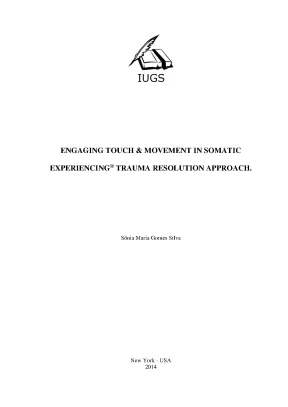
Tải xuống để đọc toàn bộENGAGING TOUCH & MOVEMENT IN SOMATIC EXPERIENCING® TRAUMA RESOLUTION APPROACH. Sônia Maria Gomes Silva New York - USA 2014 ENGAGING TOUCH & MOVEMENT IN SOMATIC EXPERIENCING® TRAUMA RESOLUTION APPROACH. Sônia Maria Gomes Silva Dr. Carlos Alberto Franco, PhD – Mentor New York - USA 2014 i Acknowledgements In memory of Freddy (Rubén Alfredo Garcia), my first master in sense-perception therapy.
To my daughter, Nabiyah Bashir, who is the biggest gift in my Life! To Peter Levine, who opened all the new possibilities for me to become who I am. Carlos Alberto Franco has been unique in his dedication to mentoring me. My thanks to Dr. Stephen Daniel, my Dean at IUGS, for his trust and support all along the way in this journey.
My deepest gratitude to Michael Piccuci and Elias Guerrero for offering me this opportunity. My indebted thanks to: Robbie Tucker for making my words understandable, since English is not my native language. She did an amazing job in this process; Silvana Pereira, graphic designer and a dear friend for my entire life; my dear brother, Newton Gomes, always present to support my needs, Fernanda Souza Silva, my niece, for her devotion and João Pedro R. Valesi for being my source of joy.
My special gratitude to: Jacqueline Carleton for opening new doors of updated Body Psychotherapy and for being extraordinary; Lael Keen for her huge generosity in providing much of Godard’s material and sources from his studies; Monica Caspari for generously sharing her knowledge and time; my dearest friend, Cornelia Rossi, for her constant presence on my path; George Zee, my dear friend, for all his great support. Thanks to: my friend Pedro Prado, Hillary Wytt, Guilherme Correa, my darling Laura Campos, Irene Trajtenberg, Marcia Guimarães, Sophie Fahri, Marcia Cezimbra, Carlos Melo, Norma Gjorup, Eduardo Worms, Danuzia Lopes, Lida Ruiter, Robert Screi, Sarah Zorica Mitic, Katarina Green, Sarah Cornish, Christine Pieler, Karin Honauer and Anne Marie. Additional thanks to all of my friends, family and students for continually inspiring me to stay alive and optimistic in my life. ii I saved my gratitude for the very end to Marcelo Muniz, my partner in this project, who I invited to co-create SOMA EMBODIMENT, a set of theories and practices inspired by my four important masters of Body Psychotherapy: Peter A.
Levine, Ida Rolf, Stephen Porges and Hubert Godard. Marcelo keeps nourishing me with the essence of Hubert Godard’s teaching. Finally, all my dreams could not have been realized without the trust of Urs Honauer and Paki Heisserer. They sponsored the SOMA EMBODIMENT project at Polarity Center (www.ch), and this Movement Education combined with Somatic Experiencing ™ hybrid is now taught in Switzerland, available to any trauma therapist.
Somatic Experiencing ® and SE™ are registered trademarks owned by Peter A. Levine, PhD, and licensed exclusively to the Foundation of Human Enrichment (FHE) and the SE Trauma Institute (SETI). I thank them for their support of this study. The problem: The personal experience of Sonia Gomes with body psychotherapies as a Clinical Psychologist, using structural & movement rolfing, yoga, spirituality and Somatic Experiencing, led to the observation that even with highly efficient SE intervention processes in severe trauma, the client goes through a recovery.
For that, one needs to redefine and restructure negative experience, with a reasonable understanding of what happened and relieve and / or transform the emotional and physiological symptoms. A problem found is the lack of integration between the spatial organization and time needed for the body to restructure more appropriate recovery embodiment, in order to increase the resilience to establish the trauma healing. The quality of this restructuring is variable. Objective: Understand how and why this occurs, and organize a new form of intervention that allows the elimination and / or symptom relief, ensuring maximum embodiment and integration in a minimum recovery time of resilience: what are the necessary and sufficient conditions for this to occur? 3.
The dissertation: This thesis, thus, has a theoretical construct that talks about the problem of trauma (Chapter I and Chapter II) and the mind-physiology question. This paper brings the basis of the updated neurosciences, seen in Chapter II. It is also addressing a historical overview of the problem and how it is done today (Chapter IV). What is needed to solve the problem (Chapters V and VI).
How to solve the problem is discussed in Chapter VI. iv The chapters of this dissertation are for: to situate the problem, understand its construction and under the guidelines of neuroscience justifiably propose a new form of intervention. Chapter VII shows that it is possible to measure, and includes a proposal for how to do this. What occurs and how? The brain rearranges to deal with the trauma and neuronal circuitry is altered physiologically.
Various muscle tensions generated by escape, fight or freeze responses are circuited in a new way, interfering with the original circuits of the subject. Main problems: procedural memory, physiological defense structure for permanent threat (anxiety, hormonal changes, muscle mobilization) and modification of perceptual processes. When intervened, it can bring up awareness for procedural memory and allows the body, contracted at different levels, to relax: the intervention allows for the decreased activation of neuronal circuits of trauma. Where they are organized: procedural memory (which withdraws the alarm level), internal organization of the muscle systems and physiology (fascia) communication.
How to achieve maximum recovery: • dis-abling the circuitry of trauma awareness, partly amending the procedural memory: Somatic Experiencing™ • re-organizing the system of procedural memory for learning awareness of new organization: moving the muscle structures from the fascia: touch and movement sought to recover the natural way to give and receive information through the senses of both the client and the therapist. Rolfing and Godard’s Movement Education applied in the Somatic Experiencing Therapy. Keywords: Somatic Experiencing ™ Trauma Therapy & Movement Education; Soma Embodiment for Trauma Therapy; Body Oriented Trauma Therapy. v SUMMARY Chapter I INTRODUCTION.
1 Chapter II PHENOMENON OF TRAUMA.A WHAT IS TRAUMA? .1 Ethologists call this innate response tonic immobility (TI): .B TYPES OF TRAUMA: .1 Trans-generational trauma: .9 Emotional or psychological trauma:.1 Considerations on the section B. TRAUMA RESIDES IN THE PHYSIOLOGY OF DEFENSE SURVIVAL RESPONSE (LEVINE, 1976): .3 Freeze or Tonic Immobility:.4 Cycle of Activation to danger & Hyperactivation: .5 Hyperactivation of the Nervous System: .7 Neurophysiology of Trauma: .8 Biological Alteration an ongoing stress: .9 Motor Activity in trauma & Stress response: .10 Phenomenon of paralysis or tonic immobility: shock state: .11 Critical Importance of the Freeze Discharge or the motor act of completion Defense Response: .12 Nature and Intensity of Trauma (Trauma symptoms): .1 PTSD - Post-Traumatic Stress Disorders: .D MEMORY OF TRAUMA AND STRESS:.E HOW TRAUMA AFFECTS THE BODY: .1 Severe dysregulation from developmental trauma: .2 Trauma affects cognition, feelings and learning:. 72 vi Chapter III A NEUROSCIENCE UPDATE ON TRAUMA RESOLUTION .A EVOLUTIONARY PSYCHOLOGY’S PERSPECTIVE:. 77 III-B HOW THE BODY IN ACTION SHAPES THE SELF: .1 Types of Brain Plasticity: .D THE BRAIN – A COMPLEX AND DYNAMIC STRUCTURE & ABILITY OF NEURONS TO CHANGE: .1 The Nervous System: .1 The ANS involved in the physiology of stress: .2 ANS and Cardiac vagal tone activity and Stress: .3 The Heart Rate Variability (HRV): .2 – Triune Brain’s model of Paul MacLean: .3 Primate Brain or Neocortex Brain: .3 The brain and its complexity in function and anatomy: .4 The Brain: a dynamic and integration structure:.5 The basic neural structures related to trauma therapeutic approaches and its functions: .6 Brain Structures of Motor /Emotions (Sub-cortical & Limbic systems): .2 The Basal ganglia:.7 The Limbic System: .1 Sensitivy to stress: .8 The Cortical Systems:.1 The parietal lobes: .10 The prefrontal cortex:.
118 Figure 9 The insula in the parietal lobes .11 The Orbitofrontal Cortex: .E THE POLYVAGAL THEORY: .1 New perspectives for adaptation to Autonomic Nervous System: .1 The Polyvagal Theory: .2 The cranial nerves: .3 Mammalian Modifications of our Evolutionary Heritage: - A Polyvagal Theory: .4 The ANS adaptative responses: .6 Social engagement and Defensive behavior: Adaptive or maladaptive strategies: .7 Immobilization with fear and without fear: .9 Social Engagement System – face/heart. 135 Chapter IV HISTORY OF SOMATIC PSYCHOLOGY .B DEFINITION OF PSYCHOLOGY: .1 Regarding regulation´s mechanism of Psychology & Body: .3 The body as a vehicle for communication and healing: .4 Different approaches of Body psychotherapies: .5 History of Somatic Psychology:.C NEURO-AFFECTIVE DEVELOPMENT PSYCHOLOGY: .1 The human biological capacity for social engagement: .2 Emotional System Regulation: .3 Affect, Caregivers and Tolerance: .4 Trauma and neuroaffective developing relationship: .5 Neural Emotional Dysregulation: .D THE SOMATOMOTOR COMPONENTS INCLUDE NEURAL STRUCTURES IN SOCIAL AND EMOTIONAL BEHAVIOR: .F SOMATIC EXPERIENCING™ - A MAP IN THE TRAUMA RESOLUTION .1 SE – Contemporary innovation for trauma therapy: .2 Somatic Experiencing™ and its clinical practice: .G SOMATIC EXPERIENCING™ & THE POLYVAGAL THEORY:. 176 Chapter V LANGUAGE OF BODY & TRAUMA RESOLUTION .A PHENOMENOLOGY OF PERCEPTION: .1 Change the sensations: .B EXTEROCEPTION – INTEROCEPTION AND PROPRIOCEPTION: .1 A Neurobiology of sensorial language: .2 There are three types of neurons of sensorial language –.1 Hearing or Sense of Sound: .2 Sense of Taste: .3 Types of touch: .4 Considerations sensorial language: .C EMBRYOLOGICAL DEVELOPMENT AND SPATIAL ORGANIZATION: .D TOUCH - A LANGUAGE OF ENGAGEMENT: .1 Neurobiology of movement:. 208 Chapter VI HOW TOUCH & MOVEMENT ACTS WITH SE TO RESTORE THE ONE SELF .A EMBODIMENT – A PATH TO SELF-REGULATION: .1 Tonic Function by Godard’s perspective for embodiment: .2 How to create a dynamic balance between inner and outer space: .3 The core stabilization and an organization space process: .4 Touch & Movement from Godard’s Analysis Movement Education: .1 There are two levels of body organization: .B FASCIAL ORIENTED & GRAVITY FIELD RELATED TO TRAUMA:.1 The importance of Fascia in trauma: The work of Dr.2 Trauma vortex and memory of traumatized fascia: .C TOUCH & MOVEMENT ACTING IN ORDER TO HEAL BODY – LEVINE & GODARD’S APPROACHES: .1 How to evoke the intelligence of the body toward self-regulation: .D TRANSFORMING FIXATIONSTONEW POSSIBILITIES:.
247 Chapter VII METHODOLOGY .A QUALITATIVE STUDY ASSESSMENT:.1 Selected Processing Mechanism .1 Setting and testing conditions. 274 Chapter VIII CONCLUSION. 281 ix Chapter I INTRODUCTION Trauma is an experience of extreme stress or shock that is or was, at some point, part of life. It is an experience that threatens body/mind’s entire organism 1 by causing a rupture in its capacity to assimilate and accommodate into inner regulatory, taking it to functioning in a new level of organization.
The organism is forced beyond its physiological adaptation’s capacity, in order to regulate the activation state of the Nervous System, and fails in its reciprocal relationship among the other body systems (LEVINE, 2010). A reciprocal relationship suggests a positive cooperation within and between systems; a system works, therefore, in coherence, 2 harmony and continuity, taking and bringing back internal environmental information related to the external environment, and vice versa, promoting well-being, comprehensive health, which means self-regulation. When there is trauma, the continuity of internal experience breaks, and one dissociates3 from the present moment. This manifests itself in a global setting between sensorimotor stimuli, and cognitive and emotional states, which arise from the experience of shock and or chronic stress.
Thus, a loss in rhythmic capacity for 1 The term organism is equivalent to the term body. It is used by most biologists who designated “a living being endowed with organs whose totality constitutes a living being," decribed by (LAMARCK, 1802, HELLER, 2012:3). 2 Coherence can be defined as: connected, open, harmonious, engaged, receptive, noetic, compassionate, empatic. The movement toward well-being is a movement toward integration.
When connected to the deep self, feel “wholeness”. Organization within body systems and cooperative, organized function between various physiological systems contributes to the sense presence. Coherence reflects a homeostatic state in which the organism is self-regulating in an optimal way. Coherence can be measured between physiologic subsystems.
Nội dung được bảo vệ bản quyền — Tải xuống đầy đủ
Trích dẫn luận án này
Sônia Maria Gomes Silva (2014). Engaging touch and movement in se trama resolution approach [Luận án tiến sĩ, IUGS (International University for Graduate Studies)]. LuanAn.net. https://luanan.net/giao-duc-hoc/tam-ly-hoc-giao-duc/engaging-touch-and-movement-in-se-trama-resolution-approach-dissertation
Câu hỏi thường gặp
Luận án "Engaging touch and movement in se trama resolution approach" nghiên cứu về vấn đề gì?
Khám phá cách tiếp cận giải quyết se trama với cảm ứng và chuyển động hấp dẫn. Tối ưu hóa tương tác người dùng.
Luận án "Engaging touch and movement in se trama resolution approach" được bảo vệ tại trường nào?
Luận án này được bảo vệ tại IUGS (International University for Graduate Studies). Năm bảo vệ: 2014.
Luận án "Engaging touch and movement in se trama resolution approach" thuộc chuyên ngành gì?
Luận án "Engaging touch and movement in se trama resolution approach" thuộc chuyên ngành Tâm lý học lâm sàng / Trị liệu tâm lý thân nghiệm (Clinical Psychology / Body Psychotherapy / Somatic Experiencing). Danh mục: Tâm Lý Học Giáo Dục.
Luận án "Engaging touch and movement in se trama resolution approach" có bao nhiêu trang?
Luận án "Engaging touch and movement in se trama resolution approach" có 307 trang. Bạn có thể xem trước một phần tài liệu ngay trên trang web trước khi tải về.
Cách tải luận án "Engaging touch and movement in se trama resolution approach" về máy như thế nào?
Để tải luận án về máy, bạn nhấn nút "Tải xuống ngay" trên trang này, sau đó hoàn tất thanh toán phí lưu trữ. File sẽ được tải xuống ngay sau khi thanh toán thành công. Hỗ trợ qua Zalo: 0559 297 239.