Luận án: Vai trò của thể chế trong phát triển doanh nghiệp ở châu Phi - Friedrich-Schiller-Universität Jena
Disstran cung cấp giải pháp quản lý luận văn toàn diện. Hỗ trợ xử lý tài liệu, phân tích dữ liệu, tối ưu quy trình nghiên cứu cho sinh viên và nhà khoa học.
Friedrich-Schiller-Universität Jena
Wirtschaftswissenschaften (Kinh tế học / Quản trị kinh doanh)
Luan An
Luận án tiến sĩ
Số trang
229
Thời gian đọc
35 phút
Lượt xem
0
Lượt tải
0
Phí lưu trữ
50 Point
Tổng quan nhanh
- Chủ đề:
- Dừng Hoạt Động Doanh Nghiệp: Giải Thể và Chấm Dứt Kinh Doanh
- Số trang:
- 229 trang
- Trường:
- Friedrich-Schiller-Universität Jena
- Chuyên ngành:
- Wirtschaftswissenschaften (Kinh tế học / Quản trị kinh doanh)
- Tác giả:
- Luong Thanh Tran
Tóm tắt nội dung luận án
I.Dừng Hoạt Động Doanh Nghiệp Giải Thể và Chấm Dứt Kinh Doanh
Chấm dứt hoạt động kinh doanh là một bước quan trọng. Việc giải thể doanh nghiệp yêu cầu tuân thủ nghiêm ngặt các quy định pháp luật. Quá trình này đảm bảo việc kết thúc một thực thể kinh doanh diễn ra hợp lệ, tránh các rủi ro pháp lý sau này. Không phải mọi sự dừng lại đều giống nhau. Có nhiều hình thức business entity termination, mỗi loại có yêu cầu riêng. Việc hiểu rõ các lựa chọn giúp chủ sở hữu đưa ra quyết định phù hợp nhất. Mục tiêu chính là bảo vệ tài sản còn lại, giải quyết các khoản nợ một cách công bằng. Các bước cần được thực hiện cẩn thận. Sự chuẩn bị kỹ lưỡng là chìa khóa. Các bên liên quan cần được thông báo kịp thời. Một quá trình dissolution có tổ chức giúp giảm thiểu xung đột. Việc này cũng bảo vệ danh tiếng của các bên liên quan. Các nghĩa vụ với cơ quan thuế và nhà nước cũng cần được hoàn tất. Việc bỏ qua các bước này có thể dẫn đến hậu quả nghiêm trọng. Đảm bảo mọi thứ rõ ràng là ưu tiên hàng đầu.
1.1. Giải Thể Là Gì Phân Biệt Các Loại Hình Chấm Dứt
Giải thể doanh nghiệp là quá trình kết thúc hoạt động kinh doanh của một thực thể pháp lý. Các hình thức chấm dứt bao gồm giải thể tự nguyện và giải thể bắt buộc. Giải thể tự nguyện do chủ sở hữu quyết định. Giải thể bắt buộc theo lệnh của tòa án hoặc cơ quan nhà nước. Một số trường hợp khác là sáp nhập hoặc hợp nhất, dẫn đến chấm dứt thực thể ban đầu. Sự khác biệt này ảnh hưởng đến quy trình, thời gian. Hiểu rõ loại hình chấm dứt giúp áp dụng đúng luật pháp. Việc này đảm bảo tính hợp pháp cho business entity termination.
1.2. Lý Do Chính Dẫn Đến Quyết Định Giải Thể Doanh Nghiệp
Nhiều yếu tố dẫn đến quyết định giải thể. Kinh doanh thua lỗ kéo dài là nguyên nhân phổ biến. Thay đổi chiến lược thị trường cũng có thể khiến một doanh nghiệp không còn phù hợp. Mâu thuẫn nội bộ giữa các đối tác hoặc cổ đông. Đôi khi, chủ sở hữu muốn nghỉ hưu hoặc chuyển sang lĩnh vực khác. Sự thay đổi luật pháp, điều kiện kinh tế bất lợi cũng đóng vai trò. Quyết định dissolution cần được cân nhắc kỹ lưỡng. Nó phải dựa trên phân tích toàn diện tình hình doanh nghiệp và thị trường.
1.3. Tầm Quan Trọng Của Việc Tuân Thủ Quy Trình Pháp Luật
Tuân thủ quy trình pháp luật là cực kỳ quan trọng. Việc này tránh các hình phạt, tranh chấp trong tương lai. Hồ sơ giải thể phải được nộp đầy đủ, đúng thời hạn. Các nghĩa vụ với chủ nợ, nhân viên, cơ quan thuế phải được hoàn thành. Một quá trình giải thể không đúng quy định có thể để lại gánh nặng pháp lý cho chủ sở hữu. Nó cũng ảnh hưởng đến corporate status sau này. Đảm bảo mọi thủ tục diễn ra minh bạch, đúng luật.
II.Thủ Tục Giải Thể LLC Tại California Hướng Dẫn Chi Tiết
Giải thể một công ty TNHH (LLC) ở California đòi hỏi các bước cụ thể. Quy trình này được giám sát bởi California Secretary of State. Việc nộp đúng biểu mẫu và tuân thủ các quy định là cần thiết. Các thành viên LLC phải đồng thuận về việc dissolution. Quyết định này thường được ghi lại trong biên bản họp. Việc này đảm bảo tính hợp lệ của quá trình. Sau đó, các biểu mẫu thích hợp sẽ được chuẩn bị. Mỗi bước đều có ý nghĩa pháp lý quan trọng. Việc bỏ qua một bước có thể kéo dài quy trình. Nó cũng có thể gây ra vấn đề trong tương lai. Các khoản nợ cần được xử lý. Tài sản cần được thanh lý hoặc phân phối. Tránh mắc lỗi trong quá trình này là chìa khóa. Nó giúp LLC kết thúc hoạt động một cách suôn sẻ. Quá trình LLC cancellation cần được thực hiện một cách cẩn trọng.
2.1. Chuẩn Bị Hồ Sơ Giải Thể LLC Với Bang California
Việc chuẩn bị hồ sơ là bước đầu tiên. Cần có sự đồng ý bằng văn bản của tất cả hoặc đa số thành viên. Biểu mẫu Certificate of Cancellation (Form LLC-4/8) là cần thiết cho LLC cancellation. Đôi khi, một Statement of Dissolution (Form LLC-3) cũng được yêu cầu. Các biểu mẫu này phải được điền đầy đủ, chính xác. Các thông tin về tên LLC, số hồ sơ California Secretary of State là bắt buộc. Hồ sơ cần thể hiện rõ ý định chấm dứt hoạt động của LLC.
2.2. Các Bước Nộp Đơn Chấm Dứt Hoạt Động Chính Thức
Sau khi chuẩn bị, hồ sơ được nộp cho California Secretary of State. Việc nộp có thể trực tiếp, qua thư hoặc trực tuyến. Phí nộp hồ sơ cần được thanh toán đầy đủ. Sau khi nộp, Secretary of State sẽ xem xét hồ sơ. Nếu hồ sơ hợp lệ, quá trình LLC cancellation sẽ được tiến hành. Ngày nộp hồ sơ hợp lệ thường được coi là ngày chấm dứt chính thức của LLC. Việc xác nhận từ cơ quan chức năng là quan trọng.
2.3. Trách Nhiệm Tiếp Theo Sau Khi Nộp Đơn Chấm Dứt
Việc nộp đơn không phải là kết thúc. LLC vẫn phải hoàn thành các nghĩa vụ. Các khoản nợ phải được thanh toán. Báo cáo thuế cuối cùng cần được nộp cho Franchise Tax Board. Mọi tài sản còn lại cần được phân phối cho thành viên. Việc này đảm bảo không còn nghĩa vụ pháp lý nào tồn tại. Sự chấm dứt đúng đắn giúp tránh các vấn đề về corporate status sau này.
III.Giải Thể Công Ty Cổ Phần Yêu Cầu và Quy Trình Thực Hiện
Quá trình corporation dissolution có nhiều điểm tương đồng nhưng cũng có những khác biệt so với LLC. Yêu cầu chính là sự chấp thuận từ hội đồng quản trị và cổ đông. Việc này đòi hỏi các cuộc họp và bỏ phiếu chính thức. Quy trình cần tuân thủ nghiêm ngặt điều lệ công ty và luật pháp bang. Giống như LLC, việc thông báo cho California Secretary of State là bắt buộc. Các biểu mẫu khác nhau được sử dụng cho công ty cổ phần. Sự phức tạp hơn do số lượng cổ đông và cấu trúc quản lý. Việc đảm bảo mọi người đều được thông báo là quan trọng. Các nghĩa vụ với chủ nợ và các bên liên quan cần được ưu tiên. Thanh lý tài sản và phân phối phần còn lại là các bước thiết yếu. Điều này giúp đảm bảo corporate status của công ty được chấm dứt hợp lệ. Tránh bất kỳ trách nhiệm pháp lý nào trong tương lai.
3.1. Quyết Định Giải Thể Công Ty Cổ Phần Từ Hội Đồng Quản Trị
Hội đồng quản trị thường đưa ra đề xuất giải thể. Quyết định này cần được thông qua bởi đa số hoặc tất cả các thành viên hội đồng. Sau đó, đề xuất được trình lên cuộc họp cổ đông. Cần có sự chấp thuận của một tỷ lệ nhất định cổ đông. Tỷ lệ này được quy định trong điều lệ công ty hoặc luật pháp bang. Biên bản cuộc họp ghi nhận quyết định này là tài liệu quan trọng. Nó làm cơ sở cho các bước corporation dissolution tiếp theo.
3.2. Thông Báo và Xử Lý Các Vấn Đề Với Cổ Đông Chủ Nợ
Sau quyết định, công ty phải thông báo cho tất cả cổ đông, chủ nợ. Thông báo này cung cấp chi tiết về quá trình giải thể. Các chủ nợ có thể đưa ra yêu cầu về khoản nợ. Công ty phải xử lý các yêu cầu này một cách công bằng. Các khoản nợ phải được thanh toán trước khi phân phối tài sản cho cổ đông. Việc này bảo vệ quyền lợi của tất cả các bên. Nó đảm bảo quá trình liquidation diễn ra minh bạch.
3.3. Hoàn Tất Hồ Sơ Giải Thể Với Cơ Quan Đăng Ký Kinh Doanh
Công ty cần nộp Articles of Dissolution cho California Secretary of State. Biểu mẫu này xác nhận việc corporation dissolution. Cần đảm bảo các thông tin trên biểu mẫu chính xác. Mọi yêu cầu pháp lý khác cần được tuân thủ. Sau khi chấp thuận, tình trạng pháp lý của công ty sẽ chấm dứt. Việc này hoàn tất quá trình business entity termination về mặt pháp lý.
IV.Thanh Lý Tài Sản Giải Quyết Nợ Hoàn Tất Winding Up
Giai đoạn winding up là trọng tâm của quá trình giải thể. Nó liên quan đến việc quản lý tài chính và tài sản của doanh nghiệp. Mục tiêu là chuyển đổi tài sản thành tiền mặt và thanh toán tất cả các khoản nợ. Việc này bao gồm bán tài sản, thu hồi các khoản phải thu. Tất cả các nghĩa vụ tài chính cần được xác định và giải quyết. Các khoản nợ với nhà cung cấp, ngân hàng, nhân viên phải được ưu tiên. Việc này đòi hỏi sự minh bạch và quản lý chặt chẽ. Sau khi các khoản liabilities được thanh toán, phần còn lại sẽ được phân phối cho chủ sở hữu. Quá trình liquidation phải tuân thủ thứ tự ưu tiên pháp lý. Sai sót trong giai đoạn này có thể dẫn đến tranh chấp. Nó cũng có thể khiến chủ sở hữu phải chịu trách nhiệm cá nhân. Mọi giao dịch cần được ghi chép cẩn thận.
4.1. Quy Trình Winding Up Bán Tài Sản và Thu Hồi Khoản Phải Thu
Giai đoạn winding up bắt đầu bằng việc thu thập và đánh giá tất cả tài sản. Tài sản bao gồm bất động sản, thiết bị, hàng tồn kho, và các khoản phải thu. Các tài sản này sau đó được bán để tạo ra tiền mặt. Việc thu hồi khoản phải thu là một phần quan trọng. Nó đảm bảo tối đa hóa nguồn tiền mặt sẵn có. Tất cả các giao dịch bán tài sản phải được ghi chép rõ ràng. Nó cần tuân thủ các quy định pháp luật. Mục đích là để thanh toán các khoản nợ doanh nghiệp.
4.2. Thanh Toán Nghĩa Vụ Xử Lý Các Khoản Nợ Doanh Nghiệp
Sau khi có tiền mặt, các khoản liabilities cần được thanh toán theo thứ tự ưu tiên. Thông thường, các khoản nợ có bảo đảm được ưu tiên trước. Tiếp theo là các khoản nợ không có bảo đảm, lương nhân viên, và thuế. Mọi chủ nợ cần được thông báo về quá trình. Việc này giúp họ có cơ hội đưa ra yêu cầu. Việc thanh toán đúng hạn và đủ số tiền giúp tránh tranh chấp. Nó cũng đảm bảo business entity termination không để lại gánh nặng.
4.3. Phân Phối Tài Sản Còn Lại Cho Chủ Sở Hữu Sau Thanh Lý
Khi tất cả các khoản liabilities đã được giải quyết, số tiền còn lại sẽ được phân phối. Việc phân phối này dành cho các thành viên LLC hoặc cổ đông của công ty cổ phần. Tỷ lệ phân phối dựa trên thỏa thuận ban đầu hoặc tỷ lệ sở hữu. Quá trình này hoàn tất giai đoạn liquidation. Nó là bước cuối cùng trong việc giải quyết tài chính. Sau bước này, doanh nghiệp không còn tài sản. Nó chấm dứt hoàn toàn về mặt kinh tế.
V.Tình Trạng Pháp Lý Doanh Nghiệp Đảm Bảo Chấm Dứt Đúng
Đảm bảo rằng corporate status của doanh nghiệp được chấm dứt đúng cách là tối quan trọng. Việc này không chỉ liên quan đến việc nộp hồ sơ. Nó còn bao gồm việc hoàn thành các nghĩa vụ cuối cùng. Nếu không, các vấn đề pháp lý có thể phát sinh trong nhiều năm sau. Việc này có thể ảnh hưởng đến những người từng là chủ sở hữu hoặc quản lý. Các trách nhiệm thuế chưa thanh toán hoặc các vụ kiện không giải quyết có thể lại tái xuất hiện. Giữ lại hồ sơ quan trọng là một phần của trách nhiệm này. Tránh các sai lầm phổ biến trong quá trình giải thể là cần thiết. Nó giúp doanh nghiệp kết thúc một cách sạch sẽ. Việc này bảo vệ tất cả các bên khỏi rủi ro không mong muốn. Sự cẩn trọng này giúp business entity termination thành công.
5.1. Giữ Vĩnh Viễn Hồ Sơ Doanh Nghiệp Sau Giải Thể
Ngay cả sau khi giải thể, một số hồ sơ cần được lưu giữ vĩnh viễn. Các tài liệu này bao gồm biên bản họp, điều lệ, hồ sơ thuế và hợp đồng quan trọng. Việc này giúp giải quyết các vấn đề phát sinh sau này. Ví dụ, các yêu cầu từ cơ quan thuế hoặc các vụ kiện tiềm ẩn. Quy định về lưu trữ hồ sơ thay đổi tùy thuộc vào bang. Việc tuân thủ các quy định này là bắt buộc. Nó đảm bảo có bằng chứng pháp lý khi cần thiết.
5.2. Trách Nhiệm Thuế và Các Nghĩa Vụ Sau Cùng
Doanh nghiệp vẫn có trách nhiệm thuế sau khi giải thể. Các báo cáo thuế cuối cùng cần được nộp cho Sở Thuế vụ Liên bang (IRS) và bang California. Các khoản thuế thu nhập, thuế bán hàng, và thuế lao động cần được thanh toán. Việc này đảm bảo không còn nghĩa vụ thuế nào. Bỏ qua bước này có thể dẫn đến các hình phạt nghiêm trọng. Các nghĩa vụ khác như bảo hiểm hoặc giấy phép cũng cần được chấm dứt hợp lệ.
5.3. Tránh Các Sai Lầm Phổ Biến Trong Quy Trình Giải Thể
Một sai lầm phổ biến là không thông báo đầy đủ cho tất cả các bên liên quan. Một sai lầm khác là không giải quyết tất cả các khoản liabilities. Việc không nộp đúng biểu mẫu hoặc bỏ sót bước winding up cũng là vấn đề. Không lưu giữ hồ sơ quan trọng cũng gây rủi ro. Việc tìm kiếm tư vấn pháp lý và kế toán chuyên nghiệp là cần thiết. Việc này giúp tránh những sai sót tốn kém. Nó đảm bảo một quá trình business entity termination suôn sẻ.
Mục lục chi tiết luận án
Tải xuống file đầy đủ để xem toàn bộ nội dung
Tải đầy đủ (229 trang)Trích đoạn nội dung luận án
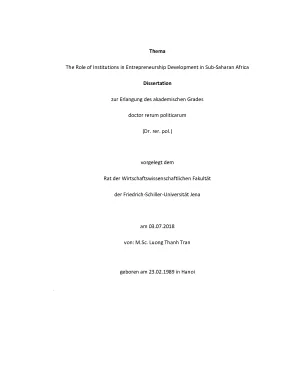
Tải xuống để đọc toàn bộThema The Role of Institutions in Entrepreneurship Development in Sub-Saharan Africa Dissertation zur Erlangung des akademischen Grades doctor rerum politicarum (Dr.) vorgelegt dem Rat der Wirtschaftswissenschaftlichen Fakultät der Friedrich-Schiller-Universität Jena am 03. Luong Thanh Tran geboren am 23.1989 in Hanoi Gutachter 1. Andreas Freytag Chair of Economic Policy Faculty of Economics and Business Administration Friedrich-Schiller-Universität Jena, Germany 2. Michael Wyrwich Department of Innovation Management and Strategy Faculty of Economics and Business Rijksuniversiteit Groningen, the Netherlands and Chair of Business Dynamics, Innovation, and Economic Change Faculty of Economics and Business Administration Friedrich-Schiller-Universität Jena, Germany 3.
Florian Noseleit Department of Innovation Management and Strategy Faculty of Economics and Business Rijksuniversiteit Groningen, the Netherlands ii Datum der Verteidigung: Table of Contents List of Figures and Tables. vi List of Abbreviations and Acronyms. ix German Summary .1 The Role of Entrepreneurship and Private Sector in Economic Development .2 Institutional Approach to Entrepreneurship .3 Sub-Saharan Africa Context .1 The Two Case Studies of Ghana and Kenya. Entrepreneurial Learning under Institutional Context: The Effectiveness of Education and Training on Entrepreneurs’ Performance in Ghana and Kenya .2 The Development of Entrepreneurial Learning in Entrepreneurship Research .3 Institutional Approach of Entrepreneurial Learning .1 Formal Learning as Formal Institutions .1 Formal Education Attainment .3 Vocational and Technical Education .2 Informal Learning as Informal Institutions.1 Learning from Experience.
46 4 The Effect of Parental Role Model on Entrepreneurs’ Entry Age, Start-up Size, and Business Development: Empirical Evidence from two Developing Countries .2 Literature Review: Parental Role Model and Entrepreneurship Intentions .1 Transmission Channels of Entrepreneurship Intentions: Nature vs Nurture .2 Parental Self-Employment and Entrepreneurs’ Entry Age to Business .3 Parental Self-Employment, Start-up Size, and Post-Entry Business Development .4 A Quick Note on Intergenerational Transmission of Entrepreneurship in Developing vs Developed Countries.1 Entrepreneurs’ Entry Age to Business .2 Business Size at Start-up and Post-entry Development. Sub-Saharan Africa in a Globalised World: Toward a Knowledge-Based Model of Entrepreneurial Economy .2 SSA Entrepreneurship Structure in the Global Economy .1 Globalisation and the Emergence of the Entrepreneurial Economy .2 Plotting SSA on the Map of Global Entrepreneurship Development.3 SSA Conditions and the two Models in Retrospect .1 Sources of Growth .1 Localisation vs Globalisation .2 Continuity vs Change. Dilemma of Jobs vs High Wages .1 Stability vs Turbulence .2 Specialisation vs Diversity .3 Homogeneity vs Heterogeneity .3 How firms function .1 Control vs Motivation .2 Firm Transaction vs Market Exchange .3 Substitutes vs Complements of Competition and Cooperation .4 Scale vs Flexibility .1 Regulation vs Stimulation .2 Targeting Outputs vs Inputs .3 Locus of Policy: National vs Local .4 Financing: Low vs High-Risk Capital .4 SSA Prospects and Policy Implications. 98 6 Is a ‘Factory Southern Africa’ Feasible? Harnessing Flying Geese to the South African Gateway .2 The Flying Geese Pattern .1 MNCs and FDI.1 The lead goose and following geese .2 Driving forces of industrial shifting .3 Reverse production cycle .4 The technology transfer challenge .2 Criteria for Successful Application within SACU .3 How does the SACU region measure up? .1 Comparative and competitive advantages and the production cycle.2 Can South Africa be the lead goose? .3 China and/or the West as the lead goose? .4 Is the Flying Geese Model Applicable? .3 Attracting Flying Geese: The Gateway Model .1 What is a gateway? .2 Some Implications of the Gateway Proposition for Policy .3 South Africa as the Southern African Gateway.1 South Africa as a Transport Hub .2 South Africa’s Global Cities .3 South Africa as a Services Hub .4 How Could SACU Countries Benefit from The South African Gateway? .5 Emerging Challenges to the South African Gateway Strategy .4 South Africa, SACU, and the RVC/GVC Policy Debate .1 A Developmental Approach? Import Replacement and Beneficiation .1 Import replacement and beneficiation .2 Which export markets? .3 Application to South Africa and the BLNS .2 A Facilitative Approach: RVC/GVC Interlinking .5 Summary and Conclusions.
162 7 Conclusion of the Dissertation .1 Summary of findings .2 General Policy Implications .3 Suggestions for Future Research. 180 Declaration of Co-authorship. 211 Lists of Publications and Presentations. 212 v List of Figures and Tables Figure 1: Institutions, Entrepreneurship, and Economic Development .7 Figure 2: Calculating Sample Size.
14 Figure 3: Double and Single Loop Learning. 20 Figure 4: The Learning Task Facing Start-up Entrepreneurs. 28 Figure 5: Calculating Annual Growth Rate. 38 Figure 6: Transmission Channels of Entrepreneurship Intentions.
59 Figure 7: The U-shaped Relation between Nascent Entrepreneurship (Total Early Stage Entrepreneurial Activity) and Per Capita Income. 77 Figure 8: The Reverse Production Cycle. 110 Figure 9: An Example of Flying Geese Pattern in Southern Africa. 123 Figure 10: Map of Harbours and Transport Corridors in East and Southern Africa.
133 Figure 11: Map of Global Flight Connections Starting at O. 137 Figure 12: Map of Regional Flight Connections Starting at O. 138 Table 1: Mapping of Formal and Informal Institutions on Entrepreneurial Learning. 33 Table 2: Sources of Entrepreneurial Learning Experience.
36 Table 3: Descriptive Continuous Variables. 38 Table 4: Correlation Matrices of Dependent and Independent Variables. 39 Table 5: Test for Heteroscedasticity. 40 Table 6: Ghanaian and Kenyan Entrepreneurs’ Business Employment Capability based on Entrepreneurial Learning.
41 Table 7: Ghanaian and Kenyan Entrepreneurs’ Business Employment Growth Capability based on Entrepreneurial Learning. 44 Table 8: Summary of Continuous and Binary Variables. 62 Table 9: Parental Entrepreneurship’s Effect on Entrepreneurs’ Entry Age to Business. 65 Table 10: Parental Entrepreneurship’s Effect on the Start-up Size of Business.
66 Table 11: Parental Entrepreneurship’s Effect on the Current Size of Business. 67 Table 12: The Relation between Per Capita Income and the Rate of Nascent Entrepreneurship, Actual Business Ownership and Stage of Economic Development. 78 Table 13: Fourteen Dimensions of the Differences between the Models of the Managed and Entrepreneurial Economy. 80 Table 14: Selective Indicators for GVC/RVCs Integration.
118 Table 15: Demographic Trends – Asia and Africa. 120 Table 16: Manufacturing as Share of GDP. 136 Table 17: LSCI and LPI for East and Southern Africa. 142 Table 18: Access to Credit Ranking of the SACU members.
147 Table 19: Annual Labour Costs for Importers and Exporters. 155 vi List of Abbreviations and Acronyms AfDB African Development Bank AGOA Africa Growth and Opportunity Act AIC Akaike Information Criterion ANC African National Congress APEC Asia–Pacific Economic Cooperation ASEAN Association of Southeast Asian Nations BIC Bayesian Information Criterion BLNS Botswana, Lesotho, Namibia and Swaziland BMZ Federal Ministry of Economic Cooperation and Development COMESA Common Market for Eastern and Southern Africa DBSA Development Bank of Southern Africa DTI Department of Trade and Industry EAC East African Community EFF Economic Freedom Fighters EPA Economic Partnership Agreement ESS Enterprise Specific Skill EU European Union FET Further Education and Training FTA Free Trade Agreement GCI Global Competitiveness Index GEM Global Entrepreneurship Monitor GVC Global Value Chain IDC Industrial Development Corporation JSE Johannesburg Stock Exchange KAS Konrad Adenauer Stiftung LPI Logistics Performance Index LSCI Liner Shipping Connectivity Index vii MNC Multinational Corporation NGO Non-Government Organisation NIE Newly Industrializing Economy NTB Non-Tariff Barrier OECD Organisation for Economic Co-operation and Development OEM Original Equipment Manufacturer OLS Ordinary Least Squares R&D Research and Development RCA Revealed Comparative Advantage REC Regional Economic Community RSS Relation Specific Skills RVC Regional Value Chain SACU Southern African Customs Union SADC Southern African Development Community SEZ Special Economic Zone SMEs Small and Medium Enterprises SSA Sub-Saharan Africa PPP Public-Private Partnership TEA Total Early Stage Entrepreneurial Activity TFTA Tripartite Free Trade Agreement UAFL United Africa Feeder Line UNECA United Nations Economic Commission for Africa UNCTAD United Nations Conference on Trade and Development UNDP United Nations Development Programme US United States WBES World Bank Enterprise Survey WEF World Economic Forum WTO World Trade Organization viii Acknowledgements Foremost, I would like to express my sincere gratitude to my first supervisor, Prof. Andreas Freytag, who has guide-lined me through the master’s level and up until the finish of my doctoral dissertation, gave me several helpful advices and supports, encouraged me and taught me how to face challenges in and outside of academia. Throughout the years, I have learned a lot from him, and being his supervisee, co-author and football teammate, I understand the German word “Doktorvater” deeply.
Secondly, I would like to thank my second supervisor and co-author, Assoc. Michael Wyrwich, who has given me critical and insightful comments, considerately and patiently answered all of my technical questions. I could not have asked for better support, guidance and encouragement. Besides, I am grateful to Assoc.
Florian Noseleit for having kindly accepted to be the third supervisor of my dissertation. I am also thankful to Prof. Peter Draper and Dr. Sören Scholvin as co-authors of my papers for valuable collaboration and fruitful teamwork.
I appreciate the kind support from colleagues at the Konrad Adenauer Stiftung, Prof. Rolf Hasse, Dr. Michael Schmitz, Frau Elvira Giebel-Felten, Julia Lohman, Dorothee Niebuhr, Pia Becker, for helping me facilitate the survey in Africa. I would like to extend my gratitude to Dr.
Roger Atinga at the University of Ghana and Dr. David Mathuva at Strathmore University. The survey could not be done without their practical supports. My tender thanks are due to colleagues at the Chair of Economic Policy, especially Annet, Susanne, Wolfgang, Matthias, Sebastian Sp., Miriam, Christoph, and Kevin for supporting me through various works, Kehinde, Huy, and Lodovico whom I share my office with, for meaningful discussions throughout the years.
I largely appreciate the main financial support from the Konrad Adenauer Stiftung, and the side funding from the World Bank, the Otto Wolff Stiftung, the Leipziger ix Wirtschaftspolitische Gesellschaft, the Graduate Academy at University of Jena, and the German Academic Exchange Service (DAAD) for the preparation of this dissertation. My special thanks go to my dear friends chi Hien, anh Nam, em Hoa, anh Chau & em Trang, chi Linh & anh Hop, anh Son, anh Dang, chi Tam, chi Huyen & Olaf, chi Van & Volker, anh Ha, anh Luu, anh Hung, anh Kien, anh Phuong, co Hanh and many others, who always care and believe in me, as well as provide moral support that lift my spirit at times of hardship and frustration. Although many of them are far away from me, I always feel their affection and kindness. Finally, and most importantly, I owe my deepest gratitude to my family, who have always been with me through many challenges and lonely time.
During the last year of my doctoral training, spending some time to contemplate in solitude, I recognise and understand the path I have chosen, is to become a better version of myself, as the name my parents gave me in Vietnamese means - to become. x German Summary In den letzten 25 Jahren haben Ökonomen wesentlich zur Entwicklung eines institutionellen Ansatzes in der Entrepreneurship-Forschung beigetragen, indem sie institutionelle Faktoren identifiziert haben, die die Entwicklung von Unternehmertum stärken, was wiederum das Wirtschaftswachstum ankurbelt (Urbano, et al. Trotz des zunehmenden Interesses an der Erforschung der Rolle von Entrepreneurship- Institutionen in den Industrieländern ist nicht viel über einen ähnlichen Ansatz in Entwicklungsländern, insbesondere Subsahara-Afrika (SSA), bekannt. Afrika ist derzeit die Region mit dem schnellsten Bevölkerungswachstum.
Jedes Jahr wächst die Bevölkerung des Kontinents um zusätzlich 20 Millionen Einwohner. Bis Ende 2050 werden in Afrika voraussichtlich 2,5 Milliarden Menschen leben, doppelt so viel wie heute (United Nations, 2017). Angesichts des demografischen Wandels ist die Untersuchung von Entrepreneurship-Institutionen in SSA wichtig, da sie eine Schlüsselrolle für die Bereitstellung von Arbeitsplätzen für junge Generationen in SSA spielen. Ein starker institutioneller Rahmen für die Entwicklung des Unternehmertums würde das Wirtschaftswachstum ankurbeln, indem die Arbeitslosigkeit junger Menschen bekämpft wird (Le, 1999), da arbeitslose Jugendliche die Ursache für viele Entwicklungsfragen wie Armut, Gewalt und illegale Einwanderung sind.
Nội dung được bảo vệ bản quyền — Tải xuống đầy đủ
Trích dẫn luận án này
Luong Thanh Tran (n.d.). Vai trò của thể chế trong phát triển doanh nghiệp ở châu Phi [Luận án tiến sĩ, Friedrich-Schiller-Universität Jena]. LuanAn.net. https://luanan.net/giao-duc-hoc/tam-ly-hoc-giao-duc/disstran
Câu hỏi thường gặp
Luận án "Vai trò của thể chế trong phát triển doanh nghiệp ở châu Phi" nghiên cứu về vấn đề gì?
Disstran cung cấp giải pháp quản lý luận văn toàn diện. Hỗ trợ xử lý tài liệu, phân tích dữ liệu, tối ưu quy trình nghiên cứu cho sinh viên và nhà khoa học.
Luận án "Vai trò của thể chế trong phát triển doanh nghiệp ở châu Phi" được bảo vệ tại trường nào?
Luận án này được bảo vệ tại Friedrich-Schiller-Universität Jena.
Luận án "Vai trò của thể chế trong phát triển doanh nghiệp ở châu Phi" thuộc chuyên ngành gì?
Luận án "Vai trò của thể chế trong phát triển doanh nghiệp ở châu Phi" thuộc chuyên ngành Wirtschaftswissenschaften (Kinh tế học / Quản trị kinh doanh). Danh mục: Tâm Lý Học Giáo Dục.
Luận án "Vai trò của thể chế trong phát triển doanh nghiệp ở châu Phi" có bao nhiêu trang?
Luận án "Vai trò của thể chế trong phát triển doanh nghiệp ở châu Phi" có 229 trang. Bạn có thể xem trước một phần tài liệu ngay trên trang web trước khi tải về.
Cách tải luận án "Vai trò của thể chế trong phát triển doanh nghiệp ở châu Phi" về máy như thế nào?
Để tải luận án về máy, bạn nhấn nút "Tải xuống ngay" trên trang này, sau đó hoàn tất thanh toán phí lưu trữ. File sẽ được tải xuống ngay sau khi thanh toán thành công. Hỗ trợ qua Zalo: 0559 297 239.