A narrative study of the experiences that disrupt or terminate en
Luận án: A narrative study of the experiences that disrupt or terminate en. Xem tóm tắt và tải về tại LuanAn.net
Old Dominion University
Community College Leadership
Luan An
Luận án tiến sĩ
Năm xuất bản
Số trang
191
Thời gian đọc
29 phút
Lượt xem
0
Lượt tải
0
Phí lưu trữ
50 Point
Tổng quan nhanh
- Chủ đề:
- 1. Unveiling Career Disruption for African American Women
- Số trang:
- 191 trang
- Trường:
- Old Dominion University
- Chuyên ngành:
- Community College Leadership
- Tác giả:
- Dana G. Stilley
- Năm:
- 2021
Tóm tắt nội dung luận án
I. Unveiling Career Disruption for African American Women
This narrative study examines the unique lived experiences that impede African American women from ascending to community college presidencies. The research uncovers factors causing career disruption within senior-level administrative roles. Higher education leadership gaps persist, particularly concerning the underrepresentation of African American women. Understanding these turning points is crucial for systemic change. The study provides insights into institutional and personal challenges faced by this demographic. It highlights the importance of personal narratives in illuminating complex issues.
1.1. Examining Leadership Pathways and Barriers
The study addresses a critical gap: the underrepresentation of African American women in community college presidencies. It investigates the specific life transitions and crisis events that interrupt or conclude their journey. Organizational structures often reflect deep-seated biases. These include patriarchy, dominance, and racial and gender discrimination. Such characteristics, ingrained in higher education's foundation, impact leadership ascension. Understanding these systemic barriers is essential for fostering inclusive environments.
1.2. The Power of Personal Narratives in Research
A narrative inquiry approach captures the richness of individual stories. Semi-structured interviews allowed participants to share their experiences. This method emphasizes the subjective reality of lived experience. It provides a platform for voices often marginalized. The study’s goal was to share these personal narratives. These insights illuminate the complex interplay of race and gender in professional settings. This qualitative research deepens understanding beyond mere statistics.
1.3. Methodology A Qualitative Inquiry Approach
Seven African American women participated. They were senior-level administrators from six New York Metropolitan area community colleges. Criterion purposeful and snowball sampling secured participants. The research employed Black Feminist Thought as an analytical lens. This framework ensures a nuanced understanding of intersectional identities. A five-step analysis revealed eight major themes. This rigorous qualitative research process underpins the study's findings.
II. Systemic Barriers and Persistent Privilege in Leadership
This section delves into the foundational biases impacting leadership roles. It reveals how higher education structures perpetuate power and privilege. These elements create significant obstacles for African American women. The study identifies specific crisis events and ongoing struggles. These challenges contribute to career disruption and hinder professional growth. Participants' personal narratives underscore the pervasive nature of these systemic issues.
2.1. Higher Education s Foundational Biases
Higher education systems originate from patriarchal, dominant structures. Racial and gender biases were foundational characteristics. These factors continue to influence leadership pathways. They create an environment where certain groups are favored. African American women often face an uphill battle against these entrenched norms. The persistence of power and privilege favors dominant groups. This dynamic profoundly affects career progression.
2.2. The Intersectional Impact of Race and Gender
Participants described the unique impact of intersecting race and gender. These dual identities create distinct challenges. Experiences include racist acts and overt discrimination. These often lead to appropriated power and feelings of invisibility. The struggle for authenticity in leadership roles is common. This lived experience is distinct from that of other racial or gender groups. The qualitative research highlights this crucial intersectionality.
2.3. Strategies for Survival Amidst Adversity
Women in the study developed coping strategies to survive. These strategies navigate complex, often hostile, environments. They address the constant fight against stereotypes. These individuals learn sense-making to process difficult experiences. The need for such strategies indicates systemic failures. Their personal narratives reveal resilience and adaptation. However, relying on these strategies places undue burden on individuals.
III. Key Lived Experiences and Turning Points Identified
The study highlights specific lived experiences that shape career trajectories. These experiences represent turning points that disrupt or terminate aspirations. Eight major themes emerged from the personal narratives. These themes reveal the multifaceted nature of challenges faced by African American women. They provide critical insights into identity reconstruction and professional choices.
3.1. Confronting Racism and Discrimination
Racism and discrimination are central to participants' experiences. These acts are not isolated incidents but recurring patterns. They manifest as microaggressions and overt bias. These experiences result in a diminished sense of power. They also create feelings of invisibility within institutions. The constant confrontation impacts mental and emotional well-being. This ongoing struggle significantly contributes to career disruption.
3.2. Battling Stereotypes and Invisibility in Leadership
African American women leaders frequently battle stereotypes. Preconceived notions limit their professional advancement. They often feel invisible within leadership structures. Their contributions go unrecognized or are undervalued. This invisibility impacts opportunities for promotion. It hinders effective leadership and reduces influence. Sense-making becomes vital in navigating these complex social dynamics.
3.3. Reconstructing Identity and Evaluating Quality of Life
Experiences of disruption force identity reconstruction. Women re-evaluate their professional and personal priorities. A theme emerged around evaluating quality of life. The demanding nature of fighting systemic battles takes a toll. Some choose to step back from the presidential pipeline. This decision represents a significant turning point. It prioritizes well-being over career advancement in a hostile environment.
IV. Implications for Community College Leadership Action
The study offers critical implications for community college leaders and practitioners. Findings necessitate action to address systemic inequities. Understanding these lived experiences is paramount. The goal is to reduce career disruption for African American women. Recommendations focus on creating more inclusive and supportive environments. This requires a commitment to institutional change.
4.1. Fostering Cultural Competency and Support Systems
Institutions must develop campus-wide cultural competency. This involves understanding the unique lived experience of African American women leaders. Leaders should secure robust mentoring and supplemental support systems. These resources can mitigate feelings of isolation. They provide guidance through challenging life transitions. Designing opportunities for shared understanding is crucial.
4.2. Reducing Discriminatory Practices and Bias
A key implication is to actively reduce racist and discriminatory experiences. This demands a thorough review of organizational structures and practices. Leaders must understand the profound impact of these experiences. Policies promoting equity and inclusion need strict enforcement. This proactive approach prevents crisis events and fosters fair career progression.
4.3. Future Research Directions in Leadership Equity
Further qualitative research is recommended. Exploring other regions of the country can broaden understanding. Comparing experiences of African American senior-level women with those of other races provides valuable context. Assessing experiences of mid-level African American leaders is also important. This continued inquiry supports ongoing efforts toward leadership equity.
Mục lục chi tiết luận án
Tải xuống file đầy đủ để xem toàn bộ nội dung
Tải đầy đủ (191 trang)Trích đoạn nội dung luận án
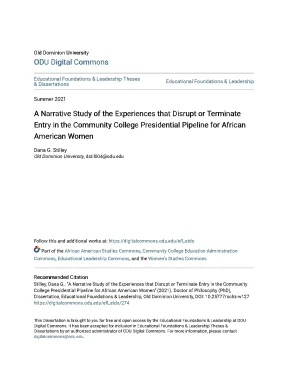
Tải xuống để đọc toàn bộOld Dominion University ODU Digital Commons Educational Foundations & Leadership Theses Educational Foundations & Leadership & Dissertations Summer 2021 A Narrative Study of the Experiences that Disrupt or Terminate Entry in the Community College Presidential Pipeline for African American Women Dana G. Stilley Old Dominion University, dstil004@odu.edu Follow this and additional works at: https://digitalcommons.edu/efl_etds Part of the African American Studies Commons, Community College Education Administration Commons, Educational Leadership Commons, and the Women's Studies Commons Recommended Citation Stilley, Dana G. "A Narrative Study of the Experiences that Disrupt or Terminate Entry in the Community College Presidential Pipeline for African American Women" (2021). Doctor of Philosophy (PhD), Dissertation, Educational Foundations & Leadership, Old Dominion University, DOI: 10.25777/schz-w127 https://digitalcommons.edu/efl_etds/274 This Dissertation is brought to you for free and open access by the Educational Foundations & Leadership at ODU Digital Commons.
It has been accepted for inclusion in Educational Foundations & Leadership Theses & Dissertations by an authorized administrator of ODU Digital Commons. For more information, please contact digitalcommons@odu. A NARRATIVE STUDY OF THE EXPERIENCES THAT DISRUPT OR TERMINATE ENTRY IN THE COMMUNITY COLLEGE PRESIDENTIAL PIPELINE FOR AFRICAN AMERICAN WOMEN By Dana G. May 1982, Brown University MBA May 1984, Columbia Graduate School of Business A Dissertation Submitted to the Faculty of Old Dominion University in Partial Fulfillment of the Requirements for the Degree of DOCTOR OF PHILOSOPHY COMMUNITY COLLEGE LEADERSHIP OLD DOMINION UNIVERSITY August 2021 Approved by: Mitchell R.
Williams (Director) Felecia Commodore (Member) Alan Schwitzer (Member) ABSTRACT A NARRATIVE STUDY OF THE EXPERIENCES THAT DISRUPT OR TERMINATE ENTRY IN THE COMMUNITY COLLEGE PRESIDENTIAL PIPELINE FOR AFRICAN AMERICAN WOMEN Dana G. Stilley Old Dominion University, 2021 Director: Dr. Williams Organizational structures, beliefs, and values in higher education are influenced by the deep-seated characteristics of patriarchy, dominance and racial and gender bias, upon which higher education was founded. These factors continue to impact the ascension of African American women to college presidencies.
Current challenges facing community colleges include a gap in executive leadership and the underrepresentation of African American women in the presidential pipeline. The purpose of this narrative inquiry was to better understand the experiences that disrupt or terminate the journey to a presidency for African American women in senior level positions at community colleges. The goal was to share the lived experiences of African American senior level administrators at community colleges in the New York Metropolitan area. Participants shared experiences during semi-structured interviews.
Participants also described the impact of the intersection of race and gender on their experiences. Seven African American women from six community colleges in the New York Metropolitan area were selected through criterion purposeful and snowball sampling. Through the lens of Black Feminist Thought a five-step analysis yielded eight major themes: (a) persistence of power and privilege, (b) development of strategies to survive, (c) community college president’s role, responsibilities, and impact, (d) fighting the fight against stereotypes, (e) invisibility, (f) evaluating quality of life, (g) racism and discrimination, and (h) a journey of faith. These findings indicated that the unique experiences of African American women are comprised of racist and discriminatory acts which result in appropriated power, feelings of invisibility, leadership challenges, and struggles with authenticity.
Implications for community college leaders and practitioners consist of taking action to understand why the experiences of African American women leaders are unique, reduce the number of racist and discriminatory experiences, and better understand the impact of these experiences. This study encourages leaders and practitioners to secure mentoring and supplemental support, develop campus-wide cultural competency, and design opportunities to understand unique experiences. Recommendations for further research include exploring other regions of the country, comparing the experiences of African American senior level women with those in other races, and assessing the experiences of mid-level African American leaders in community colleges. iii Copyright, 2021, by Dana G.
Stilley, All Rights Reserved. iv I dedicate this dissertation to my husband Derrick and my son Derrick James, the loves of my life, who consistently bring me joy and laughter. I also dedicate this dissertation to my wonderful mother Ida, who taught me to love and trust God and through it all reminded me of His favor in my life. This dissertation is also dedicated to my dear departed dad, James, who continues to guide me from his heavenly home above.
I dedicate this dissertation to my siblings, David, and Danelle, without whom I would not be able to make this journey. I also dedicate this dissertation to the beautiful, intelligent, sassy, and bold African American women who despite all odds, continue to shine and make magic. v ACKNOWLEDGEMENTS Thank you to the many people that contributed to the successful completion of my dissertation journey. To each of you I express my sincere appreciation.
Mitchell Williams, my dissertation committee chair, for your calm assurances and gentle pushes that strengthened, encouraged, and challenged me during the best and worst times. Felecia Commodore and Dr. Schwitzer, the outstanding members of my dissertation committee, who supported, inspired and guided me to think critically about my work, and strive for excellence in my research. To my large extended family, which includes aunts, uncles, in-laws, cousins, nephews, and my St.
Charles AME Zion Church family, your well wishes, prayers, words of encouragement, patience and understanding will forever by etched in my heart. To my sister-circle, the fabulous ladies that always have my back no matter what. Thank you for allowing me to laugh when I wanted to, cry when I needed to, and use my voice when I so needed to be heard. To the late Dr.
Clarence Branch, Jr., my mentor in so many ways, who guided my educational journey as a young child, and constantly encouraged me to take this leap. To sweet sixteen, the best cohort to make this journey with that anyone could ask for. I pray that we will continue to celebrate our wins and support each other throughout our losses. To the wonderful women who participated in this study.
I am honored that you shared your stories and trusted me to retell them. vi TABLE OF CONTENTS Page LIST OF TABLES. 1 BACKGROUND OF THE STUDY. 6 OVERVIEW OF METHODOLOGY.
8 DELIMITATIONS OF THE STUDY. 10 DEFINITION OF KEY TERMS. 14 LITERATURE REVIEW METHOD. 23 DEFINITION OF DIVERSITY.
24 BENEFITS OF DIVERSITY IN HIGHER EDUCATION. 26 DIVERSITY IN LEADERSHIP. 27 EVOLUTION OF RESEARCH ON AFRICAN AMERICAN WOMEN IN HIGHER EDUCATION. 28 PROFESSIONAL BARRIERS AND CHALLENGES.
30 THE GOOD OLD BOY NETWORK. 32 PERSONAL BARRIERS AND CHALLENGES. 33 ORGANIZATIONAL BARRIERS AND CHALLENGES. 34 THE GLASS CEILING.
35 INSTITUTIONAL CLIMATE AND ORGANIZATIONAL STRUCTURE. 36 STEREOTYPING AND DISCRIMINATION. 38 SEXISM AND RACISM. 40 COMMUNITY COLLEGE CHANGES AND CHALLENGES.
45 AFRICAN AMERICAN WOMEN LEADERS AND THE COMMUNITY COLLEGE. 56 RESEARCH SETTING AND CONTEXT. 62 STEP ONE: DATA ORGANIZATION AND PREPARATION. 63 STEP TWO: ABSORBING THE INFORMATION.
64 STEP THREE: THE CODING PROCESS. 64 STEP FOUR: THEMING THE DATA. 65 STEP FIVE: INTERPRETING THE DATA. 70 COMMUNITY COLLEGE DEMOGRAPHICS.
80 RESEARCH QUESTION 1:EXPERIENCES OF AFRICAN AMERICAN WOMEN LEADERS. 82 RESEARCH QUESTION 1A: EXPERIENCES THAT INFLUENCED REEXAMININATION OF EXECUTIVE LEADERSHIP. 92 RESEARCH QUESTION 2: INFLUENCE OF RACE AND GENDER. 102 RESEARCH QUESTION 3: SOCIAL AND CULTURAL FACTORS IMPACTING RETENTION AND PROMOTION.
123 SUMMARY OF MAJOR FINDINGS. 126 FINDINGS RELATED TO THE LITERATURE. 136 IMPLICATIONS FOR ACTION. 140 RECOMMENDATIONS FOR LEADERS AND PRACTITIONERS.
144 RECOMMENDATIONS FOR FURTHER RESEARCH. FIRST INTERVIEW PROTOCOL AND INTERVIEW QUESTIONS. INTERVIEW SUMMARY EMAIL. SECOND INTERVIEW PROTOCOL.
INVITATION TO PARTICIPATE. PREPARATION FOR INTERVIEW EMAIL. INFORMED CONSENT FORM. PARTICIPANT DEMOGRAPHIC FORM.
180 ix LIST OF TABLES Table 1. Community College Demographics. Themes Relative to Research Questions. 81 1 CHAPTER 1 INTRODUCTION Higher education institutions play a vital role in the development of a multicultural and equitable society.
As organizations that support social diversity, equity, and inclusion, higher education institutions are expected to include diversity in their cultures, values, and organizational structures (Arday, 2018; Levine, 1991; Sheppard, 2018; Smith, 2016). The benefits of diversity in higher education systems have been advanced by many scholars (Levine, 1991; Sheppard, 2018; Tienta, 2013). Researchers argued that faculty and staff diversity is important to strengthening the educational workplace and the surrounding community (Gasman et al, 2015; Tienta, 2013). Moreover, researchers have proposed that diversity facilitates credible decision making and policy formation (Milliken & Martins, 1996; Tienta, 2013).
Likewise, diversity supports the economy through the engagement of the abilities and aptitudes of many (American Council on Education, 2017; Evans, 2007; Smith, 2016). Over the last several decades diversity initiatives have been instituted on many college and university campuses (Tienta, 2013). Yet, the lack of diversity in leadership positions in higher education is one of the most important contemporary issues in the academy. According to Wolfe and Freeman (2013), “The underrepresentation of administrators of color in higher education is one of the most important ethical dilemmas facing colleges and universities today” (p 1).
Notwithstanding significant advances in access, curriculum, and educational technology, little change has occurred in the level of leadership provided by African Americans (Baxter- Nuamah, 2015; Braxton, 2018; Wolfe & Dilworth, 2015; Wolfe & Freeman, 2013). The majority of leadership positions at colleges and universities in the United States are held by White males. According to the United States Department of Education (2017), 6% of all 2 college presidents were Black, Afro-Caribbean, or African American in 2011. This rose to 8% by the year 2016.
In the same year, 30% of college presidents were women, yet only 5% of all college presidents were women of color, and only 7.4% of community college presidents were African American women (U. Department of Education, 2017). In the fall of 2018 only 2% of all full-time faculty at degree-granting postsecondary institutions were African American females. At the associate professor level, African American women represented 3% (U.
Department of Education, 2020). As the traditional pathway to an academic presidency is through academic affairs, the pipeline is nearly void of female candidates of color. Extensive research has been conducted on African American women in leadership positions at Predominately White Institutions (PWIs). Common themes included the examination of personal and professional barriers, and the effect of the glass ceiling (Gamble & Turner, 2015; Jackson & Harris, 2007; Lloyd-Jones, 2009; Selzer et al.
At community colleges, the student body is comprised of people that are diverse in ethnicity, academic ability, college readiness, age, and socioeconomic status. These varied backgrounds call for capable leaders that reflect the diversity of the student body (Braxton, 2018). There is limited research on African American female leadership at the community college. Further research is essential to gain a better understanding of the experiences of African American women in senior level administrative positions at community colleges.
The additional research may allow for the implementation of strategies that address the underrepresentation of African American women in higher education, create organizational diversity, and add women of color to the presidential pipeline. 3 Background of the Study The American higher education system, founded in the 1600s, was established as a set of patriarchal institutions, governed by the dominant race, for the dominate race and gender (Geiger, 2016). These ingrained characteristics continue to influence organizational structures, beliefs, and values, which impede the ascension of African American women to presidential positions within the academy (Geiger, 2016; Gill & Jones, 2013). Over forty years have passed since the Civil Rights and Women’s Movements in the US, yet only 7.4% of community college presidents were women of color in 2016 (Selzer et al.
During the same year it was reported that an excess of 50% of the community college presidents anticipated retiring within the next five years (Selzer et al.
Nội dung được bảo vệ bản quyền — Tải xuống đầy đủ
Trích dẫn luận án này
Dana G. Stilley (2021). A narrative study of the experiences that disrupt or termina [Luận án tiến sĩ, Old Dominion University]. LuanAn.net. https://luanan.net/giao-duc-hoc/tam-ly-hoc-giao-duc/a-narrative-study-of-the-experiences-that-disrupt-or-terminate-en
Câu hỏi thường gặp
Luận án "A narrative study of the experiences that disrupt or termina" nghiên cứu về vấn đề gì?
Luận án: A narrative study of the experiences that disrupt or terminate en. Xem tóm tắt và tải về tại LuanAn.net
Luận án "A narrative study of the experiences that disrupt or termina" được bảo vệ tại trường nào?
Luận án này được bảo vệ tại Old Dominion University. Năm bảo vệ: 2021.
Luận án "A narrative study of the experiences that disrupt or termina" thuộc chuyên ngành gì?
Luận án "A narrative study of the experiences that disrupt or termina" thuộc chuyên ngành Community College Leadership. Danh mục: Tâm Lý Học Giáo Dục.
Luận án "A narrative study of the experiences that disrupt or termina" có bao nhiêu trang?
Luận án "A narrative study of the experiences that disrupt or termina" có 191 trang. Bạn có thể xem trước một phần tài liệu ngay trên trang web trước khi tải về.
Cách tải luận án "A narrative study of the experiences that disrupt or termina" về máy như thế nào?
Để tải luận án về máy, bạn nhấn nút "Tải xuống ngay" trên trang này, sau đó hoàn tất thanh toán phí lưu trữ. File sẽ được tải xuống ngay sau khi thanh toán thành công. Hỗ trợ qua Zalo: 0559 297 239.