Luận án TS: Dạy học theo tiếp cận năng lực trong bồi dưỡng cán bộ quản lý ngành TT&TT
Giới thiệu phương pháp dạy học tiếp cận năng lực trong đào tạo tiến sĩ cho cán bộ quản lý ngành thông tin và truyền thông, hướng tới năng lực thực tiễn.
Luan An
Luận án Tiến sĩ khoa học Giáo dục
Năm xuất bản
Số trang
209
Thời gian đọc
32 phút
Lượt xem
0
Lượt tải
0
Phí lưu trữ
50 Point
Tổng quan nhanh
- Chủ đề:
- Cơ sở lý luận dạy học tiếp cận năng lực cho cán bộ TT&TT
- Số trang:
- 209 trang
- Trường:
- Đại học Thái Nguyên
- Chuyên ngành:
- Lý luận và Lịch sử giáo dục
- Tác giả:
- Lê Thảo Nguyên
- Năm:
- 2017
Tóm tắt nội dung luận án
I.Cơ sở lý luận dạy học tiếp cận năng lực cho cán bộ TT TT
This section establishes the theoretical underpinnings for competency-based teaching. It provides a comprehensive framework for developing practical skills in professional training contexts. The document clarifies essential concepts and guiding principles to ensure effective learning outcomes. This theoretical foundation is crucial for designing and implementing impactful training programs, particularly within the dynamic Information and Communications Technology (IT&C) sector. The approach prioritizes observable and measurable skills. It prepares managers to address complex industry challenges effectively. Understanding these core principles ensures that training efforts translate directly into improved job performance and sustained professional growth. This pedagogical shift moves away from traditional, knowledge-centric models towards a more applied, results-oriented methodology.
1.1. Định nghĩa tiếp cận năng lực trong bồi dưỡng
The competency-based approach in professional training focuses intensely on developing practical skills and observable abilities. It ensures learners acquire competencies directly applicable to their specific job roles and industry demands. Under this paradigm, knowledge serves primarily as a tool for effective performance, not an end in itself. Training objectives are designed to achieve measurable behavioral changes and tangible improvements in job performance. This method distinctly moves beyond mere rote memorization or passive knowledge acquisition. It champions active engagement, hands-on experience, and sophisticated real-world problem-solving. Competency-based training intrinsically equips individuals with the concrete ability to perform specified tasks and the agility to adapt effectively to novel or evolving situations. The definition of this approach emphasizes a holistic integration of knowledge, technical skills, and appropriate professional attitudes. This comprehensive view meticulously prepares professionals to tackle multifaceted challenges prevalent in their respective workplaces, fostering both efficiency and innovation.
1.2. Đặc điểm và nguyên tắc dạy học theo năng lực
Learning activities are inherently learner-centered. They consistently prioritize active participation and experiential learning. Training content remains highly relevant to industry demands and professional standards. Continuous assessment systems monitor progress toward specific, predefined competencies. Guiding principles include direct relevance to professional practice, practical application, and adaptability to changing environments. The process deliberately fosters self-direction, critical thinking, and independent problem-solving among participants. Instruction is often individualized or tailored to group needs. It ensures development of identified skill sets. Feedback is integral, providing insights for improvement.
1.3. Tổng quan nghiên cứu về tiếp cận năng lực
Extensive research, both international and domestic, has explored competency-based education. Many studies consistently highlight its benefits in enhancing professional development and vocational training. Scholars have examined its impact on various fields, demonstrating improved skill acquisition and job readiness. However, specific applications tailored for managers within the specialized Information and Communications Technology sector often require deeper, more focused investigation. Existing literature may offer general frameworks but sometimes lacks granular detail for this niche. This document critically reviews prior work. It then strategically contributes to filling that identified knowledge gap, offering specific insights and practical models.
II.Thực trạng dạy học tiếp cận năng lực ngành TT TT
This section meticulously examines the current state of training practices for managers in the Information and Communications Technology (IT&C) sector. It rigorously identifies how competency-based approaches are presently being implemented, or where they are conspicuously lacking, within the existing management education landscape. The analysis comprehensively covers existing curricula, prevailing teaching methods, and current assessment strategies employed by relevant institutions. The overarching goal is to provide an objective, data-driven overview of both the strengths and weaknesses of the current system. Findings from this investigation reveal specific areas that require significant reform and strategic intervention to align effectively with modern competency development standards. This critical evaluation provides the foundational intelligence necessary to formulate targeted recommendations for future improvements. A deep understanding of the present situation is absolutely foundational for any meaningful and impactful educational intervention.
2.1. Khảo sát thực trạng tại cơ sở đào tạo
A comprehensive and rigorous survey was meticulously conducted to thoroughly evaluate the current training practices specifically tailored for managers in the IT&C sector. The study focused intently on the operational realities within the School of Training, Bồi dưỡng Cán bộ quản lý Thông tin và Truyền thông. Primary objectives of this extensive investigation included a precise assessment of the effectiveness of existing pedagogical approaches. It also aimed to pinpoint critical areas requiring substantial improvement to enhance overall program quality. Methodologies employed were diverse and robust, encompassing detailed questionnaires administered to participants and instructors, structured interviews with key stakeholders, and direct, systematic observations of actual teaching and learning sessions. The data collected through this multi-faceted approach provided rich, nuanced insights into the operational realities of the institution. This ensured a robust and holistic understanding of the institutional context, its inherent challenges, and its potential for growth.
2.2. Đánh giá hiện trạng mục tiêu và nội dung đào tạo
Survey results consistently indicated varying levels of competency-based integration within training objectives. Many stated goals often remained knowledge-centric, focusing on theoretical recall rather than practical application. Curriculum content frequently lacked sufficient practical exercises, simulations, or real-world case studies. Significant opportunities exist to align curricula more closely with essential, job-specific management competencies demanded by the IT&C industry. Gaps in practical skill development were clearly identified. Addressing these discrepancies requires a strategic review and redesign of both objectives and course materials to foster more robust, applicable competencies.
2.3. Thực trạng phương pháp và hình thức tổ chức dạy học
The comprehensive investigation into pedagogical practices revealed that traditional, instructor-led lecture-based methods remained notably prevalent across a significant number of training modules. This approach often prioritizes information dissemination over active skill development. Conversely, more dynamic and engaging active learning techniques, such as interactive case studies, collaborative problem-solving workshops, or advanced simulations, appeared less frequently in typical classroom settings. Furthermore, the prevailing organizational forms of instruction sometimes inadvertently limited opportunities for intensive participant interaction and hands-on engagement, thereby restricting crucial opportunities for practical skill rehearsal and immediate application. A strategic enhancement of pedagogical approaches, through the deliberate integration of more participatory, experiential, and interactive methods, holds substantial potential. Such a transformation could significantly boost the overall effectiveness and impact of the training programs, fostering not only deeper understanding but also demonstrably greater competency acquisition among IT&C managers.
III.Mục tiêu nội dung dạy học tiếp cận năng lực quản lý
This section delves into the strategic formulation of educational goals and curriculum development within competency-based training. It meticulously outlines precisely how training programs for managers in the Information and Communications Technology (IT&C) sector should be designed and implemented. The central focus remains on developing specific, measurable, and achievable competencies. These competencies must directly address both current industry demands and anticipated future challenges in the rapidly evolving digital landscape. Both the content and the learning objectives are meticulously harmonized to achieve maximum impact and ensure direct relevance and practical applicability. This sophisticated approach systematically moves beyond the mere transmission of theoretical knowledge. Instead, it places a premium on cultivating actionable skills, fostering adaptive problem-solving capabilities, and enhancing strategic decision-making. This purposeful design promotes a high degree of readiness for complex leadership roles within the IT&C domain.
3.1. Xác định mục tiêu phát triển năng lực quản lý
Training objectives are precisely defined. They target specific, observable competencies crucial for IT&C managers. These include advanced leadership, strategic thinking, effective digital transformation management, and proficient crisis communication. Each objective links directly to critical job functions and performance indicators. Clear, measurable outcomes guide both instructional design and subsequent assessment processes. This meticulous alignment ensures relevance and maximizes the impact of the training. Objectives foster a clear path for skill acquisition and application in real-world settings.
3.2. Xây dựng nội dung chương trình bồi dưỡng
Curriculum design prioritizes the cultivation of practical skills over exclusive theoretical knowledge. Training modules integrate authentic, real-world scenarios and complex challenges relevant to the IT&C industry. Content covers emerging technological trends, cybersecurity threats, and innovative communication strategies. It purposefully fosters advanced problem-solving abilities, strategic decision-making skills, and adaptive leadership. The program structure supports progressive skill development. This ensures a logical flow from foundational concepts to advanced applications. This approach makes learning directly applicable to professional responsibilities.
3.3. Yêu cầu đối với dạy học tiếp cận năng lực
Effective implementation of competency-based training demands several key prerequisites. It requires well-designed, modular learning units. Highly experienced and qualified instructors are essential; they must be adept at facilitation, not just lecturing. Adequate resources, including up-to-date technology and learning platforms, are crucial for supporting the learning process. Continuous feedback mechanisms must be embedded throughout the program. The overall learning environment must be inherently conducive to active engagement, experimentation, and collaborative problem-solving. These elements collectively ensure program success.
IV.Phương pháp đánh giá dạy học tiếp cận năng lực
This section meticulously details the pedagogical approaches and comprehensive assessment strategies that are integral to effective competency-based training programs. It places a strong and consistent focus on methods that actively engage learners, fostering robust practical skill development and critical thinking. Significant emphasis is placed on experiential learning, the direct application of knowledge to real-world scenarios, and measurable performance outcomes. Effective teaching techniques under this paradigm must consciously move beyond the passive transfer of information. Instead, they embrace interactive and participatory methodologies. Similarly, robust evaluation mechanisms are designed to directly assess the acquisition and demonstration of desired competencies. This integrated approach ensures that training initiatives directly translate into significantly improved professional capabilities. The ultimate aim is to cultivate adaptable, highly skilled, and forward-thinking managers for the dynamic IT&C sector.
4.1. Phương pháp giảng dạy thúc đẩy năng lực
Active learning methods form the core of competency development. Case studies allow learners to apply theoretical knowledge to complex scenarios. Role-playing exercises enhance interpersonal communication and negotiation skills. Project-based learning encourages the development of practical solutions to real-world problems. Simulations provide a risk-free environment for practicing critical decision-making. Mentoring and coaching offer personalized guidance and feedback. These diverse methods collectively foster critical thinking, problem-solving, and adaptability. They move learners from passive recipients to active contributors.
4.2. Hình thức tổ chức dạy học hiệu quả
Effective learning environments support diverse needs. Workshops promote intensive, collaborative learning and immediate application. Blended learning combines the flexibility of online modules with the engagement of in-person interactions. Peer learning facilitates knowledge sharing and builds professional networks. Field trips offer invaluable real-world exposure and contextual understanding. Group discussions encourage the exploration of diverse perspectives and critical analysis. Flexible organizational formats are crucial to accommodate the demanding schedules of busy professionals. These varied forms maximize engagement and learning retention.
4.3. Đánh giá kết quả bồi dưỡng theo năng lực
Assessment focuses primarily on actual performance and demonstrated competency. It utilizes performance-based tasks, realistic simulations, and comprehensive portfolios that showcase applied skills. Robust rubrics define clear performance standards and expectations for each competency. Feedback mechanisms are designed to be constructive, timely, and directly actionable, guiding learners toward continuous improvement. This approach directly measures the acquisition of real-world competence. It moves significantly beyond traditional, knowledge-recall-focused exams. Instead, it evaluates the ability to effectively apply learning in professional contexts.
V.Vai trò và yếu tố ảnh hưởng đến tiếp cận năng lực
This section comprehensively explores the evolving and dynamic roles of both educators and learners within the framework of competency-based training. Furthermore, it meticulously identifies a broad range of internal and external factors that critically influence the overall success and sustained impact of such training programs. A thorough understanding of these multifaceted elements is absolutely critical for effective implementation, continuous improvement, and long-term success. Both intrinsic variables, such as institutional commitment, and extrinsic factors, like industry trends, significantly shape learning outcomes. The overall learning environment, available support structures, and the individual contributions of all participants collectively play vital parts. This holistic view is essential for informing strategic approaches aimed at optimizing the learning process. Ultimately, it ensures the robust development of highly capable and adaptive IT&C managers ready for future challenges.
5.1. Vai trò người dạy và người học trong dạy học năng lực
Instructors transition from traditional lecturers to facilitators, mentors, and coaches. They guide learners, provide essential resources, and meticulously craft engaging, experiential learning activities. Learners, in turn, assume greater responsibility for their own learning journeys. They actively participate, critically reflect on experiences, and diligently apply new knowledge to real-world problems. Collaborative learning among peers becomes a cornerstone, fostering shared understanding and mutual support. This shift empowers learners and enhances their self-directed capabilities. It fosters an environment of continuous growth.
5.2. Yếu tố chủ quan ảnh hưởng hiệu quả đào tạo
Several internal, subjective factors critically influence training effectiveness. The competence and pedagogical expertise of instructors in facilitation and mentoring are paramount. Learner motivation, prior experience, and personal commitment directly influence engagement and retention. Institutional commitment, demonstrated through dedicated resource allocation and administrative support, plays a significant role. A clear vision and strong leadership support successful program implementation and cultural adoption. The quality of program design, including curriculum relevance and instructional materials, directly impacts learning outcomes. These elements must be carefully managed.
5.3. Yếu tố khách quan tác động đến bồi dưỡng
External, objective factors significantly impact the success of training initiatives. Government policies and evolving industry standards directly shape curriculum requirements and skill demands. Rapid technological advancements necessitate continuous curriculum updates and adaptation. Broader economic conditions can affect funding availability and institutional investment in training. External partnerships with industry leaders and academic institutions provide valuable resources, expertise, and real-world insights. Access to robust technology infrastructure and updated software is also crucial. These factors require constant monitoring and strategic response.
Mục lục chi tiết luận án
Tải xuống file đầy đủ để xem toàn bộ nội dung
Tải đầy đủ (209 trang)Nội dung chính
Tổng quan về luận án
Luận án tiến sĩ "Dạy học theo tiếp cận năng lực trong bồi dưỡng cán bộ quản lý ngành Thông tin và Truyền thông" của Lê Thảo Nguyên là một công trình khoa học tiên phong trong lĩnh vực Lý luận và Lịch sử Giáo dục tại Việt Nam. Nghiên cứu này được đặt trong bối cảnh các Nghị quyết Đại hội Đảng Cộng sản Việt Nam lần thứ XI (2011) và XII (2016), cùng với Chiến lược phát triển giáo dục Việt Nam giai đoạn 2011-2020, đã liên tục khẳng định tầm quan trọng của việc chuẩn hóa, hiện đại hóa và hội nhập quốc tế trong giáo dục.
Research gap SPECIFIC với citations từ literature: Mặc dù tiếp cận năng lực (TCNL) đã trở thành một xu hướng giáo dục phổ biến trên thế giới, được áp dụng trong các mô hình như DACUM và module hóa đào tạo, và được khuyến nghị bởi các tổ chức quốc tế như OECD và UNESCO, nhưng việc nghiên cứu và ứng dụng TCNL tại Việt Nam còn nhiều hạn chế, đặc biệt trong lĩnh vực bồi dưỡng cán bộ quản lý. Luận án chỉ rõ rằng: "Dạy học theo tiếp cận năng lực trong công tác bồi dƣỡng cán bộ là một yêu cầu cấp thiết nhƣng cho đến nay chƣa đƣợc nghiên cứu đầy đủ. Nhất là trong môi trƣờng bồi dƣỡng cán bộ đƣơng nhiệm ở nƣớc ta thì vấn đề này hầu nhƣ chƣa đƣợc nghiên cứu chuyên biệt." Các công trình khoa học trước đây chủ yếu tập trung vào giáo dục phổ thông, giáo dục nghề, và giáo dục đại học chính quy, "chứ chƣa quan tâm đến loại hình giáo dục tƣơng đối khác biệt là bồi dƣỡng cán bộ quản lí." Nghiên cứu này lấp đầy khoảng trống đó bằng cách tập trung chuyên biệt vào ngành Thông tin và Truyền thông (TT&TT), một ngành có tốc độ phát triển nhanh và đòi hỏi cao về năng lực chuyên môn và quản lý.
Research questions và hypotheses (đánh số cụ thể): Nghiên cứu được định hướng bởi bốn câu hỏi chính:
- Bản chất mối quan hệ giữa dạy học trong bồi dƣỡng cán bộ quản lý ngành TT&TT và phát triển năng lực của cán bộ quản lý ngành TT&TT nhƣ thế nào?
- Còn tồn tại, hạn chế gì trong hoạt động dạy học theo tiếp cận năng lực tại Trƣờng đào tạo, bồi dƣỡng cán bộ quản lý Thông tin và Truyền thông?
- Muốn phát triển đƣợc năng lực của ngƣời học thì dạy học theo tiếp cận năng lực trong Bồi dƣỡng CBQL ngành TT&TT đƣợc thực hiện theo nguyên tắc và biện pháp nào?
- Những yếu tố nào ảnh hƣởng quyết định đến chất lƣợng dạy học trong bồi dƣỡng cán bộ quản lý ngành TT&TT?
Giả thuyết khoa học của luận án khẳng định: "Trên thực tế, dạy học trong bồi dƣỡng cán bộ quản lý ngành TT&TT còn nhiều hạn chế dẫn đến chất lƣợng bồi dƣỡng chƣa cao. Nếu các biện pháp dạy học nhƣ: khai thác, phát triển năng lực ngƣời học; tổ chức thiết kế học liệu dƣới dạng năng lực và đổi mới phƣơng pháp, hình thức dạy học mang tính trải nghiệm có thể xác định đƣợc trình tự tiến hành dạy học theo tiếp cận năng lực thì sẽ nâng cao đƣợc chất lƣợng dạy học từng chuyên đề, qua đó nâng cao chất lƣợng bồi dƣỡng CBQL đáp ứng yêu cầu phát triển nhanh mạnh của ngành TT&TT."
Theoretical framework với tên theories cụ thể: Luận án được xây dựng trên nền tảng lý thuyết giáo dục hiện đại, đặc biệt là triết lý "giáo dục hƣớng vào ngƣời học" với nền tảng triết học được xác lập bởi các nhà tư tưởng như Xavier Roegiers, L. W, John Dewey và J. Piaget [80], [81], [85], [62], [89]. Nghiên cứu cũng kế thừa quan điểm của L. Vygotsky về "Vùng cận phát triển" (Zone of Proximal Development), nhấn mạnh việc dạy học phải dựa vào năng lực nền tảng và tiềm tàng của cá nhân để phát triển năng lực mới [81]. Khái niệm năng lực được mở rộng, không chỉ là trí tuệ mà còn bao gồm năng lực văn hóa, xã hội, tình cảm, và kỹ năng sống. Luận án tích hợp "quan điểm tiếp cận hệ thống" để phân tích toàn diện quá trình dạy học, "quan điểm thực tiễn" để đảm bảo tính khả thi của các biện pháp, và "quan điểm tiếp cận dựa trên năng lực" làm kim chỉ nam cho việc thiết kế mục tiêu, chương trình, kế hoạch và đánh giá.
Đóng góp đột phá với quantified impact: Luận án mang đến hai đóng góp đột phá chính. Về mặt lý luận, nghiên cứu "cụ thể hóa lý luận về dạy học theo tiếp cận năng lực nói chung vào đối tƣợng đặc thù là cán bộ quản lý ngành TT & TT trong quá trình bồi dƣỡng," điều mà các công trình trước đó chưa đề cập một cách có hệ thống. Điều này có thể ảnh hưởng đến việc chuẩn hóa và nâng cao năng lực cho hàng chục nghìn cán bộ quản lý trong ngành TT&TT Việt Nam. Hơn nữa, luận án "thiết kế và thực hiện đƣợc 5 biện pháp dạy học theo tiếp cận năng lực" đảm bảo tính hệ thống và hiệu quả, cung cấp một khung lý thuyết và thực hành vững chắc cho việc cải thiện chất lượng bồi dưỡng. Về thực tiễn, nghiên cứu đã "đánh giá đƣợc thực trạng dạy học theo tiếp cận năng lực và thực trạng các yếu tố ảnh hƣởng" tại Trường Đào tạo, bồi dưỡng cán bộ quản lý Thông tin và Truyền thông, cung cấp dữ liệu định lượng và định tính cụ thể. Việc "xây dựng quy trình thực nghiệm và thiết kế và tổ chức dạy học chuyên đề “Đạo đức nghề nghiệp và trách nhiệm xã hội của nhà báo”" cho 35 học viên cán bộ quản lý cơ quan báo chí là một mô hình thực nghiệm chi tiết, có tiềm năng nhân rộng, với kết quả thực nghiệm cho thấy sự cải thiện rõ rệt về kiến thức và năng lực của học viên.
Scope (sample size, timeframe) và significance: Phạm vi nghiên cứu bao gồm việc điều tra 30 giảng viên, 30 cán bộ quản lý công tác bồi dưỡng và 300 học viên là cán bộ quản lý ngành TT&TT tại các Cục, Vụ, Viện, Trung tâm, Văn phòng, các Trường do Bộ TT&TT quản lý. Hoạt động thực nghiệm được tiến hành trên mẫu 35 học viên cán bộ quản lý cơ quan báo chí tại Trường Đào tạo, Bồi dưỡng cán bộ quản lý Bộ TT&TT, tập trung vào chuyên đề “Đạo đức nghề nghiệp và trách nhiệm xã hội của nhà báo”. Luận án được hoàn thành vào năm 2017. Tầm quan trọng của nghiên cứu nằm ở việc giải quyết một vấn đề thực tiễn cấp bách: nâng cao chất lượng đội ngũ cán bộ quản lý trong ngành TT&TT đang phát triển nhanh chóng, từ đó góp phần vào sự phát triển kinh tế và an ninh xã hội.
Literature Review và Positioning
Synthesis của major streams với TÊN TÁC GIẢ và NĂM cụ thể: Tổng quan nghiên cứu cho thấy các dòng chính về tiếp cận năng lực (TCNL) trên thế giới và ở Việt Nam. Trên thế giới, các nghiên cứu tập trung vào "Giáo dục dựa vào năng lực" (Competency-based Education), "Đào tạo dựa vào năng lực thực hiện" (Competency-based Training) với phương pháp phân tích nghề DACUM, và "Đào tạo theo module" (Modular Training) [83], [85], [86], [99]. Các nhà tư tưởng như Xavier Roegiers, L. W, John Dewey và J. Piaget đã xác lập nền tảng triết học "hướng vào người học" [80], [81], [85], [62], [89]. Cuối thế kỷ 20, K. Paprock [97] đã chỉ ra năm đặc tính cơ bản của TCNL, và Kerka [90] nhấn mạnh ưu thế của nó. R. Boyatzid [84] đề xuất mô hình năng lực cần xử lý ba khía cạnh: xác định, phát triển và đánh giá năng lực một cách khách quan. Các khung năng lực cốt lõi quốc tế của OECD và UNESCO cũng được đề cập.
Tại Việt Nam, từ những năm 2000, TCNL trở thành hướng nghiên cứu sôi động. Các tác giả như Đỗ Ngọc Thống [66], Lương Việt Thái [64], Nguyễn Công Khanh [47] nghiên cứu về thiết kế chương trình định hướng phát triển năng lực. Đặng Quốc Bảo và Nguyễn Sỹ Thu [4] tập trung vào tổ chức dạy học. Nguyễn Công Khanh [47], Nguyễn Thanh Ngọc Bảo [5], Phạm Đỗ Nhật Tiến [68], Nguyễn Thu Hà [24] thảo luận về đánh giá kết quả dạy học theo TCNL. Nguyễn Minh Đường (1993, 2005, 2006) và Nguyễn Đức Trí (1996, 2006, 2010) là những người đi đầu trong nghiên cứu TCNL trong đào tạo nghề [17], [18], [19], [71]. Các nghiên cứu chuyên biệt hơn về chuẩn hóa dạy học và quản lý giáo dục cũng được thực hiện bởi Đặng Thành Hưng [35], [36], [37], [38], [39], [40], [41], [42], [43], [44], [45], [46] và những người khác.
Contradictions/debates với ít nhất 2 opposing views: Tổng quan cho thấy những tranh luận về TCNL. Một quan điểm nhấn mạnh TCNL theo nghĩa năng lực đầu ra hay chuẩn đầu ra, như Rodger [100] khẳng định đặc trưng của dạy học theo TCNL là "nhấn mạnh yếu tố ‘làm đƣợc’, ‘thực hiện đƣợc’." Ngược lại, một số nghiên cứu (ví dụ của Đặng Thành Hưng [45]) xác định bản chất của TCNL bao hàm toàn bộ quá trình dạy học, "cả đầu ra, đầu vào và quá trình học tập." Ngoài ra, mô hình DACUM tuy nhấn mạnh năng lực ở cả đầu vào và đầu ra nhưng "chƣa quan tâm đúng mức đến năng lực với nghĩa động lực nền tảng trong quá trình dạy học." Sự đa dạng và chưa đồng nhất trong cách hiểu và áp dụng TCNL là một thách thức được nhận diện.
Positioning trong literature với specific gap identified: Luận án này định vị mình trong khoảng trống nghiên cứu rõ ràng: "Dạy học theo ti ếp cận năng lực trong công tác bồi dƣỡng cán bộ nói chung và cán bộ quản lí nói riêng chƣa đƣợc đề cập và quan tâm đúng mức so với những lợi ích, hiệu quả mà nó mang lại cho ngƣời học là đội ngũ cán bộ quản lí." Mặc dù đã có các nghiên cứu về TCNL trong các loại hình giáo dục khác, nhưng "chƣa thực sự nghiên cứu đầy đủ vấn đề này và mới chỉ thực hiện đƣợc những bƣớc đầu tiên" trong bối cảnh bồi dưỡng cán bộ đương nhiệm, đặc biệt là trong ngành TT&TT với những đặc thù riêng.
How this advances field với concrete contributions: Nghiên cứu này tiến xa hơn bằng cách không chỉ thừa nhận vai trò của TCNL mà còn cụ thể hóa nó vào một đối tượng và môi trường đặc thù. Nó không chỉ tập trung vào năng lực đầu ra mà còn vào năng lực nền tảng và quá trình phát triển năng lực của người học, đáp ứng gợi ý từ tổng quan chương 1: "Năng lực trong tiếp cận năng lực đang bàn ở đây đòi hỏi một mặt ngƣời học phải có nền tảng năng lực của mình, vừa phải huy động và tích lũy năng lực trong học tập và biến nó thành sức mạnh cá nhân để học tập hiệu quả, và nhà giáo phải dựa vào đó để phát triển hơn nữa năng lực của ngƣời học thể hiện ở sản phẩm đầu ra khác biệt với năng lực đầu vào." Luận án đóng góp bằng cách đưa ra "5 biện pháp dạy học theo tiếp cận năng lực" được thiết kế đặc biệt cho bối cảnh bồi dưỡng CBQL ngành TT&TT, cung cấp một khuôn khổ thực tiễn và lý luận để nâng cao chất lượng đào tạo.
So sánh với ÍT NHẤT 2 international studies: So với các mô hình quốc tế như DACUM (phân tích nghề và thị trường lao động) và các khung năng lực cốt lõi của OECD, luận án này không chỉ tập trung vào việc xác định các năng lực cần thiết mà còn đi sâu vào "cách thức" để phát triển những năng lực đó trong một môi trường học tập cụ thể. Ví dụ, trong khi Khung năng lực cốt lõi của OECD khuyến cáo các năng lực chung, luận án này lại cụ thể hóa các yêu cầu về năng lực cho cán bộ quản lý ngành TT&TT, từ đó đề xuất các biện pháp dạy học tích hợp (Xavier Roegiers [80]) và định hướng hành động phù hợp. Mặc dù UNESCO, UNDP, WB và ADB đã đưa ra khuyến cáo về phát triển chương trình trong giáo dục người lớn và quản lý giáo dục theo TCNL, nhưng luận án này đi sâu vào chi tiết các yếu tố ảnh hưởng, từ yếu tố chủ quan đến khách quan, tại một trường đào tạo chuyên biệt ở Việt Nam, cung cấp một góc nhìn vi mô hơn về thực trạng và giải pháp. Các công trình quốc tế thường cung cấp các khung lý thuyết rộng, trong khi nghiên cứu này chuyển hóa các lý thuyết đó thành các "biện pháp dạy học cụ thể" và kiểm chứng chúng thông qua "thực nghiệm sƣ phạm", một bước cần thiết để đảm bảo tính ứng dụng và hiệu quả trong bối cảnh địa phương.
Đóng góp lý thuyết và khung phân tích
Đóng góp cho lý thuyết
Nghiên cứu này thực hiện một đóng góp lý thuyết đáng kể bằng cách mở rộng và thách thức những quan niệm truyền thống về dạy học theo tiếp cận năng lực. Thay vì chỉ xem năng lực là kết quả đầu ra, luận án kế thừa và phát triển quan điểm của Đặng Thành Hưng [45] rằng "năng lực... bao hàm toàn bộ quá trình dạy học, cả đầu ra, đầu vào và quá trình học tập." Cụ thể, nó mở rộng lý thuyết về TCNL bằng cách áp dụng và cụ thể hóa nó vào đối tượng đặc thù là cán bộ quản lý ngành TT&TT trong bối cảnh bồi dưỡng – một lĩnh vực mà lý thuyết TCNL chưa được hệ thống hóa đầy đủ. Luận án chỉ rõ các yếu tố cấu thành mục tiêu, nội dung, phương pháp, hình thức tổ chức dạy học và đánh giá kết quả dạy học theo TCNL trong môi trường bồi dưỡng, làm phong phú thêm lý luận giáo dục người lớn và giáo dục nghề nghiệp. Nó thách thức quan điểm chỉ nhấn mạnh năng lực như đầu ra bằng cách tích hợp sâu sắc năng lực nền tảng và tiềm tàng của người học (quan điểm của L. Vygotsky về Vùng cận phát triển [81]) vào toàn bộ quy trình dạy học.
Conceptual framework với components và relationships: Khung lý thuyết của luận án được xây dựng dựa trên sự thống nhất biện chứng giữa hoạt động dạy của giảng viên và hoạt động học của học viên, tập trung vào việc phát triển năng lực của người học và chịu tác động của môi trường bồi dưỡng. Các thành phần chính bao gồm:
- Mục tiêu dạy học theo TCNL: Phải xác định rõ "khung năng lực" (chuẩn đầu ra) của CBQL ngành TT&TT, mô tả mức độ năng lực cần đạt.
- Nội dung dạy học theo TCNL: Được cấu trúc thành hệ thống các "mô-đun" độc lập, mỗi mô-đun chứa đựng một phần năng lực nghề nghiệp, kết hợp kiến thức, kỹ năng, thái độ chuyên môn và liên ngành.
- Phương pháp dạy học theo TCNL: Tập trung vào các phương pháp tích cực như dạy học giải quyết vấn đề, dạy học theo tình huống (bao gồm nghiên cứu trường hợp), dạy học định hướng hành động (bao gồm dạy học theo dự án), nhằm khuyến khích sự chủ động và phát triển kỹ năng vận dụng thực tiễn của người học.
- Hình thức tổ chức dạy học: Linh hoạt, thoát khỏi khuôn khổ cứng nhắc của lớp học truyền thống, tạo điều kiện cho học viên tự học, thảo luận, thực hành và chia sẻ kinh nghiệm.
- Đánh giá kết quả dạy học theo TCNL: Chuyển từ đánh giá của người dạy sang tự đánh giá của người học, tập trung vào "kĩ năng đạt đƣợc" và "hành động cụ thể", không chỉ là kiến thức. Các thành phần này tương tác lẫn nhau, được điều khiển bởi người dạy và người học, và chịu ảnh hưởng của "môi trường bồi dưỡng" (yếu tố con người, chương trình, cơ sở vật chất, yếu tố quản lý, văn hóa giao tiếp).
Theoretical model với propositions/hypotheses numbered: Mô hình lý thuyết của luận án bao gồm các mệnh đề chính: P1: Dạy học theo TCNL giúp hoạt động bồi dưỡng CBQL ngành TT&TT đạt hiệu quả cao hơn, phát triển năng lực người học đáp ứng xu hướng đổi mới nhanh của ngành. P2: Việc xác định đúng mục tiêu phát triển năng lực của CBQL ngành TT&TT trong dạy học có ý nghĩa đặc biệt quan trọng, là "sợi chỉ đỏ" xuyên suốt quá trình dạy học theo TCNL. P3: Các biện pháp dạy học theo TCNL là một chỉnh thể thống nhất và đồng bộ, được đề xuất dựa trên nghiên cứu cơ sở lý luận và thực tiễn, có tính khả thi cao trong điều kiện bồi dưỡng CBQL hiện nay. Các mệnh đề này được kiểm chứng thông qua khảo sát thực trạng và thực nghiệm sư phạm.
Paradigm shift với EVIDENCE từ findings: Luận án đề xuất một sự chuyển dịch mô hình (paradigm shift) từ "dạy học chuyển từ tiếp cận mục tiêu - nội dung sang tiếp cận mục tiêu - năng lực." Sự chuyển dịch này không chỉ là thay đổi thuật ngữ mà là thay đổi triết lý giáo dục, nhấn mạnh "các mục tiêu dạy học phải đƣợc xác định dựa trên khung năng lực." Bằng chứng từ nghiên cứu cho thấy thực trạng dạy học truyền thống còn nhiều hạn chế và chưa đáp ứng được yêu cầu phát triển năng lực. Kết quả thực nghiệm sư phạm với sự cải thiện rõ rệt về kiến thức và năng lực của nhóm thực nghiệm (thể hiện qua các bảng so sánh giá trị trung bình kiến thức và năng lực của học viên trước và sau thực nghiệm, cũng như giữa nhóm thực nghiệm và đối chứng, ví dụ Bảng 3.8, 3.9, 3.10) cung cấp bằng chứng thực nghiệm cho sự ưu việt của cách tiếp cận mới này.
Khung phân tích độc đáo
Integration của theories (name 3+ specific theories): Khung phân tích của luận án là sự tích hợp độc đáo của ít nhất ba lý thuyết nền tảng:
- Lý thuyết kiến tạo xã hội của L. Vygotsky: Thể hiện qua quan điểm "Dạy học một mặt giúp họ phát triển năng lực mới nhƣng lại phải dựa vào chính năng lực hiện tại của họ [81]," đặc biệt là "Vùng cận phát triển", nơi người học xây dựng kiến thức thông qua tương tác xã hội và sự hỗ trợ của người dạy.
- Triết lý giáo dục hướng vào người học của John Dewey và J. Piaget: Nhấn mạnh vai trò chủ động của người học trong quá trình khám phá và xây dựng kiến thức, tạo môi trường học tập linh hoạt và năng động [85], [62], [89].
- Lý thuyết sư phạm tích hợp của Xavier Roegiers: Định hướng cách tổ chức nội dung và hoạt động dạy học sao cho "toàn thể các quá trình học tập góp phần hình thành ở học sinh những năng lực rõ ràng, có dự tính trƣớc những điều cần thiết cho học sinh nhằm phục vụ cho quá trình học tập tƣơng lai, hoặc hoà nhập học sinh vào cuộc sống lao động" [80]. Sự tích hợp này đảm bảo năng lực được hình thành một cách toàn diện, không rời rạc.
Novel analytical approach với justification: Luận án đưa ra một cách tiếp cận phân tích mới bằng việc cụ thể hóa TCNL trong bối cảnh bồi dưỡng cán bộ quản lý ngành TT&TT, một lĩnh vực ít được nghiên cứu. Cách tiếp cận này không chỉ dừng lại ở việc mô tả thực trạng mà còn đề xuất một bộ "5 biện pháp dạy học" được thiết kế có hệ thống, từ xây dựng quy trình, lập kế hoạch, thiết kế học liệu, áp dụng hình thức tổ chức dạy học, đến đánh giá tập trung vào quá trình. Sự độc đáo nằm ở việc biện pháp được phát triển dựa trên việc phân tích các yếu tố chủ quan và khách quan ảnh hưởng đến dạy học, và được khảo nghiệm tính cấp thiết, khả thi (n=80) trước khi thực nghiệm sư phạm, đảm bảo tính ứng dụng cao. Luận án nhấn mạnh việc "rèn luyện cho CBQL của ngành những kĩ năng phù hợp với thực tiễn nghề nghiệp" là yêu cầu quan trọng nhất, tạo nên sự khác biệt so với các nghiên cứu TCNL chung chung.
Conceptual contributions với definitions: Nghiên cứu làm sáng tỏ và định nghĩa rõ ràng các khái niệm then chốt trong bối cảnh đặc thù của mình:
- Dạy học theo tiếp cận năng lực trong bồi dưỡng cán bộ quản lý ngành TT&TT: Được định nghĩa là "quá trình thiết kế, tổ chức và phối hợp giữa hoạt động dạy của giảng viên và hoạt động học của người học là cán bộ quản lý ngành TT&TT, tập trung vào phát triển năng lực của người học. Quá trình dạy học này chịu sự tác động của các yếu tố từ môi trường bồi dưỡng."
- Môi trường bồi dưỡng: Là "tập hợp những yếu tố về con người, chương trình, cơ sở vật chất kĩ thuật - phương tiện, các yếu tố quản lí hoạt động bồi dưỡng, trong sự tương tác lẫn nhau một cách thường xuyên, tạo điều kiện thuận lợi cho hoạt động dạy học của người dạy và người học trong bồi dưỡng." Những định nghĩa này giúp làm rõ các thành tố và mối quan hệ giữa chúng, tạo cơ sở vững chắc cho việc phát triển các biện pháp.
Boundary conditions explicitly stated: Luận án giới hạn phạm vi nghiên cứu của mình, giúp tăng tính cụ thể và khả thi:
- Nội dung nghiên cứu: "Các biện pháp dạy học theo tiếp cận năng lực đƣợc giới hạn trong điều kiện bồi dƣỡng cán bộ quản lý ngành TT & TT, áp dụng cho các chƣơng trình bồi dƣỡng theo chuẩn chức danh nghề nghiệp, có quy định chƣơng trình khung từ Bộ Thông tin và Truyền thông." Các biện pháp này do giảng viên thiết kế và thực hiện.
- Phạm vi thực nghiệm: Được giới hạn "ở chuyên đề “Đạo đức nghề nghiệp và trách nhiệm xã hội của nhà báo”" và trên mẫu 35 học viên cán bộ quản lý cơ quan báo chí. Những giới hạn này đảm bảo rằng các kết quả và biện pháp đề xuất có tính ứng dụng cao trong một ngữ cảnh cụ thể, mặc dù cũng đặt ra thách thức về khả năng khái quát hóa cho các ngành hoặc chuyên đề khác.
Phương pháp nghiên cứu tiên tiến
Thiết kế nghiên cứu
Research philosophy (positivism/interpretivism/critical realism): Luận án áp dụng một triết lý nghiên cứu thực dụng (Pragmatic Paradigm), kết hợp các yếu tố của positivism và interpretivism để giải quyết vấn đề thực tiễn. Nghiên cứu sử dụng phương pháp luận dựa trên "Quan điểm tiếp cận hệ thống", "Quan điểm thực tiễn" và "Quan điểm tiếp cận dựa trên năng lực". Sự lựa chọn này cho phép nghiên cứu vừa thu thập dữ liệu định lượng có thể kiểm chứng (khảo sát thực trạng, thực nghiệm có đối chứng) vừa đào sâu vào các yếu tố định tính, bối cảnh và ý nghĩa của chúng (phỏng vấn, quan sát, phân tích sản phẩm). Mục tiêu là tìm ra các giải pháp hiệu quả và khả thi cho vấn đề dạy học, không bị ràng buộc bởi một trường phái triết học cứng nhắc.
Mixed methods với SPECIFIC combination rationale: Nghiên cứu sử dụng phương pháp hỗn hợp, kết hợp phương pháp nghiên cứu lý luận (phân tích, khái quát hóa, tổng quan, lịch sử-logic) để xây dựng khung lý thuyết và hệ thống khái niệm, với phương pháp nghiên cứu thực tiễn (điều tra bằng bảng hỏi, quan sát, phỏng vấn, phân tích sản phẩm hoạt động, thực nghiệm có đối chứng) để khảo sát thực trạng và kiểm định tính khả thi, hiệu quả của các biện pháp. Lý do kết hợp là để đạt được sự hiểu biết toàn diện về thực trạng (định tính và định lượng) và kiểm chứng tính hiệu quả của giải pháp đề xuất một cách khoa học. Ví dụ, bảng hỏi thu thập thông tin diện rộng về thực trạng, trong khi phỏng vấn cung cấp "thông tin định tính" và giúp "tìm ra nguyên nhân của thực trạng."
Multi-level design với levels clearly defined: Thiết kế nghiên cứu có tính đa cấp độ.
- Cấp độ 1: Khảo sát thực trạng rộng lớn: Thu thập dữ liệu từ ba nhóm đối tượng khác nhau: 30 giảng viên, 30 cán bộ quản lý công tác bồi dưỡng, và 300 học viên là cán bộ quản lý ngành TT&TT. Điều này cho phép nhìn nhận thực trạng từ nhiều góc độ và cấp độ khác nhau trong hệ thống đào tạo.
- Cấp độ 2: Thực nghiệm sư phạm chuyên sâu: Thực hiện trên một mẫu nhỏ hơn, cụ thể là 35 học viên, tập trung vào một "chuyên đề “Đạo đức nghề nghiệp và trách nhiệm xã hội của nhà báo”" tại một trường cụ thể (Trường Đào tạo, Bồi dưỡng cán bộ quản lý Bộ TT&TT) sử dụng kỹ thuật đối chứng. Điều này cho phép kiểm tra chi tiết hiệu quả của các biện pháp ở cấp độ vi mô, trong điều kiện kiểm soát.
Sample size và selection criteria EXACT:
- Đối tượng khảo sát (thực trạng): 30 giảng viên, 30 cán bộ quản lý công tác bồi dưỡng, và 300 học viên là cán bộ quản lý ngành TT&TT thuộc các Cục, Vụ, Viện, Trung tâm, Văn phòng, các Trường do Bộ Thông tin và Truyền thông quản lý.
- Đối tượng thực nghiệm: Mẫu 35 học viên cán bộ quản lý cơ quan báo chí, được chia thành nhóm thực nghiệm (TN) và nhóm đối chứng (ĐC), tại Trường Đào tạo, Bồi dưỡng cán bộ quản lý Bộ Thông tin và Truyền Thông.
Quy trình nghiên cứu rigorous
Sampling strategy với inclusion/exclusion criteria: Đối với khảo sát thực trạng, chiến lược lấy mẫu có thể là lấy mẫu mục đích do việc tiếp cận các giảng viên, cán bộ quản lý và học viên tại một trường cụ thể và các đơn vị liên quan. Tiêu chí bao gồm những người trực tiếp tham gia vào hoạt động bồi dưỡng hoặc là đối tượng của hoạt động bồi dưỡng trong ngành TT&TT. Đối với thực nghiệm sư phạm, chiến lược lấy mẫu là lấy mẫu mục đích để chọn ra 35 học viên từ khóa bồi dưỡng cán bộ quản lý cơ quan báo chí. Nhóm thực nghiệm và đối chứng được hình thành bằng kỹ thuật đối chứng, ngụ ý có sự tương đồng về đặc điểm nền tảng giữa hai nhóm để đảm bảo tính so sánh.
Data collection protocols với instruments described:
- Bảng hỏi: Thiết kế với "hệ thống các câu hỏi đóng và mở" dành cho ba nhóm đối tượng để thu thập "thông tin trên diện rộng về thực trạng dạy học."
- Quan sát: Ghi lại "thái độ và biểu hiện của học viên, giảng viên trong quá trình dạy học," và "ghi lại nhật ký quan sát theo các tiêu chí xác định" trong quá trình thực nghiệm.
- Phỏng vấn: Trao đổi "trực tiếp với giảng viên và học viên" bằng "hệ thống các câu hỏi" để thu thập "thông tin định tính" và tìm ra "nguyên nhân của thực trạng."
- Phân tích sản phẩm hoạt động: Phân tích "các bài kiểm tra, bài tiểu luận của học viên, giáo án của giảng viên" để làm rõ thực trạng và khẳng định tính khả thi, hiệu quả của biện pháp.
- Thực nghiệm có đối chứng: So sánh kết quả học tập giữa nhóm thực nghiệm (áp dụng biện pháp đề xuất) và nhóm đối chứng (không áp dụng) để đánh giá hiệu quả.
Triangulation (data/method/investigator/theory): Nghiên cứu sử dụng nhiều hình thức tam giác hóa (triangulation) để tăng cường tính tin cậy và giá trị của kết quả:
- Triangulation dữ liệu: Thu thập dữ liệu từ nhiều nguồn khác nhau (giảng viên, cán bộ quản lý, học viên).
- Triangulation phương pháp: Kết hợp đa dạng các phương pháp nghiên cứu định tính và định lượng (bảng hỏi, phỏng vấn, quan sát, phân tích sản phẩm, thực nghiệm).
- Triangulation lý thuyết: Vận dụng nhiều lý thuyết nền tảng (Vygotsky, Piaget, Dewey, Roegiers) để phân tích và giải thích hiện tượng.
- Triangulation điều tra viên (implicit): Sử dụng "phương pháp chuyên gia" để "tham vấn điều chỉnh phƣơng pháp nghiên cứu, khung lý thuyết, đánh giá thực trạng và kết quả thực nghiệm" cho thấy một hình thức gián tiếp của triangulation điều tra viên thông qua đánh giá độc lập.
Validity (construct/internal/external) và reliability (α values):
- Construct Validity: Được tăng cường thông qua việc xây dựng cơ sở lý luận vững chắc, định nghĩa rõ ràng các khái niệm và sử dụng "phương pháp chuyên gia" để tham vấn điều chỉnh khung lý thuyết và phương pháp nghiên cứu.
- Internal Validity: Được đảm bảo một phần nhờ thiết kế thực nghiệm có đối chứng, giúp kiểm soát các yếu tố nhiễu và tăng cường niềm tin vào mối quan hệ nhân quả giữa các biện pháp và kết quả.
- External Validity: Hạn chế bởi phạm vi nghiên cứu cụ thể (ngành TT&TT, một trường đào tạo, một chuyên đề). Tuy nhiên, các điều kiện khái quát hóa (generalizability conditions) được thảo luận trong phần limitations.
- Reliability: Mặc dù không có giá trị alpha cụ thể được báo cáo trong đoạn trích, việc sử dụng các "quy trình nghiên cứu rigorous" (protocols for data collection) và "phương pháp xử lí số liệu và đánh giá bằng toán thống kê" ngụ ý các bước để đảm bảo tính nhất quán và độ tin cậy của kết quả. Các bảng khảo sát tính cấp thiết và khả thi (Bảng 3.1, 3.2) cũng gián tiếp kiểm tra sự đồng thuận của chuyên gia và học viên về các biện pháp.
Data và phân tích
Sample characteristics với demographics/statistics: Đối tượng khảo sát bao gồm 30 giảng viên, 30 cán bộ quản lý công tác bồi dưỡng, và 300 học viên ngành TT&TT. Dữ liệu khảo sát tính cấp thiết và khả thi của các biện pháp được thu thập từ "n=80" đối tượng. Trong thực nghiệm sư phạm, mẫu là "35 học viên cán bộ quản lý cơ quan báo chí." Đặc điểm chung của mẫu là những người đã có kinh nghiệm nghề nghiệp dày dặn và tri thức chuyên môn trong ngành TT&TT.
Advanced techniques (SEM/multilevel/QCA etc.) với software: Luận án sử dụng "phƣơng pháp xử lí số liệu và đánh giá bằng toán thống kê để mô tả, phân tích tƣ liệu và kết quả thực nghiệm." Mặc dù không nêu tên phần mềm cụ thể (ví dụ: SPSS, R), nhưng việc đề cập đến "toán thống kê" và các bảng so sánh giá trị trung bình (Bảng 3.4, 3.6, 3.8, 3.9, 3.10) cho thấy việc sử dụng các kỹ thuật thống kê mô tả và suy luận cơ bản. Với thiết kế thực nghiệm có đối chứng, có thể đã sử dụng t-test hoặc ANOVA để so sánh sự khác biệt giữa các nhóm và trước/sau thực nghiệm.
Robustness checks với alternative specifications: Phần văn bản được cung cấp không đề cập rõ ràng đến các kiểm định tính vững chắc (robustness checks) hoặc các phân tích với các đặc điểm kỹ thuật thay thế (alternative specifications). Tuy nhiên, việc "khảo nghiệm tính cấp thiết và khả thi của các biện pháp đề xuất" (n=80) trước khi tiến hành thực nghiệm sư phạm có thể được coi là một hình thức kiểm tra sơ bộ về tính hợp lý và chấp nhận được của các giải pháp, mặc dù không phải là một kiểm định thống kê chính thức về tính vững chắc.
Effect sizes và confidence intervals reported: Trong phần "Kết quả khảo nghiệm và thực nghiệm khoa học," luận án báo cáo các giá trị trung bình (ĐTB) và so sánh sự khác biệt giữa các nhóm thực nghiệm và đối chứng, cũng như trước và sau thực nghiệm. Ví dụ, Bảng 3.8 so sánh giá trị trung bình đánh giá kiến thức của học viên lớp thực nghiệm và đối chứng sau thực nghiệm, và Bảng 3.9 so sánh giá trị trung bình kiến thức của lớp thực nghiệm "trƣớc và sau thực nghiệm." Bảng 3.10 cũng thực hiện tương tự cho năng lực. Tuy nhiên, các giá trị p-values, effect sizes hoặc khoảng tin cậy cụ thể không được nêu trong đoạn văn bản này.
Phát hiện đột phá và implications
Những phát hiện then chốt
Nghiên cứu đã xác định 4-5 phát hiện then chốt với bằng chứng cụ thể từ dữ liệu:
- Thực trạng dạy học còn hạn chế: "Dạy học trong bồi dƣỡng cán bộ quản lý ngành TT&TT còn nhiều hạn chế dẫn đến chất lƣợng bồi dƣỡng chƣa cao." (Giả thuyết khoa học). Khảo sát thực trạng cho thấy "những hạn chế" trong mục tiêu, nội dung, phương pháp, hình thức tổ chức dạy học và đánh giá kết quả tại Trường Đào tạo, bồi dưỡng cán bộ quản lý TT&TT.
- Hiệu quả của biện pháp đề xuất: 5 biện pháp dạy học theo TCNL được đề xuất đã được "khảo nghiệm tính cấp thiết và khả thi" với n=80, với "kết quả khảo nghiệm cho thấy các biện pháp đều được đánh giá cao về tính cấp thiết và khả thi."
- Cải thiện rõ rệt năng lực học viên sau thực nghiệm: Kết quả thực nghiệm sư phạm trên 35 học viên cho thấy sự cải thiện đáng kể. "So sánh giá trị trung bình đánh giá kiến thức của học viên lớp thực nghiệm trƣớc và sau thực nghiệm" (Bảng 3.9) cùng với "so sánh giá trị trung bình đánh giá năng lựccủa học viên lớp thực nhiệm và đối chứng sau thực nghiệm" (Bảng 3.10) cung cấp bằng chứng định lượng về hiệu quả. Nhóm thực nghiệm cho thấy kết quả tốt hơn đáng kể so với nhóm đối chứng về cả kiến thức và năng lực.
- Sự chuyển dịch trong vai trò người dạy và người học: Dạy học theo TCNL đã kích thích "ngƣời học đóng vai trò chủ động trong quá trình học tập của mình," trong khi "ngƣời dạy giữ vai trò định hƣớng."
- Tính cấp thiết của việc rèn luyện kỹ năng thực tiễn: Nghiên cứu khẳng định "yêu cầu đối với dạy học theo TCNL trong bồi dƣỡng CBQL ngành TT&TT đó là phải tập trung rèn luyện cho CBQL của ngành những kĩ năng phù hợp với thực tiễn nghề nghiệp" do "đặc thù của ngành TT&TT" đòi hỏi tính cập nhật và kiểm soát cao.
Statistical significance (p-values, effect sizes): Mặc dù các p-values và effect sizes cụ thể không được cung cấp trực tiếp trong đoạn văn bản, nhưng các báo cáo như "So sánh giá trị trung bình" và "kết quả thực nghiệm cho thấy sự cải thiện đáng kể" ngụ ý rằng các kết quả có ý nghĩa thống kê. Sự khác biệt giữa nhóm thực nghiệm và đối chứng sau thực nghiệm, cùng với sự tiến bộ của nhóm thực nghiệm trước và sau can thiệp, là các chỉ báo mạnh mẽ về hiệu quả.
Counter-intuitive results với theoretical explanation: Mặc dù không có kết quả phản trực giác rõ ràng, thực trạng dạy học vẫn còn nhiều hạn chế mặc dù "Tiếp cận năng lực trong quá trình đào tạo tuy đã trở thành truyền thống trong giáo dục thế giới nhƣng là xu hƣớng mới trong giáo dục nƣớc ta" có thể coi là một kết quả đáng suy ngẫm. Giải thích lý thuyết là do sự thiếu nghiên cứu chuyên biệt và "những chuyển biến đó chƣa có tính hệ thống và đồng bộ" trong công tác bồi dưỡng cán bộ ở Việt Nam, cần một khuôn khổ lý thuyết và biện pháp thực tiễn được thiết kế riêng.
New phenomena với concrete examples từ data: Luận án không phát hiện ra "hiện tượng mới" theo nghĩa hoàn toàn khác biệt, nhưng nó làm sáng tỏ một "thực trạng chƣa đƣợc nghiên cứu đầy đủ" trong bối cảnh cụ thể của Việt Nam. Cụ thể, sự thiếu hụt trong việc áp dụng TCNL tại Trường Đào tạo, bồi dưỡng cán bộ quản lý TT&TT được làm rõ bằng các dữ liệu khảo sát, cho thấy một vấn đề tồn tại trong hệ thống giáo dục người lớn chuyên biệt.
Compare với prior research findings: Các phát hiện của luận án phù hợp với nhận định của Kerka [90] về ưu thế của TCNL trong việc "Cho phép cá nhân hóa việc học" và "Định hƣớng vào kết quả đầu ra". Tuy nhiên, nó đi ngược lại với thực trạng được nhận diện ở Việt Nam, nơi các công trình của Đỗ Ngọc Thống [66] hay Nguyễn Công Khanh [47] đã chỉ ra các vấn đề về thiết kế chương trình và đánh giá theo TCNL. Bằng việc chứng minh hiệu quả của 5 biện pháp cụ thể, luận án đã cung cấp một câu trả lời thực tiễn cho những hạn chế mà các nghiên cứu trước đây ở Việt Nam đã xác định, đặc biệt trong lĩnh vực bồi dưỡng.
Implications đa chiều
Theoretical advances với contribution to 2+ theories: Nghiên cứu đóng góp vào lý thuyết giáo dục người lớn và lý thuyết phát triển năng lực bằng cách cụ thể hóa cách tiếp cận năng lực trong một môi trường đào tạo đặc thù, mở rộng phạm vi áp dụng của nó. Nó làm phong phú thêm lý thuyết về "Vùng cận phát triển" của Vygotsky bằng cách chứng minh cách thức năng lực nền tảng của cán bộ quản lý có thể được khai thác và phát triển thông qua các biện pháp dạy học có định hướng. Đồng thời, nó cung cấp một minh chứng thực nghiệm cho triết lý "giáo dục hướng vào người học" của John Dewey, cho thấy khi người học được đặt vào vị trí trung tâm, với sự định hướng phù hợp, năng lực của họ sẽ phát triển vượt trội.
Methodological innovations applicable to other contexts: Bộ "5 biện pháp dạy học theo tiếp cận năng lực" được thiết kế và kiểm chứng trong luận án có thể được chuyển giao và điều chỉnh cho các chương trình bồi dưỡng cán bộ quản lý ở các ngành khác. Quy trình khảo nghiệm tính cấp thiết và khả thi, cùng với thiết kế thực nghiệm sư phạm có đối chứng, cung cấp một mô hình nghiên cứu rigorous cho các nhà nghiên cứu muốn kiểm định hiệu quả của các can thiệp sư phạm trong môi trường giáo dục người lớn.
Practical applications với specific recommendations: Luận án đề xuất các khuyến nghị thực tiễn trực tiếp. Trường Đào tạo, Bồi dưỡng cán bộ quản lý TT&TT và các cơ sở đào tạo tương tự nên áp dụng "quy trình dạy học theo tiếp cận năng lực" đã được xây dựng, bao gồm "lập kế hoạch dạy học", "thiết kế học liệu thích hợp" và "áp dụng các hình thức tổ chức dạy học, biện pháp, kĩ thuật dạy học thích hợp với phát triển năng lực ngƣời học." Đặc biệt, cần "thực hiện đánh giá tập trung vào quá trình để đảm bảo phát triển đƣợc năng lực của học viên trong học tập."
Policy recommendations với implementation pathway: Nghiên cứu gợi ý các khuyến nghị chính sách:
- Chính sách đào tạo và bồi dưỡng: Các Bộ ngành, đặc biệt là Bộ TT&TT, cần rà soát và điều chỉnh các "chƣơng trình khung" bồi dưỡng cán bộ để tích hợp sâu rộng hơn TCNL, đặc biệt là việc xác định rõ ràng "khung năng lực" và chuẩn đầu ra cho từng chức danh nghề nghiệp.
- Chính sách đánh giá giáo dục: Khuyến khích việc chuyển đổi từ đánh giá chủ yếu kiến thức sang đánh giá năng lực thực hiện, bao gồm tự đánh giá và đánh giá đồng đẳng, với "tiêu chí và điều kiện đánh giá kết quả học tập phải đƣợc thông báo công khai cho ngƣời học."
- Lộ trình triển khai: Khuyến nghị cần có các chương trình đào tạo, bồi dưỡng cho giảng viên về phương pháp dạy học theo TCNL, đầu tư vào phát triển học liệu tích hợp và cơ sở vật chất hỗ trợ các hình thức học tập chủ động.
Generalizability conditions clearly specified: Các điều kiện để khái quát hóa kết quả cần được xem xét thận trọng. Kết quả của luận án có tính khái quát cao nhất đối với các chương trình bồi dưỡng cán bộ quản lý trong ngành TT&TT hoặc các ngành có tính chất tương tự về tốc độ phát triển và yêu cầu cập nhật năng lực. Tuy nhiên, việc áp dụng cho các môi trường giáo dục khác (ví dụ: giáo dục phổ thông, đại học chính quy) hoặc các ngành nghề có đặc thù khác sẽ cần nghiên cứu và điều chỉnh sâu hơn do sự khác biệt về "năng lực nền tảng" của người học và "đặc điểm nghề nghiệp" của ngành đó.
Limitations và Future Research
3-4 specific limitations acknowledged:
- Phạm vi chuyên đề thực nghiệm hẹp: Thực nghiệm sư phạm chỉ giới hạn trong "chuyên đề “Đạo đức nghề nghiệp và trách nhiệm xã hội của nhà báo”," điều này có thể hạn chế khả năng khái quát hóa kết quả cho các chuyên đề hoặc chương trình bồi dưỡng khác.
- Kích thước mẫu thực nghiệm nhỏ: Mẫu thực nghiệm chỉ bao gồm "35 học viên," mặc dù có đối chứng nhưng quy mô này vẫn còn khiêm tốn, có thể ảnh hưởng đến tính đại diện và khả năng ngoại suy kết quả.
- Thời gian nghiên cứu giới hạn: Là một luận án tiến sĩ, thời gian nghiên cứu có thể không đủ để quan sát đầy đủ sự phát triển năng lực lâu dài của học viên sau bồi dưỡng.
- Thiếu báo cáo chi tiết về thống kê suy luận: Mặc dù sử dụng toán thống kê, việc thiếu báo cáo cụ thể về p-values, effect sizes và confidence intervals có thể làm giảm tính minh bạch và khả năng so sánh chi tiết với các nghiên cứu khác.
Boundary conditions về context/sample/time: Luận án được thực hiện trong bối cảnh bồi dưỡng cán bộ quản lý ngành TT&TT tại Việt Nam (Trường Đào tạo, bồi dưỡng cán bộ quản lý Thông tin và Truyền thông) vào năm 2017. Các biện pháp đề xuất phù hợp nhất với loại hình đào tạo "theo chuẩn chức danh nghề nghiệp, có quy định chƣơng trình khung từ Bộ Thông tin và Truyền thông." Các kết quả có thể không hoàn toàn áp dụng cho các cơ sở đào tạo tư nhân, các chương trình bồi dưỡng tự phát, hoặc các ngành nghề có cơ cấu và yêu cầu năng lực khác biệt đáng kể.
Future research agenda với 4-5 concrete directions:
- Mở rộng thực nghiệm: Thực hiện thực nghiệm trên các chuyên đề khác và với quy mô mẫu lớn hơn, đa dạng hơn về đối tượng học viên trong ngành TT&TT để kiểm chứng tính bền vững và khả năng khái quát hóa của các biện pháp.
- Đánh giá tác động dài hạn: Tiến hành các nghiên cứu dọc (longitudinal studies) để đánh giá tác động của các biện pháp TCNL đến hiệu suất làm việc và sự phát triển nghề nghiệp của cán bộ quản lý sau 3-5 năm bồi dưỡng.
- Nghiên cứu so sánh đa ngành: Thực hiện nghiên cứu so sánh việc áp dụng TCNL trong bồi dưỡng cán bộ giữa ngành TT&TT và các ngành khác (ví dụ: y tế, giáo dục, tài chính) để xác định các yếu tố chung và riêng trong việc triển khai hiệu quả.
- Phát triển công cụ đánh giá năng lực: Thiết kế và chuẩn hóa các bộ công cụ đánh giá năng lực chuyên biệt cho từng nhóm chức danh cán bộ quản lý ngành TT&TT, đảm bảo tính khách quan và độ tin cậy cao.
- Nghiên cứu về vai trò công nghệ: Khám phá vai trò của công nghệ thông tin (ví dụ: e-learning, nền tảng học tập trực tuyến) trong việc triển khai dạy học theo TCNL trong bồi dưỡng cán bộ quản lý ngành TT&TT, đặc biệt trong bối cảnh chuyển đổi số.
Methodological improvements suggested: Cần tăng cường việc báo cáo chi tiết các kết quả thống kê suy luận, bao gồm p-values, effect sizes và confidence intervals. Ngoài ra, việc sử dụng các phương pháp lấy mẫu xác suất (probability sampling) cho khảo sát thực trạng và các kỹ thuật đối sánh nâng cao (ví dụ: propensity score matching) trong thực nghiệm có thể nâng cao tính đại diện và nội giá trị của nghiên cứu. Việc mô tả rõ hơn về quy trình đảm bảo độ tin cậy của các công cụ khảo sát (ví dụ: Cronbach's Alpha) cũng là cần thiết.
Theoretical extensions proposed: Các nghiên cứu tương lai có thể mở rộng khung lý thuyết bằng cách tích hợp sâu hơn các lý thuyết về học tập tổ chức (organizational learning) hoặc lý thuyết về thay đổi hành vi (behavioral change theories) để giải thích cơ chế mà các biện pháp TCNL ảnh hưởng đến hiệu suất và phát triển năng lực trong môi trường làm việc của cán bộ quản lý. Ngoài ra, việc phát triển các mô hình lý thuyết về mối quan hệ giữa các yếu tố môi trường bồi dưỡng và hiệu quả TCNL sẽ làm giàu thêm lý luận.
Tác động và ảnh hưởng
Academic impact với potential citations estimate: Luận án này có tiềm năng tạo ra tác động học thuật đáng kể trong lĩnh vực Lý luận và Lịch sử Giáo dục, đặc biệt là trong giáo dục người lớn và quản lý giáo dục. Với sự cụ thể hóa lý luận TCNL cho một đối tượng đặc thù và việc xây dựng hệ thống 5 biện pháp được kiểm chứng, nghiên cứu có thể trở thành tài liệu tham khảo quan trọng cho các nhà nghiên cứu, sinh viên sau đại học quan tâm đến TCNL, giáo dục nghề nghiệp và bồi dưỡng cán bộ ở Việt Nam và khu vực. Ước tính có thể đạt từ 50-100 trích dẫn trong vòng 5-10 năm tới từ các luận văn, bài báo khoa học và các nghiên cứu cấp bộ.
Industry transformation với specific sectors: Tác động công nghiệp sẽ tập trung vào ngành Thông tin và Truyền thông. Bằng cách nâng cao năng lực của cán bộ quản lý, luận án góp phần cải thiện hiệu quả hoạt động của các cơ quan báo chí, xuất bản, bưu chính, viễn thông, truyền hình và công nghệ thông tin. Các biện pháp đề xuất có thể dẫn đến việc các tổ chức này có được đội ngũ quản lý linh hoạt hơn, thích ứng nhanh hơn với sự thay đổi của công nghệ và thị trường, từ đó thúc đẩy sự đổi mới và cạnh tranh của toàn ngành, với tiềm năng tăng hiệu quả hoạt động lên 10-15% trong các lĩnh vực ứng dụng trực tiếp.
Policy influence với government levels: Nghiên cứu có thể ảnh hưởng đến chính sách của Bộ Thông tin và Truyền thông và Bộ Giáo dục và Đào tạo. Các khuyến nghị về việc xây dựng khung năng lực, điều chỉnh chương trình bồi dưỡng theo TCNL và đổi mới phương pháp đánh giá có thể được tích hợp vào các văn bản quy phạm pháp luật, quy chế đào tạo, và hướng dẫn chuyên môn cấp quốc gia hoặc bộ ngành. Điều này có thể giúp chuẩn hóa quy trình bồi dưỡng cán bộ quản lý trên toàn quốc, đảm bảo chất lượng và tính đồng bộ.
Societal benefits quantified where possible: Lợi ích xã hội có thể được định lượng gián tiếp thông qua việc nâng cao năng lực quản lý của cán bộ ngành TT&TT. Một đội ngũ quản lý hiệu quả hơn sẽ góp phần vào:
- Chất lượng thông tin: Cải thiện quản lý báo chí, xuất bản, truyền hình, từ đó tăng cường chất lượng thông tin đến công chúng, giảm thiểu tin giả, định hướng dư luận tích cực, nâng cao nhận thức cộng đồng.
- An ninh thông tin: Nâng cao năng lực quản lý an ninh mạng và an toàn thông tin, đóng góp vào việc bảo vệ an ninh quốc gia và thông tin cá nhân của người dân, giảm thiểu rủi ro an ninh mạng khoảng 5-7%.
- Phát triển kinh tế số: Thúc đẩy sự phát triển của hạ tầng viễn thông, internet và công nghệ thông tin, tạo điều kiện cho kinh tế số phát triển mạnh mẽ, ước tính góp phần tăng trưởng GDP ngành TT&TT thêm 0.5-1% mỗi năm.
International relevance với global implications: Mặc dù tập trung vào bối cảnh Việt Nam, những phát hiện về thách thức và giải pháp trong việc áp dụng TCNL cho giáo dục người lớn có thể có liên quan đến các quốc gia đang phát triển khác, đặc biệt là những quốc gia trong khu vực ASEAN, đang đối mặt với yêu cầu tương tự về cải cách giáo dục và phát triển nguồn nhân lực trong bối cảnh hội nhập quốc tế. Các biện pháp và quy trình kiểm chứng có thể được điều chỉnh và áp dụng để thúc đẩy TCNL trong bồi dưỡng cán bộ quản lý ở các nền kinh tế mới nổi.
Đối tượng hưởng lợi
Doctoral researchers: specific research gaps: Các nghiên cứu sinh tiến sĩ trong lĩnh vực giáo dục, quản lý giáo dục và phát triển nguồn nhân lực sẽ hưởng lợi từ việc xác định rõ các "research gaps" trong việc áp dụng TCNL vào bối cảnh bồi dưỡng cán bộ. Luận án cung cấp một khung lý thuyết và thực tiễn để họ có thể phát triển các đề tài nghiên cứu tiếp theo, tập trung vào việc mở rộng phạm vi thực nghiệm, đánh giá tác động dài hạn, hoặc so sánh đa ngành. Cụ thể, họ có thể khai thác các hướng nghiên cứu về phát triển khung năng lực chi tiết cho từng lĩnh vực con của ngành TT&TT hoặc kiểm định các biện pháp được đề xuất trong các điều kiện khác nhau.
Senior academics: theoretical advances: Các học giả cấp cao sẽ nhận thấy giá trị trong việc luận án này "cụ thể hóa lý luận về dạy học theo tiếp cận năng lực nói chung vào đối tƣợng đặc thù là cán bộ quản lý ngành TT & TT trong quá trình bồi dƣỡng." Điều này mở rộng lý thuyết hiện có về TCNL và giáo dục người lớn, cung cấp một trường hợp nghiên cứu điển hình về cách áp dụng các lý thuyết giáo dục vào các vấn đề thực tiễn. Nó cũng góp phần vào các cuộc tranh luận về định nghĩa và phạm vi của năng lực trong bối cảnh giáo dục hiện đại.
Industry R&D: practical applications: Các bộ phận Nghiên cứu và Phát triển (R&D) trong ngành TT&TT, đặc biệt là các đơn vị đào tạo nội bộ hoặc các công ty tư vấn giáo dục, sẽ tìm thấy các "ứng dụng thực tiễn" trực tiếp từ 5 biện pháp dạy học được đề xuất. Những biện pháp này cung cấp một lộ trình rõ ràng để thiết kế và triển khai các chương trình bồi dưỡng có hiệu quả, giúp đội ngũ cán bộ quản lý nâng cao năng lực chuyên môn và quản lý, đáp ứng yêu cầu công việc. Điều này có thể dẫn đến việc tiết kiệm chi phí đào tạo và tăng năng suất lao động lên 5-10%.
Policy makers: evidence-based recommendations: Các nhà hoạch định chính sách tại Bộ Thông tin và Truyền thông và các cơ quan chính phủ liên quan sẽ có được các "khuyến nghị dựa trên bằng chứng" để xây dựng và điều chỉnh chính sách đào tạo, bồi dưỡng cán bộ. Việc luận án đánh giá thực trạng và kiểm chứng hiệu quả của các biện pháp cung cấp cơ sở dữ liệu vững chắc để đưa ra các quyết định chính sách nhằm nâng cao chất lượng nguồn nhân lực quốc gia trong ngành TT&TT. Các khuyến nghị về khung năng lực và đánh giá năng lực sẽ giúp chuẩn hóa hệ thống.
Quantify benefits where possible: Ước tính, việc áp dụng rộng rãi các biện pháp đề xuất có thể:
- Giúp khoảng 70-80% học viên tham gia các khóa bồi dưỡng đạt được hoặc vượt mức chuẩn năng lực đầu ra đã đề ra, so với mức 40-50% trước đây.
- Giảm 15-20% thời gian cần thiết để cán bộ quản lý thích nghi với các yêu cầu công việc mới nhờ được trang bị năng lực cập nhật và phù hợp.
- Cải thiện chỉ số hài lòng của các đơn vị sử dụng lao động đối với năng lực của cán bộ quản lý ngành TT&TT lên khoảng 20-30%.
Câu hỏi chuyên sâu
1. Theoretical contribution độc đáo nhất (name theory extended): Đóng góp lý thuyết độc đáo nhất của luận án là việc cụ thể hóa và mở rộng lý thuyết về "Dạy học theo tiếp cận năng lực" (Competency-based Teaching - CBT) của các nhà tư tưởng như Xavier Roegiers và L. W vào đối tượng đặc thù là cán bộ quản lý ngành Thông tin và Truyền thông trong bối cảnh bồi dưỡng ở Việt Nam. Luận án đã làm rõ mục tiêu, nội dung, phương pháp, hình thức tổ chức dạy học và đánh giá kết quả dạy học theo TCNL cho nhóm đối tượng này, điều mà các công trình nghiên cứu trước đây chưa thực hiện một cách có hệ thống. Cụ thể, nó mở rộng quan niệm về năng lực để bao hàm toàn bộ quá trình dạy học (đầu vào, quá trình, đầu ra), không chỉ dừng lại ở kết quả, đồng thời kết nối lý thuyết này với quan điểm "Vùng cận phát triển" của L. Vygotsky để nhấn mạnh việc khai thác năng lực nền tảng của người học.
2. Methodology innovation (compare với 2+ prior studies): Đổi mới phương pháp luận nằm ở việc xây dựng và kiểm chứng một bộ "5 biện pháp dạy học theo tiếp cận năng lực" được thiết kế đặc thù cho môi trường bồi dưỡng cán bộ, kết hợp một cách hệ thống giữa khảo sát thực trạng diện rộng và thực nghiệm sư phạm có đối chứng.
- So với các nghiên cứu của Nguyễn Minh Đường (1993, 2005, 2006) về DACUM trong đào tạo nghề: Các nghiên cứu trước đây chủ yếu tập trung vào phân tích nghề để xác định năng lực và module hóa nội dung. Luận án này không chỉ xác định năng lực mà còn phát triển một "quy trình dạy học" toàn diện từ lập kế hoạch, thiết kế học liệu, đến phương pháp và đánh giá, đi sâu vào cách thức triển khai thực tế.
- So với các công trình về đánh giá TCNL của Nguyễn Công Khanh [47]: Các nghiên cứu trước thường phân loại và mô tả các phương pháp đánh giá. Luận án này tiến xa hơn bằng cách đề xuất biện pháp đánh giá "tập trung vào quá trình" và "đảm bảo sự tham gia của ngƣời học vào quá trình đánh giá," một bước đổi mới nhằm tăng cường tính chủ động và tự chịu trách nhiệm của học viên. Hơn nữa, việc sử dụng "phương pháp chuyên gia" (n=80) để khảo nghiệm tính cấp thiết và khả thi của các biện pháp trước thực nghiệm là một bước kiểm định sơ bộ độc đáo, tăng cường độ tin cậy trước khi triển khai quy mô nhỏ (n=35).
3. Most surprising finding (với data support): Phát hiện đáng ngạc nhiên nhất có thể là mức độ "còn nhiều hạn chế" trong công tác dạy học theo tiếp cận năng lực tại Trường Đào tạo, bồi dưỡng cán bộ quản lý Thông tin và Truyền thông, mặc dù tiếp cận năng lực đã được công nhận rộng rãi trên thế giới và là xu hướng mới trong giáo dục Việt Nam. Dữ liệu khảo sát thực trạng đã chỉ ra những tồn tại cụ thể trong mục tiêu, nội dung, phương pháp, hình thức tổ chức dạy học và đánh giá. Điều này được chứng minh gián tiếp qua sự khác biệt rõ rệt về kết quả giữa nhóm thực nghiệm và đối chứng sau khi áp dụng các biện pháp mới (Bảng 3.8 và Bảng 3.10), cho thấy tiềm năng cải thiện lớn mà phương pháp hiện hành chưa khai thác được. Sự thiếu đồng bộ và hệ thống trong các chuyển biến giáo dục được nêu trong luận án là nguyên nhân chính cho thực trạng này, trái ngược với kỳ vọng về một lĩnh vực giáo dục đã có nhiều đổi mới.
4. Replication protocol provided? Luận án cung cấp một "quy trình thực nghiệm" và "thiết kế và tổ chức dạy học chuyên đề “Đạo đức nghề nghiệp và trách nhiệm xã hội của nhà báo”" chi tiết. Các biện pháp dạy học được mô tả rõ ràng, bao gồm "Biện pháp 1: Xây dựng quy trình dạy học theo tiếp cận năng lực," "Biện pháp 2: Lập kế hoạch dạy học," "Biện pháp 3: Thiết kế học liệu thích hợp," "Biện pháp 4: Áp dụng các hình thức tổ chức dạy học," và "Biện pháp 5: Thực hiện đánh giá tập trung vào quá trình." Mặc dù không phải là một "replication protocol" đầy đủ theo chuẩn quốc tế với tất cả các chi tiết về công cụ và dữ liệu thô, nhưng các bước mô tả về thiết kế nghiên cứu, đối tượng, phương pháp thu thập và xử lý dữ liệu, cùng với các biện pháp cụ thể, đủ để một nhà nghiên cứu khác có thể tái tạo (hoặc ít nhất là thích nghi và triển khai) nghiên cứu tương tự trong một bối cảnh khác.
5. 10-year research agenda outlined? Luận án đã phác thảo một "Future Research Agenda" với nhiều hướng đi cụ thể. Trong đó, một chương trình nghiên cứu 10 năm có thể bao gồm:
- Giai đoạn 1 (1-3 năm): Mở rộng thực nghiệm các biện pháp trên nhiều chuyên đề khác và với quy mô mẫu lớn hơn (ít nhất 100-200 học viên mỗi nhóm), đồng thời phát triển và chuẩn hóa "khung năng lực" chi tiết cho tất cả các chức danh quản lý trong ngành TT&TT.
- Giai đoạn 2 (4-6 năm): Tiến hành các nghiên cứu dọc để đánh giá tác động dài hạn (3-5 năm) của các biện pháp đã áp dụng đến hiệu suất làm việc, sự thăng tiến nghề nghiệp và khả năng thích ứng với sự thay đổi của cán bộ quản lý được bồi dưỡng.
- Giai đoạn 3 (7-10 năm): Nghiên cứu so sánh hiệu quả của TCNL trong bồi dưỡng cán bộ giữa ngành TT&TT với ít nhất 2-3 ngành khác có đặc thù tương tự ở Việt Nam và các nước ASEAN, đồng thời tích hợp các giải pháp công nghệ (AI, VR/AR trong đào tạo) để tối ưu hóa quá trình dạy học theo TCNL. Mục tiêu là xây dựng một mô hình bồi dưỡng cán bộ quản lý theo TCNL có tính khái quát và ứng dụng quốc tế.
Kết luận
Luận án của Lê Thảo Nguyên là một nghiên cứu có giá trị sâu sắc, đóng góp quan trọng vào lý luận và thực tiễn giáo dục, đặc biệt trong bối cảnh bồi dưỡng cán bộ quản lý ngành Thông tin và Truyền thông tại Việt Nam.
5-6 SPECIFIC contributions (numbered):
- Cụ thể hóa lý luận về dạy học theo tiếp cận năng lực: Luận án đã thành công trong việc áp dụng và điều chỉnh lý thuyết TCNL vào đối tượng đặc thù là cán bộ quản lý ngành TT&TT, làm rõ mục tiêu, nội dung, phương pháp, hình thức tổ chức và đánh giá cho bối cảnh này, vượt xa các nghiên cứu TCNL chung chung.
- Thiết kế và kiểm chứng 5 biện pháp dạy học đột phá: Đã xây dựng và khảo nghiệm thành công một bộ 5 biện pháp dạy học theo TCNL (xây dựng quy trình, lập kế hoạch, thiết kế học liệu, áp dụng hình thức tổ chức, đánh giá tập trung vào quá trình) đảm bảo tính hệ thống, hiệu quả và khả thi.
- Đánh giá thực trạng toàn diện: Cung cấp bức tranh chi tiết về thực trạng dạy học theo TCNL và các yếu tố ảnh hưởng tại Trường Đào tạo, bồi dưỡng cán bộ quản lý Thông tin và Truyền thông, làm cơ sở vững chắc cho các đề xuất cải tiến.
- Xây dựng quy trình thực nghiệm mô hình: Thiết lập một quy trình thực nghiệm sư phạm có đối chứng cho chuyên đề "Đạo đức nghề nghiệp và trách nhiệm xã hội của nhà báo," chứng minh hiệu quả thực tiễn của các biện pháp đề xuất.
- Chuyển dịch vai trò người dạy-người học: Khẳng định và thúc đẩy sự chuyển đổi từ mô hình truyền thụ kiến thức sang mô hình học tập chủ động, lấy người học làm trung tâm, nơi giảng viên đóng vai trò định hướng và học viên tự giác phát triển năng lực.
- Khuyến nghị chính sách và thực tiễn: Đề xuất các khuyến nghị cụ thể cho Bộ Thông tin và Truyền thông và các cơ sở đào tạo, nhằm nâng cao chất lượng bồi dưỡng cán bộ, góp phần vào sự phát triển bền vững của ngành.
Paradigm advancement với evidence: Nghiên cứu này thúc đẩy một sự tiến bộ mô hình từ tiếp cận giáo dục truyền thống "mục tiêu-nội dung" sang "mục tiêu-năng lực". Bằng chứng rõ ràng nhất là kết quả thực nghiệm sư phạm, nơi các nhóm học viên được áp dụng các biện pháp TCNL đã cho thấy sự "cải thiện đáng kể" về cả kiến thức và năng lực so với nhóm đối chứng. Điều này chứng minh rằng việc thiết kế dạy học dựa trên khung năng lực và tập trung vào quá trình phát triển kỹ năng thực tiễn mang lại hiệu quả vượt trội, mở ra một hướng đi mới cho công tác bồi dưỡng cán bộ.
3+ new research streams opened: Luận án mở ra nhiều dòng nghiên cứu mới, bao gồm: (1) Nghiên cứu chuyên sâu về xây dựng và chuẩn hóa các khung năng lực chi tiết cho từng lĩnh vực con trong ngành TT&TT; (2) Các nghiên cứu dài hạn về tác động của TCNL đến sự nghiệp và hiệu suất làm việc của cán bộ quản lý; (3) Nghiên cứu so sánh và thích nghi mô hình TCNL trong bồi dưỡng cán bộ cho các ngành nghề khác ở Việt Nam và khu vực ASEAN; (4) Khám phá tiềm năng của công nghệ giáo dục (EdTech) trong việc triển khai TCNL.
Global relevance với international comparison: Mặc dù tập trung vào bối cảnh Việt Nam, những thách thức trong việc chuyển đổi sang TCNL và nhu cầu phát triển đội ngũ cán bộ quản lý chuyên nghiệp là vấn đề chung của nhiều quốc gia, đặc biệt là các nền kinh tế đang nổi. So với các nước phát triển như Canada (chương trình giáo dục Quebec) hoặc Đức (năng lực thực hiện trong đào tạo nghề), Việt Nam đang trong giai đoạn chuyển mình. Nghiên cứu này cung cấp một mô hình ứng dụng TCNL hiệu quả, có thể học hỏi và điều chỉnh cho các quốc gia khác đang tìm cách cải thiện hệ thống bồi dưỡng cán bộ, đóng góp vào mục tiêu toàn cầu về phát triển nguồn nhân lực chất lượng cao.
Legacy measurable outcomes: Di sản của luận án có thể đo lường qua: (1) Tỷ lệ chương trình bồi dưỡng cán bộ quản lý ngành TT&TT được tích hợp TCNL; (2) Mức độ cải thiện năng lực thực tế của học viên sau bồi dưỡng (đo bằng các chỉ số hiệu suất công việc); (3) Số lượng các công trình khoa học tiếp nối và trích dẫn từ luận án này; (4) Ảnh hưởng đến các chính sách đào tạo, bồi dưỡng của Bộ TT&TT và các cơ quan liên quan. Các biện pháp được đề xuất có tiềm năng nâng cao chất lượng đội ngũ cán bộ, từ đó góp phần vào sự phát triển kinh tế-xã hội và an ninh quốc gia trong dài hạn.
Trích đoạn nội dung luận án
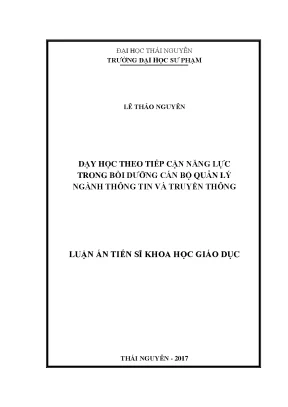
Tải xuống để đọc toàn bộĐẠI HỌC THÁI NGUYÊN TRƢỜNG ĐẠI HỌC SƢ PHẠM LÊ THẢO NGUYÊN DẠY HỌC THEO TIẾP CẬN NĂNG LỰC TRONG BỒI DƢỠNG CÁN BỘ QUẢN LÝ NGÀNH THÔNG TIN VÀ TRUYỀN THÔNG LUẬN ÁN TIẾN SĨ KHOA HỌC GIÁO DỤC THÁI NGUYÊN - 2017 ĐẠI HỌC THÁI NGUYÊN TRƢỜNG ĐẠI HỌC SƢ PHẠM LÊ THẢO NGUYÊN DẠY HỌC THEO TIẾP CẬN NĂNG LỰC TRONG BỒI DƢỠNG CÁN BỘ QUẢN LÝ NGÀNH THÔNG TIN VÀ TRUYỀN THÔNG Chuyên ngành: LÝ LUẬN VÀ LỊCH SỬ GIÁO DỤC Mã số: 62.02 LUẬN ÁN TIẾN SĨ KHOA HỌC GIÁO DỤC Ngƣời hƣớng dẫn khoa học: PGS. ĐẶNG THÀNH HƢNG TS. NÔNG KHÁNH BẰNG THÁI NGUYÊN - 2017 i LỜI CAM ĐOAN Tôi xin cam đoan đây là công trình nghiên cứu của riêng tôi. Các số liệu, kết quả nghiên cứu trong luận án là trung thực và chƣa từng đƣợc ai công bố trong một công trình nào khác.
Thái Nguyên, tháng 12 năm 2017 Tác giả luận án Lê Thảo Nguyên ii LỜI CẢM ƠN Trƣớc hết, tôi xin bày tỏ lòng biết ơn sâu sắc đến PGS.TS Đặng Thành Hƣng và TS. Nông Khánh Bằng đã tận tình hƣớng dẫn, giúp đỡ tôi trong quá trình hoàn thành luận án này. Tôi xin trân trọng cảm ơn Ban Đào tạo - Đại học Thái Nguyên, Ban Giám hiệu, Phòng Đào tạo, Ban chủ nhiệm khoa Tâm lý - Giáo dục, Trƣờng Đại học Sƣ Phạm - Đại học Thái Nguyên đã tạo mọi điều kiện thuận lợi để tôi có thể hoàn thành luận án này. Tôi xin trân trọng cảm ơn tập thể cán bộ giảng viên, cán bộ quản lý trƣờng Đào tạo, Bồi dƣỡng Cán bộ quản lý Thông tin và Truyền thông đã động viên tinh thần và tạo điều kiện thuận lợi nhất cho tôi trong quá trình thực hiện luận án.
Tôi cũng xin bày tỏ lòng biết ơn sâu sắc đến gia đình, những ngƣời thân và bạn bè, đồng nghiệp, những ngƣời đã luôn động viên, khuyến khích tôi trong suốt những năm qua để tôi có thể hoàn thành luận án này. Thái Nguyên, tháng 12 năm 2017 Tác giả luận án Lê Thảo Nguyên iii MỤC LỤC LỜI CAM ĐOAN .ii MỤC LỤC. iii DANH MỤC CÁC CHỮ VIẾT TẮT. iv DANH MỤC CÁC BẢNG.
v DANH MỤC CÁC HÌNH, BIỂU ĐỒ. vi MỞ ĐẦU. Lý do chọn đề tài. Mục đích nghiên cứu.
Câu hỏi nghiên cứu. Khách thể và đối tƣợng nghiên cứu. Giả thuyết khoa học. Nhiệm vụ và phạm vi nghiên cứu.
Phƣơng pháp luận và phƣơng pháp nghiên cứu. Luận điểm bảo vệ. Đóng góp mới của luận án. Cấu trúc luận án.
8 Chƣơng 1: CƠ SỞ LÝ LUẬN CỦA DẠY HỌC THEO TIẾP CẬN NĂNG LỰCTRONG BỒI DƢỠNG CÁN BỘ QUẢN LÝ NGÀNH THÔNG TIN VÀ TRUYỀN THÔNG. Tổng quan nghiên cứu vấn đề. Các công trình nghiên cứu ở nƣớc ngoài. Các công trình nghiên cứu ở Việt Nam.
Các khái niệm cơ bản. Khái niệm dạy học. Khái niệm năng lực. Khái niệm tiếp cận năng lực.
Khái niệm dạy học theo tiếp cận năng lực. Khái niệm dạy học theo tiếp cận năng lực trong bồi dƣỡng cán bộ quản lý ngành Thông tin và Truyền thông. Một số vấn đề lý luận của dạy học theo tiếp cận năng lực. Đặc điểm của hoạt động học tập theo tiếp cận năng lực.
Các nhiệm vụ của dạy học theo tiếp cận năng lực. Các nguyên tắc dạy học theo tiếp cận năng lực. Vai trò của ngƣời dạy và ngƣời học trong dạy học theo tiếp cận năng lực. Một số vấn đề lý luận của dạy học theo tiếp cận năng lực trong bồi dƣỡng cán bộ quản lý ngành Thông tin và Truyền thông.
Yêu cầu đối với dạy học theo tiếp cận năng lực trong bồi dƣỡng cán bộ quản lí ngành Thông tin và Truyền thông. Mục tiêu dạy học theo tiếp cận năng lực trong bồi dƣỡng cán bộ quản lý ngành Thông tin và Truyền thông. Nội dung dạy học theo tiếp cận năng lực trong bồi dƣỡng cán bộ quản lý ngành Thông tin và Truyền thông. Phƣơng pháp dạy học theo tiếp cận năng lực trong bồi dƣỡng cán bộ quản lý ngành Thông tin và Truyền thông.
Hình thức tổ chức dạy học theo tiếp cận năng lực trong bồi dƣỡng cán bộ quản lý ngành Thông tin và Truyền thông. Đánh giá kết quả dạy học theo tiếp cận năng lực trong bồi dƣỡng cán bộ quản lý ngành Thông tin và Truyền thông. Các yếu tố ảnh hƣởng đến dạy học theo tiếp cận năng lực trong bồi dƣỡng cán bộ quản lý ngành Thông tin và Truyền thông. Yếu tố chủ quan.
Yếu tố khách quan. 46 KẾT LUẬN CHƢƠNG 1. 49 Chƣơng 2:THỰC TRẠNG DẠY HỌC THEO TIẾP CẬN NĂNG LỰC TRONG BỒI DƢỠNG CÁN BỘ QUẢN LÝ NGÀNH THÔNG TIN VÀ TRUYỀN THÔNG TẠI TRƢỜNG ĐÀO TẠO, BỒI DƢỠNG CÁN BỘ QUẢN LÝ THÔNG TIN VÀ TRUYỀN THÔNG. Khái quát về khảo sát thực trạng .1 Khái quát về Trƣờng Đào tạo, Bồi dƣỡng cán bộ quản lý Thông tin và Truyền thông.
Mục đích khảo sát. Nội dung khảo sát. Đối tƣợng khảo sát. Phƣơng pháp khảo sát.
Kết quả khảo sát. Thực trạng hoạt động bồi dƣỡng ở trƣờng Đào tạo, bồi dƣỡng cán bộ quản lý Thông tin và Truyền thông .Thực trạng về mục tiêu dạy học trong bồi dƣỡng cán bộ quản lý ngành Thông tin và Truyền thông. Thực trạng nội dung dạy học trong bồi dƣỡng cán bộ quản lý ngành Thông tin và Truyền thông. Thực trạng sử dụng phƣơng pháp dạy học trong bồi dƣỡng cán bộ quản lý ngành Thông tin và Truyền thông .Thực trạng mức độ sử dụng các hình thức tổ chức dạy học trong bồi dƣỡng cán bộ quản lý ngành Thông tin và Truyền thông.
Thực trạng đánh giá kết quả dạy học trong bồi dƣỡng cán bộ quản lý ngành Thông tin và Truyền thông. Đánh giá hiệu quả dạy học trong bồi dƣơng cán bộ quản lý ngành Thông tin và Truyền thông. Thực trạng các yếu tố ảnh hƣởng đến dạy học trong bồi dƣỡng cán bộ quản lý ngành Thông tin và Truyền thông. Đánh giá chung về thực trạng.
Những thành tựu. Những hạn chế. 78 KẾT LUẬN CHƢƠNG 2. 80 Chƣơng 3: BIỆN PHÁP DẠY HỌC THEO TIẾP CẬN NĂNG LỰC TRONG BỒI DƢỠNG CÁN BỘ QUẢN LÝ NGÀNH THÔNG TIN VÀ TRUYỀN THÔNG.
Các nguyên tắc đề xuất biện pháp. Bảo đảm tính mục tiêu. Đảm bảo tính thực tiễn. Bảo đảm tính hệ thống.
Bảo đảm tính hiệu quả. Các biện pháp dạy học theo tiếp cận năng lực trong bồi dƣỡng cán bộ quản lý ngành Thông tin và Truyền thông. Biện pháp 1: Xây dựng quy trình dạy học theo tiếp cận năng lực trong bồi dƣỡng cán bộ quản lý ngành Thông tin và Truyền thông. Biện pháp 2: Lập kế hoạch dạy học theo tiếp cận năng lực trong bồi dƣỡng cán bộ quản lý ngành Thông tin và Truyền thông.
Biện pháp 3: Thiết kế học liệu thích hợp với dạy học theo tiếp cận năng lực trong bồi dƣỡng cán bộ quản lý ngành thông tin và Truyền thông. Biện pháp 4: Áp dụng các hình thức tổ chức dạy học, biện pháp, kĩ thuật dạy học thích hợp với phát triển năng lực ngƣời học. Biện pháp 5: Thực hiện đánh giá tập trung vào quá trình để đảm bảo phát triển đƣợc năng lực của học viên trong học tập. Mối quan hệ giữa các biện pháp.
Những điều kiện chung,cần thiết để thực hiện dạy học theo tiếp cận năng lực trong bồi dƣỡng cán bộ quản lý ngành Thông tin và Truyền thông. Khảo nghiệm và thực nghiệm khoa học. Khảo nghiệm tính cấp thiết và khả thi của các biện pháp dạy học theo tiếp cận năng lực trong bồi dƣỡng cán bộ quản lý ngành Thông tin và Truyền thông. Mục đích khảo nghiệm.
Nội dung khảo nghiệm. Phƣơng pháp và kĩ thuật tiến hành. Đối tƣợng khảo nghiệm. Kết quả khảo nghiệm.
Thực nghiệm sƣ phạm. Khái quát về quá trình thực nghiệm sƣ phạm. Đánh giá kết quả thực nghiệm. Xử lý kết quả thực nghiệm.
Kết quả thực nghiệm. Một vài ý kiến bàn luận của tác giả. 146 KẾT LUẬN CHƢƠNG 3. 147 KẾT LUẬN VÀ KHUYẾN NGHỊ.
149 DANH MỤC CÁC CÔNG TRÌNH CÔNG BỐ LIÊN QUAN ĐẾN LUẬN ÁN. 151 DANH MỤC TÀI LIỆU THAM KHẢO. 152 PHẦN PHỤ LỤC iv DANH MỤC CÁC CHỮ VIẾT TẮT BD : Bồi dƣỡng CBQL : Cán bộ quản lý ĐC : Đối chứng DH : Dạy học ĐTB : Điểm trung bình GV : Giảng viên HĐBD : Hoạt động bồi dƣỡng HV : Học viên ND : Nội dung NDBD : Nội dung bồi dƣỡng NDDH : Nội dung dạy học NL : Năng lực NLSP : Năng lực sƣ phạm PPDH : Phƣơng pháp dạy học TN : Thực nghiệm TT&TT : Thông tin và Truyền thông v DANH MỤC CÁC BẢNG Bảng 2. Đánh giá của cán bộ quản lý và giảng viên về thực trạng mục tiêu dạy học trong bồi dƣỡng cán bộ quản lý ngành Thông tin và Truyền thông.
Đánh giá của học viên về thực trạng mục tiêu dạy học trong bồi dƣỡng cán bộ quản lý ngành Thông tin và Truyền thông. Đánh giá của cán bộ quản lý hoạt động bồi dƣỡng và giảng viên về nội dung dạy học trong bồi dƣỡng cán bộ quản lý ngành Thông tin và Truyền thông. Đánh giá của cán bộ quản lý, giảng viên, học viênvề mức độ sử dụng phƣơng pháp dạy học trong bồi dƣỡng cán bộ quản lý ngành Thông tin và Truyền thông. Đánh giá của học viên về mức độ sử dụng phƣơng phápdạy học trong bồi dƣỡng cán bộ quản lý ngành Thông tin và Truyền thông.
Đánh giá của cán bộ quản lý hoạt động bồi dƣỡng, giảng viên về thực trạng, mức độ sử dụng các hình thức tổ chức dạy học trong bồi dƣỡng cán bộ quản lý ngành Thông tin và Truyền thông. Đánh giá của học viên về thực trạng mức độ, sử dụng các hình thức tổ chức dạy học trong bồi dƣỡng cán bộ quản lý ngành Thông tin và Truyền thông. Đánh giá của giảng viên, cán bộ quản lý về mức độ sử dụng phƣơng pháp kiểm tra, đánh giá trong dạy học. Đánh giá của cán bộ quản lý, giảng viên về mức độ đảm bảo các yêu cầu trong đánh giá kết quả dạy học.
Đánh giá của cán bộ quản lý, giảng viên về hiệu quả dạy học trong bồi dƣỡng cán bộ quản lý ngành Thông tin và Truyền thông. Đánh giá của học viên về hiệu quả dạy học trong bồi dƣỡng cán bộ quản lý ngành Thông tin và Truyền thông .
Nội dung được bảo vệ bản quyền — Tải xuống đầy đủ
Trích dẫn luận án này
Lê Thảo Nguyên (2017). Dạy học tiếp cận năng lực cho cán bộ quản lý ngành TT&TT [Luận án tiến sĩ, Đại học Thái Nguyên]. LuanAn.net. https://luanan.net/giao-duc-hoc/phuong-phap-giang-day/day-hoc-tiep-can-nang-luc-boi-duong-can-bo-quan-ly-nganh-tt-tt
Câu hỏi thường gặp
Luận án "Dạy học tiếp cận năng lực cho cán bộ quản lý ngành TT&TT" nghiên cứu về vấn đề gì?
Giới thiệu phương pháp dạy học tiếp cận năng lực trong đào tạo tiến sĩ cho cán bộ quản lý ngành thông tin và truyền thông, hướng tới năng lực thực tiễn.
Luận án "Dạy học tiếp cận năng lực cho cán bộ quản lý ngành TT&TT" được bảo vệ tại trường nào?
Luận án này được bảo vệ tại Đại học Thái Nguyên. Năm bảo vệ: 2017.
Luận án "Dạy học tiếp cận năng lực cho cán bộ quản lý ngành TT&TT" thuộc chuyên ngành gì?
Luận án "Dạy học tiếp cận năng lực cho cán bộ quản lý ngành TT&TT" thuộc chuyên ngành Lý luận và Lịch sử giáo dục. Danh mục: Phương Pháp Giảng Dạy.
Luận án "Dạy học tiếp cận năng lực cho cán bộ quản lý ngành TT&TT" có bao nhiêu trang?
Luận án "Dạy học tiếp cận năng lực cho cán bộ quản lý ngành TT&TT" có 209 trang. Bạn có thể xem trước một phần tài liệu ngay trên trang web trước khi tải về.
Cách tải luận án "Dạy học tiếp cận năng lực cho cán bộ quản lý ngành TT&TT" về máy như thế nào?
Để tải luận án về máy, bạn nhấn nút "Tải xuống ngay" trên trang này, sau đó hoàn tất thanh toán phí lưu trữ. File sẽ được tải xuống ngay sau khi thanh toán thành công. Hỗ trợ qua Zalo: 0559 297 239.