Giáo viên Alabama tích hợp nghệ thuật và âm nhạc vào chương trình giảng dạy cốt lõi
Giáo viên Alabama sáng tạo, lồng ghép nghệ thuật, âm nhạc vào chương trình dạy học, làm phong phú trải nghiệm giáo dục, thúc đẩy tư duy toàn diện.
Educational Research and Administration
Luan An
Luận án
Năm xuất bản
Số trang
144
Thời gian đọc
22 phút
Lượt xem
0
Lượt tải
0
Phí lưu trữ
40 Point
Tổng quan nhanh
- Chủ đề:
- Tích hợp Nghệ thuật Âm nhạc: Giáo dục Alabama
- Số trang:
- 144 trang
- Trường:
- The University of Southern Mississippi
- Chuyên ngành:
- Educational Research and Administration
- Tác giả:
- Laura Jane Martin
- Năm:
- 2017
Tóm tắt nội dung luận án
I.Tích hợp Nghệ thuật Âm nhạc Giáo dục Alabama
Giáo dục Alabama đang tìm kiếm các phương pháp giảng dạy tiên tiến. Tích hợp nghệ thuật và âm nhạc vào chương trình giảng dạy cốt lõi là một giải pháp hiệu quả. Điều này giúp nâng cao sự tham gia và kết quả học tập của học sinh. Tài liệu này khám phá cách giáo viên Alabama sử dụng âm nhạc. Họ đã tham gia các hội thảo tích hợp nghệ thuật. Việc này giúp cải thiện trải nghiệm học tập trong lớp học. Nhấn mạnh vào thành tích học thuật thường gây khó khăn. Tuy nhiên, tích hợp nghệ thuật mang lại lợi ích giáo dục rõ rệt. Nó kích thích tư duy sáng tạo và phát triển toàn diện.
1.1. Thách thức Tích hợp Nghệ thuật vào Giáo dục
Thách thức lớn đang hiện hữu trong giáo dục hiện đại. Sự tập trung ngày càng tăng vào thành tích học thuật. Điều này khiến việc biện minh cho tích hợp nghệ thuật trở nên khó khăn. Nhiều trường học ưu tiên các môn học cốt lõi. Nghệ thuật thường bị xem nhẹ hoặc cắt giảm. Giáo viên cần công cụ và chiến lược cụ thể. Họ phải chứng minh giá trị của nghệ thuật. Việc này giúp duy trì sự cân bằng trong chương trình giảng dạy. Các rào cản tài chính và thời gian cũng là vấn đề. Chúng ảnh hưởng đến việc thực hiện giáo dục nghệ thuật toàn diện.
1.2. Lợi ích Tích hợp Nghệ thuật cho Học sinh
Tích hợp nghệ thuật mang lại nhiều lợi ích. Các phương pháp giảng dạy hiệu quả thu hút học sinh. Chúng có thể tác động tích cực đến học tập. Tích hợp âm nhạc vào các bài học cốt lõi là một ví dụ. Nó giúp tăng cường sự tham gia của học sinh. Điều này cũng nâng cao kết quả học tập tổng thể. Lý thuyết Đa trí tuệ của Gardner hỗ trợ quan điểm này. Mỗi học sinh có cách học khác nhau. Nghệ thuật cung cấp con đường mới để tiếp cận kiến thức. Nó hỗ trợ sự phát triển kỹ năng tư duy phản biện. Khuyến khích sự sáng tạo và biểu đạt cá nhân.
1.3. Giáo dục Nghệ thuật Alabama Nhu cầu Đổi mới
Giáo dục nghệ thuật Alabama cần đổi mới. Nhiều giáo viên nhận thấy giá trị của việc tích hợp. Họ tìm kiếm các khóa đào tạo và nguồn lực. Mục tiêu là để thực hiện các phương pháp này. Việc tích hợp không chỉ giới hạn ở âm nhạc hay mỹ thuật. Nó có thể bao gồm kịch và khiêu vũ. Đổi mới giúp đáp ứng nhu cầu học tập đa dạng. Nó cũng chuẩn bị học sinh cho thế giới thực. Nơi tư duy sáng tạo và giải quyết vấn đề là chìa khóa.
II.Nghiên cứu Tích hợp Âm nhạc Chương trình Giảng dạy
Một nghiên cứu định tính đã được thực hiện. Nó khảo sát các phương pháp giảng dạy của giáo viên. Mục đích là để tìm hiểu cách họ tích hợp âm nhạc. Việc này nhằm tăng cường sự tham gia của học sinh. Đồng thời nâng cao hiệu quả học tập. Nghiên cứu tập trung vào giáo viên đã tham gia hội thảo tích hợp nghệ thuật. Nó cung cấp cái nhìn sâu sắc về thực tiễn lớp học. Cách giáo viên áp dụng kiến thức đào tạo vào chương trình. Đây là một bước quan trọng. Nó giúp tối ưu hóa việc giảng dạy liên môn.
2.1. Mục tiêu Nghiên cứu Âm nhạc trong Lớp học
Nghiên cứu có nhiều mục tiêu rõ ràng. Nó điều tra cách giáo viên sử dụng âm nhạc. Âm nhạc được dùng để nâng cao chương trình giảng dạy cốt lõi. Một mục tiêu khác là đánh giá mức độ chuẩn bị của giáo viên. Sự chuẩn bị này có được sau khi họ tham dự khóa đào tạo chuyên môn. Nghiên cứu cũng xác định nơi giáo viên tìm kiếm tài nguyên. Tài nguyên cho các hoạt động âm nhạc trong lớp học. Hiểu rõ những yếu tố này rất quan trọng. Nó giúp phát triển các chương trình hỗ trợ giáo viên hiệu quả hơn.
2.2. Phương pháp Đánh giá Tích hợp Nghệ thuật Liên môn
Nghiên cứu này là một cuộc điều tra định tính tổng quát. Nó sử dụng khung lý thuyết Đa trí tuệ của Gardner. Lý thuyết này khẳng định học sinh học theo nhiều cách khác nhau. Mười lăm giáo viên đã tình nguyện tham gia phỏng vấn. Các cuộc phỏng vấn trực tiếp, bán cấu trúc đã được tiến hành. Dữ liệu thu thập từ những cuộc thảo luận này. Nó tập trung vào thực tiễn và kinh nghiệm của giáo viên. Cụ thể là cách họ triển khai âm nhạc vào bài học. Dữ liệu này sau đó được chuyển ngữ và phân tích kỹ lưỡng. Mục đích là để tiết lộ mức độ sử dụng âm nhạc như một công cụ giảng dạy.
2.3. Câu hỏi Nghiên cứu về Sử dụng Âm nhạc trong Chương trình
Ba câu hỏi nghiên cứu chính đã được khám phá. Thứ nhất, cách giáo viên sử dụng âm nhạc để nâng cao chương trình. Thứ hai, mức độ chuẩn bị của họ sau các khóa đào tạo. Khóa đào tạo chuyên môn về tích hợp nghệ thuật. Thứ ba, nơi họ tìm kiếm các nguồn tài nguyên. Nguồn tài nguyên cho các hoạt động âm nhạc. Những câu hỏi này giúp xây dựng bức tranh toàn diện. Bức tranh về việc tích hợp âm nhạc trong môi trường lớp học. Chúng cũng cung cấp cơ sở để đưa ra khuyến nghị. Khuyến nghị cho việc Phát triển chuyên môn giáo viên nghệ thuật trong tương lai.
III.Lợi ích Tích hợp Âm nhạc Cải thiện Học tập Sáng tạo
Dữ liệu nghiên cứu cung cấp bằng chứng rõ ràng. Việc sử dụng âm nhạc trong lớp học rất hiệu quả. Nó không chỉ nâng cao thành tích học tập của học sinh. Âm nhạc còn có tác động tích cực đến hành vi. Nó giúp củng cố kỹ năng ghi nhớ. Đồng thời tăng cường sự tham gia của học sinh vào bài học. Những lợi ích này nhấn mạnh giá trị của giáo dục nghệ thuật tích hợp. Đặc biệt là trong bối cảnh Giáo dục STEAM Alabama. Nó thúc đẩy môi trường học tập năng động và sáng tạo hơn.
3.1. Âm nhạc Nâng cao Thành tích Học tập Học sinh
Sử dụng âm nhạc trong lớp học cải thiện kết quả học tập. Dữ liệu cho thấy điều này có tác động trực tiếp. Học sinh có thể hiểu sâu hơn các khái niệm. Âm nhạc hỗ trợ việc ghi nhớ thông tin. Các bài hát, nhịp điệu giúp học sinh học thuộc. Ví dụ: học bảng cửu chương, quy tắc ngữ pháp. Việc này làm cho quá trình học tập ít căng thẳng hơn. Học sinh cũng cảm thấy hứng thú hơn với bài học. Thành tích tổng thể của họ được nâng cao rõ rệt.
3.2. Tác động của Âm nhạc đến Hành vi Lớp học
Âm nhạc không chỉ tác động đến học tập. Nó còn ảnh hưởng tích cực đến hành vi trong lớp học. Âm nhạc có thể tạo ra bầu không khí yên tĩnh. Nó giúp học sinh tập trung và kỷ luật hơn. Giáo viên sử dụng âm nhạc để chuyển tiếp giữa các hoạt động. Hoặc để báo hiệu sự bắt đầu/kết thúc bài học. Điều này giúp quản lý lớp học hiệu quả hơn. Học sinh trở nên hợp tác hơn. Giảm thiểu các vấn đề về hành vi. Môi trường học tập trở nên hài hòa hơn.
3.3. Tăng cường Sự tham gia Học sinh và Hứng thú
Một trong những lợi ích quan trọng nhất. Âm nhạc tăng cường sự tham gia của học sinh. Nó làm cho các bài học trở nên sống động. Học sinh được kích thích bởi các hoạt động âm nhạc. Ví dụ: hát, vỗ tay, chuyển động theo nhịp điệu. Điều này giúp các em kết nối với nội dung. Nó cũng khuyến khích sự tương tác và làm việc nhóm. Sự hứng thú học tập tự nhiên được khơi dậy. Học sinh mong chờ các bài học có yếu tố âm nhạc. Việc này thúc đẩy sự sáng tạo học sinh tiểu học. Các em thể hiện bản thân một cách tự do hơn.
IV.Đào tạo Giáo viên Alabama Nhu cầu Tích hợp Nghệ thuật
Nghiên cứu này chỉ ra một nhu cầu rõ ràng. Giáo viên cần được đào tạo chuyên sâu hơn. Đặc biệt là trong lĩnh vực tích hợp âm nhạc vào chương trình. Phần lớn giáo viên tham gia khảo sát. Họ cảm thấy được chuẩn bị tốt hơn sau các khóa hội thảo. Điều này nhấn mạnh tầm quan trọng của phát triển chuyên môn giáo viên nghệ thuật. Việc này giúp họ tự tin thiết kế bài học âm nhạc và mỹ thuật. Từ đó triển khai hiệu quả giáo dục nghệ thuật tích hợp.
4.1. Nâng cao Chuẩn bị của Giáo viên qua Khóa học
Dữ liệu cho thấy một xu hướng tích cực. Đa số giáo viên tham gia nghiên cứu. Họ cảm thấy được chuẩn bị tốt hơn. Điều này xảy ra sau khi hoàn thành chương trình "Arts in Education". Chương trình này được cung cấp bởi Đại học South Alabama. Các khóa học này trang bị kiến thức. Nó cung cấp các kỹ năng cần thiết. Giáo viên có thể tự tin áp dụng âm nhạc vào giảng dạy. Sự chuẩn bị tốt hơn dẫn đến việc thực hành hiệu quả hơn.
4.2. Phát triển Chuyên môn Tích hợp Âm nhạc Hiệu quả
Phát triển chuyên môn là yếu tố then chốt. Nó giúp giáo viên triển khai tích hợp âm nhạc hiệu quả. Các khóa đào tạo cần cung cấp chiến lược cụ thể. Giáo viên học cách thiết kế bài học liên môn. Họ biết cách lựa chọn tài nguyên phù hợp. Các hội thảo thực hành giúp củng cố kỹ năng. Việc này cũng tạo cơ hội cho giáo viên chia sẻ kinh nghiệm. Điều này xây dựng một cộng đồng học tập hỗ trợ.
4.3. Hướng tới Chương trình Giảng dạy Sáng tạo trong Đại học
Kết quả nghiên cứu có ý nghĩa quan trọng. Chúng cho thấy cần có nhiều khóa học hơn ở cấp đại học. Các khóa học này cần tập trung vào tích hợp âm nhạc. Việc này giúp trang bị cho giáo viên tương lai. Họ sẽ có kỹ năng cần thiết ngay từ đầu. Chương trình giảng dạy sáng tạo sẽ trở thành tiêu chuẩn. Điều này cũng giúp thiết lập Tiêu chuẩn giáo dục nghệ thuật Alabama. Đảm bảo rằng tất cả học sinh đều được hưởng lợi. Lợi ích từ một nền giáo dục toàn diện và phong phú.
Mục lục chi tiết luận án
Tải xuống file đầy đủ để xem toàn bộ nội dung
Tải đầy đủ (144 trang)Trích đoạn nội dung luận án
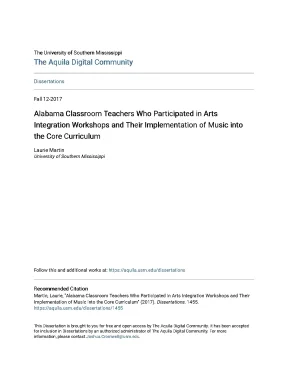
Tải xuống để đọc toàn bộThe University of Southern Mississippi The Aquila Digital Community Dissertations Fall 12-2017 Alabama Classroom Teachers Who Participated in Arts Integration Workshops and Their Implementation of Music into the Core Curriculum Laurie Martin University of Southern Mississippi Follow this and additional works at: https://aquila.edu/dissertations Recommended Citation Martin, Laurie, "Alabama Classroom Teachers Who Participated in Arts Integration Workshops and Their Implementation of Music into the Core Curriculum" (2017).edu/dissertations/1455 This Dissertation is brought to you for free and open access by The Aquila Digital Community. It has been accepted for inclusion in Dissertations by an authorized administrator of The Aquila Digital Community. For more information, please contact Joshua. ALABAMA CLASSROOM TEACHERS WHO PARTICIPATED IN ARTS INTEGRATION WORKSHOPS AND THEIR IMPLEMENTATION OF MUSIC INTO THE CORE CURRICULUM by Laura Jane Martin A Dissertation Submitted to the Graduate School and the Department of Educational Research and Administration at The University of Southern Mississippi in Partial Fulfillment of the Requirements for the Degree of Doctor of Philosophy Approved: ________________________________________________ Dr.
Hill, Committee Chair Professor, Educational Research and Administration ________________________________________________ Dr. Ann Blankenship, Committee Member Assistant Professor, Educational Research and Administration ________________________________________________ Dr. Myron Labat, Committee Member Assistant Professor, Educational Research and Administration ________________________________________________ Dr. Fuller, Committee Member Professor, Music ________________________________________________ Dr.
Coats Dean of the Graduate School December2017 COPYRIGHT BY Laura Jane Martin 2017 Published by the Graduate School ABSTRACT ALABAMA CLASSROOM TEACHERS WHO PARTICIPATED IN ARTS INTEGRATION WORKSHOPS AND THEIR IMPLEMENTATION OF MUSIC INTO THE CORE CURRICULUM by Laura Jane Martin December2017 With the growing emphasis on academic achievement, it has become increasingly more challenging to justify the integration of arts into the curriculum. Effective teachers employ instructional strategies that enhance student engagement and can positively affect student learning. This qualitative study investigated the instructional practices and experiences of classroom teachers who implement music into the academic lesson to increase student engagement and enhance learning. Specifically, the research questions explored how teachers use music to enhance their curriculum, the level of preparedness after attending arts integration professional development, and where they located resources for music activities.
Effective teachers realize that all students learn differently as proven through Gardner’s Multiple Intelligences which served as the conceptual framework for this general qualitative inquiry study. Fifteen classroom teachers volunteered to interview for this qualitative study. In these face-to-face semi-structured interviews, data was collected from participants who discussed practices and experiences of the implementation of music in their classroom lessons. This data was transcribed and analyzed to reveal the extent to which the participants utilized music as an instructional tool in the classroom.
The data showed sufficient evidence to support the fact that participants find using music in their classroom to be effective not only fort student ii achievement but for classroom behavior, to reinforce memorization skills, and engage students in the lesson. In addition, data showed that the majority of teachers who participated in this study felt more prepared to implement music into their lesson once they completed the Arts in Education professional development through the University of South Alabama. The findings in this study imply there is a need for more collegiate level classes offered in the area of music integration within the course of study. iii ACKNOWLEDGMENTS I would like to acknowledge several people who made this dissertation possible.
I would like to express my deepest gratitude to Dr. Lilian Hill and my USM committee members who patiently helped me wrap up and complete this paper. I am most grateful to Dr. Leslie Locke who faithfully worked with me from the beginning until she relocated to The University of Iowa, and my faithful sister in Christ and dear friend Dr.
Karen Dennis, University of Mobile, for her unselfish love and devotion with unwavering encouragement. I am forever indebted to my family Judy Martin Bobo, Leslie Martin Nettles, and my precious daughter Sarah Jane Shearer who on many evenings ate cereal for dinner. I love you all and am more than grateful for your love and support though this tremendous endeavor. Finally yet importantly, I acknowledge my four legged fur baby Lula who is always happy to see me when I walk in the door.
It is great to be loved unconditionally. iv DEDICATION This dissertation is lovingly dedicated to my parents Judith Martin Bobo and the late James Richard Martin who have always believed I was number one and made me feel like I was “the winner and still champion”. Their constant devotion and Godly example have inspired me to be determined and successful. Thank you for giving me every tool needed to pursue my passion for vocal music.
I love you and will forever be indebted. v TABLE OF CONTENTS ABSTRACT. v LIST OF TABLES. xiii LIST OF ILLUSTRATIONS.
xiv LIST OF ABBREVIATIONS. xv CHAPTER I – INTRODUCTION. 1 Statement of the Problem. 2 Purpose of the Study.
6 Definition of Terms. 9 CHAPTER II – LITERATURE REVIEW. 11 History and Early Research in Music Education. 11 vi Early Influences on Music Education.
12 Early Music Conventions. 15 The Yale Seminar. 16 The Manhattanville Music Curriculum Project. 18 The Tanglewood Sympsium.
19 National Association for Music Educators. 20 Music Education Curriculum. 22 Politics in Music Education. 24 No Child Left Behind.
29 Music and the Brain. 30 Listening to Music. 36 Funding in Music Education. 38 Budgets in Music Education.
40 Using Music in the Classroom. 51 CHAPTER III - METHODOLOGY. 53 Purpose of the Study. 54 vii Research Questions.
54 Methodology and Design of the Study. 62 APPENDIX A - Placeholder Appendix Title. 101 viii APPENDIX B – Standard Consent Form. 112 xi xii LIST OF TABLES Table A1.
Appendix Table Title Example (be concise). 101 xiii LIST OF ILLUSTRATIONS Figure 1. Example figure title.Error! Bookmark not defined. Example figure title.
101 xiv LIST OF ABBREVIATIONS USM The University of Southern Mississippi WCU William Carey University xv CHAPTER I – INTRODUCTION Overview In 2001 the No Child Left Behind Act (NCLB) mandated that all students must perform at grade-level proficiency, which is to be assessed and determined through scores on state mandated tests. Duncombe, Lukemeyer, and Yinger (2006) noted that the result of these scores determine funding availability for schools; therefore, more emphasis is given by educational leaders to the subject areas that are tested, such as math and reading, rather than the arts (US Department of Education, 2010). Because music courses are considered a non-tested core subject by NCLB, testing is not required. Consequently, educational leaders do not value music on an equal level as they do other core subjects (Gerrity, 2009).
In December 2015 President Barack Obama’s administration worked to execute the Every Student Succeeds Act (ESSA). This law replaced its predecessor, the No Child left behind Act. ESSA allows more power at the state level to implement an accountability structure within its public school systems (Peet & Vercelletto, 2016). According to Levy (2008), all school districts have created standards for graduation, which students must achieve to fulfill the requirements of the federal government.
Many educators feel there is insufficient funding and time for music education to be included as a class in and of itself (Conrad, 2006). If these scores fail to demonstrate an increase in student achievement, teachers could lose their positions and schools could be penalized financially by not receiving certain federal funds (Gerrity, 2009). Many of these extra supplies needed for remediation such as technology, textbooks, and computer programs can be costly. Instruments for the music classroom 1 can be expensive as well, but because some educational administrators do not value the subject of music, many music teachers are using old classroom instruments and other supplies, which may not be working properly (Spohn, 2008).
The newest and latest program is many times made available for students in math or reading, but not for the students in music class (Spohn, 2008). To raise awareness for the importance of music in the classroom, music educators have developed a plan of embedding music into the regular classroom lessons to enhance learning (Spohn, 2008). This plan is known as ‘Arts Integration’ whereby music and the other art forms are included in the lesson plans of classroom curriculum for learning enhancement (Fischer, 2002). Arts integration involves linking the educational arts such as dance, music, and visual art into a written curriculum for each subject area (Parsad & Spiegelman, 2012).
Learning math and reading through music makes learning fun, and often increases student achievement (Randall, 2012). For example, Courey, Balogh, Siken and Paik (2012) studied the implementation of music into a third-grade math lesson on fractions, which is considered by many as the most difficult mathematical concept in the 3rd grade elementary curriculum. Results showed music to be effective for students who are coming to instruction with a lower than average understanding of fractions. The students were shown to be more engaged and at ease with the instruction.
In addition to having fun learning fractions, the students demonstrated deeper knowledge of the content (Courey et al. Statement of the Problem Since the reconstruction of public elementary and secondary education during the post-Sputnik era, student access to a high quality music education has been drastically 2 reduced (Walker 1998). Past education reform policies such No Child Left Behind Act (NCLB) established through the Bush administration limited students’ access to quality music education. Gerrity (2009) said, “Although NCLB refers to music and the other arts as core subjects, the legislation along with school principals, do not encourage achievement in the core subjects with equal fortitude” (p.
While it may be true that educators believe music is beneficial for students’ course of study, principals and administrators are often reluctant to relinquish class time for music education (Rentner, Scott, Kober, Chudwsky, Joftus, & Zabala, 2006). Although the current education law, ESSA, does recognize the arts and music as an integral part of a well- rounded education, the lingering accountability systems of NCLB do not encourage using instructional time for arts instruction or even integration. Moreover, with funding based on academic achievement, and the considerable amount of emphasis geared toward the tested core subjects, teachers are expected to devote instructional time to tested subjects such as reading and math during school hours as well as during after-school hours (Hemmel & Gerrity, 2012). Research from the National Center for Education Statistics (2012) showed the value of music as a tool for instruction that stimulates knowledge retention.
Delivering lessons with engaging techniques has long been a goal of classroom teachers. Howard Gardner’s theory of multiple intelligences has been the justification for teaching in a variety of techniques. While many teachers believe in the value of arts integration in our schools, they feel pressured to spend class time teaching and remediating core subjects. In addition, many teachers felt ill-prepared to effectively integrate the arts with academic subjects (Vitulli, Santoli, & Fresne, 2013).
However, by attending professional 3 development workshops and conferences, teachers discovered ways to integrate music to enhance, rather than distract, from learning academic subjects. However, it is not known how attendance and participation in arts integration professional development classes influenced teacher’s use of music as an instructional tool. Purpose of the Study The purpose of this general qualitative study was to describe the perspectives of classroom teachers who have participated in professional development regarding the integration of music into academic core subjects. Specifically, this study explored how teachers use music to enhance their curriculum, how they use knowledge gained through attendance in Art in Education workshops to integrate music, and where they find music resources.
Data was collected through interviews and provided a description of the participants’ experiences with using music in their daily routines. This study outlined the journey of music in the education system and how it has become an integral part of the elementary classroom as an instructional tool.
Nội dung được bảo vệ bản quyền — Tải xuống đầy đủ
Trích dẫn luận án này
Laura Jane Martin (2017). Giáo viên Alabama tích hợp nghệ thuật và âm nhạc vào chương trình [Luận án tiến sĩ, The University of Southern Mississippi]. LuanAn.net. https://luanan.net/giao-duc-hoc/giao-vien-alabama-tich-hop-nghe-thuat-am-nhac-chuong-trinh-cot-loi
Câu hỏi thường gặp
Luận án "Giáo viên Alabama tích hợp nghệ thuật và âm nhạc vào chương trình" nghiên cứu về vấn đề gì?
Giáo viên Alabama sáng tạo, lồng ghép nghệ thuật, âm nhạc vào chương trình dạy học, làm phong phú trải nghiệm giáo dục, thúc đẩy tư duy toàn diện.
Luận án "Giáo viên Alabama tích hợp nghệ thuật và âm nhạc vào chương trình" được bảo vệ tại trường nào?
Luận án này được bảo vệ tại The University of Southern Mississippi. Năm bảo vệ: 2017.
Luận án "Giáo viên Alabama tích hợp nghệ thuật và âm nhạc vào chương trình" thuộc chuyên ngành gì?
Luận án "Giáo viên Alabama tích hợp nghệ thuật và âm nhạc vào chương trình" thuộc chuyên ngành Educational Research and Administration. Danh mục: Giáo Dục Học.
Luận án "Giáo viên Alabama tích hợp nghệ thuật và âm nhạc vào chương trình" có bao nhiêu trang?
Luận án "Giáo viên Alabama tích hợp nghệ thuật và âm nhạc vào chương trình" có 144 trang. Bạn có thể xem trước một phần tài liệu ngay trên trang web trước khi tải về.
Cách tải luận án "Giáo viên Alabama tích hợp nghệ thuật và âm nhạc vào chương trình" về máy như thế nào?
Để tải luận án về máy, bạn nhấn nút "Tải xuống ngay" trên trang này, sau đó hoàn tất thanh toán phí lưu trữ. File sẽ được tải xuống ngay sau khi thanh toán thành công. Hỗ trợ qua Zalo: 0559 297 239.