Adam berg dissertation denver 76 final
Luận án Tiến sĩ của Adam Berg tại Denver, phiên bản 76 cuối cùng.
Kinesiology
Luan An
Luận án tiến sĩ
Năm xuất bản
Số trang
340
Thời gian đọc
51 phút
Lượt xem
0
Lượt tải
0
Phí lưu trữ
60 Point
Tổng quan nhanh
- Chủ đề:
- 1. Giới thiệu luận án tiến sĩ Adam Berg Denver '76
- Số trang:
- 340 trang
- Trường:
- The Pennsylvania State University
- Chuyên ngành:
- Kinesiology
- Tác giả:
- Adam Berg
- Năm:
- 2016
Tóm tắt nội dung luận án
I. Giới thiệu luận án tiến sĩ Adam Berg Denver 76
Đây là giới thiệu về luận án tiến sĩ của Adam Berg, có tựa đề "DENVER ’76: THE WINTER OLYMPICS AND THE POLITICS OF GROWTH IN COLORADO DURING THE LATE 1960s AND EARLY 1970s". Công trình nghiên cứu này được đệ trình vào năm 2016 tại The Pennsylvania State University. Luận án tiến sĩ này tập trung vào các động lực chính trị và xã hội dẫn đến việc thành phố Denver từ chối đăng cai Thế vận hội Mùa đông 1976. Bản thảo cuối cùng của Adam Berg mang đến cái nhìn sâu sắc về quyền lực công dân và sự thay đổi quan điểm về tăng trưởng kinh tế ở Colorado. Đây là một công trình nghiên cứu lịch sử toàn diện và quan trọng.
1.1. Bối cảnh nghiên cứu học thuật thập niên 1970
Luận án này khám phá các sự kiện cuối thập niên 1960 và đầu thập niên 1970. Giai đoạn này chứng kiến sự thay đổi đáng kể trong dư luận về phát triển đô thị và bảo vệ môi trường. Công trình nghiên cứu này đặt các sự kiện vào bối cảnh chính trị và xã hội rộng lớn hơn. Nghiên cứu học thuật về sự kiện năm 1976 này mang lại cái nhìn sâu sắc về một thời kỳ then chốt.
1.2. Mục tiêu chính của luận văn tốt nghiệp
Mục tiêu chính là phân tích các tranh cãi chính trị xung quanh Thế vận hội Mùa đông Denver 1976. Luận văn tốt nghiệp này xem xét cách quan điểm của người dân Colorado về tăng trưởng kinh tế thay đổi. Nó cũng khảo sát việc mở rộng hiểu biết về quyền lực chính trị của công dân. Luận án tiến sĩ này tập trung vào các quyết định quan trọng của thập niên 1970 tại Denver, Colorado.
1.3. Tầm quan trọng của công trình nghiên cứu
Công trình nghiên cứu của Adam Berg có ý nghĩa lớn. Nó không chỉ là một bản thảo cuối cùng về lịch sử thể thao. Nó còn là một nghiên cứu quan trọng về dân chủ trực tiếp và quyền công dân. Nghiên cứu này cung cấp cái nhìn sâu sắc về lịch sử Colorado và sự phát triển của thành phố Denver. Đây là một đóng góp học thuật đáng kể.
II. Chính trị tăng trưởng Colorado và Thế vận hội 1976
Phần này đi sâu vào bối cảnh chính trị của Colorado trong thập niên 1960 và đầu thập niên 1970. Ban đầu, tư duy ủng hộ tăng trưởng và phát triển mạnh mẽ đã thúc đẩy nỗ lực của Denver cho Thế vận hội Mùa đông 1976. Các nhà lãnh đạo doanh nghiệp và chính trị tự tin theo đuổi việc đăng cai, tin rằng họ có được sự ủng hộ rộng rãi của công chúng. Quan điểm này đã chi phối các cuộc thảo luận và giai đoạn lập kế hoạch ban đầu cho thành phố Denver.
2.1. Quyết định trao quyền đăng cai Denver
Ngày 12 tháng 5 năm 1970, Ủy ban Olympic Quốc tế (IOC) đã trao quyền đăng cai Thế vận hội Mùa đông 1976 cho Denver, Colorado. Quyết định này là đỉnh cao của nhiều năm vận động và lập kế hoạch kỹ lưỡng. Các nhà lãnh đạo tin tưởng mạnh mẽ vào lợi ích kinh tế mà sự kiện này sẽ mang lại cho Denver.
2.2. Sự thay đổi trong quan điểm công chúng
Đến đầu thập niên 1970, quan điểm về tăng trưởng và phát triển đã thay đổi. Người dân Colorado bắt đầu đặt câu hỏi về lợi ích không giới hạn của sự tăng trưởng kinh tế. Sự lo lắng về tác động môi trường và chi phí công cộng đã gia tăng. Luận án tiến sĩ Adam Berg phân tích sự dịch chuyển quan điểm này.
2.3. Bầu cử lịch sử về ngân sách nhà nước
Ngày 7 tháng 11 năm 1972, công dân Colorado đã bỏ phiếu. Họ quyết định cấm sử dụng quỹ nhà nước cho sự kiện này. Đây là một cuộc bỏ phiếu lịch sử với tỷ lệ ba phiếu thuận trên hai phiếu chống. Kết quả này buộc các nhà tổ chức Thế vận hội của Denver phải rút lại lời mời đăng cai.
III. Các yếu tố dẫn đến sự phản đối Olympics Denver
Việc từ chối Thế vận hội Denver bắt nguồn từ sự hội tụ của nhiều mối lo ngại từ phía công dân. Sự lo lắng về việc mất đi không gian mở gần nhà trở thành một yếu tố quan trọng. Các phản đối về việc chi tiêu quá mức tiền thuế của người dân cũng thúc đẩy sự bất mãn của công chúng. Hơn nữa, sự tức giận vì công dân bị loại khỏi các thủ tục ra quyết định đã củng cố sự phản đối. Công trình nghiên cứu của Adam Berg chi tiết hóa những lý do này.
3.1. Lo ngại về không gian mở và môi trường
Người dân bày tỏ sự lo lắng sâu sắc về tác động môi trường. Sự phát triển mở rộng cho Thế vận hội đe dọa các không gian tự nhiên và cảnh quan. Việc bảo tồn các khu vực núi và không gian mở trở thành ưu tiên hàng đầu của nhiều cộng đồng ở Colorado.
3.2. Vấn đề chi tiêu tiền thuế của người dân
Các khoản chi tiêu lớn từ tiền thuế cho Thế vận hội đã gây ra sự phản đối đáng kể. Người dân đặt câu hỏi về sự cần thiết và trách nhiệm tài chính của dự án. Ưu tiên ngân sách được đặt ra trong bối cảnh kinh tế của thập niên 1970.
3.3. Thiếu sự tham gia của công dân vào quyết sách
Cảm giác bị loại trừ khỏi quá trình ra quyết định đã thúc đẩy sự phẫn nộ trong cộng đồng. Công dân đòi hỏi tiếng nói lớn hơn trong các vấn đề công cộng ảnh hưởng đến họ. Sự thiếu minh bạch và tham vấn cộng đồng gây ra mâu thuẫn giữa chính quyền và người dân thành phố Denver.
IV. Tác động và di sản từ thất bại Olympics Denver 76
Thất bại của nỗ lực đăng cai Thế vận hội của Denver đã có những tác động sâu rộng. Nó đã chứng minh sức mạnh đang phát triển của các phong trào công dân và dân chủ trực tiếp ở Hoa Kỳ. Sự kiện này trở thành một khoảnh khắc then chốt cho chủ nghĩa môi trường và sự tham gia của công dân ở Colorado. Nó đã tạo ra tiền lệ cho các quyết định chính sách công và phát triển đô thị trong tương lai. Luận án tiến sĩ của Adam Berg phân tích di sản này.
4.1. Sức mạnh của sự tham gia công dân
Quyết định của Colorado chứng minh sức mạnh của người dân. Công dân có thể thách thức các kế hoạch lớn của chính phủ và doanh nghiệp. Sự kiện này là một chiến thắng rõ ràng cho dân chủ trực tiếp và quyền tự quyết của cộng đồng.
4.2. Bài học về quy hoạch đô thị và phát triển
Thất bại của Denver cung cấp những bài học quý giá. Quy hoạch đô thị cần xem xét toàn diện tác động xã hội và môi trường. Sự phát triển bền vững trở thành một yếu tố quan trọng trong việc đưa ra các quyết định liên quan đến thành phố Denver và Colorado.
4.3. Di sản lâu dài cho chính sách Colorado
Sự kiện này để lại di sản lâu dài trong chính sách của Colorado. Nó tăng cường vai trò của người dân trong việc định hình tương lai bang. Các nhà làm luật phải chú ý hơn đến ý kiến công chúng và các vấn đề môi trường. Nghiên cứu học thuật về sự kiện năm 1976 này vẫn còn phù hợp.
V. Phương pháp luận và cấu trúc luận án Adam Berg
Luận án của Adam Berg, một công trình học thuật nghiêm túc, sử dụng phương pháp luận lịch sử. Nó phân tích một cách có hệ thống dòng thời gian của các sự kiện, chính sách và phản ứng của công chúng. Cấu trúc di chuyển từ bối cảnh ban đầu ủng hộ tăng trưởng đến cuộc nổi dậy của công dân và những hậu quả của nó. Cách tiếp cận toàn diện này đảm bảo một cuộc kiểm tra kỹ lưỡng về chủ đề. Đây là một luận văn tốt nghiệp đáng chú ý.
5.1. Tiếp cận lịch sử thể thao và chính trị
Luận án sử dụng cách tiếp cận liên ngành độc đáo. Nó kết hợp lịch sử thể thao với phân tích chính trị sâu sắc. Phương pháp này cho phép hiểu sâu sắc các động lực phức tạp đằng sau quyết định của Denver. Công trình nghiên cứu này đóng góp vào cả hai lĩnh vực.
5.2. Phân tích các chương nghiên cứu chuyên sâu
Luận án được chia thành chín chương chi tiết. Mỗi chương khám phá một khía cạnh cụ thể của câu chuyện. Từ bối cảnh lịch sử của chính sách ủng hộ tăng trưởng đến sự phản đối môi trường. Cấu trúc này cho phép trình bày rõ ràng và toàn diện.
5.3. Vai trò của các ủy viên hội đồng
Các ủy viên hội đồng đã đóng vai trò quan trọng trong việc định hình luận án. Họ cung cấp hướng dẫn và phản hồi chuyên môn có giá trị. Điều này đảm bảo tính học thuật và chất lượng cao của bản thảo cuối cùng của Adam Berg. Sự hợp tác này nâng cao tầm vóc của công trình nghiên cứu.
Tải xuống file đầy đủ để xem toàn bộ nội dung
Tải đầy đủ (340 trang)Trích đoạn nội dung luận án
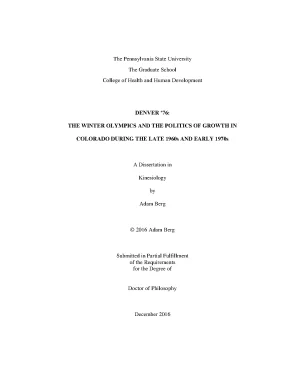
Tải xuống để đọc toàn bộThe Pennsylvania State University The Graduate School College of Health and Human Development DENVER ’76: THE WINTER OLYMPICS AND THE POLITICS OF GROWTH IN COLORADO DURING THE LATE 1960s AND EARLY 1970s A Dissertation in Kinesiology by Adam Berg © 2016 Adam Berg Submitted in Partial Fulfillment of the Requirements for the Degree of Doctor of Philosophy December 2016 The dissertation of Adam Berg was reviewed and approved* by the following: Mark Dyreson Professor of Kinesiology Dissertation Adviser Co-Chair of Committee R. Scott Kretchmar Professor of Exercise and Sport Science Co-Chair of Committtee Jaime Schultz Associate Professor of Kinesiology Peter Hopsicker Associate Professor of Kinesiology Lori D. Ginzberg Professor of History and Women’s Studies Stephen Piazza Professor of Kinesiology Graduate Program Director *Signature are on file in the Graduate School ii ABSTRACT On May 12, 1970, the International Olympic Committee (IOC) awarded Denver, Colorado, the 1976 winter Olympic games. About two and half years later, on November 7, 1972, Colorado citizens voted by a three to two margin to make it a violation of Colorado’s constitution for state funds to be allocated toward the event.
Colorado politicians and business leaders had spent years planning, campaigning, and traveling the globe to earn the right to host the winter sports festival. Nevertheless, with funding suddenly inaccessible, Denver’s Olympic planners were forced to rescind their invitation to “the youth of the world,” as Olympic hosts traditionally declared every four years. This dissertation delves into the political controversies surrounding the 1976 Denver winter Olympic games. Colorado’s decision to banish the Olympics was the product of a change in how Coloradans viewed economic growth, combined with broadened understandings of the political power of citizenship.
A pro-growth and pro-development mindset present in early 1960s motivated Denver’s political and business leaders to initiate their bid and facilitated their overriding confidence in the notion that they had the support of a large majority of Colorado’s populace. By the beginning of the 1970s, however, the idea that growth and development were unequivocal social goods had been quieted by a diverse set of issues connected to expectations regarding individual rights. Namely, within Colorado, anxiety over the infringement of open spaces near people’s homes, objections to undue spending of taxpayer dollars, and anger that citizens had been shut out of decision-making procedures inspired various people to challenge the wisdom and morality of hosting the Olympics. iii TABLE OF CONTENTS Selected Acronyms…….vi Introduction: Colorado, Growth, and Sport as Political History………………………….1 Chapter 1: The Historical Context of Pro-Growth and Pro-Olympic Policies in Colorado………………………………………………………………………………….14 Chapter 2: Selling Colorado to the United States ……………………………………….47 Chapter 3: Selling Denver to the International Olympic Committee ……………….78 Chapter 4: The Beginning of Jefferson County’s Environmentalist Revolt ……….…118 Chapter 5: The Aesthetic Rights of Middle-class Citizenship …………………………142 Chapter 6: Denverites and Politicians Take Aim at the Olympics ….
Bringing Direct Democracy to Middle-America ………………………….209 Chapter 8: The DOC’s Turn to Olympism ……………………………………….247 Chapter 9: Colorado’s Defeat of the Denver Olympics ……………….291 Epilogue: The Olympic Spirit of ’76 after November 1972.…323 iv Selected Acronyms ARO Auraria Residents Organization CIEO Citizens Interested in an Equitable Olympics CCF Citizens for Colorado’s Future COC Colorado Olympic Commission DOC Denver Organizing Committee DURA Denver Urban Renewal Authority DRI Denver Research Institute HUD Department of Housing and Urban Development IOC International Olympic Committee FIS International Ski Federation JBC Joint Budget Committee MAPC Mountain Area Protection Council POME Protect Our Mountain Environment SCUSA Colorado Ski Country USA SCOOC Southern California Olympic Organizing Committee TRO Tenants’ Rights Organization USOC United State Olympic Committee v Acknowledgements This dissertation benefited from the support and expertise of many people. First and foremost, I would like to thank Dr. Mark Dyreson, my advisor and committee chair. Over the past six years, he devoted countless hours to helping me grow as a professional scholar and historian.
I would also like to recognize and thank committee member Dr. Scott Kretchmar, who also devoted significant time and effort over the past six years to assist me in my scholarly endeavors. Furthermore, I have no doubt the quality of this dissertation has been elevated by the advice and feedback I’ve received during my studies at Penn State from Dr. Jaime Schultz, Dr.
Peter Hopsicker, and Dr. I am very happy that they agreed to serve as committee members. This dissertation was made possible by the work of dozens of librarians and archivists at the Denver Public Library, the Stephen H. Hart Library at the History Colorado Center, the Colorado State Archives and Records, the Jefferson County Archives, and the International Olympic Committee’s Olympic Studies Center.
I am thankful to all of them. In particular, the Olympic Studies Center provided a research grant that enabled me to travel to archives in Denver, Colorado, and Lausanne, Switzerland. The sources discovered on these trips have proven to be invaluable. I could never thank my parents, Aaron and Patrice Berg, appropriately.
They have always been a source of love and support. I am sure that this dissertation would not have been written without their endless encouragement. Finally, the love of Jackie Maher has and continues to lift my spirits every day. In both tangible and intangible ways, she quite literally enabled me to stay motivated and focused on the Denver winter Olympic games.
vi Introduction Colorado, Growth, and Sport in Political History In February 1973, John Jerome, a writer for Skiing magazine, turned his attention to politics. “When the votes were all counted,” Jerome recalled, “the inevitable had happened. Nixon had been reelected President and – by about the same margin – the good people of Colorado had rejected the 1976 Denver Winter Olympics.” On May 12, 1970, the International Olympic Committee (IOC) awarded Denver, Colorado, the right to host the 1976 winter Olympic games. However, about two and a half years later, as Jerome observed, Colorado citizens voted by a three to two margin to undermine the IOC’s decision.
Indeed, on November 7, 1972, Coloradans created an amendment which made it a violation of Colorado’s constitution for state funds to be allocated toward the event.1 By the time of the vote, anti-Olympic advocates within Colorado had already influenced Washington D. The United States Senate pledged $15.5 million for new Olympic facilities, but decided to make the commitment dependent on additional state support.2 Thus, after November 7, 1972, when Colorado voters passed “Amendment Number Eight,” both state and federal funds became inaccessible. As a result, Colorado’s Olympic organizers were forced to rescind their invitation to “the 1 John Jerome, “Goodbye, Denver Olympics: The Initial Bid Was a Fraud but No One Believed that Colorado Wouldn’t Go Along,” Skiing (February 1973): 68-70, 92-93, quotation from 68; “Denver Triumph a 7-Year Effort,” New York Times, 13 May 1970, p. 2 Congressional Record – Senate, S 15021, 15 September 1972, Box 1 Folder 21, Denver Olympic Committee for the 1976 Winter Olympics Records, Denver Public Library, Denver, Colorado (hereafter DOC DPL).
1 youth of the world,” as Olympic hosts traditionally declared every four years. Coloradans in effect dismantled Denver’s Olympic cauldron before it could even be built Alongside Tokyo, Japan, which rescinded the 1940 games (after Japan invaded China during World War II), Denver became (and remains) the only other city to obtain and then relinquish the Olympics and the only one to do so through a popular vote.3 By November 1972, according to Rocky Mountain News investigative reporter Richard O’Reilly, many Colorado observers viewed the question of whether or not to host the winter games as a decision “more important to the state’s future than the election of any of the state’s political candidates.”4 As Olympic proponent and President of Denver’s Chamber of Commerce Rex Jennings declared a week before the ballot: “Great cities and great states face perhaps a half a dozen crucial decisions in their entire history. These decisions are recorded in history and dramatically affect our destiny. I believe we face such a decision in defeating Amendment No.
8 at the polls next Tuesday.”5 Denver Olympics opponent and Democratic state representative Richard Lamm agreed on Amendment Number Eight’s importance, though he anticipated a different result than Jennings. As Lamm proclaimed, passing the amendment would represent a “quiet revolution” that would turn the world of traditional politics “upside down” and reveal “new realities” for Coloradans.6 Though journalist John Jerome took a more moderate 3 "Colorado: No Olympics," Chicago Tribune, 8 November 1972, p. 4 Richard O’Reilly, “Growth, Funds Key Issues in Olympics Controversy,” Rocky Mountain News, 1 November 1972, p. 5 “The Olympics Story,” Transcript from Luncheon, 31 October 1972, Box 86 Folder 27, Denver Chamber of Commerce, Denver Public Library, Denver, Colorado (hereafter DCC DPL) 6 Richard Lamm, “Citizens Can Move Their Government,” Colorado Destiny, 2 September 1972, 1, Folder 4, Citizens For Colorado’s Future, Denver Public Library, Denver, Colorado (hereafter CCF DPL).
2 view, he also saw significant weight in the result of the Denver Olympics referendum. The “Denver mess,” he claimed, was “a single city microcosm of the current national political turmoil.”7 This dissertation delves into the events and controversies surrounding the 1976 Denver winter Olympic games. How and why did Coloradans win and then discard the Olympics? Why did Colorado boosters set out to host the games in the first place? How were they able to do so successfully? Why did a majority of Colorado voters then become united against Denver’s Olympic plans? Furthermore, what can this event teach about the history of Colorado during the late 1960s and early 1970s? What, additionally, might it reveal about the place of sport within American society during that era? The Politics of Growth Colorado’s decision to banish the Olympics was the product of a change in how Coloradans viewed economic growth, combined with broadened understandings of the political power of citizenship. A pro-growth and pro-development mindset present in early 1960s motivated the state’s political and business leaders to initiate an all-out bid for the winter games.
Importantly, the predominance of this pro-growth outlook facilitated the bidders’ confidence that they had the support or at least the implied consent of a large majority of Colorado’s populace. By the beginning of the 1970s, however, a diverse set of issues connected to expectations for individual rights challenged the notion that growth and development were unequivocal social goods. Namely, within Colorado, anxieties over the infringement of open spaces near people’s homes, objections to undue 7 Jerome, “Goodbye, Denver Olympics,” 68. 3 spending of taxpayer dollars, and anger that citizens had been shut out of decision making procedures inspired Colorado constituents to challenge the wisdom and morality of hosting the Olympics.
The people who bid for the games wanted to use the Olympics to spur Colorado’s economy and promote fast development. Ironically, by bringing the games to the Centennial State, Colorado’s Olympic planners created a venue where an overt clash over the meaning and merits of economic expansion could take place. The controversy over the Denver Olympics represented a political issue in and of itself, but it also became a larger forum through which citizens gathered to debate how they should structure and organize their community. In supporting or objecting to the Denver Olympics, Colorado’s citizens contested more than a single sporting event.
At least since the 1970s, scholars and cultural critics of sport have argued that sport, and “physical culture” more broadly, carries the potential to become a vehicle for communicating and normalizing socially constructed knowledge.8 Such knowledge functions to create a sense of order, coherence, and meaning within social groups. As the anthropologist Clifford Geertz claims, messages conveyed though sport often provide a commentary “upon the whole matter of assorting human beings into fixed hierarchal 8 Within historical literature “sport” is usually defined (implicitly and explicitly) as a structured activity with human invented rules and goals in which the rules stipulate physical skills permitted to reach the goals.
Nội dung được bảo vệ bản quyền — Tải xuống đầy đủ
Trích dẫn luận án này
Adam Berg (2016). Adam berg dissertation denver 76 final [Luận án tiến sĩ, The Pennsylvania State University]. LuanAn.net. https://luanan.net/giao-duc-hoc/adam-berg-dissertation-denver-76-final
Câu hỏi thường gặp
Luận án "Adam berg dissertation denver 76 final" nghiên cứu về vấn đề gì?
Luận án Tiến sĩ của Adam Berg tại Denver, phiên bản 76 cuối cùng.
Luận án "Adam berg dissertation denver 76 final" được bảo vệ tại trường nào?
Luận án này được bảo vệ tại The Pennsylvania State University. Năm bảo vệ: 2016.
Luận án "Adam berg dissertation denver 76 final" thuộc chuyên ngành gì?
Luận án "Adam berg dissertation denver 76 final" thuộc chuyên ngành Kinesiology. Danh mục: Giáo Dục Học.
Luận án "Adam berg dissertation denver 76 final" có bao nhiêu trang?
Luận án "Adam berg dissertation denver 76 final" có 340 trang. Bạn có thể xem trước một phần tài liệu ngay trên trang web trước khi tải về.
Cách tải luận án "Adam berg dissertation denver 76 final" về máy như thế nào?
Để tải luận án về máy, bạn nhấn nút "Tải xuống ngay" trên trang này, sau đó hoàn tất thanh toán phí lưu trữ. File sẽ được tải xuống ngay sau khi thanh toán thành công. Hỗ trợ qua Zalo: 0559 297 239.