Dissertation final lr 6 17 21
Luận văn cuối khóa LR 6 17 21: Phân tích chuyên sâu các phương pháp và ứng dụng mới nhất trong lĩnh vực.
Curriculum & Instruction
Luan An
Luận án tiến sĩ
Năm xuất bản
Số trang
278
Thời gian đọc
42 phút
Lượt xem
0
Lượt tải
0
Phí lưu trữ
50 Point
Tổng quan nhanh
- Chủ đề:
- Nghiên cứu Luận án: Phát triển Tư duy Điều tra Sư phạm
- Số trang:
- 278 trang
- Trường:
- The Pennsylvania State University
- Chuyên ngành:
- Curriculum & Instruction
- Tác giả:
- Logan Rutten
- Năm:
- 2021
Tóm tắt nội dung luận án
I.Nghiên cứu Luận án Phát triển Tư duy Điều tra Sư phạm
Luận án tiến sĩ này tập trung vào việc chuẩn bị giáo viên tương lai. Họ cần trở thành người học suốt đời, sẵn sàng đáp ứng các yêu cầu thay đổi liên tục của nghề dạy học. Một cách tiếp cận quan trọng là phát triển tư duy điều tra thông qua thực hành điều tra theo chu kỳ. Tuy nhiên, còn ít thông tin về cách các chiều kích thực nghiệm của tư duy điều tra thực sự biểu hiện ở các ứng viên giáo viên. Đề tài nghiên cứu này nhằm giải quyết khoảng trống kiến thức đó, đặc tả tư duy điều tra trong bối cảnh cụ thể của trường phát triển chuyên môn (PDS). Đây là một nghiên cứu khoa học quan trọng, góp phần làm sâu sắc hiểu biết về quá trình viết luận văn và phát triển giáo viên chuyên nghiệp. Luận án làm rõ các khái niệm cốt lõi, cung cấp một cái nhìn toàn diện về sự phát triển của giáo viên trong bối cảnh thực tiễn.
1.1. Mục tiêu Luận án Tiến sĩ
Giáo dục giáo viên cần chuẩn bị học viên thành người học suốt đời. Họ phải đáp ứng các yêu cầu thay đổi không ngừng của nghề dạy học. Một cách tiếp cận phổ biến là thúc đẩy phát triển tư duy điều tra. Các ứng viên giáo viên tham gia vào quá trình điều tra thực tiễn theo chu kỳ. Ít thông tin về cách các chiều kích thực nghiệm của tư duy điều tra biểu hiện. Luận án này giải quyết khoảng trống kiến thức đó. Luận án tiến sĩ này là một đề tài nghiên cứu quan trọng. Nó khám phá sâu sắc cách tư duy điều tra hoạt động.
1.2. Bối cảnh Nghiên cứu Khoa học
Nghiên cứu được thực hiện dưới dạng một nghiên cứu tình huống. Nó đặc trưng hóa tư duy điều tra ở các ứng viên giáo viên. Họ tham gia điều tra thực tiễn trong các kỳ thực tập lâm sàng. Bối cảnh diễn ra là một trường phát triển chuyên môn (PDS). Thực hành điều tra đóng vai trò là phương pháp sư phạm chủ đạo. Luận án đóng góp vào nghiên cứu khoa học. Nó cung cấp cái nhìn sâu sắc về việc phát triển giáo viên.
1.3. Khái niệm Tư duy Điều tra
Tư duy điều tra là một cấu trúc quan trọng. Nó đề cập đến việc hệ thống hóa, nghiên cứu có chủ ý. Mục tiêu là thực hành chuyên môn của chính các ứng viên. Đây là quá trình học hỏi liên tục. Nó giúp giáo viên phản tư và cải thiện. Viết luận văn về khái niệm này đòi hỏi sự hiểu biết sâu sắc. Luận án này làm rõ định nghĩa và ứng dụng.
II.Thiết kế Phương pháp Luận văn Nghiên cứu Case PDS
Thiết kế nghiên cứu của luận án là một nghiên cứu tình huống toàn diện. Nó tập trung vào việc mô tả tư duy điều tra trong bối cảnh PDS, nơi thực hành điều tra được coi là phương pháp sư phạm đặc trưng. Dữ liệu chính được thu thập từ các cuộc phỏng vấn bán cấu trúc với sáu ứng viên giáo viên. Các tài liệu và ghi chú thực địa từ quan sát đóng vai trò là nguồn dữ liệu phụ. Quá trình phân tích dữ liệu theo chủ đề bốn chu kỳ, được dẫn dắt bởi một khung bốn chiều về tư duy điều tra. Phương pháp này đảm bảo tính chặt chẽ và sâu sắc cho đề tài nghiên cứu, góp phần vào việc chỉnh sửa luận văn một cách khoa học và chính xác.
2.1. Thiết kế Nghiên cứu Luận văn
Nghiên cứu này là một phân tích tình huống cụ thể. Nó tập trung vào tư duy điều tra trong PDS. Thực hành điều tra được sử dụng như một phương pháp sư phạm đặc trưng. Thiết kế này cho phép khám phá chi tiết. Nó cung cấp cái nhìn sâu sắc về bối cảnh thực tế. Viết luận văn yêu cầu một thiết kế rõ ràng.
2.2. Thu thập Dữ liệu Đề tài Nghiên cứu
Sáu ứng viên giáo viên tham gia nghiên cứu. Mỗi người trải qua năm cuộc phỏng vấn bán cấu trúc. Đây là nguồn dữ liệu chính. Các tài liệu khác và ghi chú thực địa là nguồn dữ liệu phụ. Chúng đến từ các quan sát của người tham gia. Việc thu thập dữ liệu này đảm bảo tính toàn diện của đề tài nghiên cứu. Nó cung cấp bằng chứng vững chắc.
2.3. Phân tích Dữ liệu Luận văn
Dữ liệu được diễn giải qua khung bốn chiều. Khung này dùng cho tư duy điều tra. Phân tích dữ liệu theo phương pháp chủ đề bốn chu kỳ. Nó là một phân tích theo lý thuyết. Quá trình này tạo ra các chủ đề và khung. Chúng mô tả đặc điểm của từng chiều kích tư duy điều tra. Việc chỉnh sửa luận văn dựa trên phân tích này.
III.Khám phá Thực tiễn Tư duy Điều tra trong Giáo dục
Luận án khẳng định sự cần thiết của việc chuẩn bị giáo viên học tập suốt đời, những người có thể đáp ứng các yêu cầu giảng dạy không ngừng thay đổi. Tư duy điều tra, thông qua quá trình điều tra thực tiễn có hệ thống, được coi là một cách tiếp cận hiệu quả để đạt được mục tiêu này. Mặc dù thực hành điều tra đã trở thành một phương pháp sư phạm phổ biến trong các chương trình giáo dục giáo viên, nhưng hiểu biết về cách nó phát huy trong thực tế của ứng viên vẫn còn hạn chế. Nghiên cứu này làm sáng tỏ vai trò của thực hành điều tra và cách PDS hỗ trợ sự phát triển tư duy này, cung cấp bằng chứng có giá trị cho việc bảo vệ luận văn và phát triển các chương trình giáo dục hiệu quả hơn.
3.1. Sự phát triển Quan điểm Điều tra
Các nhà giáo dục đồng ý về nhu cầu chuẩn bị giáo viên học tập. Họ cần có khả năng đáp ứng yêu cầu thay đổi. Tư duy điều tra là cách tiếp cận được trích dẫn rộng rãi. Nó thúc đẩy sự phát triển của các ứng viên. Giáo viên tương lai được trang bị để tự nghiên cứu. Đây là một yếu tố quan trọng trong nghiên cứu khoa học giáo dục.
3.2. Vai trò Thực hành Điều tra
Thực hành điều tra đã trở thành phương pháp sư phạm phổ biến. Nó được áp dụng trong các chương trình giáo dục giáo viên tiền dịch vụ. Tuy nhiên, ít thông tin về cách tư duy điều tra biểu hiện. Đặc biệt là trong quá trình điều tra của ứng viên. Luận án này làm sáng tỏ vai trò của nó. Nó hỗ trợ các ứng viên bảo vệ luận văn của mình bằng cách cung cấp bằng chứng.
3.3. Bối cảnh Trường Phát triển Chuyên môn
Nghiên cứu diễn ra trong bối cảnh PDS. PDS là môi trường lý tưởng cho thực hành điều tra. Nó hỗ trợ các ứng viên giáo viên thực hiện nghiên cứu. Bối cảnh này ảnh hưởng đến sự phát triển của tư duy điều tra. Các PDS cung cấp một nền tảng vững chắc. Nó giúp giáo viên tương lai phát triển kỹ năng điều tra.
IV.Kết quả Luận án Tiến sĩ Hiểu biết Quan điểm Điều tra
Các phát hiện của luận án tiến sĩ này cho thấy sự đa dạng, phức tạp và phong phú bên trong cấu trúc tư duy điều tra. Kết quả nhấn mạnh sự cần thiết của việc học tập chuyên môn liên tục cho các nhà giáo dục giáo viên, đặc biệt là những người làm việc trong bối cảnh PDS. Cần thường xuyên xem xét và thảo luận về các mục đích của thực hành điều tra và tư duy điều tra. Nghiên cứu này khẳng định sự phù hợp lâu dài của việc thúc đẩy tư duy điều tra như một mục tiêu xứng đáng trong giáo dục giáo viên, cung cấp thông tin giá trị cho quá trình phản biện luận văn và giúp định hình các chương trình hướng dẫn viết luận văn hiệu quả.
4.1. Sự Đa dạng trong Tư duy Điều tra
Các phát hiện cho thấy sự đa dạng của tư duy điều tra. Nó phức tạp và phong phú. Khái niệm này biểu hiện khác nhau giữa các cá nhân. Luận án tiến sĩ này cung cấp bằng chứng. Nó minh họa các khía cạnh khác nhau. Những hiểu biết này rất quan trọng cho phản biện luận văn.
4.2. Vai trò của Các Nhà Giáo dục
Kết quả gợi ý nhu cầu học hỏi chuyên môn liên tục. Điều này dành cho các nhà giáo dục giáo viên. Đặc biệt là những người làm việc trong bối cảnh PDS. Mục đích của thực hành điều tra cần được đặt câu hỏi. Các nhà giáo dục cần thảo luận liên tục. Điều này giúp định hình các chương trình hướng dẫn viết luận văn hiệu quả.
4.3. Thúc đẩy Phát triển Chuyên môn
Thúc đẩy tư duy điều tra là mục tiêu đáng giá. Đây là một mục tiêu chính của giáo dục giáo viên. Luận án khẳng định sự phù hợp vĩnh viễn của nó. Việc này có lợi cho sự phát triển chuyên môn. Nó chuẩn bị giáo viên cho tương lai. Chỉnh sửa luận văn cần nhấn mạnh các giá trị này.
V.Hàm ý Nghiên cứu Khoa học Hỗ trợ Phát triển Giáo viên
Nghiên cứu này không chỉ cung cấp những hiểu biết sâu sắc về tư duy điều tra mà còn đề xuất các con đường cho nghiên cứu khoa học trong tương lai. Cần mở rộng nghiên cứu về sự học hỏi của các nhà giáo dục giáo viên, người giám sát và nhà phát triển chuyên môn. Luận án cũng đưa ra một cơ sở vững chắc cho việc nghiên cứu mở rộng về đóng góp của PDS đối với các đặc điểm tư duy điều tra của ứng viên giáo viên. Cuối cùng, nó khẳng định lại tầm quan trọng vĩnh cửu của việc thúc đẩy tư duy điều tra như một mục tiêu cốt lõi của giáo dục giáo viên, hướng dẫn các đề tài nghiên cứu và hướng dẫn viết luận văn trong tương lai.
5.1. Hướng Nghiên cứu Khoa học Tương lai
Nghiên cứu đề xuất các con đường mới. Cần nghiên cứu thêm về tư duy điều tra. Cần mở rộng nghiên cứu về sự học hỏi của các nhà giáo dục giáo viên. Điều này bao gồm cả người giám sát và nhà phát triển chuyên môn. Đề tài nghiên cứu này mở ra nhiều lĩnh vực tiềm năng.
5.2. Đóng góp của PDS vào Nghiên cứu
Nghiên cứu cung cấp cơ sở cho việc mở rộng điều tra. Cần tập trung vào đóng góp của PDS. PDS ảnh hưởng đến đặc điểm của tư duy điều tra. Ảnh hưởng này thể hiện ở các ứng viên giáo viên. Việc này làm sâu sắc hiểu biết về vai trò của PDS. Nghiên cứu khoa học cần tiếp tục khám phá điều này.
5.3. Tầm quan trọng Phát triển Giáo viên
Luận án khẳng định sự liên quan vĩnh cửu. Việc thúc đẩy tư duy điều tra là mục tiêu quan trọng. Đây là một mục tiêu xứng đáng trong giáo dục giáo viên. Nó đóng góp vào sự phát triển toàn diện của giáo viên. Hướng dẫn viết luận văn nên tích hợp các nguyên tắc này.
Tải xuống file đầy đủ để xem toàn bộ nội dung
Tải đầy đủ (278 trang)Trích đoạn nội dung luận án
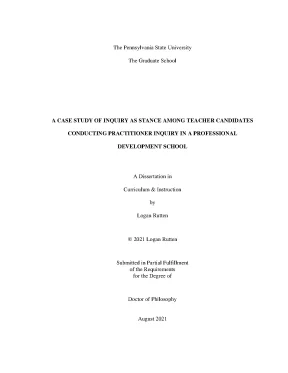
Tải xuống để đọc toàn bộThe Pennsylvania State University The Graduate School A CASE STUDY OF INQUIRY AS STANCE AMONG TEACHER CANDIDATES CONDUCTING PRACTITIONER INQUIRY IN A PROFESSIONAL DEVELOPMENT SCHOOL A Dissertation in Curriculum & Instruction by Logan Rutten © 2021 Logan Rutten Submitted in Partial Fulfillment of the Requirements for the Degree of Doctor of Philosophy August 2021 ii The dissertation of Logan Rutten was reviewed and approved by the following: Rachel Wolkenhauer Assistant Professor of Education (Curriculum & Instruction) Dissertation Advisor Chair of Committee Bernard Badiali Associate Professor of Education (Curriculum & Instruction) Amy Crosson Assistant Professor of Education (Curriculum & Instruction) Dana Mitra Professor of Education (Education Policy Studies) Kimberly Powell Professor of Education (Curriculum & Instruction), Art Education, Music Education, and Asian Studies Director of Graduate Studies in Curriculum & Instruction iii ABSTRACT Teacher educators broadly agree upon the need to prepare teachers who, as lifelong learners, are poised to meet the perpetually changing demands of teaching. One widely cited approach to addressing this need is to promote the development of an inquiry stance among teacher candidates by engaging them in the cyclical process of practitioner inquiry—the systematic, intentional study of their own professional practices. Although practitioner inquiry has become a common pedagogy within preservice teacher education programs, little is known about how the empirical dimensions of the construct, inquiry as stance, actually play out among teacher candidates as they inquire. In response, this case study was conducted in order to characterize inquiry stance among teacher candidates who were engaged in practitioner inquiry during clinical internships in the context of a professional development school (PDS).
This study features a case analysis of inquiry as stance within a PDS in which practitioner inquiry served as a signature pedagogy. Six teacher candidates each participated in a series of five semi-structured interviews as the study’s primary data source; documents and field notes from participant-observations served as secondary data sources. Interpreting these sources through a four-dimensional framework for inquiry as stance, the data were analyzed in a four-cycle, theory-led thematic analysis. This analysis led to the generation of themes and frameworks to describe the characteristics of each dimension of inquiry as stance as it played out in the study’s context.
The study’s findings indicate the diversity, complexity, and richness within the inquiry stance construct. The findings suggest the need for teacher educators, particularly those working within PDS contexts, to engage in ongoing professional learning in which iv the purposes of practitioner inquiry and inquiry as stance are continually questioned and deliberated. In addition to suggesting avenues for future research about inquiry stance, the study provides a warrant for expanded research on the learning of teacher educators, supervisors, and professional developers as well as the contributions of PDSs to the characteristics of teacher candidates’ inquiry stances. The study affirms the perennial relevance of promoting an inquiry stance as a worthy aim of teacher education.
v TABLE OF CONTENTS LIST OF FIGURES. viii LIST OF TABLES. 1 Background and Statement of the Research Problem. 2 Statement of Purposes and Research Question.
9 Overview of the Research Design. 10 Significance of the Study. 12 A REVIEW OF LITERATURE. 14 The Practitioner Inquiry Movement.
15 Demarcating the Movement: Definitions and Terminology. 15 Underpinnings of the Movement. 20 Research on Practitioner Inquiry in Preservice Teacher Education. 25 Practitioner Inquiry and Inquiry as Stance.
31 A Conceptual Framework for Inquiry as Stance. 31 Empirical Research on Inquiry Stance. 37 Toward an Analytic Framework for Studying Inquiry as Stance. 64 Linking Moderate Constructivism and Pragmatism to Qualitative Case Study.
66 Research Design and Methods. 71 Case Definition and Boundaries. 72 Identification of Case and Study Context. 74 Identification of Participants.
94 Issues of Research Ethics. 103 A Useful Framework for Describing a PDS as a Teacher Education Context. 108 The Historical Legacy of the PDS. 108 Roles and Relationships in the PDS.
114 vi Guiding Beliefs and Principles of the RVSU-RVSD PDS: The NAPDS Nine Essentials. 114 Support Structures in the PDS. 118 The Curriculum for Preservice Teacher Education in the PDS. 135 The Knowledge Dimension of Inquiry as Stance.
135 Perceiving Inquiry as a Requirement. 138 Perceiving Inquiry as a Community Expectation. 143 Becoming Curious About One’s Own and Others’ Knowing. 144 Claiming a Direction for Worthy Inquiry.
150 Valuing Inquiry as an Activity that Generates Worthy Knowledge. 155 Asserting Ownership Over the Generation of Worthy Knowledge. 156 The Community Dimension of Inquiry as Stance. 158 The Collaboration Continuum.
159 Seeking Input for Independent Inquiry. 161 Cultivating Inquiry Relationships. 168 The Structure Continuum. 171 Unstructured Inquiry Activities.
172 Loosely Structured Inquiry Talk. 174 Purposefully Structured Inquiry Talk. 178 Structured Inquiry Activities. 179 The Collaboration-Structure Compass: Teacher Candidates Inquiring in Community.
182 The Practice Dimension of Inquiry as Stance. 185 Problematizing and Reinventing Practice Through Inquiry. 187 Anywhere, Anytime, Anyone: Stretching the Legitimate Contexts for Inquiry. 188 The Purpose Dimension of Inquiry as Stance.
191 Process Completion Purpose. 197 Instrumental/Efficiency Purpose. 199 Social Change Purpose. 208 Conclusion and Chapter Summary.
210 DISCUSSION AND IMPLICATIONS. 218 For Local Practice. 219 For Teacher Education Programs. 227 vii Limitations, Opportunities for Future Research, and Conclusions.
239 APPENDIX A: CODE BOOK WITH A PRIORI CODES AND DEFINITIONS. 259 APPENDIX B: INQUIRY STANCE REFLECTION CHECKLIST. 261 APPENDIX C: MONTHLY INTERVIEW PROTOCOL. 262 viii LIST OF FIGURES Figure 2-1: Cycle of inquiry, adapted from Dana et al.
17 Figure 2-2: Conceptual framework for inquiry as stance (Adapted from Cochran-Smith & Lytle, 2009, p. 34 Figure 2-3: Analytic framework for inquiry as stance (Adapted from Cochran-Smith & Lytle, 2009, p. 54 Figure 3-1: Crotty’s (1998) four-element framework for social research, synthesized with Yin’s (2018) five elements of case study research design. 61 Figure 3-2: Holistic, single-case study design, adapted from Yin (2018, p.
73 Figure 3-3: Systematic transcription process. 84 Figure 3-4: Process of four-cycle, theory-led thematic analysis. 105 Figure 4-2: Burns’s (2012) magnification of the connecting link in Zeichner’s (2006) framework. 106 Figure 4-3: Modification of Burns’s (2012) connecting link.
107 Figure 5-1: The project-stance continuum within the Knowledge dimension. 137 Figure 5-2: May’s annotations of the inquiry cycle (May, Interview 2/5, 2. 154 Figure 5-3: The collaboration continuum. 159 Figure 5-4: The structure continuum.
172 Figure 5-5: The collaboration-structure compass within the Community dimension. 182 Figure 5-6: Themes within the Practice dimension. 186 ix Figure 5-7: Overlapping, interconnected inquiry purposes within the Purpose dimension. 192 x LIST OF TABLES Table 2-1: Terminology for practitioner inquiry.
20 Table 3-1: Relevant documents by source and type. 87 Table 5-1: Project-stance continuum themes and illustrative quotations. 138 Table 5-2: Inquiry purposes, definitions, and illustrative quotations. 193 xi ACKNOWLEDGEMENTS This dissertation would never have been possible without the support of many people, those named and those unnamed, whose generosity and kindness shaped these pages.
I would like to express my deepest appreciation to Dr. Rachel Wolkenhauer, my advisor and committee chair, for sparking my interest in practitioner inquiry, for continually challenging me as a scholar and teacher educator, and for her unwavering support. It has been the privilege of a lifetime to inquire alongside Dr. I would like to extend my sincere appreciation to each of my committee members—Dr.
Bernard Badiali, Dr. Amy Crosson, Dr. Dana Mitra, and, prior to her retirement, Dr. I am particularly grateful to Dr.
Badiali for introducing me to the power of metaphor in supervision, for encouraging my persistent questions about methodology, and for his untold hours of steady mentorship. Crosson introduced me to the generative and joyful potential of integrative scholarship. She pushed me as a scholar and a writer, and she taught me the value of looking for inspiration in fields of study beyond my own. Mitra showed me how to challenge ideas firmly but with kindness.
She championed some of my earliest efforts at scholarly writing, and she taught me how to persevere through even the most daunting writing challenges. Kornhaber deepened my understanding of the power of a good question, and she encouraged my interest in qualitative research at a key juncture in my doctoral program. I am profoundly indebted to the six teacher candidates who participated in this study. They have taught me so much about how to teach teachers.
They cheerfully answered my endless questions and innumerable follow-ups. They dug through their xii papers and computer files to help with my inquiry, and they welcomed me into their own inquiries with open arms. They amazed me with their dedication to becoming students of their students, and they showed me how to become a better student of mine. I would like to thank all of the teachers in my life, especially those from the Bismarck Public Schools in Bismarck, North Dakota and from Concordia College in Moorhead, Minnesota.
In particular, I wish to acknowledge Mrs. Jo Lynde, Mrs. Debra Emerson, Ms. Linda Brandt, Mrs.
Ann Pearce, Dr. Edward Schmoll, Dr. Heather Waddell, Dr. Chabora, and Dr.
In the company of these, some of the greatest of my teachers, I include all of my students. If any of my students from the past, present, or future should happen to read these words, know that you are a constant source of wonder and inspiration. This work is for you. Many members of my family have been with me every step of the way.
My maternal grandmother, Mrs. Betty Bloomquist, cheered me on through the move to Pennsylvania and into graduate school. Her precious memory is a daily reminder of what it means to be a reader, a wonderer, and a lifelong learner. My aunt and uncle, Patricia and Gary Helfenstein, provided encouragement and the “toads of Irish love” that were needed both to start this degree and to see it through to the end.
As I pushed onward, my parents, Robert and Caryl Rutten, kept me grounded through long phone calls, stories from my home soil, and boundless love. My brother, Lucas Rutten, helped me keep a sense of humor and stay connected to the arts during graduate school. I reserve my final thanks for my duet partner, my best friend, and my wife, Heather Rutten, without whom I cannot imagine this journey. 1 CHAPTER 1 INTRODUCTION This dissertation study investigated how the construct of inquiry as stance (Cochran-Smith & Lytle, 1999, 2009) played out among teacher candidates who were engaged in practitioner inquiry during clinical internships within the context of a professional development school (PDS).
The study sought to expand the literature on practitioner inquiry in preservice teacher education programs through an empirical analysis of one manifestation of inquiry as stance. The study also sought to create some useful and potentially transferrable tools that could inform the work of teacher educators, supervisors, and other people who are responsible for supporting the development of teacher candidates. To achieve these aims, the researcher adopted a case study methodology and developed a case analysis that was synthesized from the perspectives of the study’s participants as revealed through interviews, documents, and participant- observations. Six teacher candidates who were conducting practitioner inquiry—the systematic, intentional study by educators of their own professional practices (Cochran- Smith & Lytle, 1993, 2009)—participated in this study during their clinical internships in a PDS in which teacher educators widely regarded practitioner inquiry as a signature pedagogy (Shulman, 2005) for developing teacher candidates’ inquiry stances.
Chapter 1 opens the dissertation with an explanation and justification of the research problem that was addressed by this study. Next, the study’s purposes and research question are presented, followed by an overview of the research design. Then, the study’s significance is situated within the fields of teacher education and PDS 2 scholarship. The chapter concludes with a brief summary and an overview of the dissertation’s subsequent chapters.
Nội dung được bảo vệ bản quyền — Tải xuống đầy đủ
Trích dẫn luận án này
Logan Rutten (2021). Dissertation final lr 6 17 21 [Luận án tiến sĩ, The Pennsylvania State University]. LuanAn.net. https://luanan.net/khoa-hoc-giao-duc/dissertation-final-lr-6-17-21
Câu hỏi thường gặp
Luận án "Dissertation final lr 6 17 21" nghiên cứu về vấn đề gì?
Luận văn cuối khóa LR 6 17 21: Phân tích chuyên sâu các phương pháp và ứng dụng mới nhất trong lĩnh vực.
Luận án "Dissertation final lr 6 17 21" được bảo vệ tại trường nào?
Luận án này được bảo vệ tại The Pennsylvania State University. Năm bảo vệ: 2021.
Luận án "Dissertation final lr 6 17 21" thuộc chuyên ngành gì?
Luận án "Dissertation final lr 6 17 21" thuộc chuyên ngành Curriculum & Instruction. Danh mục: Khoa Học Giáo Dục.
Luận án "Dissertation final lr 6 17 21" có bao nhiêu trang?
Luận án "Dissertation final lr 6 17 21" có 278 trang. Bạn có thể xem trước một phần tài liệu ngay trên trang web trước khi tải về.
Cách tải luận án "Dissertation final lr 6 17 21" về máy như thế nào?
Để tải luận án về máy, bạn nhấn nút "Tải xuống ngay" trên trang này, sau đó hoàn tất thanh toán phí lưu trữ. File sẽ được tải xuống ngay sau khi thanh toán thành công. Hỗ trợ qua Zalo: 0559 297 239.