A single subject evaluation of facilitated communication in the c
Đánh giá đơn lẻ về giao tiếp được hỗ trợ, khám phá hiệu quả và thách thức trong các ứng dụng thực tế.
Antioch University Seattle
Tâm lý học (Doctor of Psychology)
Luan An
Luận án
Năm xuất bản
Số trang
318
Thời gian đọc
48 phút
Lượt xem
0
Lượt tải
0
Phí lưu trữ
60 Point
Tổng quan nhanh
- Chủ đề:
- 1. Đánh giá Giao tiếp Hỗ trợ: Một nghiên cứu chủ thể duy nhất
- Số trang:
- 318 trang
- Trường:
- Antioch University Seattle
- Chuyên ngành:
- Tâm lý học (Doctor of Psychology)
- Tác giả:
- Nancy A. Meissner
- Năm:
- 2018
Tóm tắt nội dung luận án
I. Đánh giá Giao tiếp Hỗ trợ Một nghiên cứu chủ thể duy nhất
Nghiên cứu này thực hiện một đánh giá chủ thể duy nhất về giao tiếp hỗ trợ (Facilitated Communication - FC). Mục tiêu là phân tích khả năng hoàn thành bài tập về nhà của một nam giới 17 tuổi mắc chứng tự kỷ không nói. Phương pháp tiếp cận kết hợp các kỹ thuật định lượng và định tính. Việc này cung cấp một cái nhìn toàn diện về hiệu quả và tính hợp lệ của FC trong một bối cảnh thực tế. Các phát hiện đóng góp vào các nghiên cứu tính hợp lệ của FC. Việc đánh giá này bổ sung vào nghiên cứu về rối loạn giao tiếp. Đây là một phương pháp luận nghiên cứu can thiệp quan trọng.
1.1. Thiết kế nghiên cứu đơn lẻ
Nghiên cứu sử dụng thiết kế thực nghiệm đơn lẻ. Điều này cho phép xem xét sâu sắc một cá nhân cụ thể. Phương pháp này đặc biệt phù hợp để đánh giá các can thiệp phức tạp như giao tiếp hỗ trợ. Nó tập trung vào sự thay đổi hành vi của một chủ thể theo thời gian. Tính nghiêm ngặt của thiết kế đơn lẻ tăng cường độ tin cậy của các phát hiện.
1.2. Đối tượng và phương pháp tiếp cận
Đối tượng nghiên cứu là một thanh niên mắc rối loạn phổ tự kỷ. Anh ta là người không nói. Nhiệm vụ là hoàn thành các câu hỏi bài tập về nhà. Nghiên cứu sử dụng giao tiếp hỗ trợ làm phương tiện giao tiếp. Đây là một trường hợp điển hình trong nghiên cứu giao tiếp hỗ trợ. Việc này đòi hỏi sự đánh giá cẩn thận về các phương pháp giao tiếp thay thế và tăng cường (AAC).
1.3. Mục tiêu đánh giá giao tiếp
Mục tiêu chính là đánh giá hiệu quả của giao tiếp hỗ trợ. Nó xem xét khả năng tạo ra các phản hồi chính xác. Nghiên cứu cũng khảo sát liệu giao tiếp có độc lập với ảnh hưởng của người hỗ trợ hay không. Việc này cung cấp dữ liệu quan trọng về tính xác thực của thông điệp được tạo ra. Nó góp phần vào cuộc tranh luận về tính hợp lệ của giao tiếp hỗ trợ. Các phương pháp đánh giá thực nghiệm được áp dụng để đảm bảo tính khách quan.
II. Tính hợp lệ Giao tiếp Hỗ trợ Phân tích kết quả
Các phát hiện từ nghiên cứu cho thấy sự phức tạp trong tính hợp lệ của giao tiếp hỗ trợ. Dữ liệu chỉ ra rằng khả năng tạo ra phản hồi chính xác của người tham gia còn hạn chế trong điều kiện kiểm soát. Điều này phù hợp với các nghiên cứu trước đây về ảnh hưởng của người hỗ trợ. Tuy nhiên, trong các tường thuật tự phát, có những dấu hiệu của giao tiếp đích thực. Sự khác biệt này là trọng tâm của cuộc tranh luận về tính hiệu quả của FC. Các nghiên cứu tính hợp lệ của FC vẫn cần được tiếp tục.
2.1. Phản ứng dưới điều kiện kiểm soát
Trong các điều kiện được kiểm soát chặt chẽ, người tham gia ít khi đưa ra câu trả lời đúng. Điều này xảy ra khi không có sự can thiệp đáng kể từ người hỗ trợ. Các thử nghiệm này được thiết kế để giảm thiểu thiên vị từ người hỗ trợ. Chúng nhằm đánh giá khả năng độc lập thực sự của người sử dụng FC. Kết quả này đặt ra câu hỏi về tính xác thực của giao tiếp dưới áp lực.
2.2. Giao tiếp tự phát không kiểm soát
Ngược lại, trong các tường thuật tự phát, một số tin nhắn được đánh máy dường như là giao tiếp chân thực. Những tình huống này thường ít bị kiểm soát hơn. Chúng phản ánh khả năng giao tiếp của cá nhân độc lập với sự điều khiển của người hỗ trợ. Phát hiện này làm phức tạp thêm việc đánh giá giao tiếp hỗ trợ. Nó nhấn mạnh sự cần thiết của các phương pháp đánh giá thực nghiệm đa dạng.
2.3. Ảnh hưởng của người hỗ trợ
Sự chênh lệch giữa các điều kiện kiểm soát và không kiểm soát là rất đáng chú ý. Điều này cho thấy vai trò của người hỗ trợ. Các nghiên cứu trước đây đã liên tục chỉ ra ảnh hưởng của người hỗ trợ có thể chi phối kết quả. Kết quả này củng cố các lo ngại về thiên vị của người hỗ trợ. Nó gợi ý rằng một số giao tiếp có thể không phải là của người dùng. Đây là một vấn đề quan trọng trong nghiên cứu rối loạn giao tiếp.
III. Nghiên cứu Giao tiếp Hỗ trợ Bối cảnh lịch sử và tranh cãi
Giao tiếp hỗ trợ (FC) đã có một lịch sử gây tranh cãi. Việc sử dụng nó cho người mắc rối loạn phổ tự kỷ đã gây ra nhiều cuộc tranh luận nảy lửa. Các nghiên cứu về tính hợp lệ của FC đã đưa ra những kết quả trái ngược. Một mặt, những người ủng hộ báo cáo những câu chuyện thành công đầy cảm động. Mặt khác, các nhà khoa học chỉ ra thiếu bằng chứng thực nghiệm rõ ràng. Điều này đã dẫn đến việc nhiều người coi FC là một liệu pháp ngụy khoa học.
3.1. Lịch sử và nghiên cứu FC
Lịch sử của giao tiếp hỗ trợ bắt đầu từ những năm 1970. Nó được giới thiệu như một phương pháp giúp người không nói giao tiếp. Nhiều nghiên cứu đã được thực hiện để đánh giá tính hiệu quả. Tuy nhiên, phần lớn các nghiên cứu kiểm soát đã không chứng minh được tính xác thực của thông điệp. Điều này làm gia tăng sự hoài nghi trong cộng đồng khoa học và y tế.
3.2. Tranh luận về tính xác thực
Tranh luận về tính xác thực của FC vẫn tiếp diễn. Một số người tin rằng thông điệp được tạo ra thực sự là của người dùng. Họ cho rằng các điều kiện kiểm soát gây ra lo lắng và cản trở khả năng của người dùng. Ngược lại, những người chỉ trích nhấn mạnh bằng chứng thiếu sót. Họ cho rằng thông điệp thường phản ánh ý nghĩ của người hỗ trợ. Đây là một phần của cuộc tranh cãi về ngụy khoa học trong trị liệu.
3.3. Lý thuyết truyền thống và hạn chế
Các lý thuyết truyền thống đã cố gắng giải thích sự khác biệt này. Tuy nhiên, chúng thường thiếu một cơ sở lý thuyết vững chắc. Sự thiếu sót này đã trở thành một lập luận quan trọng chống lại những người ủng hộ FC. Nó đòi hỏi một cách tiếp cận mới để hiểu các hiện tượng quan sát được. Nghiên cứu về rối loạn giao tiếp cần các mô hình giải thích mạnh mẽ hơn.
IV. Rối loạn phổ tự kỷ Cơ chế thần kinh và giao tiếp
Hiểu biết về rối loạn phổ tự kỷ đã phát triển đáng kể nhờ nghiên cứu thần kinh học. Các nghiên cứu EEG, fMRI và DTI chỉ ra tự kỷ là một rối loạn về kết nối thần kinh ở não. Đặc biệt, có sự dưới kết nối đường dài và dưới/quá kết nối đường ngắn. Những phát hiện này cung cấp một cơ sở sinh học cho các thách thức giao tiếp. Chúng mở ra con đường mới cho nghiên cứu giao tiếp ở người mắc rối loạn phổ tự kỷ.
4.1. Khám phá khoa học thần kinh
Các kỹ thuật hình ảnh thần kinh đã tiết lộ những bất thường cấu trúc não. Chúng cũng cho thấy bất thường về chức năng ở người mắc tự kỷ. Các công cụ này cho phép các nhà khoa học quan sát trực tiếp hoạt động của não. Phát hiện này đã thay đổi cách nhìn nhận về các rối loạn phát triển thần kinh. Nó giúp xác định các mục tiêu can thiệp mới.
4.2. Rối loạn kết nối thần kinh
Mô hình rối loạn kết nối thần kinh là một lý thuyết hàng đầu về tự kỷ. Sự kết nối kém hiệu quả giữa các vùng não xa nhau cản trở sự tích hợp thông tin. Sự kết nối quá mức hoặc kém hiệu quả cục bộ cũng góp phần vào các triệu chứng. Điều này ảnh hưởng đến khả năng xử lý thông tin phức tạp và lập kế hoạch vận động. Điều này có liên quan trực tiếp đến các thách thức trong giao tiếp.
4.3. Hội nhập cảm giác vận động
Nghiên cứu mới nổi liên kết những phát hiện thần kinh học với hành vi. Nghiên cứu cảm giác vận động đã lâu bị bỏ qua. Các tài khoản trực tiếp cũng chỉ ra sự tích hợp cảm giác bất thường. Lập kế hoạch vận động không chuẩn là những đặc điểm cốt lõi của tự kỷ. Việc hiểu rõ những khía cạnh này rất quan trọng để phát triển các phương pháp can thiệp hiệu quả. Chúng bao gồm các phương pháp tăng cường giao tiếp.
V. Kết nối thần kinh trong tự kỷ Lý thuyết mới về FC
Tác giả đề xuất một lý thuyết mới để giải thích sự khác biệt trong kết quả của giao tiếp hỗ trợ. Lý thuyết này dựa trên bằng chứng kết hợp từ nghiên cứu hình ảnh thần kinh và cảm giác vận động. Nó giải thích tại sao khả năng giao tiếp thay đổi giữa điều kiện kiểm soát và không kiểm soát. Sự thiếu đồng bộ hóa kích hoạt các vùng não và dưới kết nối đường dài là chìa khóa. Những yếu tố này ảnh hưởng đến sự tích hợp cảm giác và lập kế hoạch vận động bậc cao.
5.1. Lý thuyết về sự khác biệt kết quả
Lý thuyết này cho rằng dưới kết nối thần kinh cản trở khả năng tích hợp. Điều này đặc biệt đúng khi có các yêu cầu nhận thức và cảm xúc cao. Trong các thiết kế kiểm soát, sự lo lắng và yêu cầu phức tạp làm trầm trọng thêm tình trạng này. Điều này dẫn đến khó khăn trong việc tạo ra thông điệp độc lập. Lý thuyết này cung cấp một khuôn khổ để hiểu các nghiên cứu tính hợp lệ của FC.
5.2. Ảnh hưởng của lo âu và nhận thức
Sự gia tăng lo âu và nhu cầu nhận thức/cảm xúc làm suy yếu khả năng giao tiếp. Đặc biệt trong các thiết kế nghiên cứu kiểm soát chặt chẽ. Điều này giải thích tại sao người dùng FC thể hiện khả năng khác nhau. Trong môi trường không căng thẳng, họ có thể giao tiếp tự phát hơn. Việc này cho thấy tầm quan trọng của bối cảnh trong các phương pháp đánh giá thực nghiệm.
5.3. Hướng nghiên cứu trong tương lai
Nghiên cứu về kết nối thần kinh dựa trên nhiệm vụ có thể làm sáng tỏ thêm vấn đề này. Các tiến bộ trong lĩnh vực này sẽ giải thích sự khác biệt. Đặc biệt, nó sẽ giải thích kết quả tạo ra khi đánh máy có hỗ trợ. Việc này có thể dưới điều kiện kiểm soát so với không kiểm soát. Nghiên cứu này định hình tương lai của phương pháp luận nghiên cứu trong can thiệp tự kỷ.
Mục lục chi tiết luận án
Tải xuống file đầy đủ để xem toàn bộ nội dung
Tải đầy đủ (318 trang)Trích đoạn nội dung luận án
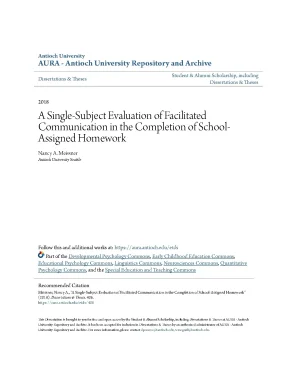
Tải xuống để đọc toàn bộAntioch University AURA - Antioch University Repository and Archive Student & Alumni Scholarship, including Dissertations & Theses Dissertations & Theses 2018 A Single-Subject Evaluation of Facilitated Communication in the Completion of School- Assigned Homework Nancy A. Meissner Antioch University Seattle Follow this and additional works at: https://aura.edu/etds Part of the Developmental Psychology Commons, Early Childhood Education Commons, Educational Psychology Commons, Linguistics Commons, Neurosciences Commons, Quantitative Psychology Commons, and the Special Education and Teaching Commons Recommended Citation Meissner, Nancy A., "A Single-Subject Evaluation of Facilitated Communication in the Completion of School-Assigned Homework" (2018).edu/etds/406 This Dissertation is brought to you for free and open access by the Student & Alumni Scholarship, including Dissertations & Theses at AURA - Antioch University Repository and Archive. It has been accepted for inclusion in Dissertations & Theses by an authorized administrator of AURA - Antioch University Repository and Archive. For more information, please contact dpenrose@antioch.edu, wmcgrath@antioch.
A SINGLE-SUBJECT EVALUATION OF FACILITATED COMMUNICATION IN THE COMPLETION OF SCHOOL-ASSIGNED HOMEWORK A Dissertation Presented to the Faculty of Antioch University Seattle Seattle, WA In Partial Fulfillment of the Requirements for the Degree Doctor of Psychology By Nancy A. Meissner December 2017 A SINGLE-SUBJECT EVALUATION OF FACILITATED COMMUNICATION IN THE COMPLETION OF SCHOOL-ASSIGNED HOMEWORK This dissertation, by Nancy A. Meissner, has been approved by the committee members signed below who recommend that it be accepted by the faculty of Antioch University Seattle in Seattle, WA in partial fulfillment of requirements for the degree of DOCTOR OF PSYCHOLOGY Dissertation Committee: _________________________ Alejandra Suarez, Ph. Chairperson _________________________ Jane Harmon-Jacobs, Ph.
_________________________ Sara Paul, Ed. ________________ Date ii ©Copyright by Nancy A. Meissner, 2017 All Rights Reserved iii 1 ABSTRACT A SINGLE-SUBJECT EVALUATION OF FACILITATED COMMUNICATION IN THE COMPLETION OF SCHOOL-ASSIGNED HOMEWORK Nancy A. Meissner Antioch University Seattle Seattle, WA Few projects have combined quantitative and qualitative approaches in the analysis of facilitated communication as did this study of a 17-year-old nonverbal autistic male responding to homework questions using facilitated communication.
Findings were consistent with prior studies: Tim was minimally able to produce correct responses independent of facilitator influence under controlled conditions; whereas, at least some typed messages in the spontaneous narratives appear to be his authentic communications independent of facilitator control. An overview of the history of facilitated communication, its related research, and the heated debates around its validity are presented. Disparate findings between controlled and non- controlled circumstances are examined, first within a traditional paradigm, and then within the framework of the past decade’s sensorimotor and neuroimaging research. EEG, fMRI, and DTI neuroimaging studies indicate autism is a disorder of disrupted cerebral neural connectivity - specifically of long-range neural underconnectivity and short-range over- and, to a lesser degree, under-connectivity.
Research linking these findings with the long-discounted sensorimotor behavioral research (and firsthand accounts) indicating aberrant sensory integration and motor planning processes are core features of autism has just begun. 2 A key argument against advocates’ explanations for FC being authentic in some situations but not in others has been with their lack of a substantiating theory. Based on combined evidence from neuroimaging and sensorimotor research, this author theorizes that dyssynchronous activation of brain regions and long-range underconnectivity necessary for higher order integration of sensory input and motor planning, which are exacerbated by increased anxiety and cognitive and emotional demands imposed by controlled designs, explain the disparities between abilities to respond under controlled versus non-controlled conditions. As demonstrated through neuroimaging research, widespread disrupted cerebral neural connectivity appears to be the fundamental neurological mechanism underlying autism with its associated behaviors that have for too-long been socially interpreted and misinterpreted rather than neurologically explained.
This author proposes that as task-based neuroconnectivity research advances, the disruptions in neural connectivity will account for the differing outcomes produced when typing with facilitation under controlled versus non-controlled conditions. This dissertation is available in open access at AURA, http://aura.edu/ and Ohio Link ETD Center, https://etd. Keywords: facilitated communication, autism, supported typing, underconnectivity, sensorimotor integration Dedication It is with deep gratitude that I dedicate this work to Tim, his family, and his aides/facilitators for sharing your lives and experiences, for your perseverance in fighting for the rights of those with disabilities, for your investment of time and energy in seeing this project through to its completion, and for your dedication to contributing to the body of knowledge addressing facilitated communication and the nature of autism. It is also with respect and gratitude that I dedicate this work to all autistics and their families and facilitators who have “spoken out” either verbally or in writing about their internally-lived experiences of autism – on their own behalf as well as on the behalf of all who are and may remain unable or as yet have been unable to communicate their experiences.
Finally, I am grateful to those researchers and clinicians who have listened to and heard those voices, to the firsthand accounts of those who are best qualified to guide science into the most salient and productive avenues toward uncovering the underlying pathogenesis of autism and toward correctly understanding the behaviors that have for too long been misinterpreted and labeled based on etically-constructed and often false assumptions. iv Acknowledgments I want to thank my committee members, family, and friends who encouraged me and believed I could complete this project when I faltered under life’s challenges. It was a difficult, convoluted, and demanding journey that led first through false starts and dead ends, then through frustration and disappointment, and finally through deep mires of information into discovery and understanding. It was a journey that ultimately opened onto a clearing of more comprehensive understandings of autism specifically and scientific methods generally than I had ever imagined.
I especially want to thank Alex, my committee chair, who never failed to support me, but who also challenged me to follow where the leads demanded I go whether or not that was where I had intended or wanted to go; who, while trying her hardest to protect me from my sometimes compulsive pursuit of thoroughness, also taught me the most valuable of research lessons - to stay the course, with dogged discipline no matter how difficult, of pursuing objective scientific inquiry. In the end, this discipline of objectivity taught me to deeply appreciate and embrace two tenets of scientific research – Embrace Paradox: “How wonderful that we have met with a paradox. Now we have some hope of making progress” (Niels Bohr, n.) And examine both the old and the recent with new eyes: “The real voyage of discovery consists not in seeking new landscapes, but in having new eyes” (Marcel Proust, n. v Table of Contents Page Dedication .v List of Tables.
xi List of Figures. xii Chapter I: Introduction .1 More Than a Question of Authorship .2 Firsthand Accounts and Autobiographies .7 Making the Case .14 Chapter II: Literature Review .18 Autism and Intellect .18 Iterations of the Definition of Autism: Has There Been any Substantive Change?. 29 Historical Background of Facilitated Communications .38 The early years. 40 Early empirical test designs.
43 Modifications to empirical test designs. 45 The “resurgence” of facilitated communication. 50 Alternative methods of testing facilitated communication. 59 The Essence of Autism.
66 vi Early brain development .69 The not-so-quiet revolution.71 Neuroimaging brain research. 78 Functional magnetic resonance imaging (fMRI). 80 Diffusion tensor imaging studies. 91 Motor system behavioral research.
102 Sensory systems behavioral research. 110 Multisensory and sensorimotor integration research. 124 Inertia, control, and getting stuck .127 Associative thought patterns .129 Difficulty/inability to stop feeling the change .137 Compensating for an unreliable sense by other senses .138 Other possible sensory and cognitive experiences.139 vii Chapter III: Methods. 145 Sensory integration and perception .149 Developmental history of communication.
151 Facilitators and assistants. 155 Equipment and Materials .155 Preliminary baseline and ceiling ability levels .156 Testing facilitated communication. 157 Chapter IV: Results .161 Preliminary Baseline and Ceiling Levels .162 Qualitative Analysis of Narratives .165 Session 1, pages 2, 3, and top of 4. 166 viii Supplemental Session 2 .170 Facilitator style and influence.
196 Typing from copy. 196 Receptive auditory vocabulary. 197 Quantitative Analysis of Test Results .204 Design elements of controlled testing .210 Qualitative Discussion of Narratives .212 Narrative day 1, Session 1 .210 Facilitator over-control .219 ix Linguistic process analysis .222 The final day, Session 4. 228 Equivocal evidence: Sessions 4, 4, 5, and 5a .233 Qualitative analysis summary .234 Portfolios and anecdotal reports.235 Chapter VI: Conclusions, Weaknesses, Recommendations .241 Journey, Stage One .241 Journey, Stage Two .245 Weaknesses of the Study .254 Appendix A: Word and Photo List .274 Appendix B: Baseline Data: Independent Pointing, Typing, and Receptive Language .276 Appendix C: Daily Protocol Sheets .278 Appendix D: First Responses to Homework Questions: Quantitative Scores .289 Appendix E: Supplemental Communication Sessions: Quantitative Scores .293 Appendix F: Categorization of Typos.296 Appendix G: Permission to Use Copyrighted Figure .301 x List of Tables Page 1.
Possible Internal (self) versus External (other) Orientations of Awareness. Number and Orientation of Errors in Keyboard Key Strikes .175 xi List of Figures Page 1. International 10-20 Electrode Placement System. Left Cerebral Cortex: Broca’s and Wernicke’s Areas.
Medial Surface Right Cerebral Cortex. Right Temporal Lobe Gyri. Cerebral Gyri: Medial Surface. The Limbic System.
Tractographic Reconstruction of Neural Connections via DTI. Diffusion MRI: DTI Color Map. White Matter Fiber Tracts. Diffusion Tensor Tractographies of Neural Tracts.
Superior Longitudinal Fasciculus. Percent Homework Completed .164 xii 1 Chapter I: Introduction Few topics in disabilities studies or special education have incited the firestorm of controversy that swirls around facilitated communication (FC), not just in the professional literature, but also in the media, in educational and therapeutic systems, and within families and homes. In addition, few topics have been cited as often in highlighting the rift between science and practice - the scientist-practitioner gap - as has the continued use of facilitated communication. In her foreword to Lilienfeld, Lynn, and Lohr’s Science and Pseudoscience in Clinical Psychology, Tavris (2003) illustrates the scope of this “gap” as well as the fervor in the divide over the use of facilitated communication in her statement, Today, however, calling it a “gap” is like saying there is an Israeli-Arab “gap” in the Middle East.
It is a war, involving deeply held beliefs, political passions, views of human nature and the nature of knowledge and – as all wars ultimately involve – money, territory, and livelihoods. (xiv) Facilitated communication is a highly controversial form of augmentative and alternative communication (AAC), claimed by many to enable or expand the abilities of individuals with disabilities such as cerebral palsy and severe autism to communicate. Its use is based on the belief that some individuals who are unable to produce speech or use sign language may none- the-less have the mental capacity to communicate given another means to do so. Facilitated communication is a technique through which a facilitator provides emotional and psychological encouragement, varying levels of physical support, and physical resistance to the forward hand movement of the facilitated communication user (henceforth, communicators) to provide motor control.
Physical support may initially involve fully holding the hand or wrist, sometimes with additional isolation of the index finger being necessary to enable the user to select and touch 2 desired selections on a communication board, letter board, or keyboard. For others, touching the communicator’s elbow, shoulder, or back is all that is required, with the common goal being to move toward completely independent typing (Biklen, 1990; Biklen & Schubert, 1991; Crossley, 1992; Szempruch & Jacobson, 1993). More Than a Question of Authorship The most tangible question inherent in the controversy around facilitated communication is that of authorship: Who, in actuality, is doing the communicating – the facilitated communication user - the communicator - enabled by emotional and physical support, or the facilitator acting inadvertently on or through the communicator through some Ouija Board or Clever Hans phenomena?
Nội dung được bảo vệ bản quyền — Tải xuống đầy đủ
Trích dẫn luận án này
Nancy A. Meissner (2018). A single subject evaluation of facilitated communication in [Luận án tiến sĩ, Antioch University Seattle]. LuanAn.net. https://luanan.net/giao-duc-chuyen-biet/giao-duc-dac-biet/a-single-subject-evaluation-of-facilitated-communication-in-the-c
Câu hỏi thường gặp
Luận án "A single subject evaluation of facilitated communication in" nghiên cứu về vấn đề gì?
Đánh giá đơn lẻ về giao tiếp được hỗ trợ, khám phá hiệu quả và thách thức trong các ứng dụng thực tế.
Luận án "A single subject evaluation of facilitated communication in" được bảo vệ tại trường nào?
Luận án này được bảo vệ tại Antioch University Seattle. Năm bảo vệ: 2018.
Luận án "A single subject evaluation of facilitated communication in" thuộc chuyên ngành gì?
Luận án "A single subject evaluation of facilitated communication in" thuộc chuyên ngành Tâm lý học (Doctor of Psychology). Danh mục: Giáo Dục Đặc Biệt.
Luận án "A single subject evaluation of facilitated communication in" có bao nhiêu trang?
Luận án "A single subject evaluation of facilitated communication in" có 318 trang. Bạn có thể xem trước một phần tài liệu ngay trên trang web trước khi tải về.
Cách tải luận án "A single subject evaluation of facilitated communication in" về máy như thế nào?
Để tải luận án về máy, bạn nhấn nút "Tải xuống ngay" trên trang này, sau đó hoàn tất thanh toán phí lưu trữ. File sẽ được tải xuống ngay sau khi thanh toán thành công. Hỗ trợ qua Zalo: 0559 297 239.