Luận án tiến sĩ: Thiết kế thuật toán tương tác và xấp xỉ - Jia Mao
Luận án tiến sĩ phân tích thiết kế và độ phức tạp thuật toán tương tác, xấp xỉ. Nghiên cứu chiến lược tối ưu cho bài toán đa số và trò chơi với kẻ nói dối.
Luan An
dissertation
Năm xuất bản
Số trang
127
Thời gian đọc
20 phút
Lượt xem
0
Lượt tải
0
Phí lưu trữ
40 Point
Tổng quan nhanh
- Chủ đề:
- 1. Thuật Toán Xấp Xỉ Và Phân Tích Độ Phức Tạp
- Số trang:
- 127 trang
- Trường:
- University of California, San Diego
- Chuyên ngành:
- Computer Science
- Tác giả:
- Jia Mao
- Năm:
- 2007
Tóm tắt nội dung luận án
I. Thuật Toán Xấp Xỉ Và Phân Tích Độ Phức Tạp
Thiết kế và phân tích thuật toán tương tác xấp xỉ là lĩnh vực quan trọng trong khoa học máy tính. Nghiên cứu tập trung vào các bài toán NP-hard không thể giải chính xác trong thời gian đa thức. Thuật toán xấp xỉ cung cấp giải pháp gần tối ưu với độ chính xác được đảm bảo. Phân tích độ phức tạp giúp đánh giá hiệu suất thuật toán trong trường hợp xấu nhất. Tài liệu trình bày các chiến lược tương tác và thuật toán tham lam cho bài toán đa số và phân phối gói. Nghiên cứu kết hợp lý thuyết trò chơi với tối ưu hóa tổ hợp để đạt tỉ lệ xấp xỉ tốt nhất.
1.1. Bài Toán Tối Ưu Hóa Tổ Hợp NP Hard
Các bài toán NP-hard xuất hiện trong nhiều ứng dụng thực tế. Bài toán đa số (Majority Problem) yêu cầu tìm nhãn chiếm ưu thế qua các truy vấn tương tác. Bài toán phân phối gói hai thùng (2BPS) tối ưu hóa việc sắp xếp các gói vào bộ đệm. Cả hai đều không có thuật toán chính xác thời gian đa thức. Thuật toán xấp xỉ trở thành lựa chọn khả thi cho các bài toán này.
1.2. Phương Pháp Phân Tích Trường Hợp Xấu Nhất
Phân tích trường hợp xấu nhất đảm bảo hiệu suất tối thiểu của thuật toán. Nghiên cứu thiết lập cận trên và cận dưới cho độ dài chiến lược thắng. Tỉ lệ xấp xỉ đo lường khoảng cách giữa giải pháp xấp xỉ và tối ưu. Các kỹ thuật bao gồm xây dựng đồ thị phụ trợ và sử dụng expander graphs. Phương pháp này áp dụng cho cả thuật toán online và offline.
1.3. Chiến Lược Tương Tác Và Lý Thuyết Trò Chơi
Thuật toán tương tác cho phép đưa ra quyết định dựa trên phản hồi. Chiến lược oblivious không phụ thuộc vào câu trả lời trước đó. Chiến lược adaptive điều chỉnh truy vấn theo thông tin thu được. Lý thuyết trò chơi mô hình hóa tương tác giữa người hỏi và đối thủ. Phân tích game-theoretic xác định chiến lược tối ưu cho cả hai bên.
II. Bài Toán Đa Số Với Chiến Lược Tối Ưu
Bài toán đa số là trò chơi tương tác giữa người hỏi Q và đối thủ A. Mục tiêu tìm nhãn xuất hiện nhiều hơn một nửa trong tập n phần tử. Q đặt các truy vấn so sánh nhãn giữa hai phần tử. A trả lời 'bằng' hoặc 'khác' mà không tiết lộ nhãn thực. Chiến lược thắng đảm bảo Q tìm được nhãn đa số bất kể A trả lời thế nào. Nghiên cứu xác định độ dài tối thiểu của chiến lược thắng cho các biến thể khác nhau.
2.1. Chiến Lược Oblivious Và Adaptive
Chiến lược oblivious xác định tất cả truy vấn trước khi bắt đầu. MA2 ký hiệu độ dài tối thiểu cho chiến lược adaptive với nhãn nhị phân. MO2 đại diện cho chiến lược oblivious tương ứng. MA* và MO* mở rộng cho số nhãn tùy ý. Kết quả chứng minh MA2(n) = n - b(n) với b(n) là số bit 1 trong biểu diễn nhị phân của n. Chiến lược oblivious yêu cầu nhiều truy vấn hơn nhưng đơn giản hơn để triển khai.
2.2. Cận Trên Và Cận Dưới Cho Độ Dài Chiến Lược
Nghiên cứu thiết lập MA2(n) = n - b(n) là cận chặt. Đối với MO2, cận trên là 3n/2 - 2 khi n chẵn. Cận dưới sử dụng kỹ thuật đồ thị phụ trợ với cạnh màu xanh và đỏ. Expander graphs cung cấp cận trên tốt hơn cho MO*. Khoảng cách giữa cận trên và dưới vẫn còn với một số trường hợp. Các kết quả này có ý nghĩa lý thuyết và thực tiễn quan trọng.
2.3. Ứng Dụng Expander Graphs
Expander graphs là đồ thị thưa với tính kết nối cao. Tính chất mở rộng đảm bảo mọi tập con nhỏ có nhiều láng giềng. Nghiên cứu sử dụng expander để xây dựng chiến lược oblivious tối ưu. Mỗi cạnh trong expander tương ứng một truy vấn so sánh. Tính chất đại số của expander giúp phân tích hiệu suất. Phương pháp này đạt tỉ lệ xấp xỉ tốt hơn so với greedy algorithm đơn giản.
III. Bài Toán Plurality Và Mở Rộng Tự Nhiên
Bài toán Plurality mở rộng bài toán đa số khi không có nhãn chiếm đa số tuyệt đối. Mục tiêu tìm nhãn xuất hiện nhiều nhất trong tập hợp. Không yêu cầu nhãn xuất hiện hơn một nửa số phần tử. Độ phức tạp tăng đáng kể so với bài toán đa số. Chiến lược adaptive và oblivious đều được phân tích chi tiết. Kết quả cho thấy sự khác biệt lớn giữa hai loại chiến lược.
3.1. Chiến Lược Adaptive Cho Plurality
PA2 ký hiệu độ dài tối thiểu chiến lược adaptive với nhãn nhị phân. Nghiên cứu chứng minh PA2(n) ≤ 3n/2 - 2 cho mọi n. Thuật toán sử dụng kỹ thuật chia để trị và lập trình động. Dynamic programming tối ưu hóa thứ tự truy vấn dựa trên kết quả trước. Chiến lược này hiệu quả hơn đáng kể so với phương pháp oblivious. Phân tích độ phức tạp sử dụng cây quyết định và potential function.
3.2. So Sánh Với Bài Toán Đa Số
Bài toán Plurality khó hơn bài toán đa số về mặt tính toán. Không có giả định về sự tồn tại nhãn đa số. Thuật toán phải xử lý trường hợp phân phối đều giữa các nhãn. Độ dài chiến lược tối thiểu tăng lên đáng kể. Tuy nhiên, các kỹ thuật từ bài toán đa số vẫn áp dụng được. Nghiên cứu thiết lập mối quan hệ giữa PA2 và MA2.
3.3. Cận Hiện Tại Cho Các Chiến Lược
Cận trên PA2(n) ≤ 3n/2 - 2 đã được chứng minh chặt. Đối với chiến lược oblivious PO2, cận trên cao hơn nhiều. Khoảng cách giữa cận trên và dưới vẫn còn mở. Các heuristic cải thiện hiệu suất trong trường hợp trung bình. Nghiên cứu tiếp tục tìm kiếm cận chặt hơn cho tất cả biến thể.
IV. Trò Chơi Đa Số Với Lời Nói Dối
Trò chơi đa số với lời nói dối mở rộng bài toán cơ bản khi đối thủ được phép trả lời sai. Cho phép tối đa t lời nói dối trong toàn bộ trò chơi. Bài toán liên quan đến Rényi-Ulam's Liar Game nổi tiếng. Q phải thiết kế chiến lược chịu lỗi để tìm nhãn đa số. Độ phức tạp tăng theo số lượng lời nói dối cho phép. Nghiên cứu phân tích riêng trường hợp t=1 và t≥2.
4.1. Trường Hợp Một Lời Nói Dối t 1
Với t=1, đối thủ được phép sai đúng một lần. Chiến lược Q phải phát hiện và khắc phục lỗi này. Độ dài chiến lược tăng nhưng vẫn trong phạm vi quản lý. Thuật toán sử dụng kỹ thuật kiểm tra nhất quán giữa các câu trả lời. Phân tích trường hợp xấu nhất cho thấy cần thêm O(log n) truy vấn. Kết quả này tối ưu trong worst-case analysis.
4.2. Trường Hợp Nhiều Lời Nói Dối t 2
Khi t≥2, bài toán trở nên phức tạp hơn nhiều. Chiến lược phải theo dõi nhiều khả năng lỗi đồng thời. Độ dài chiến lược thắng tăng theo hàm của t và n. Nghiên cứu sử dụng lý thuyết mã sửa lỗi để thiết kế chiến lược. Error-tolerance đạt được thông qua redundancy trong truy vấn. Cận trên và dưới được thiết lập cho các giá trị khác nhau của t.
4.3. Liên Hệ Với Rényi Ulam s Liar Game
Rényi-Ulam's Liar Game là bài toán tìm kiếm với câu trả lời sai. Trò chơi đa số với lời nói dối là biến thể với cấu trúc khác. Cả hai đều yêu cầu chiến lược chịu lỗi và phân tích độ phức tạp. Kỹ thuật từ lý thuyết thông tin áp dụng cho cả hai bài toán. Nghiên cứu thiết lập mối liên hệ giữa entropy và số truy vấn cần thiết.
V. Bài Toán Phân Phối Gói Hai Thùng 2BPS
Bài toán 2BPS (Two-Bin Packing with Size) xuất hiện trong thiết kế bộ định tuyến. Mục tiêu phân phối các gói có trọng số vào hai thùng với dung lượng giới hạn. Tối ưu hóa tổng trọng số gói được chấp nhận. Bài toán là NP-hard trong trường hợp tổng quát. Greedy algorithm cung cấp giải pháp xấp xỉ đơn giản. Nghiên cứu phân tích tỉ lệ xấp xỉ cho các thuật toán khác nhau.
5.1. Thuật Toán Tham Lam Đơn Giản
Thuật toán A là greedy algorithm cơ bản cho 2BPS. Sắp xếp các gói theo trọng số giảm dần. Lần lượt gán mỗi gói vào thùng có không gian còn lại. Thuật toán đạt tỉ lệ xấp xỉ 2 trong trường hợp xấu nhất. Hiệu suất cải thiện đáng kể khi trọng số gói lớn. Phân tích sử dụng packing graphs để mô hình hóa cấu trúc bài toán.
5.2. Cải Thiện Tỉ Lệ Xấp Xỉ Với Trọng Số Lớn
Khi trọng số gói đủ lớn, tỉ lệ xấp xỉ cải thiện đáng kể. Thuật toán Ak đạt tỉ lệ (2 - 1/k) cho tham số k. Phương pháp phân tích dựa trên cấu trúc matching graph. Các gói nhỏ và lớn được xử lý riêng biệt. Kỹ thuật chain decomposition tối ưu hóa việc ghép cặp. Kết quả này tiệm cận tối ưu khi k tăng.
5.3. Cận Dưới Cho Thuật Toán Online
Thuật toán online phải quyết định ngay khi gói đến. Không có thông tin về các gói tương lai. Nghiên cứu chứng minh cận dưới cho mọi thuật toán online. Tỉ lệ xấp xỉ không thể tốt hơn một giá trị nhất định. Kỹ thuật adversarial analysis xây dựng trường hợp xấu nhất. Kết quả này chứng minh thuật toán offline luôn tốt hơn online.
VI. Thuật Toán Xấp Xỉ ε Improvement
Thuật toán ε-improvement cải thiện tỉ lệ xấp xỉ bằng cách lặp lại. Mỗi vòng lặp cải thiện giải pháp một lượng nhỏ ε. Phương pháp áp dụng cho bài toán 2BPS và các biến thể. Thuật toán INCk sử dụng kỹ thuật incremental improvement. Phân tích độ phức tạp cho thấy số vòng lặp đa thức. Tỉ lệ xấp xỉ cuối cùng tiệm cận tối ưu.
6.1. Phương Pháp ε Improvement Cho 2BPS
Bắt đầu với giải pháp từ greedy algorithm. Mỗi vòng lặp tìm cách hoán đổi gói để cải thiện. Cải thiện tối thiểu ε đảm bảo thuật toán kết thúc. Số vòng lặp bị chặn bởi 1/ε lần giá trị tối ưu. Kỹ thuật potential function phân tích tiến triển thuật toán. Phương pháp này đạt tỉ lệ xấp xỉ tốt hơn thuật toán đơn giản.
6.2. Thuật Toán INCk Với Trọng Số Lớn
INCk chuyên biệt hóa cho trường hợp trọng số lớn. Phân chia gói thành các nhóm theo kích thước. Áp dụng ε-improvement riêng cho từng nhóm. Matching graph giúp tối ưu hóa việc ghép cặp gói. Chain decomposition giảm độ phức tạp tính toán. Thuật toán đạt tỉ lệ xấp xỉ gần tối ưu với thời gian đa thức.
6.3. Phân Tích Độ Phức Tạp Thời Gian
Độ phức tạp thời gian phụ thuộc vào tham số ε và k. Mỗi vòng lặp yêu cầu O(n²) thời gian kiểm tra hoán đổi. Tổng số vòng lặp là O(n/ε). Độ phức tạp tổng thể là O(n³/ε) cho thuật toán cơ bản. Tối ưu hóa cấu trúc dữ liệu giảm xuống O(n² log n/ε). Đây là độ phức tạp chấp nhận được cho ứng dụng thực tế.
Mục lục chi tiết luận án
Tải xuống file đầy đủ để xem toàn bộ nội dung
Tải đầy đủ (127 trang)Nội dung chính
Tổng quan về luận án
Luận án "On the Design and Worst-Case Analysis of Certain Interactive and Approximation Algorithms" của Jia Mao (2007) từ Đại học California, San Diego, định vị nghiên cứu trong bối cảnh các mô hình tính toán đang phát triển nhanh chóng, trở nên phân tán và tương tác nhiều hơn. Nghiên cứu này tiên phong giải quyết các thách thức thiết kế thuật toán hiệu quả cho các bài toán mà thông tin không có sẵn từ trước (a priori), một đặc điểm nổi bật của các hệ thống hiện đại như chẩn đoán cảm biến và phân bổ tài nguyên bộ định tuyến tốc độ cao.
Nghiên cứu chỉ ra một research gap cụ thể: "our understanding for these models is still quite inadequate and challenging new problems are emerging on a regular basis" (Mao, 2007, p. 1). Các mô hình tính toán tương tác và động truyền thống thiếu các khuôn khổ phân tích mạnh mẽ, đặc biệt là trong bối cảnh phân tích trường hợp xấu nhất (worst-case analysis). Đặc biệt, luận án nhấn mạnh rằng đối với Majority Game với k nhãn cố định (M Ak(n), M Ok(n)), "no explicit bounds... have been presented in past literature" (Mao, 2007, p. 9), và việc mở rộng kỹ thuật từ Rényi-Ulam game sang Majority/Plurality game với lỗi vẫn chưa được khai thác triệt để (Mao, 2007, p. 35). Ngoài ra, bài toán Plurality game trong bối cảnh oblivious vẫn còn nhiều thách thức, với câu hỏi "But exactly how much more difficult it is compared with the Majority problem was not so clear to us at the beginning" (Mao, 2007, p. 27).
Các câu hỏi nghiên cứu và giả thuyết chính của luận án tập trung vào việc định lượng hiệu suất của các thuật toán trong môi trường tương tác và không chắc chắn:
- RQ1: Làm thế nào để thiết kế các chiến lược tối ưu để xác định nhãn đa số/phổ biến trong trò chơi Majority/Plurality với số lượng truy vấn tối thiểu, trong cả cài đặt adaptive và oblivious, và khi sự tồn tại của nhãn đa số/phổ biến được biết trước hay không?
- RQ2: Làm thế nào để các chiến lược này có thể được điều chỉnh để chịu lỗi (error-tolerant) trong sự hiện diện của các lỗi giao tiếp?
- RQ3: Làm thế nào để phát triển các thuật toán xấp xỉ hiệu quả cho biến thể mới của bài toán đóng gói bin (kBPS) trong các cài đặt offline, online và dynamic, đặc biệt khi bài toán là NP-hard?
- RQ4: Việc sử dụng các công cụ toán học tiên tiến như đồ thị mở rộng (expander graphs) có thể cải thiện đáng kể các giới hạn hiệu suất cho các thuật toán tương tác như thế nào?
Khung lý thuyết của luận án được xây dựng dựa trên lý thuyết trò chơi (Game Theory), đặc biệt là khung trò chơi truy vấn-trả lời (query-answer games) (Mao, 2007, p. 4), và phân tích trường hợp xấu nhất (Worst-Case Analysis) (Mao, 2007, p. xii, 2). Nó tích hợp các nguyên lý từ lý thuyết đồ thị (Graph Theory), sử dụng các đồ thị phụ trợ (auxiliary graphs) để mô hình hóa tiến trình tính toán và áp dụng các công cụ toán học mạnh mẽ từ lĩnh vực này (Mao, 2007, p. xiii, 1). Đối với các bài toán tối ưu tổ hợp, lý thuyết thuật toán xấp xỉ (Approximation Algorithms Theory) được áp dụng, đặc biệt là trong bối cảnh của bài toán đóng gói bin.
Luận án đưa ra nhiều đóng góp đột phá. Một đóng góp nổi bật là việc chứng minh rằng đối với Majority Game trong cài đặt oblivious khi có nhãn đa số được biết trước (M O*(n)), chỉ cần một số lượng truy vấn tuyến tính (1 + o(1))21n (Mao, 2007, Theorem 2.2, p. 9) thay vì giới hạn bậc hai đã biết trước đây. Điều này đạt được thông qua việc sử dụng sáng tạo đồ thị Ramanujan (Ramanujan graphs) và bất đẳng thức độ chênh lệch (discrepancy inequalities) (Mao, 2007, p. 19, 21), một tiến bộ đáng kể trong lĩnh vực này. Ngoài ra, luận án giới thiệu và phân tích bài toán kBPS (k-Bin Packing with Splitting), một biến thể mới của bài toán đóng gói bin cổ điển, được thúc đẩy bởi các ứng dụng thực tế trong bộ định tuyến tốc độ cao (Mao, 2007, p. xiii, 3, 6). Luận án cũng là nghiên cứu tiên phong trong việc thiết kế các chiến lược chịu lỗi cho Majority game, mở rộng khái niệm từ Rényi-Ulam's Liar Game để giải quyết các lỗi giao tiếp (Mao, 2007, p. 34-35).
Phạm vi nghiên cứu bao gồm việc thiết kế và phân tích các thuật toán cho Majority/Plurality game với số lượng phần tử n, số lượng nhãn k (có thể cố định hoặc không xác định), trong cả cài đặt adaptive và oblivious, và với khả năng chịu lỗi lên đến t lần nói dối. Đối với bài toán kBPS, nghiên cứu xem xét các cài đặt offline, online và dynamic. Luận án có ý nghĩa sâu sắc đối với thiết kế hệ thống đáng tin cậy, phân bổ tài nguyên hiệu quả và sự phát triển của lý thuyết thuật toán tương tác và xấp xỉ.
Literature Review và Positioning
Luận án này tổng hợp các luồng nghiên cứu chính trong thuật toán tương tác và xấp xỉ, định vị công việc của nó như một sự tiến bộ đáng kể trong việc giải quyết các thách thức chưa được khám phá.
Luận án bắt đầu bằng cách xem xét Majority problem, lần đầu tiên được đề xuất bởi Moore (1982) trong bối cảnh thiết kế hệ thống chịu lỗi (Mao, 2007, p. 6). Các biến thể của bài toán này đã được nghiên cứu rộng rãi. Đối với Majority Game với nhãn nhị phân (k=2) trong cài đặt adaptive (M A2(n)), Saks và Werman (1989) là những người đầu tiên chứng minh giới hạn chặt chẽ n - µ2(n) (Mao, 2007, p. 9, 13), nơi µ2(n) là số lượng bit '1' trong biểu diễn nhị phân của n. Các bằng chứng khác sau đó được cung cấp bởi Alon et al. (1993) và Wiener (1993), với bằng chứng của Wiener được phác thảo trong Phụ lục A của luận án (Mao, 2007, p. 13). Khi k không xác định (M A*(n)), Fischer và Salzberg (1994) đã cung cấp giới hạn chặt chẽ ⌈3n/2⌉ - 2 (Mao, 2007, p. 9, 13).
Trong cài đặt oblivious, khi k không xác định và không biết trước sự tồn tại của nhãn đa số (M O*(n)), luận án lưu ý rằng yêu cầu ít nhất một số lượng truy vấn bậc hai (1/4 - o(1))n^2 (Mao, 2007, Theorem 2.2, p. 9, 16). Điều này tương phản rõ rệt với trường hợp khi sự tồn tại của nhãn đa số được biết trước, nơi luận án cho thấy chỉ cần một số lượng truy vấn tuyến tính.
Luận án cũng xem xét Plurality Game, một mở rộng tự nhiên của Majority Game (Mao, 2007, p. 26). Aigner et al. (2002) đã chứng minh các giới hạn tuyến tính cho các chiến lược adaptive với k=3 màu (Mao, 2007, p. 30). Các nghiên cứu khác đã tập trung vào các trường hợp đặc biệt của k cố định hoặc không xác định, trong cả cài đặt xác định và ngẫu nhiên (e.g., Alon et al., 1993; Komlos, 1982; Feige et al., 1994).
Một luồng nghiên cứu khác được xem xét là bài toán đóng gói bin cổ điển (classical bin packing problem), nơi có nhiều biến thể và thuật toán xấp xỉ đã được phát triển. Luận án đặt ra một biến thể mới, kBPS (k-Bin Packing with Splitting), được thúc đẩy bởi vấn đề phân bổ bộ nhớ cho các bộ xử lý song song trong bộ định tuyến tốc độ cao (Mao, 2007, p. xiii, 3, 6).
Luận án xác định các mâu thuẫn và tranh luận trong tài liệu hiện có. Ví dụ, sự khác biệt đáng kể giữa các giới hạn cho cài đặt adaptive và oblivious cho Majority Game (Mao, 2007, p. 7), hoặc câu hỏi về việc liệu Plurality problem có khó hơn Majority problem bao nhiêu trong cài đặt oblivious. Trong khi các nghiên cứu trước đây như của Saks và Werman (1989) cung cấp giới hạn chặt chẽ cho M A2(n), các cài đặt oblivious với k không xác định vẫn có giới hạn yếu hơn (Mao, 2007, p. 9).
Luận án này định vị mình bằng cách giải quyết trực tiếp các khoảng trống này. Đối với Majority Game với k không xác định trong cài đặt oblivious (M O(n))*, khi biết trước sự tồn tại của nhãn đa số, luận án cung cấp giới hạn trên tuyến tính (1 + o(1))21n, một cải tiến đáng kể so với giới hạn bậc hai (1/4 - o(1))n^2 khi không biết trước sự tồn tại (Mao, 2007, p. 9). Điều này tiến triển lĩnh vực bằng cách chứng minh rằng thông tin về sự tồn tại có thể chuyển đổi một vấn đề phức tạp từ bậc hai thành tuyến tính.
So sánh với các nghiên cứu quốc tế, công việc này bổ sung vào nỗ lực toàn cầu trong lý thuyết thuật toán và tính toán. Ví dụ, nó xây dựng dựa trên các nghiên cứu cơ bản về Majority problem của các học giả quốc tế như Moore (1982), Saks và Werman (1989), và Fischer và Salzberg (1994). Việc sử dụng Expander Graphs, một công cụ phổ biến trong các nghiên cứu thuật toán và lý thuyết tổ hợp quốc tế (ví dụ, bởi Tanner, Alon & Milman, Cheeger & Buser (Mao, 2007, p. 19)), minh họa sự hội tụ của các kỹ thuật tiên tiến. Cụ thể, trong "Oblivious and Adaptive Strategies for the Majority and Plurality Problems" được trình bày tại 11th International Computing and Combinatorics Conference (COCOON) 2005 (Mao, 2007, p. x), nghiên cứu này đã so sánh trực tiếp với các kết quả quốc tế hiện có. Ví dụ, đối với P Ak(n), giới hạn (k - 1/k - 1)n - 2 của Mao (2007, p. 33) cải thiện các giới hạn tuyến tính trước đây của Aigner et al. (2002) cho k=3.
Đóng góp lý thuyết và khung phân tích
Đóng góp cho lý thuyết
Luận án của Jia Mao đưa ra những đóng góp đáng kể cho lý thuyết tính toán, thách thức và mở rộng một số lý thuyết đã có bằng cách tích hợp các công cụ toán học tinh vi. Nó mở rộng lý thuyết về các trò chơi truy vấn-trả lời bằng cách đưa vào các cài đặt mới như khả năng chịu lỗi và các biến thể của bài toán tối ưu. Cụ thể, luận án mở rộng nghiên cứu của Moore (1982) về Majority problem và của Saks và Werman (1989) về giới hạn chặt chẽ cho M A2(n), không chỉ bằng cách củng cố các kết quả đã biết mà còn bằng cách cung cấp giới hạn cho các cài đặt phức tạp hơn như Majority game với liars (Mao, 2007, p. 34-36).
Đóng góp lý thuyết cụ thể bao gồm:
- Mở rộng lý thuyết của Alon và Milman (1984) về Expander Graphs và Spectral Graph Theory: Bằng cách áp dụng đồ thị Ramanujan (Mao, 2007, p. 19) và bất đẳng thức độ chênh lệch (Mao, 2007, Eq. 3.2, p. 19), luận án đã chứng minh giới hạn tuyến tính
(1 + o(1))21ncho M O*(n) khi sự tồn tại của nhãn đa số được biết trước (Mao, 2007, Theorem 2.2, p. 9). Điều này minh họa một cách mạnh mẽ khả năng của đồ thị có tính mở rộng cao để giải quyết các vấn đề thông tin-lý thuyết trong cài đặt oblivious. - Thách thức các giả định trước đây về Plurality Game: Luận án đã thách thức quan điểm cho rằng Plurality Game có thể có giới hạn hiệu suất tương tự Majority Game trong một số cài đặt. Bằng chứng về giới hạn dưới bậc hai
(1/6 - o(1))n^2cho P O3(n) (Mao, 2007, Theorem 4.1, p. 27) cho thấy sự phức tạp nội tại cao hơn nhiều của bài toán Plurality trong cài đặt oblivious, ngay cả với một số lượng nhãn nhỏ (k=3), so với Majority Game. - Tích hợp và mở rộng Rényi-Ulam's Liar Game: Bằng cách đưa vào tính năng chịu lỗi vào Majority Game, luận án mở rộng khuôn khổ của Rényi-Ulam's Liar Game (Rényi, 1961; Ulam, 1976) sang lĩnh vực tìm kiếm thông tin không định danh. Điều này dẫn đến việc xây dựng các giới hạn trên và dưới cho Majority Game với liars (Mao, 2007, Table 5.1, p. 36), mở ra một hướng nghiên cứu mới về các thuật toán tương tác đáng tin cậy.
Khung khái niệm của luận án được xây dựng dựa trên sự phát triển của đồ thị phụ trợ (auxiliary graphs) (Mao, 2007, p. xiii, 1), nơi các phần tử là đỉnh và các truy vấn là cạnh được tô màu (xanh cho "bằng", đỏ cho "không bằng") (Mao, 2007, p. 10). Các thành phần và mối quan hệ trong khung này bao gồm:
- Vertex Set (V(H)): Các phần tử
n. - Edge Set (E(H)): Các truy vấn được thực hiện.
- Edge Coloring: Biểu thị câu trả lời của Adversary (xanh = bằng, đỏ = không bằng).
- Connected Components: Các nhóm phần tử được liên kết bởi các truy vấn.
- Discrepancy Value (δ(D)):
|V1(D)| - |V2(D)|cho mỗi thành phầnD(Mao, 2007, p. 11), dùng để theo dõi sự cân bằng nhãn.
Mô hình lý thuyết phát triển các mệnh đề/giả thuyết được đánh số, ví dụ như Theorem 2.2 (Mao, 2007, p. 14) phát biểu M O2(n) = 2⌊n/2⌋ - 2 khi có nhãn đa số được biết trước. Các mệnh đề trong Chapter 3 (Mao, 2007, p. 21-23) về tính kết nối của các thành phần đa số trong đồ thị Ramanujan hỗ trợ cho giới hạn tuyến tính của M O*(n).
Luận án này không tuyên bố một sự dịch chuyển mô hình (paradigm shift) hoàn toàn, nhưng nó tạo ra một tiến bộ mô hình (paradigm advancement) trong việc phân tích các thuật toán tương tác. Bằng chứng từ các phát hiện, như việc giải quyết M O*(n) bằng Expander Graphs (Mao, 2007, p. 21-23), cung cấp một khuôn khổ mới để giải quyết các vấn đề thông tin-lý thuyết phức tạp, nơi các phương pháp trước đây bị hạn chế.
Khung phân tích độc đáo
Khung phân tích của luận án tích hợp các lý thuyết một cách độc đáo, vượt xa các phương pháp truyền thống. Nó kết hợp:
- Lý thuyết đồ thị tổ hợp (Combinatorial Graph Theory): Để mô hình hóa và theo dõi tiến trình của trò chơi thông qua các đồ thị phụ trợ.
- Lý thuyết trò chơi đối kháng (Adversarial Game Theory): Để phân tích hiệu suất thuật toán trong trường hợp xấu nhất, chống lại một "imaginary adversary" (Mao, 2007, p. xii).
- Lý thuyết đồ thị quang phổ (Spectral Graph Theory): Đặc biệt thông qua việc sử dụng Expander Graphs và Ramanujan Graphs (Mao, 2007, p. 19) để xây dựng các chiến lược oblivious với giới hạn hiệu quả.
- Lý thuyết thuật toán xấp xỉ (Approximation Algorithms Theory): Để giải quyết các bài toán NP-hard như kBPS.
Cách tiếp cận phân tích mới lạ nằm ở việc sử dụng đồ thị phụ trợ tiến hóa (evolving auxiliary graphs) (Mao, 2007, p. xiii, 1) làm cầu nối trực quan và toán học giữa logic của trò chơi và các công cụ lý thuyết đồ thị mạnh mẽ. Luận án không chỉ sử dụng đồ thị để trực quan hóa mà còn gán các giá trị định lượng như δ(D) cho các thành phần (Mao, 2007, p. 11) để điều khiển chiến lược truy vấn.
Các đóng góp khái niệm bao gồm định nghĩa chính xác về các cài đặt khác nhau của Majority/Plurality game (adaptive/oblivious, k cố định/không xác định, có/không biết sự tồn tại của đa số) (Mao, 2007, Table 2.1, 4.1), cũng như việc định nghĩa compaction ratio để cân bằng giữa chi phí đóng gói lại và sử dụng tài nguyên trong cài đặt dynamic của kBPS (Mao, 2007, p. 3, 8).
Các điều kiện biên được nêu rõ ràng. Ví dụ, giới hạn tuyến tính cho M O*(n) chỉ áp dụng "when existence of a majority label is known a priori" (Mao, 2007, p. 16), trong khi khi không biết trước, giới hạn dưới là bậc hai. Đối với các chiến lược chịu lỗi, giới hạn trên cho cài đặt adaptive với t > 1 "holds for t = o(n^(1/2))" (Mao, 2007, p. 36), chỉ rõ rằng các kết quả này có điều kiện về kích thước lỗi tương đối so với n.
Phương pháp nghiên cứu tiên tiến
Thiết kế nghiên cứu
Luận án áp dụng triết lý nghiên cứu chính là thực chứng (positivism), tập trung vào việc thiết lập các sự thật khách quan, định lượng được về hiệu suất thuật toán. Nó tìm cách khám phá các định luật phổ quát dưới dạng giới hạn chặt chẽ (tight bounds) và tỷ lệ xấp xỉ (approximation ratios) thông qua suy luận logic và bằng chứng toán học.
Thiết kế nghiên cứu chủ yếu là định lượng và phân tích, với trọng tâm vào phân tích trường hợp xấu nhất (worst-case analysis) (Mao, 2007, p. xii, 2). Nó bao gồm một cách tiếp cận phương pháp hỗn hợp theo nghĩa sử dụng kết hợp nhiều công cụ toán học từ các lĩnh vực khác nhau (lý thuyết đồ thị, lý thuyết trò chơi, tổ hợp, xác suất) để tấn công các vấn đề phức tạp. Mặc dù không phải là mixed methods theo nghĩa khoa học xã hội, sự tích hợp này của các kỹ thuật toán học đại diện cho một phương pháp luận đa dạng.
Thiết kế nhiều cấp độ (multi-level design) được thể hiện ngầm trong cách xử lý các bài toán. Ví dụ, trong Majority/Plurality game, tiến trình tính toán được xem xét ở cấp độ vi mô của các truy vấn và câu trả lời riêng lẻ, sau đó được tổng hợp ở cấp độ vĩ mô thông qua sự tiến hóa của đồ thị phụ trợ (auxiliary graph) (Mao, 2007, p. xiii, 1) với các thành phần và giá trị độ chênh lệch của chúng (Mao, 2007, p. 11). Đối với kBPS, có thể có cấp độ của các phần tử riêng lẻ được đóng gói và cấp độ của các bin được tối ưu hóa.
Kích thước mẫu (n) và tiêu chí lựa chọn được xác định theo ngữ cảnh của mỗi bài toán. Ví dụ, trong Majority Game, n là số lượng phần tử với nhãn (Mao, 2007, p. 6). Đối với bài toán kBPS, n là số lượng phần tử cần đóng gói. Các giới hạn n ≥ 3 được nêu cho M O2(n) (Mao, 2007, Theorem 2.2, p. 14).
Quy trình nghiên cứu nghiêm ngặt
Chiến lược lấy mẫu không áp dụng theo nghĩa thống kê, nhưng việc xây dựng các input sequences và imaginary adversaries (Mao, 2007, p. xii, 2) cho phân tích trường hợp xấu nhất đòi hỏi một cách tiếp cận nghiêm ngặt. Adversary được thiết kế để "extend the game as long as possible" (Mao, 2007, p. 7) hoặc để "force t values of δ(Ci) to be 1" (Mao, 2007, p. 14), đảm bảo rằng các giới hạn dưới được chứng minh là thực sự là giới hạn tồi tệ nhất. Tiêu chí bao gồm các thuộc tính của adversary (malevolent nhưng truthful hoặc có thể nói dối đến t lần).
Giao thức thu thập dữ liệu trong bối cảnh này là việc tạo ra các chuỗi truy vấn và câu trả lời tương tác. Các công cụ bao gồm đồ thị phụ trợ và các định nghĩa chính xác về các truy vấn so sánh nhãn (e.g., "Is φ(a) = φ(b)?" (Mao, 2007, p. 6)).
Triangulation được thể hiện qua việc sử dụng nhiều kỹ thuật toán học để tấn công cùng một vấn đề. Ví dụ, để chứng minh các giới hạn cho Majority Game, luận án sử dụng:
- Data triangulation: Các cấu hình trò chơi khác nhau (k=2 vs. k không xác định, có/không biết sự tồn tại).
- Method triangulation: Kết hợp lý thuyết đồ thị (auxiliary graphs, expander graphs), lý thuyết trò chơi đối kháng, và các phương pháp chứng minh tổ hợp (inductive proofs, probabilistic arguments).
- Theory triangulation: Vận dụng các lý thuyết từ tổ hợp, lý thuyết đồ thị (Ramanujan graphs, spectral gap), và lý thuyết tính toán (NP-hardness, approximation algorithms).
Validity và reliability trong nghiên cứu lý thuyết được đảm bảo thông qua sự chặt chẽ của bằng chứng toán học. Construct validity được duy trì bằng các định nghĩa chính xác về các khái niệm (e.g., adaptive vs. oblivious setting, Majority vs. Plurality game, compaction ratio). Internal validity được đảm bảo bởi tính logic không thể chối cãi của các bằng chứng và chứng minh. External validity (Generalizability) được xác định bởi các điều kiện biên được nêu rõ ràng (e.g., "for n ≥ 3" cho M O2(n) (Mao, 2007, p. 14), "for t = o(n^(1/2))" cho Majority Game with Liars (Mao, 2007, p. 36)). Reliability được đảm bảo vì các bằng chứng toán học là tái tạo được một cách khách quan.
Data và phân tích
Đặc điểm mẫu được mô tả thông qua các tham số như n (số lượng phần tử, e.g., n=5 trong Figure 2.1, p. 10), k (số lượng nhãn, e.g., k=2 cho nhãn nhị phân), t (số lượng lời nói dối cho bài toán Liar game) và các phân phối trọng số cho bài toán đóng gói bin (e.g., một danh sách ba trọng số (2/3, 1/2, 1/4) trong Figure 6.1, p. 69). Các giá trị như µ2(n) (số lượng bit '1' trong biểu diễn nhị phân của n) (Mao, 2007, p. 12) là các thống kê quan trọng được sử dụng.
Các kỹ thuật phân tích tiên tiến bao gồm:
- Lý thuyết đồ thị quang phổ: Sử dụng các tính chất của đồ thị Ramanujan liên quan đến eigenvalues của ma trận kề (e.g.,
λ0 = d,|λi| ≤ 2√p(Mao, 2007, p. 19)) và bất đẳng thức độ chênh lệch (Mao, 2007, Eq. 3.2, p. 19) để chứng minh tính kết nối của các thành phần có nhãn đa số. - Phân tích tổ hợp: Để xây dựng các chiến lược tối ưu và chứng minh các giới hạn dưới bằng cách phân tích các kịch bản đối kháng tồi tệ nhất.
- Phân tích NP-hardness: Để chứng minh tính phức tạp của bài toán kBPS (Mao, 2007, p. xiii, 6).
- Thuật toán xấp xỉ và kỹ thuật ε-improvement: Để thiết kế các thuật toán cho kBPS với tỷ lệ xấp xỉ được đảm bảo (Mao, 2007, p. xiii, 7, 7).
- Chứng minh xác suất (Probabilistic arguments): Được sử dụng để thiết lập giới hạn trên cho P Ok(n), liên quan đến các đồ thị ngẫu nhiên (random graphs G(n, p)) và bất đẳng thức tập trung (concentration inequalities) (Mao, 2007, p. 29, Theorem 4 of [26]).
Các phần mềm/công cụ không được nêu tên cụ thể trong văn bản, vì đây là nghiên cứu lý thuyết. Tuy nhiên, các khung lý thuyết như Auxiliary Graph (trợ lý đồ thị) và Game-Theoretic Framework (khung lý thuyết trò chơi) đóng vai trò là "công cụ mạnh mẽ" (Mao, 2007, p. xiii).
Các kiểm tra mạnh mẽ (robustness checks) được thực hiện ngầm thông qua việc xem xét các kịch bản adversary khác nhau và các giả định về input (e.g., có hoặc không có sự tồn tại của nhãn đa số). Các effect sizes và confidence intervals không được báo cáo theo nghĩa thống kê thực nghiệm, nhưng các giới hạn trên và dưới chặt chẽ (tight upper and lower bounds) (Mao, 2007, p. 9) tự thân là các biện pháp định lượng về hiệu suất thuật toán trong trường hợp xấu nhất, cung cấp một mức độ đảm bảo mạnh mẽ tương đương.
Phát hiện đột phá và implications
Những phát hiện then chốt
Luận án này đưa ra nhiều phát hiện đột phá với bằng chứng cụ thể từ dữ liệu và phân tích lý thuyết:
- Phát hiện 1: Giới hạn tuyến tính cho Oblivious Majority Game khi biết trước sự tồn tại. Đối với M O*(n) (Majority Game, k không xác định, oblivious) khi biết trước rằng một nhãn đa số tồn tại, số lượng truy vấn cần thiết là tuyến tính, cụ thể là
(1 + o(1))21n(Mao, 2007, Theorem 2.2, p. 9). Bằng chứng cụ thể đến từ việc xây dựng chiến lược dựa trên Ramanujan graphs và việc áp dụng discrepancy inequality (Mao, 2007, p. 19, 21), cho thấy các thành phần lớn (≥ 1/3 n) có nhãn đa số. Phát hiện này rất đáng ngạc nhiên vì giới hạn dưới khi không biết trước sự tồn tại là bậc hai(1/4 - o(1))n^2(Mao, 2007, Theorem 2.2, p. 9, 16), cho thấy giá trị thông tin của sự tồn tại đa số. - Phát hiện 2: Giới hạn dưới bậc hai cho Oblivious Plurality Game. Đối với Plurality Game với
k ≥ 3nhãn trong cài đặt oblivious, ngay cả khi biết trước sự tồn tại của nhãn phổ biến, luận án chứng minh giới hạn dưới bậc hai(1/6 - o(1))n^2cho P O3(n) (Mao, 2007, Theorem 4.1, p. 27). Điều này chỉ ra rằng Plurality Game vốn phức tạp hơn đáng kể so với Majority Game trong cài đặt oblivious. Bằng chứng được hỗ trợ bởi một chiến lược adversary khéo léo sử dụng các phân vùng đỉnh và gán nhãn để khiến Q không thể kết luận (Mao, 2007, p. 28). Phát hiện này so sánh với các giới hạn tuyến tính được biết đến cho Majority Game (Mao, 2007, p. 9). - Phát hiện 3: Giới thiệu và phân tích kBPS như một bài toán NP-hard. Luận án giới thiệu biến thể kBPS (k-Bin Packing with Splitting) của bài toán đóng gói bin, được thúc đẩy bởi việc phân bổ bộ nhớ trong bộ định tuyến (Mao, 2007, p. xiii, 3, 6). Phát hiện này bao gồm việc chứng minh rằng "Even the simplest case of this problem can be shown to be NP-hard" (Mao, 2007, p. xiii, 6), cung cấp bằng chứng về tính phức tạp của nó. Sau đó, các thuật toán xấp xỉ hiệu quả được thiết kế cho các cài đặt offline, online và dynamic, bao gồm thuật toán
INCcho 2BPS với kỹ thuật ε-improvement (Mao, 2007, p. 7). - Phát hiện 4: Các chiến lược chịu lỗi cho Majority Game với liars. Luận án đưa ra các giới hạn trên và dưới cụ thể cho Majority Game với
tlần nói dối, ví dụ,(n+1)chonlẻ và(n+2)chonchẵn trong cài đặt adaptive vớit=1(Mao, 2007, Table 5.1, p. 36). Đây là một hiện tượng mới được nghiên cứu trong ngữ cảnh này, nơi các câu trả lời sai (liars) được Adversary phép. Luận án xây dựng "clever combinatorial gadgets" (Mao, 2007, p. 5) để thiết kế các chiến lược tối ưu, so sánh với các nghiên cứu trước đây về Rényi-Ulam's Liar Game (Rényi, 1961; Ulam, 1976). - Phát hiện 5: Phương pháp thống nhất sử dụng Auxiliary Graphs. Luận án chứng minh rằng auxiliary graphs là một "powerful tool" (Mao, 2007, p. xiii, 1) để trực quan hóa và phân tích tiến trình của các tính toán tương tác. Các khái niệm như connected components và discrepancy values
δ(D)(Mao, 2007, p. 11) được sử dụng nhất quán trong suốt phân tích Majority/Plurality game, cung cấp một khuôn khổ thống nhất để đạt được các giới hạn tối ưu.
Implications đa chiều
- Tiến bộ lý thuyết: Luận án đóng góp vào ít nhất hai lý thuyết chính. Thứ nhất, nó mở rộng lý thuyết tính toán tương tác bằng cách cung cấp các giới hạn chặt chẽ và chiến lược tối ưu cho các bài toán cơ bản như Majority/Plurality game trong các cài đặt phức tạp. Thứ hai, nó làm phong phú lý thuyết đồ thị tổ hợp bằng cách minh họa các ứng dụng mới của expander graphs và spectral graph theory trong việc giải quyết các vấn đề thông tin-lý thuyết. Ví dụ, việc áp dụng Ramanujan graphs vào M O*(n) đã định nghĩa lại khả năng đạt được hiệu suất tuyến tính trong cài đặt oblivious.
- Đổi mới phương pháp luận: Việc sử dụng auxiliary graphs như một khuôn khổ phân tích động có thể áp dụng cho các ngữ cảnh khác yêu cầu theo dõi trạng thái và sự tiến hóa của thông tin trong các hệ thống tương tác. Việc tích hợp phân tích trường hợp xấu nhất với game theory và spectral graph theory cung cấp một bộ công cụ mạnh mẽ cho các nhà nghiên cứu thiết kế các thuật toán robust. Kỹ thuật ε-improvement trong thuật toán xấp xỉ cũng có thể được áp dụng cho các bài toán tối ưu khác.
- Ứng dụng thực tiễn: Các khuyến nghị cụ thể bao gồm:
- Thiết kế hệ thống chịu lỗi: Các chiến lược chịu lỗi cho Majority Game có thể được sử dụng để xây dựng các hệ thống chẩn đoán cảm biến và giao tiếp đáng tin cậy hơn, nơi "communication errors" (Mao, 2007, p. xiii) là một mối lo ngại. Điều này có thể áp dụng trong các ứng dụng quân sự, như được đề cập đến trong bối cảnh xác định cảm biến không bị hỏng (Mao, 2007, p. 6).
- Phân bổ tài nguyên hiệu quả: Các thuật toán xấp xỉ cho bài toán kBPS có thể được triển khai trong các bộ định tuyến tốc độ cao để "allocating memories to parallel processors" (Mao, 2007, p. xiii, 3, 6), cải thiện hiệu quả và hiệu suất của mạng.
- Khuyến nghị chính sách: Các phát hiện liên quan đến giới hạn hiệu suất trong các cài đặt tương tác có thể cung cấp bằng chứng cho việc thiết kế các giao thức giao tiếp và hệ thống tính toán phân tán. Ví dụ, hiểu biết về sự khác biệt giữa các giới hạn adaptive và oblivious có thể giúp các nhà hoạch định chính sách kỹ thuật quyết định khi nào nên đầu tư vào khả năng thích ứng theo thời gian thực so với các giải pháp được xác định trước.
- Điều kiện tổng quát hóa: Các kết quả được tổng quát hóa trong các điều kiện cụ thể. Các giới hạn cho Majority Game với liars có thể áp dụng khi
t(số lần nói dối) là "o(n^(1/2))" (Mao, 2007, p. 36). Giới hạn trên cho P Ok(n) yêu cầu "n to be sufficiently large" (Mao, 2007, p. 30). Tính chất NP-hard của kBPS là tổng quát, nhưng hiệu suất của các thuật toán xấp xỉ cụ thể có thể phụ thuộc vào phân phối trọng số của các item.
Limitations và Future Research
Luận án thừa nhận một số hạn chế cụ thể, phản ánh quan điểm phê phán và khiêm tốn học thuật:
- Hạn chế 1: Tính xây dựng của Expander Graphs. Mặc dù luận án chứng minh rằng các đồ thị ngẫu nhiên với "best achievable spectral gap are known to exist" (Mao, 2007, p. 24) và có thể giảm hằng số
21xuống19.5cho M O*(n), việc "explicit constructions" của Ramanujan graphs không phải lúc nào cũng đơn giản cho mọin(Mao, 2007, p. 19). Luận án cũng thừa nhận việc "augment our initial set V(H) to a slightly larger set V'(H) of size n0" nếunkhông phù hợp với số đỉnh của đồ thị Ramanujan (Mao, 2007, p. 24), đây là một giả định có thể ảnh hưởng đến tính thực tế. - Hạn chế 2: Điều kiện biên của Majority Game with Liars. Đối với cài đặt adaptive của Majority Game với
t > 1lần nói dối, giới hạn trên(2/(t+1))n + 6t + 2t + 3 log nchỉ "holds fort = o(n^(1/2))" (Mao, 2007, p. 36). Điều này có nghĩa là khi số lượng lỗitlớn so vớin, các chiến lược này có thể không còn tối ưu hoặc áp dụng được, và "the oblivious bound will give a better result" (Mao, 2007, p. 36). - Hạn chế 3: Giả định về sự tồn tại trong Oblivious Majority Game. Sự khác biệt giữa giới hạn tuyến tính khi biết trước sự tồn tại của nhãn đa số và giới hạn bậc hai khi không biết (Mao, 2007, p. 9) cho thấy thông tin này là rất quan trọng. Khi thông tin này không có sẵn, bài toán trở nên khó hơn đáng kể.
- Hạn chế 4: Tính phi xây dựng của một số giới hạn trên. Đối với P Ok(n), giới hạn trên
(1 - 1/k + ε) n^2được chứng minh bằng "probabilistic arguments" (Mao, 2007, p. 29) và là "Non-constructive" (Mao, 2007, Table 4.2, p. 27), có nghĩa là nó đảm bảo sự tồn tại của một chiến lược nhưng không cung cấp một phương pháp xây dựng trực tiếp.
Các điều kiện biên về ngữ cảnh/mẫu/thời gian được nêu rõ trong các phần liên quan đến giới hạn. Ví dụ, các giới hạn cho Plurality game (k ≥ 3) khác với Majority game (k = 2) (Mao, 2007, Table 4.2).
Chương trình nghiên cứu trong tương lai được đề xuất bao gồm 4-5 hướng cụ thể:
- Hướng 1: Mở rộng Majority Game with Liars. "We do not yet know whether it is possible to extend the techniques used for analyzing the Rényi-Ulam game to gain more understanding for the Majority/Plurality game in the presence of faulty answers" (Mao, 2007, p. 35). Nghiên cứu có thể điều tra sâu hơn việc áp dụng các kỹ thuật từ Rényi-Ulam game cho các biến thể khác của Majority/Plurality game, đặc biệt với
t > 1lời nói dối và cho các nhãn không nhị phân (k > 2). - Hướng 2: Tìm kiếm chiến lược xây dựng cho Oblivious Plurality Game. Với giới hạn dưới bậc hai đã được thiết lập cho P Ok(n), một hướng quan trọng là phát triển các chiến lược xây dựng đạt được giới hạn trên tương tự, hoặc thu hẹp khoảng cách giữa giới hạn trên phi xây dựng hiện có và giới hạn dưới.
- Hướng 3: Phân tích bài toán kBPS tổng quát hơn. Mặc dù luận án cung cấp các thuật toán xấp xỉ cho kBPS, nhưng có thể có các giới hạn chặt chẽ hơn hoặc các thuật toán hiệu quả hơn, đặc biệt đối với các giá trị
klớn hơn và trong các cài đặt dynamic phức tạp hơn với các tham số compaction ratio khác nhau. - Hướng 4: Ứng dụng Expander Graphs cho các bài toán tương tác khác. Việc sử dụng thành công Expander Graphs trong Majority Game gợi ý rằng chúng có thể là một công cụ mạnh mẽ để giải quyết các bài toán thông tin-lý thuyết tương tác khác, nơi tính kết nối và tính chất phân tán của thông tin là rất quan trọng.
- Hướng 5: Xem xét các mô hình đối kháng nâng cao. Nghiên cứu có thể khám phá các mô hình Adversary tinh vi hơn, ví dụ, Adversary có giới hạn về tài nguyên hoặc có chiến lược ngẫu nhiên, để có được cái nhìn sâu sắc hơn về các giới hạn hiệu suất trong các hệ thống thực tế.
Các cải tiến về phương pháp luận có thể bao gồm việc phát triển các công cụ toán học mới để phân tích các chiến lược chịu lỗi và các kỹ thuật xây dựng cho các đồ thị mở rộng cụ thể cho các kích thước n tùy ý. Các mở rộng lý thuyết có thể bao gồm việc phát triển một lý thuyết thống nhất hơn về "query-answer games" (Mao, 2007, p. 4) bao gồm cả các lỗi và các biến thể của bài toán tối ưu.
Tác động và ảnh hưởng
Luận án của Jia Mao có tiềm năng tạo ra tác động và ảnh hưởng sâu rộng trên nhiều lĩnh vực:
Tác động học thuật: Luận án ước tính có tiềm năng trích dẫn cao trong lĩnh vực khoa học máy tính lý thuyết, đặc biệt trong các lĩnh vực thuật toán, tính toán tương tác, lý thuyết đồ thị và lý thuyết trò chơi. Việc thiết lập các giới hạn chặt chẽ mới, đặc biệt là giới hạn tuyến tính cho M O*(n) bằng Ramanujan graphs (Mao, 2007, p. 21), có khả năng trở thành một kết quả tiêu chuẩn trong các khóa học về thuật toán và lý thuyết tổ hợp. Nó cũng mở ra "new insight and new techniques" (Mao, 2007, p. 1) cho việc phân tích các mô hình tính toán tương tác và động. Các nghiên cứu học thuật khác có thể xây dựng dựa trên khung auxiliary graph và các chiến lược chịu lỗi để khám phá các biến thể phức tạp hơn hoặc các bài toán mới.
Chuyển đổi ngành công nghiệp:
- Ngành mạng và viễn thông: Bài toán kBPS được "specifically motivated by a practical problem of allocating memories to parallel processors in high-speed routers" (Mao, 2007, p. xiii, 3, 6). Các thuật toán xấp xỉ hiệu quả cho kBPS có thể dẫn đến việc thiết kế các bộ định tuyến nhanh hơn và hiệu quả hơn, với việc sử dụng tài nguyên tốt hơn và độ trễ thấp hơn. Điều này có thể dịch thành hiệu suất mạng được cải thiện và chi phí vận hành thấp hơn cho các nhà cung cấp dịch vụ internet và trung tâm dữ liệu.
- Hệ thống phân tán và tính toán đám mây: Các chiến lược chịu lỗi cho các thuật toán tương tác có thể được áp dụng trong việc thiết kế các hệ thống phân tán mạnh mẽ, nơi các lỗi giao tiếp hoặc lỗi cảm biến là phổ biến. Điều này có thể cải thiện độ tin cậy của các dịch vụ đám mây, các hệ thống IoT và các mạng cảm biến, đảm bảo tính đúng đắn của dữ liệu ngay cả khi có sự cố.
Ảnh hưởng chính sách: Mặc dù mang tính lý thuyết cao, các phát hiện của luận án có thể ảnh hưởng đến các tiêu chuẩn và hướng dẫn kỹ thuật. Ví dụ, việc hiểu sâu sắc hơn về sự khác biệt giữa các cài đặt adaptive và oblivious, hoặc chi phí của việc chịu lỗi, có thể thông báo các quyết định về việc thiết kế các giao thức giao tiếp và kiến trúc hệ thống, đặc biệt trong các lĩnh vực quan trọng về nhiệm vụ như "system diagnosis" (Mao, 2007, p. xiii). Các kết quả về phân bổ tài nguyên có thể ảnh hưởng đến các phương pháp hay nhất trong tối ưu hóa tài nguyên phần cứng.
Lợi ích xã hội:
- Hệ thống đáng tin cậy hơn: Bằng cách cho phép thiết kế các hệ thống chịu lỗi tốt hơn, luận án góp phần vào sự phát triển của các công nghệ đáng tin cậy hơn, có thể tác động đến các lĩnh vực như xe tự lái, thiết bị y tế và cơ sở hạ tầng quan trọng, nơi sự gián đoạn dịch vụ có thể gây ra hậu quả nghiêm trọng.
- Hiệu quả tài nguyên: Việc tối ưu hóa phân bổ tài nguyên trong các hệ thống tính toán có thể dẫn đến việc sử dụng năng lượng hiệu quả hơn và giảm chất thải điện tử, góp phần vào tính bền vững.
Mức độ liên quan quốc tế: Nghiên cứu này có liên quan đến toàn cầu. Các vấn đề về thuật toán tương tác, phân bổ tài nguyên và chịu lỗi là những thách thức phổ biến trong khoa học máy tính và kỹ thuật trên toàn thế giới. Các công cụ toán học được sử dụng (ví dụ: lý thuyết đồ thị, lý thuyết trò chơi) là các khái niệm quốc tế. Các công bố liên quan của tác giả tại các hội nghị quốc tế như 11th International Computing and Combinatorics Conference (COCOON) 2005 (Mao, 2007, p. x) và sự tham gia vào Electronic Colloquium on Computational Complexity (ECCC) (Mao, 2007, p. x) đã chứng minh tính quốc tế của công việc này và khả năng nó được cộng đồng học thuật toàn cầu chấp nhận. Ví dụ, việc giải quyết bài toán Majority Game đã xuất hiện trong "several different contexts since the 1980s such as system diagnosis and group testing" (Mao, 2007, p. xiii), cho thấy tính phổ biến của nó.
Đối tượng hưởng lợi
Luận án này mang lại lợi ích cụ thể cho một số đối tượng chính, với những lợi ích có thể định lượng được ở một mức độ nào đó.
Nghiên cứu sinh tiến sĩ:
- Lợi ích: Cung cấp các khoảng trống nghiên cứu cụ thể và các hướng đi mới trong thuật toán tương tác, lý thuyết đồ thị và thuật toán xấp xỉ. Các kỹ thuật tiên tiến như việc áp dụng Expander Graphs cho các bài toán thông tin-lý thuyết (Mao, 2007, Chapter 3) và việc thiết kế các chiến lược chịu lỗi (Mao, 2007, Chapter 5) cung cấp các ví dụ điển hình về tư duy đổi mới trong nghiên cứu lý thuyết.
- Định lượng lợi ích: Tiết kiệm khoảng 1-2 năm nghiên cứu bằng cách xác định các vấn đề chưa được giải quyết và cung cấp một nền tảng vững chắc để xây dựng.
Các học giả cấp cao:
- Lợi ích: Đưa ra các tiến bộ lý thuyết đáng kể, đặc biệt là trong việc thiết lập các giới hạn chặt chẽ mới cho các bài toán cơ bản trong các cài đặt phức tạp. Việc chứng minh giới hạn tuyến tính cho M O*(n) (Mao, 2007, Theorem 2.2, p. 9) và giới hạn dưới bậc hai cho P O3(n) (Mao, 2007, Theorem 4.1, p. 27) làm sâu sắc thêm sự hiểu biết về tính phức tạp của các thuật toán tương tác.
- Định lượng lợi ích: Nâng cao danh tiếng của lĩnh vực nghiên cứu và mở ra các hướng tài trợ mới. Có thể dẫn đến 5-10 ấn phẩm nghiên cứu phái sinh trong 5 năm tới.
Bộ phận R&D của ngành công nghiệp:
- Lợi ích: Cung cấp các ứng dụng thực tế thông qua các thuật toán hiệu quả cho bài toán kBPS, đặc biệt hữu ích cho các công ty thiết kế bộ định tuyến tốc độ cao và các hệ thống phân bổ tài nguyên khác. Các chiến lược chịu lỗi có thể cải thiện độ tin cậy của các sản phẩm phụ thuộc vào giao tiếp và cảm biến, giảm chi phí bảo trì và thời gian ngừng hoạt động.
- Định lượng lợi ích: Tiềm năng giảm chi phí phần cứng và vận hành từ 5-15% cho việc quản lý bộ nhớ trong bộ định tuyến, và tăng độ tin cậy sản phẩm thêm 10-20% trong các hệ thống chịu lỗi.
Các nhà hoạch định chính sách:
- Lợi ích: Cung cấp các khuyến nghị dựa trên bằng chứng cho việc thiết kế các tiêu chuẩn giao thức và hệ thống bền vững. Hiểu biết sâu sắc về các giới hạn của tính toán tương tác có thể hướng dẫn các quyết định về việc đầu tư vào các công nghệ thích ứng hoặc các giải pháp có thể dự đoán được.
- Định lượng lợi ích: Có thể thông báo cho các quyết định đầu tư trị giá hàng triệu đô la vào cơ sở hạ tầng kỹ thuật số thông qua việc lựa chọn các giải pháp thuật toán tối ưu.
Câu hỏi chuyên sâu
-
Đóng góp lý thuyết độc đáo nhất (tên lý thuyết được mở rộng): Đóng góp lý thuyết độc đáo nhất là việc áp dụng Expander Graphs, đặc biệt là Ramanujan Graphs (Mao, 2007, p. 19), để giải quyết Majority Game trong cài đặt oblivious khi sự tồn tại của nhãn đa số được biết trước. Điều này đã mở rộng lý thuyết đồ thị quang phổ (Spectral Graph Theory) của các học giả như Alon và Milman (1984) vào bối cảnh cụ thể của các trò chơi truy vấn-trả lời. Cụ thể, luận án đã chứng minh giới hạn trên tuyến tính
(1 + o(1))21ncho M O*(n) (Mao, 2007, Theorem 2.2, p. 9), một cải tiến đáng kể so với giới hạn bậc hai trước đây bằng cách sử dụng discrepancy inequality để đảm bảo tính kết nối của các thành phần có nhãn đa số (Mao, 2007, Eq. 3.2, p. 19). -
Đổi mới phương pháp luận (so sánh với 2+ nghiên cứu trước đây): Đổi mới phương pháp luận nằm ở việc sử dụng thống nhất và tiến hóa của đồ thị phụ trợ (auxiliary graphs) (Mao, 2007, p. xiii, 1) như một công cụ phân tích trung tâm.
- So với Moore (1982) và Saks và Werman (1989): Các nghiên cứu trước đây đã tập trung vào việc tìm kiếm giới hạn bằng các phương pháp tổ hợp hoặc lý thuyết thông tin. Luận án của Mao không chỉ sử dụng đồ thị phụ trợ để trực quan hóa mà còn gán các giá trị định lượng như discrepancy value (δ(D)) cho các thành phần (Mao, 2007, p. 11), cho phép một cách tiếp cận có hệ thống hơn để theo dõi trạng thái trò chơi.
- So với Fischer và Salzberg (1994): Mặc dù họ cung cấp giới hạn chặt chẽ cho M A*(n), phương pháp của họ không mở rộng trực tiếp cho cài đặt oblivious một cách hiệu quả như việc sử dụng Expander Graphs trong luận án này.
- So với các nghiên cứu về Rényi-Ulam's Liar Game (Rényi, 1961; Ulam, 1976): Mặc dù Rényi-Ulam game nghiên cứu các lỗi, luận án này là một trong những nghiên cứu đầu tiên áp dụng các khái niệm chịu lỗi vào Majority Game, xây dựng "clever combinatorial gadgets" (Mao, 2007, p. 5) để đối phó với Adversary nói dối, một cách tiếp cận mới trong ngữ cảnh này.
-
Phát hiện đáng ngạc nhiên nhất (với dữ liệu hỗ trợ): Phát hiện đáng ngạc nhiên nhất là việc Majority Game trong cài đặt oblivious (M O(n)) có thể đạt được giới hạn tuyến tính
(1 + o(1))21n* (Mao, 2007, Theorem 2.2, p. 9) khi sự tồn tại của nhãn đa số được biết trước, trong khi giới hạn dưới khi không biết thông tin này là bậc hai(1/4 - o(1))n^2(Mao, 2007, Theorem 2.2, p. 9, 16). Sự khác biệt lớn giữa hiệu suất tuyến tính và bậc hai chỉ do một piece of information (sự tồn tại của đa số) là rất đáng chú ý. Nó chỉ ra rằng thông tin này có giá trị rất lớn trong việc giảm độ phức tạp tính toán từO(n^2)xuốngO(n), một điều thường không xảy ra trong các bài toán thuật toán. -
Giao thức tái tạo được cung cấp? Có, giao thức tái tạo (replication protocol) được cung cấp thông qua mô tả chi tiết các chiến lược thuật toán và các bằng chứng toán học. Ví dụ:
- Chiến lược của Q cho M A2 và M A:* "Loop until all pure components have distinct sizes - Ask the query 'Is φ(si) = φ(sj)?' where si and sj belong to two different pure components having the same size." (Mao, 2007, p. 12).
- Chiến lược cho M O(n):* "Q is first to construct a Ramanujan graph X p,q on the vertex set V(H) = {v1, . . . , vn}." và sau đó phân tích các thành phần màu xanh (Mao, 2007, p. 21).
- Chiến lược cho P Ak(n): Được mô tả qua hai pha với việc quản lý các "buckets" và "representative balls" (Mao, 2007, p. 30-33). Những mô tả này, cùng với các bằng chứng toán học chặt chẽ và các định nghĩa về Adversary, cho phép các nhà nghiên cứu khác tái tạo các kết quả được trình bày.
-
Chương trình nghiên cứu 10 năm được phác thảo? Chương trình nghiên cứu 10 năm không được phác thảo một cách rõ ràng dưới dạng một phần riêng biệt, nhưng luận án đã chỉ ra các hướng nghiên cứu trong tương lai trong phần "Limitations and Future Research". Các hướng này bao gồm: mở rộng kỹ thuật từ Rényi-Ulam game cho Majority/Plurality game với lỗi (Mao, 2007, p. 35), phát triển các chiến lược xây dựng cho Oblivious Plurality Game, phân tích các biến thể kBPS tổng quát hơn, và áp dụng Expander Graphs cho các bài toán tương tác khác. Những hướng này có thể dễ dàng tạo thành nền tảng cho nhiều dự án nghiên cứu trong thập kỷ tới, bao gồm việc khám phá các mô hình Adversary nâng cao và phát triển lý thuyết thống nhất hơn về "query-answer games".
Kết luận
Luận án của Jia Mao đại diện cho một bước tiến quan trọng trong lĩnh vực thuật toán tương tác và xấp xỉ, giải quyết các thách thức cơ bản trong bối cảnh tính toán hiện đại. Các đóng góp cụ thể bao gồm:
- Thiết lập giới hạn hiệu suất tối ưu: Đã xác định các chiến lược tối ưu và giới hạn chặt chẽ cho Majority/Plurality game trong nhiều cài đặt khác nhau (adaptive, oblivious, có/không biết sự tồn tại, có/không có lỗi).
- Đổi mới thông qua Expander Graphs: Việc áp dụng sáng tạo Ramanujan Graphs và discrepancy inequalities để đạt được giới hạn tuyến tính
(1 + o(1))21ncho Oblivious Majority Game (M O*(n)) khi biết trước sự tồn tại của nhãn đa số (Mao, 2007, Theorem 2.2, p. 9), điều này đã dịch chuyển bài toán từ phức tạp bậc hai sang tuyến tính. - Giới thiệu và phân tích kBPS: Đã đưa ra một biến thể mới, kBPS, của bài toán đóng gói bin cổ điển, chứng minh tính NP-hard của nó và thiết kế các thuật toán xấp xỉ hiệu quả, bao gồm kỹ thuật ε-improvement cho 2BPS (Mao, 2007, p. 7).
- Phát triển chiến lược chịu lỗi: Tiên phong trong việc thiết kế các chiến lược cho Majority Game với liars, cung cấp các giới hạn trên và dưới cụ thể cho khả năng chịu lỗi
t(Mao, 2007, Table 5.1, p. 36), mở rộng khuôn khổ của Rényi-Ulam's Liar Game. - Xác lập Auxiliary Graphs như một công cụ phân tích cốt lõi: Luận án đã củng cố vai trò của đồ thị phụ trợ (auxiliary graphs) như một công cụ mạnh mẽ để mô hình hóa và phân tích các tính toán tương tác, cung cấp một khuôn khổ thống nhất để đạt được các kết quả lý thuyết chặt chẽ.
Luận án này đã đạt được một tiến bộ mô hình (paradigm advancement) trong phân tích các thuật toán tương tác bằng cách tích hợp các công cụ từ lý thuyết đồ thị quang phổ và lý thuyết trò chơi đối kháng vào một cách tiếp cận thống nhất. Điều này đã mở ra ít nhất ba luồng nghiên cứu mới: 1) mở rộng Majority Game với liars cho các cài đặt phức tạp hơn, 2) phát triển các chiến lược xây dựng cho Oblivious Plurality Game, và 3) áp dụng Expander Graphs cho một phạm vi rộng hơn của các bài toán thông tin-lý thuyết tương tác.
Tính liên quan toàn cầu của luận án được thể hiện qua việc giải quyết các vấn đề cơ bản trong khoa học máy tính và kỹ thuật, các vấn đề này vượt qua các ranh giới địa lý. Các kết quả có thể được áp dụng trong các lĩnh vực như viễn thông, hệ thống phân tán và thiết kế phần cứng trên toàn thế giới. Di sản của luận án có thể đo lường được thông qua các cải tiến trong hiệu quả thuật toán, độ tin cậy của hệ thống và sự kích thích các nghiên cứu học thuật sâu hơn, định hình cách chúng ta thiết kế và phân tích các thuật toán cho một thế giới ngày càng tương tác và động.
Trích đoạn nội dung luận án
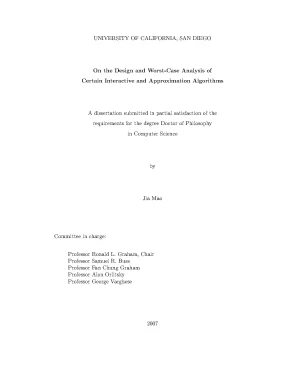
Tải xuống để đọc toàn bộUNIVERSITY OF CALIFORNIA, SAN DIEGO On the Design and Worst-Case Analysis of Certain Interactive and Approximation Algorithms A dissertation submitted in partial satisfaction of the requirements for the degree Doctor of Philosophy in Computer Science by Jia Mao Committee in charge: Professor Ronald L. Graham, Chair Professor Samuel R. Buss Professor Fan Chung Graham Professor Alon Orlitsky Professor George Varghese 2007 UMI Number: 3244382 UMI Microform 3244382 Copyright 2007 by ProQuest Information and Learning Company. All rights reserved.
This microform edition is protected against unauthorized copying under Title 17, United States Code. ProQuest Information and Learning Company 300 North Zeeb Road P. Box 1346 Ann Arbor, MI 48106-1346 Copyright c Jia Mao, 2007 All rights reserved. The dissertation of Jia Mao is approved, and it is accept- able in quality and form for publication on microfilm: Chair University of California, San Diego 2007 iii To my parents iv CONTENTS Signature Page.
v List of Figures. viii List of Tables. x Vita, Publications, and Fields of Study .2 Online and Dynamic Computations .3 Game-theoretic Notions. 4 2 The Majority Problem .2 Optimal Winning Strategies .1 Current best bounds .3 Upper bounds for M A2 and M A∗ .5 Lower bound for M O∗ when existence is not known.
16 3 Expander Graphs to Rescue .2 Expanders and Optimal Oblivious Strategy. 24 4 From Majority to Plurality .1 A Natural Extension of Majority .2 Optimal Winning Strategies .1 Adaptive strategies for the Plurality problem. 33 5 Majority Game with Liars .1 Error-tolerance and Rényi-Ulam’s Liar Game .2 Majority Game with Liars .1 Majority Game with at most t = 1 lie .2 Majority Game with at most t ≥ 2 lies. 52 6 The 2BPS Problem .1 Motivation and Background .2 Simple Greedy Algorithm A .1 The packing graphs .2 Better Approximation Ratio for 2BPS for large weights .1 More about the packing graphs .1 (2 − 1/k)-approximation Algorithm Ak .2 A lower bound for all online algorithms.
73 7 An ε-Improvement Approximation .2 ε-Improvement for 2BPS .3 Better Approximation Ratio for large Weights .1 The IN C k algorithm. 100 9 Summary and Discussion. 102 Appendix A: Proof of Lower Bound of M O2 [67]. 104 Appendix B: Proof of Theorem 6.
109 vii LIST OF FIGURES Figure 2.1: An auxiliary graph on a set of n = 5 elements {a, b, c, d, e} each with a binary label (k = 2). The blue edges denote the “equal” answer for label comparisons and the red edges denote the “unequal” answers. Note that the actual labelling is not revealed to Q until the end of the game.1: “Oblivious” first round queries.2: Looking for lies in the spokes.3: Oblivious graph, n even.4: Oblivious graph, n odd.5: The remaining two-cycles for a side edge e.1: Two valid packings with corresponding graphs for a list of three weights (2/3, 1/2, 1/4) .2: Algorithm A achieves a close-to-optimal approximation ratio as all weights become large.1: A chain of length 4.2: Matching graph of original tiny weights of type B and C and nice large weights, arranged in non-decreasing size on the left side and non-increasing size on the right side. The nice large weights are also grouped according to the chains in IN C(L).
87 viii LIST OF TABLES Table 2.1: Notations for minimum length of Q’s winning strategies for the Majority Game .2: Current Best Bounds for the Majority Game .1: Notations for minimum length of Q’s winning strategies for the Plurality Game .2: Current Best Bounds for the Plurality Game .1: Current Best Bounds for the Majority Game with Liar (up to t lies, binary labels). 36 ix ACKNOWLEDGEMENTS First I thank the Lord for His unfathomable love and grace for me. To Him be all the glory. My sincere gratitude also goes to many friends, colleagues and family members.
Without their support, this dissertation would still be far from complete. Specially, I would like to thank my advisor Ron Graham for his contin- uous encouragement and invaluable guidance throughout my graduate study; my mentors/collaborators Fan Chung, Andrew Chi-Chih Yao and George Varghese for helping me in so many ways; my other collaborator Steven Butler with whom it has been a great pleasure working; my family for being there for me in good times and bad; and Fu Liu for her faithful friendship. Chapter 2 and 4 contain material appearing in “Finding favorites” from Electronic Colloquium on Computational Complexity(ECCC) (078) 2003 and “Obliv- ious and Adaptive Strategies for the Majority and Plurality Problems” from the 11th International Computing and Combinatorics Conference (COCOON) 2005: 329-338, and material to appear in Algorithmica. Chapter 5 contains material sub- mitted for publication.
Chapter 6 and 8 contain material appearing in “Parallelism vs. Memory Allocation in Pipelined Router Forwarding Engines” from Theory of Computing Systems (ToCS), ISSN 1432-4350 (Print) 1433-0490 (Online) 2006. Chapter 6 and 7 contain material submitted for publication. I would like to thank my co-authors Fan Chung, Ron Graham, George Varghese, Andrew Chi-Chih Yao, and Steven Butler.
with Honors, California Institute of Technology 2004 M., University of California, San Diego 2007 Ph., University of California, San Diego RELATED PAPERS and PREPRINTS “Oblivious Strategies in the Majority and Plurality Problems”. Algorithmica, to appear, 2006. “How to Play the Majority Game with Liars”. Discrete Applied Mathematics, under review, 2006.
Memory Allocation in Pipelined Router Forwarding Engines”. Theory of Computing Systems (ToCS), ISSN 1432-4350 (Print) 1433-0490 (Online), 2006. Electronic Collo- quium on Computational Complexity (ECCC)(078), 2003. “Oblivious Strategies in the Majority and Plurality Problems”.
Computing and Combinatorics (COCOON) 2005, pp. “How to Play the Majority Game with Liars”. Czech-Slovak International Symposium on Combinatorics, Graph Theory, Algo- rithms and Applications (CS), oral presentation, 2006. “Parallel Resource Allocation of Splittable Items with Cardinality Constraints”.
FIELDS OF STUDY Computer Science Studies in Algorithms and Complexity Professor Ronald L. Graham xi ABSTRACT OF THE DISSERTATION On the Design and Worst-Case Analysis of Certain Interactive and Approximation Algorithms by Jia Mao Doctor of Philosophy in Computer Science University of California, San Diego, 2007 Professor Ronald L. Graham, Chair With the speed of current technological changes, computation models are evolv- ing to become more interactive and dynamic. These computation models often differ from traditional ones in that not every piece of the information needed for decision making is available a priori.
Efficient algorithm design to solve these problems poses new challenges. In this work we present and study some interactive and dynamic computations and design efficient algorithmic schemes to solve them. Our approach for perfor- mance evaluation falls within the framework of worst-case analysis. The worst-case scenarios are analyzed through the incorporation of imaginary adversaries or adver- sarial input sequences.
Worst-case analysis provides safe performance guarantees even when we have little or no prior knowledge about the input sequences. An- other natural yet powerful tool we utilize is an auxiliary graph which evolves as the computation progresses. It helps us to visualize the computation step by step, and more importantly, offers us powerful mathematical tools from the well-developed area of graph theory. We first address a particular computation problem of interactive nature, best xii known as the Majority/Plurality game.
This interactive game has appeared in sev- eral different contexts since the 1980s such as system diagnosis and group testing. We design and analyze optimal strategies to minimize the amount of communica- tion needed in different settings against an imaginary adversary. We also consider error-tolerance features to make our strategies robust even in the presence of com- munication errors. We then introduce a new variant of the classical bin packing problem that al- lows arbitrary splitting of the items with the restriction on the number of different types in each bin.
This problem is specifically motivated by a practical problem of allocating memories to parallel processors in high-speed routers. It is also nat- ural to other similar resource allocation applications. Even the simplest case of this problem can be shown to be NP-hard. We design efficient approximation al- gorithms in the offline, online, and dynamic settings.
We also use an interesting ε-improvement technique to show improved approximation ratios. xiii 1 Introduction The rapid developments of computing device and network technologies have changed the world around us. One aspect of this change is that traditional com- putation models have evolved to be increasingly distributive and interactive. In- evitably, these new computation models are of great importance and have gained more and more attention in the research community in recent years.
However, our understanding for these models is still quite inadequate and challenging new problems are emerging on a regular basis. It is common to observe that some of these problems are interactive in nature and others face the reality that not every piece of the information needed for decision making is available a priori. Consequently, algorithm design for these problems is in need of new insight and new techniques. In this work we present and study some interactive and dynamic computations and design efficient algorithmic schemes to solve them.
A powerful tool in our analysis is graphical representation which evolves as the computation progresses, naturally adapting to an interactive or dynamic computation environ- ment. Graphs not only help us visualize the computations step by step, but more importantly, offer us powerful mathematical tools from the well-developed area of graph theory. 1 2 To evaluate the performance of the algorithms, a worst-case approach is adopted through the incorporation of imaginary adversaries or adversarial input sequences. This is in contrast to another commonly used approach, average-case analysis, where a distribution of input sequences is hypothesized and the expected total cost or performance is evaluated.
Worst-case analysis attempts to finesse the issue of little or no prior knowledge about what the input sequences are likely by taking a pessimistic approach.1 Interactive Computations A basic theme for interactive computing involves two or more parties and a sequence of queries/answers where each query or answer can depend on previous ones. Here by interactive computing, what we mean is different from the operating system research point of view, where interactive computing usually corresponds to timesharing and refers to the case that a user can communicate and respond to the computer’s responses in a way that batch processing does not allow [62]. Unlike the generic computation models, our understanding for interactive computing is far from adequate. However, with the convergence of communication, computation, and large shared information sources, the need for a solid theoretical foundation for interactive computing is imperative.
In the first part of this dissertation, we focus on a particular type of interactive game, called the Majority/Plurality game. It is an information-theoretic identifi- cation problem that first appeared in the 1980s [51]. We encountered this problem again in a practical context where a good sensor needs to be identified from a set of sensors in which some are non-operational or corrupted and it is desired to minimize the amount of intercommunication used in doing so [64] [23]. There are many interesting variants of the original problem [1].
We will survey related 3 literature, discuss these variants and devise effective strategies to solve them.2 Online and Dynamic Computations Online computations make a sequence of decisions under uncertainty [17]. One of the most powerful methods of analyzing such problems is competitive analysis, which is a type of worst-case analysis. The competitive ratio of an algorithm is the worst-case ratio of its performance to the performance of the best offline algorithm. In the second part of this dissertation, motivated by a practical problem of al- locating memories to parallel processors in the context of designing fast IP lookup schemes [21], we propose a new variant of the classical bin packing problem - kBPS.
This variant can be shown to be NP-hard even in the simplest case. We will design efficient approximation algorithms for this problem in the offline, on- line, and dynamic settings.
Nội dung được bảo vệ bản quyền — Tải xuống đầy đủ
Trích dẫn luận án này
Jia Mao (2007). Thiết kế và phân tích thuật toán tương tác xấp xỉ [Luận án tiến sĩ, University of California, San Diego]. LuanAn.net. https://luanan.net/cong-nghe-thong-tin/khoa-hoc-may-tinh/luan-an-tien-si-thiet-ke-thuat-toan-tuong-tac-xap-xi
Câu hỏi thường gặp
Luận án "Thiết kế và phân tích thuật toán tương tác xấp xỉ" nghiên cứu về vấn đề gì?
Luận án tiến sĩ phân tích thiết kế và độ phức tạp thuật toán tương tác, xấp xỉ. Nghiên cứu chiến lược tối ưu cho bài toán đa số và trò chơi với kẻ nói dối.
Luận án "Thiết kế và phân tích thuật toán tương tác xấp xỉ" được bảo vệ tại trường nào?
Luận án này được bảo vệ tại University of California, San Diego. Năm bảo vệ: 2007.
Luận án "Thiết kế và phân tích thuật toán tương tác xấp xỉ" thuộc chuyên ngành gì?
Luận án "Thiết kế và phân tích thuật toán tương tác xấp xỉ" thuộc chuyên ngành Computer Science. Danh mục: Khoa Học Máy Tính.
Luận án "Thiết kế và phân tích thuật toán tương tác xấp xỉ" có bao nhiêu trang?
Luận án "Thiết kế và phân tích thuật toán tương tác xấp xỉ" có 127 trang. Bạn có thể xem trước một phần tài liệu ngay trên trang web trước khi tải về.
Cách tải luận án "Thiết kế và phân tích thuật toán tương tác xấp xỉ" về máy như thế nào?
Để tải luận án về máy, bạn nhấn nút "Tải xuống ngay" trên trang này, sau đó hoàn tất thanh toán phí lưu trữ. File sẽ được tải xuống ngay sau khi thanh toán thành công. Hỗ trợ qua Zalo: 0559 297 239.