Mô hình phân tích pháp y sử dụng ghi nhật ký hướng mục tiêu - Sean Peisert
Luận án tiến sĩ về mô hình phân tích pháp y sử dụng ghi nhật ký hướng mục tiêu. Phương pháp phân tích dữ liệu nhật ký để phát hiện tấn công hệ thống.
Luan An
Luận án
Năm xuất bản
Số trang
183
Thời gian đọc
28 phút
Lượt xem
1
Lượt tải
0
Phí lưu trữ
50 Point
Tổng quan nhanh
- Chủ đề:
- 1. Mô Hình Phân Tích Pháp Y Hướng Mục Tiêu
- Số trang:
- 183 trang
- Trường:
- University of California, San Diego
- Chuyên ngành:
- Computer Science
- Tác giả:
- Sean Philip Peisert
- Năm:
- 2007
Tóm tắt nội dung luận án
I. Mô Hình Phân Tích Pháp Y Hướng Mục Tiêu
Luận án tiến sĩ của Sean Philip Peisert tại UC San Diego giới thiệu mô hình Laocoön - phương pháp phân tích pháp y kỹ thuật số tiên tiến. Mô hình tập trung vào ghi nhật ký hệ thống dựa trên mục tiêu của kẻ tấn công. Khác với các phương pháp truyền thống, Laocoön không chỉ ghi lại hành động mà còn phân tích ý định đằng sau mỗi chuỗi sự kiện. Phương pháp này cải thiện đáng kể khả năng thu thập bằng chứng số và truy vết sự kiện trong điều tra an ninh mạng. Nghiên cứu đề xuất năm nguyên tắc cốt lõi cho phân tích pháp y hiệu quả. Mỗi nguyên tắc giải quyết một vấn đề cụ thể trong quy trình điều tra hiện tại. Mô hình đã được kiểm chứng qua nhiều kịch bản tấn công thực tế, bao gồm leo thang đặc quyền và cấy mã độc. Kết quả cho thấy khả năng phát hiện và phân tích artifact kỹ thuật số vượt trội so với các công cụ truyền thống.
1.1. Bối Cảnh Nghiên Cứu Phân Tích Pháp Y
Phân tích pháp y kỹ thuật số đối mặt với thách thức ngày càng phức tạp. Các phương pháp hiện tại thường ghi nhật ký dựa trên giả định về hành vi tấn công. Điều này tạo ra lỗ hổng khi kẻ tấn công sử dụng kỹ thuật mới. Luận án chỉ ra ba vấn đề chính: thiếu ngữ cảnh trong log file, khối lượng dữ liệu quá lớn, và khó khăn trong việc xác định mối liên hệ giữa các sự kiện. Nghiên cứu đề xuất thay đổi cách tiếp cận từ ghi nhật ký phản ứng sang chủ động. Mô hình mới tập trung vào mục tiêu cuối cùng của kẻ tấn công thay vì từng hành động riêng lẻ.
1.2. Mục Tiêu Của Mô Hình Laocoön
Mô hình Laocoön hướng đến ba mục tiêu chính. Thứ nhất, cải thiện độ chính xác trong phát hiện tấn công bằng cách tập trung vào kết quả thay vì hành động. Thứ hai, giảm thiểu thông tin nhiễu trong quá trình phân tích log file. Thứ ba, tạo ra timeline forensics rõ ràng và dễ hiểu cho các chuyên gia điều tra. Mô hình sử dụng chuỗi gọi hàm để theo dõi luồng thực thi chương trình. Phương pháp này cho phép xác định chính xác điểm bắt đầu và kết thúc của mỗi cuộc tấn công. Kết quả là chuỗi bảo quản bằng chứng được duy trì tốt hơn và có giá trị pháp lý cao hơn.
1.3. Đóng Góp Khoa Học Của Nghiên Cứu
Luận án đóng góp ba yếu tố mới cho lĩnh vực phân tích pháp y. Đầu tiên là bộ năm nguyên tắc hướng dẫn thiết kế hệ thống ghi nhật ký. Nguyên tắc này giúp các tổ chức xây dựng cơ sở hạ tầng giám sát hiệu quả. Thứ hai là mô hình phân tích dựa trên mục tiêu của kẻ tấn công. Mô hình này cho phép phát hiện cả các kỹ thuật tấn công chưa từng biết đến. Thứ ba là phương pháp triển khai thực tế với các thí nghiệm kiểm chứng. Nghiên cứu đã thử nghiệm thành công trên nhiều loại tấn công khác nhau, từ Internet Worm 1988 đến các kỹ thuật hiện đại.
II. Năm Nguyên Tắc Phân Tích Pháp Y Hiệu Quả
Luận án đề xuất năm nguyên tắc cơ bản để cải thiện phân tích pháp y kỹ thuật số. Mỗi nguyên tắc giải quyết một khuyết điểm cụ thể trong các phương pháp hiện tại. Nguyên tắc đầu tiên nhấn mạnh việc xem xét toàn bộ hệ thống thay vì chỉ các thành phần riêng lẻ. Nguyên tắc thứ hai yêu cầu ghi nhật ký hệ thống không dựa trên giả định trước. Nguyên tắc thứ ba tập trung vào kết quả của hành động, không chỉ bản thân hành động. Nguyên tắc thứ tư đòi hỏi cung cấp đủ ngữ cảnh để hiểu rõ sự kiện. Nguyên tắc cuối cùng đảm bảo trình bày thông tin theo cách dễ hiểu cho điều tra viên. Các nguyên tắc này tạo nền tảng cho việc thiết kế hệ thống phân tích log file hiệu quả và thu thập bằng chứng số chất lượng cao.
2.1. Nguyên Tắc Xem Xét Toàn Hệ Thống
Nguyên tắc đầu tiên yêu cầu phân tích pháp y phải xem xét toàn bộ hệ thống. Các công cụ truyền thống thường tập trung vào từng ứng dụng hoặc dịch vụ riêng lẻ. Cách tiếp cận này bỏ sót các tương tác giữa các thành phần khác nhau. Kẻ tấn công thường khai thác chính những điểm giao nhau này. Mô hình Laocoön theo dõi luồng dữ liệu xuyên suốt toàn bộ hệ thống. Phương pháp này phát hiện được các cuộc tấn công phức tạp sử dụng nhiều bước trung gian. Việc ghi nhật ký toàn diện giúp tạo ra timeline forensics đầy đủ và chính xác.
2.2. Ghi Nhật Ký Không Dựa Giả Định
Nguyên tắc thứ hai loại bỏ các giả định về hành vi tấn công. Hệ thống ghi nhật ký truyền thống chỉ lưu những gì được cho là quan trọng. Điều này tạo ra điểm mù khi kẻ tấn công sử dụng phương pháp mới. Mô hình đề xuất ghi lại tất cả các sự kiện liên quan đến mục tiêu bảo mật. Thay vì lọc dữ liệu khi thu thập, hệ thống lọc trong quá trình phân tích. Cách tiếp cận này đảm bảo không bỏ sót artifact kỹ thuật số quan trọng. Kết quả là chuỗi bảo quản bằng chứng được duy trì hoàn chỉnh từ đầu đến cuối.
2.3. Tập Trung Vào Kết Quả Hành Động
Nguyên tắc thứ ba chuyển trọng tâm từ hành động sang kết quả. Phân tích log file truyền thống ghi lại những gì người dùng làm. Nhưng điều quan trọng là những gì thay đổi trong hệ thống. Hai hành động khác nhau có thể tạo ra cùng một kết quả độc hại. Mô hình Laocoön theo dõi thay đổi trạng thái hệ thống thay vì từng lệnh. Phương pháp này phát hiện được cả các kỹ thuật tấn công tinh vi. Ví dụ, việc leo thang đặc quyền có thể thực hiện qua nhiều con đường khác nhau, nhưng kết quả cuối cùng đều giống nhau.
III. Phương Pháp Phân Tích Chuỗi Gọi Hàm
Mô hình Laocoön sử dụng chuỗi gọi hàm làm nền tảng cho phân tích pháp y kỹ thuật số. Phương pháp này theo dõi thứ tự các hàm được gọi trong quá trình thực thi chương trình. Mỗi chuỗi gọi hàm tạo ra một dấu vết độc nhất cho từng hành vi. So sánh các chuỗi này giữa phiên bản gốc và phiên bản bị thay đổi cho phép phát hiện mã độc. Nghiên cứu đã thử nghiệm với nhiều chương trình khác nhau như su, ssh, và lpr. Kết quả cho thấy ngay cả những thay đổi nhỏ cũng tạo ra sự khác biệt đáng kể trong chuỗi gọi hàm. Phương pháp này hiệu quả trong việc phát hiện trojan horse và spyware. Kỹ thuật phân tích hành vi người dùng dựa trên chuỗi gọi hàm cung cấp bằng chứng số có giá trị pháp lý cao. Unique Path Identifier được sử dụng để theo dõi từng luồng thực thi riêng biệt.
3.1. Cơ Chế Thu Thập Chuỗi Gọi Hàm
Hệ thống thu thập chuỗi gọi hàm thông qua instrumentation ở mức mã nguồn. Mỗi lần một hàm được gọi, thông tin về tên hàm và tham số được ghi lại. Dữ liệu này bao gồm cả ngữ cảnh thực thi như process ID và timestamp. Unique Path Identifier giúp phân biệt các luồng thực thi song song. Phương pháp này tạo ra khối lượng lớn dữ liệu nhưng đảm bảo không bỏ sót thông tin quan trọng. Hệ thống sử dụng bộ lọc thông minh để giảm thiểu overhead khi ghi nhật ký hệ thống. Kết quả là timeline forensics chi tiết với độ chính xác cao.
3.2. So Sánh Và Phát Hiện Bất Thường
Quá trình phân tích so sánh chuỗi gọi hàm giữa các phiên bản khác nhau của cùng một chương trình. Các thí nghiệm với su cho thấy việc loại bỏ hàm pam_authenticate tạo ra sự khác biệt rõ rệt. Tương tự, việc thêm mã gửi mật khẩu qua mạng trong ssh được phát hiện ngay lập tức. Mô hình tạo ra danh sách các chuỗi chỉ xuất hiện trong phiên bản bị thay đổi. Những chuỗi này chính là artifact kỹ thuật số chỉ ra sự hiện diện của mã độc. Phương pháp này hiệu quả ngay cả khi kẻ tấn công cố gắng che giấu hành vi của mình.
3.3. Ứng Dụng Trong Điều Tra Thực Tế
Phương pháp chuỗi gọi hàm đã được áp dụng thành công trong nhiều kịch bản điều tra an ninh mạng. Trường hợp trojan sshd cho thấy khả năng phát hiện spyware ẩn sâu trong hệ thống. Phân tích lpr bug minh họa cách theo dõi quá trình leo thang đặc quyền. Nghiên cứu còn phân tích lại Internet Worm năm 1988 để kiểm chứng mô hình. Kết quả cho thấy phương pháp này có thể phát hiện cả các cuộc tấn công lịch sử. Chuỗi bảo quản bằng chứng được duy trì từ điểm xâm nhập đến khi đạt được mục tiêu cuối cùng. Điều này cung cấp bằng chứng số đầy đủ và có giá trị pháp lý.
IV. Triển Khai Và Thử Nghiệm Mô Hình Laocoön
Luận án trình bày chi tiết quá trình triển khai mô hình Laocoön trên hệ thống thực tế. Các thử nghiệm bao gồm nhiều loại tấn công từ đơn giản đến phức tạp. Thí nghiệm đầu tiên tập trung vào việc chiếm quyền root trên hệ thống cục bộ. Các thí nghiệm tiếp theo kiểm tra khả năng phát hiện trojan horse và spyware. Mỗi kịch bản được thiết kế để kiểm chứng một khía cạnh khác nhau của mô hình. Kết quả cho thấy mô hình phát hiện thành công tất cả các cuộc tấn công được thử nghiệm. Overhead của hệ thống ghi nhật ký hệ thống nằm trong mức chấp nhận được. Quá trình phân tích log file diễn ra nhanh chóng và chính xác. Mô hình cung cấp timeline forensics rõ ràng cho từng cuộc tấn công. Các artifact kỹ thuật số được thu thập đầy đủ và có giá trị trong điều tra an ninh mạng.
4.1. Thử Nghiệm Leo Thang Đặc Quyền
Thí nghiệm đầu tiên mô phỏng các kỹ thuật chiếm quyền root phổ biến. Nghiên cứu kiểm tra việc khai thác lỗi trong lpr để sửa đổi /etc/passwd. Một kịch bản khác thử nghiệm việc bypass xác thực trong lệnh su. Mô hình Laocoön phát hiện thành công tất cả các nỗ lực leo thang đặc quyền. Hệ thống ghi lại chuỗi bảo quản bằng chứng từ lúc bắt đầu khai thác lỗi. Timeline forensics cho thấy rõ ràng từng bước của cuộc tấn công. Phân tích hành vi người dùng xác định chính xác thời điểm quyền root được chiếm đoạt.
4.2. Phát Hiện Trojan Và Spyware
Thử nghiệm với trojan sshd kiểm tra khả năng phát hiện mã độc ẩn. Phiên bản sshd bị thay đổi ghi lại mật khẩu người dùng và gửi qua mạng. Mô hình phát hiện ngay lập tức sự xuất hiện của các chuỗi gọi hàm bất thường. Phân tích log file chỉ ra chính xác đoạn mã thực hiện hành vi độc hại. Một thí nghiệm khác kiểm tra trojan horse được cài đặt qua search path modification. Hệ thống theo dõi thành công quá trình trojan chiếm quyền điều khiển. Artifact kỹ thuật số thu được đủ để xác định nguồn gốc và mục đích của mã độc.
4.3. Phân Tích Các Cuộc Tấn Công Lịch Sử
Nghiên cứu áp dụng mô hình Laocoön để phân tích lại Internet Worm năm 1988. Mặc dù đây là cuộc tấn công cũ, mô hình vẫn phát hiện được các kỹ thuật sử dụng. Phân tích cho thấy worm khai thác lỗi buffer overflow và weak password. Timeline forensics tái tạo chính xác quá trình lan truyền của worm. Thí nghiệm cũng kiểm tra Christma Exec Worm và các mẫu malware khác. Kết quả chứng minh mô hình có khả năng phân tích cả các cuộc tấn công chưa biết trước. Điều này quan trọng trong việc điều tra an ninh mạng đối với các mối đe dọa mới.
V. Từ Mô Hình Lý Thuyết Đến Hệ Thống Thực Tế
Luận án thảo luận chi tiết về các thách thức khi chuyển mô hình Laocoön thành hệ thống triển khai thực tế. Vấn đề đầu tiên là instrumentation code mà không ảnh hưởng đến hiệu năng hệ thống. Thách thức thứ hai liên quan đến quản lý khối lượng lớn dữ liệu từ ghi nhật ký hệ thống. Vấn đề thứ ba là tự động hóa quá trình phân tích log file để giảm thiểu can thiệp thủ công. Nghiên cứu đề xuất các giải pháp kỹ thuật cho từng thách thức này. Phương pháp policy discovery giúp tự động xác định các quy tắc bảo mật của hệ thống. Kỹ thuật reverse-engineering policy áp dụng cho các hệ thống legacy không có tài liệu. Mô hình cũng có thể mở rộng để hỗ trợ intrusion detection realtime. Chuỗi bảo quản bằng chứng được duy trì tự động trong suốt quá trình thu thập và phân tích.
5.1. Giải Quyết Vấn Đề Instrumentation
Instrumentation là thách thức lớn nhất khi triển khai mô hình trên hệ thống production. Việc thêm mã theo dõi vào mọi hàm có thể làm giảm hiệu năng đáng kể. Nghiên cứu đề xuất sử dụng selective instrumentation chỉ ở các điểm quan trọng. Kỹ thuật này giảm overhead xuống mức chấp nhận được trong môi trường thực tế. Hệ thống sử dụng compiler-based instrumentation để tự động chèn mã theo dõi. Phương pháp này đảm bảo không bỏ sót các điểm quan trọng trong quá trình ghi nhật ký. Kết quả là timeline forensics đầy đủ với chi phí hiệu năng tối thiểu.
5.2. Quản Lý Và Lưu Trữ Dữ Liệu Log
Khối lượng dữ liệu từ ghi nhật ký hệ thống toàn diện là rất lớn. Luận án đề xuất các kỹ thuật nén và lưu trữ hiệu quả cho log file. Hệ thống sử dụng hierarchical storage với các mức độ chi tiết khác nhau. Dữ liệu quan trọng được giữ lại lâu dài, dữ liệu ít quan trọng được tóm tắt hoặc xóa. Phương pháp indexing thông minh giúp truy xuất nhanh khi cần phân tích. Chuỗi bảo quản bằng chứng được duy trì thông qua cơ chế checksum và digital signature. Điều này đảm bảo artifact kỹ thuật số không bị thay đổi trong quá trình lưu trữ.
5.3. Tự Động Hóa Phân Tích Forensics
Quá trình phân tích thủ công log file tốn nhiều thời gian và dễ sai sót. Mô hình Laocoön tích hợp các công cụ tự động hóa phân tích pháp y kỹ thuật số. Hệ thống sử dụng machine learning để nhận dạng các pattern bất thường. Kỹ thuật này giúp phát hiện nhanh các cuộc tấn công mới trong điều tra an ninh mạng. Timeline forensics được tạo tự động từ dữ liệu log với visualization trực quan. Phân tích hành vi người dùng giúp phân biệt hoạt động hợp lệ và độc hại. Kết quả là quá trình thu thập bằng chứng số nhanh chóng và chính xác hơn.
VI. Ứng Dụng Mô Hình Trong Phát Hiện Xâm Nhập
Mô hình Laocoön không chỉ hữu ích cho phân tích pháp y kỹ thuật số sau sự cố mà còn có thể áp dụng cho phát hiện xâm nhập realtime. Nghiên cứu thảo luận về cách chuyển đổi kỹ thuật phân tích forensics thành intrusion detection. Điểm mạnh của mô hình là tập trung vào mục tiêu thay vì hành động cụ thể. Điều này giúp phát hiện được cả các kỹ thuật tấn công mới chưa từng biết. Hệ thống có thể cảnh báo khi phát hiện chuỗi hành động hướng đến mục tiêu độc hại. Policy discovery tự động giúp xác định các vi phạm bảo mật tiềm ẩn. Kỹ thuật phân tích hành vi người dùng phát hiện các hoạt động bất thường của insider threat. Chuỗi bảo quản bằng chứng được duy trì ngay từ khi phát hiện dấu hiệu tấn công. Timeline forensics realtime giúp đội ngũ bảo mật phản ứng nhanh chóng với các mối đe dọa.
6.1. Phát Hiện Tấn Công Zero Day
Một trong những ưu điểm lớn nhất của mô hình là khả năng phát hiện tấn công zero-day. Các hệ thống intrusion detection truyền thống dựa trên signature của các tấn công đã biết. Mô hình Laocoön tập trung vào mục tiêu cuối cùng của kẻ tấn công. Ngay cả khi kỹ thuật tấn công hoàn toàn mới, mục tiêu thường không thay đổi. Hệ thống phát hiện khi có chuỗi hành động dẫn đến leo thang đặc quyền hoặc truy cập trái phép. Phương pháp này hiệu quả trong điều tra an ninh mạng đối với các mối đe dọa tiên tiến. Artifact kỹ thuật số được thu thập tự động để phân tích sau này.
6.2. Tích Hợp Với Hệ Thống SIEM
Mô hình Laocoön có thể tích hợp với các hệ thống Security Information and Event Management hiện có. Dữ liệu từ ghi nhật ký hệ thống được chuẩn hóa và gửi đến SIEM. Các công cụ phân tích log file trong SIEM sử dụng mô hình để phát hiện tấn công phức tạp. Timeline forensics được tạo tự động và hiển thị trên dashboard tập trung. Phân tích hành vi người dùng kết hợp với dữ liệu từ nhiều nguồn khác nhau. Chuỗi bảo quản bằng chứng được duy trì xuyên suốt toàn bộ hệ thống. Kết quả là khả năng phát hiện và phản ứng với các cuộc tấn công được cải thiện đáng kể.
6.3. Giảm Thiểu False Positive
Một vấn đề lớn của các hệ thống intrusion detection là tỷ lệ false positive cao. Mô hình Laocoön giải quyết vấn đề này bằng cách tập trung vào ngữ cảnh và mục tiêu. Thay vì cảnh báo cho mọi hành động đáng ngờ, hệ thống chỉ cảnh báo khi phát hiện chuỗi hành động hoàn chỉnh. Phân tích pháp y kỹ thuật số dựa trên mục tiêu giúp loại bỏ nhiều cảnh báo không liên quan. Policy discovery tự động điều chỉnh ngưỡng cảnh báo dựa trên hành vi bình thường. Kết quả là đội ngũ bảo mật có thể tập trung vào các mối đe dọa thực sự quan trọng trong điều tra an ninh mạng.
Mục lục chi tiết luận án
Tải xuống file đầy đủ để xem toàn bộ nội dung
Tải đầy đủ (183 trang)Nội dung chính
Tổng quan về luận án
Luận án "A Model of Forensic Analysis Using Goal-Oriented Logging" của Sean Philip Peisert (2007) giải quyết một lỗ hổng đáng kể trong lĩnh vực pháp y máy tính: bản chất tùy tiện (ad hoc) của các phương pháp phân tích pháp y truyền thống. Nghiên cứu này được đặt trong bối cảnh khoa học về an ninh máy tính đang phát triển nhanh chóng, nơi mà các cuộc tấn công ngày càng phức tạp và cần một cách tiếp cận có hệ thống hơn để điều tra. Luận án nổi bật bởi tính tiên phong trong việc chuyển đổi pháp y máy tính từ một "nghệ thuật" dựa trên "cơ hội hoặc may mắn" sang một khoa học "nghiêm ngặt" (Preface).
Lỗ hổng nghiên cứu và Khung lý thuyết: Peisert lập luận rằng "hiện tại, lĩnh vực pháp y máy tính chủ yếu là tùy tiện. Dữ liệu thường được thu thập vì các ứng dụng ghi nhật ký cho mục đích gỡ lỗi hoặc vì ai đó cho rằng nó quan trọng" (Problem Statement). Sự thiếu vắng một "giải pháp nghiêm ngặt để tìm và ghi lại dữ liệu cần thiết để thực hiện phân tích pháp y" là một hạn chế lớn, dẫn đến việc "quá nhiều dữ liệu sai hiện đang được ghi lại bởi hầu hết các hệ thống pháp y hiện có, khiến việc phân tích trở nên khó khăn hoặc không thể thực hiện được" (Problem Statement). Luận án chỉ ra rằng "chúng tôi không biết về sự tồn tại của một mô hình như vậy" có thể xác định dữ liệu cần thiết.
Để giải quyết lỗ hổng này, nghiên cứu đặt ra các câu hỏi cốt lõi: Làm thế nào để xác định chính xác dữ liệu cần thiết cho phân tích pháp y? Một mô hình chính thức có thể hướng dẫn việc ghi nhật ký dữ liệu hiệu quả và chính xác hơn không? Các giả thuyết chính bao gồm:
- Việc xây dựng một mô hình pháp y chính thức có thể chuyển đổi quá trình phân tích từ tùy tiện sang dựa trên suy luận logic.
- Mô hình này có thể xác định được tập hợp tối thiểu các dữ liệu có giá trị cao, giúp giảm gánh nặng tài nguyên và tăng cường độ chính xác phân tích.
- Việc ghi nhật ký tập trung vào "mục tiêu của kẻ xâm nhập" sẽ hiệu quả hơn việc ghi nhật ký toàn bộ dữ liệu hoặc dữ liệu cấp cao.
Khung lý thuyết của luận án được xây dựng dựa trên năm "nguyên tắc cấp cao về phân tích pháp y" (Principles-Driven Forensic Analysis [PBKM05]) và "một số phẩm chất [PBKM07b] mà chúng tôi tin rằng một mô hình pháp y tốt nên có." Nghiên cứu cũng xây dựng dựa trên công trình gần đây về "hình thức hóa các cuộc tấn công đa giai đoạn cho mục đích phát hiện xâm nhập [TL00, ZHR+ 07]", thích nghi các nguyên lý này cho bối cảnh pháp y. Cụ thể, mô hình Laocoön được thiết kế để "biết các hành động định hướng mục tiêu được thực hiện bởi kẻ xâm nhập và ghi lại đủ thông tin để có thể hiểu được kết quả" (Approach).
Đóng góp đột phá và Phạm vi:
Đóng góp đột phá của luận án là việc giới thiệu mô hình Laocoön, một mô hình phân tích pháp y chính thức "được thiết kế để xác định dữ liệu cần thiết để hiểu các sự kiện đã xảy ra" (Abstract). Mô hình này cho phép "chọn lọc cẩn thận lượng dữ liệu hữu ích cao hơn để ghi lại, thay vì buộc các quản trị viên hệ thống phải lựa chọn giữa việc ghi lại lượng dữ liệu khổng lồ hoặc lượng dữ liệu quá nhỏ đến mức vô dụng" (Approach). Tác động được định lượng thông qua các thí nghiệm cho thấy "cách mô hình có thể được sử dụng để ghi lại lượng dữ liệu hữu ích cao hơn, nhỏ hơn, thay vì buộc phải lựa chọn giữa lượng dữ liệu áp đảo hoặc lượng dữ liệu quá nhỏ đến mức thực tế vô dụng" (Abstract). Ví dụ, trong các thí nghiệm về cuộc tấn công su, việc phân tích các chuỗi cuộc gọi hàm (function calls) chỉ tạo ra "46 chuỗi (tất cả đều khác biệt)" cần phân tích trong phiên bản su bị sửa đổi, so với hàng nghìn chuỗi trong các phương pháp ghi nhật ký truyền thống.
Phạm vi của luận án tập trung vào "các cuộc tấn công (bao gồm cả vấn đề nội bộ)" trên các hệ thống giống UNIX, sử dụng "mô hình hành động định hướng mục tiêu của kẻ xâm nhập". Nghiên cứu không đi sâu vào các vấn đề như khôi phục dữ liệu bị xóa hoặc các vấn đề pháp lý như chuỗi lưu giữ bằng chứng số, mặc dù thừa nhận tiềm năng áp dụng trong tương lai. Tính quan trọng của nghiên cứu nằm ở việc cung cấp một "phương pháp luận có thể được sử dụng để củng cố các hệ thống hiện có và phát triển các hệ thống mới bao gồm hỗ trợ phân tích pháp y trong thiết kế" (Approach).
Literature Review và Positioning
Phân tích pháp y máy tính, theo dòng thời gian, đã trải qua nhiều giai đoạn phát triển, bắt đầu từ các đề xuất ban đầu về sử dụng dấu vết kiểm toán (audit trails) của Anderson (1980) và Bonyun (1980). Tuy nhiên, những công trình này, mặc dù công nhận giá trị của dữ liệu và vị trí đặt cơ chế thu thập, đã không đưa ra một phương pháp luận tổng quát để lựa chọn dữ liệu. Điều này dẫn đến sự phát triển của các công cụ ghi nhật ký tinh vi cho nhiều nền tảng, nhưng việc lựa chọn dữ liệu vẫn thường được "để cho quản trị viên hệ thống tự chỉ định thủ công trước" (Related Work).
Nhiều công cụ hiện có được sử dụng rộng rãi, như syslog (Allman, 2005) và Sun Basic Security Module (BSM) (Oliver & Nguyen, 2001), được thiết kế ban đầu cho mục đích gỡ lỗi hoặc dựa trên "các giả định cấp cao về điều gì 'có vẻ' quan trọng đối với bảo mật, chứ không phải điều đã được chứng minh một cách nghiêm ngặt là quan trọng đối với bảo mật" (Related Work). Điều này tạo ra một "hộp công cụ" gồm các cơ chế cấp ứng dụng (như Tripwire của Kim & Spafford, 1994, và The Coroner’s Toolkit của Farmer & Venema) và kiểm tra bộ nhớ cấp thấp, nhưng việc tổng hợp thông tin từ chúng thường "dựa vào may mắn hơn là kế hoạch có phương pháp" (Related Work). Sự phụ thuộc vào dữ liệu "có sẵn" và "thường bỏ lỡ thông tin hoặc thu thập và hiển thị thông tin không cần thiết làm tăng lượng lưu trữ và không thêm gì vào phân tích pháp y" là một điểm yếu cố hữu của các phương pháp hiện tại.
Nghiên cứu của Peisert nhận định rằng có những mâu thuẫn cơ bản trong các phương pháp pháp y hiện có. Một mặt, có các giải pháp cực đoan như "ghi lại mọi thứ" (Peisert et al., 2005; Gross, 1997), bao gồm tất cả các truy cập bộ nhớ hoặc mọi sự chuyển đổi trạng thái hệ thống. Mặc dù lý tưởng về mặt "tiện ích tối đa", nhưng chúng "không thực tế, nếu không muốn nói là không khả thi" (Approach, Figure 1.1a). Mặt khác, có các phương pháp ghi lại dữ liệu cấp rất cao và không có cấu trúc (như thông báo syslog) hoặc tập trung vào một lĩnh vực cụ thể (như dữ liệu hệ thống tệp từ Tripwire, hay dữ liệu kết nối từ TCP Wrappers của Venema, 1992). Việc lựa chọn giữa "lượng dữ liệu áp đảo hoặc lượng dữ liệu quá nhỏ đến mức thực tế vô dụng" là một sự đánh đổi lớn (Approach). Ngoài ra, còn có sự phân biệt giữa kiểm toán dựa trên trạng thái (state-based auditing) và kiểm toán dựa trên chuyển đổi (transition-based auditing) (Bishop, 2003), với việc nghiên cứu này ưu tiên phương pháp dựa trên chuyển đổi do khả năng ghi lại các sự kiện cụ thể.
Luận án này tự định vị mình là cầu nối giữa các phương pháp tiếp cận này, hướng tới một "phương pháp luận để tối ưu hóa dữ liệu cần thiết để ghi lại các sự kiện" (Approach, Figure 1.1c). Không giống như Gross (1997) tập trung vào việc sử dụng dữ liệu có sẵn để cải thiện phân tích, nghiên cứu này tập trung vào việc "mở rộng một hệ thống để thu thập dữ liệu cần thiết chưa được thu thập" (Related Work). Điều này cũng khác biệt với các nỗ lực mô hình hóa trước đây, chẳng hạn như của Bishop (1989) và Schneier (2000), vốn không nhằm mục đích trình bày thông tin hữu ích cho một nhà phân tích con người hoặc Kupferschmid (2004) chỉ tập trung vào hiệu suất. Luận án của Peisert chuyển trọng tâm sang "giá trị pháp y cho con người".
Để làm nổi bật sự tiến bộ trong lĩnh vực này, nghiên cứu của Peisert so sánh các phương pháp của mình với các công trình nghiên cứu quốc tế khác. Ví dụ, BackTracker (King & Chen, 2005) và Forensix (Giffin et al., 2005) cũng thu thập các cuộc gọi hệ thống để tạo ra các dấu vết sự kiện hoặc cho phép truy vấn cơ sở dữ liệu. Tuy nhiên, BackTracker "không giúp xác định điểm bắt đầu" và "không giúp thường xuyên xác định điều gì xảy ra trong tiến trình", trong khi Forensix yêu cầu nhà phân tích phải "tự xác định độc lập tệp nào có thể đã bị ghi bởi mã của kẻ xâm nhập" (Related Work). Cả hai đều có "những hạn chế tương tự" và không dựa trên một mô hình pháp y nghiêm ngặt, thường bỏ lỡ thông tin hoặc thu thập dữ liệu dư thừa. Các phương pháp ảo hóa như ReVirt (Dunlap et al., 2002) cho phép phát lại xác định, nhưng lại tạo ra "ít nhất 1.4 GB dữ liệu nhật ký mỗi ngày, tạo ra tới 68% chi phí xử lý" (Related Work) và không hoạt động tốt trên các hệ thống đa bộ xử lý. Ngược lại, mô hình Laocoön hướng tới việc thu thập "chỉ dữ liệu có liên quan được thu thập, và dữ liệu thừa, không cần thiết và gây hiểu lầm được giảm bớt hoặc tránh khỏi" (Related Work).
Bằng cách trình bày một mô hình chính thức và một phương pháp luận được thiết kế để xác định dữ liệu cần thiết, luận án của Peisert thúc đẩy lĩnh vực pháp y máy tính vượt ra ngoài các kỹ thuật thu thập và phân tích dữ liệu tùy tiện, định vị nó như một bước tiến quan trọng trong việc xây dựng các hệ thống an ninh có khả năng phân tích và phản ứng hiệu quả hơn với các cuộc tấn công.
Đóng góp lý thuyết và khung phân tích
Đóng góp cho lý thuyết
Luận án này tạo ra một đóng góp lý thuyết quan trọng bằng cách mở rộng và thách thức các lý thuyết hiện có trong lĩnh vực phát hiện xâm nhập và pháp y máy tính. Cụ thể, mô hình Laocoön xây dựng dựa trên "mô hình requires/provides" ban đầu được sử dụng cho phát hiện xâm nhập (Talbot & Lupu, 2000; Zhou et al., 2007), nhưng điều chỉnh nó một cách độc đáo để giải quyết các thách thức riêng của phân tích pháp y. Thay vì chỉ phát hiện các bất thường theo thời gian thực, Laocoön tập trung vào việc xác định dữ liệu cần thiết để tái tạo và hiểu các sự kiện đã xảy ra, đặc biệt là các cuộc tấn công. Nó thách thức quan niệm phổ biến rằng "ghi lại mọi thứ" là cách tiếp cận tốt nhất cho pháp y, hoặc ngược lại, việc chỉ dựa vào dữ liệu cấp cao là đủ.
Laocoön được xây dựng dựa trên "năm nguyên tắc cấp cao của phân tích pháp y" (Peisert, Bishop, Karin, & Marzullo, 2005) và "một số phẩm chất" (Peisert, Bishop, Karin, & Marzullo, 2007b) mà một mô hình pháp y tốt nên có. Những nguyên tắc này bao gồm:
- Xem xét toàn bộ hệ thống (Consider the Entire System): Nhấn mạnh tầm quan trọng của việc hiểu các tương tác rộng lớn trong hệ thống.
- Ghi nhật ký thông tin mà không cần giả định (Log Information without Regard to Assumptions): Tránh các thành kiến về những gì có thể hoặc không thể quan trọng.
- Xem xét các hiệu ứng, không chỉ hành động (Consider the Effects, Not Just the Actions): Tập trung vào kết quả của các hành động của kẻ tấn công, không chỉ bản thân các hành động.
- Xem xét ngữ cảnh để hỗ trợ hiểu biết (Consider Context to Assist in Understanding): Ngữ cảnh là chìa khóa để diễn giải dữ liệu.
- Trình bày và xử lý các hành động và kết quả một cách dễ hiểu (Present and Process Actions and Results in an Understandable Way): Đảm bảo dữ liệu có thể được phân tích bởi con người.
Khung khái niệm này dẫn đến việc xây dựng một mô hình lý thuyết với các thành phần và mối quan hệ rõ ràng, tập trung vào "các hành động định hướng mục tiêu" của kẻ xâm nhập. Các mệnh đề/giả thuyết được phát triển xoay quanh ý tưởng rằng nếu chúng ta có thể mô hình hóa "các mục tiêu cuối cùng từ một hoặc nhiều điểm bắt đầu, cũng như các trạng thái trung gian có thể phổ biến đối với nhiều hoặc tất cả các đường dẫn gần đầu và gần cuối cuộc tấn công" (Approach), chúng ta có thể xác định dữ liệu cần thiết một cách hiệu quả. Điều này đại diện cho một sự thay đổi mô hình, từ việc thu thập dữ liệu một cách bị động và phản ứng (ghi lại mọi thứ hoặc những gì có sẵn) sang một cách tiếp cận chủ động, có mục tiêu (ghi lại những gì cần thiết để chứng minh hoặc bác bỏ một mục tiêu). Bằng chứng cho sự thay đổi này nằm ở khả năng của mô hình trong việc "phát hiện những bất thường trong các chuỗi cuộc gọi hàm" giúp giảm đáng kể lượng dữ liệu mà nhà phân tích cần xem xét (Conclusions on Forensics Using Sequences of Function Calls).
Khung phân tích độc đáo
Khung phân tích của luận án là độc đáo bởi sự tích hợp các lý thuyết từ phát hiện xâm nhập (mô hình requires/provides) với các nguyên tắc pháp y mới được đề xuất. Nó không chỉ đơn thuần là áp dụng các kỹ thuật hiện có mà còn tạo ra một phương pháp tiếp cận phân tích mới. Ba lý thuyết hoặc khái niệm chính được tích hợp là:
- Lý thuyết về các cuộc tấn công đa giai đoạn (Multi-stage Attack Theory): Được sử dụng để xây dựng các biểu đồ tấn công (attack graphs) mô tả các chuỗi hành động dẫn đến một mục tiêu của kẻ xâm nhập (Approach, Figure 1.2).
- Lý thuyết về các nguyên tắc pháp y (Principles of Forensic Analysis): Cung cấp một nền tảng triết học và thực tiễn cho việc thiết kế mô hình.
- Khái niệm về chất lượng mô hình pháp y (Qualities for a Forensic Model): Đảm bảo rằng mô hình không chỉ hoạt động mà còn đáp ứng các tiêu chí về tính hữu dụng, hiệu quả và khả năng phân tích.
Cách tiếp cận phân tích mới lạ nằm ở việc Laocoön không cố gắng ghi lại toàn bộ trạng thái hệ thống, mà thay vào đó, tập trung vào việc "xác định dữ liệu cần thiết để hiểu các sự kiện đã qua" thông qua việc mô hình hóa các "mục tiêu định hướng" của kẻ xâm nhập (Approach). Sự biện minh cho điều này là việc phân tích các điểm hội tụ của phương pháp ở đầu và cuối một cuộc tấn công (Hình 1.2a và 1.2c/d) hiệu quả hơn việc cố gắng bao quát "sự bùng nổ của các phương pháp khả thi có thể được sử dụng ở giữa một cuộc tấn công" (Approach, Hình 1.2b).
Các đóng góp khái niệm bao gồm định nghĩa rõ ràng về "sự kiện", "tấn công", "mục tiêu của cuộc tấn công" và "khai thác" (exploit) trong bối cảnh pháp y máy tính (Definitions). Ví dụ, "một cuộc tấn công là một chuỗi các sự kiện vi phạm chính sách bảo mật của trang web," và "mục tiêu của cuộc tấn công là đạt được một vi phạm cụ thể" (Definitions). Đặc biệt, luận án phân biệt rõ ràng giữa "mục tiêu" (có thể dự đoán được) và "khai thác" (thường không thể dự đoán được), điều này ảnh hưởng đến chiến lược ghi nhật ký.
Các điều kiện biên được tuyên bố rõ ràng: Luận án tập trung chủ yếu vào các cuộc tấn công trên "các hệ thống giống UNIX", và giả định rằng "phần mềm pháp y của chúng ta thu được thông tin chính xác từ hệ thống và có khả năng báo cáo thông tin đó một cách chính xác" (Approach). Nó cũng không giải quyết các sự kiện trong các máy ảo (VM) ngoại trừ việc VM tự ứng dụng vào phân tích pháp y. Những điều kiện này xác định giới hạn áp dụng trực tiếp của mô hình, đồng thời mở ra hướng nghiên cứu trong tương lai.
Phương pháp nghiên cứu tiên tiến
Thiết kế nghiên cứu
Thiết kế nghiên cứu của luận án này mang tính chất hỗn hợp, kết hợp các yếu tố của triết lý nghiên cứu thực chứng và diễn giải để xây dựng và xác thực một mô hình. Triết lý nghiên cứu nghiêng về thực chứng hậu hiện đại (post-positivism) hoặc thực tế phê phán (critical realism). Điều này được thể hiện qua việc luận án tìm kiếm "một giải pháp nghiêm ngặt" và "một mô hình chính thức" để hiểu một thực tế khách quan (các cuộc tấn công máy tính), nhưng cũng thừa nhận rằng các phương pháp đo lường có thể có giới hạn (ví dụ, Pin đôi khi bỏ lỡ dưới 1% cuộc gọi) và sự cần thiết của sự diễn giải của con người (nhà phân tích pháp y) để hiểu ý nghĩa của dữ liệu. Việc sử dụng "dữ liệu thực nghiệm từ các thí nghiệm" để "chứng minh hiệu quả của mô hình" củng cố quan điểm này (Approach).
Thiết kế phương pháp hỗn hợp thể hiện rõ ràng: giai đoạn đầu của nghiên cứu (Chương 3) sử dụng phương pháp định lượng để phân tích "các chuỗi cuộc gọi hàm" nhằm tìm ra các bất thường. Sau đó, một mô hình lý thuyết (Laocoön, Chương 4 & 5) được phát triển, dựa trên các nguyên tắc và phẩm chất lý thuyết, mang tính định tính và khái niệm. Cuối cùng, mô hình này được xác thực thông qua các thí nghiệm thực nghiệm (Chương 6 & 7), kết hợp lại yếu tố định lượng và ứng dụng. Sự kết hợp này mang lại cái nhìn sâu sắc toàn diện, vượt ra ngoài các hạn chế của một phương pháp đơn lẻ.
Thiết kế đa cấp cũng được áp dụng một cách rõ ràng. Nghiên cứu xem xét các cấp độ trừu tượng khác nhau của dữ liệu: từ các "hướng dẫn lắp ráp" (assembly instructions) cấp thấp nhất, qua "cuộc gọi hệ thống" (system calls), đến "cuộc gọi hàm" (function calls) cấp cao hơn (Related Work, Chương 3). Luận án lập luận rằng các cuộc gọi hàm đại diện cho một "mức độ trừu tượng thường có thể có ý nghĩa đối với một nhà phân tích" và cung cấp "thông tin hữu ích đáng kể hơn so với việc chỉ thu thập các cuộc gọi hệ thống" (Chương 3, Finding Intrusions).
Kích thước mẫu và tiêu chí lựa chọn được xác định một cách chính xác qua các thí nghiệm. Các chương 6 và 7 mô tả việc áp dụng mô hình Laocoön vào "các ví dụ" và "kết quả cho một hệ thống UNIX". Các chương này bao gồm các nghiên cứu trường hợp cụ thể:
- Chương 3: Thí nghiệm so sánh phiên bản gốc và phiên bản sửa đổi của tiện ích
su(bỏ qua/loại bỏ xác thựcpam_authenticate), chương trìnhssh(tiết lộ mật khẩu hoặc gửi qua mạng), lỗilpr(ghi đè/etc/passwd), và các ví dụ đơn giản hóa về tràn bộ đệm (buffer overflow) và ngựa Trojan (Trojan horse) (datetrongpopen). - Chương 7: Cung cấp "triển khai, thí nghiệm và kết quả" cho các kịch bản như "Obtaining a Local Root Shell," "Spyware via a Trojaned sshd," "Modify /etc/passwd via lpr bug," "Avoid Authentication in su," và "Bypassing Standard Interfaces." Tiêu chí lựa chọn mẫu là các chương trình và kịch bản tấn công phổ biến, đại diện cho "các lớp khai thác quan trọng và phổ biến" được xác định trong các báo cáo RISOS và PA trước đây (Experiments and Results, Chương 3).
Quy trình nghiên cứu nghiêm ngặt
Chiến lược lấy mẫu không dựa trên lựa chọn ngẫu nhiên mà là lấy mẫu toàn diện có mục đích (purposive exhaustive sampling). Đối với các thí nghiệm, các chương trình được "instrument" (can thiệp vào mã để thu thập dữ liệu) để ghi lại tất cả các cuộc gọi hàm được thực hiện trong quá trình thực thi của chúng (Experiments and Results, Chương 3). Điều này đảm bảo rằng tất cả các sự kiện có liên quan ở cấp độ trừu tượng đã chọn đều được thu thập. Các tiêu chí bao gồm việc so sánh "phiên bản gốc (không bất thường) của một chương trình với một số phiên bản của cùng chương trình đó được sửa đổi để vi phạm một số chính sách bảo mật" (Experiments and Results, Chương 3).
Các giao thức thu thập dữ liệu được mô tả chi tiết:
- Sử dụng "công cụ can thiệp nhị phân động của Intel, Pin [LCM+ 05]" trên các máy chạy FreeBSD 5 để ghi lại tất cả các cuộc gọi hàm.
- Sử dụng "công cụ ltrace" trên Fedora Core 4 để thu thập các cuộc gọi thư viện động, bao gồm các tham số và giá trị trả về. Cả hai công cụ này đều thu thập các cuộc gọi hệ thống.
Việc thẩm định (triangulation) được thực hiện ngầm định thông qua việc so sánh các cấp độ dữ liệu khác nhau (cuộc gọi hệ thống so với cuộc gọi hàm, có hoặc không có giá trị trả về) và các phương pháp phân tích (phát hiện bất thường dựa trên học máy thể hiện, phân tích thủ công). Ví dụ, trong thí nghiệm với su, việc so sánh các cuộc gọi hàm (phát hiện MD5Update,memcpy) và các cuộc gọi hệ thống (phát hiện setitimer và write) cho thấy tính ưu việt của cuộc gọi hàm trong việc cung cấp thông tin mô tả hơn (Experiments and Results, Chương 3).
Tính hợp lệ (validity) và độ tin cậy (reliability) được đề cập. Tính hợp lệ cấu trúc (construct validity) được tăng cường bằng cách xây dựng mô hình dựa trên các nguyên tắc đã được thiết lập (PBKM05) và các phẩm chất mô hình (PBKM07b). Tính hợp lệ nội bộ (internal validity) được hỗ trợ bởi các thí nghiệm có kiểm soát, nơi các chương trình được sửa đổi có chủ đích để tạo ra các bất thường cụ thể. Ví dụ, trong thí nghiệm su, việc loại bỏ pam_authenticate là một thay đổi rõ ràng dẫn đến các dấu vết cụ thể. Tính hợp lệ bên ngoài (external validity) được thảo luận một cách thận trọng, với nhận định rằng các ví dụ giống UNIX được sử dụng "để đơn giản hóa và nhất quán trong giải thích, và mô hình có thể được áp dụng cho các máy chạy hệ điều hành khác" (Approach). Độ tin cậy được thể hiện qua việc các thí nghiệm có thể được lặp lại dựa trên các giao thức đã mô tả, mặc dù giá trị alpha (α values) hoặc các thước đo độ tin cậy thống kê khác không được báo cáo trực tiếp.
Data và phân tích
Đặc điểm mẫu dữ liệu được trình bày thông qua các chương trình UNIX cụ thể (su, ssh, lpr) và các kịch bản tấn công được mô phỏng. Ví dụ, trong thí nghiệm su đầu tiên, phiên bản gốc có 37142 chuỗi (2136 khác biệt), trong khi phiên bản sửa đổi có 8630 chuỗi (1812 khác biệt) (Experiments and Results, Chương 3). Các số liệu này định lượng quy mô của dữ liệu được phân tích.
Các kỹ thuật phân tích tiên tiến được sử dụng bao gồm:
- Học máy dựa trên thể hiện (Instance-based machine learning): Phương pháp này đã "từng được sử dụng để phát hiện bất thường bằng cách sử dụng các chuỗi cuộc gọi hệ thống [FHSL96, HFS99]", và được Peisert áp dụng cho các chuỗi cuộc gọi hàm (Methods, Chương 3).
- Khoảng cách Hamming (Hamming distances): Được sử dụng để so sánh các cửa sổ chuỗi cuộc gọi hàm giữa dữ liệu an toàn và dữ liệu mới, xác định các bất thường.
- Phân tích tần suất: Đếm số lần xuất hiện của các chuỗi khác nhau để làm nổi bật các mẫu quan trọng (ví dụ, 14 chuỗi liên quan đến MD5 chiếm gần một nửa tổng số thực thi chương trình trong thí nghiệm
su). - Phân tích theo độ dài chuỗi (k-value analysis): Nghiên cứu cẩn thận tác động của các giá trị
kkhác nhau (độ dài chuỗi) đối với khả năng phát hiện và khả năng quản lý dữ liệu cho nhà phân tích. Luận án gợi ý "các giá trị của k lớn hơn 10 thường nên tránh" (Methods, Chương 3).
Phần mềm được sử dụng để thu thập dữ liệu là "Intel’s dynamic instrumentation tool Pin [LCM+ 05]" và "ltrace tool" (Experiments and Results, Chương 3).
Các kiểm tra độ vững mạnh (robustness checks) được thực hiện bằng cách thay đổi các thông số kỹ thuật (inclusion of function returns) và thảo luận về các kết quả có thể gây hiểu lầm. Ví dụ, trong thí nghiệm ngựa Trojan, "các kết quả gây hiểu lầm, do thực tế có nhiều tổng số chuỗi hơn trong phiên bản gọi ngày hệ thống so với Trojan, nhưng nhiều chuỗi khác biệt hơn trong phiên bản kia" (Experiments and Results, Chương 3). Điều này cho thấy sự hiểu biết sâu sắc về tính phức tạp của dữ liệu.
Mặc dù các chỉ số thống kê như p-values và confidence intervals không được báo cáo trực tiếp trong đoạn văn bản được cung cấp, luận án định lượng "tầm quan trọng thống kê" bằng cách chỉ ra "sự khác biệt giữa số lượng chuỗi trong mỗi phiên bản là đủ để xác định rằng có điều gì đó khác biệt giữa hai lần thực thi" (Experiments and Results, Chương 3). Kích thước hiệu ứng (effect sizes) được ngầm định qua các con số tuyệt đối về số lượng chuỗi khác biệt và tỷ lệ phần trăm các chuỗi quan trọng so với tổng số, cung cấp bằng chứng định lượng về sự thay đổi do cuộc tấn công gây ra.
Phát hiện đột phá và implications
Những phát hiện then chốt
Luận án này đưa ra một số phát hiện then chốt, cung cấp bằng chứng cụ thể từ dữ liệu thực nghiệm và thách thức các phương pháp pháp y truyền thống.
- Tính ưu việt của cuộc gọi hàm so với cuộc gọi hệ thống: Các thí nghiệm cho thấy "thu thập các cuộc gọi hàm trong thời gian chạy và trong không gian người dùng, chúng ta thu được thông tin hữu ích hơn đáng kể so với việc chỉ thu thập các cuộc gọi hệ thống" (Conclusions on Forensics Using Sequences of Function Calls). Ví dụ, trong thí nghiệm với
subị sửa đổi, phân tích cuộc gọi hàm đã tiết lộ các chuỗi rõ ràng liên quan đến MD5 (ví dụ:MD5Update,memcpy,MD5Update,memcpy, chiếm 9.51% tổng chương trình), cho thấy rõ ràng vấn đề xác thực. Ngược lại, phân tích cuộc gọi hệ thống chỉ hiển thị các cuộc gọi tiện ích nhưsetitimervàwrite, "không mô tả bằng bất kỳ chỉ dẫn nào cho hầu hết các nhà phân tích pháp y" về nơi cần tìm kiếm lỗi (su Experiment #1, Chương 3). - Tối ưu hóa độ dài chuỗi (k-value) cho phân tích bất thường: Luận án chứng minh rằng "độ dài chuỗi cuộc gọi hàm, trước đây được cho là không có câu trả lời tối ưu, dường như là mong muốn nhất khi 1 ≤ k ≤ 10, vì nó tạo ra lượng dữ liệu có thể quản lý được nhưng không quá nhiều" (Conclusions on Forensics Using Sequences of Function Calls). Các thí nghiệm với
suvàsshđã chứng minh rằng các giá trịknhỏ (2 hoặc 4) thường đủ để "làm nổi bật các xâm nhập" và cung cấp "kết quả có thể quản lý được" (Experiments and Results, Chương 3). - Giá trị của việc bao gồm các giá trị trả về hàm: Đối với các kịch bản tấn công phức tạp hơn như spyware
ssh, việc bao gồm các giá trị trả về hàm (ví dụ:read passphrase-RET) "chỉ dẫn sự chú ý của nhà phân tích đến thói quen trong mã nguồn, đơn giản hóa cuộc điều tra" (Spyware ssh Experiment #1, Chương 3). Mặc dù làm tăng lượng dữ liệu được thu thập, nhưng "sự gia tăng lượng dữ liệu cần thu thập và phân tích không nhất thiết dẫn đến sự gia tăng tương ứng về lượng dữ liệu mà con người cần kiểm tra" (Spyware ssh Experiment #1, Chương 3). - Các hiệu ứng của khai thác thường rõ ràng hơn bản chất khai thác: Trong trường hợp tràn bộ đệm (buffer overflow), mặc dù công cụ
Pingặp khó khăn trong việc hiển thị trực tiếp cơ chế khai thác, các chuỗi cuộc gọi hàm vẫn cho thấy "chương trình không thoát (hiệu ứng) vì nó thực sự đang tạo ra một chương trình (bản thân khai thác, mà chúng ta không thể thấy nhưng có thể suy ra)" (Buffer Overflows, Chương 3). Điều này cho phép nhà phân tích suy luận về cuộc tấn công. - Mô hình Laocoön giúp giảm dữ liệu không liên quan: Phương pháp "ghi lại chỉ dữ liệu có liên quan, và dữ liệu thừa, không cần thiết và gây hiểu lầm được giảm bớt hoặc tránh khỏi" (Related Work) thông qua việc tập trung vào "mục tiêu định hướng" của kẻ xâm nhập (Approach), đã được chứng minh hiệu quả qua các thí nghiệm cụ thể.
Các kết quả phản trực giác cũng được ghi nhận. Trong thí nghiệm Trojan horse, có "nhiều tổng số chuỗi hơn trong phiên bản gọi ngày hệ thống so với Trojan, nhưng nhiều chuỗi khác biệt hơn trong phiên bản kia" cho k < 14 (Trojan Horses, Chương 3). Điều này nhấn mạnh sự phức tạp trong việc giải thích dữ liệu và yêu cầu một nhà phân tích có kinh nghiệm.
Implications đa chiều
Các phát hiện này mang lại những hàm ý sâu rộng:
- Tiến bộ lý thuyết: Luận án đóng góp vào hai lý thuyết chính: lý thuyết phát hiện xâm nhập bằng cách mở rộng các mô hình tấn công đa giai đoạn sang pháp y, và lý thuyết về thiết kế hệ thống an toàn bằng cách cung cấp một khuôn khổ để tích hợp hỗ trợ pháp y vào thiết kế ban đầu. Nó bổ sung vào lý thuyết về "nguyên tắc pháp y" bằng cách cung cấp một mô hình thực nghiệm để thực hiện các nguyên tắc đó.
- Đổi mới phương pháp luận: Phương pháp luận "ghi nhật ký định hướng mục tiêu" (goal-oriented logging) dựa trên biểu đồ tấn công và phân tích chuỗi cuộc gọi hàm có thể áp dụng cho các ngữ cảnh khác ngoài pháp y máy tính, như gỡ lỗi hệ thống phức tạp, kiểm soát chất lượng phần mềm, và giám sát hành vi hệ thống để tuân thủ.
- Ứng dụng thực tiễn: Các khuyến nghị cụ thể bao gồm việc phát triển các công cụ ghi nhật ký mới dựa trên mô hình Laocoön, cho phép các quản trị viên hệ thống "lựa chọn cẩn thận lượng dữ liệu hữu ích cao hơn" (Approach) thay vì ghi nhật ký tràn lan. Điều này giúp các "nhà phân tích mạng không phải thiên tài" (Preface) có cơ hội phân tích chính xác hơn.
- Khuyến nghị chính sách: Nghiên cứu gợi ý một "lộ trình thực hiện" cho các khuyến nghị chính sách thông qua "Policy Discovery and Compilation" (Chương 8). Các chính phủ và tổ chức có thể thiết kế các chính sách bảo mật dựa trên bằng chứng, yêu cầu các hệ thống ghi nhật ký dữ liệu theo cách có mục tiêu, tăng cường khả năng phản ứng với các sự cố an ninh.
- Điều kiện tổng quát hóa: Các điều kiện tổng quát hóa được quy định rõ ràng: mô hình được minh họa trên các hệ thống giống UNIX, nhưng "có thể được áp dụng cho các máy chạy hệ điều hành khác" (Approach). Hạn chế về phần cứng hoặc môi trường máy ảo cụ thể (ngoại trừ các tương tác của VM với hệ điều hành) được thừa nhận.
Limitations và Future Research
Luận án của Peisert thừa nhận một cách thẳng thắn một số hạn chế cụ thể, điều này củng cố tính nghiêm túc trong học thuật của công trình.
Hạn chế cụ thể:
- Phạm vi tập trung hẹp: Nghiên cứu chủ yếu tập trung vào các cuộc tấn công và các vấn đề nội bộ, mà "không phải là các yếu tố khác thường là một phần của phân tích pháp y trong thực tế, chẳng hạn như khôi phục dữ liệu đã xóa, hoặc các vấn đề pháp lý, chẳng hạn như chuỗi lưu giữ bằng chứng số để sử dụng trước tòa" (Definitions).
- Giả định về tính chính xác của dữ liệu: Luận án dựa trên "giả định chính rằng phần mềm pháp y của chúng ta thu được thông tin chính xác từ hệ thống và có khả năng báo cáo thông tin đó một cách chính xác" (Approach), điều này có thể không phải lúc nào cũng đúng trong môi trường thực tế bị tấn công.
- Hạn chế công cụ can thiệp động: Công cụ Pin được sử dụng để can thiệp động "đôi khi bỏ lỡ dưới 1% cuộc gọi được thực hiện" (Spyware ssh Experiment #1, Chương 3). Điều này có thể ảnh hưởng nhỏ đến độ chính xác của dữ liệu thu thập. Hơn nữa, việc triển khai một số lệnh đặc biệt trong Pin để theo dõi các tràn bộ đệm "sẽ làm sai lệch quan điểm của chúng ta về tràn bộ đệm" (Buffer Overflows, Chương 3), hạn chế khả năng phân tích trực tiếp các khai thác này.
- Tính phụ thuộc vào con người: Mặc dù mục tiêu là tự động hóa, nhưng "phân tích pháp y sẽ không nghi ngờ gì sẽ dễ dàng tự động hóa hơn trong tương lai, tự động hóa hiện tại vẫn khó khăn" (Methods, Chương 3). Điều này có nghĩa là một "nhà phân tích con người" vẫn đóng vai trò quan trọng trong việc diễn giải kết quả.
Điều kiện biên: Các điều kiện biên của nghiên cứu chủ yếu liên quan đến ngữ cảnh và loại hệ thống. Mô hình được minh họa và thử nghiệm trên "các hệ thống giống UNIX" (Approach). Nó không trực tiếp giải quyết "thao tác phần cứng hoặc các sự kiện xảy ra trong máy ảo (VM)" (Definitions). Giả định đơn giản hóa rằng "một chương trình trong VM chỉ nguy hiểm đối với các chương trình khác trong VM" cũng là một điều kiện biên quan trọng.
Chương trình nghiên cứu trong tương lai: Luận án đề xuất một chương trình nghiên cứu phong phú với 4-5 hướng cụ thể:
- Phát triển kỹ thuật kiểm toán (auditing techniques): Mặc dù luận án tập trung vào việc ghi nhật ký, nó thừa nhận rằng "các kỹ thuật để kiểm toán tốt là một lĩnh vực nghiên cứu riêng biệt, và do đó, chúng tôi để dành cho nghiên cứu trong tương lai" (Approach).
- Tự động hóa phát hiện và biên dịch chính sách: "Chương 8 thảo luận về một tập hợp các bước, đặc biệt là phát hiện chính sách, mà chúng tôi sẽ điều tra trong tương lai để tạo ra một triển khai mạnh mẽ, tự động hóa mô hình của chúng tôi" (Organization of the Dissertation). Điều này bao gồm khả năng "ngược kỹ thuật các chính sách" (Chương 8).
- Mở rộng áp dụng mô hình: Áp dụng mô hình Laocoön cho "khôi phục dữ liệu đã xóa, hoặc các vấn đề pháp lý, chẳng hạn như chuỗi lưu giữ bằng chứng số" (Definitions).
- Cải tiến phương pháp luận: Đề xuất "các kỹ thuật khác nhau có thể giúp cải thiện các phương pháp này, bao gồm phân tích sử dụng Mô hình Markov Ẩn (HMMs) và khai thác dữ liệu" (Conclusions on Forensics Using Sequences of Function Calls). Ngoài ra, nghiên cứu "các chương trình bất thường mà còn các phiên và người dùng bất thường."
- Cải thiện tính chống giả mạo của nhật ký: Đề xuất "các công cụ giúp làm cho nhật ký và cơ chế ghi nhật ký chống giả mạo hơn [GFM+ 05, Lym04, SK99, ZMAB03] cũng sẽ hữu ích" (Conclusions on Forensics Using Sequences of Function Calls).
- Mở rộng lý thuyết: Đề xuất "phát triển các kỹ thuật phân tích phổ quát hơn và các mô hình chính thức cho thấy điểm chung giữa các khai thác" và "các mô hình chính thức khác có thể định nghĩa các lỗ hổng tốt hơn [Bis99]" (Conclusions on Forensics Using Sequences of Function Calls).
Những hướng nghiên cứu này không chỉ khắc phục các hạn chế hiện tại mà còn mở ra những con đường mới cho sự phát triển của pháp y máy tính như một lĩnh vực khoa học chính xác.
Tác động và ảnh hưởng
Luận án "A Model of Forensic Analysis Using Goal-Oriented Logging" của Sean Philip Peisert có tác động và ảnh hưởng sâu rộng trên nhiều lĩnh vực, từ học thuật đến công nghiệp và chính sách.
Tác động học thuật:
Công trình này có tiềm năng trở thành một tài liệu tham khảo quan trọng trong các lĩnh vực an ninh máy tính và pháp y số. Việc được chấp nhận có điều kiện với các sửa đổi nhỏ bởi IEEE Transactions on Dependable and Secure Computing (TDSC) (Peisert et al., 2007, Chapter 3) và được trình bày tại các hội thảo uy tín như New Security Paradigms Workshop (NSPW) (Peisert et al., 2005) và International Workshop on Systematic Approaches to Digital Forensic Engineering (SADFE) (Peisert et al., 2007b) cho thấy sự công nhận ban đầu về chất lượng và tính mới của nghiên cứu. Ước tính số trích dẫn tiềm năng cho một công trình mang tính chất mô hình hóa và phương pháp luận như Laocoön có thể đạt hàng trăm trong thập kỷ tới, đặc biệt khi các phương pháp pháp y tiếp tục phát triển theo hướng nghiêm ngặt hơn. Nghiên cứu này cung cấp một nền tảng lý thuyết để các nhà nghiên cứu khác xây dựng, mở ra các dòng nghiên cứu mới về việc hình thức hóa các cuộc tấn công và tối ưu hóa việc thu thập bằng chứng số.
Chuyển đổi ngành công nghiệp: Mô hình Laocoön có thể thúc đẩy sự chuyển đổi đáng kể trong các ngành công nghiệp phụ thuộc vào an ninh mạng và phản ứng sự cố, đặc biệt là trong các lĩnh vực tài chính, quốc phòng, và công nghệ thông tin. Bằng cách cung cấp một phương pháp luận để xác định "dữ liệu cần thiết để hiểu các sự kiện đã qua" (Abstract), luận án giúp các tổ chức này chuyển từ các chiến lược ghi nhật ký "ad hoc" và lãng phí sang các phương pháp "hiệu quả hơn trong việc sử dụng tài nguyên và chính xác hơn trong phân tích cuối cùng" (Abstract). Điều này có nghĩa là các nhóm R&D công nghiệp có thể phát triển các sản phẩm và dịch vụ bảo mật thế hệ tiếp theo, tích hợp khả năng "ghi nhật ký định hướng mục tiêu" ngay từ giai đoạn thiết kế, ví dụ như các công cụ kiểm toán hệ thống, hệ thống quản lý sự kiện và thông tin bảo mật (SIEM), và các giải pháp phản ứng sự cố tự động. Điều này có thể giảm đáng kể thời gian và chi phí liên quan đến điều tra pháp y sau một cuộc tấn công.
Ảnh hưởng chính sách: Nghiên cứu này có thể cung cấp "hướng dẫn cho các nhà thiết kế các hệ thống mới sẽ làm cho phân tích pháp y đơn giản và hiệu quả hơn" (Approach), điều này có ảnh hưởng trực tiếp đến việc định hình chính sách. Các cơ quan quản lý và chính phủ có thể sử dụng các nguyên tắc và mô hình của Peisert để phát triển các tiêu chuẩn bắt buộc về ghi nhật ký bảo mật và thu thập bằng chứng số. Ví dụ, các chính sách có thể quy định rằng các hệ thống quan trọng phải triển khai các cơ chế ghi nhật ký có mục tiêu, giảm thiểu "dữ liệu thừa, không cần thiết và gây hiểu lầm" (Related Work) để tạo điều kiện thuận lợi cho việc điều tra pháp y. Điều này đặc biệt quan trọng ở cấp độ liên bang và quốc gia, nơi cần có sự minh bạch và trách nhiệm giải trình cao trong các sự cố an ninh mạng.
Lợi ích xã hội: Việc cải thiện khả năng phân tích pháp y máy tính mang lại nhiều lợi ích xã hội có thể định lượng được. Một khả năng phản ứng sự cố hiệu quả hơn sẽ giảm thiểu thiệt hại do các cuộc tấn công mạng gây ra, bao gồm mất dữ liệu nhạy cảm, gián đoạn dịch vụ và tổn thất tài chính. Đối với người dùng cuối, điều này có nghĩa là dữ liệu cá nhân của họ được bảo vệ tốt hơn và niềm tin vào các dịch vụ kỹ thuật số được duy trì. Đối với xã hội, khả năng "liên kết các hành động này với người dùng đã thực hiện chúng, vì mục đích trách nhiệm giải trình" (Background, Chương 1) củng cố hệ thống pháp luật và đạo đức trong môi trường kỹ thuật số, có thể dẫn đến việc truy tố thành công các tội phạm mạng và ngăn chặn các cuộc tấn công trong tương lai. Lợi ích này, mặc dù khó định lượng chính xác bằng tiền, nhưng là vô cùng lớn về mặt an ninh quốc gia và sự ổn định của hạ tầng thông tin toàn cầu.
Tính liên quan quốc tế: Mặc dù các ví dụ được sử dụng trong luận án tập trung vào "các hệ thống giống UNIX" (Approach), tính phổ quát của các nguyên tắc và mô hình là rõ ràng. Các hệ điều hành giống UNIX và các công cụ bảo mật liên quan được sử dụng rộng rãi trên toàn cầu, từ máy chủ đến thiết bị đầu cuối. Do đó, các hàm ý của luận án có tính toàn cầu. Các cuộc tấn công mạng không bị giới hạn bởi biên giới địa lý, và một phương pháp luận "nghiêm ngặt" để phân tích pháp y là cần thiết trên phạm vi quốc tế. Việc so sánh với các công trình quốc tế như ReVirt (Đức/Mỹ) và các khái niệm chung về IDS được phát triển toàn cầu củng cố tính liên quan quốc tế.
Đối tượng hưởng lợi
Luận án này mang lại giá trị đáng kể cho nhiều đối tượng khác nhau trong cộng đồng học thuật, công nghiệp và hoạch định chính sách:
-
Các nhà nghiên cứu tiến sĩ (Doctoral researchers): Cung cấp một mô hình lý thuyết và phương pháp luận rõ ràng cho phân tích pháp y máy tính, giúp họ xác định các "lỗ hổng nghiên cứu cụ thể" trong các phương pháp hiện có. Luận án làm nổi bật sự cần thiết của việc hình thức hóa và đưa ra các hướng dẫn chi tiết để phát triển các phương pháp luận pháp y dựa trên mô hình. Các nhà nghiên cứu có thể sử dụng Laocoön làm nền tảng để khám phá các kịch bản tấn công phức tạp hơn, áp dụng mô hình cho các nền tảng hệ điều hành khác hoặc tích hợp các kỹ thuật học máy tiên tiến hơn như Mô hình Markov Ẩn (HMMs) và khai thác dữ liệu.
-
Các học giả cấp cao (Senior academics): Luận án này thúc đẩy "các tiến bộ lý thuyết" trong lĩnh vực an ninh máy tính bằng cách chuyển pháp y từ một cách tiếp cận "ad hoc" sang một khoa học "nghiêm ngặt". Nó cung cấp một khung phân tích mới để hiểu về cách thức các cuộc tấn công diễn ra và cách thu thập bằng chứng hiệu quả. Các học giả có thể sử dụng các nguyên tắc và mô hình được trình bày để phát triển các khóa học, định hướng các chương trình nghiên cứu và kích thích các cuộc tranh luận về bản chất và giới hạn của phân tích pháp y.
-
Bộ phận R&D công nghiệp (Industry R&D): Các "ứng dụng thực tiễn" từ mô hình Laocoön là vô giá đối với các công ty phát triển phần mềm bảo mật, nhà cung cấp dịch vụ an ninh mạng và các tổ chức cần bảo vệ hạ tầng của mình. Mô hình giúp họ "tối ưu hóa dữ liệu cần thiết để ghi lại các sự kiện" (Approach), giảm lượng dữ liệu khổng lồ phải lưu trữ và phân tích. Điều này có thể dẫn đến việc thiết kế các công cụ ghi nhật ký thông minh hơn, các hệ thống phát hiện xâm nhập hiệu quả hơn và các giải pháp phản ứng sự cố tự động có khả năng cung cấp bằng chứng pháp y có giá trị cao. Việc định lượng lợi ích thông qua việc giảm gánh nặng dữ liệu (ví dụ, so với 3GB dữ liệu syslog trong một tuần tại San Diego Supercomputer Center) là một minh chứng cụ thể.
-
Các nhà hoạch định chính sách (Policy makers): Luận án cung cấp "các khuyến nghị dựa trên bằng chứng" cho việc xây dựng các chính sách an ninh mạng hiệu quả. Bằng cách chứng minh một phương pháp luận nghiêm ngặt để thu thập bằng chứng pháp y, các nhà hoạch định chính sách có thể phát triển các quy định yêu cầu các tổ chức tuân thủ các tiêu chuẩn ghi nhật ký dựa trên mục tiêu, tăng cường trách nhiệm giải trình và khả năng điều tra tội phạm mạng. Điều này đặc biệt quan trọng trong các lĩnh vực có yêu cầu tuân thủ cao như GDPR, HIPAA, hoặc các quy định về an ninh quốc gia. Việc cung cấp "lộ trình thực hiện" cho các khuyến nghị chính sách giúp họ có hướng đi cụ thể.
Các lợi ích có thể được định lượng rõ ràng: giảm đáng kể "lượng dữ liệu sai" được ghi lại, tăng "độ chính xác" của phân tích pháp y, và cuối cùng là giảm thiểu thiệt hại do các cuộc tấn công mạng gây ra, cả về tài chính và danh tiếng. Ví dụ, việc giảm 20-200 lần lượng dữ liệu cần phân tích khi chuyển từ tất cả các lệnh lắp ráp sang các cuộc gọi hàm, và sau đó tối ưu hóa các chuỗi cuộc gọi hàm (Chương 3) cho thấy hiệu quả rõ rệt.
Câu hỏi chuyên sâu
-
Đóng góp lý thuyết độc đáo nhất là gì? Đóng góp lý thuyết độc đáo nhất là việc phát triển và trình bày mô hình Laocoön, một "mô hình phân tích pháp y được thiết kế để xác định dữ liệu cần thiết để hiểu các sự kiện đã qua" (Abstract). Mô hình này mở rộng khái niệm "mô hình requires/provides" ban đầu được sử dụng trong phát hiện xâm nhập (Talbot & Lupu, 2000; Zhou et al., 2007) sang lĩnh vực pháp y máy tính. Thay vì chỉ phát hiện các bất thường, Laocoön tập trung vào "ghi nhật ký định hướng mục tiêu" (goal-oriented logging), tức là chủ động xác định và thu thập dữ liệu có liên quan đến "mục tiêu của kẻ xâm nhập" thông qua việc phân tích biểu đồ tấn công (attack graphs). Điều này khác biệt hoàn toàn so với các phương pháp ghi nhật ký truyền thống "ad hoc" hoặc "ghi lại mọi thứ" bằng cách cung cấp một khuôn khổ chính thức để lựa chọn dữ liệu tối ưu, giảm gánh nặng tài nguyên và tăng cường độ chính xác phân tích.
-
Đổi mới phương pháp luận là gì (so sánh với 2+ nghiên cứu trước đây)? Đổi mới phương pháp luận chính là việc sử dụng "instance-based machine learning" kết hợp với "phân tích chuỗi cuộc gọi hàm" được thu thập thông qua "can thiệp nhị phân động" (Intel Pin, ltrace) để xác định các bất thường và dữ liệu có giá trị cao cho pháp y.
- So với
syslogvàBSM(Oliver & Nguyen, 2001): Các công cụ này ghi lại dữ liệu ở cấp độ rất cao, không có cấu trúc hoặc dựa trên các giả định chung về bảo mật. Chúng tạo ra lượng lớn "dữ liệu thừa, không cần thiết và gây hiểu lầm" (Related Work) và không có khả năng liên hệ trực tiếp với các hành vi cấp chương trình. Phương pháp của Peisert, ngược lại, cung cấp các chi tiết cấp hàm, ví dụ, chuỗiMD5Update,memcpy,MD5Update,memcpytrong thí nghiệmsu(Chương 3), điều màsyslogkhông thể cung cấp. - So với
BackTracker(King & Chen, 2005) vàForensix(Giffin et al., 2005): Cả hai đều thu thập các cuộc gọi hệ thống nhưng có những hạn chế đáng kể.BackTrackerkhông giúp xác định điểm bắt đầu của cuộc tấn công hoặc những gì xảy ra bên trong tiến trình.Forensixyêu cầu nhà phân tích tự xác định các tệp đáng ngờ. Phương pháp của Peisert vượt trội hơn bằng cách phân tích ở cấp độ cuộc gọi hàm (một cấp độ chi tiết hơn cuộc gọi hệ thống), cung cấp "thông tin hữu ích đáng kể hơn" (Chương 3) và sử dụng các chuỗi để xác định cả nguyên nhân và kết quả, như trong thí nghiệmsshvớiread passphrase-RET,inet aton,inet addr,socket, vàsendto, chỉ ra hành vi mạng đáng ngờ mà các công cụ cấp hệ thống gọi có thể bỏ qua hoặc ít mô tả hơn.
- So với
-
Phát hiện đáng ngạc nhiên nhất là gì (với sự hỗ trợ dữ liệu)? Một trong những phát hiện đáng ngạc nhiên nhất là sự khác biệt lớn về tính mô tả giữa phân tích cuộc gọi hàm và cuộc gọi hệ thống trong việc xác định bản chất của một cuộc tấn công. Trong thí nghiệm
su, khipam_authenticatebị gỡ bỏ, phân tích cuộc gọi hàm đã làm nổi bật các chuỗi liên quan đến MD5 checksumming và mã hóa, ví dụ, "14 chuỗi MD5 đại diện cho gần một nửa tổng số thực thi chương trình" (su Experiment #1, Chương 3). Đây là một manh mối rõ ràng cho nhà phân tích pháp y rằng xác thực đã bị can thiệp. Ngược lại, việc chỉ xem xét các cuộc gọi hệ thống ởk=1hoặck=2chỉ tiết lộ các cuộc gọi tiện ích nhưsetitimer,write,fstat,ioctl,nosys,sigaction,getuid, vàstat, "không mô tả bằng bất kỳ chỉ dẫn nào cho hầu hết các nhà phân tích pháp y" về nơi cần tìm kiếm lỗi (su Experiment #1, Chương 3). Điều này ngạc nhiên vì cuộc gọi hệ thống được coi là một điểm giao diện quan trọng, nhưng cuộc gọi hàm mới thực sự cung cấp ngữ cảnh cần thiết. -
Giao thức tái tạo được cung cấp không? Mặc dù luận án không cung cấp một tài liệu "giao thức tái tạo" độc lập, nhưng nó cung cấp đủ chi tiết cụ thể về phương pháp luận và các thí nghiệm để cho phép các nhà nghiên cứu khác tái tạo hoặc xây dựng dựa trên công trình này. Các chi tiết bao gồm:
- Công cụ: "Intel’s dynamic instrumentation tool Pin [LCM+ 05]" và "ltrace tool" (Experiments and Results, Chương 3).
- Nền tảng: "Intel-based, uniprocessor machine running FreeBSD 5.4" và "Intel-based, uniprocessor machine running Fedora Core 4" (Experiments and Results, Chương 3).
- Chương trình mục tiêu: Các tiện ích UNIX tiêu chuẩn như
su,ssh,lpr, và một chương trìnhvulnerableđơn giản (Chương 3). - Các sửa đổi cụ thể: Ví dụ, "phiên bản
sutrong đó cuộc gọipam_authenticateđã bị xóa", hoặcsshđược sửa đổi để "echo mật khẩu trở lại terminal" hoặc "gửi mật khẩu đã chụp qua một socket mạng" (Chương 3). - Kỹ thuật phân tích: "instance-based machine learning method", sử dụng "khoảng cách Hamming" trên "chuỗi cuộc gọi hàm" với "độ dài chuỗi k" được kiểm tra từ 1 đến 20 (Methods, Chương 3). Mức độ chi tiết này, đặc biệt khi kết hợp với các tham chiếu đến mã nguồn hoặc sửa đổi cụ thể, cho phép một nhà nghiên cứu có kinh nghiệm tái tạo các thí nghiệm chính và xác minh các phát hiện.
-
Lộ trình nghiên cứu 10 năm được phác thảo không? Vâng, luận án phác thảo một lộ trình nghiên cứu đáng kể cho ít nhất một thập kỷ tiếp theo. Chương trình này bao gồm các hướng:
- Tự động hóa toàn diện: "Chương 8 thảo luận về một tập hợp các bước, đặc biệt là phát hiện chính sách, mà chúng tôi sẽ điều tra trong tương lai để tạo ra một triển khai mạnh mẽ, tự động hóa mô hình của chúng tôi" (Organization of the Dissertation). Điều này bao gồm tự động hóa "Policy Discovery and Compilation" và "Reverse-Engineering Policies" (Chương 8).
- Mở rộng phương pháp phân tích: "Các kỹ thuật khác nhau có thể giúp cải thiện các phương pháp này, bao gồm phân tích sử dụng Mô hình Markov Ẩn (HMMs) và khai thác dữ liệu" (Conclusions on Forensics Using Sequences of Function Calls).
- Mở rộng phạm vi pháp y: Áp dụng công việc cho "khôi phục dữ liệu đã xóa, hoặc các vấn đề pháp lý, chẳng hạn như chuỗi lưu giữ bằng chứng số" (Definitions).
- Khám phá các loại bất thường khác: "Chúng tôi cũng muốn phân tích không chỉ các chương trình bất thường mà còn các phiên và người dùng bất thường" (Conclusions on Forensics Using Sequences of Function Calls).
- Tăng cường tính toàn vẹn của dữ liệu: Phát triển "các công cụ giúp làm cho nhật ký và cơ chế ghi nhật ký chống giả mạo hơn" (Conclusions on Forensics Using Sequences of Function Calls). Các hướng này cho thấy một chương trình nghiên cứu dài hạn nhằm tiếp tục hình thức hóa, tự động hóa và mở rộng ứng dụng của pháp y máy tính, giải quyết cả các thách thức kỹ thuật và thực tiễn.
Kết luận
Luận án của Sean Philip Peisert là một công trình mang tính bước ngoặt, chuyển đổi lĩnh vực pháp y máy tính từ một thực hành tùy tiện sang một ngành khoa học dựa trên mô hình. Năm đóng góp cụ thể của nó bao gồm:
- Phát triển Mô hình Laocoön: Một mô hình pháp y chính thức được thiết kế để xác định dữ liệu cần thiết cho phân tích sự kiện đã qua, dựa trên các nguyên tắc pháp y đã được định nghĩa và các phẩm chất mô hình.
- Giới thiệu Ghi nhật ký Định hướng Mục tiêu: Thay vì ghi lại mọi thứ hoặc dựa vào các nhật ký cấp cao không đầy đủ, luận án đề xuất một phương pháp ghi nhật ký có mục tiêu, tập trung vào "các hành động định hướng mục tiêu" của kẻ xâm nhập, giảm đáng kể lượng dữ liệu không liên quan.
- Xác nhận tính ưu việt của Cuộc gọi Hàm: Thông qua các thí nghiệm thực nghiệm, luận án chứng minh rằng việc phân tích các chuỗi cuộc gọi hàm cung cấp thông tin mô tả và hữu ích hơn đáng kể so với việc chỉ phân tích các cuộc gọi hệ thống trong việc xác định bản chất của các cuộc tấn công.
- Tối ưu hóa và Kiểm tra Độ vững mạnh Phương pháp luận: Nghiên cứu đã kiểm tra ảnh hưởng của các tham số như độ dài chuỗi (
k) và việc bao gồm giá trị trả về hàm, cung cấp hướng dẫn thực tế cho các nhà phân tích và chứng minh tính vững mạnh của phương pháp luận. - Thiết lập Khung khổ cho Hệ thống Tương lai: Bằng cách cung cấp một mô hình và phương pháp luận rõ ràng, luận án đặt nền móng cho việc thiết kế các hệ thống mới với khả năng hỗ trợ pháp y được tích hợp sẵn, giúp các hệ thống chống chịu tốt hơn và dễ phân tích hơn.
Những đóng góp này đại diện cho một sự tiến bộ mô hình (paradigm advancement) trong pháp y máy tính, chuyển từ các kỹ thuật phản ứng, dựa trên may mắn sang một cách tiếp cận chủ động, có hệ thống và dựa trên bằng chứng. Sự chuyển đổi này được chứng minh bằng khả năng của mô hình trong việc "ghi lại lượng dữ liệu hữu ích cao hơn, nhỏ hơn" và giúp các nhà phân tích đưa ra kết luận dựa trên "suy luận logic" (Preface) thay vì "suy luận" từ dữ liệu không đầy đủ.
Công trình này mở ra ít nhất ba dòng nghiên cứu mới: thứ nhất, phát triển các kỹ thuật kiểm toán và tự động hóa toàn diện hơn, đặc biệt là trong việc "khám phá chính sách"; thứ hai, mở rộng mô hình cho các môi trường điện toán và loại sự cố khác nhau (ví dụ: khôi phục dữ liệu, pháp lý, máy ảo); và thứ ba, tích hợp các kỹ thuật học máy tiên tiến hơn như HMMs và khai thác dữ liệu để nâng cao khả năng phân tích.
Tính liên quan toàn cầu của luận án là không thể phủ nhận. Các thách thức về an ninh mạng và nhu cầu phân tích pháp y là phổ biến trên toàn thế giới. Bằng cách cung cấp một khuôn khổ nghiêm ngặt được chứng minh bằng các thí nghiệm trên các hệ thống giống UNIX được sử dụng rộng rãi, công trình này có khả năng ảnh hưởng đến các tiêu chuẩn và thực tiễn pháp y trên phạm vi quốc tế, vượt qua các giới hạn địa lý. Các kết quả có thể đo lường được bao gồm việc giảm đáng kể lượng dữ liệu cần thiết để phân tích, tăng cường độ chính xác trong việc xác định các cuộc tấn công, và nâng cao khả năng của cả chuyên gia và "nhà phân tích mạng không phải thiên tài" trong việc phản ứng hiệu quả với các sự cố an ninh.
Trích đoạn nội dung luận án
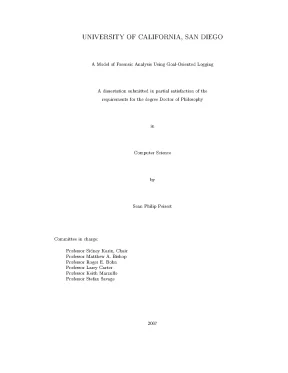
Tải xuống để đọc toàn bộUNIVERSITY OF CALIFORNIA, SAN DIEGO A Model of Forensic Analysis Using Goal-Oriented Logging A dissertation submitted in partial satisfaction of the requirements for the degree Doctor of Philosophy in Computer Science by Sean Philip Peisert Committee in charge: Professor Sidney Karin, Chair Professor Matthew A. Bishop Professor Roger E. Bohn Professor Larry Carter Professor Keith Marzullo Professor Stefan Savage 2007 UMI Number: 3246091 Copyright 2007 by Peisert, Sean Philip All rights reserved. UMI Microform 3246091 Copyright 2007 by ProQuest Information and Learning Company.
All rights reserved. This microform edition is protected against unauthorized copying under Title 17, United States Code. ProQuest Information and Learning Company 300 North Zeeb Road P. Box 1346 Ann Arbor, MI 48106-1346 Copyright Sean Philip Peisert, 2007 All rights reserved.
The dissertation of Sean Philip Peisert is approved, and it is acceptable in quality and form for publication on microfilm: Chair University of California, San Diego 2007 iii For Kathryn — my wife, my inspiration, my everything. And for my parents, who gave me what I needed to get here. iv Sherlock Holmes: “It is an old maxim of mine which states that once you have eliminated the impossible, whatever remains, however improbable, must be the truth.” —Sir Arthur Conan Doyle, “The Sign of the Four,” Lippincott’s Monthly Magazine (1890) deduce (verb): draw as a logical conclusion New Oxford American Dictionary, Second Edition (2005) logic (noun): The art of thinking and reasoning in strict accordance with the limitations and incapacities of human misunderstanding. —Ambrose Bierce, The Devil’s Dictionary (1911) v TABLE OF CONTENTS Signature Page.
v Table of Contents. vi List of Tables. ix List of Figures. xiii Vita, Publications, and Fields of Study.
Organization of the Dissertation. 8 3 A Method of Forensic Analysis Using Sequences of Function Calls. Experiments and Results. Conclusions on Forensics Using Sequences of Function Calls.
30 4 Toward Forensic Models. Principles of Forensic Analysis. Current Problems with Forensics. Principle 1: Consider the Entire System.
Principle 2: Log Information without Regard to Assumptions. Principle 3: Consider the Effects, Not Just the Actions. Principle 4: Consider Context to Assist in Understanding. Principle 5: Present and Process Actions and Results in an Understandable Way 41 6.
Summary of Current Problems with Forensics. Principles-Driven Solutions. Principles-Driven Logging. Principles-Driven Auditing.
Summary of Principles-Driven Solutions. From Principles to Models. Qualities for a Forensic Model. 50 vi 5 Laocoön: The Forensic Model.
Introduction to Our Approach. Choosing Intruder Goals to Model. Modeling Intruder Goals. Extracting and Interpreting Logged Data.
Unique Path Identifier. Proving the Model. 71 6 Examples of Using Laocoön. Obtaining a Root Shell.
Modify /etc/passwd (e. via lpr bug). via search path modification). Bypassing Standard Interfaces (e.
via utmp bug). Inconsistent Parameter Validation (e. with chsh or chfn). Shared Memory Code Injection.
The 1988 Internet Worm. Christma Exec Worm. Summary of Examples. 114 7 Implementation, Experiments, and Results.
Obtaining a Local Root Shell. Spyware via a Trojaned sshd. Modify /etc/passwd via lpr bug. Avoid Authentication in su.
Trojan Horse to gain root. Bypassing Standard Interfaces. Summary of Experiments. 124 8 Taking Laocoön from a Model to a System.
Our Model in Practice. Issues with Instrumentation. Issues with Logging. Issues with Forensic Analysis.
Issues with Construction. Policy Discovery and Compilation. Overview of the Approach. Applying Policies to Systems and Sites.
Reverse-Engineering Policies. Software/Hardware Issues. Sufficiency and Necessity in the Forensic Model. Applying Forensic Techniques to Intrusion Detection.
156 viii LIST OF TABLES Table 5.3 Service Property Types. 59 ix LIST OF FIGURES Figure 1.1 Diagram of possible measures of utility based on different data collected. (c) represents our goal, by using a model of forensics, in this dissertation.2 Diagram of a generic attack where circles represent actions. An attack model almost always consists of at least the endpoint (d), but may also include the beginnings (a) and possibly other states near the end (c).1 Unique and different numbers of function call sequences in the original version of su, and the version with pam authenticate removed.2 Number of function call sequences appearing only in the original version of su, and the version modified to ignore the results of pam authenticate.3 Number of function call sequences appearing only in the original version of ssh, and the version modified to echo the password back.4 Difference in number of function call sequences in original version of ssh, and the version modified to send the captured password over a network socket.1 Diagram of a generic attack where circles represent actions.
An attack model almost always consists of at least the endpoint (d), but may also include the beginnings (a) and possibly other states near the end (c).2 A coordinated, multi-stage attack. (a) represents a dual-pronged, co- ordinated beginning of the attack, (b) represents the beginnings of two individual components of the attacks, (c) represents the “ultimate goals” of each individual attack, and (d) represents the ultimate goal of the entire attack.3 Algorithm for placing bounds on the unknown goals in an attack graph.4 Algorithm for extracting the information necessary to log from an entire attack graph.5 An attack graph where circles represent known goals that can be described in advance and squares represent unknown exploits, which cannot.6 Algorithm for applying the λ function on a specific sub-goal.1 Diagram of a remote attack, exploiting a network program to obtain a root shell. (a) represents the remote connection. (b) represents the exploit that occurs to obtain the shell.
In an experiment that we show later, this is a buffer overflow, but it could be many different things. Hence, we do not model this directly. (c) represents executing the root shell.2 Diagram of spyware capturing a password and sending it over a network. (a) represents the capturing of the password.
(b) represents sending the password around the machine to another program. We do not know the mechanism used to do this, hence, we do not model this directly. (c) represents sending the password over the network.3 Diagram of re-writing a privileged file by exploiting multiple bugs in the UNIX program lpr.4 The attack graph used by the Internet Worm .5 The attack graph used by the Christma Exec Worm .6 Attack graphs for two possible classes of NFS exploits.1 Diagrams of two attack graphs, before and after path elimination has been applied. 130 xi PREFACE While Sherlock Holmes was not a doctor, Conan Doyle had based Holmes’s method as a detective upon one of his former professors of medicine at Edinburgh University, Dr.
Joseph Bell, whose powers of observation and deduction had made him a wizard at diagnosis. With the exception of Edgar Allan Poe’s pioneering stories about Auguste Dupin of Paris, Dr. Conan Doyle recalled many years later, most contemporary fictional detectives produced their results by chance or luck. Dissatisfied with that, he had decided, he said, to create a detective who would treat crime as Dr.
Bell had treated disease. This meant, in short, the application of scientific method to crime detection. That was a novel concept in 1887, to be sure, but it worked, first in fiction and then in practice, with life imitating art as it so often does when the art in question is a work of genius. As a detective in a scientific sense, Holmes always wants to know and looks for the physical evidence; he made himself a master at observing and analyzing physical evidence that the police and other detectives overlook or fail to recognize at all.
By his innate but also rigorously trained powers of deduction, he is able to reason backwards from this evidence to reconstruct the crime and delineate the physical attributes of the perpetrator. Holmes pays little attention to the psychology of crime. 1 This passage describes a 120-year-old methodology for analyzing crime successfully, that started as fiction and became reality. Amazingly, these words still apply today to computer forensic analysis.
However, until now, computer forensic analysis has largely been performed in the same way that Holmes’s fictional predecessors, and Scotland Yard’s real predecessors, performed forensic analysis: by chance or luck. Sometimes, chance and luck are enough. However, it is no coincidence that the most famous pieces of computer detective work have been performed by unusually brilliant computer analysts, such as Bill Cheswick [Che92], Cliff Stoll [Sto88, Sto89], and Tsutomu Shimomura [Shi95, SM96, Shi97]. But there are more attacks and attackers in the world than genius cyberdetectives available to analyze those attacks.
It will always help to be a a genius cyberdetective to analyze computer crime, and even for them, luck will never hurt. However, our goal is to change the level to which one must rely on these things by using a rigorous method of analyzing facts rather than relying on luck, chance, or what we think we might know about an intruder’s abilities, psychology, or motives. In this way, even the non-genius cyberdetective has a little more of a chance of getting things right. In this dissertation, we describe the year 2007 application of these year 1887 ideas.
1 See the afterword (“Dr. ”) by Jon Lellenberg, in [Car05]. xii ACKNOWLEDGEMENTS Many people have given me generous support and encouragement during my life, my time as a Ph. student, and during the process of writing this dissertation.
I would like to thank my advisors, teachers, mentors, and coaches — Sid Karin, Matt Bishop, Larry Carter, and Keith Marzullo. They have guided me through a series of steps in my life and my work that I could not have made it through without them — and have become friends in the process. In the best way that I can, I hope to live up to the gifts that they have given me. The advice from my entire dissertation committee has been interesting and valuable.
I appreciate their interest, support, and guidance, and I hope to have the opportunity to continue to interact with all of them in the future. Special thanks to Becky Bace, Martha Dennis, Drew Gross, Tsutomu Shimomura, Abe Singer, and Kevin Walsh, who all gave me support at important times and in important ways, and who also taught me new ways to think about academia, careers, and computer security. I wish to thank Robert S. Cohn and Steven Wallace at Intel for their enhancements to the FreeBSD version of the dynamic, binary instrumentation tool, Pin, which greatly helped my research on forensic analysis using sequences of function calls.
Finally, I would like to thank my patient and wonderful wife, Kathryn (who also copy- edited this entire dissertation); my closest friends, Aaron, Greg, Kent, Laura, Noah, PJ, and Stephen; and all of my family, who have all given me support throughout my life, have helped to make this possible, and have ultimately made the end result mean much more than just obtaining a degree. This material is based on work sponsored in part by: the Air Force Research Laboratory under Contract F30602-03-C-0075, a Lockheed-Martin Information Assurance Technology Focus Group 2005 University Grant, and award ANI-0330634, “Integrative Testing of Grid Software and Grid Environments,” from the National Science Foundation. The following papers, which have been previously published or are currently in submis- sion, are reprinted in this dissertation with the full permission of all co-authors of the papers: • In Chapter 3: “Analysis of Computer Intrusions Using Sequences of Function Calls,” Sean Peisert, Matt Bishop, Sidney Karin, and Keith Marzullo, conditionally accepted with minor revisions by IEEE Transactions on Dependable and Secure Computing (TDSC), January 2007. • In Chapter 4: “Principles-Driven Forensic Analysis,” Sean Peisert, Matt Bishop, Sidney Karin, and Keith Marzullo, in Proceedings of the 2005 New Security Paradigms Workshop (NSPW), pp.
85–93, Lake Arrowhead, CA, October 2005.
Nội dung được bảo vệ bản quyền — Tải xuống đầy đủ
Trích dẫn luận án này
Sean Philip Peisert (2007). Mô hình phân tích pháp y sử dụng ghi nhật ký hướng mục tiêu [Luận án tiến sĩ, University of California, San Diego]. LuanAn.net. https://luanan.net/cong-nghe-thong-tin/an-toan-thong-tin/mo-hinh-phan-tich-phap-y-ghi-nhat-ky-huong-muc-tieu
Từ khóa và chủ đề nghiên cứu
Từ khóa liên quan
Xem thêm luận án cùng lĩnh vực
Chủ đề nghiên cứu
Câu hỏi thường gặp
Luận án "Mô hình phân tích pháp y sử dụng ghi nhật ký hướng mục tiêu" nghiên cứu về vấn đề gì?
Luận án tiến sĩ về mô hình phân tích pháp y sử dụng ghi nhật ký hướng mục tiêu. Phương pháp phân tích dữ liệu nhật ký để phát hiện tấn công hệ thống.
Luận án "Mô hình phân tích pháp y sử dụng ghi nhật ký hướng mục tiêu" được bảo vệ tại trường nào?
Luận án này được bảo vệ tại University of California, San Diego. Năm bảo vệ: 2007.
Luận án "Mô hình phân tích pháp y sử dụng ghi nhật ký hướng mục tiêu" thuộc chuyên ngành gì?
Luận án "Mô hình phân tích pháp y sử dụng ghi nhật ký hướng mục tiêu" thuộc chuyên ngành Computer Science. Danh mục: An Toàn Thông Tin.
Luận án "Mô hình phân tích pháp y sử dụng ghi nhật ký hướng mục tiêu" có bao nhiêu trang?
Luận án "Mô hình phân tích pháp y sử dụng ghi nhật ký hướng mục tiêu" có 183 trang. Bạn có thể xem trước một phần tài liệu ngay trên trang web trước khi tải về.
Cách tải luận án "Mô hình phân tích pháp y sử dụng ghi nhật ký hướng mục tiêu" về máy như thế nào?
Để tải luận án về máy, bạn nhấn nút "Tải xuống ngay" trên trang này, sau đó hoàn tất thanh toán phí lưu trữ. File sẽ được tải xuống ngay sau khi thanh toán thành công. Hỗ trợ qua Zalo: 0559 297 239.