Nỗ lực tổng hợp Prostaglandin PGF2a - Luận án Tiến sĩ của Amy Marie Pollard
Luận án: Synthetic efforts towards the synthesis of prostaglandin pgf2a. Xem tóm tắt và tải về tại LuanAn.net
Năm xuất bản
Số trang
142
Thời gian đọc
22 phút
Lượt xem
0
Lượt tải
0
Phí lưu trữ
40 Point
Tổng quan nhanh
- Chủ đề:
- 1. Giới thiệu Prostaglandin PGF2a: Tầm quan trọng sinh học
- Số trang:
- 142 trang
- Trường:
- Louisiana State University and Agricultural and Mechanical College
- Chuyên ngành:
- Chemistry
- Tác giả:
- Amy Marie Pollard
- Năm:
- 2016
Tóm tắt nội dung luận án
I. Giới thiệu Prostaglandin PGF2a Tầm quan trọng sinh học
Tài liệu này trình bày các nỗ lực nghiên cứu tổng hợp Prostaglandin PGF2a. PGF2a là một eicosanoid quan trọng, đóng vai trò thiết yếu trong nhiều quá trình sinh học và y học. Nghiên cứu sâu về cấu trúc và con đường tổng hợp hóa học của PGF2a mang lại hiểu biết về cơ chế hoạt động của hợp chất. Đồng thời, mở ra tiềm năng ứng dụng trong dược lý prostaglandin. Các nỗ lực tổng hợp hóa học nhằm cung cấp đủ lượng hợp chất này cho mục đích khoa học và phát triển thuốc.
1.1. Eicosanoid Nhóm hợp chất quan trọng
Prostaglandin PGF2a thuộc nhóm eicosanoid, các phân tử tín hiệu lipid có nguồn gốc từ axit béo. Chúng tham gia vào nhiều chức năng tế bào và mô, bao gồm viêm, miễn dịch, và sinh sản. Sự hiểu biết về eicosanoid giúp khám phá các mục tiêu điều trị mới. Việc tổng hợp hóa học các eicosanoid phức tạp như PGF2a là một thách thức lớn trong hóa hữu cơ.
1.2. Dược lý prostaglandin Vai trò đa dạng
PGF2a có các hoạt tính dược lý mạnh mẽ. Hợp chất này ảnh hưởng đến sự co thắt cơ trơn, điều hòa huyết áp, và các quá trình viêm nhiễm. Nghiên cứu dược lý prostaglandin tập trung vào việc khai thác những tác động này để phát triển các loại thuốc mới. Tiềm năng ứng dụng của PGF2a trong điều trị các bệnh liên quan đến sinh sản và viêm là rất lớn, thúc đẩy nhu cầu về các phương pháp tổng hợp hiệu quả.
II. Chiến lược Tổng hợp Hóa học PGF2a Thiết kế mới
Việc tổng hợp Prostaglandin PGF2a là một nhiệm vụ phức tạp trong hóa hữu cơ do cấu trúc lập thể đa dạng và các nhóm chức nhạy cảm. Tài liệu này khám phá các chiến lược tổng hợp hóa học mới, nhằm vượt qua những hạn chế của phương pháp hiện tại. Một thiết kế tổng hợp PGF2a cải tiến được đề xuất, tập trung vào hiệu quả và khả năng kiểm soát lập thể. Các nỗ lực nghiên cứu hóa dược hướng tới việc tìm ra con đường tổng hợp bền vững và có thể mở rộng quy mô.
2.1. Phương pháp tổng hợp hiện tại
Các phương pháp tổng hợp PGF2a đã được báo cáo trước đây thường đòi hỏi nhiều bước, năng suất thấp, hoặc gặp khó khăn trong việc kiểm soát lập thể. Việc tổng hợp hóa học PGF2a hiệu quả vẫn là một lĩnh vực nghiên cứu tích cực. Cần có các phản ứng tổng hợp mới để đơn giản hóa quy trình và tăng tính chọn lọc.
2.2. Thiết kế tổng hợp PGF2a cải tiến
Một thiết kế tổng hợp PGF2a mới được đề xuất, tận dụng các phản ứng hóa hữu cơ chọn lọc. Thiết kế này tập trung vào việc xây dựng khung carbon cốt lõi của prostaglandin một cách hiệu quả. Mục tiêu là phát triển một chiến lược tổng hợp đơn giản hơn, ít bước hơn và có khả năng kiểm soát tốt hơn đối với cấu hình lập thể của phân tử Prostaglandin PGF2a.
2.3. Sinh tổng hợp PGF2a Góc nhìn liên quan
Mặc dù tài liệu tập trung vào tổng hợp hóa học, việc hiểu biết về sinh tổng hợp PGF2a trong tự nhiên cung cấp những hiểu biết quan trọng. Các enzym sinh tổng hợp PGF2a tạo ra phân tử với độ chọn lọc lập thể hoàn hảo. Kiến thức này có thể truyền cảm hứng cho việc thiết kế các phản ứng tổng hợp hóa học mimet hóa các quá trình tự nhiên, cải thiện hiệu quả của các phản ứng tổng hợp PGF2a.
III. Phản ứng Iodocyclization Nỗ lực tổng hợp PGF2a
Phản ứng iodocyclization đóng vai trò trung tâm trong chiến lược tổng hợp Prostaglandin PGF2a được khám phá trong tài liệu này. Đây là một phản ứng tổng hợp hóa học quan trọng, cho phép hình thành các vòng carbocyclic hoặc heterocyclic với độ chọn lọc lập thể cao. Nỗ lực nghiên cứu tập trung vào việc tối ưu hóa phản ứng này để xây dựng các phần quan trọng của khung PGF2a. Các chất trung gian tổng hợp từ phản ứng này là tiền chất quan trọng cho bước tiếp theo.
3.1. Thảo luận phản ứng iodocyclization
Phản ứng iodocyclization là một công cụ mạnh mẽ trong hóa hữu cơ để tạo ra các cấu trúc vòng. Tài liệu thảo luận chi tiết về cơ chế và các yếu tố ảnh hưởng đến phản ứng này khi áp dụng cho việc tổng hợp Prostaglandin PGF2a. Các kết quả từ các phản ứng iodocyclization Hirama và Uei cũng được phân tích, cung cấp bối cảnh cho các nỗ lực tổng hợp.
3.2. Điều kiện kết quả phản ứng
Nhiều điều kiện phản ứng khác nhau đã được thử nghiệm để tối ưu hóa hiệu quả của phản ứng iodocyclization. Các kết quả bao gồm năng suất và độ chọn lọc lập thể của các sản phẩm. Việc phân tích kỹ lưỡng các sản phẩm chính và phụ từ phản ứng iodocyclization là rất cần thiết để đảm bảo tính chính xác cho các bước tổng hợp PGF2a tiếp theo.
3.3. Các mô hình hệ thống iodocyclization
Để đánh giá tính khả thi của phản ứng iodocyclization, các mô hình hệ thống đơn giản hơn đã được tổng hợp và nghiên cứu. Cụ thể, việc tổng hợp 4-(iodomethyl)-6-methyl-1,3-dioxan-2-one đã được thực hiện như một hệ thống mô hình. Nghiên cứu trên các mô hình này giúp hiểu rõ hơn về tính chất và khả năng ứng dụng của phản ứng trước khi áp dụng vào các cấu trúc phức tạp hơn của chất trung gian tổng hợp PGF2a.
IV. Tổng hợp Chất trung gian PGF2a phân tích lập thể
Việc tổng hợp các chất trung gian quan trọng là một phần cốt lõi trong chiến lược tổng hợp Prostaglandin PGF2a. Tài liệu mô tả chi tiết quá trình tổng hợp các tiền chất phức tạp, tập trung vào việc kiểm soát cấu hình lập thể. Phân tích lập thể kỹ lưỡng được thực hiện để xác nhận cấu trúc của các chất trung gian. Nghiên cứu này đóng góp đáng kể vào lĩnh vực hóa hữu cơ và nghiên cứu hóa dược prostaglandin.
4.1. Tổng hợp chất trung gian chính
Quá trình tổng hợp hóa học bao gồm các bước điều chế 1-(benzyloxy)-4-vinylhex-5-en-3-ol và 1-((4-methoxybenzyl)oxy)-4-vinylhex-5-en-3-ol. Sau đó, chất trung gian quan trọng 4-(2-(benzyloxy)ethyl)-6-(iodomethyl)-5-vinyl-1,3-dioxan-2-one đã được tổng hợp. Các phản ứng tổng hợp này là các bước then chốt để xây dựng khung carbon của Prostaglandin PGF2a.
4.2. Phân công cấu hình lập thể
Độ chính xác trong việc phân công cấu hình lập thể là rất quan trọng đối với các phân tử phức tạp như Prostaglandin PGF2a. Tài liệu thảo luận về các phương pháp được sử dụng để xác định stereochemistry của các sản phẩm tổng hợp. Phân tích NMR và các kỹ thuật quang phổ khác đã được áp dụng để xác nhận các cấu hình R/S của các trung tâm bất đối xứng.
4.3. Tính toán Gaussian hỗ trợ
Để hỗ trợ việc phân công cấu hình lập thể và hiểu rõ hơn về các tính chất điện tử của các phân tử, các tính toán Gaussian đã được thực hiện. Các tính toán này cung cấp thông tin lý thuyết quý giá, bổ sung cho dữ liệu thực nghiệm. Việc kết hợp phương pháp tính toán và thực nghiệm giúp củng cố độ tin cậy của các kết quả nghiên cứu tổng hợp hóa học PGF2a.
V. Nghiên cứu Hóa dược Prostaglandin PGF2a tiềm năng
Nghiên cứu về tổng hợp Prostaglandin PGF2a có ý nghĩa sâu rộng đối với lĩnh vực hóa dược. Những nỗ lực này không chỉ nâng cao hiểu biết về hóa hữu cơ mà còn mở ra con đường tiềm năng cho việc phát triển các hợp chất mới. Các thành tựu trong chiến lược tổng hợp cung cấp các phương pháp đáng tin cậy để tạo ra PGF2a và các dẫn xuất của nó, đáp ứng nhu cầu trong nghiên cứu dược lý prostaglandin và ứng dụng lâm sàng.
5.1. Thành tựu nghiên cứu tổng hợp
Tài liệu này trình bày các thành tựu đáng kể trong việc phát triển các phương pháp tổng hợp PGF2a hiệu quả hơn. Các phản ứng tổng hợp mới và việc kiểm soát lập thể được cải thiện đã được chứng minh. Những kết quả này là nền tảng quan trọng cho việc sản xuất các lượng lớn Prostaglandin PGF2a cho nghiên cứu và thử nghiệm tiền lâm sàng, góp phần vào nghiên cứu hóa dược.
5.2. Hướng phát triển trong hóa dược
Các nỗ lực tổng hợp PGF2a mở ra hướng phát triển mới trong hóa dược. Khả năng điều chế các biến thể của PGF2a cho phép khám phá mối quan hệ cấu trúc-hoạt tính. Điều này có thể dẫn đến việc phát hiện các loại thuốc mới với hồ sơ dược lý được cải thiện, nhắm mục tiêu cụ thể hơn và ít tác dụng phụ hơn, ứng dụng từ hóa hữu cơ vào y học.
Tải xuống file đầy đủ để xem toàn bộ nội dung
Tải đầy đủ (142 trang)Trích đoạn nội dung luận án
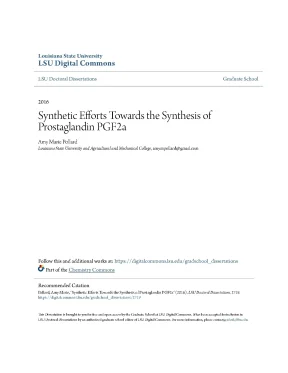
Tải xuống để đọc toàn bộLouisiana State University LSU Digital Commons LSU Doctoral Dissertations Graduate School 2016 Synthetic Efforts Towards the Synthesis of Prostaglandin PGF2a Amy Marie Pollard Louisiana State University and Agricultural and Mechanical College, amympollard@gmail.com Follow this and additional works at: https://digitalcommons.edu/gradschool_dissertations Part of the Chemistry Commons Recommended Citation Pollard, Amy Marie, "Synthetic Efforts Towards the Synthesis of Prostaglandin PGF2a" (2016). LSU Doctoral Dissertations.edu/gradschool_dissertations/2719 This Dissertation is brought to you for free and open access by the Graduate School at LSU Digital Commons. It has been accepted for inclusion in LSU Doctoral Dissertations by an authorized graduate school editor of LSU Digital Commons. For more information, please contactgradetd@lsu.
SYNTHETIC EFFORTS TOWARDS THE SYNTHESIS OF PROSTAGLANDIN PGF2 A Dissertation Submitted to the Graduate Faculty of the Louisiana State University and Agricultural and Mechanical College in partial fulfillment of the requirements for the degree of Doctor of Philosophy in The Department of Chemistry by Amy Marie Pollard B., University of Tennessee, 2007 August 2016 i OTF, Cinco de Mayo 2013, you are the reason why I do what I do. -PAP ii ACKNOWLEDGMENTS I would like to thank Emmett Pollard for being supportive of my scientific explorations from playing with chemistry sets to helping me incorporate my company. Also thank you for helping me whenever I needed help with life. To Monica Kimbrough Baker, thank you for teaching me composure and to play for keeps.
I would like to thank my mother for being there for me. Sincere thanks go to Dr. Michael Miller for introducing me to wonderful world of biochemical research at the age of 14. Dean Jeffery Engler, thank you for allowing me to join your research group before I finished high school.
You both have been great mentors throughout my scientific career. To the Comprehensive Cancer Center at UAB, thank you for your support and for allowing me to be a part of your program. Michael Best, you were honestly the best. Thank you for convincing me that chemistry was as interesting as biochemistry and for being an overall excellent mentor and research professor.
I’d also like to thank my Sensei Paul and the UTK Martials Arts Club for teaching me to get back up after being thrown to the ground. I would like to sincerely thank my research advisor, Dr. Crowe, for letting me join his research group and for giving me a new perspective on organic chemistry; I will use it well. I would also like to thank Connie Davis for GCMS training and general advice.
Rafael Cueto, thank you for allowing me to use your lab and assistance with ozonolysis. Thanks also go to Dr. Dale Treleavan (1945-2013), Dr. Thomas Weldeghiorhis for the NMR training and analysis help.
I would like to thank Dean Guillermo Ferreya, and Dr. Carol Taylor for helping me through my graduate school experience. Lastly I would like to thank Dr. Roger Laine and Dr.
You both have helped me more times than I can count. Thank you for your counsel. You were there when things got crazy. I fear that a mere thank is not enough, but thank you.
iii TABLE OF CONTENTS ACKNOWLEDGMENTS. iii LIST OF TABLES. v LIST OF FIGURES. vi LIST OF IMAGES.
x LISTS OF SCHEMES. xi LIST OF ABBREVIATIONS. xvi CHAPTER 1: PROGRESS TOWARDS THE SYNTHESIS OF PROSTAGLANDIN PGF2a .1 Introduction to Prostaglandins .2 Methods of Prostaglandin Synthesis .3 Synthetic Design for Prostaglandin Synthesis .4 Discussion of Iodocyclization .5 Synthesis of 1-(benzyloxy)-4-vinylhex-5-en-3-ol and 1-((4-methoxybenzyl)oxy)-4- vinylhex-5-en-3-ol .6 Syntheses of 4-(iodomethyl)-6-methyl-1,3-dioxan-2-one model system for 4-(2- (benzyloxy)ethyl)-6-(iodomethyl)-5-vinyl-1,3-dioxan-2-one .7 Synthesis of 4-(2-(benzyloxy)ethyl)-6-(iodomethyl)-5-vinyl-1,3-dioxan-2-one .8 Discussion of Stereochemical Assignments .9 Discussion of Gaussian Calculations .11 Experimental and Spectroscopic Data .125 iv LIST OF TABLES Table 1. Results from Hirama and Uei Iodocyclization Reactions.
Integration of tert-butyl pent-4-en-2-yl Carbonate Reaction Mixture. 26 Table 3 Reaction Conditions for Synthesis of tert-butyl pent-4-en-2-yl carbonate. Integration and Chemical Shifts of Major and Minor Iodocyclization Product from 4- (iodomethyl)-6-methyl-1,3-dioxan-2-one Crude, Spectra of Major and Minor Isomers Product. Reference Splitting Patterns and Chemical Shifts of Reaction Product (H1 500MHz)7.
Chemical shifts of 1-(benzyloxy)-4-vinylhex-5-en-3-yl tert-butyl carbonate Protons. Results and Conditions. Comparison of Previously Reported Iodocyclization Reaction Results. Chemical Shift (δ), Splitting, and Coupling Constant (J, Hz) values for H-NMR of 1.
Cosy Cross Peaks 4-(2-(benzyloxy)ethyl)-6-(iodomethyl)-5-vinyl-1,3-dioxan-2-one. HSQCDEPT Cross Peaks 4-(2-(benzyloxy)ethyl)-6-(iodomethyl)-5-vinyl-1,3-dioxan- 2-one. Summary of (4R,5R,6R)-4-(2-(benzyloxy)ethyl)-6-(iodomethyl)-5-vinyl-1,3- dioxan-2-one Gaussian Calculation Results. Summary of (4R,5R,6R)-4-(2-(benzyloxy)ethyl)-6-(iodomethyl)-5-vinyl-1,3- dioxan-2-one Gaussian Calculation Results.
55 v LISTOF FIGURES Figure 1. Chromatograph of Iodocyclization Product, Fragmented Product, and Extracted Ions 256, 230, and 103. GC of tert-butyl pent-4-en-2-yl carbonate Reaction Mixture. GC/MS Chromatograph and Spectra of tert-butyl pent-4-en-2-yl Carbonate Reaction Crude Using Duan, J.
4-(iodomethyl)-6-methyl-1,3-dioxan-2-one Crude, Spectra of Major and Minor Isomers Product from Mohapatra, D. 1H NMR of 1-(benzyloxy)-4-vinylhex-5-en-3-yl tert-butyl carbonate, 1. 1H NMR of BOC-ON Unsuccessful Reaction Crude with Chemical Shifts Similar to Chemical Shifts of Reaction Product. NMR of 4-(2-(benzyloxy)ethyl)-6-(iodomethyl)-5-vinyl-1,3-dioxan-2-one.
Cosy of 4-(2-(benzyloxy)ethyl)-6-(iodomethyl)-5-vinyl-1,3-dioxan-2-one. HSQCDEPT of 4-(2-(benzyloxy)ethyl)-6-(iodomethyl)-5-vinyl-1,3-dioxan-2-one. Roesy of 4-(2-(benzyloxy)ethyl)-6-(iodomethyl)-5-vinyl-1,3-dioxan-2-one. 1H NMR Homonuclear Decoupling (500 MHz, Chloroform-d) δ 2.
1H-NMR Split Pattern for H-20a and H-20b. Smaller Carbonate Used in DFT B3LYP 6-31+ g(df, pd) calculations. Relative Conformational Energies (kcal/mol) of the Smaller Carbonate. 2-Phenyl-1,3-dioxane 1H-NMR (400MHz, CDCl3).
2-Phenyl-1,3-dioxane 13C-NMR (101Hz, CDCl3). 2-Phenyl-1,3-dioxane, GC/MS EI (filament voltage 70 eV). Penta-1,4-dien-3-ol, 1H-NMR (400MHz, CDCl3). Penta-1,4-dien-3-ol, 13C-NMR (101MHz, CDCl3).
1-(Benzyloxy)-4-vinylhex-5-en-3-ol, HSQC. 4-penten-2-ol, 1H-NMR (400 MHz, CDCl3). Pent-4-en-2-yl carbamate, 1H-NMR (400 MHz, CDCl3). 98 Figure 45 Pent-4-en-2-yl carbamate, 1H-NMR (400 MHz, benzene-d).
Pent-4-en-2-yl carbamate, 13 C-NMR (101 MHz, CDCl3). Pent-4-en-2-yl carbamate, 13 C-NMR (101 MHz, benzene-d). GC/MS of pent-4-en-2-yl carbamate, EI (filament voltage 70 eV). Tert-butyl pent-4-en-2-yl carbonate product from Kumar, D., 2011 procedure purified using AgNO3 10 wt% on silica, 1H-NMR (400 MHz, CDCl3).
Tert-butyl pent-4-en-2-yl carbonate reaction crude using Duan, J. Tert-butyl pent-4-en-2-yl carbonate product from Kumar, D., 2011 procedure purified using AgNO3 10 wt% on silica, 13C-NMR (101 MHz, CDCl3). GC/MS chromatograph and spectra of tert-butyl pent-4-en-2-yl carbonate product from Kumar, D., 2011 procedure purified using AgNO3 10 wt% on silica, EI (filament voltage 70 eV). GC/MS chromatograph and spectra of tert-butyl pent-4-en-2-yl carbonate reaction crude Duan, J.
GC/MS chromatograph and spectra of tert-butyl pent-4-en-2-yl carbonate reaction mixture, EI (filament voltage 70 eV). GC/MS chromatograph and spectra of tert-butyl pent-4-en-2-yl carbonate contaminant, EI (filament voltage 70 eV). GC/MS chromatograph and spectra of tert-butyl pent-4-en-2-yl carbonate contaminant, EI (filament voltage 70 eV). GC/MS of 4-(iodomethyl)-6-methyl-1,3-dioxan-2-one, EI (filament voltage 70 eV).
122 ix LIST OF IMAGES Image 1. Linoleic Acid C18:2, omega-6. Chiral Auxiliary (4R, 5R)-2-((1E, 3E)-penta-1, 3-dien-1-yl)-4, 5-diphenyl-1, 3-bis (phenylsulfonyl)-1, 3, 2-diazaborolidine. 18 x LISTS OF SCHEMES Scheme 1.
Enzymatic Cascade Producing Prostaglandins and Thromboxanes. Two Molecule Coupling Model. Three Molecule Coupling Model. Synthesis of Prostaglandin Core by Using a Diels-Alder Reaction and Radical Induced Skeletal Translocation.
Synthesis of Prostaglandin Core with Side Chain for Use in Two Component Method. One Pot Three Component Coupling Using a Chiral Catalyst to Synthesize a Prostaglandin. Retrosynthetic Design of Prostaglandin Synthesis. Route to Alkene 1.
13 Scheme 10 Iodocyclization of a 3-Acylamino Ester. Synthesis of Alcohols. Attempted Reduction Using Chary-Laxmi method. Synthesis of Aldehydes.
Synthesis of (E)-5-bromopenta-1,3-diene. Synthesis and Mechanism of 1-(benzyloxy)-4-vinylhex-5-en-3-ol and 1-((4- methoxybenzyl) oxy)-4-vinylhex-5-en-3-ol. Synthesis of Pent-4-en-2-yl Carbamate. Attempted Synthesis of 4-(iodomethyl)-6-methyl-1,3-dioxan-2-one Using Basic Work Up.
Synthesis of 4-(iodomethyl)-6-methyl-1,3-dioxan-2-one Using Acidic Workup. Reaction Product Fragmented and Products. Hecker and Heathcock Iodocyclization results. Synthesis of 4-(iodomethyl)-6-methyl-1,3-dioxan-2-one via Carbonate Cyclization.
Tert-butyl pent-4-en-2-yl carbonate and By-Products from pen-4-en-2-ol Reaction with Boc Anhydride. Synthesis of Carbonate 1.68 using Boc-ON and n-BuLi. Synthesis of 4-(iodomethyl)-6-methyl-1,3-dioxan-2-one from Carbonate. Synthesis of Carbonate 1.69 Using Steglich Esterification.
Attempted Synthesis of Carbonate 1.69 Using BOC-ON. Iodocyclization of 1-(benzyloxy)-4-vinylhex-5-en-3-yl tert-butyl carbonate. IBr Induced Cyclization by Duan and Smith. Formation of Minor Isomer, Sterically Unfavorable Pathway.
Formation of Major Isomer, Kinetically Favorable Pathway. 58 xii LIST OF ABBREVIATIONS AcCl Acetyl Chloride AChE Acetylcholinesterase AIBN Azobisisobutyronitrile COSY COrrelation SpectroscopY COX-1 Cyclooxygenase-1 COX-2 Cyclooxygenase-2 cPGES Prostaglandin E Synthase CSA Camphorsulfonic Acid DHA Docosahexaenoic acid DMAP N,N-Dimethylpyridin-4-amine DTGS Deuterated-TriGlycine Sulfate ESI Electrospray Ionization ETP Ethopabate FTIR Fourier Transform Infrared GRAS Generally Recognized as Safe GC/MS Gas Chromatography–Mass Spectrometry H Hour xiii HPLC High-performance Liquid Chromatography HSQCDEPT Heteronuclear Single Quantum Correlation Spectroscopy Distortionless Enhancement of Polarization Transfer LC Liquid Chromatography LHMDS Lithium bis(trimethylsilyl)amide NIS N-Iodosuccinimide NMR Nuclear Magnetic Resonance mPGES-1 Microsomal Prostaglandin E2 Synthase-1 mPGES-2 Microsomal Prostaglandin E2 Synthase-1 PCC Pyridinium Chlorochromate PGD2 Prostaglandin D2 PGE2 Prostaglandin E2 PGF2 Prostaglandin F2 PGG2 Prostaglandin G2 PGH2 Prostaglandin H2 PGI2 Prostaglandin I2 PGJ2 Prostaglandin J2 Py Pyridine xiv Rf Retardation Factor ROESY Rotating-Frame Overhauser SpectroscopY RT Room Temperature SERS Surface Enhanced Raman Scattering TNT Trinitrotoluene TOF Time of Flight p-TSA/TsOH p-Toluenesulfonic Acid TXA2 Thromboxane A2 TXB2 Thromboxane B2 xv ABSTRACT This dissertation describes strategies for synthesizing prostaglandin PGF2α. Our synthetic design creates the stereochemistry needed for the core and side chains of the target prostaglandin PGF2 and PGF2 synthase selective analogues while incorporating iodocyclization desymmetrization of acyclic dienes. A model system for 4-(iodomethyl)-6-methyl-1,3-dioxan-2- one was developed and synthesized for our target compound 4-(2-(benzyloxy)ethyl)-6- (iodomethyl)-5-vinyl-1,3-dioxan-2-one.
Both compounds were successfully synthesized providing useful stereocenters for completing the synthesis of prostaglandin PGF2 .Efforts toward total stereochemical control of PGF2α include the partial syntheses of bis- diethylanimedimethylsilane and of (4S,5S)-2-((1E,3E)-penta-1,3-dien-1-yl)-4,5-diphenyl-1,3- ditosyl-1,3,2-diazaborolidine. xvi CHAPTER 1: PROGRESS TOWARDS THE SYNTHESIS OF PROSTAGLANDIN PGF2 1.1 Introduction to Prostaglandins Essential fatty acids omega-3, omega-6, including eicosapentaenoic and docosahexaenoic acid (DHA), precursors to prostanoids, are critical for circulation, production of hemoglobin, immune function, and anti-inflammatory response.1 A study reported in 2006 by R. Bayer suggests that omega-3 fatty acids are a possible treatment for inflammatory pain.2 Studies by Wall et al. concluded that increasing consumption of omega-3 fatty acids increases production of inflammation mediators and regulators.
3 Linoleic acid, a C18:2 omega-6 fatty acids (Image 1) is the precursor to arachidonic acid which is oxidized by cyclooxygenase 1 or 2 forming prostaglandin PGG2, an inflammatory stimulator. In the C18:2 type nomenclature, C18 represents the number of carbons in the chain; the 2 represents the number of alkenes in the chain. PGG2 is reduced by PGH2 synthase forming prostaglandin PGH2, which undergoes enzymatic reactions to produce five different prostaglandins: PGI2, PGF1α, PGF2α, PGE2, PGD2, and a thromboxane, TXA2. The primary prostaglandins undergo additional enzymatic reactions to form additional prostanoids, which are responsible for homeostasis, (Scheme 1).2 Methods of Prostaglandin Synthesis There are three major prostaglandin synthetic designs.
The first is synthesis of the core cyclopentane with appropriate side groups which can be used in subsequent reactions for attachment of α and ω chains. Linoleic Acid C18:2, omega-6 2 PGF2 Scheme 1. Enzymatic Cascade Producing Prostaglandins and Thromboxanes 3 The second is a two molecule coupling, where one molecule contains the cyclopentane core and an attached side chain. This molecule is coupled to a second chain, (Scheme 2).
The third method of prostaglandin synthesis is the three component coupling (Scheme 3).4 Following is an example of each approach. A derivative of Corey’s lactone was synthesized by Augustyns et al. 5 Lactone synthesis began with a Diels-Alder reaction of 1.13, followed by a radical induced skeletal translocation affording lactone product 1.15, which was isomerized to produce 1. Decarboxylmethylation with lithium chloride gave lactone 1.17 which was functionalized via bromohydrin formation followed by acetylation.
Radical debromination of the core structure was accompanied by the potential for side chain attachment 1. Two molecule coupling completed by Togashi et al. 6 commenced with the 1,1-dibromo alkene (1.20) coupling to an aldehyde chain affording alkyne 1. Swern oxidation transformed the hydroxyl group to a ketone giving product 1.
K-selectride was used to stereoselectively reduce the ketone carbonyl, producing alcohol 1. Reduction of the alkyne, followed by hydroxyl group acylation yielded 1.
Nội dung được bảo vệ bản quyền — Tải xuống đầy đủ
Trích dẫn luận án này
Amy Marie Pollard (2016). Tổng hợp Prostaglandin PGF2a: Nỗ lực nghiên cứu [Luận án tiến sĩ, Louisiana State University and Agricultural and Mechanical College]. LuanAn.net. https://luanan.net/y-hoc/tong-hop-prostaglandin-pgf2a-luan-an-amy-marie-pollard
Câu hỏi thường gặp
Luận án "Tổng hợp Prostaglandin PGF2a: Nỗ lực nghiên cứu" nghiên cứu về vấn đề gì?
Luận án: Synthetic efforts towards the synthesis of prostaglandin pgf2a. Xem tóm tắt và tải về tại LuanAn.net
Luận án "Tổng hợp Prostaglandin PGF2a: Nỗ lực nghiên cứu" được bảo vệ tại trường nào?
Luận án này được bảo vệ tại Louisiana State University and Agricultural and Mechanical College. Năm bảo vệ: 2016.
Luận án "Tổng hợp Prostaglandin PGF2a: Nỗ lực nghiên cứu" thuộc chuyên ngành gì?
Luận án "Tổng hợp Prostaglandin PGF2a: Nỗ lực nghiên cứu" thuộc chuyên ngành Chemistry. Danh mục: Y Học.
Luận án "Tổng hợp Prostaglandin PGF2a: Nỗ lực nghiên cứu" có bao nhiêu trang?
Luận án "Tổng hợp Prostaglandin PGF2a: Nỗ lực nghiên cứu" có 142 trang. Bạn có thể xem trước một phần tài liệu ngay trên trang web trước khi tải về.
Cách tải luận án "Tổng hợp Prostaglandin PGF2a: Nỗ lực nghiên cứu" về máy như thế nào?
Để tải luận án về máy, bạn nhấn nút "Tải xuống ngay" trên trang này, sau đó hoàn tất thanh toán phí lưu trữ. File sẽ được tải xuống ngay sau khi thanh toán thành công. Hỗ trợ qua Zalo: 0559 297 239.