Luận án: Thiết lập mục tiêu và hợp đồng kỳ vọng cải thiện bài tập về nhà của trẻ em
Thiết lập mục tiêu giúp trẻ cải thiện bài tập về nhà. Hướng dẫn chi tiết để xây dựng thói quen học tập hiệu quả, tăng khả năng tập trung và kết quả học tập.
Tâm lý học (Psychology)
Luan An
Luận án
Năm xuất bản
Số trang
144
Thời gian đọc
22 phút
Lượt xem
0
Lượt tải
0
Phí lưu trữ
40 Point
Tổng quan nhanh
- Chủ đề:
- Thiết lập mục tiêu: Cải thiện bài tập về nhà của trẻ
- Số trang:
- 144 trang
- Trường:
- Louisiana State University and Agricultural and Mechanical College
- Chuyên ngành:
- Tâm lý học (Psychology)
- Tác giả:
- Deborah Lynn Miller
- Năm:
- 1992
Tóm tắt nội dung luận án
I.Thiết lập mục tiêu Cải thiện bài tập về nhà của trẻ
Thiết lập mục tiêu là một phương pháp mạnh mẽ. Nó giúp trẻ em cải thiện kết quả học tập. Đặc biệt, hiệu suất bài tập về nhà được nâng cao rõ rệt. Khi trẻ có mục tiêu rõ ràng, việc học trở nên có định hướng. Trẻ hiểu rõ những gì cần hoàn thành. Điều này giảm sự lúng túng, tăng cường sự tập trung. Thiết lập mục tiêu học tập biến việc hoàn thành bài tập thành một nhiệm vụ có ý nghĩa. Nó không chỉ là nghĩa vụ.
1.1. Mục tiêu là gì Nền tảng cải thiện việc học
Mục tiêu là đích đến cụ thể. Nó là kết quả mong muốn trong học tập. Mục tiêu cung cấp một lộ trình. Nó định hướng nỗ lực của trẻ. Ví dụ: hoàn thành 5 bài toán trong 20 phút. Hoặc đọc một chương sách trước bữa tối. Những mục tiêu này tạo ra khuôn khổ. Trẻ biết mình cần làm gì. Hiệu suất học tập tăng lên đáng kể. Đây là một phương pháp học tập hiệu quả. Nó xây dựng nền tảng vững chắc cho việc tự học.
1.2. Tại sao cần thiết lập mục tiêu cho bài tập về nhà
Bài tập về nhà thường gây áp lực. Thiết lập mục tiêu giúp phá vỡ các nhiệm vụ lớn. Trẻ em thấy việc hoàn thành từng bước dễ dàng hơn. Mục tiêu tạo ra sự kiểm soát. Trẻ cảm thấy có quyền tự chủ. Điều này tăng động lực học tập cho trẻ. Việc hoàn thành mục tiêu nhỏ mang lại cảm giác thành công. Nó khuyến khích trẻ tiếp tục. Kết quả là cải thiện bài tập về nhà tổng thể. Trẻ học cách quản lý công việc của mình.
1.3. Kết nối mục tiêu với thành công học tập
Mục tiêu là cầu nối tới thành công. Nó giúp trẻ hình dung kết quả. Trẻ nhận ra giá trị của nỗ lực. Thiết lập mục tiêu khuyến khích sự kiên trì. Trẻ học cách vượt qua khó khăn. Hoàn thành mục tiêu nhỏ dần xây dựng sự tự tin. Sự tự tin là yếu tố then chốt. Nó thúc đẩy trẻ đặt ra mục tiêu cao hơn. Thành tích học tập từ đó cũng được nâng cao. Đây là chu trình tích cực cho sự phát triển học tập của trẻ.
II.Lợi ích của thiết lập mục tiêu học tập hiệu quả
Thiết lập mục tiêu mang lại nhiều lợi ích. Nó không chỉ giúp trẻ hoàn thành bài tập. Nó còn phát triển các kỹ năng sống quan trọng. Trẻ học cách tự định hướng. Trẻ học cách chịu trách nhiệm. Những kỹ năng này rất cần thiết cho tương lai. Một hệ thống mục tiêu hiệu quả sẽ nuôi dưỡng sự độc lập. Nó thúc đẩy sự phát triển toàn diện của trẻ em.
2.1. Nâng cao kỹ năng tự học và trách nhiệm cá nhân
Thiết lập mục tiêu khuyến khích trẻ tự lập. Trẻ tự quyết định cách tiếp cận bài tập. Trẻ học cách tự giải quyết vấn đề. Đây là nền tảng của kỹ năng tự học. Trẻ chịu trách nhiệm về kết quả. Việc này củng cố ý thức trách nhiệm cá nhân trong học tập. Trẻ không còn phụ thuộc hoàn toàn vào người lớn. Trẻ trở thành người học chủ động. Điều này giúp trẻ phát triển năng lực tự chủ.
2.2. Phát triển khả năng quản lý thời gian học tập
Mục tiêu cụ thể đòi hỏi kế hoạch. Trẻ cần phân bổ thời gian hợp lý. Việc này phát triển khả năng quản lý thời gian học tập. Trẻ học cách ưu tiên nhiệm vụ. Trẻ biết cách sử dụng thời gian hiệu quả hơn. Ví dụ: Đặt mục tiêu hoàn thành bài tập A trước bài tập B. Hoặc dành 30 phút cho môn Toán mỗi ngày. Điều này giúp trẻ tránh bị quá tải. Nó cũng giảm căng thẳng liên quan đến bài tập.
2.3. Củng cố động lực và sự tự tin trong học tập
Mỗi khi một mục tiêu được hoàn thành, trẻ nhận được phần thưởng. Phần thưởng đó là cảm giác đạt được thành tựu. Cảm giác này là động lực mạnh mẽ. Nó củng cố động lực học tập cho trẻ. Trẻ thấy được tiến bộ của mình. Sự tự tin của trẻ tăng lên rõ rệt. Trẻ tin tưởng vào khả năng của bản thân. Điều này tạo ra chu trình tích cực. Trẻ muốn đặt ra và đạt được nhiều mục tiêu hơn.
III.Phương pháp thiết lập mục tiêu SMART cho trẻ em
Mục tiêu cần phải được định nghĩa rõ ràng. Phương pháp SMART là công cụ lý tưởng. SMART là viết tắt của Specific (Cụ thể), Measurable (Đo lường được), Achievable (Khả thi), Relevant (Liên quan), Time-bound (Có thời hạn). Áp dụng SMART giúp trẻ em đặt ra mục tiêu hiệu quả. Nó biến ước muốn thành hành động cụ thể. Phương pháp này hướng dẫn trẻ lập kế hoạch học tập cho trẻ một cách có hệ thống.
3.1. Xác định mục tiêu Cụ thể Đo lường được
Mục tiêu phải cụ thể. Nó không thể là "làm bài tập tốt hơn". Thay vào đó, nó là "hoàn thành 10 câu hỏi Toán trước 7 giờ tối". Sự cụ thể giúp trẻ hình dung nhiệm vụ. Mục tiêu cũng cần đo lường được. Trẻ biết rõ khi nào mục tiêu đã đạt được. "Đọc thêm sách" không đo lường được. "Đọc 30 trang truyện trong 3 ngày" thì có. Điều này tạo ra sự minh bạch. Trẻ dễ dàng theo dõi tiến độ.
3.2. Đảm bảo mục tiêu Khả thi Liên quan
Mục tiêu phải khả thi. Đặt mục tiêu quá cao gây nản lòng. "Hoàn thành tất cả bài tập trong 15 phút" là không thực tế. "Làm xong bài tập tiếng Anh trong 45 phút" thì khả thi hơn. Mục tiêu cần liên quan đến việc học. Nó phải phù hợp với khả năng của trẻ. Một mục tiêu liên quan sẽ có ý nghĩa. Trẻ thấy được mục đích của nỗ lực. Điều này duy trì động lực học tập cho trẻ.
3.3. Đặt thời hạn cho mục tiêu Yếu tố Thời gian
Mỗi mục tiêu cần có thời hạn. Thời hạn tạo ra áp lực tích cực. Nó thúc đẩy trẻ hành động. "Hoàn thành bài tập Khoa học vào thứ Sáu" là một ví dụ. Không có thời hạn, mục tiêu dễ bị trì hoãn. Trẻ học cách quản lý thời gian hiệu quả. Trẻ nhận ra tầm quan trọng của việc hoàn thành công việc đúng hạn. Đây là kỹ năng quý giá cho học tập và cuộc sống.
IV.Xây dựng kế hoạch học tập Quản lý thời gian cho trẻ
Thiết lập mục tiêu là bước đầu tiên. Xây dựng kế hoạch học tập chi tiết là bước tiếp theo. Một kế hoạch rõ ràng giúp trẻ biến mục tiêu thành hành động. Nó cung cấp cấu trúc cho thời gian học tập. Kế hoạch này là công cụ hữu ích. Nó giúp trẻ quản lý thời gian học tập hiệu quả. Trẻ cảm thấy ít bị choáng ngợp hơn.
4.1. Lập lịch trình học tập hàng ngày hàng tuần
Trẻ cần một lịch trình học tập cố định. Lịch trình này bao gồm thời gian cụ thể cho từng môn. Ví dụ: Từ 4:00 chiều đến 5:00 chiều là giờ làm bài tập Toán. Lịch trình cần tính đến các hoạt động khác. Các hoạt động ngoại khóa, giải trí cũng quan trọng. Lịch trình hàng tuần giúp trẻ có cái nhìn tổng thể. Trẻ biết mình cần làm gì mỗi ngày. Điều này giảm căng thẳng bài tập. Nó tạo ra thói quen học tập lành mạnh.
4.2. Ưu tiên công việc phân chia nhiệm vụ nhỏ
Không phải tất cả bài tập đều có độ khó như nhau. Trẻ cần học cách ưu tiên. Nhiệm vụ khó hơn, cần nhiều thời gian hơn nên làm trước. Nhiệm vụ lớn nên được chia thành các phần nhỏ. Ví dụ: thay vì "làm bài tập lịch sử", hãy chia thành "đọc chương 5" và "trả lời câu hỏi 1-3". Việc này giúp trẻ không bị quá tải. Trẻ dễ dàng bắt đầu và hoàn thành từng phần. Kế hoạch học tập cho trẻ trở nên dễ thực hiện.
4.3. Sử dụng công cụ hỗ trợ quản lý thời gian
Nhiều công cụ có thể hỗ trợ. Đồng hồ hẹn giờ giúp trẻ tập trung. Lịch hoặc bảng kế hoạch giúp theo dõi tiến độ. Ứng dụng quản lý thời gian cũng là lựa chọn. Trẻ có thể đánh dấu công việc đã hoàn thành. Điều này mang lại cảm giác thành tựu. Nó thúc đẩy trẻ tiếp tục. Sử dụng công cụ biến việc quản lý thời gian thành trò chơi. Trẻ hứng thú hơn với việc học.
V.Tăng động lực giảm căng thẳng Trách nhiệm tự học
Mục tiêu và kế hoạch chỉ là công cụ. Điều quan trọng là nuôi dưỡng động lực bên trong. Tạo môi trường hỗ trợ là cần thiết. Trẻ cần cảm thấy được khuyến khích. Việc này giúp trẻ phát triển trách nhiệm cá nhân trong học tập. Đồng thời, nó giúp giảm căng thẳng bài tập. Trẻ học cách tự chủ hơn trong quá trình học.
5.1. Tạo môi trường học tập tích cực tại nhà
Môi trường học tập ảnh hưởng lớn. Góc học tập yên tĩnh, đủ ánh sáng là cần thiết. Giảm thiểu các yếu tố gây xao nhãng. Ví dụ: tắt tivi, điện thoại trong giờ học. Một không gian học tập chuyên biệt giúp trẻ tập trung. Nó tạo thói quen tốt. Môi trường tích cực hỗ trợ kỹ năng tự học. Trẻ cảm thấy thoải mái hơn khi làm bài tập.
5.2. Động viên khen thưởng nỗ lực và tiến bộ
Sự công nhận là động lực mạnh mẽ. Khen ngợi nỗ lực của trẻ, không chỉ kết quả. Ví dụ: "Con đã rất cố gắng làm bài tập khó này". Hoặc "Con đã hoàn thành đúng mục tiêu đặt ra". Thưởng nhỏ cho việc đạt mục tiêu có thể hữu ích. Phần thưởng không nhất thiết phải vật chất. Một lời khen chân thành, thời gian chơi thêm cũng có giá trị. Điều này củng cố động lực học tập cho trẻ.
5.3. Khuyến khích trẻ tự đánh giá điều chỉnh mục tiêu
Trẻ cần học cách tự nhìn nhận. Sau khi hoàn thành mục tiêu, hãy hỏi trẻ. "Con cảm thấy thế nào về cách mình đã làm?" "Có điều gì có thể làm tốt hơn không?" "Mục tiêu tiếp theo của con là gì?" Việc tự đánh giá phát triển tư duy phản biện. Trẻ học cách điều chỉnh kế hoạch. Điều này tăng cường trách nhiệm cá nhân trong học tập. Trẻ trở thành người học độc lập, có khả năng tự cải thiện.
Tải xuống file đầy đủ để xem toàn bộ nội dung
Tải đầy đủ (144 trang)Trích đoạn nội dung luận án
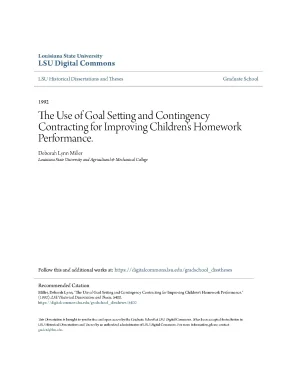
Tải xuống để đọc toàn bộLouisiana State University LSU Digital Commons LSU Historical Dissertations and Theses Graduate School 1992 The Use of Goal Setting and Contingency Contracting for Improving Children's Homework Performance. Deborah Lynn Miller Louisiana State University and Agricultural & Mechanical College Follow this and additional works at: https://digitalcommons.edu/gradschool_disstheses Recommended Citation Miller, Deborah Lynn, "The Use of Goal Setting and Contingency Contracting for Improving Children's Homework Performance. LSU Historical Dissertations and Theses.edu/gradschool_disstheses/5400 This Dissertation is brought to you for free and open access by the Graduate School at LSU Digital Commons. It has been accepted for inclusion in LSU Historical Dissertations and Theses by an authorized administrator of LSU Digital Commons.
For more information, please contact gradetd@lsu. INFORMATION TO USERS This manuscript has been reproduced from the microfilm master. UMI films the text directly from the original or copy submitted. Thus, some thesis and dissertation copies are in typewriter face, while others may be from any type of computer printer.
The quality of this reproduction is dependent upon the quality of the copy submitted. Broken or indistinct print, colored or poor quality illustrations and photographs, print bleedthrough, substandard margins, and improper alignment can adversely affect reproduction. In the unlikely event that the author did not send UMI a complete manuscript and there are missing pages, these will be noted. Also, if unauthorized copyright material had to be removed, a note will indicate the deletion., maps, drawings, charts) are reproduced by sectioning the original, beginning at the upper left-hand corner and continuing from left to right in equal sections with small overlaps.
Each original is also photographed in one exposure and is included in reduced form at the back of the book. Photographs included in the original manuscript have been reproduced xerographically in this copy. Higher quality 6" x 9" black and white photographic prints are available for any photographs or illustrations appearing in this copy for an additional charge. Contact UMI directly to order.
UMI University Microfilms International A Bell & Howell Information Company 300 North Zeeb Road. Ml 48106-1346 USA 313/761-4700 800/521-0600 Order Number 9302918 The use of goal setting and contingency contracting for improving children's homework performance Miller, Deborah Lynn, Ph. The Louisiana State University and Agricultural and Mechanical Col. Ann Arbor, MI 48106 THE USE OF GOAL SETTING AND CONTINGENCY CONTRACTING FOR IMPROVING CHILDREN'S HOMEWORK PERFORMANCE A Dissertation Submitted to the Graduate Faculty of the Louisiana State University and Agricultural and Mechanical College in partial fulfillment of the requirements for the degree of Doctor of Philosophy in The Department of Psychology by Deborah L., Louisiana State University, 1989 August, 1992 ACKNOWLEDGEMENTS I would like to express my appreciation to those individuals who provided much assistance throughout the course of my dissertation.
First, I would like to thank my committee members for their guidance and support during this project. These individuals included Phillip Brantley, Ph., Johnny Matson, Ph., Lisa Moore, Ph., David Pugh, Ph., and Arthur Riopelle, Ph. Special recognition goes to Mary Lou Kelley, Ph., my committee chairperson and mentor, who's faith in my abilities and encouragement over the last five years have greatly contributed to my development as a psychologist. I am grateful to all those who aided with data collection, particularly Alice Kahle, M., who devoted much time and effort to this project despite her own busy schedule.
Also, the friendships of Kevin Everett, Ph. (even if he did finish first), Brad Thomason, Ph.2B, and Alyson McCain, M. They each contributed greatly to my graduate career in terms of both professional and some less than professional matters. Special recognition goes to Adam Landis, whose patience and understanding throughout this process have been constant.
Adam deserves an honorary degree in ii psychology as he has devoted so much to seeing me through this project. Finally, I cannot say enough concerning the support and encouragement I have received from my family, particularly from my parents. My achievements thus far would have been far fewer without them and I am truly grateful for all they have given me. iii TABLE OF CONTENTS Page ACKNOWLEDGEMENTS ii LIST OF TABLES vi LIST OF FIGURES vii ABSTRACT viii INTRODUCTION 1 METHOD 32 RESULTS 50 DISCUSSION 64 REFERENCES 73 APPENDICES A CONSENT FORM 82 B HOMEWORK PROBLEM CHECKLIST 83 C CONNERS PARENT RATING SCALE-48 84 D CONNERS TEACHER RATING SCALE-28 85 E HOMEWORK SCORING PROTOCOL 86 F TREATMENT EVALUATION INVENTORY- SHORT FORM 87 G PARENT'S CONSUMER SATISFACTION QUESTIONNAIRE 88 H HOMEWORK INTERACTION CODING SYSTEM- REVISED 98 I INTERACTION BEHAVIOR CODE-REVISED 105 J TREATMENT INTEGRITY QUESTIONNAIRE 107 K DEMOGRAPHIC QUESTIONNAIRE 108 iv L HOMEWORK OBSERVATION GUIDELINES 110 M HOMEWORK COMPLETION MONITORING SHEET- BASELINE 112 N HOMEWORK AND GOAL SETTING: PARENT HANDOUT 113 O HOMEWORK AND CONTINGENCY CONTRACTING: PARENT HANDOUT 116 P HOMEWORK CONTRACT 120 Q CONTRACT MONITORING SHEET 121 R CODING SHEET 122 S HOMEWORK INTERACTION CODING SYSTEM- REVISED.
PERCENT OF INTERVALS IN WHICH EACH HICS-R CATEGORY WAS OBSERVED 124 T INTERACTION BEHAVIOR CODE-REVISED. PERCENT OF INTERVALS OF POSITIVE AND NEGATIVE BEHAVIOR FOR PARENTS AND CHILDREN ACROSS TREATMENT PHASES 128 VITA 132 v LIST OF TABLES Table Page 1. Conners Parent Rating Scale (CPRS-48) T-Scores 35 3. Conners Teacher Rating Scale (CTRS-28) T-Scores 36 4.
Homework Goals Worksheet 45 5. Homework Problem Checklist: Pre- and Post-Treatment Scores 57 6. Interaction Behavior Code-Revised: Goal Setting. Percent of Intervals in which each IBC-R Category Was Observed.
Interaction Behavior Code-Revised: Contract Sessions. Percent of Intervals in which each IBC-R Category Was Observed. Parents' Consumer Satisfaction Questionnaire Scores 62 vi LIST OF FIGURES Figure Page 1. Percent of on-task behavior across subjects 51 2.
Percent of homework completed accurately across subj ects 53 vii ABSTRACT Research suggests that homework has favorable effects on learning and student achievement. However, research directed at improving homework completion and accuracy has been limited in scope. The present study examined the effects of goal setting and contingency contracting on children's homework performance. Subjects were four parent-child dyads in which the child exhibited clinically significant homework problems.
Dependent variables of primary interest included direct observation of children's on-task behavior, work accuracy, and Homework Problem Checklist scores (Anesko, Schoiock, Ramirez, & Levine, 1987). Using a combination of multiple baseline and withdrawal (ABAB) designs, goal setting and contingency contracting produced significant improvements in children's homework accuracy. Results concerning the effects of treatment on percent of on-task behavior were less clear although two of four subjects evidenced significant improvements in on-task behavior. Homework Problem Checklist scores improved significantly for two of four subjects.
Social validity of the procedures was supported by parent ratings on standardized questionnaires. Methodological contributions and limitations are discussed as are suggestions for further research. viii INTRODUCTION As ubiquitous as homework might seem, particularly to students, teachers, and parents, its importance and contribution to learning has been debated. Those speaking against homework have suggested that it is an unwholesome activity that lacks professional supervision and allows children to practice their mistakes (Paschal, Weinstein, & Walberg, 1984).
Others propose that homework interferes with important family and community activities thus decreasing children's play and leisure time and adversely affecting family life (LaConte, 1981; McDermott, Goldman, & Varenne, 1984). In contrast, proponents of homework believe that it fosters a closer relationship between home and school and promotes independent work and study habits (McDermott et al. However, much of the literature on homework consists of opinion pieces or methodologically flawed studies. Indeed, relatively few homework studies are empirical and results between studies are often conflictual (Foyle & Bailey, 1988; Keith, 1982; Paschal et al.
However, many reviews of empirical research on homework conclude that it has favorable effects on learning (Goldstein, 1960; Hedges, 1971; Keith, Reimers, Fehrman, Pottebaum, & Aubey, 1986; Paschal et al. 1 2 Homework problems are common and a source of conflict for many families (Anesko & O'Leary, 1982). Unfortunately, few studies have examined methods of improving children's homework performance. Goal setting and contingency contracting are two procedures used successfully to modify academic and other problem behaviors.
This review provides a detailed summary of the literature within three areas: homework, goal setting, and contingency contracting. Homework and Academic Achievement In the United States, average scores on achievement tests have declined for several decades. Cross-national studies on academic achievement reveal that American children exhibit only mediocre levels of achievement in mathematics and science as compared to Chinese and Japanese children (Stevenson, Lee, & Stigler, 1986; Stigler, Lee, Lucker, & Stevenson, 1982; Stigler, Lee, & Stevenson, 1987; Walberg, 1984). For example, Chen and Stevenson (1989) analyzed interview, questionnaire, and achievement test data from 60 schools in American, Chinese, and Japanese cities.
American children receive the least homework and family help. Children in cultures that give longer homework assignments obtain higher scores on achievement tests. American students might therefore increase achievement scores through increased amounts of assigned homework (Chen & Stevenson, 1989). 3 Although research suggests that homework generally exhibits a moderate, positive effect on student achievement, other variables such as time, study skills, and student characteristics are rarely differentiated from those effects (Keith, 1982).
Using a large, nationally representative sample of American high school seniors (N=20,364), Keith and his colleagues utilized path analysis to investigate the relation between homework time and high school grades and between homework and achievement test scores (Keith, 1982; Keith & Page, 1985). Results indicated that amount of time spent on homework is an important predictor of students' grades even after controlling for other variables such as race, family background, and field of study. Further, increased homework time is positively associated with increased achievement, regardless of ability level. In comparison, then, to other variables (e., race, SES, family background), homework is a manipulable variable that can be used as an intervention, both at a system and individual level, to improve academic achievement (Keith & Page, 1985).
Support for the relation of homework to academic achievement also can be drawn from research on academic response rate. Academic achievement is positively associated with the amount of time students spend actively attending to instructional tasks (Graden, 4 Thurlow, & Ysseldyke, 1983; Leach & Dolan, 1985; Rosenshine, 1979; Rosenshine & Berliner, 1978). Thus, any procedure that increases time on-task or engaged time will enhance learning. For example, in one study, student engaged time accounted for 58% of the variance in mathematics achievement (Leach & Tunnecliffe, 1984).
Thus, homework, an activity that provides students with increased opportunities to attend and respond to instructional tasks, can also augment students' engaged time and thus enhance academic achievement. Parent Involvement with Homework: Help or Hindrance? It appears that homework generally enhances learning and achievement. Does parent involvement in the homework process further enhance students• achievement? Few studies have specifically addressed this question. Research on homework generally has not investigated the degree or value of parent involvement in homework.
Parent involvement is negatively correlated with achievement (Chen & Stevenson, 1989; Epstein, 1983; Wolf, 1979). That is, students receiving more parent help with homework exhibit lower levels of achievement. This negative relationship may indicate that teachers are encouraging parental assistance for children needing additional help, that parents recognize their children's weaknesses and offer help, or that low achieving children request or require parental help more frequently 5 (Epstein, 1983). Based on the negative correlation between parent involvement in homework and academic achievement, Chen and Stevenson (1989) concluded that parent involvement with homework may serve a remedial function.
However, these studies generally suffer from small sample sizes, definitional problems, retrospective reports, and unequal cell sizes, in addition to the problems inherent with any correlational research (e. Maertens and Johnston (1972) conducted an experimental study in which approximately 400 children received one of three interventions: (a) no homework, (b) homework with immediate parent feedback, and (c) homework with delayed parent feedback. Both homework conditions significantly improved test scores over the no homework condition. In addition, parent involvement resulted in consistent completion of homework assignments.
However, differences between immediate and delayed feedback were not obtained. Maertens and Johnston (1972) therefore suggested that planned parent involvement was a significant contributor to the effectiveness of the homework treatment.
Nội dung được bảo vệ bản quyền — Tải xuống đầy đủ
Trích dẫn luận án này
Deborah Lynn Miller (1992). Cải thiện bài tập về nhà của trẻ bằng thiết lập mục tiêu [Luận án tiến sĩ, Louisiana State University and Agricultural and Mechanical College]. LuanAn.net. https://luanan.net/giao-duc-hoc/tam-ly-hoc-giao-duc/cai-thien-bai-tap-ve-nha-cua-tre-bang-thiet-lap-muc-tieu-va-hop-dong-ky-vong
Câu hỏi thường gặp
Luận án "Cải thiện bài tập về nhà của trẻ bằng thiết lập mục tiêu" nghiên cứu về vấn đề gì?
Thiết lập mục tiêu giúp trẻ cải thiện bài tập về nhà. Hướng dẫn chi tiết để xây dựng thói quen học tập hiệu quả, tăng khả năng tập trung và kết quả học tập.
Luận án "Cải thiện bài tập về nhà của trẻ bằng thiết lập mục tiêu" được bảo vệ tại trường nào?
Luận án này được bảo vệ tại Louisiana State University and Agricultural and Mechanical College. Năm bảo vệ: 1992.
Luận án "Cải thiện bài tập về nhà của trẻ bằng thiết lập mục tiêu" thuộc chuyên ngành gì?
Luận án "Cải thiện bài tập về nhà của trẻ bằng thiết lập mục tiêu" thuộc chuyên ngành Tâm lý học (Psychology). Danh mục: Tâm Lý Học Giáo Dục.
Luận án "Cải thiện bài tập về nhà của trẻ bằng thiết lập mục tiêu" có bao nhiêu trang?
Luận án "Cải thiện bài tập về nhà của trẻ bằng thiết lập mục tiêu" có 144 trang. Bạn có thể xem trước một phần tài liệu ngay trên trang web trước khi tải về.
Cách tải luận án "Cải thiện bài tập về nhà của trẻ bằng thiết lập mục tiêu" về máy như thế nào?
Để tải luận án về máy, bạn nhấn nút "Tải xuống ngay" trên trang này, sau đó hoàn tất thanh toán phí lưu trữ. File sẽ được tải xuống ngay sau khi thanh toán thành công. Hỗ trợ qua Zalo: 0559 297 239.