The influence of james hubert blenk on catholic education in the
Ảnh hưởng của James Hubert Blake đối với giáo dục Công giáo: Khám phá di sản và tác động lâu dài của ông đối với hệ thống trường học.
Education, administration
Luan An
Luận án
Năm xuất bản
Số trang
230
Thời gian đọc
35 phút
Lượt xem
0
Lượt tải
0
Phí lưu trữ
50 Point
Tổng quan nhanh
- Chủ đề:
- Archbishop Blenk's Early Educational Leadership Journey
- Số trang:
- 230 trang
- Trường:
- Louisiana State University and Agricultural and Mechanical College
- Chuyên ngành:
- Education, administration
- Tác giả:
- Sister Mary Bernardine Hill
- Năm:
- 1964
Tóm tắt nội dung luận án
I.Archbishop Blenk s Early Educational Leadership Journey
James Hubert Blenk significantly influenced Catholic education. His career spanned from 1885 to 1917. This period saw Blenk's profound impact across the Archdiocese of New Orleans. His leadership shaped foundational aspects of the educational system.
1.1. Blenk s Formative Years and Academic Path
James Hubert Blenk's academic journey started early. His schooling laid the groundwork for later leadership. Higher educational background prepared him for the priesthood. This background instilled a deep understanding of theological and pedagogical principles. Blenk's education emphasized intellectual rigor and spiritual formation. These early experiences defined his approach to catholic education history. The future archbishop blenk developed a comprehensive view of learning. Early life experiences fostered a commitment to educational excellence. Blenk's path to the priesthood included robust academic training. This foundation became critical for his later blenk educational reforms.
1.2. Leading Jefferson College Shaping Future Clergy
Father Blenk returned to Jefferson College. He took on vital roles there. He served as a teacher of literature and language. His interest in the sciences also became evident. Blenk later became the vice-president. His leadership style began to emerge. The college experienced early growth under his guidance. Blenk's election to the presidency marked a new era. First changes initiated at Jefferson College showed his vision. Blenk played a crucial role in shaping future clergy. The institution incorporated by the state, enhancing its standing. Jefferson College was eventually given to the Marists. This period at Jefferson College honed Blenk's skills for broader diocesan education policies.
1.3. Curriculum Innovations at Jefferson College
Curriculum innovations characterized Blenk's presidency. Physical education was introduced into the curriculum. This demonstrated a holistic approach to student development. Expansion of the science curriculum received significant attention. Blenk recognized the importance of modern subjects. He balanced classical studies with practical knowledge. This focus strengthened academic offerings. The curriculum prepared students for diverse future roles. These changes at Jefferson College foreshadowed Blenk's later impact. His early efforts contributed significantly to catholic school curriculum development. This commitment to curriculum enhancement defined much of his work.
II.Blenk s Vision for Catholic Education Philosophy Reforms
Archbishop Blenk developed a clear philosophy of education. This philosophy guided his actions throughout his career. It prioritized both intellectual development and practical skills. His vision aimed for comprehensive student formation. This foundation underpinned significant blenk educational reforms.
2.1. Advocating Mental Discipline and Practical Knowledge
Blenk believed in the mental discipline theory. This approach emphasized rigorous intellectual training. It aimed to strengthen students' minds through challenging subjects. Alongside this, practical knowledge received significant stress. Blenk understood the need for education to prepare students for real-world challenges. This dual focus ensured students gained both academic prowess and useful skills. His philosophy sought to create well-rounded individuals. Such individuals could contribute effectively to society and the Church. This advocacy shaped the content and method of instruction. It informed his views on catholic school curriculum.
2.2. Championing Vocational and Science Education
Interest in vocational education was a hallmark of Blenk's vision. He recognized the value of skilled trades. Providing such training offered pathways to economic stability. Blenk also championed science education. The expansion of the science curriculum at Jefferson College exemplified this. He saw science as essential for modern society. Balancing traditional studies with scientific and vocational training was key. This forward-thinking approach aimed to make Catholic schools relevant. It ensured students were prepared for a changing world. Archbishop Blenk promoted a curriculum responding to contemporary needs.
2.3. Laying Foundations for Diocesan Education Policies
Blenk's philosophy, developed during his time at Jefferson College, laid crucial foundations. This vision informed his later role as archbishop blenk. His commitment to comprehensive education translated into archdiocese of new orleans education goals. He sought to apply these principles broadly. The desire for strong academic foundations and practical skills shaped his future directives. His early work influenced the entire scope of catholic education history. Blenk's ideas fostered a cohesive approach to education. This proactive stance guided the development of diocesan education policies.
III.Diocesan Education Policies Under Blenk s Guidance
Archbishop James Hubert Blenk brought a strategic mind to diocesan education. His tenure as Archbishop, starting in 1906, initiated significant changes. Blenk's leadership established structured policies for the entire archdiocese. These policies aimed at unifying and strengthening Catholic schools.
3.1. Establishing Cohesive Archdiocesan Standards
Blenk's administration worked to establish cohesive standards. These standards applied across all catholic schools. A unified approach ensured quality and consistency. Previously, schools sometimes operated with varied guidelines. Blenk sought to streamline administration and curriculum. This effort aimed for higher educational outcomes. The goal was to elevate the overall reputation of archdiocese of new orleans education. Blenk encouraged adherence to specific pedagogical practices. He emphasized consistent religious instruction blenk believed vital for formation. These standards helped integrate schools into a more coherent system.
3.2. Promoting Parochial School Development and Growth
Promotion of parochial school development became a priority. Blenk understood the importance of accessible Catholic education. Efforts focused on expanding the number of schools. He also sought to improve existing facilities. This growth strategy aimed to serve more Catholic families. Parochial schools formed the backbone of the system. Blenk encouraged parishes to invest in their schools. His leadership fostered a period of expansion. This strengthened the reach of blenk educational reforms. Parochial school development was central to his mission.
3.3. Addressing Educational Needs Across the Archdiocese
Blenk addressed diverse educational needs. This included various communities within the archdiocese. He sought to ensure equitable access to quality education. Special attention was paid to areas requiring more resources. The archbishop blenk understood the challenges of a growing population. He advocated for resources to support these efforts. His policies reflected a broad concern for all students. Blenk's influence extended to curriculum planning. He aimed to provide relevant education for all children. This approach solidified the long-term legacy of blenk.
IV.Developing Parochial Schools Blenk s Impact Legacy
James Hubert Blenk's impact on parochial school development was substantial. His efforts built upon earlier foundations. Blenk's vision focused on creating a robust and accessible system. This period between 1885 and 1917 witnessed significant advancements.
4.1. Strengthening the Parochial School System Structure
Blenk actively worked to strengthen the parochial school system structure. He sought to organize schools more efficiently. This involved clear guidelines for parish-level education. He encouraged standard administrative practices. The goal was to ensure stability and growth. Blenk recognized the parish as the primary unit of catholic education. Strengthening these local schools was paramount. This structural reinforcement contributed to the long-term viability. It secured the future of catholic education history in the region. His leadership provided a framework for consistent operation.
4.2. Enhancing Teacher Training and Professionalism
Enhancing teacher training was a key area of focus for Blenk. He understood the critical role of qualified educators. Efforts were made to improve teacher preparation. This led to higher professionalism within the schools. Well-trained teachers ensured better instruction. Blenk advocated for ongoing development programs. This commitment improved teaching quality across the archdiocese. The archbishop blenk believed in investing in human capital. Improved teacher quality was essential for effective religious instruction blenk valued deeply. This focus had a lasting positive effect on the school system.
4.3. Blenk s Enduring Influence on Catholic Schools
The enduring influence of blenk shaped Catholic schools for decades. His reforms established a solid foundation. Policies implemented under his guidance continued to benefit the archdiocese. Blenk's commitment to quality and accessibility left a lasting legacy. He fostered an environment of growth and improvement. The structured approach to education persisted. His work ensured the sustained development of the parochial school system. Blenk's vision continues to inspire. His contributions remain a crucial part of catholic education history in New Orleans.
V.Enhancing Catholic School Curriculum Instruction
Archbishop Blenk's progressive views significantly enhanced catholic school curriculum and instruction. His presidency at Jefferson College demonstrated his innovative approach. Later, as Archbishop, he extended these principles across the entire archdiocese.
5.1. Integrating Practical Skills and Modern Sciences
Blenk championed integrating practical skills into the curriculum. This move ensured students gained relevant abilities. Modern sciences also received strong emphasis. Blenk recognized the changing educational landscape. He expanded science offerings significantly. This prepared students for a rapidly advancing world. The curriculum moved beyond solely classical studies. Blenk educational reforms aimed for a balanced education. This balance equipped students for both spiritual and worldly success. It provided a more comprehensive learning experience within archdiocese of new orleans education.
5.2. Emphasizing Religious Instruction and Formation
Religious instruction blenk considered paramount. It formed the core of Catholic education. Blenk ensured robust catechetical programs. These programs instilled faith and moral values. Spiritual formation was integrated throughout the curriculum. This emphasis ensured schools fulfilled their primary mission. It reinforced the distinct identity of Catholic schools. Blenk believed in holistic development. This included strong spiritual grounding alongside academic rigor. His focus ensured that religious education remained central to the catholic school curriculum.
5.3. Adapting Curriculum for Diverse Student Populations
Blenk also focused on adapting curriculum for diverse student populations. This approach acknowledged varied learning needs. Blenk sought to provide education for all children. This included efforts to reach underserved communities. His policies aimed for inclusivity. The curriculum was designed to be effective for different backgrounds. This adaptability ensured broad access to quality Catholic education. Blenk's vision promoted a responsive and dynamic educational system. This thoughtful approach became a significant part of the legacy of blenk.
Mục lục chi tiết luận án
Tải xuống file đầy đủ để xem toàn bộ nội dung
Tải đầy đủ (230 trang)Trích đoạn nội dung luận án
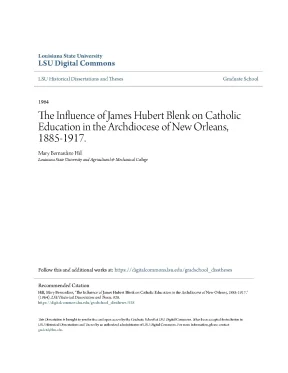
Tải xuống để đọc toàn bộLouisiana State University LSU Digital Commons LSU Historical Dissertations and Theses Graduate School 1964 The Influence of James Hubert Blenk on Catholic Education in the Archdiocese of New Orleans, 1885-1917. Mary Bernardine Hill Louisiana State University and Agricultural & Mechanical College Follow this and additional works at: https://digitalcommons.edu/gradschool_disstheses Recommended Citation Hill, Mary Bernardine, "The Influence of James Hubert Blenk on Catholic Education in the Archdiocese of New Orleans, 1885-1917. LSU Historical Dissertations and Theses.edu/gradschool_disstheses/928 This Dissertation is brought to you for free and open access by the Graduate School at LSU Digital Commons. It has been accepted for inclusion in LSU Historical Dissertations and Theses by an authorized administrator of LSU Digital Commons.
For more information, please contact gradetd@lsu. T his d isse r ta tio n has been 6 4 -1 0 ,4 9 0 m icro film ed e x a ctly a s r e c e iv e d HILL, M ., S is te r M ary B e m a rd in e, 1924- THE INFLUENCE OF JAMES HUBERT BLENK ON CATHOLIC EDUCATION IN THE ARCHDIOCESE OF NEW ORLEANS, 1885-1917. L ou isian a State U n iv ersity , E d ., 1964 E ducation, adm in istration University Microfilms, Inc., Ann Arbor, Michigan THE INFLUENCE OF JAMES HUBERT BLENK ON CATHOLIC EDUCATION IN THE ARCHDIOCESE OF NEW ORLEANS, 1885-1917 A Dissertation Submitted to the Graduate Faculty of the Louisiana State University and Agricultural and Mechanical College in partial fulfillment of the requirements for the degree of Doctor of Education in The Department of Education by Sister Mary Bernardine Hill, M., Our Lady of Holy Cross College, 1946 M., Notre Dame University, 1956 January, 1964 ACKNOWLEDGMENTS The writer gratefully acknowledges the assistance received from many persons in the writing of her dissertation. Most especially must she mention Dr.
Rodney Cline, her major professor, under whose immediate direction the research was conducted; the other members of her committee— Dr. Ralph Schmidt, Dr. Harrison, and Dr. Bezou for his advice in the selection of a topic and the permission to use the New Orleans Archdiocesan Archives; the Marist Fathers who allowed the use of their archives in Washington, D.; the members of the various Religious Communities; and Sister Mary John Berchmans who generously gave of her time to type the first draft of this study.
Special appreciation and gratitude are due to Mother Mary Hilary to whom the writer owes the opportunity to pursue higher graduate study. TABLE OP CONTENTS PAGE ACKNOWLEDGMENTS. ii AB STRACT. EDUCATION IN THE ARCHDIOCESE OP NEW ORLEANS PRIOR TO 1 9 0 6.
1 Highlights in the Development of Catholic Education in the Archdiocese of New Orleans Between 1725 and 1860. 1 Catholic Education in New Orleans under French R u l e. 3 Concern for girls' education. 5 The Ursulines’ school.
7 Catholic Education under Spanish Rule. 9 Creation of the Diocese of New O r l e a n s. 9 Educational efforts of the Spanish. 11 Educational Conditions during Early Statehood.
15 Madames of the Sacred Heart. 16 The Sisters of Loretto. 18 Catholic Education Between 1829-1833. 19 The Poydras Asylum.
Patrick's Orphanage and St. 20 Sisters of Mount C a r m e l. 21 Diocesan Education under Bishop Antoine Blanc. 23 iii CHAPTER PAGE First pastoral l e t t e r.
23 Jesuits re-established. 24 Work of other R e l i gious. 25 Concern for the c o l o r e d. 26 Statue of Catholic Education from 1860-1906.
27 Conditions Immediately Following the Civil W a r. 28 Jefferson College reopened. 29 Pronouncements of Archbishop Napoleon Joseph Perche. 29 Response of the clergy and r elig i o u s.
31 Archdiocese faced with bankruptcy. 33 Financial crisis averted. 33 The Work of Archbishop Francis Janssens. 34 Independent incorporation of p a r i s h e s.
35 Preparatory seminary opened. 35 Provisions for Negro education. 36 Facilities provided for deaf-mutes. 37 Organization of Catholic Winter School.
38 Decrease of the Archdiocesan debt. 39 Louis Placide Chapelle, Archbishop and Diplomat. 41 Interest in education. 41 Rejection of Faribault P l a n.
42 Educational picture in the Archdiocese in 1906. JAMES HUBERT BLENK— THE MAN AND THE EDUCATOR. 46 Early Life and Schooling. 46 Higher Educational Background •.
48 Education for the priesthood. 49 Father Blenk Returns to Jefferson C o l l e g e. 51 iv CHAPTER PAGE Early Growth of the College. 51 Incorporation by the state.
52 Jefferson given to the Marists. 54 Teacher of literature and language. 55 Interest in the sciences. 56 Vice-president of Jefferson.
57 Blenk the President of Jefferson C o l l e g e. 58 Blenk's election to the presidency. 58 First changes initiated. 60 Physical education introduced into curriculum.
63 Expansion of science curriculum. 65 Father Blenk1s Philosophy of Education. 65 Belief in the mental discipline theory. 66 Practical knowledge stressed.
66 Interest in vocational education. 67 Advocacy of the principle of self-activity. 68 Interest in teacher-preparation. 69 Devotion to classroom duties.
70 Building Program under Father Blenk. 74 Auditor of the Apostolic Delegation to Cuba and Porto Rico. 75 Bishop of Porto Rico. 76 Back to Louisiana.
FROM PRIVATE TO PAROCHIAL SCHOOLS. 83 Problems Awaiting the New Archbishop. 84 Need for Reorganization of the School S y s t e m. 84 v CHAPTER PAGE Blenk's earliest statement concerniny the schools.
85 Recommendations of the Baltimore Councils. 86 Catholic schools prior to 1906. 87 Importance of private institutions. 88 Beginning of Parochial Schools.
90 Lack of unity in conduct of schools. 91 Recommendations of Archbishop Blenk concerning the establishment of parochial schools. 94 Cooperation of pastors. 94 Private schools not abandoned.
96 Financing the Schools of the Archdiocese of New Orleans Prior to 1906. 96 Finances in the Colonial Period. 97 Effects of Statehood on Catholic School Finances. 97 Means of support.
98 Maintenance of schools after the Civil W a r. 99 Private school maintenance. 100 Financing school personnel. 100 Growth and maintenance of Negro s c h o o l s.
101 School Finances Subsequent to the Episcopate of Archbishop James Hubert Blenk. 103 Financial Organization of Parochial Schools. 103 Capital outlay revenues. 103 Revenues for operational costs.
104 Financial resources for Negro parochial s c h o o l s. 105 Archbishop Blenk's Evaluation of the Parochial School System. THE FIRST ARCHDIOCESAN SCHOOL BOARD. 107 Early Efforts to Coordinate Catholic Schools in New Orleans.
107 Attempts at Organization before 1906. 108 vi CHAPTER PAGE New Orleans Free School Association. 108 Second petition to the legislature. 109 Efforts of Archbishop Janssens.
109 Archbishop Blenk, Organizer of Catholic Schools. Ill Creation of the Catholic School Board. 112 Objectives of the Board. 114 Selection of a school board .116 Duties of the School Board.117 Committee on statistics.
119 Local school boards proposed.123 Primary syllabus submitted. 124 Music in the s c h o o l .125 Interest in physical fitness p r o g r a m. 127 Tentative Curriculum Presented. 128 Importance of reading stressed.
129 Financing the School Board. TEACHER EDUCATION PROVIDED IN THE ARCHDIOCESE OF NEW ORLEANS. 133 The Need for Teacher-Training Institutions in New O r l e a n s. 134 Teacher Education Prior to 1906.
134 Teacher-Education under Archbishop B l e n k. 136 Dominican College, Archdiocesan training school. 140 Development of Teacher-Training Facilities. 143 Academy of the Holy Angels, College Department.
143 Other summer normal courses arranged.145 vii CHAPTER PAGE National Catholic Educational Association Convention in New O r l e a n s. 147 Preparation in the Archdiocese.147 Benefits of the convention to the S o u t h. 148 Invitations to Religious Communities. 149 Education of the Clergy.
152 The Role of the Priest in Parochial Education. Joseph's Seminary opened.153 Curriculum of minor seminary.155 Plans for major seminary f a i l. NEGRO EDUCATION UNDER ARCHBISHOP BLENK. 158 Early Decrees Concerning Negro Education.
158 The Advancement of Negro Education after 1906. 159 Mother Katherine Drexel, Benefactress of the Archdiocese of New Orleans.160 Mother Drexel visits New Orleans. 161 Xavier University Preparatory School. 162 The industrial department.
163 Home economics course. 164 Xavier teacher training school.165 Mother Drexel's rural schools. 165 Drexel Fund aid for public schools. 167 Expansion in the Archdiocese of New Orleans.
169 Corpus Christi School. 170 Blessed Sacrament School. 171 Schools outside the city of New O r l e a n s. 171 The Sisters of the Holy Family and Negro Education.
173 Holy Rosary Industrial School. 174 viii CHAPTER PAGE Lafon Home for Negro B o y s. 174 Free school for boys. OTHER EDUCATIONAL ACCOMPLISHMENTS OF ARCHBISHOP B L E N K.
178 Archbishop Blenk, Promoter of Higher Education. 178 Higher Education for Foreign Students. 180 Commencement Speaker at L. 181 Expansion of Elementary School Facilities.
183 New Religious Orders Admitted to the Archdiocese. 183 Existing Educational Facilities Improved. 184 Opposition to Child L a b o r. 186 Death of Archbishop B l e n k .189 Status of Catholic Education in the Archdiocese of New Orleans Prior to 1906.
190 Education under Spanish Rule. 190 Conditions During Early Statehood. 191 Arrival of Religious Communities of Women. 191 Provision of Education of Boys.
192 Effects of the Civil War on Catholic Education. 193 The Inauguration of the Crusade for Parochial S c h o o l s. 194 Catholic Education in the Archdiocese after 1906. 195 Change from Private to Parochial S c h o o l s.
196 Financing the Parochial Schools. 196 Archdiocesan School Board. 198 Negro Catholic Education Given Impetus. 199 ix CHAPTER PAGE Other Educational Interests ofArchbishop Blerik.
213 X ABSTRACT Catholic education in the Archdiocese of New Orleans antedates the establishment of the Archdiocese itself. Whereas the Archdiocese was not established until 1850, the first Catholic school had been founded in 1725. With the passing years various Religious Orders entered the Archdiocese to engage in the works of education. Private institutions built and financed mainly by these men and women bore the major burden of Catholic education in Louisiana.
However, the methods, materials, and techniques they employed were those of the various European countries from which they came, thus creating a diversified educational set-up in the Archdiocese. A period of 181 years elapsed before anything was accomplished that would provide the unifying bond among these institutions. With the advent of James Hubert Blenk as Arch bishop of New Orleans in 1906, the first steps were taken to standardize and coordinate the Archdiocesan parochial school system. This study is an attempt to provide its readers with the scope of the work of Archbishop Blenk in this important undertaking.
xi In obtaining data for this study, the writer examined the personal correspondence, sermons and pastoral letters of the Archbishop, as well as newspapers and other documents published between 1906 and 1917, now housed in the Archdioce san Archives in New Orleans. Manuscript materials and annals of the various Religious Orders have also been surveyed for pertinent information. Furthermore, the writer did research in the archives of the Marist Seminary in Washington, D., and held interviews with acquaintances of the Archbishop to determine the extent of his influence in educational circles before he became Archbishop. From these sources the greater part of the data necessary for the compilation of this research study was obtained.
Nội dung được bảo vệ bản quyền — Tải xuống đầy đủ
Trích dẫn luận án này
Sister Mary Bernardine Hill (1964). The influence of james hubert blenk on catholic education in [Luận án tiến sĩ, Louisiana State University and Agricultural and Mechanical College]. LuanAn.net. https://luanan.net/ly-luan-va-lich-su-giao-duc/triet-hoc-giao-duc/the-influence-of-james-hubert-blenk-on-catholic-education-in-the
Câu hỏi thường gặp
Luận án "The influence of james hubert blenk on catholic education in" nghiên cứu về vấn đề gì?
Ảnh hưởng của James Hubert Blake đối với giáo dục Công giáo: Khám phá di sản và tác động lâu dài của ông đối với hệ thống trường học.
Luận án "The influence of james hubert blenk on catholic education in" được bảo vệ tại trường nào?
Luận án này được bảo vệ tại Louisiana State University and Agricultural and Mechanical College. Năm bảo vệ: 1964.
Luận án "The influence of james hubert blenk on catholic education in" thuộc chuyên ngành gì?
Luận án "The influence of james hubert blenk on catholic education in" thuộc chuyên ngành Education, administration. Danh mục: Triết Học Giáo Dục.
Luận án "The influence of james hubert blenk on catholic education in" có bao nhiêu trang?
Luận án "The influence of james hubert blenk on catholic education in" có 230 trang. Bạn có thể xem trước một phần tài liệu ngay trên trang web trước khi tải về.
Cách tải luận án "The influence of james hubert blenk on catholic education in" về máy như thế nào?
Để tải luận án về máy, bạn nhấn nút "Tải xuống ngay" trên trang này, sau đó hoàn tất thanh toán phí lưu trữ. File sẽ được tải xuống ngay sau khi thanh toán thành công. Hỗ trợ qua Zalo: 0559 297 239.