Subrepresentation semirings and an analogue of 6j symbols
Khảo sát các đại số semiring và biểu tượng 6j tương tự, nghiên cứu mối quan hệ giữa các đại số này và ứng dụng trong lý thuyết vật lý lượng tử.
Năm xuất bản
Số trang
71
Thời gian đọc
11 phút
Lượt xem
0
Lượt tải
0
Phí lưu trữ
40 Point
Tổng quan nhanh
- Chủ đề:
- 1. Khám phá Semiring Phụ Biểu Diễn và Cấu trúc Đại số
- Số trang:
- 71 trang
- Trường:
- Louisiana State University and Agricultural and Mechanical College
- Chuyên ngành:
- Applied Mathematics
- Tác giả:
- Nam Hee Kwon
- Năm:
- 2007
Tóm tắt nội dung luận án
I. Khám phá Semiring Phụ Biểu Diễn và Cấu trúc Đại số
Luận văn nghiên cứu semiring của các biểu diễn con, cụ thể là SG(End(V)). Cấu trúc đại số này được phân tích cho các nhóm khả quy đơn giản G. Trọng tâm là tìm hiểu các hằng số cấu trúc của semiring. Phân tích này mang lại cái nhìn sâu sắc về lý thuyết biểu diễn nền tảng. Semiring phụ biểu diễn cung cấp một khuôn khổ tự nhiên. Nó kết nối các quan điểm lý thuyết biểu diễn với các ứng dụng thực tế. Việc hiểu rõ các cấu trúc đại số này rất quan trọng. Nó tiết lộ cách các tác động nhóm ảnh hưởng đến đại số ma trận. Nghiên cứu này mở rộng các khái niệm cơ bản trong đại số hiện đại.
1.1. Định nghĩa và Vai trò của Semiring Phụ Biểu diễn
Semiring phụ biểu diễn là một cấu trúc đại số độc đáo. Nó bao gồm tất cả các không gian con bất biến dưới tác động của một nhóm. Cụ thể, SG(End(V)) là semiring của các biểu diễn con của đại số ma trận End(V). Nhóm G tác động lên đại số này bằng phép tự đẳng cấu. Việc nghiên cứu semiring này cung cấp cái nhìn sâu sắc về cách các biểu diễn tương tác. Nó là một khái niệm trung tâm trong lý thuyết biểu diễn. Semiring giúp phân tích các cấu trúc phức tạp, làm rõ các mối quan hệ đại số.
1.2. Nghiên cứu Cấu trúc Hằng số
Hằng số cấu trúc của một semiring định nghĩa các phép toán của nó. Trong bối cảnh này, chúng được nghiên cứu thông qua các biểu tượng 6j xoắn mới. Việc xác định các hằng số này là mục tiêu chính của luận văn. Chúng tiết lộ thông tin về cách các thành phần của semiring kết hợp. Nghiên cứu này mở rộng hiểu biết về đại số Wigner-Racah. Nó cũng giúp phân tích các tích tensor của các biểu diễn. Các hằng số này là chìa khóa để giải mã các tương tác phức tạp.
1.3. Cơ sở Đại số cho Biểu diễn
Công trình này đặt nền tảng đại số vững chắc. Nó khám phá các tính chất của các biểu diễn nhóm. Các cấu trúc đại số là cốt lõi để hiểu cách các biểu diễn tương tác. Lý thuyết biểu diễn cung cấp các công cụ cần thiết. Nó phân tích các đối tượng phức tạp này. Các phương pháp đại số được áp dụng để giải quyết các vấn đề. Đặc biệt là liên quan đến các biểu diễn bất khả quy và các nhóm Lie. Nền tảng này rất quan trọng cho các phát triển lý thuyết sâu hơn.
II. Giới thiệu Biểu tượng 6j xoắn và Nhóm Khả Quy Đơn Giản
Luận văn giới thiệu khái niệm biểu tượng 6j xoắn mới. Các biểu tượng này được định nghĩa cho các nhóm khả quy đơn giản G. Chúng là một mở rộng của biểu tượng 6j cổ điển của Wigner. Biểu tượng 6j cổ điển áp dụng cho nhóm Lie SU(2). Nghiên cứu này tập trung vào cấu trúc của các semiring phụ biểu diễn SG(End(V)). Các biểu tượng 6j xoắn cung cấp một công cụ mạnh mẽ. Chúng giúp phân tích các tính chất của các đối tượng G-module mới. Khái niệm này mở rộng lĩnh vực lý thuyết biểu diễn. Nó cung cấp một cái nhìn sâu sắc mới về việc ghép mô men động lượng.
2.1. Nguồn gốc Biểu tượng 6j xoắn
Biểu tượng 6j xoắn có nguồn gốc từ biểu tượng 6j cổ điển của Wigner. Chúng được phát triển để nghiên cứu các nhóm khả quy đơn giản. Biểu tượng này đóng vai trò quan trọng trong cơ học lượng tử và việc ghép mô men động lượng. Luận văn mở rộng khái niệm này sang một lớp nhóm rộng hơn. Nó tạo ra một công cụ mới cho lý thuyết biểu diễn. Việc này cho phép phân tích các cấu trúc phức tạp hơn. Nó cũng cung cấp một cách tiếp cận mới để hiểu các tương tác.
2.2. Nhóm khả quy đơn giản và Ứng dụng
Một nhóm khả quy đơn giản là một loại nhóm có các tính chất cụ thể. Các tính chất này đơn giản hóa lý thuyết biểu diễn của chúng. Nghiên cứu tập trung vào các nhóm này. Nó cho phép xây dựng một khung lý thuyết mạch lạc. Việc hiểu các nhóm khả quy đơn giản rất quan trọng. Nó giúp mở rộng các khái niệm từ SU(2) sang các nhóm chung hơn. Các ứng dụng có thể bao gồm vật lý lý thuyết và toán học thuần túy. Đặc biệt là trong việc phân loại các biểu diễn bất khả quy.
2.3. Nghiên cứu Mô đun G mới
Luận văn nhấn mạnh vào các đối tượng mô đun G mới. Các mô đun này được định nghĩa dựa trên các biểu diễn nhóm. Việc nghiên cứu cấu trúc của chúng là cốt lõi. Nó giúp hiểu rõ hơn về cách các biểu diễn tương tác. Các biểu tượng 6j xoắn được sử dụng để phân tích các mô đun này. Điều này làm phong phú lý thuyết biểu diễn chung. Nó cung cấp các công cụ mới để khám phá các mối quan hệ phức tạp. Đặc biệt trong việc phân tích tích tensor của các biểu diễn.
III. Liên hệ Biểu tượng 6j xoắn với 3j cổ điển Wigner Racah
Luận văn thiết lập mối liên hệ quan trọng giữa các biểu tượng 6j xoắn mới. Chúng được liên kết với biểu tượng 3j cổ điển của Wigner. Mối quan hệ này rất quan trọng. Nó cung cấp một cầu nối với đại số Wigner-Racah đã biết. Biểu tượng 3j cổ điển mô tả việc phân tích tích tensor của ba biểu diễn. Việc hiểu mối liên hệ này làm sâu sắc thêm hiểu biết. Nó mở rộng về cả hai loại biểu tượng. Các tính chất của biểu tượng 6j xoắn cũng được khám phá chi tiết. Điều này giúp xác nhận tính hợp lệ và giá trị của các khái niệm mới.
3.1. Kết nối với Biểu tượng 3j cổ điển
Luận văn chứng minh mối liên hệ trực tiếp. Biểu tượng 6j xoắn có thể được biểu diễn thông qua biểu tượng 3j cổ điển. Mối liên hệ này là một thành tựu quan trọng. Nó giúp xác nhận tính hợp lệ của khái niệm mới. Nó cũng cung cấp một cách để tính toán và hiểu các biểu tượng 6j xoắn. Điều này dựa trên các công cụ đã được thiết lập. Đặc biệt là các hệ số Clebsch-Gordan. Kết nối này củng cố vị trí của biểu tượng 6j xoắn trong lý thuyết biểu diễn.
3.2. Tính chất của Biểu tượng 6j xoắn
Các tính chất của biểu tượng 6j xoắn được nghiên cứu cẩn thận. Bao gồm các tính đối xứng và các quan hệ trực giao. Việc hiểu các tính chất này là cần thiết. Nó giúp ứng dụng các biểu tượng trong các vấn đề cụ thể. Các tính chất này cũng cung cấp cái nhìn sâu sắc về cấu trúc đại số cơ bản. Chúng phản ánh cách các biểu diễn nhóm tương tác. Đặc biệt là trong bối cảnh các nhóm khả quy đơn giản. Việc này tương tự như các tính chất của biểu tượng 6j trong đại số Wigner-Racah.
3.3. So sánh với Đại số Wigner Racah
Đại số Wigner-Racah là một khuôn khổ mạnh mẽ. Nó mô tả việc ghép mô men động lượng. Luận văn so sánh các biểu tượng 6j xoắn với các biểu tượng trong đại số này. Sự so sánh này làm nổi bật những điểm tương đồng và khác biệt. Nó giúp định vị các biểu tượng 6j xoắn trong lý thuyết biểu diễn rộng hơn. Việc này cũng chỉ ra cách khái niệm mới mở rộng các công cụ hiện có. Nó cung cấp một sự tổng quát hóa cho việc ghép mô men động lượng trong các nhóm khác SU(2).
IV. Ứng dụng Lý thuyết Biểu diễn Từ Vật liệu tổng hợp
Lý thuyết được trình bày không chỉ có giá trị thuần túy. Nó có động lực ban đầu từ khoa học vật liệu. Cụ thể, vấn đề là dự đoán các tính chất hiệu quả của vật liệu tổng hợp. Các tính chất vật lý phụ thuộc mạnh mẽ vào cấu trúc vi mô. Nghiên cứu này cung cấp một cách tiếp cận đại số. Nó giúp hiểu các "quan hệ chính xác" trong vật liệu. Các quan hệ này mô tả các tính chất không phụ thuộc cấu trúc vi mô. Công trình này kết nối lý thuyết biểu diễn trừu tượng với các vấn đề kỹ thuật quan trọng. Nó mở ra hướng nghiên cứu mới trong khoa học vật liệu.
4.1. Động lực từ Khoa học Vật liệu
Nhu cầu hiểu các tính chất vật liệu tổng hợp thúc đẩy nghiên cứu này. Việc tạo ra vật liệu có tính chất mong muốn là một thách thức. Đặc biệt là khi các tính chất phụ thuộc vào cấu trúc vi mô. Lý thuyết biểu diễn cung cấp một ngôn ngữ để mô tả điều này. Nó giúp giải quyết các vấn đề phức tạp. Việc này cho thấy tầm quan trọng của các cấu trúc đại số trong các lĩnh vực ứng dụng. Các biểu diễn nhóm cung cấp một khuôn khổ mạnh mẽ để phân tích.
4.2. Khái niệm G closure và Quan hệ chính xác
Một "G-closure" là tập hợp các giá trị có thể của một tính chất. Nó được tạo ra từ các vật liệu đã cho với tỷ lệ cố định. Trong một số trường hợp, tập hợp này thoái hóa thành một "quan hệ chính xác". Các quan hệ chính xác cung cấp thông tin độc lập với cấu trúc vi mô. Việc tìm kiếm các quan hệ này là một vấn đề quan trọng trong vật liệu. Lý thuyết biểu diễn cung cấp các công cụ để khám phá những quan hệ này.
4.3. Hạn chế của Phương pháp cổ điển
Các phương pháp phân tích cổ điển có những hạn chế nghiêm trọng. Chúng thường phụ thuộc nhiều vào chi tiết ngữ cảnh vật lý. Chúng cũng không thể xác định liệu tất cả các quan hệ chính xác đã được tìm thấy hay chưa. Lý thuyết đại số mới cung cấp một cách tiếp cận khái quát hơn. Nó vượt qua những hạn chế này. Việc này cho thấy sức mạnh của lý thuyết biểu diễn trong việc giải quyết các vấn đề thực tiễn. Nó cung cấp một khung phân tích mạnh mẽ hơn.
V. Cấu trúc đại số cơ bản và Biểu diễn bất khả quy
Luận văn đặt nền tảng trên lý thuyết biểu diễn. Nó bao gồm biểu diễn của nhóm Lie SU(2). Đây là một nhóm quan trọng trong vật lý. Các khái niệm như tích tensor của biểu diễn và các hệ số Clebsch-Gordan được xem xét. Các biểu diễn bất khả quy đóng vai trò trung tâm. Chúng là các khối xây dựng cơ bản của mọi biểu diễn. Việc hiểu rõ các khái niệm này là thiết yếu. Nó giúp xây dựng các lý thuyết phức tạp hơn. Nó cũng là nền tảng cho việc mở rộng sang các nhóm và cấu trúc đại số khác.
5.1. Lý thuyết Biểu diễn SU 2 cổ điển
Nhóm SU(2) là nền tảng cho nhiều lý thuyết vật lý. Đặc biệt là lý thuyết mô men động lượng và cơ học lượng tử. Lý thuyết biểu diễn của SU(2) được nghiên cứu kỹ lưỡng. Nó cung cấp các ví dụ cụ thể cho các biểu tượng 3j và 6j. Việc xem xét lại SU(2) giúp hiểu rõ hơn về các khái niệm được mở rộng. Các biểu diễn của SU(2) là bất khả quy và có vai trò trung tâm trong nhiều ứng dụng.
5.2. Tích Tensor và Hệ số Clebsch Gordan
Tích tensor của các biểu diễn cho phép kết hợp các hệ thống. Hệ số Clebsch-Gordan mô tả cách phân tích tích tensor này thành các biểu diễn bất khả quy. Chúng là công cụ quan trọng trong việc ghép mô men động lượng. Các hệ số này có mối liên hệ chặt chẽ với các biểu tượng 3j. Chúng đóng vai trò cốt yếu trong việc hiểu cấu trúc của không gian biểu diễn tổng thể. Việc này là một phần không thể thiếu của lý thuyết biểu diễn.
5.3. Định nghĩa Biểu diễn bất khả quy
Một biểu diễn bất khả quy là một biểu diễn không thể phân tách thành các biểu diễn con nhỏ hơn. Chúng là các "nguyên tử" của lý thuyết biểu diễn. Mọi biểu diễn đều có thể được phân tích thành tổng trực tiếp các biểu diễn bất khả quy. Việc xác định và phân loại các biểu diễn bất khả quy là một mục tiêu chính. Nó là mục tiêu trong lý thuyết biểu diễn cho các nhóm Lie và các cấu trúc đại số khác. Việc này là nền tảng cho việc xây dựng các lý thuyết phức tạp hơn.
Mục lục chi tiết luận án
Tải xuống file đầy đủ để xem toàn bộ nội dung
Tải đầy đủ (71 trang)Trích đoạn nội dung luận án
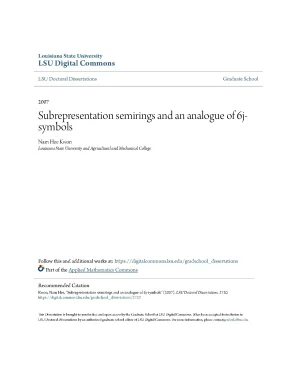
Tải xuống để đọc toàn bộLouisiana State University LSU Digital Commons LSU Doctoral Dissertations Graduate School 2007 Subrepresentation semirings and an analogue of 6j- symbols Nam Hee Kwon Louisiana State University and Agricultural and Mechanical College Follow this and additional works at: https://digitalcommons.edu/gradschool_dissertations Part of the Applied Mathematics Commons Recommended Citation Kwon, Nam Hee, "Subrepresentation semirings and an analogue of 6j-symbols" (2007). LSU Doctoral Dissertations.edu/gradschool_dissertations/2720 This Dissertation is brought to you for free and open access by the Graduate School at LSU Digital Commons. It has been accepted for inclusion in LSU Doctoral Dissertations by an authorized graduate school editor of LSU Digital Commons. For more information, please contactgradetd@lsu.
SUBREPRESENTATION SEMIRINGS AND AN ANALOGUE OF 6j-SYMBOLS A Dissertation Submitted to the Graduate Faculty of the Louisiana State University and Agricultural and Mechanical College in partial fulfillment of the requirements for the degree of Doctor of Philosophy in The Department of Mathematics by Nam Hee Kwon B., Inha University, South Korea, 1996 M., Seoul National University, 1999 May 2007 Acknowledgments It is my great pleasure to express my sincere appreciation to my thesis advisor, Prof. Without his invaluable advice, this dissertation would not be com- pleted. I also would like to express my special thanks to the committee members, Prof. Pramod Achar, Prof.
Jorge Morales, Prof. Gestur Olafsson, Prof. Lawrence Smolinsky and Prof. I am grateful to the Department of Mathematics at Louisiana State University for the financial support during my doctoral program.
Most importantly, I would like to thank my wife, Sunghye Shin, and my children, Yesueng and Yein, for their love and encouragement. I dedicate this dissertation to my parents, Guntaek Kwon and Yiesoon Yang. ii Table of Contents Acknowledgments .1 Two Basic Lemmas .2 Representation Theory of SU (2) .3 The Classical 3j and 6j Symbols .4 Quasi Simply Reducible Groups .2 A Specific Case of End(V ) .3 G-invariant Ideals and Subalgebras. Structure Constants of SSU (2) (End(V )) and The Vanishing of 6j- Symbols .2 Structure Constants of SSU (2) (End(V )).
Subrepresentation Semirings over Quasi Simply Reducible Groups 27 4.1 Twisted Dual and Homomorphism Modules .3 Structure Constants and The Vanishing of Twisted 6j-Symbols. Frobenius-Schur Invariants, Even and Odd Representations .1 New Frobenius-Schur Invariants .2 Even and Odd Representations. Some Properties of Twisted 6j-Symbols .1 Connection with The Classical 3j-Symbols .2 Properties of The Classical 3j-Symbols .4 Properties of The Twisted 6j-Symbols. 66 iii Abstract Let G be a quasi simply reducible group, and let V be a representation of G over the complex numbers C.
In this thesis, we introduce the twisted 6j-symbols over G which have their origin to Wigner’s 6j-symbols over the group SU (2) to study the structure constants of the subrepresentation semiring SG (End(V )), and we study the representation theory of a quasi simply reducible group G laying emphasis on our new G-module objects. We also investigate properties of our twisted 6j-symbols by establishing the link between the twisted 6j-symbols and Wigner’s 3j-symbols over the group G. iv Introduction In this thesis, we examine the structure of the semiring of subrepresentations of certain matrix algebra on which a group acts by algebra automorphism. The study of this semiring, while very natural from a representation-theoretic perspective, was first motivated by a problem in materials science.
We begin by describing how this semiring arises in the theory of composite materials. In materials science, it is an important problem to create a composite material with desired properties. However, it is not easy to predict effective properties of composites because their physical properties are usually strongly dependent on the microstructure. For these reasons, it is natural to consider the set of all pos- sible values of a given physical properties of a composite material that is made with given materials of fixed proportions as one changes the microstructure of the composite.
We call this set a G-closure. It is a subset of an appropriate vec- tor space tensors. Even though most G-closure sets have a non-empty interior, in exceptional cases they degenerate to a surface which is called an exact relation. Because exact relations give the information about a composite material regard- less of its microstructure, it has been an important problem in materials to find such exact relations.
Unfortunately, the classical approach to find exact relations through analytical computations was limited by heavily dependence on the details of the physical context. Moreover, these techniques could not be used to determine whether all exact relations in a specific contest had been found. Recently, in [GMS] the authors developed an abstract theory of exact relations, which not only led to the discovery of many new exact relations, but also gave complete lists in many physical situations. The success of this approach was due 1 to its reduction of the problem of finding exact relations to algebraic questions concerned with the representation theory of the group SO(3).
More specifically, it was shown that finding an exact relation was equivalent to solving an equation involving the multiplication of subrepresentations in a certain matrix SO(3). We now define subrepresentation semiring following [S2]. Let A be an associative algebra with identity over a field k. Assume that the algebra A has a G-module structure with the additional property α·(xy) = (α·x)(α·y) for α ∈ G and x, y ∈ A.
In other words, G acts on A by algebra automorphism. We call A a G-algebra. For a given G-algebra A, let SG (A) be the set of all subrepresentations (i. Then we can give a semiring structure on SG (A) with the usual addition of subspaces and multiplication given by XY = span{xy | x ∈ X, y ∈ Y }.
We call the semiring SG (A) the subrepresentation semiring of the G-algebra A. A fundamental example is given by A = End(V ), where V is a representation of a group G. This was the case that arose in the study of exact relation. In par- ticular, it was shown in [GMS] how the search for exact relations reduce to the algebraic problem of computing the structure constants of certain subrepresenta- tion semiring SG (End(V )) for G = SO(3).
Moreover, it was observed by Etingof and Sage independently that the structure constants of SSO(3) (End(V )) are in fact related to the vanishing of Wigner’s 6j-symbols which arise in the quantum theory of angular momentum. It is well known that there is a double covering homo- morphism π : SU (2) −→ SO(3), and π yields a canonical isomorphism between SSO(3) (End(V )) and SSU (2) (End(V )). Here V denotes a representation of SO(3) over C. Thus for a given representation V over the complex numbers C the struc- ture constants of SSU (2) (End(V )) are also related to the vanishing of Wigner’s 6j-symbols.
This is an unexpected link because Wigner initially developed his 6j- symbols for SU (2) in the quite different context of the quantum theory of angular 2 momentum. Wigner himself generalized his construction of 6j-symbols to a more general class of groups called simply reducible groups, and Sharp further generalized them to quasi simply reducible groups. Quasi simply reducible groups were intro- duced by Mackey in [M3]; their representation theory has broad similarities to the representation theory of the group SU (2). Recall that every irreducible representa- tion of the group SU (2) can be parameterized by the set of nonnegative half integer 1 Z , and each irreducible representation is self-dual (i.
Moreover, the tensor product of two irreducible representations of SU (2) is multiplicity- free, which can be easily checked by the Clebsch-Gordan formula. Keeping these rep- resentation theoretic properties in mind, we define quasi simply reducible groups as follows. A finite or compact group G is called a quasi simply reducible group if there exists an involutory anti-automorphism on G that leaves the conjugacy classes invariant, and irreducible representations of G satisfy the multiplicity-free property. If we take the involutory anti-automorphism on G to be the multiplica- tion inverse, then in this case we call the group G a simply reducible group.
SU (2) is the fundamental example of a simply reducible group. Now the following natural question arises: How are the structure constants of SG (End(V )) related to the 6j-symbols over G when we replace the group SU (2) by an arbitrary quasi simply reducible group G? To answer this question, in this thesis we explicitly calculate the structure con- stants of the subrepresentation semiring SG (End(V )) by introducing a new class of 6j-symbols over G which we will call the twisted 6j-symbols in this thesis. Before giving a more detailed description of the content of this thesis, we briefly digress to mention that the subrepresentation semiring SG (End(V )) can also be used to describe the G-invariant ideals and subalgebras of End(V ). 3 Let A be a G-algebra, and let I be a G-invariant left ideal of A.
Then we define the saturation of I by I = {J ∈ SG (A) | J ⊂ I}. Clearly I is a saturated left ideal containing the maximum element I, where we consider the inclusion as a partial 0 0 order on SG (A) (Saturated means that if J ∈ I and J ⊂ J, then J ∈ I). Thus we can assign each G-invariant left ideal I of A to the saturated left ideal I of SG (A) containing a maximum element, and this mapping is a bijective correspon- dence. Furthermore, when A = End(V ) it is known explicitly about the types of saturated left ideals of SG (End(V )).
More precisely, let W be a subrepresentation of V. Then we define G-invariant left ideal Ann(V ) called annihilator of W by Ann(W ) = {f ∈ End(V ) | f (W ) = 0}. It is known that every saturated left ideal of SG (End(V )) is of the form Ann(W ) (see [S1]). Similarly, for a given G-algebra A there is a bijection between G-invariant subalgebras and saturated subhemirings of SG (A) containing their maximum elements.
Recall that we call a set R a hemiring if R is an additive monoid under multiplication, but not containing the unity. In the G-algebra End(V ), it is also known that every nonzero saturated subhemiring is given by the saturation of a certain induced G-module. A complete description of the invariant subalgebras is given in [S2] for the case of V irreducible. Now we give an in depth description of the contents of this thesis.
From Chapter 1 to 3, we cover basic material and motivations for this thesis. The main results are exhibited in Chapter 4 through Chapter 6. In Chapter 1, we review the classical 3j and 6j symbols through the represen- tation theory of the Lie algebra sl(2, C). Our approach is different from that of Wigner.
It does not generalized to arbitrary groups, but it is quickened and more elegant for SU (2). We also introduce the definition of quasi simply reducible groups and give some examples of quasi simply reducible groups. 4 In Chapter 2 and 3, we give some background on subrepresentation semirings. In Chapter 2, we define subrepresentation semiring and recall some basic concepts.
We then focus on the important class of subrepresentation semirings coming from central simple algebras of the form End(V ), where V is a representation. In Chap- ter 3 we review how the structure constants of SSU (2) (End(V )) are related to the vanishing of 6j-symbols. In Chapter 4, we consider a group G endowed with an involutory anti-automorphism. we first introduce new G-modules which are called twisted dual G-modules and twisted homomorphism G-modules respectively.
As vector spaces, these will coin- cide the usual notion of dual spaces V ∗ and homomorphism spaces Hom(V, W ), but they will have new G-module structures. Using these new G-modules, we define Clebsch-Gordan coefficients and twisted 6j-symbols for a quasi simply reducible group G. Then in Theorem (4.
Nội dung được bảo vệ bản quyền — Tải xuống đầy đủ
Trích dẫn luận án này
Nam Hee Kwon (2007). Subrepresentation semirings and an analogue of 6j symbols [Luận án tiến sĩ, Louisiana State University and Agricultural and Mechanical College]. LuanAn.net. https://luanan.net/khoa-hoc-tu-nhien/subrepresentation-semirings-and-an-analogue-of-6j-symbols
Câu hỏi thường gặp
Luận án "Subrepresentation semirings and an analogue of 6j symbols" nghiên cứu về vấn đề gì?
Khảo sát các đại số semiring và biểu tượng 6j tương tự, nghiên cứu mối quan hệ giữa các đại số này và ứng dụng trong lý thuyết vật lý lượng tử.
Luận án "Subrepresentation semirings and an analogue of 6j symbols" được bảo vệ tại trường nào?
Luận án này được bảo vệ tại Louisiana State University and Agricultural and Mechanical College. Năm bảo vệ: 2007.
Luận án "Subrepresentation semirings and an analogue of 6j symbols" thuộc chuyên ngành gì?
Luận án "Subrepresentation semirings and an analogue of 6j symbols" thuộc chuyên ngành Applied Mathematics. Danh mục: Khoa Học Tự Nhiên.
Luận án "Subrepresentation semirings and an analogue of 6j symbols" có bao nhiêu trang?
Luận án "Subrepresentation semirings and an analogue of 6j symbols" có 71 trang. Bạn có thể xem trước một phần tài liệu ngay trên trang web trước khi tải về.
Cách tải luận án "Subrepresentation semirings and an analogue of 6j symbols" về máy như thế nào?
Để tải luận án về máy, bạn nhấn nút "Tải xuống ngay" trên trang này, sau đó hoàn tất thanh toán phí lưu trữ. File sẽ được tải xuống ngay sau khi thanh toán thành công. Hỗ trợ qua Zalo: 0559 297 239.