Liouvillian solutions of first-order algebraic ODEs - Nguyễn Trí Đạt
Luận án tiến sĩ phát triển các phương pháp mới xác định nghiệm Liouvillian của phương trình vi phân đại số cấp một, ứng dụng hình học đại số và lý thuyết trường hàm để giải quyết bài toán vi phân phức tạp.
Algebra and number theory
Luan An
Doctoral dissertation
Năm xuất bản
Số trang
97
Thời gian đọc
15 phút
Lượt xem
1
Lượt tải
0
Phí lưu trữ
40 Point
Mục lục chi tiết
Tóm tắt nội dung
I. Liouvillian Solutions First Order Algebraic ODEs
First-order algebraic ordinary differential equations (AODEs) represent a fundamental class of mathematical problems. Finding exact solutions remains challenging. Traditional methods work only for special cases. This research explores liouvillian solutions—solutions expressible through elementary functions and their integrals. The approach transforms differential problems into algebraic geometry questions. Algebraic curves provide the geometric framework. Parametrizations and algebraic function fields become essential tools. The methodology extends classical algorithms for rational solutions. It applies differential Galois theory principles. The research covers autonomous equations and general first-order cases. Genus classification plays a crucial role. Zero-genus curves admit rational parametrizations. Positive-genus cases require power transformations. The work bridges symbolic integration with algebraic geometry.
1.1. Differential Equations as Algebraic Curves
First-order AODEs define algebraic curves naturally. Each equation represents a polynomial relationship between variables and derivatives. The curve's geometric properties determine solution existence. Rational parametrizations exist for genus-zero curves. Higher-genus curves require different techniques. Algebraic geometry tools become applicable. The curve's genus measures topological complexity. Genus zero indicates simpler structure. Positive genus suggests transcendental behavior. This geometric perspective enables new solution methods.
1.2. Elementary Functions and Integration
Liouvillian solutions involve elementary functions. These include polynomials, exponentials, and logarithms. Symbolic integration extends the solution space. The Risch algorithm provides theoretical foundation. Exponential integrals appear frequently. Logarithmic integrals complement them. Closed-form solutions require careful analysis. Differential fields capture this structure. Extensions allow wider solution classes. The hierarchy reflects integration complexity.
1.3. Algebraic Function Fields Theory
Algebraic function fields formalize curve properties. Associated fields connect geometry with algebra. Rational functions on curves form fields. Transcendence degree measures independence. Field extensions correspond to curve coverings. Optimal parametrizations minimize complexity. This theory proves solution structure theorems. It classifies liouvillian solutions systematically. The approach unifies various solution types.
II. Autonomous AODEs Rational Liouvillian Methods
Autonomous first-order AODEs omit explicit variable dependence. They form an important subclass. Rational liouvillian solutions extend purely rational ones. The methodology generalizes classical algorithms. Differential field extensions enable this generalization. Wider fields accommodate exponential and logarithmic terms. The approach begins with rational solution algorithms. Extensions consider logarithmic derivatives. Exponential functions appear through substitutions. Integration produces liouvillian expressions. Classification separates algebraic from transcendental cases. Algebraic solutions involve radicals. Transcendental solutions require exponentials or logarithms. The genus-zero case admits complete characterization. Associated algebraic function fields prove key results. Rational parametrizations facilitate computations. The method produces algorithmic procedures. Examples demonstrate practical applicability.
2.1. Generalization of Rational Solution Algorithms
Classical algorithms find rational solutions efficiently. They analyze polynomial structures. Degree bounds limit search spaces. Undetermined coefficient methods work well. The generalization considers differential field extensions. Logarithmic derivatives introduce new terms. Exponential substitutions expand solution classes. The extended algorithm maintains computational feasibility. Symbolic computation systems implement these methods. Complexity remains manageable for practical cases.
2.2. Classification by Algebraic Structure
Liouvillian solutions split into categories. Algebraic solutions involve only radicals. They satisfy polynomial equations. Transcendental solutions require exponentials or logarithms. They cannot satisfy polynomial equations. This classification guides solution strategies. Genus-zero curves admit rational liouvillian solutions. Associated fields prove this result. The proof uses parametrization theory. Each case requires specific techniques.
2.3. Computational Implementation Examples
Algorithms translate into computer programs. Symbolic mathematics software handles computations. Maple and Mathematica provide platforms. Examples illustrate the methodology. Simple cases verify correctness. Complex cases demonstrate power. Step-by-step procedures ensure reproducibility. Output includes closed-form expressions. Verification confirms solution validity. Performance metrics assess efficiency.
III. Genus Zero Curves Complete Solution Theory
Genus-zero algebraic curves possess special properties. They admit rational parametrizations. This simplifies solution finding dramatically. The theory of associated algebraic function fields applies directly. Every genus-zero curve is birationally equivalent to a line. Parametrizations provide explicit coordinate expressions. Liouvillian solutions must be rational liouvillian. This theorem restricts solution forms. The proof uses field theory arguments. Associated fields characterize function relationships. Optimal rational parametrizations minimize degree. They reduce computational complexity. The classification theorem organizes solutions. Algebraic cases involve radical expressions. Transcendental cases require exponential or logarithmic functions. Quasi-linear ODEs connect to the original problem. First-order quasi-linear equations are simpler. Transformations relate them to AODEs. The method inherits existing algorithms. It extends their applicability systematically.
3.1. Rational Parametrization Techniques
Genus-zero curves parametrize rationally. Standard methods produce parametrizations. Optimal parametrizations have minimal degree. They reduce computational cost. Algorithms compute these parametrizations. Algebraic geometry provides theoretical basis. Birational equivalence preserves essential properties. The line serves as universal model. Coordinate transformations yield explicit formulas. These formulas enable solution computation.
3.2. Associated Fields and Solution Structure
Associated algebraic function fields characterize solutions. They capture functional dependencies. Field extensions correspond to solution complexity. The main theorem restricts solution types. Genus-zero implies rational liouvillian solutions. No other liouvillian solutions exist. This result simplifies the search problem. It provides completeness guarantees. The proof combines algebra and geometry. Field theory arguments establish necessity.
3.3. Quasi Linear ODE Reduction Methods
First-order quasi-linear ODEs are tractable. Standard methods solve them. Transformations connect AODEs to quasi-linear forms. Associated fields enable these transformations. Optimal parametrizations facilitate conversion. The reduced equation is simpler. Classical techniques then apply. Solutions transform back to original variables. This reduction strategy proves effective. It leverages existing algorithmic infrastructure.
IV. Positive Genus Cases Power Transformation Approach
Positive-genus curves present greater challenges. They lack rational parametrizations. Standard genus-zero methods fail. Power transformations offer an alternative approach. These transformations modify the differential equation structure. They may reduce genus effectively. The transformation introduces new variables. Relationships between old and new variables are algebraic. The transformed equation may have lower genus. Sometimes genus reduces to zero. Then previous methods apply. The approach is not always successful. Some equations resist genus reduction. Theoretical conditions determine applicability. Algebraic function field properties guide choices. Ramification theory plays a role. Branch points indicate transformation opportunities. The method extends solution capabilities. It handles cases beyond genus-zero. Computational complexity increases. Symbolic computation becomes more demanding. Examples demonstrate feasibility. Specific equation classes benefit most.
4.1. Power Transformation Theory
Power transformations change variables algebraically. They introduce fractional exponents. The transformation formula is explicit. New variables relate to old ones. The differential equation transforms accordingly. Chain rule determines derivative relationships. The transformed equation may simplify. Genus may decrease under transformation. Conditions for genus reduction exist. Algebraic geometry provides criteria. Ramification indices matter. Branch point structure influences outcomes.
4.2. Genus Reduction Strategies
Reducing genus enables simpler methods. Not all curves admit genus reduction. Theoretical obstructions exist. Ramification theory identifies opportunities. Specific transformation types work better. Polynomial degree considerations matter. The goal is genus-zero transformation. Then rational parametrizations become available. Multiple transformations may compose. Sequential reductions sometimes succeed. The strategy requires experimentation. Symbolic computation assists exploration.
4.3. Computational Challenges and Solutions
Positive-genus cases demand more computation. Symbolic systems face complexity limits. Memory requirements grow. Execution time increases substantially. Optimization techniques help. Groebner basis methods apply. Resultant computations eliminate variables. Modular arithmetic reduces coefficient size. Parallel processing offers speedup. Specialized algorithms improve performance. Trade-offs between generality and efficiency exist. Practical implementations balance these factors.
V. Differential Galois Theory Theoretical Foundation
Differential Galois theory provides deep theoretical insights. It extends classical Galois theory to differential equations. The theory characterizes solvability in closed form. Liouville's theorem is central. It describes elementary function solutions. Differential field extensions formalize solution spaces. The Picard-Vessiot extension is fundamental. It contains all solutions. Galois groups measure solution complexity. Solvable groups correspond to liouvillian solutions. The Risch algorithm implements these ideas. It decides elementary integrability. Symbolic integration relies on this foundation. The theory connects algebra, analysis, and geometry. It explains why some equations lack closed-form solutions. Obstructions are group-theoretic. Differential algebraic geometry extends the framework. It handles systems of equations. The theory guides algorithm development. It provides existence theorems. These theorems prevent futile searches. The framework is comprehensive and elegant.
5.1. Liouville s Theorem and Extensions
Liouville's theorem characterizes elementary solutions. It specifies allowable operations. Algebraic functions form the base. Exponentials of integrals extend the field. Logarithms of functions add transcendence. Finite towers of extensions suffice. The theorem is constructive. It guides solution construction. Differential field theory formalizes this. Extensions must satisfy differential conditions. The tower structure is explicit. Each level adds specific function types.
5.2. Risch Algorithm and Symbolic Integration
The Risch algorithm decides integrability. It determines if integrals are elementary. The algorithm is recursive. It handles nested exponentials and logarithms. Base cases involve rational functions. Inductive steps extend the field. The algorithm either finds the integral or proves impossibility. It is complete for elementary functions. Implementation is complex. Symbolic systems like Mathematica use it. The algorithm's correctness relies on differential Galois theory.
5.3. Galois Groups and Solution Structure
Differential Galois groups classify solutions. They are algebraic groups. Solvable groups indicate liouvillian solutions. Non-solvable groups mean no closed form exists. The group measures symmetry. It acts on solution spaces. Representation theory applies. The structure theorem connects groups to solution types. Abelian groups give simple solutions. Non-abelian solvable groups add complexity. The theory is profound and beautiful.
VI. Applications Algebraic Differential Equations
Algebraic differential equations appear throughout mathematics and physics. First-order cases are fundamental. They model growth processes. Population dynamics uses them. Chemical kinetics involves such equations. Physics employs them extensively. Classical mechanics generates AODEs. Trajectory problems reduce to first-order systems. Liouvillian solutions provide exact answers. They enable qualitative analysis. Phase portraits become explicit. Stability analysis uses closed forms. Symbolic solutions reveal parameter dependencies. Bifurcation points appear clearly. The methods apply to real problems. Engineering benefits from exact solutions. Control theory uses them. Optimization relies on explicit formulas. Computer algebra systems automate solution finding. They implement the algorithms discussed. Users access powerful tools. The theory ensures correctness. Applications validate the research. They demonstrate practical value. Future extensions promise broader applicability.
6.1. Physical and Engineering Applications
Physics generates many first-order AODEs. Newton's laws produce them. Energy conservation creates algebraic constraints. Combined with dynamics, AODEs result. Exact solutions aid understanding. They validate numerical methods. Engineering design uses closed forms. Optimal control requires explicit solutions. Trajectory planning benefits. Robotics applications exist. The methods provide design insights. Parameter optimization becomes feasible.
6.2. Biological and Chemical Systems
Population models use first-order equations. Logistic growth is fundamental. Chemical reactions follow rate laws. Mass action kinetics creates AODEs. Enzyme kinetics involves algebraic constraints. Michaelis-Menten equations are examples. Liouvillian solutions reveal dynamics. They show equilibrium behavior. Stability follows from explicit formulas. Bifurcation analysis becomes concrete. The methods illuminate biological phenomena.
6.3. Computer Algebra System Implementation
Symbolic systems implement these algorithms. Maple has differential equation solvers. Mathematica provides DSolve function. They use the theoretical foundations discussed. Users access sophisticated methods. Input is the differential equation. Output is the closed-form solution. When solutions exist, systems find them. When impossible, systems report failure. The implementations democratize advanced mathematics. Researchers focus on modeling. Software handles solution finding.
Tải xuống file đầy đủ để xem toàn bộ nội dung
Tải đầy đủ (97 trang)Trích đoạn nội dung luận án
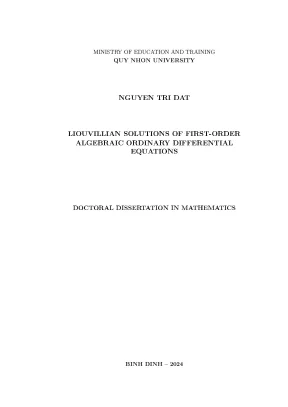
Tải xuống để đọc toàn bộMINISTRY OF EDUCATION AND TRAINING QUY NHON UNIVERSITY NGUYEN TRI DAT LIOUVILLIAN SOLUTIONS OF FIRST-ORDER ALGEBRAIC ORDINARY DIFFERENTIAL EQUATIONS DOCTORAL DISSERTATION IN MATHEMATICS BINH DINH – 2024 MINISTRY OF EDUCATION AND TRAINING QUY NHON UNIVERSITY NGUYEN TRI DAT LIOUVILLIAN SOLUTIONS OF FIRST-ORDER ALGEBRAIC ORDINARY DIFFERENTIAL EQUATIONS Speciality: Algebra and number theory Speciality code: 9 46 01 04 Reviewer 1: Prof. Phung Ho Hai Reviewer 2: Prof. Dang Duc Trong Reviewer 3: Assoc. Le Anh Vu Supervisors: 1.
Ngo Lam Xuan Chau 2. Le Cong Trinh BINH DINH – 2024 Declaration This dissertation was done at the Department of Mathematics and Statistics, Quy Nhon University under the supervision of Dr. Ngo Lam Xuan Chau and Assoc. Le Cong Trinh.
I hereby declare that the results presented in it are truthful and original. Most of them were published in peer-reviewed journals, others have not been published elsewhere. For using results from joint papers I have gotten permissions from my co-authors. Binh Dinh, 2024 Nguyen Tri Dat i Abstract Differential equations have been studied for a long time.
Various exact solution methods have been proposed for special cases. The main aim of this dissertation is to develop and investigate new methods for determining liouvillian solutions of first-order algebraic ordinary differential equations (AODEs). For this purpose, the differential problem is transformed into an algebraic geometric one by considering the differential equation to be an algebraic equation. Such an equation defines an algebraic curve and therefore, tools from algebraic geometry can be applied.
In particular, parametrizations of algebraic curves and algebraic function fields are intrinsically used to solve the problem and prove properties of the obtained solutions. A first idea for determining rational liouvillian solutions of first-order autonomous AODEs is presented. This approach is a generalization of a well-known algorithm for finding rational solutions. It admits an extension to the computation of the liouvillian solutions which is obtained by considering the wider differential fields.
A second focus lies on the extension of the first idea to the problem of finding liou- villian solutions of first-order autonomous AODEs of genus zero. In this situation, the theory of associated fields of algebraic functions is applied to prove a liouvillian solution (if there exists) must be a rational liouvillian solution. This leads to a classification of the liouvillian solutions respect to algebraic and transcendental cases. Last focus studies liouvillian solutions of first-order AODEs.
If an AODE is of genus zero, we prove that its liouvillian solutions can be found via first-order quasi- linear ODEs by means of associated fields of algebraic functions and optimal rational parametrizations. This method inherits the approach of existing algorithms for find- ing rational general solutions. Finally, we present an approach for solving first-order AODEs of positive genera by means of power transformations. ii Acknowledgments First of all I want to thank my supervisor Dr.
Ngo Lam Xuan Chau for the possibility to work at QNU and in particular in his research group. He helped me a lot to become a more independent researcher and always encouraged me to work on my own ideas. Working under his enthusiasm and kind guidance is an honor for me. Without him this dissertation could not have been finished.
I also want to express my gratitude to my co-supervisor Assoc. Le Cong Trinh for his hospitality during my research visits at QNU. Moreover, he taught me a lot from his mathematical expertise when we were working together on the seminars at QNU. I want to thank the colleagues and secretaries at the Department of Mathematics and Statistics and the Department of Graduate Training for their help and the friendly atmosphere throughout many occasions when I came and worked at QNU.
I also want to thank my own institute, UTH, for letting me a chance to obtain the Doctor’s degree. I want to express my gratitude to the coaches of Duong-Sinh-Tam-The club at Xuan Yen Ward, Song Cau Town for giving the cure to my severe illness and teaching me how to nurture my spiritual and physical health, that I can overcome my hard time and continue my work. My special thanks are due to my family – especially my wife Tuyet Phuong and my son Minh Tien – for their love, understanding and supporting throughout the years, that I was able to focus on my research. Binh Dinh, 2024 Nguyen Tri Dat iii Contents Introduction 1 1 Preliminaries 5 1.2 Plane algebraic curves .3 Fields of algebraic functions of one variable .4 Rational functions on algebraic curves .1 Associated fields of algebraic functions.
19 2 Rational liouvillian solutions of first-order autonomous AODEs 21 2.1 Solving first-order AODEs by parametrizations .2 Rational liouvillian solutions .4 An algorithm and examples. 33 3 Liouvillian solutions of first-order autonomous AODEs of genus zero 39 3.3 An algorithm and applications. 45 iv 4 Liouvillian solutions of first-order AODEs 54 4.1 Liouvillian solutions of first-order AODEs of genus zero .1 Associated differential equations .2 Main results and an algorithm .3 An investigation of first-order ODEs (4.2 Power transformations and their applications .2 Reduced forms by power transformations .3 Möbius transformations .4 Liouvillian solutions of first-order AODEs with liouvillian coefficients. 75 Index 79 Bibliography 82 Curriculum vitae 87 v List of algorithms Page Algorithm RatSol Rational general solutions of first-order autonomous AODEs 24 Algorithm RatLiouSol Rational liouvillian solutions of first-order autonomous AODEs 33 Algorithm LiouSolAut Liouvillian solutions of first-order autonomous AODEs of genus zero 45 Algorithm LiouSol Liouvillian solutions of first-order AODEs of genus zero 57 Algorithm RedPol Reduced forms of irreducible polynomials 67 vi Table of notations k : A differential field of characteristic zero K : The field of constants of a differential field k E : The differential extension field of k K(x) : The differential field of rational functions in x with constants K Q : The algebraic closure field of rational numbers C : The field of complex numbers K : An algebraic closed field of characteristic zero A2 (K) : The affine plane over K P2 (K) : The projective plane over K K[t]; K[x, y] : The polynomial ring of one; two variables over K K(x){y} : The ring of differential polynomials in y over K F : A polynomial in K[x, y] or differential polynomial in K(x){y} Σ : A prime differential ideal Σi : Essential prime differential ideals {F } : The radical differential ideal generated by the differential polynomial F SF : The separant of the differential polynomial F degx G : The degree of G with respect to x V(F ) : The zero set of F ∈ K[x, y] in A2 (K) C = V(F ) : The affine algebraic curve defined by F F̂ : The homogenization of F ∈ K[x, y] Γ = V(F̂ ) : The projective closure of the affine algebraic curve C g(Γ) : The genus of the projective curve Γ R(P2 ) : The field of rational functions on P2 (K) R(A2 ) : The field of rational functions on A2 (K) R(F̂ ) : The field of rational functions on F̂ E; L; K(η, ξ) : The field of algebraic functions of one variable K(t) : The field of rational functions of one variable rest (A, B) : The Sylvester resultant respect to A, B ∈ K[t]\{0} exp x : The exponent of x log x : The inverse function of exp x o : The valuation ring p : The place (of a valuation ring) gL : The genus of the function field L vii Introduction A differential equation (DE) is an equation that includes one or more unknown functions and their derivatives.
The history of DEs can be traced back to the inven- tion of calculus by Newton (in physics) and Leibniz (in pure mathematics) around 1660s–1670s. In application, the functions generally represent physical quantities, the derivatives represent their rates of change, and the DE defines a relationship between the two. Hence, these DEs play a prominent role in many disciplines including physics, engineering, economics, and biology. If a DE contains an unknown function and its derivatives which depend on an independent variable x then it is called an ordinary differential equation (ODE).
A DE is called linear if the relationship of the unknown function and its derivatives is linear; otherwise, it is called nonlinear. Such DEs can exhibit very complicated behavior over extended time intervals, characteristic of chaos. Unfortunately, there are very few methods of solving nonlinear DEs exactly. Most ODEs encountered in physics are linear; hence, there are many ways for solving them.
An idea of transforming nonlinear DEs into linear DEs and then solve the last ones may be a reasonable candidate. However, it works for only some cases. Therefore, studying independently the solutions of nonlinear DEs is necessary, and it also contains a lot of challenges. In this dissertation, we study liouvillian general solutions of first-order algebraic ordinary differential equations (AODEs) which is a fundamental problem in the theory of non-linear algebraic DEs.
A first-order AODE is a DE of the form F (y, y ′ ) = 0, where F is an irreducible polynomial in two variables with coefficients in K(x), K is an algebraically closed field of characteristic zero. Solving an AODE is a problem of determining differentiable functions y = y(x) satisfying F (y(x), y ′ (x)) = 0. an algebraic extension field of K(x)), then it is called a rational solution (resp. an algebraic solution).
If such a solution y(x) belongs to a liouvillian extension of K(x), then it is called a liouvillian solution. A solution may contain an arbitrary constant. In this case, such a solution is called a general solution. For example, y(x) = exp(x2 + c) is a liouvillian general solution of the first-order AODE y ′ − 2xy = 0.
1 First-order AODEs have been studied a lot and there are many solution methods for their special classes. The study of these AODEs can be dated back to the works of Fuchs [16] (1884). In [20] (1926), Ince presented an overall picture of ODEs. In [30,31] (1970s), Matsuda classified differential function fields having no movable critical points up to isomorphism of differential fields.
By focusing on particular solutions, in [29] (1913), Malmquist studied the class of first-order AODEs having transcendental meromorphic solutions, and Eremenko revisited later in [10] (1982). Applied Matsuda’s theory, Eremenko in [11] (1998) gave a theoretical consideration on a degree bound for rational solutions which sheds light on the issue of finding the solution’s explicit form. Finding the closed form solution of an ODE can be traced back to the works of Liouville (1830s) for the simplest ODE y ′ = α, where α ∈ k and k is a differential field of characteristic zero. If such an equation has a solution in some elementary differential extension field E of k having the same subfield of constants K, then there exist constants c1 , c2 ,.
, un ∈ Kk and v ∈ k such that n X u′ α= ci i + v ′. i=1 ui In [44] (1968), Rosenlicht showed how Liouville theorem can be handled algebraically. For the algorithm consideration of such ODE, the pioneer work is due to Risch. In R [41, 42] (1960s), Risch described a method to determine an elementary integral u where u is an elementary function.
To extend Risch’s method, in [51, 52] (1970s), Singer studied elementary solutions of first-order AODEs. As a special result, there are necessary and sufficient conditions for the ODE y ′ = R(y) ∈ C(y) having an elementary solution. In [56] (2017), Srinivasan generalized this result to the case of liouvillian solutions with the same conditions. In [25] (1986), Kovacic presented an effective method to find liouvillian solutions of second order linear homogeneous ODEs.
This work contains an algorithm for finding rational general solutions of a Riccati equation which is applicable to the works of Chen and Ma [7] (2005) and Vo et al.
Nội dung được bảo vệ bản quyền — Tải xuống đầy đủ
Câu hỏi thường gặp
Luận án "Liouvillian solutions of first-order algebraic ODEs" nghiên cứu về vấn đề gì?
Luận án tiến sĩ phát triển các phương pháp mới xác định nghiệm Liouvillian của phương trình vi phân đại số cấp một, ứng dụng hình học đại số và lý thuyết trường hàm để giải quyết bài toán vi phân phức tạp.
Luận án "Liouvillian solutions of first-order algebraic ODEs" được bảo vệ tại trường nào?
Luận án này được bảo vệ tại Quy Nhon University. Năm bảo vệ: 2024.
Luận án "Liouvillian solutions of first-order algebraic ODEs" thuộc chuyên ngành gì?
Luận án "Liouvillian solutions of first-order algebraic ODEs" thuộc chuyên ngành Algebra and number theory. Danh mục: Đại Số.
Luận án "Liouvillian solutions of first-order algebraic ODEs" có bao nhiêu trang?
Luận án "Liouvillian solutions of first-order algebraic ODEs" có 97 trang. Bạn có thể xem trước một phần tài liệu ngay trên trang web trước khi tải về.
Cách tải luận án "Liouvillian solutions of first-order algebraic ODEs" về máy như thế nào?
Để tải luận án về máy, bạn nhấn nút "Tải xuống ngay" trên trang này, sau đó hoàn tất thanh toán phí lưu trữ. File sẽ được tải xuống ngay sau khi thanh toán thành công. Hỗ trợ qua Zalo: 0559 297 239.