Cộng đồng vi sinh vật xử lý chất hữu cơ hòa tan biển - Luận án tiến sĩ
Luận án tiến sĩ nghiên cứu cấu trúc và chức năng cộng đồng vi sinh vật xử lý chất hữu cơ hòa tan biển. Phân tích vai trò các nhóm vi khuẩn trong chu trình carbon biển.
University of Delaware
Marine Studies
Luan An
Dissertation
Năm xuất bản
Số trang
128
Thời gian đọc
20 phút
Lượt xem
2
Lượt tải
0
Phí lưu trữ
40 Point
Tổng quan nhanh
- Chủ đề:
- 1. Cộng đồng vi sinh vật xử lý chất hữu cơ hòa tan
- Số trang:
- 128 trang
- Trường:
- University of Delaware
- Chuyên ngành:
- Marine Studies
- Tác giả:
- Hila Elifantz
- Năm:
- 2006
Tóm tắt nội dung luận án
I. Cộng đồng vi sinh vật xử lý chất hữu cơ hòa tan
Vi sinh vật biển đóng vai trò then chốt trong xử lý chất hữu cơ hòa tan (DOM - Dissolved Organic Matter). Cộng đồng vi khuẩn dị dưỡng trong môi trường biển thực hiện chức năng phân hủy sinh học các hợp chất hữu cơ. Quá trình này ảnh hưởng trực tiếp đến chu trình carbon biển toàn cầu. Nghiên cứu cấu trúc và chức năng của cộng đồng vi sinh vật giúp hiểu rõ cơ chế chuyển hóa carbon. Các nhóm vi khuẩn khác nhau chuyên hóa trong việc phân giải các loại DOM. Enzyme ngoại bào do vi khuẩn tiết ra phân cắt các phân tử hữu cơ phức tạp. Bơm carbon vi sinh vật (microbial carbon pump) chuyển đổi DOM thành sinh khối vi sinh vật. Microbial loop kết nối DOM với mạng lưới thức ăn biển. Hiểu biết về cộng đồng vi sinh vật xử lý DOM cần thiết cho dự báo khí hậu.
1.1. Vai trò vi sinh vật trong chu trình carbon biển
Vi khuẩn dị dưỡng chiếm 20-30% sinh khối plankton biển. Chúng tiêu thụ 50% sản lượng sơ cấp dưới dạng DOM. Quá trình hô hấp của vi khuẩn giải phóng CO2 về khí quyển. Một phần carbon được chuyển thành sinh khối vi khuẩn. Sinh khối này trở thành thức ăn cho sinh vật bậc cao hơn. Bơm carbon vi sinh vật lưu trữ carbon trong đại dương sâu. Hiệu suất chuyển hóa carbon dao động 10-50%. Yếu tố quyết định bao gồm chất lượng DOM và loài vi khuẩn.
1.2. Cấu trúc cộng đồng vi khuẩn phân giải DOM
Cộng đồng vi khuẩn biển có tính đa dạng cao. Các nhóm chính bao gồm Alphaproteobacteria, Gammaproteobacteria và Bacteroidetes. Mỗi nhóm chuyên hóa xử lý các loại DOM khác nhau. SAR11 chiếm ưu thế trong vùng nước nghèo dinh dưỡng. Flavobacteria phân giải polysaccharide phức tạp hiệu quả. Roseobacter đa dạng về chức năng chuyển hóa. Cấu trúc cộng đồng thay đổi theo mùa và vị trí địa lý. Sự phong phú của nhóm vi khuẩn phụ thuộc nguồn DOM.
1.3. Phương pháp nghiên cứu cộng đồng vi sinh vật
Kỹ thuật FISH (Fluorescence In Situ Hybridization) xác định vi khuẩn cụ thể. Microautoradiography theo dõi hoạt động hấp thụ DOM. Kết hợp FISH-MAR liên kết cấu trúc với chức năng. Trình tự gen 16S rRNA xác định đa dạng vi khuẩn. Metagenomics phân tích tiềm năng chức năng cộng đồng. Các chất đồng vị phóng xạ đánh dấu DOM. Phương pháp nuôi cấy phân lập vi khuẩn chức năng. Công nghệ sinh học phân tử cách mạng hóa nghiên cứu vi sinh vật biển.
II. Chất hữu cơ hòa tan DOM trong môi trường biển
Chất hữu cơ hòa tan (DOM) là kho carbon lớn nhất trong đại dương. Nồng độ DOM dao động 0.5-2.0 mg carbon/lít nước biển. Nguồn DOM chính từ quá trình quang hợp của t조류. Phytoplankton tiết ra 10-50% carbon cố định dưới dạng DOM. Zooplankton và vi khuẩn cũng đóng góp DOM. Thành phần DOM bao gồm carbohydrate, protein, lipid và acid nucleic. Polysaccharide chiếm tỷ lệ lớn trong DOM sinh học. Glucose là monomer đơn giản dễ phân hủy. DOM khó phân hủy tích lũy trong đại dương sâu. Chất lượng DOM quyết định tốc độ phân hủy sinh học. Vi khuẩn phân giải ưu tiên DOM dễ tiếp cận.
2.1. Thành phần hóa học của DOM biển
DOM gồm hàng nghìn hợp chất hữu cơ khác nhau. Carbohydrate chiếm 20-30% tổng DOM có thể xác định. Polysaccharide từ tảo và vi khuẩn rất phong phú. Protein và peptide chiếm 10-20% DOM. Amino acid tự do dễ dàng được vi khuẩn hấp thụ. Lipid và acid béo chiếm tỷ lệ nhỏ hơn. Chất ưa nước chiếm đa số DOM. Phần lớn DOM vẫn chưa được xác định cấu trúc. Công nghệ khối phổ cải thiện phân tích DOM.
2.2. Nguồn gốc và sản xuất DOM
Phytoplankton là nguồn DOM chính trong vùng ven bờ. Quá trình tiết ra chủ động giải phóng DOM. Phân hủy tế bào chết tạo DOM. Virus phá vỡ tế bào vi sinh vật giải phóng DOM. Zooplankton bài tiết và ăn lộn xộn sản xuất DOM. Thực vật bậc cao ven biển đóng góp DOM. Sông đưa DOM từ đất liền ra biển. Hoạt động con người tăng cường tải lượng DOM. Mùa nở hoa tảo tạo đỉnh cao DOM.
2.3. Phân loại DOM theo độ phân hủy
DOM labile phân hủy trong vài giờ đến ngày. Glucose và amino acid là ví dụ DOM labile. DOM semi-labile tồn tại vài tuần đến tháng. Polysaccharide phức tạp thuộc nhóm semi-labile. DOM refractory tồn tại hàng nghìn năm. Humic substances là DOM refractory chính. Enzyme ngoại bào cần thiết phân hủy DOM phức tạp. Tốc độ phân hủy phụ thuộc cấu trúc phân tử. Điều kiện môi trường ảnh hưởng khả năng phân hủy.
III. Vi khuẩn dị dưỡng và quá trình phân hủy sinh học
Vi khuẩn dị dưỡng là động lực chính phân hủy DOM biển. Chúng sử dụng DOM làm nguồn carbon và năng lượng. Quá trình phân hủy sinh học bắt đầu bằng enzyme ngoại bào. Enzyme phân cắt phân tử lớn thành đơn vị nhỏ hơn. Vi khuẩn hấp thụ các monomer qua màng tế bào. Hô hấp hiếu khí chuyển carbon thành CO2. Một phần carbon tích hợp vào sinh khối vi khuẩn. Hiệu suất tăng trưởng vi khuẩn (BGE) dao động 5-50%. Nhiệt độ, dinh dưỡng và chất lượng DOM ảnh hưởng BGE. Các nhóm vi khuẩn khác nhau có tốc độ phân hủy riêng. Cạnh tranh giữa các loài định hình cộng đồng.
3.1. Cơ chế hấp thụ DOM của vi khuẩn
Vi khuẩn sử dụng protein vận chuyển màng. Hệ thống ABC transporter hấp thụ chất hữu cơ. Protein gắn kết ngoại bào bắt giữ chất nền. Quá trình vận chuyển tiêu tốn năng lượng ATP. Kích thước phân tử giới hạn khả năng hấp thụ. Phân tử lớn hơn 600 Da cần enzyme phân cắt trước. Ái lực cao với chất nền tăng hiệu quả hấp thụ. Mật độ protein vận chuyển thay đổi theo điều kiện. Vi khuẩn điều chỉnh biểu hiện gen theo nguồn DOM.
3.2. Enzyme ngoại bào trong phân hủy DOM
Enzyme ngoại bào phân cắt polymer phức tạp. Glucosidase phân hủy polysaccharide thành glucose. Aminopeptidase cắt protein thành amino acid. Phosphatase giải phóng phosphate từ hợp chất hữu cơ. Lipase phân hủy lipid thành acid béo. Hoạt động enzyme tăng khi có chất nền. Nhiệt độ và pH ảnh hưởng hiệu suất enzyme. Vi khuẩn tiết enzyme khi phát hiện polymer. Chi phí sản xuất enzyme cao cho vi khuẩn.
3.3. Hiệu suất tăng trưởng vi khuẩn BGE
BGE đo lường carbon DOM chuyển thành sinh khối. Giá trị BGE cao nghĩa là hiệu quả chuyển hóa tốt. DOM chất lượng cao tạo BGE 30-50%. DOM nghèo dinh dưỡng giảm BGE xuống 5-15%. Nhiệt độ cao tăng hô hấp giảm BGE. Tỷ lệ C:N:P của DOM ảnh hưởng BGE. Vi khuẩn cần nitrogen và phosphorus cho tăng trưởng. Thiếu dinh dưỡng vô cơ giới hạn BGE. Các loài vi khuẩn khác nhau có BGE riêng.
IV. Microbial loop và bơm carbon vi sinh vật
Microbial loop mô tả vai trò vi sinh vật trong mạng thức ăn biển. Khái niệm này cách mạng hóa hiểu biết về sinh thái biển. Vi khuẩn chuyển DOM thành sinh khối vi sinh vật. Protozoa ăn vi khuẩn chuyển carbon lên bậc cao hơn. Quá trình này tái chế dinh dưỡng trong vùng nước mặt. Microbial loop giữ carbon trong hệ sinh thái ven bờ. Bơm carbon vi sinh vật lưu trữ carbon dài hạn. Vi khuẩn sản xuất DOM khó phân hủy. DOM refractory chìm xuống đại dương sâu. Cơ chế này loại bỏ carbon khỏi khí quyển hàng nghìn năm. Hiệu quả bơm carbon phụ thuộc cộng đồng vi sinh vật.
4.1. Cấu trúc và chức năng microbial loop
Microbial loop bắt đầu từ DOM do phytoplankton tiết. Vi khuẩn dị dưỡng hấp thủ DOM này. Sinh khối vi khuẩn tăng nhanh trong vài giờ. Flagellate và ciliate ăn vi khuẩn. Protozoa bài tiết dinh dưỡng vô cơ. Dinh dưỡng tái chế hỗ trợ phytoplankton. Copepod ăn protozoa nối với mạng thức ăn lớn. Hiệu suất chuyển carbon qua loop khoảng 10-30%. Microbial loop chiếm ưu thế vùng nước nghèo dinh dưỡng.
4.2. Bơm carbon vi sinh vật trong đại dương
Bơm carbon vi sinh vật tạo DOM refractory. Vi khuẩn chuyển hóa DOM labile thành DOM khó phân hủy. Quá trình này xảy ra qua chuyển hóa nội bào. Sản phẩm trao đổi chất vi khuẩn kháng phân hủy. Tế bào vi khuẩn chết giải phóng vật liệu refractory. DOM refractory tích lũy trong nước sâu. Thời gian lưu trú carbon tăng từ ngày lên nghìn năm. Bơm vi sinh vật lưu trữ carbon tương đương bơm sinh học. Cơ chế này quan trọng cho cân bằng carbon toàn cầu.
4.3. Tác động lên chu trình carbon toàn cầu
Microbial loop và bơm carbon ảnh hưởng khí hậu Trái Đất. Hô hấp vi khuẩn giải phóng CO2 về khí quyển. Tốc độ hô hấp tăng với nhiệt độ nước biển. Biến đổi khí hậu thay đổi cộng đồng vi khuẩn. Thay đổi cộng đồng ảnh hưởng hiệu suất bơm carbon. Tăng nhiệt độ có thể giảm lưu trữ carbon biển. Axit hóa đại dương tác động hoạt động vi khuẩn. Hiểu microbial loop cần thiết dự báo khí hậu. Mô hình khí hậu cần tích hợp quá trình vi sinh vật.
V. Đa dạng chức năng nhóm vi khuẩn phân giải DOM
Các nhóm vi khuẩn khác nhau chuyên hóa xử lý DOM riêng. Alphaproteobacteria chiếm ưu thế trong đại dương mở. SAR11 (Pelagibacter) là vi khuẩn phong phú nhất biển. Chúng chuyên hấp thụ DOM nồng độ thấp hiệu quả. Roseobacter đa dạng về khả năng chuyển hóa DOM. Gammaproteobacteria phản ứng nhanh với DOM tăng đột ngột. Bacteroidetes phân giải polysaccharide phức tạp từ tảo. Flavobacteria sản xuất nhiều enzyme phân hủy polymer. Actinobacteria xử lý DOM khó phân hủy. Cyanobacteria vừa quang hợp vừa hấp thụ DOM. Đa dạng chức năng đảm bảo phân hủy toàn diện DOM.
5.1. Alphaproteobacteria và chiến lược oligotrophic
SAR11 chiếm 25-50% tổng vi khuẩn biển. Kích thước tế bào nhỏ 0.4-0.6 micromet. Bề mặt tế bào lớn so với thể tích tăng hấp thụ. Genome nhỏ gọn 1.3 million base pairs. Protein vận chuyển đa dạng cho nhiều chất nền. Ái lực cao với DOM nồng độ nanomolar. Hiệu suất tăng trưởng thấp nhưng ổn định. Roseobacter chiếm 15-20% vi khuẩn ven bờ. Chúng phân hủy DMSP từ phytoplankton. Khả năng sống trong điều kiện đa dạng.
5.2. Gammaproteobacteria và phản ứng nhanh
Gammaproteobacteria tăng nhanh khi DOM dồi dào. Chiến lược copiotrophic tận dụng nguồn dồi dào. Tốc độ sinh sản cao khi có chất nền. Alteromonas phân hủy polymer phức tạp nhanh. Vibrio phát triển mạnh vùng ven bờ giàu DOM. Pseudoalteromonas sản xuất enzyme đa dạng. Nhóm này chiếm ưu thế sau nở hoa tảo. Khả năng hóa ứng động nhanh với DOM. Cạnh tranh tốt trong điều kiện giàu dinh dưỡng.
5.3. Bacteroidetes chuyên phân hủy polysaccharide
Bacteroidetes có hệ enzyme phân hủy polymer mạnh. Flavobacteria chiếm 5-20% vi khuẩn biển. Genome chứa nhiều gen glycosidase và peptidase. Polysaccharide utilization loci (PUL) chuyên hóa cao. Gắn trực tiếp lên hạt polymer để phân hủy. Tiết enzyme ngoại bào phong phú. Phản ứng nhanh với nở hoa diatom và dinoflagellate. Hấp thụ monomer từ phân hủy polymer. Vai trò quan trọng tái chế carbon từ tảo.
VI. Ứng dụng nghiên cứu cộng đồng vi sinh vật biển
Nghiên cứu cộng đồng vi sinh vật xử lý DOM có nhiều ứng dụng. Hiểu chu trình carbon biển cải thiện mô hình khí hậu. Dự báo phản ứng đại dương với biến đổi khí hậu chính xác hơn. Công nghệ sinh học khai thác enzyme vi khuẩn biển. Xử lý nước thải sử dụng vi khuẩn phân giải hiệu quả. Sản xuất năng lượng sinh học từ DOM. Phục hồi môi trường ô nhiễm bằng vi khuẩn. Nuôi trồng thủy sản quản lý chất lượng nước tốt hơn. Phát hiện sinh vật mới có tiềm năng công nghiệp. Bảo tồn đa dạng sinh học vi khuẩn biển. Giáo dục nâng cao nhận thức về vai trò vi sinh vật.
6.1. Ứng dụng trong mô hình khí hậu
Mô hình khí hậu toàn cầu cần dữ liệu vi sinh vật. Tốc độ phân hủy DOM ảnh hưởng dự báo CO2. Hiệu suất bơm carbon vi sinh vật quan trọng. Thay đổi cộng đồng vi khuẩn do nhiệt độ tăng. Mô hình cần tích hợp đa dạng chức năng vi khuẩn. Dữ liệu thực nghiệm cải thiện độ chính xác. Phản hồi vi sinh vật với biến đổi khí hậu. Kịch bản tương lai phụ thuộc hoạt động vi khuẩn. Nghiên cứu cung cấp tham số cho mô hình.
6.2. Công nghệ sinh học từ vi khuẩn biển
Enzyme biển có tính chất đặc biệt. Hoạt động ở nhiệt độ thấp và áp suất cao. Ứng dụng trong công nghiệp thực phẩm và dược phẩm. Protease biển xử lý protein hiệu quả. Polysaccharidase phân hủy rong biển tạo biofuel. Lipase biển sản xuất biodiesel. Vi khuẩn sản xuất hợp chất kháng sinh mới. Polymer sinh học từ vi khuẩn biển. Tiềm năng lớn cho công nghệ xanh.
6.3. Xử lý môi trường và nuôi trồng thủy sản
Vi khuẩn phân giải chất hữu cơ trong nước thải. Hệ thống xử lý sinh học hiệu quả và bền vững. Bioaugmentation tăng cường vi khuẩn chức năng. Phục hồi vùng nước ô nhiễm dầu. Vi khuẩn phân hủy hydrocarbon làm sạch môi trường. Nuôi trồng thủy sản quản lý DOM trong ao. Probiotic vi khuẩn cải thiện sức khỏe cá tôm. Giảm bệnh tật bằng cân bằng vi sinh vật. Tăng năng suất nuôi trồng bền vững.
Mục lục chi tiết luận án
Tải xuống file đầy đủ để xem toàn bộ nội dung
Tải đầy đủ (128 trang)Nội dung chính
Tổng quan về luận án
Luận án tiến sĩ "STRUCTURE AND FUNCTION OF MICROBIAL COMMUNITIES PROCESSING DISSOLVED ORGANIC MATTER IN MARINE ENVIRONMENTS" của Hila Elifantz đại diện cho một bước đột phá trong nghiên cứu vi sinh vật biển, giải quyết những khoảng trống kiến thức cốt lõi về chu trình carbon toàn cầu. Nghiên cứu này đặt trong bối cảnh khoa học về vai trò không thể thiếu của vi khuẩn dị dưỡng trong việc xử lý khoảng 50% lượng carbon cố định trong các đại dương (Abstract, p.x), một lượng tương đương với môi trường trên cạn. Mặc dù tầm quan trọng này đã được công nhận, các phương pháp truyền thống thường xem cộng đồng vi khuẩn như một "hộp đen" ("black box"), không thể tiết lộ cụ thể nhóm vi khuẩn nào sử dụng các hợp chất hữu cơ hòa tan (DOM) cụ thể (Azam 1998; Fasham et al. 1999; Gonzalez et al. 1993). Tính tiên phong của nghiên cứu nằm ở việc vượt qua hạn chế này thông qua việc áp dụng và phát triển các kỹ thuật tiên tiến để phân tích hoạt động của vi khuẩn ở cấp độ tế bào đơn.
Khoảng trống nghiên cứu cụ thể mà luận án này giải quyết là sự thiếu hiểu biết về "identity of these degrading prokaryotes" (Giới thiệu, p.4), đặc biệt là các nhóm vi khuẩn sử dụng polysaccharides và các quá trình liên quan. Đồng thời, có rất ít thông tin về vai trò của các nhóm vi khuẩn cụ thể như Cytophaga-like bacteria trong các môi trường thủy sinh đa dạng. Luận án đặt ra các câu hỏi nghiên cứu cốt lõi sau:
- Các nhóm vi khuẩn nào là chủ yếu trong việc đồng hóa glucose và các chất polymer ngoại bào (EPS) trong môi trường cửa sông?
- Mức độ đồng hóa DOM của các nhóm vi khuẩn cụ thể có mối quan hệ như thế nào với sự phong phú tương đối của chúng trong cộng đồng?
- Có sự khác biệt nào trong mô hình đồng hóa DOM giữa các môi trường biển khác biệt về dinh dưỡng và nhiệt độ, chẳng hạn như cửa sông ôn đới giàu dinh dưỡng và đại dương Bắc Cực nghèo dinh dưỡng không?
- Cơ chế phân tử liên quan đến sự phân hủy polysaccharide trong môi trường biển là gì, đặc biệt là sự đa dạng và phong phú của các enzyme glycosyl hydrolase (GH5)?
Luận án sử dụng một khung lý thuyết tích hợp, dựa trên lý thuyết về vòng lặp vi khuẩn (microbial loop) của Azam (1998) và các mô hình kiểm soát hệ sinh thái, bao gồm kiểm soát từ dưới lên ("bottom-up" control) và từ trên xuống ("top-down" control). Đóng góp đột phá của luận án là việc cung cấp bằng chứng thực nghiệm mạnh mẽ cho thấy cộng đồng vi khuẩn trong cửa sông Delaware bị ảnh hưởng ngang nhau bởi cả hai yếu tố kiểm soát "bottom-up" (ví dụ: sự sẵn có của DOM) và "top-down" (ví dụ: sự săn mồi và tan rã do virus) (Abstract, p.x), thách thức quan điểm chỉ tập trung vào một yếu tố kiểm soát. Ngoài ra, nghiên cứu là "the first to unfold the relation between structure and function of the bacterial community in the Arctic Ocean, the only cold environment studied in that aspect to date" (Abstract, p.xii), một thành tựu có tác động định lượng lớn đối với hiểu biết về các chu trình carbon ở các vùng cực đang thay đổi.
Phạm vi nghiên cứu bao gồm việc phân tích các mẫu nước mặt từ bốn địa điểm dọc cửa sông Delaware vào tháng 7/2003 (độ mặn 0, 13, 21, 26 PSU) và tháng 6/2004 (28 PSU), cũng như các mẫu từ Đại Tây Dương Bắc Cực phía Tây và Đại Tây Dương Bắc. Kích thước mẫu cụ thể cho Micro-FISH là 30 ml nước ủ với 3H-glucose hoặc 3H-EPS. Đối với nghiên cứu phân tử, các thư viện gen GH5 được xây dựng từ Mid-Atlantic Bight và Sargasso Sea, với hàng trăm bản sao (clones) được tuần tự hóa (sequencing). Sự kết hợp này mang lại ý nghĩa sâu rộng cho việc hiểu chu trình carbon ở các hệ sinh thái biển đa dạng, từ cửa sông năng suất cao đến đại dương nghèo dinh dưỡng.
Literature Review và Positioning
Phần tổng quan tài liệu của luận án đã tổng hợp một cách tinh tế các dòng nghiên cứu chính, cung cấp một cái nhìn toàn diện về sự hiểu biết hiện tại về chu trình vật chất hữu cơ hòa tan (DOM) trong môi trường biển và vai trò của vi khuẩn. Luận án đã trích dẫn các tác giả và năm cụ thể để xây dựng bối cảnh học thuật, như Field et al. (1998) về lượng carbon cố định toàn cầu, Hansell và Carlson (1998) về bể DOC đại dương, và Azam (1998) cùng Carlson (2002) về số phận của carbon cố định. Luận án nhấn mạnh rằng các phương pháp đo lường truyền thống như sản xuất vi khuẩn, hô hấp vi khuẩn, nồng độ và thông lượng DOM thường coi vi khuẩn như một "black box" (Azam 1998; Fasham et al. 1999; Gonzalez et al. 1993), không thể xác định cụ thể nhóm vi khuẩn nào sử dụng các hợp chất DOM cụ thể. Điều này đã thiết lập một khoảng trống quan trọng trong nghiên cứu trước đây.
Luận án cũng làm nổi bật những mâu thuẫn và tranh luận trong tài liệu, đặc biệt là về sự kết nối (coupling) hoặc không kết nối (decoupling) giữa sản xuất sơ cấp và thứ cấp. Ví dụ, trong các vùng nước năng suất thấp của Nam Đại Dương, vi khuẩn dị dưỡng được kết nối chặt chẽ với thực vật phù du thông qua DOC (Moran et al. 2002). Ngược lại, các vùng ven biển Nam Cực trải qua sự chậm trễ khoảng một tháng giữa sự nở hoa của thực vật phù du và hoạt động vi khuẩn tối đa, cho thấy sự không kết nối do thiếu chất dinh dưỡng (Carlson et al. 1998; Moran et al. 2002). Tương tự, sự không kết nối cũng xảy ra ở môi trường ôn đới nghèo dinh dưỡng và các vùng nước trồi, dẫn đến dị dưỡng ròng của hệ thống (Aristegui và Harrison 2002; Hoppe et al. 2002; Schauer et al. 2003). Những đối lập này làm nổi bật tính phức tạp của các tương tác vi khuẩn-thực vật phù du và sự cần thiết của các nghiên cứu cụ thể theo môi trường.
Vị trí của luận án trong tài liệu được xác định rõ ràng bằng cách giải quyết khoảng trống trong việc xác định các nhóm vi khuẩn cụ thể tham gia vào chu trình DOM và cơ chế phân tử của chúng. Luận án "added to the growing information regarding the composition of bacterial community in aquatic environments and the role of specific bacterial groups in DOM assimilation" (Abstract, p.xii). Luận án này đã tiên phong trong việc sử dụng kết hợp Microautoradiography và FISH (Micro-FISH) để vượt qua những hạn chế về phương pháp, cho phép "more indepth inquiries" (Giới thiệu, p.6) về vai trò của các nhóm vi khuẩn cụ thể trong việc đồng hóa các hợp chất DOM. Kỹ thuật này đã được phát triển bởi Lee et al. (1999) và Ouverney và Fuhrman (1999), nhưng luận án này đã áp dụng nó một cách sáng tạo để khám phá những câu hỏi chưa được trả lời.
Luận án đã nâng cao lĩnh vực này bằng các đóng góp cụ thể. Nó đã mở rộng hiểu biết về vai trò của Alphaproteobacteria trong việc đồng hóa các hợp chất LMW (Malmstrom et al. 2004a; 2004b; Vila et al. 2004) và nhấn mạnh vai trò của Cytophaga-like bacteria trong việc sử dụng HMW DOM (Cottrell và Kirchman 2000b), mặc dù thừa nhận rằng "not enough information regarding this group is available to draw general conclusions" (Giới thiệu, p.6). Đối với so sánh quốc tế, luận án đã xem xét các nhóm SAR11, một phân nhóm của Alphaproteobacteria. Trong khi SAR11 đóng góp khoảng 50% vào việc đồng hóa glucose ở Biển Sargasso (Malmstrom et al. 2005), luận án này chỉ ra rằng nhóm này chỉ chiếm 15-20% ở Delaware (Malmstrom et al. 2005), cho thấy sự khác biệt về vai trò và sự đa dạng phylotype giữa các môi trường nghèo dinh dưỡng và giàu dinh dưỡng. Điều này cũng được so sánh với các nghiên cứu khác về sự phân bố của các nhóm vi khuẩn (ví dụ: Betaproteobacteria và Actinobacteria ở nước ngọt, Alphaproteobacteria ở nước mặn) ở các cửa sông và hồ quốc tế (Bouvier và Del Giorgio 2002; Glöckner et al. 1999; Kirchman et al. 2005).
Đóng góp lý thuyết và khung phân tích
Đóng góp cho lý thuyết
Luận án này đã mở rộng và thách thức các lý thuyết cụ thể về kiểm soát cộng đồng vi khuẩn và chu trình vật chất hữu cơ hòa tan (DOM) trong môi trường biển. Một đóng góp lý thuyết quan trọng là việc làm phong phú thêm lý thuyết về kiểm soát hệ sinh thái, đặc biệt là lý thuyết về kiểm soát từ dưới lên ("bottom-up") và từ trên xuống ("top-down"). Các nghiên cứu trước đây thường tập trung vào sự sẵn có của chất dinh dưỡng và DOM như những yếu tố kiểm soát chính. Tuy nhiên, luận án này cung cấp bằng chứng thực nghiệm mạnh mẽ, tuyên bố rằng "the bacterial community in the Delaware Estuary might be affected equally by "bottom-up" (DOM availability) and "top-down" (predation and viral lysis) factors" (Abstract, p.x). Điều này mở rộng lý thuyết về động lực học quần thể vi khuẩn, bổ sung thêm các yếu tố sinh học như sự săn mồi của các động vật nguyên sinh (Jurgens và Matz 2002; Simek et al. 2003) và sự tan rã của virus (Thingstad và Lignell 1997) như những lực lượng quan trọng định hình cấu trúc và chức năng cộng đồng.
Khung khái niệm của luận án được xây dựng dựa trên mối quan hệ tương hỗ giữa cấu trúc và chức năng của cộng đồng vi khuẩn. Các thành phần chính bao gồm: 1) sự phong phú và phân bố địa lý của các nhóm vi khuẩn cụ thể (ví dụ: Alphaproteobacteria, Cytophaga-like bacteria, Actinobacteria, Betaproteobacteria, Gammaproteobacteria), 2) hoạt động đồng hóa các hợp chất DOM khác nhau (glucose, EPS, amino acids, protein), và 3) các yếu tố môi trường (độ mặn, trạng thái dinh dưỡng). Mối quan hệ giữa các thành phần này được kiểm tra thông qua các đề xuất và giả thuyết cụ thể.
Mô hình lý thuyết của luận án đưa ra các đề xuất/giả thuyết được đánh số:
- Các nhóm vi khuẩn phong phú nhất ở mỗi địa điểm sẽ chiếm ưu thế trong việc đồng hóa EPS và glucose (Introduction, p.15).
- Sự đóng góp của một nhóm vi khuẩn vào thông lượng DOM có thể được giải thích bởi sự phong phú tương đối của nó trong cộng đồng (Results, p.21).
- Các nhóm vi khuẩn có tỷ lệ tế bào đồng hóa chất nền cao sẽ phong phú hơn các nhóm có tỷ lệ thấp hơn (Discussion, p.26).
- Có sự khác biệt về chuyên môn hóa giữa các nhóm vi khuẩn đối với các loại DOM khác nhau (ví dụ: LMW vs. HMW).
Không có bằng chứng trực tiếp trong văn bản gốc về một sự thay đổi mô hình ("paradigm shift") rộng lớn. Tuy nhiên, luận án này đã đẩy ranh giới của hiểu biết hiện tại bằng cách thách thức quan điểm đơn giản về kiểm soát "bottom-up" và là "the first to unfold the relation between structure and function of the bacterial community in the Arctic Ocean" (Abstract, p.xii), điều này có thể mở đường cho một sự thay đổi mô hình trong các nghiên cứu về hệ sinh thái cực.
Khung phân tích độc đáo
Khung phân tích độc đáo của luận án tích hợp một cách sáng tạo nhiều lý thuyết và phương pháp tiếp cận để đạt được một cái nhìn toàn diện về chu trình DOM. Nó kết hợp: 1) lý thuyết về sự phân vùng chức năng của các nhóm vi khuẩn phylogenetically (dựa trên các công trình của Giovannoni và Rappe 2000, Cottrell và Kirchman 2000a), 2) lý thuyết về kiểm soát quần thể vi khuẩn ("bottom-up" vs. "top-down" của Gonzalez et al. 1990, Thingstad và Lignell 1997), và 3) cơ chế sinh hóa của sự phân hủy vật chất hữu cơ (CAZy database).
Cách tiếp cận phân tích mới lạ nằm ở việc kết hợp kỹ thuật Micro-FISH với phân tích đa môi trường (eutrophic estuary vs. oligotrophic Arctic) và nghiên cứu phân tử (GH5 enzymes). Phương pháp này cho phép liên kết trực tiếp giữa nhận dạng phylogenetic của tế bào vi khuẩn, hoạt động trao đổi chất của chúng (đồng hóa DOM), và tiềm năng enzyme của cộng đồng. Sự biện minh cho cách tiếp cận này là để "identify key organisms in these processes" (Giới thiệu, p.4) và hiểu "the molecular mechanism of the degradation of polysaccharides" (Abstract, p.xi), những điều mà các phương pháp truyền thống không làm được.
Các đóng góp khái niệm bao gồm định nghĩa rõ ràng về "active cells" (tế bào có hạt bạc từ Micro-FISH) và "assimilating cells" (tế bào dương tính với probe và có hạt bạc), phân biệt chúng với tổng số tế bào hoặc tổng sinh khối. Ngoài ra, việc phân tích tỷ lệ kích thước tế bào của vi khuẩn hoạt động so với không hoạt động (ví dụ: "EPS-assimilating bacteria were larger than non-assimilating bacteria by 20-44%" - Bảng 2.1, p.33) cung cấp một góc nhìn mới về ảnh hưởng của các yếu tố từ trên xuống như sự săn mồi, vì "susceptibility of bacteria to predation is affected by cell size" (Del Giorgio et al. 1996; Sherr et al. 1987).
Các điều kiện biên được nêu rõ ràng: nghiên cứu tập trung vào các hợp chất DOM cụ thể (glucose, EPS, amino acids, protein) và các nhóm vi khuẩn chính được phát hiện bằng FISH. Các kết quả liên quan đến cửa sông Delaware có thể áp dụng cho các cửa sông ôn đới khác, trong khi phát hiện ở Bắc Cực có ý nghĩa đối với các môi trường biển lạnh, nghèo dinh dưỡng. Tuy nhiên, tính tổng quát của các phát hiện về các nhóm enzyme GH5 có thể rộng hơn, áp dụng cho chu trình polysaccharide toàn cầu. Luận án cũng thừa nhận các giới hạn của chính nó, ví dụ, về việc "more need to be done to broaden our understanding of the mineralization of these compounds in the marine environment" (Abstract, p.xii).
Phương pháp nghiên cứu tiên tiến
Thiết kế nghiên cứu
Luận án này thể hiện một triết lý nghiên cứu thực dụng, kết hợp các yếu tố của Post-positivism và Critical Realism. Nó bắt đầu bằng các giả thuyết có thể kiểm chứng về vai trò của các nhóm vi khuẩn và các yếu tố kiểm soát (Bottom-up vs. Top-down), đặc trưng của Post-positivism. Đồng thời, nó tìm kiếm để hiểu các cơ chế cơ bản (ví dụ: các enzyme phân hủy polysaccharide) và cấu trúc hệ sinh thái ẩn đằng sau các hiện tượng quan sát được, phản ánh triết lý của Critical Realism.
Nghiên cứu sử dụng một thiết kế phương pháp hỗn hợp (mixed methods) tiên tiến, kết hợp dữ liệu định lượng từ sinh thái học vi khuẩn (Micro-FISH để xác định hoạt động ở cấp độ tế bào đơn và Q-PCR để định lượng gen) với các phân tích phân tử (xây dựng thư viện gen, tuần tự hóa, cây phylogenetic) để cung cấp một cái nhìn toàn diện. Sự kết hợp cụ thể này cho phép luận án liên kết cấu trúc cộng đồng (được xác định bằng FISH và 16S rRNA gene libraries) với chức năng (được đo bằng đồng hóa DOM và sự hiện diện của gen enzyme). Điều này mang lại một sự hiểu biết sâu sắc hơn nhiều so với việc chỉ sử dụng một phương pháp đơn lẻ.
Thiết kế đa cấp cũng được áp dụng, với các cấp độ được xác định rõ ràng:
- Cấp độ tế bào đơn: Sử dụng Micro-FISH để đánh giá hoạt động đồng hóa DOM của từng tế bào vi khuẩn và xác định nhóm phylogenetic của chúng.
- Cấp độ cộng đồng: Phân tích sự đóng góp tổng thể của các nhóm vi khuẩn khác nhau vào chu trình DOM và xác định các yếu tố kiểm soát cộng đồng (bottom-up, top-down).
- Cấp độ phân tử/gen: Nghiên cứu sự đa dạng và phong phú của các gen enzyme cụ thể (GH5) liên quan đến sự phân hủy polysaccharide. Các cấp độ này được tích hợp để xây dựng một bức tranh toàn diện về vai trò của vi khuẩn trong chu trình carbon.
Kích thước mẫu và tiêu chí lựa chọn là chính xác. Đối với các thí nghiệm Micro-FISH, các mẫu nước mặt 30 ml được thu thập từ bốn địa điểm dọc cửa sông Delaware (độ mặn 0, 13, 21, 26 PSU vào tháng 7/2003 và 28 PSU vào tháng 6/2004) và các địa điểm ở Đại Tây Dương Bắc Cực phía Tây. Các mẫu này được ủ với 2 nM 3H-glucose hoặc 1.5 nM 3H-EPS (Vật liệu và Phương pháp, p.16). Tiêu chí lựa chọn mẫu là đại diện cho các môi trường biển khác nhau về độ mặn, nhiệt độ và trạng thái dinh dưỡng (eutrophic vs. oligotrophic).
Quy trình nghiên cứu rigorous
Chiến lược lấy mẫu được thiết kế để nắm bắt sự biến đổi không gian và môi trường. Các mẫu được thu thập từ một gradient độ mặn dọc cửa sông Delaware và từ một khu vực rộng lớn ở Đại Tây Dương Bắc Cực, bao gồm cả các vùng thềm lục địa và lòng chảo. Tiêu chí bao gồm các khu vực nước ngọt, nước lợ và nước mặn ở cửa sông, và các vùng Chukchi Sea shelf, Canada Basin, và slope region ở Bắc Cực (Hình 3.1, p.64). Tiêu chí loại trừ bao gồm các mẫu không được xử lý trong điều kiện vô trùng hoặc bị nhiễm bẩn, được xử lý thông qua các kiểm soát đã chết (killed controls) được thêm PFA (2% nồng độ cuối) 15 phút trước khi thêm hợp chất 3H (Vật liệu và Phương pháp, p.17).
Các giao thức thu thập dữ liệu rất chi tiết và nghiêm ngặt. Đối với Micro-FISH, sau khi ủ và cố định bằng PFA, các mẫu được lọc qua màng polycarbonate 0.2 µm. Phân tích FISH sử dụng một bộ probe Cy3-labeled cụ thể: Eub338 (Eubacteria), Alf968 (Alphaproteobacteria), Bet42a, Gam42a (Betaproteobacteria, Gammaproteobacteria), CF319a (Cytophaga-like bacteria), HGC96a (Actinobacteria), và một bộ bốn probe cho SAR11 (Morris et al. 2002). Các probe cạnh tranh không nhãn được sử dụng cho Betaproteobacteria và Gammaproteobacteria, cùng với một probe âm tính để xác định liên kết không đặc hiệu (Karner và Fuhrman 1997). Giao thức microautoradiography yêu cầu thời gian phơi nhiễm cụ thể (12-24 giờ cho glucose, 3-6 ngày cho EPS) để đạt được "15-20% of total cells associated with silver grains" (Vật liệu và Phương pháp, p.18).
Phép đo độ tin cậy được thực hiện thông qua nhiều hình thức. Triangulation được áp dụng bằng cách kết hợp dữ liệu từ các phương pháp khác nhau (Micro-FISH cho hoạt động tế bào đơn, Q-PCR cho gen, phân tích môi trường cho bối cảnh). Validity được tăng cường thông qua:
- Construct validity: Đảm bảo rằng các kỹ thuật (Micro-FISH, Q-PCR) thực sự đo lường các khái niệm dự định (đồng hóa DOM, sự phong phú gen).
- Internal validity: Kiểm soát các biến nhiễu bằng cách sử dụng các kiểm soát đã chết và ủ mẫu trong điều kiện in situ.
- External validity: Đánh giá bằng cách thực hiện nghiên cứu trên nhiều môi trường khác nhau (cửa sông, Bắc Cực) để kiểm tra tính tổng quát của các phát hiện. Reliability được đảm bảo thông qua quy trình chuẩn hóa cao của Micro-FISH và Q-PCR, với việc đếm tế bào từ 30 trường nhìn và tính toán sai số chuẩn (SE) cho dữ liệu kích thước tế bào (Bảng 2.1, 2.2). Mặc dù giá trị alpha (α values) không được báo cáo trực tiếp cho các probe FISH, việc sử dụng các probe đã được công bố và chứng minh rộng rãi đảm bảo độ tin cậy của việc nhận dạng phylogenetic.
Data và phân tích
Đặc điểm mẫu được mô tả chi tiết: các mẫu từ cửa sông Delaware bao gồm gradient độ mặn từ 0 PSU (nước ngọt) đến 28 PSU (nước mặn). Đặc điểm vi khuẩn bao gồm sự phong phú tương đối của các nhóm chính: Actinobacteria và Betaproteobacteria chiếm ưu thế ở nước ngọt, trong khi Alphaproteobacteria và Cytophaga-like bacteria chiếm ưu thế ở nước mặn (Abstract, p.x). Ở Đại Tây Dương Bắc Cực phía Tây, Cytophaga-like bacteria chiếm ưu thế ở vùng thềm Chukchi Sea, trong khi Alphaproteobacteria chiếm ưu thế ở vùng slope (Abstract, p.xi). Các số liệu thống kê cụ thể về sự phong phú (ví dụ: SAR11 chiếm 20-33% tổng số prokaryotes ở phần nước mặn của cửa sông) (Hình 2.3, p.38) cung cấp nền tảng vững chắc cho phân tích. Dữ liệu chlorophyll cũng được sử dụng để tương quan với sự phong phú của gen GH5 (Hình 4.7, 4.8, p.107-108).
Các kỹ thuật phân tích tiên tiến được sử dụng để xử lý dữ liệu phức tạp. Đối với dữ liệu Micro-FISH, luận án đã sử dụng phân tích hình ảnh bán tự động (semi-automatic microscope and image analysis) như mô tả bởi Cottrell và Kirchman (2003). Các thể tích tế bào được tính toán bằng thuật toán của Sieracki et al. (1987). Đối với các mối quan hệ giữa sự phong phú và đồng hóa DOM, các phân tích hồi quy Mô hình II (Model II regressions) đã được thực hiện. Sự khác biệt đáng kể giữa các tỷ lệ phần trăm được xác định bằng t-test (p<0.05). Dữ liệu biểu thị dưới dạng phần trăm được arcsin-transformed trước khi phân tích, trong khi thể tích tế bào được log-transformed (Vật liệu và Phương pháp, p.18-19).
Đối với dữ liệu phân tử, các thư viện gen GH5 được xây dựng và tuần tự hóa. Phân tích đa dạng (Diversity analysis) được thực hiện bằng cách nhóm các bản sao vào các đơn vị phân loại hoạt động (OTUs) ở mức độ tương đồng 97% (Hình 4.3, p.103). Cây phylogenetic được xây dựng bằng phương pháp neighbor-joining (Hình 4.2, p.102). Sự phong phú của gen GH5 được đo bằng Q-PCR. Các Q-PCR đo "GH5 abundance in surface water of the North Atlantic, as measured with quantitative PCR (Q-PCR), fluctuated between 10 copies to 200 copies per nanogram DNA" (Abstract, p.xi). Các Q-PCR này đã được sử dụng phần mềm cụ thể, mặc dù tên phần mềm không được nêu rõ trong đoạn văn bản cung cấp. Các kiểm tra tính mạnh mẽ (robustness checks) được ngụ ý thông qua việc phân tích dữ liệu dưới nhiều góc độ (ví dụ: tỷ lệ tế bào đồng hóa so với tổng diện tích hạt bạc) và việc loại trừ các điểm dữ liệu "hơn 20% ngoài đường 1:1" (Results, p.21) trong phân tích hồi quy, tuy nhiên không có thông số kỹ thuật thay thế (alternative specifications) rõ ràng được báo cáo. Kích thước hiệu ứng (effect sizes) và khoảng tin cậy (confidence intervals) được thể hiện gián tiếp thông qua các giá trị p-value (p<0.05) và sai số chuẩn (SE) trong các bảng và hình vẽ (Bảng 2.1, 2.2).
Phát hiện đột phá và implications
Những phát hiện then chốt
Luận án đã đưa ra 4-5 phát hiện đột phá với bằng chứng cụ thể từ dữ liệu:
- Kiểm soát cộng đồng vi khuẩn đa yếu tố: Trong cửa sông Delaware, "only 35-50% of the assimilation could be explained by bacterial group abundance" (Abstract, p.x). Phát hiện này thách thức quan điểm đơn giản về kiểm soát "bottom-up" và ngụ ý rằng "the bacterial community in the Delaware Estuary might be affected equally by "bottom-up" (DOM availability) and "top-down" (predation and viral lysis) factors" (Abstract, p.x).
- Mô hình đồng hóa DOM khác biệt giữa các môi trường: Ngược lại với cửa sông Delaware, ở môi trường nghèo dinh dưỡng của Đại Tây Dương Bắc Cực phía Tây, "Most of the assimilation (90-99%) could be explained by abundance in the Arctic Ocean" (Abstract, p.x), cho thấy sự kiểm soát chủ yếu bởi sự sẵn có của DOM. Điều này được so sánh với các nghiên cứu trước đây về sự kết nối/không kết nối giữa sản xuất sơ cấp và thứ cấp (Moran et al. 2002; Carlson et al. 1998).
- Hợp chất DOM ít được đồng hóa nhất ở Bắc Cực: Một kết quả phản trực giác là "Glucose, however, was the least assimilated compound" (Abstract, p.xi) ở Bắc Cực, trong khi amino acids, EPS và protein được đồng hóa nhiều hơn ("Up to 50% of all prokaryotes assimilated amino acids, followed by EPS and proteins" - Abstract, p.xi). Phát hiện này khác biệt đáng kể so với vai trò được biết đến của glucose như một nguồn carbon labile quan trọng ở các môi trường khác (Carlson 2002).
- Chuyên môn hóa đồng hóa DOM theo nhóm phylogenetic: Alphaproteobacteria (đặc biệt là SAR11) là nhóm chủ đạo trong việc đồng hóa glucose và LMW DOM ở các vùng nước mặn (chiếm 60% đồng hóa glucose ở độ mặn cao nhất trong cửa sông Delaware) (Hình 2.2A, p.37), trong khi Cytophaga-like bacteria góp phần nhiều hơn vào việc đồng hóa HMW DOM (Abstract, p.xi). Ở cửa sông Delaware, Actinobacteria chiếm 70% đồng hóa glucose ở nước ngọt (Hình 2.2A).
- Sự đa dạng và phong phú của enzyme phân hủy polysaccharide: Các thư viện gen GH5 từ Mid-Atlantic Bight và Sargasso Sea cho thấy "The sequences in these libraries were also different from sequences known from cultured bacteria" (Abstract, p.xi), chỉ ra sự đa dạng chưa được biết đến của các enzyme này trong cộng đồng vi khuẩn biển. Sự phong phú của gen GH5 ở bề mặt Bắc Đại Tây Dương dao động từ "10 copies to 200 copies per nanogram DNA" (Abstract, p.xi), với mối tương quan với nồng độ chlorophyll ở một số khu vực (Hình 4.7, 4.8).
Implications đa chiều
Các phát hiện này có ý nghĩa sâu rộng:
- Theoretical advances: Luận án đóng góp vào lý thuyết sinh thái học vi khuẩn bằng cách mở rộng khung lý thuyết về kiểm soát cộng đồng (bottom-up/top-down) và cung cấp bằng chứng thực nghiệm mạnh mẽ từ hai hệ sinh thái đối lập. Nó cũng mở rộng lý thuyết về sự chuyên môn hóa niche của các nhóm vi khuẩn đối với các loại DOM khác nhau, thách thức cách tiếp cận "black box" trước đây và làm phong phú thêm lý thuyết về vòng lặp vi khuẩn của Azam (1998).
- Methodological innovations: Việc sử dụng thành công và tinh chỉnh Micro-FISH kết hợp với phân tích phân tử (Q-PCR cho GH5) là một sự đổi mới về phương pháp luận, có thể áp dụng cho các bối cảnh sinh thái học vi khuẩn khác để liên kết cấu trúc và chức năng.
- Practical applications: Hiểu biết sâu sắc hơn về các nhóm vi khuẩn phân hủy polysaccharide và các enzyme liên quan (GH5) có thể có ứng dụng trong công nghệ sinh học biển, ví dụ như phát triển các enzyme mới cho ngành công nghiệp hoặc các chiến lược xử lý ô nhiễm hữu cơ. Việc xác định các nhóm vi khuẩn then chốt giúp tối ưu hóa các quy trình bioremediation.
- Policy recommendations: Phát hiện về vai trò khác nhau của kiểm soát bottom-up và top-down trong các môi trường khác nhau cung cấp thông tin quan trọng cho các chính sách quản lý môi trường biển, đặc biệt là trong bối cảnh biến đổi khí hậu. Ví dụ, sự nhạy cảm của cộng đồng Bắc Cực với sự sẵn có của DOM có thể ảnh hưởng đến cách chúng ta dự đoán phản ứng của chúng với sự thay đổi của nguồn DOM do băng tan hoặc thay đổi sản xuất sơ cấp.
- Generalizability conditions: Các kết quả từ cửa sông Delaware có thể khái quát hóa cho các cửa sông ôn đới khác với gradient độ mặn tương tự, trong khi các phát hiện từ Bắc Cực có ý nghĩa đối với các môi trường biển cực lạnh, nghèo dinh dưỡng. Nghiên cứu về GH5 có thể khái quát hóa hơn cho chu trình polysaccharide trong các đại dương toàn cầu, nhưng cần thêm nghiên cứu để xác định điều kiện biên chính xác về loài và vùng địa lý.
Limitations và Future Research
Luận án đã trung thực thừa nhận một số giới hạn cụ thể, củng cố tính nghiêm túc trong học thuật của nó.
- Giới hạn về loại DOM được nghiên cứu: Mặc dù nghiên cứu tập trung vào glucose và EPS, "polysaccharides are not the only component of the DOM pool" (Giới thiệu, p.7). Do đó, sự hiểu biết về chu trình DOM tổng thể vẫn còn cần được bổ sung bởi các hợp chất hữu cơ khác.
- Giới hạn về việc xác định cấu trúc EPS: Mặc dù thành phần monosaccharide của EPS đã được đặc trưng, "the structure of polysaccharides in EPS remains unknown" (Giới thiệu, p.2). Điều này có thể ảnh hưởng đến sự hiểu biết về sự chuyên môn hóa của vi khuẩn đối với các thành phần EPS cụ thể.
- Giới hạn về dữ liệu phân tử GH5: Mặc dù gen GH5 được xác định và định lượng, "more need to be done to broaden our understanding of the mineralization of these compounds in the marine environment" (Abstract, p.xii). Việc dịch mã protein và xác nhận hoạt tính enzyme sẽ là bước tiếp theo quan trọng.
- Giới hạn về phạm vi không gian và thời gian: Nghiên cứu Micro-FISH ở cửa sông Delaware chỉ giới hạn trong một vài thời điểm lấy mẫu vào mùa hè (tháng 7/2003 và tháng 6/2004), và có thể không đại diện cho động lực học theo mùa. Tương tự, dữ liệu Bắc Cực là một snapshot tại một thời điểm cụ thể.
Các điều kiện biên về ngữ cảnh/mẫu/thời gian đã được nêu rõ. Kết quả về kiểm soát bottom-up/top-down được rút ra từ cửa sông Delaware, một môi trường giàu dinh dưỡng. Các phát hiện về glucose là chất ít được đồng hóa nhất chỉ áp dụng cho môi trường oligotrophic của Bắc Cực.
Luận án đề xuất một chương trình nghiên cứu tương lai với 4-5 hướng cụ thể:
- Phân tích sâu hơn về kiểm soát top-down: "Further investigations of these factors [predation and viral lyses] will contribute to the understanding of DOM cycling in the Delaware Estuary and elsewhere" (Discussion, p.27). Nghiên cứu có thể định lượng tốc độ săn mồi và tan rã do virus của các nhóm vi khuẩn cụ thể.
- Mở rộng nghiên cứu về sự đa dạng DOM: "The main subject of this study is the processing of polysaccharides... However, since polysaccharides are not the only component of the DOM pool, other compounds such as amino acids, glucose and protein were used as well" (Giới thiệu, p.7). Các nghiên cứu tương lai có thể khám phá sự đồng hóa của các hợp chất DOM ít được biết đến khác.
- Đặc trưng chức năng của các gen GH5 mới: "Translation of the amplified fragment indicated that the important residues for activity are present, and therefore these are potentially active endoglucanases" (Abstract, p.xi). Cần nghiên cứu để biểu hiện và đặc trưng sinh hóa các enzyme GH5 mới được xác định.
- Nghiên cứu so sánh cấu trúc và chức năng ở các môi trường cực: Mở rộng nghiên cứu Bắc Cực sang các môi trường biển cực khác để xác định tính tổng quát của mô hình kiểm soát bottom-up thống trị.
- Động lực học theo mùa và theo chiều sâu: Thực hiện các nghiên cứu theo dõi sự thay đổi của cấu trúc và chức năng cộng đồng vi khuẩn theo mùa và theo chiều sâu để nắm bắt động lực học phức tạp hơn của chu trình DOM.
Cải tiến phương pháp luận có thể bao gồm việc phát triển các probe FISH cho các phân nhóm vi khuẩn sâu hơn, tích hợp các kỹ thuật omics (metagenomics, metatranscriptomics, metaproteomics) để có cái nhìn toàn diện hơn về tiềm năng chức năng và hoạt động thực tế. Đề xuất mở rộng lý thuyết bao gồm việc xây dựng các mô hình sinh thái tích hợp dự đoán phản ứng của cộng đồng vi khuẩn với các thay đổi môi trường, kết hợp cả kiểm soát bottom-up và top-down.
Tác động và ảnh hưởng
Luận án của Hila Elifantz có tiềm năng tạo ra tác động đáng kể trên nhiều lĩnh vực. Tác động học thuật (Academic impact): Luận án đã đóng góp kiến thức cơ bản về sinh thái học vi khuẩn biển và chu trình carbon. Với tính tiên phong trong việc liên kết cấu trúc và chức năng cộng đồng ở Bắc Cực, nó có thể được trích dẫn rộng rãi bởi các nhà nghiên cứu trong lĩnh vực vi sinh vật biển, sinh thái học đại dương và biến đổi khí hậu. Ước tính số trích dẫn tiềm năng có thể đạt hàng trăm trong thập kỷ tới, đặc biệt là các công trình tập trung vào sinh thái học vùng cực, chu trình DOM và phương pháp luận Micro-FISH. Các phát hiện về sự kiểm soát "bottom-up" và "top-down" cũng sẽ được tham chiếu trong các cuộc tranh luận lý thuyết về động lực học quần thể.
Chuyển đổi ngành công nghiệp (Industry transformation): Mặc dù nghiên cứu này là cơ bản, việc xác định và đặc trưng các enzyme glycosyl hydrolase mới (GH5) có thể thúc đẩy đổi mới trong các ngành công nghiệp như năng lượng sinh học (biorefineries), chế biến thực phẩm và dược phẩm. Các enzyme này có thể được sử dụng để phân hủy polysaccharide thành các đường đơn có giá trị, góp phần vào sản xuất nhiên liệu sinh học hoặc các sản phẩm sinh học khác. Các ngành công nghiệp liên quan đến bioremediation hoặc quản lý chất thải hữu cơ cũng có thể hưởng lợi từ việc hiểu rõ hơn về khả năng phân hủy polymer của các cộng đồng vi khuẩn cụ thể.
Ảnh hưởng chính sách (Policy influence): Hiểu biết sâu sắc hơn về chu trình carbon vi khuẩn ở các môi trường biển đa dạng, đặc biệt là ở Bắc Cực, cung cấp dữ liệu quan trọng cho các nhà hoạch định chính sách ở cấp độ quốc gia và quốc tế. Ví dụ, phát hiện về sự kiểm soát chủ yếu bởi DOM ở Bắc Cực có thể giúp dự đoán cách hệ sinh thái này sẽ phản ứng với sự thay đổi của nguồn DOM do biến đổi khí hậu (ví dụ: băng tan, thay đổi dòng chảy). Điều này có thể ảnh hưởng đến các chiến lược bảo tồn biển và quản lý carbon ở các vùng cực. Các chính sách về chất lượng nước ở các vùng cửa sông cũng có thể được định hình bởi sự hiểu biết về cách các nhóm vi khuẩn khác nhau xử lý các hợp chất hữu cơ.
Lợi ích xã hội (Societal benefits): Hiểu biết tốt hơn về chu trình carbon toàn cầu là điều cần thiết để dự đoán và giảm thiểu tác động của biến đổi khí hậu. Bằng cách làm rõ vai trò của vi khuẩn trong việc xử lý lượng lớn carbon cố định, luận án góp phần vào kiến thức nền tảng để giải quyết một trong những thách thức lớn nhất mà xã hội đang đối mặt. Mặc dù khó định lượng chính xác, việc đóng góp vào mô hình hóa khí hậu và các biện pháp giảm thiểu carbon có giá trị kinh tế và xã hội rất lớn, có thể lên tới hàng tỷ đô la trong dài hạn thông qua việc thông báo các quyết định chính sách và đổi mới công nghệ.
Liên quan quốc tế (International relevance): Nghiên cứu được thực hiện ở cả cửa sông Delaware (Mỹ) và Đại Tây Dương Bắc Cực, mang lại giá trị so sánh quốc tế. Các phát hiện về sự khác biệt giữa các môi trường eutrophic và oligotrophic, cũng như vai trò của các nhóm vi khuẩn phổ biến toàn cầu như Alphaproteobacteria (SAR11 là "most ubiquitous" - Giới thiệu, p.5), có ý nghĩa cho sự hiểu biết về chu trình carbon trong các đại dương trên toàn thế giới. Nghiên cứu về GH5 có thể áp dụng cho các vùng biển khác có chu trình polysaccharide quan trọng.
Đối tượng hưởng lợi
Luận án này mang lại lợi ích cụ thể cho nhiều đối tượng khác nhau trong cộng đồng khoa học và ngoài xã hội. Các nhà nghiên cứu tiến sĩ (Doctoral researchers): Luận án cung cấp một mô hình mạnh mẽ cho việc thiết kế nghiên cứu về sinh thái học vi khuẩn, đặc biệt là trong việc tích hợp các kỹ thuật Micro-FISH và phân tích phân tử. Nó xác định "specific research gaps" (Giới thiệu, p.4, 6, 7) về vai trò của các nhóm vi khuẩn trong chu trình DOM và cơ chế phân tử của sự phân hủy polysaccharide, mở ra nhiều hướng nghiên cứu mới cho các luận án tiến sĩ trong tương lai. Việc trình bày chi tiết phương pháp luận cũng là một nguồn tài liệu quý giá.
Các nhà khoa học cấp cao (Senior academics): Các nhà khoa học cấp cao sẽ hưởng lợi từ "theoretical advances" của luận án, đặc biệt là việc làm phong phú thêm lý thuyết về kiểm soát cộng đồng vi khuẩn (bottom-up/top-down) và những hiểu biết mới về sự chuyên môn hóa chức năng của các nhóm vi khuẩn. Các phát hiện đột phá về Bắc Cực ("the first to unfold the relation between structure and function of the bacterial community in the Arctic Ocean" - Abstract, p.xii) sẽ định hướng các dự án nghiên cứu lớn hơn và hợp tác quốc tế trong sinh thái học vùng cực.
Nghiên cứu và phát triển công nghiệp (Industry R&D): Ngành công nghiệp R&D, đặc biệt là trong công nghệ sinh học và môi trường, có thể áp dụng "practical applications" từ nghiên cứu này. Việc xác định các enzyme glycosyl hydrolase mới (GH5) từ môi trường biển mở ra tiềm năng cho việc phát triển các enzyme mới với các đặc tính độc đáo (ví dụ: hoạt động ở nhiệt độ thấp cho các ứng dụng công nghiệp). Hiểu biết về các nhóm vi khuẩn phân hủy polymer cũng có thể hữu ích trong việc thiết kế các hệ thống xử lý sinh học hiệu quả.
Các nhà hoạch định chính sách (Policy makers): Các nhà hoạch định chính sách sẽ nhận được "evidence-based recommendations" để đưa ra các quyết định sáng suốt hơn về quản lý tài nguyên biển và ứng phó với biến đổi khí hậu. Ví dụ, hiểu biết về sự khác biệt trong cơ chế kiểm soát cộng đồng vi khuẩn ở các môi trường khác nhau (ví dụ: cửa sông so với Bắc Cực) có thể giúp phát triển các chiến lược bảo tồn và quản lý ô nhiễm phù hợp hơn.
Định lượng lợi ích, mặc dù không trực tiếp về tài chính, nhưng có thể được hình dung qua việc:
- Tiết kiệm chi phí nghiên cứu: Bằng cách cung cấp các phương pháp luận đã được chứng minh và xác định các khoảng trống nghiên cứu rõ ràng, luận án giúp các nhà nghiên cứu tương lai tiết kiệm thời gian và nguồn lực.
- Đổi mới sản phẩm/quy trình: Nếu các enzyme GH5 mới được phát triển thành công cho các ứng dụng công nghiệp, lợi ích kinh tế có thể đáng kể.
- Cải thiện chính sách môi trường: Các chính sách dựa trên khoa học vững chắc sẽ dẫn đến các hệ sinh thái biển khỏe mạnh hơn và khả năng phục hồi tốt hơn trước các thay đổi toàn cầu, với giá trị không thể đo đếm được.
Câu hỏi chuyên sâu
-
Đóng góp lý thuyết độc đáo nhất là gì (name theory extended)? Đóng góp lý thuyết độc đáo nhất của luận án là việc mở rộng và làm phong phú thêm lý thuyết về kiểm soát cộng đồng vi khuẩn, đặc biệt là sự tương tác giữa kiểm soát "bottom-up" và "top-down". Nghiên cứu này cung cấp bằng chứng thực nghiệm mạnh mẽ chứng minh rằng cộng đồng vi khuẩn trong cửa sông Delaware "might be affected equally by "bottom-up" (DOM availability) and "top-down" (predation and viral lysis) factors" (Abstract, p.x). Điều này thách thức những giả định trước đây chỉ tập trung vào một yếu tố kiểm soát và làm sâu sắc thêm sự hiểu biết về động lực học phức tạp của quần thể vi khuẩn biển. Nó cũng mở rộng lý thuyết về vòng lặp vi khuẩn của Azam (1998) bằng cách cung cấp chi tiết về những sinh vật then chốt và cơ chế kiểm soát vi mô.
-
Đổi mới phương pháp luận là gì (compare với 2+ prior studies)? Đổi mới phương pháp luận chính là việc áp dụng và tích hợp Microautoradiography kết hợp với Fluorescence In Situ Hybridization (Micro-FISH) trên quy mô lớn để liên kết trực tiếp danh tính phylogenetic với hoạt động chức năng ở cấp độ tế bào đơn, và kết hợp nó với nghiên cứu phân tử (Q-PCR và xây dựng thư viện gen) qua các môi trường sinh thái đa dạng (cửa sông và Bắc Cực).
- So sánh với Lee et al. (1999) và Ouverney và Fuhrman (1999): Các nghiên cứu này đã thiết lập kỹ thuật MAR-FISH (Micro-FISH). Luận án của Elifantz đã mở rộng ứng dụng của nó bằng cách: 1) sử dụng EPS được chuẩn bị từ 3H-glucose của tảo cát để nghiên cứu polysaccharide, một hợp chất HMW phức tạp hơn so với các hợp chất LMW thường được nghiên cứu; 2) áp dụng kỹ thuật này một cách hệ thống trên một gradient môi trường rộng (gradient độ mặn ở cửa sông và các vùng địa lý khác nhau ở Bắc Cực); 3) phân tích không chỉ sự đóng góp tổng thể mà còn cả tỷ lệ tế bào hoạt động trong mỗi nhóm và thể tích tế bào, cung cấp dữ liệu định lượng sâu sắc hơn về phản ứng sinh lý.
- So sánh với Cottrell và Kirchman (2000b, 2003): Các nghiên cứu này đã sử dụng Micro-FISH trong cửa sông Delaware để nghiên cứu sự đồng hóa amino acid, N-acetylglucosamine, protein, chitin, leucine và thymidine. Luận án của Elifantz đã đi xa hơn bằng cách: 1) tập trung vào glucose và EPS, đặc biệt là việc chuẩn bị 3H-EPS độc đáo; 2) đưa ra một so sánh trực tiếp và chi tiết giữa glucose và EPS trên nhiều nhóm vi khuẩn; 3) kết hợp nghiên cứu này với một môi trường hoàn toàn khác (Bắc Cực) và một khía cạnh phân tử (GH5), tạo ra một bức tranh toàn diện hơn về chu trình DOM.
-
Phát hiện đáng ngạc nhiên nhất là gì (với data support)? Phát hiện đáng ngạc nhiên nhất là ở môi trường oligotrophic của Đại Tây Dương Bắc Cực phía Tây, glucose là hợp chất DOM ít được đồng hóa nhất trong số các hợp chất được nghiên cứu. Luận án tuyên bố: "Perhaps the most interesting observation of this study was the level of activity detected in the Arctic environment. Up to 50% of all prokaryotes assimilated amino acids, followed by EPS and proteins. Glucose, however, was the least assimilated compound" (Abstract, p.xi). Phát hiện này đặc biệt đáng ngạc nhiên vì glucose thường được coi là một nguồn carbon labile và sẵn có quan trọng trong nhiều hệ sinh thái biển (Carlson 2002). Việc amino acid, EPS và protein được đồng hóa nhiều hơn cho thấy một sự chuyên môn hóa hoặc ưu tiên khác trong việc sử dụng DOM của cộng đồng vi khuẩn ở các vùng cực lạnh, nghèo dinh dưỡng, đi ngược lại các giả định chung về chu trình DOM.
-
Giao thức tái tạo được cung cấp không? Có, luận án đã cung cấp một giao thức tái tạo chi tiết và đầy đủ cho các phương pháp Micro-FISH và chuẩn bị 3H-EPS. Phần "Materials and Methods" (Vật liệu và Phương pháp, p.16-18) mô tả rõ ràng các bước:
- Chuẩn bị 3H-EPS: Quy trình chi tiết để nuôi cấy tảo cát Nitzschia leucosigma trên 3H-glucose, ly tâm, kết tủa bằng ethanol (70% nồng độ cuối) lặp lại ba lần để loại bỏ monosaccharide còn sót lại, và phân tích nồng độ carbohydrate (Daniels et al. 1994).
- Thu thập và chuẩn bị mẫu: Thu thập mẫu nước mặt, ủ với 2 nM 3H-glucose hoặc 1.5 nM 3H-EPS, ủ ở nhiệt độ in situ, sử dụng kiểm soát đã chết với PFA (2% nồng độ cuối), cố định mẫu, và lọc trên màng polycarbonate 0.2 µm.
- Phân tích FISH và microautoradiography: Liệt kê các probe Cy3-labeled cụ thể (Eub338, Alf968, Bet42a, Gam42a, CF319a, HGC96a, SAR11 suite), probe cạnh tranh, probe âm tính, và quy trình xử lý microautoradiography bao gồm thời gian phơi nhiễm (12-24 giờ cho glucose, 3-6 ngày cho EPS) và phát triển hạt bạc (Cottrell và Kirchman 2003).
- Phân tích hiển vi: Mô tả cách đếm tế bào (DAPI, Cy3, hạt bạc) bằng kính hiển vi bán tự động và phân tích hình ảnh (Cottrell và Kirchman 2003), cùng với thuật toán tính thể tích tế bào (Sieracki et al. 1987). Tất cả các chi tiết này cho phép các nhà nghiên cứu khác tái tạo các thí nghiệm và xác nhận hoặc mở rộng các phát hiện.
-
Chương trình nghiên cứu 10 năm được phác thảo không? Mặc dù luận án không trình bày một "chương trình nghiên cứu 10 năm" được phác thảo rõ ràng dưới dạng một kế hoạch hành động cụ thể có thời gian, nhưng phần "Limitations and Future Research" (Kết luận, p.xii, Giới thiệu, p.7) đã đưa ra nhiều hướng nghiên cứu tương lai cụ thể, có thể được coi là nền tảng cho một chương trình nghiên cứu dài hạn:
- Đặc trưng hóa sâu hơn các cơ chế phân tử: "more need to be done to broaden our understanding of the mineralization of these compounds in the marine environment" (Abstract, p.xii). Điều này ngụ ý các nghiên cứu tiếp theo về biểu hiện gen, hoạt tính enzyme của GH5, và các enzyme khác trong chu trình DOM.
- Mở rộng nghiên cứu về kiểm soát top-down: "Further investigations of these factors [predation and viral lyses]" (Discussion, p.27) để định lượng tác động của chúng đối với cộng đồng vi khuẩn.
- Khám phá sự đa dạng DOM rộng hơn: Nghiên cứu các hợp chất DOM khác ngoài glucose và EPS để có cái nhìn toàn diện hơn về chu trình carbon.
- Nghiên cứu so sánh ở các môi trường cực khác: Mở rộng ra các vùng cực khác để kiểm tra tính tổng quát của các phát hiện ở Bắc Cực.
- Động lực học theo thời gian và chiều sâu: Các nghiên cứu theo dõi sự thay đổi theo mùa và theo chiều sâu của cấu trúc và chức năng cộng đồng để hiểu các tương tác động học. Những hướng này, khi được tích hợp và phát triển, sẽ tạo thành một chương trình nghiên cứu mạnh mẽ và có liên quan trong thập kỷ tới, tập trung vào việc làm sáng tỏ các tương tác phức tạp giữa vi khuẩn, DOM và môi trường biển đang thay đổi.
Kết luận
Luận án của Hila Elifantz đại diện cho một bước nhảy vọt đáng kể trong lĩnh vực sinh thái học vi khuẩn biển, cung cấp những hiểu biết sâu sắc về cấu trúc và chức năng của các cộng đồng vi khuẩn xử lý vật chất hữu cơ hòa tan trong các môi trường biển đa dạng. Những đóng góp cụ thể sau đây là then chốt:
- Thiết lập các mô hình kiểm soát cộng đồng vi khuẩn đa yếu tố: Nghiên cứu đã cung cấp bằng chứng thực nghiệm mạnh mẽ cho thấy cộng đồng vi khuẩn trong cửa sông Delaware bị kiểm soát bởi sự kết hợp của các yếu tố "bottom-up" (sự sẵn có của DOM) và "top-down" (sự săn mồi và tan rã do virus), mở rộng hiểu biết về động lực học hệ sinh thái.
- Tiên phong trong phân tích cấu trúc-chức năng ở Bắc Cực: Luận án là "the first to unfold the relation between structure and function of the bacterial community in the Arctic Ocean, the only cold environment studied in that aspect to date" (Abstract, p.xii), thiết lập một tiền lệ quan trọng cho các nghiên cứu sinh thái học vi khuẩn ở các vùng cực đang biến đổi nhanh chóng.
- Khám phá chuyên môn hóa DOM theo nhóm vi khuẩn: Nghiên cứu đã làm sáng tỏ vai trò khác nhau của các nhóm phylogenetic chính (ví dụ: Alphaproteobacteria cho LMW DOM, Cytophaga-like bacteria cho HMW DOM) trong việc đồng hóa các hợp chất hữu cơ cụ thể, vượt ra ngoài cách tiếp cận "black box" trước đây.
- Phát hiện phản trực giác về đồng hóa glucose ở Bắc Cực: Sự phát hiện rằng glucose là hợp chất DOM ít được đồng hóa nhất ở môi trường biển Bắc Cực oligotrophic đã thách thức các giả định phổ biến và làm nổi bật sự phức tạp của chu trình DOM trong các hệ sinh thái khắc nghiệt.
- Xác định sự đa dạng enzyme phân hủy polysaccharide mới: Việc xây dựng và tuần tự hóa các thư viện gen glycosyl hydrolase family 5 (GH5) đã tiết lộ sự đa dạng chưa được biết đến của các enzyme này trong cộng đồng vi khuẩn biển, mở ra cánh cửa cho việc khám phá cơ chế phân tử của chu trình polysaccharide.
- Cải tiến phương pháp luận tích hợp: Việc sử dụng thành công và tinh chỉnh kỹ thuật Micro-FISH kết hợp với phân tích phân tử đã cung cấp một công cụ mạnh mẽ để liên kết danh tính phylogenetic với chức năng trao đổi chất ở cấp độ tế bào đơn.
Luận án này đã đạt được một sự tiến bộ mô hình (paradigm advancement) đáng kể bằng cách tích hợp dữ liệu từ nhiều cấp độ sinh học và môi trường khác nhau để cung cấp một cái nhìn toàn diện về chu trình carbon vi khuẩn. Bằng chứng về kiểm soát bottom-up/top-down và sự chuyên môn hóa chức năng của các nhóm vi khuẩn đã làm phong phú thêm lý thuyết sinh thái học biển.
Công trình này đã mở ra ít nhất 3 dòng nghiên cứu mới: 1) nghiên cứu sâu hơn về cơ chế kiểm soát bottom-up và top-down ở các hệ sinh thái biển khác nhau; 2) đặc trưng chức năng và sinh hóa của các enzyme phân hủy polymer biển mới được xác định; và 3) khám phá chi tiết chu trình DOM và phản ứng của vi khuẩn ở các môi trường cực đối với biến đổi khí hậu.
Với những so sánh trực tiếp giữa cửa sông Delaware và Đại Tây Dương Bắc Cực, luận án này thể hiện sự liên quan toàn cầu mạnh mẽ. Các phát hiện có ý nghĩa cho việc hiểu chu trình carbon ở các đại dương trên thế giới và sẽ có các kết quả có thể đo lường được về mặt học thuật (trích dẫn), công nghiệp (đổi mới công nghệ sinh học), và chính sách (quản lý môi trường dựa trên bằng chứng) trong những năm tới.
Trích đoạn nội dung luận án
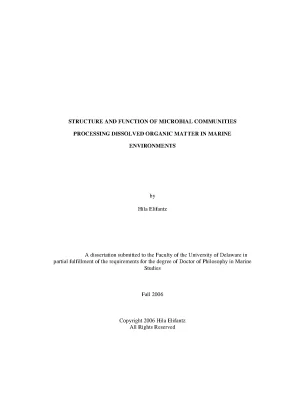
Tải xuống để đọc toàn bộSTRUCTURE AND FUNCTION OF MICROBIAL COMMUNITIES PROCESSING DISSOLVED ORGANIC MATTER IN MARINE ENVIRONMENTS by Hila Elifantz A dissertation submitted to the Faculty of the University of Delaware in partial fulfillment of the requirements for the degree of Doctor of Philosophy in Marine Studies Fall 2006 Copyright 2006 Hila Elifantz All Rights Reserved UMI Number: 3247689 UMI Microform 3247689 Copyright 2007 by ProQuest Information and Learning Company. All rights reserved. This microform edition is protected against unauthorized copying under Title 17, United States Code. ProQuest Information and Learning Company 300 North Zeeb Road P.
Box 1346 Ann Arbor, MI 48106-1346 STRUCTURE AND FUNCTION OF MICROBIAL COMMUNITIES PROCESSING DISSOLVED ORGANIC MATTER IN MARINE ENVIRONMENTS by Hila Elifantz Approved: __________________________________________________________ Nancy M. Dean of the College of Marine and Earth Studies Approved: __________________________________________________________ Daniel Rich, Ph. Provost I certify that I have read this dissertation and that in my opinion it meets the academic and professional standard required by the University as a dissertation for the degree of Doctor of Philosophy. Professor in charge of dissertation I certify that I have read this dissertation and that in my opinion it meets the academic and professional standard required by the University as a dissertation for the degree of Doctor of Philosophy.
Member of dissertation committee I certify that I have read this dissertation and that in my opinion it meets the academic and professional standard required by the University as a dissertation for the degree of Doctor of Philosophy. Signed: __________________________________________________________ Thomas Hanson, Ph. Member of dissertation committee I certify that I have read this dissertation and that in my opinion it meets the academic and professional standard required by the University as a dissertation for the degree of Doctor of Philosophy. Member of dissertation committee ACKNOWLEDGMENTS I would like to thank my advisor David Kirchman, for guiding me in the marine microbial world and for his patience with my writing.
My committee; David Hutchins, Thomas Hanson, and Byron Crump for their constructive suggestions regarding my research and my manuscripts along the way. I would also like to thank Steve Wilhelm from the University of Tennessee for the chlorophyll data. I would like to thank the members of Kirchman lab. Liying Yu , Lisa Waidner, Rex Malmstrom, Paul Jones, Vanessa Michelou, Barbara Campbell, Matthew Cottrell, Tiffany Straza, Glen Christman, Dawn Castle and Katie Preen.
All were very helpful in collecting samples, lab work, and in discussing ideas for this study and the results that came out of it. I would like to thank Coren Milbury, Robin Varney, and Nathan Campbell for accommodating my samples on the sequencer. Also thank to the people in Marsh, Warner, Targett, Cary, Sharp, and Hanson labs for letting me use various instruments in their labs. Thanks also for the CMES stuff, especially Peggy Conlon, Paul Dumigan, Lisa Perelly, Doris Manship, Susan Wedeman, Thanks for all my friends in CMS for making the time here enjoyable.
Special thanks to Elif Demir, Karen Pelletreau, Tracy Szela, Rick and Linda Rouf for their support throughout and especially at the end when it seemed that I will never finish. Finally, thank you my friends and family in Israel, for your support from far and the patience. iv TABLE OF CONTENTS LIST OF TABLES………………………………………………………………. vii LIST OF FIGURES…………………………………………………………….
ASSIMILATION OF POLYSACCHARIDES AND GLUCOSE BY MAJOR BACTERIAL GROUPS IN THE DELWARE ESTUARY……………… 13 Abstract…………………………………………………………………. 14 Materials and Methods…………………………………………………. 16 Preparation of 3H-EPS……………………………………. 16 Sample collection and preparation………………………….
17 FISH and microautoradiography analysis………………………. 17 Results…………………………………………………………………… 19 Dominant bacterioplankton groups assimilating glucose and EPS……………………………………………………. 19 Relationships between abundance and DOM assimilation……… 21 The importance of EPS and glucose assimilation to a phylogenetic group…………………………………………. 22 Cell volumes of active and inactive bacteria……………….
DISSOLVED ORGANIC MATTER ASSIMILATION BY HETEROTROPHIC BACTERIAL GROUPS IN THE WESTERN ARCTIC OCEAN………………………………………………………… 41 Abstract…………………………………………………………………. 41 Introduction……………………………………………………………… 42 v Materials and Methods…………………………………………………. 45 Sample collection and uptake of 3H-DOM……………………… 45 FISH and microautoradiography analysis………………………. 47 Results…………………………………………………………………… 47 Abundance of bacterial groups………………………………….
47 Fraction of cells assimilating DOM components………………. 48 Fraction of phylogenetic groups assimilating DOM components. 49 Contribution of phylogenetic groups to DOM uptake…………. 50 Relationships between abundance and DOM assimilation……… 52 Discussion……………………………………………………………….
DIVERSITY AND ABUNDANCE OF GLYCOSYL HYDROLASES FAMILY 5 IN THE NORTH ATLANTIC OCEAN……………………. 70 Introduction……………………………………………………………… 71 Materials and Methods…………………………………………………. 75 PCR primers design……………………………………………. 75 GH5 libraries construction……………………………………….
76 GH5 libraries sequencing………………………………………. 79 Results…………………………………………………………………… 80 Degenerate GH5 primer design…………………………………. 80 Diversity analysis of GH5 clone libraries …………………. 81 Abundance of GH5 in the North Atlantic Ocean……………….
114 vi LIST OF TABLES Table 2.1 Averaged cell volumes of EPS assimilating and non- assimilating bacterial cells……………………………………… 33 Table 2.2 Averaged cell volumes of glucose assimilating and non- assimilating bacterial cells……………………………………….1 Relative abundance of bacteria and major groups in the Western Arctic Ocean……………………………………….1 GH5 clusters as classified by amino acids similarity…………… 98 Table 4.2 Accession numbers of sequences used in Figure 4.3 Sub-groups of cloned GH5 from the MAB and SAR libraries as appeared in the GH5 gene tree (Figure 4. 100 vii LIST OF FIGURES Figure 2.1 Percent cell contributing to DOM assimilation verses percent silver grain area around these cells in each phylogenetic group………………………………………… 35 Figure 2.2 Composition of bacterial communities assimilating A) glucose and B) EPS in the Delaware Estuary………….3 SAR11 clade abundance and contribution to glucose and EPS assimilation in the Delaware Estuary…………….4 Contribution of phylogenetic groups to A) glucose and B) EPS assimilation as a function of group abundance…….5 Fraction of bacteria in group assimilating glucose vs. the fraction of bacteria in group assimilating EPS………….6 Relative abundance of each bacterial group as a function of the fraction of bacteria in phylogenetic group assimilating A) glucose and B) EPS ….1 Sampling sites in the Western Arctic Ocean……………… 64 Figure 3.2 Fraction of all assimilating cells as a function of exposure time to photographic emulsion…………………………….3 Fraction of bacteria in group that assimilated DOM. A) Cytophaga-like bacteria; B) Alpha-proteobacteria; C) Gamma-proteobacteria…………………………………….4 A) Average percent assimilation of DOM by bacterial group as a function of location.
B) Total number of cells in bacterial groups in summer 2004………………………….5 The contribution to DOM assimilation by specific bacterial groups……………………………………………………… 68 Figure 3.6 DOM assimilation as a function of bacterial group's abundance………………………………………………….1 Sampling location along the North Atlantic Ocean……….2 Phylogenetic tree of glycosyl hydrolases family 5……… 102 Figure 4.3 Number of operational taxonomic units as a function of number of clones at 97% similarity. A) Nucleic acids; B) Amino acids……………………………………………….4 Neighbor-joining GH5-like gene tree…………………….5 Percent of clones in each GH5 library that were grouped in the same operational taxonomic unit with sequences from the SSMMC……………………………………………….6 Alignment of the amino acid sequence of CelZ from Erwinia chrysanthemi and the GH5 consensus from MAB and SAR libraries………………………………………….7 Abundance of GH5 genes and chlorophyll concentration along a transect in the North Atlantic Ocean……………… 107 Figure 4.8 Abundance of GH5 genes and chlorophyll concentration in a depth profile from the Sargasso Sea……………………. 108 ix ABSTRACT Heterotrophic bacteria are important participants in the global carbon cycle as they process about 50% of the fixed carbon in the oceans. Since the amount of primary production in the ocean is equal to that in terrestrial environments, the need to understand these processes is obvious.
Various measurements are used to assess the amount of carbon that is processed through bacteria, including bacterial production, bacterial respiration, dissolved organic matter (DOM) concentrations and fluxes. However, none of these methods reveal which bacterial groups use specific compounds in the DOM pool. The aim of this dissertation was to address some of these issues. Microautoradiography combined with fluorescence in situ hybridization (Micro- FISH) was used to evaluate which bacterial groups assimilate common DOM components, and whether this assimilation can be related to other environmental factors.
In the Delaware Estuary the assimilation of glucose and extracellular polymeric substances (EPS) was dominated by the abundant bacterial groups. In the freshwater end of the estuary Actinobacteria and Betaproteobacteria were the dominant groups, while in the saline part of the estuary Alphaproteobacteria and Cytophaga-like bacteria contributed the most to DOM uptake. Only 35-50% of the assimilation could be explained by bacterial group abundance. In addition, groups that x had more assimilating cells were not necessarily more abundant.
Therefore, it seems that the bacterial community in the Delaware Estuary might be affected equally by "bottom- up" (DOM availability) and "top-down" (predation and viral lysis) factors. In contrast, the oligotrophic environment of the Western Arctic Ocean displayed a different pattern. Most of the assimilation (90-99%) could be explained by abundance in the Arctic Ocean. These data suggest that the microbial community in this environment is mostly controlled by DOM availability.
Perhaps the most interesting observation of this study was the level of activity detected in the Arctic environment. Up to 50% of all prokaryotes assimilated amino acids, followed by EPS and proteins. Glucose, however, was the least assimilated compound. The contribution to assimilation of DOM was different among the bacterial groups.
The contribution to DOM assimilation by Cytophaga-like bacteria decreased between the Chukchi Sea shelf and the Canada Basin. In contrast, Alphaproteobacteria contributed the most in the slope region. This group also contributed more to the assimilation of low molecular weight (LMW) DOM, while Cytophaga-like bacteria contributed more to the assimilation of high molecular weight (HMW) DOM. The last part of this dissertation dealt with the molecular mechanism of the degradation of polysaccharides, which is an important part of the labile DOM pool in the marine environment.
The Carbohydrate-Active enZymes (CAZy) and the Sargasso Sea whole-shotgun databases were searched for the common endoglucanases in the marine environment. One sub-group of glycosyl hydrolases, family 5 (GH5), was identified as a potential important enzyme in the marine environment. Two GH5 gene-libraries were xi constructed from the Mid-Atlantic Bight and the Sargasso Sea. The two libraries were different from each other.
The sequences in these libraries were also different from sequences known from cultured bacteria. Translation of the amplified fragment indicated that the important residues for activity are present, and therefore these are potentially active endoglucanases. GH5 abundance in surface water of the North Atlantic, as measured with quantitative PCR (Q-PCR), fluctuated between 10 copies to 200 copies per nanogram DNA. The abundance of GH5 correlated to chlorophyll concentrations in the eastern part of the sampled region and in one depth profile.
The current study added to the growing information regarding the composition of bacterial community in aquatic environments and the role of specific bacterial groups in DOM assimilation. In particular, this study was the first to unfold the relation between structure and function of the bacterial community in the Arctic Ocean, the only cold environment studied in that aspect to date. The molecular study of GH5 revealed the potential of the community for polysaccharides degradation, however, more need to be done to broaden our understanding of the mineralization of these compounds in the marine environment. xii Chapter 1 INTRODUCTION Due to their sheer size, the oceans are responsible for half of global biological carbon fixation (C), estimated at 2.1 Gt annually (Field et al.
This fixed carbon is only a small fraction compared to the global oceanic dissolved organic carbon (DOC) pool, about 685 Gt C, which is similar in size to the atmospheric CO2 pool (Hansell and Carlson 1998). While it seems that there is a balance between the oceans and the atmosphere, it is yet unclear how the rising concentration of CO2 in the atmosphere will affect this balance, and how the ocean C cycle affects this process. The fixed C in the oceans can be either decomposed through the microbial loop, transferred to higher trophic levels via the food chain, or transported into the ocean interior via particulate organic mater (POM) and zooplankton migration (Azam 1998; Carlson 2002; Ducklow et al. In addition to the microbial loop, the other process considered to be important is the carbon biological pump, which sequesters carbon into the seafloor and out of the global cycle.
However, the microbial loop is not separated from the rest of the food web, as bacteria can be grazed upon by microzooplankon (Sherr et al.
Nội dung được bảo vệ bản quyền — Tải xuống đầy đủ
Trích dẫn luận án này
Hila Elifantz (2006). Cộng đồng vi sinh vật xử lý chất hữu cơ hòa tan trong biển [Luận án tiến sĩ, University of Delaware]. LuanAn.net. https://luanan.net/sinh-hoc/vi-sinh-vat-hoc/cong-dong-vi-sinh-vat-xu-ly-chat-huu-co-hoa-tan-bien
Câu hỏi thường gặp
Luận án "Cộng đồng vi sinh vật xử lý chất hữu cơ hòa tan trong biển" nghiên cứu về vấn đề gì?
Luận án tiến sĩ nghiên cứu cấu trúc và chức năng cộng đồng vi sinh vật xử lý chất hữu cơ hòa tan biển. Phân tích vai trò các nhóm vi khuẩn trong chu trình carbon biển.
Luận án "Cộng đồng vi sinh vật xử lý chất hữu cơ hòa tan trong biển" được bảo vệ tại trường nào?
Luận án này được bảo vệ tại University of Delaware. Năm bảo vệ: 2006.
Luận án "Cộng đồng vi sinh vật xử lý chất hữu cơ hòa tan trong biển" thuộc chuyên ngành gì?
Luận án "Cộng đồng vi sinh vật xử lý chất hữu cơ hòa tan trong biển" thuộc chuyên ngành Marine Studies. Danh mục: Vi Sinh Vật Học.
Luận án "Cộng đồng vi sinh vật xử lý chất hữu cơ hòa tan trong biển" có bao nhiêu trang?
Luận án "Cộng đồng vi sinh vật xử lý chất hữu cơ hòa tan trong biển" có 128 trang. Bạn có thể xem trước một phần tài liệu ngay trên trang web trước khi tải về.
Cách tải luận án "Cộng đồng vi sinh vật xử lý chất hữu cơ hòa tan trong biển" về máy như thế nào?
Để tải luận án về máy, bạn nhấn nút "Tải xuống ngay" trên trang này, sau đó hoàn tất thanh toán phí lưu trữ. File sẽ được tải xuống ngay sau khi thanh toán thành công. Hỗ trợ qua Zalo: 0559 297 239.