Biosynthetic Chemistry of Marine Actinomycete Bacteria - A PhD Dissertation by Charles Bradford Larson, University of California San Diego
Khám phá hóa sinh vi sinh vật biển: Hóa tổng hợp từ vi khuẩn Actinomycete. Nghiên cứu chuyên sâu về cơ chế sinh học phân tử.
University of California San Diego
Biomedical Sciences
Luan An
Luận án tiến sĩ
Năm xuất bản
Số trang
246
Thời gian đọc
37 phút
Lượt xem
0
Lượt tải
0
Phí lưu trữ
50 Point
Tổng quan nhanh
- Chủ đề:
- 1. Marine actinobacteria và nguồn marine natural products
- Số trang:
- 246 trang
- Trường:
- University of California San Diego
- Chuyên ngành:
- Biomedical Sciences
- Tác giả:
- Charles Bradford Larson
- Năm:
- 2019
Tóm tắt nội dung luận án
I. Marine actinobacteria và nguồn marine natural products
Marine actinobacteria là nguồn tài nguyên phong phú cho các hợp chất tự nhiên biển. Môi trường đại dương khắc nghiệt tạo ra sự đa dạng hóa học độc đáo. Áp suất cao, nồng độ muối lớn và nhiệt độ thấp kích hoạt quá trình trao đổi chất thứ cấp đặc biệt. Các vi khuẩn actinomycetes biển sản sinh ra nhiều phân tử có hoạt tính sinh học mạnh mẽ. Hóa học sinh tổng hợp liên kết mã di truyền vi sinh vật với cấu trúc hóa học phức tạp. Nghiên cứu tập trung vào việc khai thác kho dược liệu tự nhiên quý giá này. Các hợp chất phân lập từ vi khuẩn biển mở ra hướng điều trị mới cho nhiều bệnh lý phức tạp. Kháng sinh, thuốc chống ung thư và chất kháng viêm là những ví dụ tiêu biểu. Việc khám phá không gian hóa học biển tiếp tục phát triển nhanh chóng nhờ các phương pháp phân tích hiện đại.
1.1. Nguồn gốc và giá trị dược liệu của marine natural products
Marine natural products giữ vị trí then chốt trong lịch sử y học cổ truyền và hiện đại. Y học cổ truyền từng dựa vào thảo mộc tự nhiên. Kỷ nguyên vàng của thuốc kháng sinh bùng nổ nhờ vi sinh vật đất. Ngày nay, sự chú ý hướng về đại dương. Biển chiếm hơn 70% bề mặt Trái Đất. Hệ sinh thái biển lưu giữ nguồn đa dạng sinh học khổng lồ. Các sinh vật biển phát triển các hợp chất tự nhiên để tự vệ và cạnh tranh sinh tồn. Những phân tử này có cấu trúc hóa học phức tạp và hoạt tính chọn lọc cao. Chúng cung cấp các tiền chất dược phẩm quan trọng. Nhiều loại thuốc chống ung thư hiện nay có nguồn gốc trực tiếp từ vi sinh vật biển.
1.2. Đặc tính phân loại và sinh thái của marine actinobacteria
Marine actinobacteria chiếm ưu thế lớn trong hệ vi sinh vật trầm tích biển sâu. Các chi như Salinispora và Streptomyces thích nghi hoàn hảo với điều kiện sống mặn. Bộ gen của chúng chứa nhiều cụm gen sinh tổng hợp chuyên biệt. Cấu trúc thành tế bào và hệ thống vận chuyển ion giúp chúng tồn tại dưới áp suất cao. Sự thích nghi sinh thái này định hình con đường sinh tổng hợp hóa học độc đáo. Vi khuẩn biển tổng hợp các chất trao đổi chất có halogen hóa hoặc liên kết peptide bất thường. Khả năng cạnh tranh sinh thái thúc đẩy vi khuẩn tiết ra các chất ức chế vi sinh vật xung quanh. Đây chính là nguồn cung cấp dồi dào các chất kháng sinh tiềm năng.
1.3. Khai thác hệ thống chiết xuất hóa học đa dạng sinh học
Việc tối ưu hóa môi trường nuôi cấy giúp kích hoạt các con đường sinh tổng hợp thầm lặng. Thử nghiệm trên 146 chủng vi khuẩn cho thấy sự biến đổi lớn về thành phần hóa học khi thay đổi cơ chất. Dung môi chiết xuất như ethyl acetate hay butanol ảnh hưởng trực tiếp đến hiệu suất thu hồi sản phẩm tự nhiên. Pha lỏng và pha rắn của môi trường nuôi cấy tạo ra các phân tử khác biệt. Phân tích phổ khối MS/MS phân giải cao hỗ trợ phát hiện các chất chuyển hóa mới trong dịch chiết thô. Tối ưu hóa quy trình nuôi cấy rút ngắn thời gian phân lập các hợp chất quý.
II. Khảo sát genome mining và biosynthetic gene clusters BGCs
Công nghệ giải trình tự DNA thế hệ mới đã cách mạng hóa ngành hóa sinh tự nhiên. Phương pháp genome mining cho phép tìm kiếm trực tiếp các biosynthetic gene clusters (BGCs) trên bộ gen. Vi khuẩn biển sở hữu nhiều cụm gen chưa từng được biểu hiện trong điều kiện phòng thí nghiệm. Việc giải mã trình tự toàn bộ bộ gen làm sáng tỏ tiềm năng sinh học bị ẩn giấu. Các thuật toán sinh tin học giúp dự đoán chính xác cấu trúc hóa học từ dữ liệu gen. Phương pháp tiếp cận từ gen đến phân tử thay thế phương pháp sàng lọc truyền thống. Nghiên cứu tập trung giải mã mối liên hệ giữa các gen tổng hợp và sản phẩm chuyển hóa cuối cùng.
2.1. Chiến lược genome mining trong kỷ nguyên giải trình tự DNA
Genome mining là công cụ chủ lực trong khám phá dược chất từ vi sinh vật. Công nghệ giải trình tự toàn bộ bộ gen cung cấp cơ sở dữ liệu di truyền khổng lồ. Phần mềm sinh tin học quét qua hàng triệu cặp base để phát hiện các trình tự bảo thủ. Các motif đặc trưng của enzyme giúp định vị chính xác vị trí cụm gen. Kỹ thuật này giúp phân loại nhanh chóng các chủng vi khuẩn có tiềm năng cao. Các con đường sinh tổng hợp mới được phát hiện trước khi tiến hành nuôi cấy. Việc này tiết kiệm đáng kể thời gian và chi phí nghiên cứu trong phòng thí nghiệm.
2.2. Nhận diện Biosynthetic gene clusters BGCs tiềm năng
Biosynthetic gene clusters (BGCs) chứa toàn bộ các gen cần thiết để tổng hợp một phân tử hoàn chỉnh. Cụm gen bao gồm gen mã hóa enzyme xúc tác, gen điều hòa và gen kháng tự thân. Phân tích BGCs cho phép hiểu rõ từng bước lắp ráp khung carbon. Nhiều BGCs ở trạng thái im lặng khi nuôi cấy trong điều kiện tiêu chuẩn. Các nhà nghiên cứu sử dụng kỹ thuật kích hoạt gen hoặc thay đổi chất cảm ứng để đánh thức chúng. Sự đa dạng của BGCs phản ánh sự phong phú của các hợp chất tự nhiên biển.
2.3. Phương pháp mạng phân tử Molecular Networking phân loại dịch chiết
Mạng phân tử Molecular Networking liên kết dữ liệu phổ khối song song MS/MS thành các cụm cấu trúc tương đồng. Phương pháp này nhóm các phân tử có cùng cơ chế phân mảnh ion. Nhà nghiên cứu dễ dàng nhận diện các dẫn xuất mới của các hợp chất đã biết. Sự kết hợp giữa Molecular Networking và genome mining tạo ra bước đột phá. Kỹ thuật này giúp phát hiện nhanh các họ hóa chất chưa từng được mô tả. Việc lập bản đồ phân tử định hướng chính xác quá trình tinh sạch và xác định cấu trúc sản phẩm tự nhiên.
III. Cơ chế enzyme PKS và NRPS tạo các secondary metabolites
Sự sinh tổng hợp các secondary metabolites trong vi khuẩn biển phụ thuộc vào các phức hợp enzyme khổng lồ. Polyketide synthases (PKS) và Non-ribosomal peptide synthetases (NRPS) là hai hệ thống enzyme chủ đạo. Chúng hoạt động như những dây chuyền lắp ráp sinh học chính xác. Khung phân tử được xây dựng từ các đơn vị tiền chất đơn giản như acyl-CoA hoặc axit amin. Các module enzyme thực hiện nối dài chuỗi và biến đổi hóa học liên tục. Sự phối hợp giữa PKS và NRPS tạo nên các hợp chất lai có cấu trúc tinh vi. Hiểu rõ cơ chế xúc tác enzyme mở ra khả năng kỹ thuật hóa sinh tổng hợp để tạo ra dược chất mới.
3.1. Phức hợp Polyketide synthases PKS và cấu trúc phân tử
Hệ enzyme Polyketide synthases (PKS) chịu trách nhiệm tổng hợp các chuỗi polyketide đa dạng. PKS loại I bao gồm các module đa chức năng sắp xếp tuần tự. Mỗi module chứa miền acyltransferase (AT), ketosynthase (KS) và acyl carrier protein (ACP). Miền ketoreductase (KR), dehydratase (DH) và enoylreductase (ER) quyết định mức độ khử hóa của khung carbon. Sự sắp xếp tuần tự của các miền enzyme quyết định cấu trúc hóa học của sản phẩm. PKS loại II và III tạo ra các phân tử thơm hoặc các chuỗi lipid đặc biệt. Các chất chuyển hóa này thường có hoạt tính kháng khuẩn và kháng ung thư mạnh mẽ.
3.2. Vai trò Non ribosomal peptide synthetases NRPS sinh tổng hợp
Non-ribosomal peptide synthetases (NRPS) xúc tác tổng hợp các chuỗi peptide mà không cần khuôn mẫu mARN hay ribosome. Hệ enzyme NRPS có cấu trúc module độc lập. Mỗi module chứa miền adenylation (A) để nhận diện và kích hoạt axit amin đặc hiệu. Miền peptidyl carrier protein (PCP) giữ chuỗi peptide đang phát triển. Miền condensation (C) tạo liên kết peptide giữa các đơn vị liên tiếp. NRPS có khả năng kết hợp cả các axit amin phi protein và axit amin dạng D. Điều này tạo ra tính đa dạng hóa học và độ bền sinh học cao cho các phân tử thuốc peptide.
3.3. Con đường sinh tổng hợp các secondary metabolites biển
Secondary metabolites đóng vai trò quan trọng trong giao tiếp hóa học và bảo vệ tế bào vi khuẩn. Các con đường sinh tổng hợp tích hợp nhiều enzyme biến đổi sau lắp ráp. Quá trình methyl hóa, oxy hóa, glycosyl hóa và halogen hóa hoàn thiện cấu trúc phân tử. Sự hiện diện của các nguyên tử clo hoặc brom từ nước biển tạo nên tính chất dược lý đặc thù. Các chất chuyển hóa thứ cấp này thể hiện hoạt tính sinh học chọn lọc cao đối với các đích phân tử ở người. Chúng là nguồn cảm hứng lớn cho ngành hóa dược tổng hợp và phát triển thuốc.
IV. Streptomyces secondary metabolism và Salinispora tropica
Chi Streptomyces và Salinispora là những đại diện tiêu biểu nhất cho vi khuẩn actinomycetes biển. Quá trình Streptomyces secondary metabolism nổi tiếng với khả năng sản xuất phần lớn kháng sinh lâm sàng. Trong khi đó, loài Salinispora tropica là vi khuẩn bắt buộc sống trong môi trường biển đầu tiên được phân lập. Bộ gen của Salinispora tropica dành phần lớn dung lượng cho các con đường sinh tổng hợp. Sự trao đổi chất của các loài này tạo ra nhiều hợp chất có cấu trúc độc nhất vô nhị. Nghiên cứu sinh tổng hợp ở các chủng này cung cấp mô hình hoàn hảo để giải mã các cơ chế enzyme phức tạp.
4.1. Đặc trưng trao đổi chất Streptomyces secondary metabolism
Streptomyces secondary metabolism biểu hiện sự đa dạng di truyền vượt trội so với các vi khuẩn khác. Một chủng Streptomyces biển thường chứa từ 20 đến 40 cụm gen sinh tổng hợp khác nhau. Quá trình trao đổi chất thứ cấp được kiểm soát chặt chẽ bởi mạng lưới điều hòa tín hiệu. Khi nguồn dinh dưỡng cạn kiệt, vi khuẩn chuyển sang giai đoạn sinh sản và tiết ra các chất kháng sinh. Các anthracycline như cosmomycin C và D là ví dụ điển hình về chất chuyển hóa từ Streptomyces. Chúng thể hiện hoạt tính ức chế mạnh tế bào khối u thông qua cơ chế xen phủ DNA.
4.2. Khám phá hoạt chất tiềm năng từ chi Salinispora tropica
Salinispora tropica là nguồn cung cấp nhiều hợp chất tự nhiên biển có giá trị y học đặc biệt. Bộ gen nhỏ gọn của loài này chứa mật độ BGCs cao chưa từng thấy. Vi khuẩn này tổng hợp các phân tử phức tạp như macrolide, polyketide và hợp chất chứa dị vòng. Điều kiện nước biển tự nhiên là yếu tố bắt buộc cho sự phát triển và trao đổi chất của vi khuẩn. Khả năng biến đổi trao đổi chất của Salinispora tropica mở ra cơ hội khai thác nhiều hoạt chất mới. Các nghiên cứu sâu về loài này đã thiết lập tiêu chuẩn mới cho sinh học biển.
4.3. Biểu hiện cụm gen phosphonate ở chủng Salinispora pacifica
Loài Salinispora pacifica sở hữu cụm gen sinh tổng hợp phosphonate độc đáo mang enzyme phosphoenolpyruvate phosphomutase (PepM). Con đường này liên quan đến chu trình photpho trong đại dương. Cụm gen tham gia vào quá trình phân hủy và chuyển hóa các hợp chất phosphonate nhân tạo như glyphosate. Việc phân lập và biểu hiện dị loại các enzyme PepM và N-acetyltransferase giúp làm rõ cơ chế chuyển hóa này. Nghiên cứu này chứng minh khả năng thích ứng trao đổi chất linh hoạt của vi khuẩn biển trước các biến đổi môi trường sống.
V. Tối ưu sinh tổng hợp và phát triển Salinosporamide A mới
Salinosporamide A là một trong những thành tựu nổi bật nhất của hóa sinh vi khuẩn biển. Phân tử này là chất ức chế proteasome 20S mạnh mẽ được phát hiện từ Salinispora tropica. Cấu trúc beta-lactone độc đáo gắn liền với chuỗi chloroethyl mang lại hoạt tính sinh học vượt trội. Hoạt chất này đã bước vào các thử nghiệm lâm sàng điều trị đa u tủy xương và ung thư não. Việc tối ưu hóa sinh tổng hợp và biểu hiện gen giúp vượt qua rào cản về sản lượng thấp trong nuôi cấy tự nhiên. Công nghệ sinh học hiện đại đang mở đường cho việc sản xuất quy mô lớn các dược chất biển phức tạp này.
5.1. Cơ chế ức chế proteasome của hoạt chất Salinosporamide A
Salinosporamide A (marizomib) ức chế không hồi phục phức hợp proteasome 20S của tế bào ung thư. Phân tử này gắn đồng hóa trị vào vị trí threonine hoạt động của proteasome. Nhóm chloroethyl đóng vai trò then chốt trong việc tạo vòng tetrahydrofuran thứ hai và khóa chặt enzyme. Khả năng vượt qua hàng rào máu não giúp hoạt chất này điều trị hiệu quả u nguyên bào thần kinh đệm. Tính chọn lọc cao và độc tính thấp hơn so với các thuốc ức chế proteasome thế hệ trước tạo nên lợi thế vượt trội. Đây là minh chứng rõ nét cho giá trị ứng dụng y học của vi khuẩn biển.
5.2. Công nghệ TAR cloning thu nhận cụm gen sinh học trọn vẹn
Công nghệ Transformation-Associated Recombination (TAR) cloning trong nấm men cho phép thu nhận trực tiếp các BGCs kích thước lớn. Phương pháp này không phụ thuộc vào PCR truyền thống, tránh hiện tượng đột biến trình tự. Vector bẫy tái tổ hợp được thiết kế với các đoạn tương đồng đặc hiệu với hai đầu của cụm gen mục tiêu. Quá trình tái tổ hợp đồng đẳng tự nhiên trong nấm men Saccharomyces cerevisiae lắp ráp chính xác cụm gen mong muốn. Kỹ thuật này đã bắt giữ thành công toàn bộ cụm gen cosmomycin từ Streptomyces biển để phục vụ nghiên cứu chức năng.
5.3. Biểu hiện dị loại heterologous expression trong vật chủ mới
Biểu hiện dị loại (heterologous expression) giải quyết bài toán biểu hiện các cụm gen im lặng từ vi khuẩn biển khó nuôi cấy. Cụm gen hoàn chỉnh sau khi thu nhận bằng TAR cloning được chuyển vào các vật chủ biểu hiện như Streptomyces coelicolor hoặc Streptomyces albus. Vật chủ mới cung cấp nguồn tiền chất dồi dào và hệ thống phiên mã tương thích. Kỹ thuật này giúp sản xuất ổn định các dẫn xuất phân tử mới với hiệu suất cao. Biểu hiện dị loại kết hợp sinh học tổng hợp tạo tiền đề công nghiệp hóa việc sản xuất dược phẩm tự nhiên.
Mục lục chi tiết luận án
Tải xuống file đầy đủ để xem toàn bộ nội dung
Tải đầy đủ (246 trang)Trích đoạn nội dung luận án
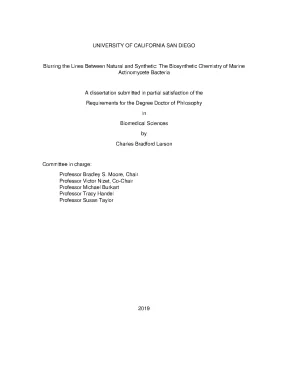
Tải xuống để đọc toàn bộUNIVERSITY OF CALIFORNIA SAN DIEGO Blurring the Lines Between Natural and Synthetic: The Biosynthetic Chemistry of Marine Actinomycete Bacteria A dissertation submitted in partial satisfaction of the Requirements for the Degree Doctor of Philosophy in Biomedical Sciences by Charles Bradford Larson Committee in charge: Professor Bradley S. Moore, Chair Professor Victor Nizet, Co-Chair Professor Michael Burkart Professor Tracy Handel Professor Susan Taylor 2019 The dissertation of Charles Bradford Larson is approved, and it is acceptable in quality and form for publication on microfilm and electronically: Co-Chair Chair University of California San Diego 2019 iii Dedication In loving memory of William Larson iv Table of Contents Signature Page. iv Table of Contents. v List of Figures.
viii List of Tables. xiv Abstract of the Dissertation. xvi Chapter 1: Introduction to the Dissertation.1 Natural Products as Traditional Medicines………….2 Microbial Natural Products………………………………………………….3 Technological Advancements in Analytical Chemistry During the Golden Age………………………………………………………………………….4 Marine Natural Products………………………………………………………….5 Actinomycetes Contribution to the Natural Products Pharmacopeia…….6 Natural Products Biosynthesis: Connecting Genes to Molecules………….7 DNA Sequencing and Natural Products Biosynthesis……………………….8 High Throughput and Whole Genome Sequencing Reveals Huge Biosynthetic Potential………………………………………………………………… 18 1.9 Heterologous Expression of Natural Products……………………………….10 Opportunities in Modern Natural Products Discovery and Overview of Dissertation Chapters.11 References for Chapter 1. 24 Chapter 2: Prioritizing Natural Product Diversity in a Collection of 146 Bacterial Strains Based on Growth and Extraction Protocols……………………….1 Introduction to Chapter 2.2 Chapter 2 Introduction References.3 Reprint of “: Prioritizing Natural Product Diversity in a Collection of 146 Bacterial Strains Based on Growth and Extraction Protocols”.
39 Chapter 3: PCR-Independent Method of Transformation-Associated Recombination Reveals the Cosmomycin Biosynthetic Gene Cluster in an Ocean Streptomycete……….1 Introduction to Chapter 3.2 Chapter 3 Introduction References.3 Reprint of “PCR-Independent Method of Transformation-Associated Recombination Reveals the Cosmomycin Biosynthetic Gene Cluster in an Ocean Streptomycete”.67 Chapter 4: Marine Actinobacteria Salinispora pacifica Biosynthetic Gene Cluster Produces Phosphonate Degradation Products of Glyphosate………………….1 Phosphorus in Nature and the Marine Phosphorus Cycle.2 Anthropogenic Phosphonate Contamination in the Environment.1 Identification of Salinispora PepM Sequences.2 Heterologous Expression of S. pacifica Phosphonate BGC.3 Purification of Compounds 1-3.4 Cloning and Expression of Phosphonate N-acetyltransferases.5 Distribution of PepM (SppJ) Homologs in the Marine Environment.2 Analysis of the distribution of PepM homologs.3 Cloning and Plasmid Assembly.5 Purification of Phosphonates Produced in Heterologous Host.6 NMR and MS/MS Analysis.7 Cloning and Purification of GNATs from Phosphonate Cluster.6 References for Chapter 4.130 vii List of Figures Figure 1.1: Bioactive chemicals from traditional plant medicines.2: Drugs from the Golden Age of natural products discovery.3: Marine Natural Products.1: Molecular network of all generated extracts.2: Effects of genus and species on molecular diversity-network analysis.3: Effects of additional attributes on molecular diversity-network analysis.4: Time-dependent changes in natural product distribution in Salinispora arenicola CNH-877, grown in ISP2.1: Molecular Network of All Streptomyces Extracts Color Coded By Culture Medium.2: Molecular Network of All Acquired Extracts Color Coded By Genus.3: Molecular Network of All Salinispora Extracts Color Coded By Species.4: Illustration of the major drivers of chemical speciation within the Salinispora data.5: Molecular Network of All Generated Extracts Color Coded by Extraction Solvent.6: Molecular Network of Salinispora Extracts from Different Media Phases.7: Comparison of MS/MS spectra of arenicolide A (upper spectrum, m/z: 827.489,) and a novel, formally hydrated arenicolide analogue (lower spectrum, m/z: 845.501) from the ethyl acetate extract of Salinispora pacifica CNT-138.8: Molecular Network of All Acquired Extracts Color Coded By Strain Location.9: Molecular Network of Salinispora arenicola CNH877 strains grown in four different liquid media and extracted at three different time points.1: A selection of anthracyclines approved for treatment of cancer.2: Capture vector assembly.3: Gene map of biosynthetic gene clusters associated with the biosynthesis of cosmomycins C and D.4: Cosmomycin cluster identified by molecular networking.1: PCR screening of multiple yeast colonies.73 viii Supplementary Figure S3.2: PCR screening of individual yeast colonies.3: Sequencing of integrated cosmomycin pathway.4 PCR amplification of integrated cosmomycin pathway.5: MS2 fragmentation analysis of cosmomycin C (1).6: MS2 fragmentation analysis of cosmomycin D (2).7: MS1 spectrum of cosmomycin analog 3.8: MS2 fragmentation analysis of cosmomycin analog 3.9: MS1 spectrum of cosmomycin analog A.10: MS2 fragmentation analysis of cosmomycin analog A.11: MS2 fragmentation analysis of cosmomycin analog B.12: 1H NMR spectrum of cosmomycin C (1).13: 1H NMR spectrum of A.14: Overlaid 1H NMR spectrum of 1 and A.15: HSQC spectrum of 1.16: HSQC NMR spectrum of A.17: COSY NMR spectrum of 1.18: Molecular network of cosmomycin native producers and heterologous host. CNT-302 molecular network.1: Depiction of a Salinispora colony, the S. pacifica BGC and its small molecule products.2: Biosynthetic scheme for P-C bond installation.3: Depiction of phosphonate BGCs.4: Crude preparation of heterologous host fermentation.5: 1H NMR spectra of both heterologous host and S.
coelicolor M1152 extracts purified by chromatography.6: Broad band decoupling of the NMR spectrum of the enriched fraction of heterologous host extracts reveals the influence of a phosphorus nucleus on three peaks.7: 1H/31P two-dimensional NMR spectrum (HMBC) of enriched preparation of heterologous host extracts.8: 1H NMR analysis of HILIC purified products of fermentation.9: MS/MS analysis of HILIC purified metabolites.10: 31P NMR analysis of heterologous host extracts spiked with synthetic phosphonate standards.11: MS analysis of GNAT enzyme assays with AMPA substrate.12: MS analysis of GNAT enzyme assays with 2-AEP substrate.13: Sequence Similarity Network of S. pacifica PepM homologs found in marine genomes and metagenomes.14: Putative biosynthetic pathway for the production of na-AMPA.1: Gel electrophoresis analysis of phosphonate BGC amplicons prior to assembly.2: Gel digest of assembled S. pacifica BGC in the pCAP03 plasmid.3: HRMS data for m/z=110, including molecular formula calculation.4: HRMS data for m/z=125, including molecular formula calculation.5: HRMS data for m/z=152, including molecular formula calculation.6: 1H NMR analysis of spiking experiments with naAMPA, AMPA, and 2-HEP synthetic standards.7: NMR Analysis of Crude Extract.8: Protein gel (10% acrylamide) of HisTrap purified GNAT enzymes.9: Amplification of small regions of the S. pacifica phosphonate BGC from genomic DNA isolated from the heterologous host.143 x List of Tables Supplementary Table S2.1: Overview of the bacterial strains used in this study.2: Overview of the compounds detected in this study.3: Information about detected staurosporine analogues in the ISP2 time course network.1: 1H NMR chemical shift assignments of compounds 1 and 4 and the related cosmomycin analogs obelmycin C4 and A447C/D.2: Comparison of Streptomyces sp.1: Genes in the Salinispora pacifica phosphonate BGC and their closest homolog determined by NCBI BLAST.2: Multiple Sequence Alignment of S.
pacifica phosphonate BGC GNATs and B. pacifica PepM homologs in marine genomes and metagenomes in the MAR DB database.4: Color coded legend for sequence similarity network.5: Primers used for the amplification of the S. pacifica phosphonate BGC and specific GNATs from the cluster.228 xi Acknowledgements Many thanks to my mentor Brad Moore, who offered me the opportunity to perform my doctoral studies in his laboratory and provided the support and mentorship necessary to complete my studies. His kind but rigorous and thorough instruction and mentorship has shaped me into a competent natural products chemist.
I would also like to thank my Co-Advisor, Victor Nizet, who offered to liaison with the BMS department which allowed me to work at the beautiful laboratory at the Scripps Institute of Oceanography I have called home for the last several years. Additionally, I would like to thank the wonderful natural products community at SIO. Members of the Jensen, Gerwick, Hughes, Fenical, and Allen laboratories provided an environment that encouraged curiosity, collaboration, and fun. Many thanks to the post-doctoral researchers who aided my progress through the years, including Dr.
Yuta Kudo, Dr. Shaun McKinnie, Dr. Hanna Luhavaya, Dr. Jonathan Chekan, Dr.
Ellis O’Neill, Dr. Peter Jordan, and Dr. I would also like to thank my family for their loving encouragement and support throughout my journey in science. Chapter 2, in full, is a reprint of materials as it appears in “Prioritizing Natural Product Diversity in a Collection of 146 Bacterial Strains Based on Growth and Extraction Protocols” in Journal of Natural Products, 2016, Max Crusman, Ellis C.
da Silva, Paul R. The dissertation author was a secondary investigator and author of this paper. Chapter 3, in full, is a reprint of materials as it appears in “PCR-Independent Method of Transformation-Associated Recombination Reveals the Cosmomycin xii Biosynthetic Gene Cluster in an Ocean Streptomycete” in Journal of Natural Products, 2017, Charles Bradford Larson, Max Crusman, Bradley S. The dissertation author was the primary investigator and author of this paper.
xiii Vita 2012-2019 Ph., University of California, San Diego 2006-2010 B., University of Michigan Publications 2019 O'Neill E. Targeted antibiotic discovery through biosynthesis-associated resistance determinants: target directed genome mining. Crit Rev Microbiol. PCR-independent Method of Transformation Associated Recombination Reveals the Cosmomycin Biosynthetic Gene Cluster in an Ocean Streptomycete.
Prioritizing Natural Product Diversity in a Collection of 146 Bacterial Strains Based on Growth and Extraction Protocols. 2016 Wang M, Carver JJ, Phelan VV, Sanchez LM, Garg N, Peng Y, Nguyen DD, Watrous J, Kapono CA, Luzzatto-Knaan T, Porto C, Bouslimani A, Melnik AV, Meehan MJ, Liu WT, Crüsemann M, Boudreau PD, Esquenazi E, Sandoval-Calderón M, Kersten RD, Pace LA, Quinn RA, Duncan KR, Hsu CC, Floros DJ, Gavilan RG, Kleigrewe K, Northen T, Dutton RJ, Parrot D, Carlson EE, Aigle B, Michelsen CF, Jelsbak L, Sohlenkamp C, Pevzner P, Edlund A, McLean J, Piel J, Murphy BT, Gerwick L, Liaw CC, Yang YL, Humpf HU, Maansson M, Keyzers RA, Sims AC, Johnson AR, Sidebottom AM, Sedio BE, Klitgaard A, Larson CB, P CAB, Torres-Mendoza D, Gonzalez DJ, Silva DB, Marques LM, Demarque DP, Pociute E, O'Neill EC, Briand E, Helfrich EJN, Granatosky EA, Glukhov E, Ryffel F, Houson H, Mohimani H, Kharbush JJ, Zeng Y, Vorholt JA, Kurita KL, Charusanti P, McPhail KL, Nielsen KF, Vuong L, Elfeki M, Traxler MF, Engene N, Koyama N, Vining OB, Baric R, Silva RR, Mascuch SJ, Tomasi S, Jenkins S, Macherla V, Hoffman T, Agarwal V, Williams PG, Dai J, Neupane R, Gurr J, Rodríguez AMC, Lamsa A, Zhang C, Dorrestein K, Duggan BM, Almaliti J, Allard PM, Phapale P, Nothias LF, Alexandrov T, Litaudon M, Wolfender JL, Kyle JE, Metz TO, Peryea T, Nguyen DT, VanLeer D, Shinn P, Jadhav A, Müller R, Waters KM, Shi W, Liu X, Zhang L, Knight R, Jensen PR, Palsson BO, Pogliano K, Linington RG, Gutiérrez M, Lopes NP, Gerwick WH, Moore BS, Dorrestein xiv PC, Bandeira N. Sharing and Community Curation of Mass Spectrometry Data with Global Natural Products Social Molecular Networking Nature Biotech. Characterization of Recombinant B.
abortus Strain RB51SOD towards Understanding the Uncorrelated Innate and Adaptive Immune Responses Induced by RB51SOD Compared to Its Parent Vaccine Strain RB51 (* co-first authors) Front. VIOLIN: Vaccine Investigation and Online Information Network Nucleic Acids Res. xv Abstract of the Dissertation Blurring the Lines Between Natural and Synthetic: The Biosynthetic Chemistry of Marine Actinomycete Bacteria by Charles Bradford Larson Doctor of Philosophy in Biomedical Sciences University of California San Diego, 2019 Professor Bradley S. Moore, Chair Professor Victor Nizet, Co-Chair Nature is the source of an incredible diversity of complex chemistry.
The wide variety of chemical scaffolds produced as secondary metabolites have been the source xvi of many useful medicinal therapies for the treatment of human disease, in addition to providing useful tools for probing biology. The biosynthetic machinery that produces these molecules is encoded in the genomes of organisms, and recent technological advancements in bioinformatics, DNA sequencing, and gene cloning and capture techniques offer researchers new opportunities for natural products discovery. When combined with modern analytical chemistry techniques, these methods are a powerful engine for compound discovery. The marine environment represents a unique well of biodiversity to investigate with this new methodology, with a unique evolutionary history ancient than terrestrial habitats.
Chapter 2 of this dissertation describes the in-depth analysis of a collection of 146 marine actinomycetes by mass spectrometry and molecular networking to investigate their biosynthetic capacity. These bacteria were cultured in a variety of media, and their extracts were used to generate approximately 1.8 million mass spectra.
Nội dung được bảo vệ bản quyền — Tải xuống đầy đủ
Trích dẫn luận án này
Charles Bradford Larson (2019). Biosynthetic Chemistry of Marine Actinomycete Bacteria [Luận án tiến sĩ, University of California San Diego]. LuanAn.net. https://luanan.net/sinh-hoc/vi-sinh-vat-hoc/biosynthetic-chemistry-marine-actinomycete-bacteria
Câu hỏi thường gặp
Luận án "Biosynthetic Chemistry of Marine Actinomycete Bacteria" nghiên cứu về vấn đề gì?
Khám phá hóa sinh vi sinh vật biển: Hóa tổng hợp từ vi khuẩn Actinomycete. Nghiên cứu chuyên sâu về cơ chế sinh học phân tử.
Luận án "Biosynthetic Chemistry of Marine Actinomycete Bacteria" được bảo vệ tại trường nào?
Luận án này được bảo vệ tại University of California San Diego. Năm bảo vệ: 2019.
Luận án "Biosynthetic Chemistry of Marine Actinomycete Bacteria" thuộc chuyên ngành gì?
Luận án "Biosynthetic Chemistry of Marine Actinomycete Bacteria" thuộc chuyên ngành Biomedical Sciences. Danh mục: Vi Sinh Vật Học.
Luận án "Biosynthetic Chemistry of Marine Actinomycete Bacteria" có bao nhiêu trang?
Luận án "Biosynthetic Chemistry of Marine Actinomycete Bacteria" có 246 trang. Bạn có thể xem trước một phần tài liệu ngay trên trang web trước khi tải về.
Cách tải luận án "Biosynthetic Chemistry of Marine Actinomycete Bacteria" về máy như thế nào?
Để tải luận án về máy, bạn nhấn nút "Tải xuống ngay" trên trang này, sau đó hoàn tất thanh toán phí lưu trữ. File sẽ được tải xuống ngay sau khi thanh toán thành công. Hỗ trợ qua Zalo: 0559 297 239.