Faculty Use of Collaborative Online International Learning (COIL) for Internationalization at Home - Sally Strand Mudiamu
Khám phá cách giảng viên sử dụng COIL để Quốc tế hóa tại Nhà, tăng cường hợp tác và trải nghiệm học tập toàn cầu ngay trong khuôn viên trường.
Educational Leadership: Postsecondary Education
Luan An
Luận án tiến sĩ
Năm xuất bản
Số trang
262
Thời gian đọc
40 phút
Lượt xem
0
Lượt tải
0
Phí lưu trữ
50 Point
Tổng quan nhanh
- Chủ đề:
- 1. Giải quyết khoảng trống toàn cầu: IaH & Chuẩn bị sinh viên
- Số trang:
- 262 trang
- Trường:
- Portland State University
- Chuyên ngành:
- Educational Leadership: Postsecondary Education
- Tác giả:
- Sally Strand Mudiamu
- Năm:
- 2020
Tóm tắt nội dung luận án
I. Giải quyết khoảng trống toàn cầu IaH Chuẩn bị sinh viên
Các trường đại học đang đối mặt với thách thức lớn. Họ chưa chuẩn bị đầy đủ sinh viên cho công việc và tư cách công dân toàn cầu thế kỷ 21. Quốc tế hóa chương trình giảng dạy là yếu tố then chốt cho sự chuẩn bị này. Nó đảm bảo sự công bằng trong giáo dục đại học. Trong nhiều thập kỷ, các tổ chức đã dựa vào hoạt động di chuyển sinh viên ra và vào. Mục tiêu là quốc tế hóa các tổ chức, chương trình giảng dạy, giảng viên và việc học của sinh viên. Phương pháp này có những hạn chế đáng kể.
1.1. Thách thức chuẩn bị sinh viên toàn cầu
Giáo dục hiện tại thường không trang bị đầy đủ kỹ năng toàn cầu. Sinh viên cần những kỹ năng này để thành công trong thế kỷ 21. Sự thiếu hụt này ảnh hưởng đến khả năng làm việc và đóng góp của họ trên phạm vi quốc tế. Quốc tế hóa chương trình giảng dạy giải quyết trực tiếp vấn đề này. Nó mang lại nền giáo dục có liên quan hơn cho tất cả sinh viên. Mục tiêu là tạo ra những công dân toàn cầu có năng lực.
1.2. Hạn chế của di chuyển sinh viên truyền thống
Chỉ một số ít sinh viên đi du học hoặc thực tập ở nước ngoài. Con số này chiếm khoảng 10% tổng số sinh viên. Rất ít sinh viên thuộc nhóm thiểu số, đủ điều kiện Pell hoặc sinh viên ngoài truyền thống tham gia. Điều này tạo ra một sự bất bình đẳng. Trải nghiệm quốc tế không thể tiếp cận được với tất cả mọi người. Các trường đại học cần một cách tiếp cận toàn diện hơn. Cách tiếp cận này phải đảm bảo công bằng cho trải nghiệm quốc tế hóa.
1.3. Sự cần thiết của quốc tế hóa tại nhà IaH
Các trường đại học phải thay đổi trọng tâm. Từ di chuyển sinh viên, chuyển sang Quốc tế hóa tại nhà (IaH). Điều này đảm bảo mọi sinh viên đều có trải nghiệm giáo dục quốc tế hóa. Trải nghiệm này là một phần trong chương trình học của họ. IaH cung cấp các cơ hội học tập toàn cầu. Nó không yêu cầu sinh viên rời khỏi khuôn viên trường. Điều này tạo ra một con đường công bằng hơn cho việc học tập quốc tế.
II. COIL Phương pháp đổi mới quốc tế hóa chương trình
Học tập quốc tế trực tuyến hợp tác (COIL) là một phương pháp sư phạm đột phá. Nó cung cấp một giải pháp cho việc quốc tế hóa giáo dục. COIL giúp sinh viên đạt được năng lực toàn cầu. Nó không yêu cầu di chuyển thể chất. Phương pháp này tạo ra các môi trường học tập phong phú. Sinh viên tham gia vào trao đổi ảo và hợp tác trực tuyến quốc tế. Điều này thúc đẩy sự phát triển của năng lực liên văn hóa. COIL là một đổi mới sư phạm quan trọng cho giáo dục đại học.
2.1. COIL Một cách tiếp cận sư phạm mới
COIL là một cách tiếp cận sư phạm tiên tiến. Nó sử dụng công nghệ để kết nối sinh viên trên toàn thế giới. Các khóa học COIL được thiết kế để tích hợp hợp tác quốc tế. Sinh viên tham gia vào các dự án chung. Điều này mang lại một chiều hướng toàn cầu cho chương trình giảng dạy. COIL tạo ra các trải nghiệm học tập chân thực và có ý nghĩa. Nó làm phong phú thêm kiến thức và kỹ năng của sinh viên.
2.2. Hợp tác trực tuyến quốc tế cho sinh viên
Hợp tác trực tuyến là cốt lõi của COIL. Sinh viên từ các trường đại học khác nhau làm việc cùng nhau. Họ thực hiện các nhiệm vụ và dự án chung. Điều này thúc đẩy giao tiếp xuyên văn hóa. Nó cũng phát triển các kỹ năng làm việc nhóm toàn cầu. Trao đổi ảo này tạo ra một lớp học không biên giới. Sinh viên tiếp xúc với các quan điểm và nền văn hóa đa dạng. COIL mở rộng phạm vi tiếp cận của giáo dục quốc tế.
2.3. Phát triển năng lực liên văn hóa qua COIL
Tham gia vào các khóa học COIL giúp sinh viên phát triển. Họ rèn luyện năng lực liên văn hóa và kỹ năng giao tiếp xuyên văn hóa. Sinh viên học cách điều hướng các bối cảnh văn hóa khác nhau. Họ hiểu và tôn trọng sự đa dạng. Điều này trang bị cho họ để thành công trong một thế giới ngày càng kết nối. COIL cung cấp một nền tảng thực tế để áp dụng các kỹ năng toàn cầu.
III. Vai trò của giảng viên trong triển khai COIL IaH
Giảng viên đóng vai trò trung tâm trong sự thành công của COIL. Nghiên cứu này nhấn mạnh COIL là một can thiệp do giảng viên dẫn dắt. Điều này có nghĩa là sự chủ động và kinh nghiệm của giảng viên là rất quan trọng. Việc tích hợp COIL vào chương trình giảng dạy đòi hỏi sự phát triển chuyên môn. Các trường đại học cần hỗ trợ giảng viên. Điều này đảm bảo họ có đủ kỹ năng để thiết kế và quản lý các khóa học hợp tác trực tuyến. Vai trò của giảng viên là động lực chính trong việc thúc đẩy Quốc tế hóa tại nhà.
3.1. COIL như một can thiệp do giảng viên dẫn dắt
COIL không phải là một chương trình từ trên xuống. Nó là một sáng kiến do giảng viên dẫn dắt. Giảng viên tích cực lựa chọn và thiết kế các yếu tố COIL vào khóa học của họ. Sự nhiệt tình và cam kết của giảng viên thúc đẩy việc triển khai. Nó tạo ra các cơ hội học tập toàn cầu mới. Điều này trao quyền cho giảng viên trong việc định hình chương trình giảng dạy quốc tế hóa. Nó cũng đảm bảo sự phù hợp với các mục tiêu học thuật.
3.2. Kinh nghiệm giảng viên trong dạy COIL
Nghiên cứu định tính này khảo sát sâu rộng kinh nghiệm của giảng viên. Các cuộc phỏng vấn thu thập dữ liệu về việc dạy các khóa học COIL. Phân tích dữ liệu tiết lộ những hiểu biết quan trọng. Nó chỉ ra các phương pháp hay nhất và những thách thức. Kinh nghiệm của giảng viên cung cấp lộ trình thực tế. Điều này giúp các tổ chức khác triển khai COIL hiệu quả. Nghiên cứu này cũng làm nổi bật tác động của COIL đối với việc học của sinh viên.
3.3. Hỗ trợ phát triển chuyên môn giảng viên
Để COIL thành công, giảng viên cần được hỗ trợ liên tục. Các chương trình phát triển chuyên môn là cần thiết. Chúng giúp giảng viên xây dựng năng lực. Điều này bao gồm thiết kế, quản lý và đánh giá các dự án hợp tác trực tuyến. Hỗ trợ này đảm bảo giảng viên tự tin và thành thạo. Họ có thể cung cấp trải nghiệm COIL chất lượng cao. Đầu tư vào giảng viên là đầu tư vào chất lượng giáo dục quốc tế hóa.
IV. Đảm bảo học tập toàn cầu công bằng cho mọi sinh viên
Các phát hiện của nghiên cứu này có ý nghĩa quan trọng. Chúng định hướng chiến lược quốc tế hóa thể chế. COIL cung cấp một phương tiện công bằng để học tập toàn cầu. Nó đảm bảo mọi sinh viên đều có cơ hội phát triển năng lực liên văn hóa. Điều này chuẩn bị cho họ một thế giới đa dạng. Bằng cách ưu tiên các phương pháp như COIL, các trường đại học có thể thực sự quốc tế hóa giáo dục của họ. Điều này không chỉ dành cho một số ít mà cho tất cả sinh viên.
4.1. Cơ hội học tập toàn cầu cho mọi sinh viên
COIL dân chủ hóa việc tiếp cận học tập toàn cầu. Nó mang lại trải nghiệm quốc tế cho tất cả sinh viên. Điều này bao gồm những người không thể di chuyển. COIL đảm bảo tính công bằng trong giáo dục quốc tế hóa. Mọi sinh viên đều có cơ hội tương tác với các nền văn hóa khác. Họ phát triển sự hiểu biết toàn cầu. Đây là một con đường thiết yếu để chuẩn bị cho công việc và tư cách công dân toàn cầu.
4.2. Phát triển năng lực liên văn hóa và giao tiếp xuyên văn hóa
Thông qua COIL, sinh viên được rèn luyện các kỹ năng thiết yếu. Năng lực liên văn hóa được tăng cường đáng kể. Kỹ năng giao tiếp xuyên văn hóa được cải thiện. Sinh viên học cách hợp tác hiệu quả với các đồng nghiệp quốc tế. Họ giải quyết vấn đề trong bối cảnh toàn cầu. Những kỹ năng này là vô giá cho sự nghiệp tương lai và sự tham gia vào xã hội.
4.3. Chiến lược quốc tế hóa thể chế cho giáo dục toàn diện
Nghiên cứu này cung cấp cơ sở bằng chứng cho các chiến lược. Các tổ chức nên xem xét COIL là một thành phần cốt lõi. Nó giúp đạt được mục tiêu quốc tế hóa. Các trường đại học có thể tạo ra một môi trường học tập toàn diện. Môi trường này chuẩn bị tất cả sinh viên. Nó trang bị cho họ kiến thức và kỹ năng cần thiết. Họ sẽ thành công trong thế giới toàn cầu hóa. Điều này hỗ trợ tầm nhìn về giáo dục đại học công bằng hơn.
Mục lục chi tiết luận án
Tải xuống file đầy đủ để xem toàn bộ nội dung
Tải đầy đủ (262 trang)Trích đoạn nội dung luận án
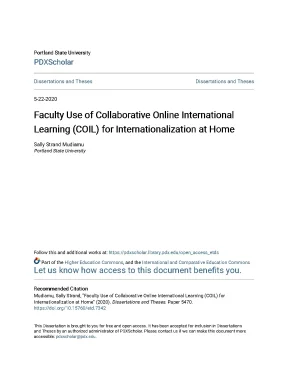
Tải xuống để đọc toàn bộPortland State University PDXScholar Dissertations and Theses Dissertations and Theses 5-22-2020 Faculty Use of Collaborative Online International Learning (COIL) for Internationalization at Home Sally Strand Mudiamu Portland State University Follow this and additional works at: https://pdxscholar.edu/open_access_etds Part of the Higher Education Commons, and the International and Comparative Education Commons Let us know how access to this document benefits you. Recommended Citation Mudiamu, Sally Strand, "Faculty Use of Collaborative Online International Learning (COIL) for Internationalization at Home" (2020). Dissertations and Theses.7342 This Dissertation is brought to you for free and open access. It has been accepted for inclusion in Dissertations and Theses by an authorized administrator of PDXScholar.
Please contact us if we can make this document more accessible: pdxscholar@pdx. Faculty Use of Collaborative Online International Learning (COIL) for Internationalization at Home by Sally Strand Mudiamu A dissertation submitted in partial fulfillment of the requirements for the degree of Doctor of Education in Educational Leadership: Postsecondary Education Dissertation Committee: Karen Haley, Chair Dilafruz Williams Yoko Sakurauchi Kimberley Brown Portland State University 2020 © Sally Strand Mudiamu FACULTY USE OF COIL FOR INTERNATIONALIZATION AT HOME i Abstract Universities are not preparing all of their students for 21st century global work and citizenship. Internationalization of the Curriculum is critical to this preparation and equity in higher education. Over the past decades, universities have relied on outbound and inbound student mobility to internationalize their institutions, the curriculum, the faculty, and student learning.
students neither study nor intern abroad. Of the 10% who do go abroad, very few are underrepresented, Pell-eligible, or post-traditional students. Universities need to shift their focus from student mobility to Internationalization at Home so that all students may have an internationalized education experience as part of their degree. This qualitative study examined faculty experience in teaching Collaborative Online International Learning courses as a pedagogical approach with curricular implications for Internationalization at Home.
The interview data and analysis have implications for institutional internationalization strategy to equitably prepare all students for 21st century global work and citizenship. Key findings include that Collaborative Online International Learning is a faculty-driven intervention for Internationalization at Home, giving all students opportunities for global learning and engagement. FACULTY USE OF COIL FOR INTERNATIONALIZATION AT HOME ii Dedication To my family: Bernard N., Sarah, Aimée, Bernard M. & Lukusa Mudiamu For my parents: Larry & Harriet Strand FACULTY USE OF COIL FOR INTERNATIONALIZATION AT HOME iii Acknowledgements My deepest thanks goes to my advisor, Karen J.
Haley, for taking me on as an advisee and shepherding me through the dissertation journey. Her calm and patient guidance was critical to this endeavor. Her generosity of time spent with me thinking through the study and reading endless drafts will make me forever grateful. I want to thank my dissertation committee: Dilafruz Williams, Yoko Sakurauchi and Kimberley Brown.
It is an honor for me to have you share your tremendous breadth and depth of knowledge around global learning in higher education. Thank you for the time you have invested in me. I also want to recognize my cohort, who were my “brain trust” for this dissertation. Their unwavering support and solidarity made this learning experience the best of my life.
Thank you for being such amazing colleagues. My family’s support and sacrifices made it possible for me to be a doctoral student. For my husband, Bernard: Thank you for believing in me. Sarah, Aimée, Bernard and Lukusa: This degree is for you.
I hope you will be inspired to pursue life- long learning to develop your gifts so as to share them with the world. For my parents Larry and Harriet Strand: They laid the foundation for every accomplishment and success I’ve ever had. I wished they had lived to see this day. They spent their lives lifting up others.
May I do the same in my work as a scholar- practitioner. FACULTY USE OF COIL FOR INTERNATIONALIZATION AT HOME iv Table of Contents Abstract.iii List of Tables. vi Chapter One: Introduction of the Problem. 1 Background and Significance of the Problem.
3 Internationalization at Home. 9 Statement of the Research Problem. 11 Purpose of the Study. 12 Methodology and Research Questions.
14 Chapter Two: Review of the Literature. 15 Internationalization of Higher Education. 15 Internationalization at Home. 25 Internationalization of the Curriculum.
74 Chapter Three: Methodology. 81 Data Collection Process. 84 Coding and Analysis. 92 Validity and Transferability.
93 Limitations of the Method. 95 Chapter Four: Presentation of the Data. 97 Faculty Professional Growth. 97 Global Learning for All Students.
125 Equity of Access to International Learning. 177 FACULTY USE OF COIL FOR INTERNATIONALIZATION AT HOME v Chapter Five: Discussion and Implications for Practice. 181 COIL is a Faculty Intervention for Internationalization at Home. 182 Faculty Use COIL to Prepare Students for 21st Century Life.
186 Faculty Experienced Benefits to Teaching COIL. 189 COIL Integrates UN Sustainable Development Goals into the Curriculum. 193 Implications for Practice. 194 Limitations and Future Research.
206 Appendix A: Interview Questions & Protocol. 244 Appendix B: A Priori Codes. 247 Appendix C: Study Invitation Email. 249 Appendix D: Informed Consent Form.
250 Appendix E: Email Follow-Up to Interview. 253 FACULTY USE OF COIL FOR INTERNATIONALIZATION AT HOME vi List of Tables Table 1: Faculty Participants. 82 FACULTY USE OF COIL FOR INTERNATIONALIZATION AT HOME 1 Chapter One: Introduction of the Problem Universities are not preparing students, especially underrepresented students, for global work and citizenship in the 21st century. This failure perpetuates structural social and economic inequalities for college graduates.
First-generation and Pell-eligible students pursue higher education as a way of joining the middle class through professional mobility. However, those not prepared through a formal international education experience to participate in the global workforce will find that their bachelor’s degrees worth less in the job marketplace. Lack of a global learning experience can also make students vulnerable to civic tribalism and nationalism, undermining the foundations of a liberal education. Employers are asking for “career ready” graduates (World Economic Forum [WEF], 2016, 2020), especially those who have intercultural problem-solving skills.
The Future of Jobs report by the World Economic Forum (2016) and UN 2030 Sustainable Development Goals (United Nations, 2015) both call for higher education that prepares students to work in a globally networked and globally sourced work environments. Nearly 80% of knowledge workers currently work on global virtual teams (Ferrazzi, 2014) and most jobs in the future will require the ability to do so. Therefore, practicing intercultural communication and problem solving virtually and collaboratively will be an important “career ready” preparation for all college graduates. Possessing a sense of global citizenship (Andreotti, 2006; Banks, 2008; WEF, 2019) is vital to enhance students’ critical thinking skills and informed action when FACULTY USE OF COIL FOR INTERNATIONALIZATION AT HOME 2 navigating difference in their local communities as well as in the workplace.
Global awareness fosters accountability towards learning with “the other,” which is necessary prerequisite to sustain a pluralistic society (Andreotti, 2006; Banks, 2008; WEF, 2019) as well as to perform 21st century work. Therefore, global competency is both skill and attitude which must be cultivated as part of a university education. Universities are internationalizing themselves in response to the pressures of globalization. Indeed, internationalization has become ancillary to the mission of higher education.
Institutions have adopted a holistic institutional approach to internationalization that is referred to as “Comprehensive Internationalization” (American Council on Education [ACE], 2015; Hudzik, 2011) or “pervasive internationalization” (Association of Public and Land-Grant Universities [APLU], 2017). The Center for International and Global Engagement at the American Council for Education has recommended six strategic areas for institutions to align their institutional priorities to become more “globally orientated and internationally connected institutions” (ACE, 2015). The foundation is an articulated institutional commitment to internationalization, such as a mission statement linked to internationalized learning outcomes, student mobility targets, and faculty research. There also must be adequate support from administrative leadership to create staffing structures to support internationalization goals.
The curriculum, co-curriculum, and student learning outcomes should be informed by international learning for global citizenship and work. Faculty policies and practices, such as promotion and tenure, should be linked to Internationalization of the Curriculum and international joint research and publication. Outbound student mobility (study FACULTY USE OF COIL FOR INTERNATIONALIZATION AT HOME 3 abroad) should receive the same resources as recruiting inbound international students. Finally, collaboration through public/private and international partnerships must be pursued to help universities better understand and respond to the needs of their communities and local employers.
These six focus areas of internationalization have been adopted by most universities in their mission statements, but there is uneven engagement in them (Hudzik, 2014). This uneven engagement can undermine institutional mandates that 100% of graduates leave with an international learning experience as part of their undergraduate degree (Landorf, Doscher, Hardrick, & Musil, 2018; Waseda University, 2012). For example, many universities look at internationalization as a way to increase revenue to benefit local students through international student enrollments and international special programs. However, there is little articulation on how revenue generated from international student enrollments is to be invested or reallocated at the university to provide an international learning experience for all students (Hudzik, 2014).
Similarly, universities pursue internationalization to increase their rankings and “brand” recognition (Hudzik, 2014) as a way to attract the most talented and motivated students (Astin, 2016). Again, there is a lack of clarity on how an improved world university ranking and bringing more “talented” students improves teaching and learning outcomes for all students (Hudzik, 2011). Background and Significance of the Problem Underrepresented students, who are pursuing higher education, are most vulnerable to the forces of globalization (Applegate, 2018; Morey, 2004). Wages are FACULTY USE OF COIL FOR INTERNATIONALIZATION AT HOME 4 already lower for bachelor’s degree holders raised on low incomes (Herschbein, 2016).
Contemporary higher education inequalities are exacerbated for students at open access institutions, where notions of education for public good are undermined by neoliberal differentiation of disciplines and degrees (Altbach, 2013). A lack of an international learning experience as part of their degree will further hinder underrepresented graduates in a globally networked society. Conversely, while lack of an international experience can lessen the value of a degree, the intentional addition of such an experience can mitigate structural disadvantages for underrepresented students. An international learning experience as part of the undergraduate curriculum is increasingly identified with social mobility and professional employment (Department of Education [DoE], 2012).
Participation in international learning also improves the quality of undergraduate learning outcomes (Soria & Troisi, 2014) and the perceived value of the baccalaureate degree by future employers (Bondi & Matthews, 2017; Paige, Fry, Stallman, Josić & Jon, 2009; Streitwieser, 2014). Finally, it empowers underrepresented students by defining themselves in a global community (Acquaye & Crewe, 2012). While universities have widened the overall scope of their international activities, they have continued to rely almost exclusively on Education Abroad programming to deliver global learning experiences to their students (Farrugia & Sanger, 2017). Work to overcome the barriers of the “four F’s”—faculty, finances, family and fears (Cole, 1991) —to Education Abroad has been unceasing at the institutional level.
Universities participate in a national advocacy campaign, called Generation Study Abroad, through FACULTY USE OF COIL FOR INTERNATIONALIZATION AT HOME 5 the Institute for International Education. They negotiate external non-profit Education Abroad providers to bring down instructional costs and offer scholarships. Where possible, grants have replaced traditional financial aid to get underrepresented students, fearful of incurring more debt, to study abroad (Whatley, 2017). General education and disciplinary curriculum have been articulated through Education Abroad programming, some of which are led by home institution faculty and based on a course that is already offered (Hamir & Gozik, 2018).
Nội dung được bảo vệ bản quyền — Tải xuống đầy đủ
Trích dẫn luận án này
Sally Strand Mudiamu (2020). Faculty use of COIL for Internationalization at Home [Luận án tiến sĩ, Portland State University]. LuanAn.net. https://luanan.net/quan-ly-giao-duc/quan-ly-giao-duc-dai-hoc/faculty-use-of-collaborative-online-international-learning-coil
Câu hỏi thường gặp
Luận án "Faculty use of COIL for Internationalization at Home" nghiên cứu về vấn đề gì?
Khám phá cách giảng viên sử dụng COIL để Quốc tế hóa tại Nhà, tăng cường hợp tác và trải nghiệm học tập toàn cầu ngay trong khuôn viên trường.
Luận án "Faculty use of COIL for Internationalization at Home" được bảo vệ tại trường nào?
Luận án này được bảo vệ tại Portland State University. Năm bảo vệ: 2020.
Luận án "Faculty use of COIL for Internationalization at Home" thuộc chuyên ngành gì?
Luận án "Faculty use of COIL for Internationalization at Home" thuộc chuyên ngành Educational Leadership: Postsecondary Education. Danh mục: Quản Lý Giáo Dục Đại Học.
Luận án "Faculty use of COIL for Internationalization at Home" có bao nhiêu trang?
Luận án "Faculty use of COIL for Internationalization at Home" có 262 trang. Bạn có thể xem trước một phần tài liệu ngay trên trang web trước khi tải về.
Cách tải luận án "Faculty use of COIL for Internationalization at Home" về máy như thế nào?
Để tải luận án về máy, bạn nhấn nút "Tải xuống ngay" trên trang này, sau đó hoàn tất thanh toán phí lưu trữ. File sẽ được tải xuống ngay sau khi thanh toán thành công. Hỗ trợ qua Zalo: 0559 297 239.