Luận án tiến sĩ sustainable cultural heritage tourism in cambodia case studies o
Tài liệu: Luận án tiến sĩ sustainable cultural heritage tourism in cambodia case studies of angkor preah vihear and sambo preikuk du lịch di sản văn hóa bền vữn
Economic Management (Tourism Economics)
Luan An
Luận án tiến sĩ
Năm xuất bản
Số trang
159
Thời gian đọc
24 phút
Lượt xem
0
Lượt tải
0
Phí lưu trữ
50 Point
Tổng quan nhanh
- Chủ đề:
- Sustainable Cultural Heritage Tourism in Cambodia
- Số trang:
- 159 trang
- Trường:
- Trường Đại học Kinh tế Quốc dân
- Chuyên ngành:
- Economic Management (Tourism Economics)
- Tác giả:
- Chea Bora
- Năm:
- 2022
Tóm tắt nội dung luận án
I.Sustainable Cultural Heritage Tourism in Cambodia
This dissertation examines sustainable cultural heritage tourism (SCHT) in Cambodia, focusing on three key sites: Angkor, Preah Vihear, and Sambo Preikuk. The study explores challenges and opportunities for balancing tourism development with heritage preservation. It highlights the importance of stakeholder collaboration, economic benefits, and environmental protection in maintaining cultural sites. Data from interviews and case studies provide insights into current practices and future strategies.
1.1. Definition and Importance
SCHT integrates cultural preservation with tourism growth. It ensures heritage sites remain accessible while protecting their historical value. Cambodia’s heritage sites attract global visitors, contributing to the economy. However, unchecked tourism risks degradation. The study emphasizes the need for sustainable policies to balance tourism and conservation.
1.2. Current State of SCHT in Cambodia
Cambodia’s cultural heritage is a key tourism driver. Angkor Wat and Preah Vihear are UNESCO sites facing pressure from mass tourism. Local communities rely on tourism income but lack formal roles in decision-making. The research identifies gaps in infrastructure, visitor management, and environmental safeguards at these sites.
1.3. Key Objectives of the Study
The study aims to evaluate SCHT practices in Cambodia. It assesses economic, social, and environmental dimensions. Findings will inform policies for sustainable tourism. Recommendations include stakeholder engagement frameworks and adaptive management strategies for heritage sites.
II.Case Studies Angkor Preah Vihear Sambo Preikuk
Three sites represent diverse aspects of Cambodian heritage. Each faces unique challenges in balancing tourism with preservation. The analysis compares their management strategies and identifies lessons for broader implementation.
2.1. Angkor Wat Challenges and Successes
Angkor Wat is Cambodia’s most iconic site. High visitor numbers strain infrastructure and conservation efforts. The study notes successful public-private partnerships but highlights issues like overcrowding and waste management. Community involvement remains limited.
2.2. Preah Vihear Cultural Significance and Threats
Preah Vihear’s historical and religious value attracts scholars and tourists. Border disputes and political tensions complicate its management. The site lacks sufficient funding for maintenance, and local communities report minimal economic benefits from tourism.
2.3. Sambo Preikuk Underutilized Potential
Sambo Preikuk is less developed than other sites. Its remote location limits accessibility but preserves its authenticity. The study finds untapped potential for sustainable tourism. Challenges include poor infrastructure and limited marketing.
III.Stakeholder Engagement in SCHT Development
Effective SCHT requires collaboration among governments, private sectors, and local communities. The study identifies gaps in stakeholder coordination and proposes solutions for inclusive decision-making.
3.1. Government and Policy Frameworks
Cambodia’s tourism policies prioritize growth over sustainability. Regulations lack enforcement, leading to environmental degradation. The study recommends updating legal frameworks to integrate SCHT principles.
3.2. Private Sector Involvement
Hotels, tour operators, and investors play a critical role. Many lack commitment to sustainability. The research suggests incentives for eco-friendly practices and partnerships with local communities.
3.3. Community Participation
Local communities often exclude from tourism planning. Their input is vital for culturally sensitive practices. The study advocates for community-based tourism models to ensure equitable benefits.
IV.Economic and Social Dimensions of SCHT
SCHT generates revenue but requires careful management to avoid negative social impacts. The study evaluates economic contributions and community well-being in heritage sites.
4.1. Economic Benefits and Risks
Tourism creates jobs and boosts local economies. However, over-reliance on tourism destabilizes communities. The research highlights the need for diversification and long-term financial planning.
4.2. Social Impact on Local Communities
Tourism can empower communities through cultural exchange. However, it may also displace residents or erode traditions. The study finds mixed outcomes, urging inclusive policies to protect cultural identity.
4.3. Balancing Development and Preservation
Economic growth must align with heritage protection. The study proposes zoning regulations and visitor caps to reduce pressure on sites. Education programs for tourists and locals are recommended to foster respect for heritage.
Mục lục chi tiết luận án
Tải xuống file đầy đủ để xem toàn bộ nội dung
Tải đầy đủ (159 trang)Trích đoạn nội dung luận án
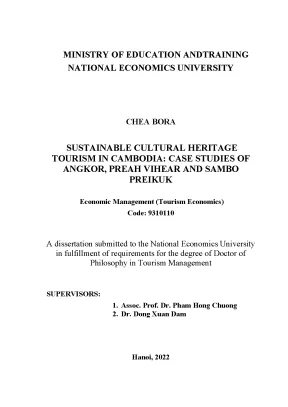
Tải xuống để đọc toàn bộMINISTRY OF EDUCATION ANDTRAINING NATIONAL ECONOMICS UNIVERSITY CHEA BORA SUSTAINABLE CULTURAL HERITAGE TOURISM IN CAMBODIA: CASE STUDIES OF ANGKOR, PREAH VIHEAR AND SAMBO PREIKUK Economic Management (Tourism Economics) Code: 9310110 A dissertation submitted to the National Economics University in fulfillment of requirements for the degree of Doctor of Philosophy in Tourism Management SUPERVISORS: 1. Pham Hong Chuong 2. Dong Xuan Dam Hanoi, 2022 TIEU LUAN MOI download : skknchat123@gmail.com DECLARATION I hereby declare that doctoral thesis “Sustainable Cultural Heritage Tourism in Cambodia: Case studies of Angkor, Preah Vihear and Sambo Preikuk is written by me and has not been submitted for any degree or has not been published yet. I am responsible for my declaration.
Bora CHEA TIEU LUAN MOI download :i skknchat123@gmail.com ACKNOWLEDGMENTS This research has been completed with useful guidance, continuous encouragement, strong support, kind assistance and sincere love of a number of individuals who I wish to express my profound thanks and high appreciation here. First and foremost, my sincerest gratitude goes to the Government of Socialist Republic of Vietnam through the Ministry of Education and Training Vietnam and the National Economics University for awarding me a doctoral scholarship that enabled me to undertake this research. Next, my greatest gratitude goes to the Royal Government of Cambodia who always deliberately encourages and supports officials including myself to pursue higher education and exchange practical experiences for the purposes of capacity building. Moreover, my profound thanks goes to my supervisors, Assoc.
Pham Hong Chuong, president of National Economics University and Dr. Dong Xuan Dam who got me started and provided a way ahead when I got stuck. I will be forever thankful for their insightful feedback and suggestions, continuous encouragement and support throughout this research. Furthermore, my heartfelt thanks goes to Assoc.
Pham Truong Hoang, Head of Faculty of Tourism and Hospitality for his useful guidance, and kind assistance with many of the important issues during my study and research. In addition, my special thanks goes to all professors and lecturers for their useful knowledge, hard work, and valuable time spending to teach me during my study. Without you all, I can not complete each course successfully and have a chance to complete this research. Also, my sincere appreciation goes to all international tourists, local communities, private sectors, and officials in tourism sector who participated in this research.
It has been a privilege to learn about their invaluable experiences, useful thoughts and essential opinions. Finally, my deep love and sincere gratitude goes to my beloved nuclear and extended family for their great support and endless love, that gave me strength, courage and determination to pursue my goals even further. TIEU LUAN MOI download :ii skknchat123@gmail.com TABLE OF CONTENTS DECLARATION.ii TABLE OF CONTENTS.iii LIST OF ABBREVIATIONS.vii LIST OF TABLES.ix LIST OF FIGURES.ix CHAPTER 1: INTRODUCTION. Rational of the Study.
Purpose of the Study. Subject and Scope of the Study. Contribution of the Study. Context of the Study.
Outline of the Study.10 CHAPTER 2: LITERATURE REVIEW. The Concept of Cultural Heritage Tourism. Definition of Cultural Heritage Tourism. The Elements of Cultural Heritage Tourism.
The Importance of Cultural Heritage Tourism. The Concept of Sustainable Cultural Heritage Tourism.Definition of SCHT. The Dimension of SCHT. The Importance of SCHT.
Measures of Sustainable Cultural Heritage Tourism. The Importance of CHT Management. Actions to Manage CHT. The Engagement of Stakeholders in CHT.
Conceptual Framework of the Study.26 TIEU LUAN MOI download iii: skknchat123@gmail. Participants and Recruitment Procedures. Data Collection Methods and Procedures. Semi-structured interviews.
Confidentiality and Anonymity.43 CHAPTER 4: THE RESULT OF FINDINGS. Profile of Case Studies. Perception of SCHT in Cambodia.46 TIEU LUAN MOI download iv: skknchat123@gmail. Understanding of SCHT Dimension….
Economic Dimension of SCHT. Social Dimension of SCHT. Environmental Dimension of SCHT. Involvement and Collaboration of Stakeholders in SCHT.
Development of SCHT in Cambodia. Key Tasks Accomplished Related to SCHT. Current Situation of SCHT in Cambodia. Meassures to Achieve SCHT in Cambodia.105 CHAPTER 5: DISCUSSION, CONCLUSION & RECOMMENDATIONS.
Global Perception of SCHT in Cambodia. Engagement and Collaborating Mechanism in SCHT. Current State of Development of SCHT in Cambodia. Measures to Achieve SCHT in Cambodia.
Clear Understaning of Perception of SCHT in Cambodia. Best Experience in Collaboration Mechanism but Need to Further Engage Relevant Stakeholders. Global Level of SCHT Achieved but Need to Enhance Dimensional Level. Successful Measure in Achieving SCHT in Cambodia.
At National Level. At Site Level. Proposed Model of Managing SCHT. Limitation and Perspective of the Study.137 Appendix A: Research Information Sheet for Participants.137 Appendix B: Consent Form for Participants.138 TIEU LUAN MOI download :v skknchat123@gmail.com Appendix C: Interview Protocol for Interview and Focus group.139 Appendix D: Summary Tables of Participant Responses.1: Understanding of SCHT in Cambodia (Case of Angkor)…………….2: Understanding of SCHT in Cambodia (Case of PVH).3: Understanding of SCHT in Cambodia (Case of SPK) .4: Summary of Economic Dimension of SCHT (Case of Angkor) .5: Summary of Economic Dimension of SCHT (Case of PHV) .6: Summary of Economic Dimension of SCHT (Case of SPK) .7: Summary of Social Dimension of SCHT (Case of Angkor) .8: Summary of Social Dimension of SCHT (Case of PVH) .9: Summary of Social Dimension of SCHT (Case of SPK) .10: Summary of Environmental Dimension of SCHT (Case of Angkor) .11: Summary of Environmental Dimension of SCHT (Case of PVH) .12: Summary of Environmental Dimension of SCHT (Case of SPK) .13: Involvement and collaboration of stakeholders in SCHT (Case of Angkor) .14: Involvement and collaboration of stakeholders in SCHT (Case of PVH) .15: Involvement and collaboration of stakeholders in SCHT (Case of SPK) .16: Summary of Current Situation of SCHT in Cambodia (Case of Angkor) .17: Summary of Current Situation of SCHT in Cambodia (Case of PVH) .18: Summary of Current Situation of SCHT in Cambodia (Case of SPK) .19: Summary of Measures to Achieve SCHT in Cambodia (Case of Angkor) .20: Summary of Measures to Achieve SCHT in Cambodia (Case of PVH) .21: Summary of Measures to Achieve SCHT in Cambodia (Case of SPK).
149 TIEU LUAN MOI download vi: skknchat123@gmail.com LIST OF ABBREVIATIONS ADB Asian Development Bank ANA APSARA National Authority ANK Angkor CATA Cambodia Association of Travel Agents CHT Cultural Heritage Tourism CRA Cambodia Restaurant Association CTF Cambodia Tourism Federation GDP Gross Domestic Product H Hotel ICC International Coordination Committee ICC-Angkor The International Coordination Committee for the Safeguarding and Development of Historic Site of Angkor. ICC-PVH International Coordination Committee for the Conservation and Enhancement of the Temple Preah Vihear ICCROM The International Centre for the Study of the Preservation and Restoration of Cultural Property ICOMOS International Council on Monuments and Sites IT International Tourist LC Local Community LTO Local Tour Operator MCFA Ministry of Culture and Fine Arts MICE Meeting, Incentive, Convention, Exhibition MLMUPC Ministry of Land Management, Urban Planning and Construction MOE Ministry of Environment MOI Ministry of Interior MOP Ministry of Planning MOT Ministry of Tourism OUV Outstanding Universal Value PA Provincial Authority PPP Public Private Partnership PVH Preah Vihear PVHNA Preah Vihear National Authority RGC Royal Government of Cambodia TIEU LUAN MOI download vii: skknchat123@gmail.com SPK Sambo Preikuk SPKNA Sambo Preikuk National Authority SCHT Sustainable Cultural Heritage Tourism UNESCO United Nations Educational, Scientific and Cultural Organization WCED World Commission on Environment and Development WHS World Heritage Site WTTC World Travel And Tourism Council TIEU LUAN MOI download viii : skknchat123@gmail.campuchia LIST OF TABLES Table 3.1: The Characteristics of Research Participants……………………….2: The Summary of Participants for Semi-Structured Interviews……….3: The Characteristics of Participants for Focus Groups………………….36 LIST OF FIGURES Figure 2.1: Classification of Cultural Heritage…………………………………….2: The Three Pillars of Sustainability…………………………………….3: Sustainable Tourism Cycle……………………………………………….4: The Conceptual Framework of Sustainable CHT………….1: Proposed model of (3C+1C) of Collaboration in Managing SCHT in Cambodia .campuchia TIEU LUAN MOI download ix: skknchat123@gmail.campuchia CHAPTER 1: INTRODUCTION 1. Chapter Overview This chapter is an introduction chapter which provide an overall picture of the thesis. It begins with the rational of the research in followed by the purpose of the research.
It then states limit the subject and scope of the research and state contribution of the research. Finally, it ends with an outline of the thesis as a whole. Rational of the Study Tourism is considered one of the most rapid growing industries around the globe during the last several decades. Meantime, it has become one of the main sources of income for many developing countries in the world as it brings in great amounts of income into a local economy in the form of spending on goods and services needed by tourists.
According to UNWTO (2017), this accounts for 30% of the world's trade of services, and 7% of overall exports of goods and services. Also, tourism has established employment advantages in many related sectors ranging from construction to agriculture and telecommunication, in which one in eleven jobs allowing the tourism industry to generate USD 1.5 trillion in export earnings (UNWTO, 2017). In this regard, there is a great deal of discourse on cultural heritage which becomes one of the most important tourism resources, and Cultural Heritage Tourism (CHT) is one of the most salient forms of industry today. Cambodia is one country among those where CHT is backbone of economy.
Before the pandemic, Cambodia has gained over 50% of tourists visits cultural and heritage sites (MOT, 2019). Over the last two decades, CHT has become a pillar of equitable growth and played an instrumental role in poverty reduction in Cambodia. The previous two decades of sustained high growth, together with peace and macro-economic stability, has provided a new opportunity for rapid poverty reduction and enhanced living standard. In particular, the poverty rate dropped from 100 percent in 1979 to 11 percent in 2019.
Undoubtedly, CHT is playing a substantial part in this growth. However, with the massive growth and the size, most experts in the field of tourism are concerned with the impact of the excessive development of tourism especially in the form of CHT. This requires that we increase alertness. Heritage should in no way suffer from these gains.
It is because CHT can be viewed as double-face sector. One face: it can promote economic growth, employment and revenue for host region. Another face: with increasing competition, cultural destinations must compete among each other, (LUAN.campuchia TIEU LUAN MOI download : skknchat123@gmail.campuchia which can cause imbalance between the three dimensions of sustainable tourism (Peng, 2011). This, accordingly, has provoked a lot of discussions about its sustainability.
The application of the sustainable development paradigm in tourism becomes a popular topic, as this sector is becoming a major source of growth in most countries of the world, particularly in developing countries, where their industrial capacity is still limited (Sharpley, 2000; Butcher, 2003; Dwyer, 2004). To achieve this, there should be a collaboration within some key stakeholders and all stakeholders need to build a mutual understanding on planning, managing, and developing cultural heritage in a sustainable and responsible manner, which will not harm and affect local culture. At the same time, ecosystems and diversity should be strictly preserved. In that sense, opinions and attitudes of tourism stakeholders on the protection of cultural heritage and the possibilities of sustainable tourism development in their environment are very important.
The guarantee of sustainable management of the site, sustainable income from this generation to the next generation of local community, and keeping high quality of tourists' experiences are essential to what constitutes sustainable tourism or sustainable development of tourism (Peng, 2011). Thus, achieving Sustainable Cultural Heritage Tourism (SCHT) is an important practical topic to be discussed and studied. The finding of this study could be a valuable contribution to literature in the tourism sector in the context of Cambodia, SCHT in particular, as few research studies were conducted related to CHT in Cambodia since the synergy between culture and tourism was introduced. Those research studies seemed to focus more on the potential of cultural resources, especially in terms of how to develop and promote tourism products rather than the promotion of SCHT.
Moreover, the study will inform the key stakeholders about the importance of sustainable cultural heritage tourism.
Nội dung được bảo vệ bản quyền — Tải xuống đầy đủ
Trích dẫn luận án này
Chea Bora (2022). Luận án tiến sĩ sustainable cultural heritage tourism in cam [Luận án tiến sĩ, National Economics University]. LuanAn.net. https://luanan.net/nghien-cuu-van-hoa/ton-giao-hoc/campuchia
Câu hỏi thường gặp
Luận án "Luận án tiến sĩ sustainable cultural heritage tourism in cam" nghiên cứu về vấn đề gì?
Tài liệu: Luận án tiến sĩ sustainable cultural heritage tourism in cambodia case studies of angkor preah vihear and sambo preikuk du lịch di sản văn hóa bền vữn
Luận án "Luận án tiến sĩ sustainable cultural heritage tourism in cam" được bảo vệ tại trường nào?
Luận án này được bảo vệ tại National Economics University. Năm bảo vệ: 2022.
Luận án "Luận án tiến sĩ sustainable cultural heritage tourism in cam" thuộc chuyên ngành gì?
Luận án "Luận án tiến sĩ sustainable cultural heritage tourism in cam" thuộc chuyên ngành Economic Management (Tourism Economics). Danh mục: Tôn Giáo Học.
Luận án "Luận án tiến sĩ sustainable cultural heritage tourism in cam" có bao nhiêu trang?
Luận án "Luận án tiến sĩ sustainable cultural heritage tourism in cam" có 159 trang. Bạn có thể xem trước một phần tài liệu ngay trên trang web trước khi tải về.
Cách tải luận án "Luận án tiến sĩ sustainable cultural heritage tourism in cam" về máy như thế nào?
Để tải luận án về máy, bạn nhấn nút "Tải xuống ngay" trên trang này, sau đó hoàn tất thanh toán phí lưu trữ. File sẽ được tải xuống ngay sau khi thanh toán thành công. Hỗ trợ qua Zalo: 0559 297 239.