Porwoll uchicago 0330d 14784
Khóa học UChicago Porwoll 0330d 14784: Tìm hiểu chuyên sâu về các chủ đề cốt lõi và phương pháp tiếp cận đột phá trong lĩnh vực này.
The University of Chicago
Divinity
Luan An
Luận án tiến sĩ
Năm xuất bản
Số trang
355
Thời gian đọc
54 phút
Lượt xem
0
Lượt tải
0
Phí lưu trữ
60 Point
Tổng quan nhanh
- Chủ đề:
- Tổng quan luận văn Porwoll về giáo dục Paris TK12.
- Số trang:
- 355 trang
- Trường:
- The University of Chicago
- Chuyên ngành:
- Divinity
- Tác giả:
- Robert John Porwoll
- Năm:
- 2019
Tóm tắt nội dung luận án
I.
Nghiên cứu của Robert John Porwoll từ Đại học Chicago khám phá các phương pháp sư phạm sáng tạo thế kỷ 12. Thế kỷ này chứng kiến sự phát triển mạnh mẽ của các trường học mới. Trung tâm trí tuệ nở rộ. Nghệ thuật tự do thoát khỏi sự độc quyền của tu viện. Đến cuối thế kỷ, "universitas" Paris hình thành. Giáo dục phát triển theo hướng đổi mới. Luận văn phân tích sâu sắc các thực hành và lý thuyết giáo dục. Nó tập trung vào bốn nhà tư tưởng hàng đầu. Đó là Peter Abelard, Hugh of Saint-Victor, Peter Lombard và John of Salisbury. Họ đã định hình bối cảnh trí tuệ Paris đang phát triển nhanh chóng. Nghiên cứu cung cấp một cái nhìn toàn diện. Nó về cách các phương pháp sư phạm này đặt nền móng cho giáo dục đại học hiện đại. Luận văn của Porwoll đóng góp vào lịch sử giáo dục. Nó đặc biệt làm rõ các cuộc tranh luận về phương pháp học thuật. Công trình này là một phần quan trọng của kho tàng tri thức từ Đại học Chicago.
1.1. Bối cảnh lịch sử và sự hình thành đại học.
Thế kỷ 12 là giai đoạn bản lề ở châu Âu. Nhiều nền văn hóa học đường mới xuất hiện. Các trung tâm trí tuệ phát triển mạnh mẽ. Nghệ thuật tự do chuyển giao từ các tu viện và trường nhà thờ. Đến cuối thế kỷ, "universitas" Paris dần hình thành. Các hướng đi trong giáo dục, về cả thực hành và lý thuyết, đều mang tính đổi mới, thử nghiệm. Việc này định hình cấu trúc giáo dục tương lai.
1.2. Mục tiêu nghiên cứu các nhà sư phạm nổi bật.
Luận văn này là một nghiên cứu chi tiết. Nó về các dự án sư phạm đổi mới của bốn nhà tư tưởng nổi bật. Họ hoạt động trong môi trường trí tuệ Paris. Peter Abelard và Hugh of Saint-Victor là những người đương thời. Phương pháp giảng dạy của họ rất có uy tín và được săn đón. Peter Lombard và John of Salisbury là những học trò của họ. Nghiên cứu khám phá sự phát triển tư duy của các thế hệ này.
1.3. Porwoll UChicago Đóng góp cho lịch sử giáo dục.
Luận văn này được Robert John Porwoll bảo vệ. Đây là công trình tiến sĩ tại Khoa Thần học, Đại học Chicago. Nghiên cứu của Porwoll phân tích sâu sắc. Nó về các cuộc tranh luận sư phạm thế kỷ 12. "Báo cáo Porwoll UChicago" này cung cấp góc nhìn mới. Nó về sự tiến hóa của tư duy học thuật. Công trình này là một đóng góp giá trị cho lịch sử Đại học Chicago thông qua các sản phẩm học thuật của mình.
II.
Peter Abelard là một nhân vật trung tâm trong cuộc tranh luận sư phạm thế kỷ 12. Ông đối mặt nhiều thách thức. Abelard là một giáo viên không có bậc thầy danh giá. Ông tìm cách mở trường riêng. Để xây dựng danh tiếng, ông dựa vào tài năng bản thân. Abelard có khả năng trả lời các câu hỏi của học sinh. Ông sử dụng lý luận biện chứng một cách trình diễn. Điều này giúp ông đánh giá giá trị các nguồn có thẩm quyền. Sự phụ thuộc vào tài năng (ingenium) của Abelard khơi mào một cuộc thảo luận rộng hơn. Cuộc thảo luận này về tài năng trong số những người đương thời. Phương pháp của Abelard khuyến khích tư duy phê phán. Nó thúc đẩy sự tự do học thuật. Ông cho phép học sinh chất vấn và phân tích. Điều này mở ra một không gian cho phát biểu tự do trong học thuật. Abelard tạo điều kiện cho một hình thức tranh luận trí tuệ. Đây là nền tảng cho sự phát triển giáo dục đại học sau này.
2.1. Thách thức của giáo viên độc lập và xây dựng danh tiếng.
Abelard đối mặt với nhiều khó khăn. Ông là một giáo viên không có bậc thầy có uy tín. Ông muốn thành lập trường riêng. Giải pháp của ông là xây dựng danh tiếng. Ông dựa vào tài năng đặc biệt của mình. Abelard thể hiện năng lực giải đáp các vấn đề phức tạp. Điều này thu hút nhiều học sinh đến với ông.
2.2. Sử dụng lý luận biện chứng và nguồn thẩm quyền.
Abelard trả lời câu hỏi của học sinh thông qua biện chứng. Ông sử dụng lý luận biện chứng một cách trình diễn. Việc này để đánh giá giá trị của các nguồn có thẩm quyền. Phương pháp của Abelard khai thác cuộc thảo luận lớn hơn. Cuộc thảo luận này về tài năng (ingenium) trong số những người cùng thời. Nó là một cách tiếp cận sáng tạo.
2.3. Ảnh hưởng đến sự phát triển tự do học thuật.
Phương pháp giảng dạy của Abelard thúc đẩy sự tìm tòi trí tuệ. Nó khuyến khích đánh giá phê phán các nguồn thông tin. Điều này định hình các hình thức ban đầu của diễn ngôn học thuật. Nó đóng góp vào một nền văn hóa tranh luận cởi mở. Abelard gián tiếp mở đường cho các khái niệm về tự do học thuật và phát biểu tự do trong bối cảnh giáo dục.
III.
Hugh of Saint-Victor mang đến một góc nhìn khác. Ông phê phán sự phụ thuộc vào tài năng của các bậc thầy Paris. Hugh coi đó là nguy hiểm và vô trật tự. Ông tin rằng nó có thể dẫn đến sự hỗn loạn trí tuệ. Đáp lại, Hugh xây dựng một chương trình sư phạm mở rộng. Chương trình này bao gồm cả khía cạnh đạo đức và trí tuệ của học sinh. Hugh đề xuất một sự thay thế. Nó cho quỹ đạo giáo dục Paris. Chương trình của ông nhấn mạnh kỷ luật chi tiết (disciplina) và giảng dạy theo chương trình (doctrina). Điều này nhằm nuôi dưỡng một cá nhân toàn diện. Quan điểm của Hugh đặt nền móng cho chính sách trường đại học. Nó hướng tới một cấu trúc giáo dục có tổ chức hơn. Ông muốn kiểm soát chất lượng và nội dung giảng dạy. Hugh tin rằng giáo dục cần sự cân bằng. Nó giữa sự tự do khám phá và khuôn khổ có trật tự. Điều này có ý nghĩa lớn đối với quản trị giáo dục đại học sau này.
3.1. Phê bình cách tiếp cận dựa vào tài năng ở Paris.
Hugh nhìn nhận sự phụ thuộc vào tài năng của các bậc thầy Paris. Ông coi đó là nguy hiểm và vô trật tự. Hugh tin rằng cách tiếp cận này thiếu đi sự nghiêm túc cần thiết. Nó dẫn đến một môi trường học thuật thiếu kỷ luật. Ông tìm kiếm một giải pháp thay thế. Ông muốn một phương pháp giáo dục có cấu trúc rõ ràng.
3.2. Chương trình sư phạm toàn diện Đạo đức và trí tuệ.
Hugh xây dựng một chương trình sư phạm bao quát. Nó bao gồm cả khía cạnh đạo đức và trí tuệ của học sinh. Chương trình này nhấn mạnh sự phát triển toàn diện. Ông muốn nuôi dưỡng những cá nhân có đạo đức và trí tuệ. Đây là một tầm nhìn mới mẻ. Nó phản ánh một chính sách trường đại học hướng tới sự phát triển con người.
3.3. Phương pháp giảng dạy Disciplina và Doctrina.
Hugh trình bày một phương án thay thế. Ông nhấn mạnh kỷ luật chi tiết (disciplina). Ông áp dụng giảng dạy theo chương trình (doctrina). Phương pháp này đối lập với xu hướng của Paris. Nó cung cấp một khung khổ rõ ràng. Điều này đóng góp vào các ý tưởng ban đầu về quản trị giáo dục đại học. Nó nhấn mạnh cấu trúc và quy trình.
IV.
Các học trò của Abelard và Hugh đã tiếp tục phát triển tư duy sư phạm. Peter Lombard và John of Salisbury là những học trò thế hệ thứ hai. Lombard là học trò của Hugh. Salisbury là học trò của Abelard. Mỗi người đều tiếp thu nhiều điều từ bậc thầy của mình. Đồng thời, họ cũng trân trọng đối thủ của bậc thầy. Tư duy sư phạm của họ đại diện cho cách tiếp cận của thế hệ thứ hai. Họ đưa ra các tổng hợp khác biệt. Các tổng hợp này kết hợp các yếu tố của Abelard và Hugh. Họ phát triển các chiến lược sư phạm độc đáo của riêng mình. Peter Lombard tập trung vào việc đào tạo người đọc các tác phẩm có thẩm quyền. Ông nhấn mạnh việc hiểu và diễn giải văn bản. John of Salisbury tổng hợp tư tưởng Abelardian và Hugonic. Ông tạo ra một phương pháp tiếp cận toàn diện hơn. Những đóng góp này cho thấy sự tiến hóa của quản trị giáo dục đại học. Nó từ việc tập trung vào tài năng cá nhân đến việc xây dựng một chương trình học có cấu trúc và đọc hiểu sâu sắc.
4.1. Ảnh hưởng của các bậc thầy tiền bối đến thế hệ sau.
Lombard và Salisbury là thế hệ học trò kế cận. Lombard theo học Hugh. Salisbury là học trò của Abelard. Mỗi người đều tiếp thu sâu sắc từ thầy của mình. Họ cũng học hỏi từ những người đối lập. Điều này thể hiện sự đa dạng trong tư duy giáo dục. Nó cho thấy sự cởi mở trong học thuật thời bấy giờ.
4.2. Peter Lombard Phương pháp đọc và diễn giải tài liệu.
Lombard đã có những đóng góp độc đáo. Ông tập trung vào việc bồi dưỡng người đọc các tài liệu có thẩm quyền. Lombard phát triển một chiến lược sư phạm đặc biệt. Nó giúp học sinh hiểu sâu các văn bản cổ. Phương pháp của ông định hình cách tiếp cận việc học. Nó nhấn mạnh phân tích và giải thích. Điều này là một phần quan trọng của quản trị giáo dục đại học.
4.3. John of Salisbury Tổng hợp tư tưởng Abelardian và Hugonic.
Salisbury trình bày một tổng hợp Neo-Abelardian. Ông kết hợp các yếu tố của Abelard và Hugh. Salisbury đưa ra các chiến lược sư phạm nguyên bản. Cách tiếp cận của ông đại diện cho thế hệ thứ hai. Nó là một sự pha trộn tinh tế. Nó phản ánh sự phát triển của tư duy giáo dục. Việc này có liên quan đến các chính sách trường đại học và quản trị giáo dục.
V.
Các cuộc tranh luận về sư phạm ở Paris thế kỷ 12 để lại di sản sâu rộng. Chúng đặt nền móng cho sự phát triển của đại học hiện đại. Các ý tưởng về tài năng, kỷ luật và chương trình giảng dạy vẫn còn nguyên giá trị. Luận văn của Porwoll cung cấp một phân tích sâu sắc. Nó về những lý thuyết sư phạm nền tảng này. Nghiên cứu của ông làm sáng tỏ đời sống trí tuệ thời Trung cổ. Nó cho thấy cách các cuộc tranh luận cổ xưa này ảnh hưởng đến chính sách trường đại học ngày nay. "Báo cáo Porwoll UChicago" chứng minh tầm quan trọng của lịch sử. Nó trong việc hiểu các cấu trúc giáo dục hiện tại. Các khái niệm về tự do học thuật cũng có thể được truy nguyên từ những cuộc tranh luận này. Các phương pháp quản trị giáo dục đại học hiện đại đã kế thừa nhiều điều. Đó là từ những tư tưởng sư phạm ban đầu. Việc hiểu lịch sử này giúp chúng ta đánh giá cao. Nó về sự phức tạp của hệ thống giáo dục ngày nay.
5.1. Tầm quan trọng của cuộc tranh luận sư phạm ở Paris.
Sư phạm Paris thế kỷ 12 định hình giáo dục. Nó đặt nền móng cho đại học hiện đại. Các cuộc tranh luận ảnh hưởng đến cấu trúc học thuật. Đây là giai đoạn quan trọng. Nó đánh dấu sự chuyển đổi trong tư duy giáo dục. Nó hướng tới một hệ thống có tổ chức hơn.
5.2. Luận văn Porwoll Phân tích sâu sắc lịch sử giáo dục.
Luận văn của Porwoll đưa ra phân tích sâu sắc. Nó về các lý thuyết sư phạm nền tảng. Nó cung cấp cái nhìn sâu sắc. Nó về đời sống trí tuệ thời Trung cổ. "Báo cáo Porwoll UChicago" là một đóng góp quan trọng. Nó cho lịch sử Đại học Chicago và lĩnh vực nghiên cứu lịch sử giáo dục.
5.3. Kết nối với sự tiến hóa của quản trị giáo dục đại học.
Các cuộc tranh luận sư phạm ban đầu đã định hình các thực hành sau này. Các ý tưởng về tài năng, kỷ luật, chương trình giảng dạy vẫn tồn tại. Những gốc rễ lịch sử này là nền tảng. Nó cho quản trị giáo dục đại học hiện đại. Các khái niệm về tự do học thuật và chính sách trường đại học cũng bắt nguồn từ đây.
Tải xuống file đầy đủ để xem toàn bộ nội dung
Tải đầy đủ (355 trang)Trích đoạn nội dung luận án
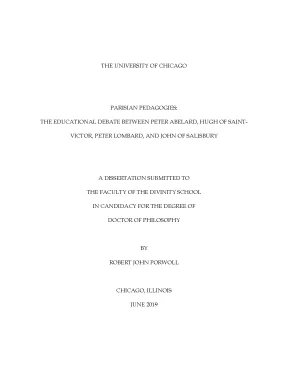
Tải xuống để đọc toàn bộTHE UNIVERSITY OF CHICAGO PARISIAN PEDAGOGIES: THE EDUCATIONAL DEBATE BETWEEN PETER ABELARD, HUGH OF SAINT- VICTOR, PETER LOMBARD, AND JOHN OF SALISBURY A DISSERTATION SUBMITTED TO THE FACULTY OF THE DIVINITY SCHOOL IN CANDIDACY FOR THE DEGREE OF DOCTOR OF PHILOSOPHY BY ROBERT JOHN PORWOLL CHICAGO, ILLINOIS JUNE 2019 *** Uxori meae carissimae, piro aculeoso, Liberisque meis, quae meam vitam laetificant *** Copyright © by Robert J Porowll All Rights Reserved Table of Contents Acknowledgements v Abstract vii 1. Introduction: The Question of Twelfth-Century Pedagogy 1 Part I 2. Peter Abelard and a Teacher’s Talent in Early Twelfth-Century Schools 22 3. Order and Balance: Hugh of Saint-Victor’s Critique of the Parisian Masters 81 4.
Doctrina and Disciplina: The Contours of Hugh’s Pedagogical Program 126 Part II 5. Peter Lombard: Cultivating Readers of Authorities 201 6. John of Salisbury: A Neo-Abelardian Synthesis 260 Bibliography 326 iv Acknowledgements Since first reading Plato, I have been fascinated by the thorny persona of Socrates and the question of educating for wisdom and for virtue. My philosophical, historical, and religious interests continue to recur to how persons may be cultivated in conversation with other persons.
My own career so far reflects the investment of many such teachers, for whose model and guidance I am grateful. Among my first teachers include Professor Jack Marler, Professor Gregory Beabout, Fr., and Professor James Ginther. Their gift of time and high demands stiffened my sinews early in my studies and provided examples of excellent teaching and research. More recently, I have been indebted to Professor Susan Schreiner, Professor Margaret Mitchell, and Professor Ryan Coyne for their reflective criticism that refined my thought and pressed me to consider wider and stranger possibilities.
Their personable teaching and articulate mastery over their fields set a gold standard that I carry with me. To Professor Rachel Fulton Brown I am grateful for her investment in my development and her pedagogical model. Most of all, I am indebted to the wise and humane guidance of my magistra, Professor Willemien Otten. Her grace, precision, and flexibility amid the dual demands of highest intellectual performance and close family life are models that I would hope to imitate the better.
I have received more help than I can recall. The Divinity School was a crucible for learning, supported my studies, and provided my writing fellowship. The Lumen Christi Institute provided a warm haven for conversation and conviviality and my years in Hyde v Park would have been lesser without it. Conversation and good cheer with friends nourished my mind and soul.
I would be remiss to pass over those who in recent years have fallen asleep and whose memories I cherish, including, Joshua Casteel, Jeffrey Morris, Małgorzata Stiff, and John Morris. My final thanks belong to my ever supportive, trusting, and loving wife, Estera Porwoll, who never flagged despite the ordeals of academic life and who celebrated its joys. My daughters, Lucy, Monica, and Teresa, fill my life with love and wonder. vi Abstract The twelfth century in Europe was a long and pivotal century that saw the emergence of new school cultures and intellectual centers.
The liberal arts move out of the proprietorship of monasteries and cathedral schools; by the end of the century the Parisian universitas or university was forming. The directions that education took in these schools—their practices and their theories—were innovative and experimental. This is a study of the innovative pedagogical projects of four prominent teachers and thinkers who operated within the quickly growing intellectual milieu of Paris. Peter Abelard and Hugh of Saint-Victor were contemporaries whose teaching was prestigious and sought after.
Abelard faced the challenges that beset a teacher without a prestigious master and who sought to open his own school. His solution was to build his reputation by relying upon his talent to answer students’ questions through a performative use of dialectical reason in judging the merit of authoritative sources. Abelard’s talent reliance tapped into a larger discussion of talent (ingenium) among his contemporaries. Hugh viewed the Parisian masters’ reliance upon talent as hazardous and disorderly and in response constructed an expansive pedagogical program that encompassed moral and intellectual sides of the student.
By detailed discipline (disciplina) and curricular teaching (doctrina), Hugh presented an alternative to the Parisian trajectory. Peter Lombard and John of Salisbury were students of Hugh and Abelard respectively. They each imbibed much from their own master and also gained an appreciation of their master’s rival. Their own pedagogical thought represents a second vii generation’s approach, offering diverging syntheses of Abelardian and Hugonic elements within their own original, pedagogical strategies.
Lombard’s Four Books of Sentences aimed to mold the student into a diligent and humble reader who respected and trusted the correct authorities. John viewed the liberal arts from his active diplomatic and administrative career, serving the archbishops of Canterbury, and presented a fusion of Abelardian and Hugonic elements to resolve his persistent worries with excessive talent- reliance among scholars. viii Chapter 1: Introduction: The Question of Twelfth-Century Pedagogy The education of succeeding generations may be said to be the crucial factor in a society’s preservation or transformation. Plato called education “the first among the finest gifts that are given to the best men” and left an intellectual legacy that linked education with the character or culture of society.1 In his classic study of παιδεία or ancient Hellenistic education, Henri-Irénée Marrou claimed, “Education is a collective technique which a society employs to instruct its youth in the values and accomplishments of the civilization within which it exists.”2 Already in antiquity, education was the subject of sharp and evolving debate.
Rather than a placid monolith, the sources of Greek and Roman education that professed the liberal arts often constituted persistent tensions between debated visions of liberal education. For example, philosophers countered dominant rhetorical education; Jews and Christians rivaled the Greek and Roman classics with new texts; Christians among themselves varied widely on the proper fusion of classical arts with the wisdom derived from and leading back to the Logos. Medieval Europe inherited this contested legacy of liberal arts. It was a tradition that not only propounded the vital need for correct and good education but also left many interpretative options for how to constitute that liberal education.
The medieval 1 Plato, Laws 644b, “ὡς πρῶτον τῶν καλλίστων τοῖς ἀρίστοις ἀνδράσιν παραγιγνόμενον,” ed. Ioannes Burnet, Platonis Opera V. 2 Henri-Irénée Marrou, A History of Education in Antiquity, trans. George Lamb (Madison: University of Wisconsin Press, 1956), xiii.
1 European tradition of the liberal arts did not and could not simply reproduce the schools and education (institutio) of the imperium romanum. Instead, medieval teachers and scholars reinvented the liberal arts in accordance with their own material conditions, cultural forms, and intellectual and ethical aims and aspirations. Monks, bishops, and cathedral-school teachers practiced the arts, bending them from imperial service and administration toward a new set of aims and practices, chief among them the reading and writing on sacred scripture.3 Drawing upon this tradition, medieval masters found themselves supplied with stores of diverse articulated educational ideals, pedagogical methodologies, practical techniques and texts for school exercises. Rather than hindering creativity, these materials allowed medieval pedagogues to synthesize the elements into their own creative innovations.
These innovations would transform the educational landscape through the course of the twelfth century in ways that would shape the course of European cultural history.4 These pedagogical innovations and the debates they sparked deserved careful attention. The present work is a study of the pedagogical debates amid the changing educational landscape of early twelfth-century Paris between four keynote thinkers and teachers: Peter Abelard, Hugh of Saint-Victor, Peter Lombard, and John of Salisbury. 3 A classic treatment of monastic culture of liberal arts is Jean Leclercq’s. See Jean Leclercq, OSB, The Love of Learning and the Desire for God: A Study of Monastic Culture, trans.
Stephen Jaeger’s study of the culture of liberal arts within the cathedral schools is an unmatched treatment. Stephen Jaeger, The Envy of Angels: Cathedral Schools and Social Ideals in Medieval Europe, 950–1200 (Philadelphia: University of Pennsylvania Press, 1994), 21–195. 4 For example, see John Van Engen, “The Twelfth Century: Reading, Reason, and Revolt in a World of Custom,” European Transformations: The Long Twelfth Century, ed. Noble, John Van Engen (Notre Dame: University of Notre Dame Press, 2012), 17–44.
2 *** Any discussion of the twelfth-century is fraught with interpretative questions. Scholars have found it a hinge or transitional century for diverse reasons. Rapid changes, crises, and developments occurred in several spheres: new political orders or energy became visible in Germany, France, England, and Iberia; an agricultural revolution fed a reurbanization that in turn spurred commerce and trade; reform ideals stirred programs in monastic, papal, and popular religious aspects; new energy appeared in the schools with a corresponding emergence of vernacular literature.5 On account of these movements, scholars have often described this era as a renaissance. Though scholars had already been using the term ahead of him, Charles Homer Haskins is responsible for popularizing the notion of the twelfth century as a renaissance (in The Renaissance of the Twelfth Century, 1927).6 Haskins opposed the notion of renaissance articulated by Jacob Burkhardt (Die Geschichte der Renaissance in Italien, 1867), for whom renaissance was revival of classicism, budding secularity, and the mother of modernity.
Haskins’ renaissance was inseparable from religious thought and tended toward innovation upon the classics rather than their close adherence.7 5 For a brief but insightful survey of these and other features, see John Cotts, Europe’s Long Twelfth Century: Order, Anxiety, and Adaptation, 1095–1229 (New York: Palgrave Macmillan, 2013). 6 For a historiographical narrative of the notion of renaissance, see Alex Novikoff, “The Renaissance of the Twelfth Century before Haskins,” Haskins Society Journal 16 (2005): 104–116; “Introduction,” The Twelfth- Century Renaissance: A Reader, ed. Alex Novikoff (Toronto: University of Toronto Press, 2017), xv–xxii. For Haskins, see The Renaissance of the Twelfth Century (Cambridge, MA: Harvard University Press, 1927); The Rise of the Universities (New York: Henry Holt and Co, 1923).
7 For Haskins’ divergence from Burkhardt, see Robert Benson and Giles Constable, “Introduction,” Renaissance and Renewal in the Twelfth Century, ed. Robert Benson, Giles Constable (Cambridge, MA: Harvard University Press, 1982), xx–xxix. Another recent collection that takes a nuanced view toward the 3 Some have embraced the optimism of Haskins’ account in narrower fields. For the rising school culture, Richard Southern offered a strong account and defense of medieval humanism with a distinct character to that of early modern humanism.
The humanism of the schools (or “scholastic humanism”) had four features: dignity of human nature, introspective inquiry, friendship between humanity and God, and the intelligibility of the natural order.8 Southern’s scholastic humanism bore within it the seeds of its own later dissolution, yet it initiated an intellectual revolution that unfolded a widespread political, social, and doctrinal order for medieval Europe.9 Few scholars are willing to discard the notion of this renaissance, but very many have wished to expose the hidden complications and ragged edges apparently occluded by the optimistic outlook.10 A more pessimistic view of twelfth-century humanism appears in the work of C. Contrary to Southern’s assessment of “scholastic humanism” as a development, Jaeger viewed the twelfth century as a decay and decline from the oral culture of letters and virtue-formation in the tenth- and changes and shifts that occurred in the twelfth century is European Transformations: The Long Twelfth Century, ed. Noble, John Van Engen (Notre Dame: University of Notre Dame Press, 2012). 8 Richard Southern, Scholastic Humanism and the Unification of Europe, Volume I: Foundations (Oxford: Blackwell Publishers, 1995), 22–35; “Medieval Humanism,” Medieval Humanism and Other Studies (New York: Harper & Row, 1970), 29–60.
9 Southern, Scholastic Humanism, I. More recently Peter Dinzelbacher has offered a stark argument for an optimistic assessment of broad- sweeping twelfth-century trends. Rather than focusing on an aspect (e., intellectual or political), Dinzelbacher compared structural or climatic qualities with earlier medieval culture.
Nội dung được bảo vệ bản quyền — Tải xuống đầy đủ
Trích dẫn luận án này
Robert John Porwoll (2019). Porwoll uchicago 0330d 14784 [Luận án tiến sĩ, The University of Chicago]. LuanAn.net. https://luanan.net/ly-luan-va-lich-su-giao-duc/porwoll-uchicago-0330d-14784
Câu hỏi thường gặp
Luận án "Porwoll uchicago 0330d 14784" nghiên cứu về vấn đề gì?
Khóa học UChicago Porwoll 0330d 14784: Tìm hiểu chuyên sâu về các chủ đề cốt lõi và phương pháp tiếp cận đột phá trong lĩnh vực này.
Luận án "Porwoll uchicago 0330d 14784" được bảo vệ tại trường nào?
Luận án này được bảo vệ tại The University of Chicago. Năm bảo vệ: 2019.
Luận án "Porwoll uchicago 0330d 14784" thuộc chuyên ngành gì?
Luận án "Porwoll uchicago 0330d 14784" thuộc chuyên ngành Divinity. Danh mục: Lý Luận và Lịch Sử Giáo Dục.
Luận án "Porwoll uchicago 0330d 14784" có bao nhiêu trang?
Luận án "Porwoll uchicago 0330d 14784" có 355 trang. Bạn có thể xem trước một phần tài liệu ngay trên trang web trước khi tải về.
Cách tải luận án "Porwoll uchicago 0330d 14784" về máy như thế nào?
Để tải luận án về máy, bạn nhấn nút "Tải xuống ngay" trên trang này, sau đó hoàn tất thanh toán phí lưu trữ. File sẽ được tải xuống ngay sau khi thanh toán thành công. Hỗ trợ qua Zalo: 0559 297 239.