Education reform as moral disengagement the racist subtext of th
Cải cách giáo dục là sự vô cảm về đạo đức: phân tích văn bản phân biệt chủng tộc ngầm và tác động của nó.
College of William & Mary
Education Policy / Education
Luan An
Luận án
Năm xuất bản
Số trang
219
Thời gian đọc
33 phút
Lượt xem
0
Lượt tải
0
Phí lưu trữ
50 Point
Tổng quan nhanh
- Chủ đề:
- 1. Education Reform
- Số trang:
- 219 trang
- Trường:
- College of William & Mary
- Chuyên ngành:
- Education Policy / Education
- Tác giả:
- R. Davis Clement, II
- Năm:
- 2018
Tóm tắt nội dung luận án
I. Education Reform
Education reform là một chủ đề nóng trong lĩnh vực giáo dục. Nó liên quan đến việc thay đổi và cải thiện hệ thống giáo dục để đáp ứng nhu cầu của xã hội. Tuy nhiên, quá trình reform này cũng có thể dẫn đến sự phân biệt chủng tộc và bất công xã hội.
1.1. Moral Disengagement
Moral disengagement là một khái niệm được sử dụng để mô tả quá trình mà con người tách rời khỏi các giá trị và nguyên tắc đạo đức của mình. Trong bối cảnh reform giáo dục, moral disengagement có thể dẫn đến sự bỏ qua các vấn đề phân biệt chủng tộc và bất công xã hội.
1.2. Racist Subtext
Racist subtext là một thuật ngữ dùng để mô tả các thông điệp và ý nghĩa phân biệt chủng tộc được ẩn chứa trong ngôn ngữ và hành động. Trong reform giáo dục, racist subtext có thể được sử dụng để che giấu các chính sách và hành động phân biệt chủng tộc.
II. Systemic Racism
Systemic racism là một hình thức phân biệt chủng tộc được thể hiện trong các hệ thống và cấu trúc xã hội. Trong lĩnh vực giáo dục, systemic racism có thể dẫn đến sự bất công và phân biệt chủng tộc trong việc tiếp cận giáo dục và nguồn lực.
2.1. Educational Policy
Educational policy là một yếu tố quan trọng trong việc định hình hệ thống giáo dục. Tuy nhiên, các chính sách giáo dục cũng có thể bị ảnh hưởng bởi systemic racism và phân biệt chủng tộc.
2.2. Ethical Implications
Ethical implications của reform giáo dục là rất quan trọng. Các quyết định và hành động trong reform giáo dục cần phải được xem xét và đánh giá dựa trên các nguyên tắc đạo đức và giá trị công bằng.
III. Racial Inequality
Racial inequality là một vấn đề nghiêm trọng trong lĩnh vực giáo dục. Sự bất công và phân biệt chủng tộc trong giáo dục có thể dẫn đến sự chênh lệch về kết quả học tập và cơ hội giữa các nhóm chủng tộc khác nhau.
3.1. School Equity
School equity là một yếu tố quan trọng trong việc đảm bảo công bằng và bình đẳng trong giáo dục. Các trường học cần phải được thiết kế và quản lý để đáp ứng nhu cầu của tất cả các học sinh, bất kể chủng tộc hoặc nền tảng xã hội.
3.2. Critical Race Theory
Critical race theory là một khung lý thuyết được sử dụng để phân tích và hiểu về các vấn đề phân biệt chủng tộc trong xã hội. Trong lĩnh vực giáo dục, critical race theory có thể được sử dụng để chỉ ra và giải quyết các vấn đề phân biệt chủng tộc và bất công xã hội.
IV. Pedagogical Bias
Pedagogical bias là một hình thức phân biệt chủng tộc được thể hiện trong việc giảng dạy và học tập. Các giáo viên và chương trình giáo dục cần phải được thiết kế để đáp ứng nhu cầu của tất cả các học sinh, bất kể chủng tộc hoặc nền tảng xã hội.
4.1. Teacher Education
Teacher education là một yếu tố quan trọng trong việc đảm bảo chất lượng giáo dục. Các chương trình đào tạo giáo viên cần phải được thiết kế để giúp giáo viên hiểu và giải quyết các vấn đề phân biệt chủng tộc và bất công xã hội trong lớp học.
4.2. Curriculum Design
Curriculum design là một yếu tố quan trọng trong việc định hình chương trình giáo dục. Các chương trình giáo dục cần phải được thiết kế để đáp ứng nhu cầu của tất cả các học sinh, bất kể chủng tộc hoặc nền tảng xã hội.
V. Conclusion
Kết luận, reform giáo dục là một chủ đề phức tạp và đa dạng. Các vấn đề phân biệt chủng tộc và bất công xã hội cần phải được giải quyết và giải quyết trong quá trình reform giáo dục. Các quyết định và hành động trong reform giáo dục cần phải được xem xét và đánh giá dựa trên các nguyên tắc đạo đức và giá trị công bằng.
5.1. Future Directions
Hướng đi tương lai của reform giáo dục cần phải được định hình bởi các nguyên tắc công bằng và giá trị đạo đức. Các quyết định và hành động trong reform giáo dục cần phải được xem xét và đánh giá dựa trên các nguyên tắc đạo đức và giá trị công bằng.
5.2. Recommendations
Các khuyến nghị cho reform giáo dục cần phải được dựa trên các nguyên tắc công bằng và giá trị đạo đức. Các quyết định và hành động trong reform giáo dục cần phải được xem xét và đánh giá dựa trên các nguyên tắc đạo đức và giá trị công bằng.
Mục lục chi tiết luận án
Tải xuống file đầy đủ để xem toàn bộ nội dung
Tải đầy đủ (219 trang)Trích đoạn nội dung luận án
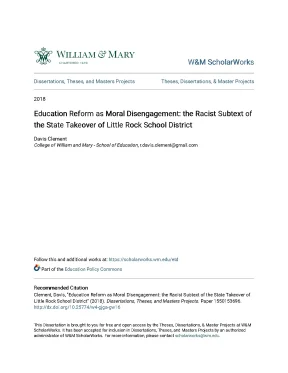
Tải xuống để đọc toàn bộW&M ScholarWorks Dissertations, Theses, and Masters Projects Theses, Dissertations, & Master Projects 2018 Education Reform as Moral Disengagement: the Racist Subtext of the State Takeover of Little Rock School District Davis Clement College of William and Mary - School of Education, r.com Follow this and additional works at: https://scholarworks.edu/etd Part of the Education Policy Commons Recommended Citation Clement, Davis, "Education Reform as Moral Disengagement: the Racist Subtext of the State Takeover of Little Rock School District" (2018). Dissertations, Theses, and Masters Projects.25774/w4-gjga-gw16 This Dissertation is brought to you for free and open access by the Theses, Dissertations, & Master Projects at W&M ScholarWorks. It has been accepted for inclusion in Dissertations, Theses, and Masters Projects by an authorized administrator of W&M ScholarWorks. For more information, please contact scholarworks@wm.
EDUCATION REFORM AS MORAL DISENGAGEMENT: THE RACIST SUBTEXT OF THE STATE TAKEOVER OF LITTLE ROCK SCHOOL DISTRICT ___________________________________________ A Dissertation Presented to The Faculty of the School of Education The College of William & Mary in Virginia ___________________________________________ In Partial Fulfillment Of the Requirements for the Degree Doctor of Philosophy ___________________________________________ by R. Davis Clement, II August 2018 EDUCATION REFORM AS MORAL DISENGAGEMENT: THE RACIST SUBTEXT OF THE STATE TAKEOVER OF LITTLE ROCK SCHOOL DISTRICT By R. Davis Clement, II ___________________________________________ Approved August 2018 by ______________________________________ Jason A. Chairperson of Doctoral Committee ______________________________________ Stephanie J.
______________________________________ Megan Tschannen-Moran, Ph. ii DEDICATION This dissertation is dedicated to Sherri Burks, principal at Little Rock Preparatory Academy from 2011 to 2012—a master teacher and true servant leader who helped me unlearn a lot of bad lessons and taught me to just trust the students. iv TABLE OF CONTENTS Dedication .x List of Tables. xii CHAPTER ONE: INTRODUCTION .2 Background: The Long Shadow of Central High .3 Problem: The Paradox of Reform .16 Definitions of Terms .17 CHAPTER TWO: LITERATURE REVIEW .20 The Landscape of Racism and Reform: A Context Model .21 Discursive mechanisms and influence .23 Hegemony and tools of thought .24 Policy Narratives of Education Reform .27 State of decline .27 Potential for recovery .35 Race, Psychology, and Politics .38 Social psychology and racism .42 Critical race policy analyses .45 Discrimination and the plausibility standard .54 CHAPTER THREE: METHOD .68 Accuracy and Trustworthiness of Analysis .70 vi Organizational level .71 Expert review and peer debriefing .72 CHAPTER FOUR: FINDINGS .74 What Harmful Acts Do These Discourses Concern? .75 Discourses on improvement .76 Meritocracy and marketization .78 Discourse on school choice .79 Resegregation and privatization .80 Discourse on community .81 Discrimination and white preference .83 Discourse on administration and governance .83 Disfranchisement of Black majority .86 Unconscious Racism and Discriminatory Intent .89 History of the case .91 Departures from norms .136 Distance from action .139 Defense as instigation .140 Self as victim .142 Victim as perpetrator .152 CHAPTER FIVE: DISCUSSION .155 viii Moral Disengagement as Intent .158 Limitations of the Study .165 Sympathies with actors .168 Relationships with actors .171 For education leaders .179 Appendix: Policy Actors .205 ix ACKNOWLEDGEMENTS First, to my parents, Ronnie and Vicki Clement, and my brother, Daniel Clement, thank you for your support, encouragement, and patience.
To Melanie Lichtenstein, my chief accountability partner: you should be writing! To Ufuk Erdogan, who changed my life by introducing me to Sci-Hub, and whose level of discipline and organization I will never achieve. To Diana Theisinger and Paige Hendricks, for taking me under your wings. To Lisa Horrell and Nicole Williams (the dream team), you will never be able to replace me in your hearts; thank you both for the coffee, the laughs, the incessant crying, and for talking so loudly everyone could hear our business. I would also like to thank Dr.
Melissa Martinez and Dr. Colleen Larson, my Clark Seminar mentors, for their early feedback on my proposal. Stephanie Blackmon, for pushing me to really clarify my research questions and for giving such rich feedback along the way. Jamel Donnor, for all the used books, for showing me the right direction, and for keeping it real.
Megan Tschannen-Moran, for introducing me to the field and for insisting that I have fun in my research. Jason Chen, thank you for putting up with my preludes (before telling me to delete them) and for demanding ruthless clarity and concision. Peggie Constantino, thank you for always listening, strategizing, and thinking aloud; and for treating me like a colleague. Michael DiPaola, for giving me sage advice that I frequently ignored to my own detriment, for letting me teach your classes, and for being a true mentor.
Abdul-Qadir Islam, I can’t imagine what writing this dissertation would have been like without you listening to me complain about Dr. Chen’s demands, for building me up, for holding me to my writing goals, and for keeping my eyes on the prize. x LIST OF TABLES Table 1. Percent of LRSD Students Scoring Proficient or Advanced on State Assessment, by Race.
Student Demographics of LRSD Compared to Little Rock Charter Schools. Concept Codes: Moral Disengagement. Orders of Discourse and Associated Harms. Framework of Moral Disengagement.
Moral Disengagement: Justification. Moral Disengagement: Comparison. Moral Disengagement: Euphemism. Amorphous Agents’ Actions.
Glossary of Sanitized Terms. Moral Disengagement: Diffusion. Moral Disengagement: Displacement. Moral Disengagement: Dismissal.
Moral Disengagement: Victim Blaming. Moral Disengagement: Dehumanization .147 xi ABSTRACT Public support for market-based education reforms persists despite evidence that these reforms exacerbate the educational marginalization of Black and Brown students. Even among Democrats and ostensibly equity-minded policy actors, support for reforms like charter schools is widespread. How do people come to support racially stratifying policies despite their supposed commitment to ethic of social justice? The purpose of this study was to investigate the relationship between the theories of unconscious racism (Lawrence, 1995a) and moral disengagement (Bandura, 1999) in the state takeover of a majority Black school district by a majority white state government.
Methods included a critical race analysis of Doe v. Arkansas Department of Education (2016) and a critical discourse study of the state takeover speech of elite white policy actors. Findings included two parallel appeals: to the legal precedent on which Lawrence based the theory of unconscious racism, from the court in Doe v. DOE; and to the mechanisms of moral disengagement, from white policy actors justifying the takeover.
It is therefore plausible that public support for racist education policies is a result of morally disengaging policy rhetoric, and that these policies are protected by strict legal obstacles to discrimination claims. Recommendations include increased political involvement on the part of school leaders, including principals; further critical policy studies of pre-adoption policy discourse and policy outcomes; and deeper interdisciplinary investigation of the moral disengagement of individual policy actors and citizens in an education policy arena. Davis Clement, II Department of Education Policy, Planning, & Leadership The College of William & Mary in Virginia xii EDUCATION REFORM AS MORAL DISENGAGEMENT: THE RACIST SUBTEXT OF THE STATE TAKEOVER OF LITTLE ROCK SCHOOL DISTRICT CHAPTER ONE Introduction Contemporary education reform, referred to ad nauseum as “the greatest civil rights challenge of our time” by at least the past four American presidents (Paige & Witty, 2010), has not only failed to produce the great equalizing education system that Horace Mann envisioned, it has increased social inequality and entrenched a market ideology in which those inequalities are seen as natural and acceptable (Dumas, 2013; Payne & Knowles, 2009; Rector-Aranda, 2016). Its biggest failures are well-known: school integration has been reversed (K.
Brown, 2005; Diem & Brooks, 2013); No Child Left Behind increased the numbers of children left behind (Hursh, 2007); and privately- run charter schools are draining funds from public school districts, despite showing little to no benefit to student achievement (Buras, 2011; Payne & Knowles, 2009; Winters, 2012). When policies are known to have racially stratifying effects, policy actors may define the issues in ways that absolve them and the public from culpability for those effects (Adamson & Darling-Hammond, 2012; Bohrnstedt, Kitmitto, Ogut, Sherman, & Chan, 2015; Gillborn, 2013a). These conceptualizations come to comprise the landscape of reform as policy actors set agendas based on public consent to “commonsense” reforms (Au & Apple, 2009; Gramsci, 1971). Theories of discourse, policy, and race suggest an underlying structure to these contradictions of education reform.
2 Discourse theory suggests that values and beliefs are developed through communication and social interaction, and these values and beliefs may benefit some groups and marginalize others (van Dijk, 2006b). Policies, which are constructed and communicated through discourse, codify power relations between groups and establish the limits of agency and restraint in society (Ball, 1994). Race itself is a “product of social thought and relations” (Delgado & Stefancic, 2012, p. 8) constructed to serve the interests of those in power; two such examples of social relations are discourse and policy.
The interrelated nature of race, discourse, and policy makes possible a study of the formation of education reform policy that accounts for the role of ideology in constructing race and difference. With these theoretical assertions in mind, I investigated the language of elite white policy actors in Little Rock, Arkansas—a school district with a well-known history of racist policy and race-based marginalization (Kirk, 2005; Shukur & Walker, 2017)—for ways in which their discourse around the 2015 state takeover of the school district concealed the dissonance between social justice-minded education reforms and racially stratified educational outcomes. Background: The Long Shadow of Central High In studies of race and policy, the context is broader than the immediate circumstance (Buras, 2013), meaning that whatever the specific policy question at hand—in the current case, state takeover—there are larger social relations and power implications at play. Conflict between local and statewide racial attitudes has influenced the landscape of education policy and reform in Little Rock for decades.
In the fall of 1957, Little Rock School Superintendent Virgil Blossom was preparing to implement the district plan for token integration (i., minimal compliance) of Little Rock schools (Kirk, 3 2005), in accordance with the Brown rulings, with approval from the Little Rock school board and the Little Rock political establishment, including the local chapter of the NAACP (Baer, 2008; Jacoway, 2007). As a self-contained policy arena, the politically moderate city of Little Rock was reluctantly pro-integration; national NAACP attorneys considered Little Rock to be a favorable testing ground for desegregation of Southern schools because of its mild racial climate relative to other Southern cities (Kirk, 2005). Little Rock’s White Citizen’s Council was disproportionately small compared to other similarly-sized Southern cities, and Little Rock voters had recently elected two integrationists to the school board just months prior (Baer, 2008). But the surrounding state of Arkansas was not so moderate (K.
Many north Arkansas towns with very few Black1 citizens had already fully integrated in response to Brown, but south Arkansas towns with larger or even majority Black populations remained fully segregated (Kirk, 2005). When Governor Orval Faubus ordered the Arkansas National Guard to block the integration of Central High School, the mayor of Little Rock said Faubus was stoking controversy to “create tensions where none existed” (Baer, 2008, p. 137) in an effort to boost his reelection chances with voters outside the more liberal-leaning capital city. In 1 I have kept with the convention of capitalizing Black and not white for ethical reasons, which I think are best explained by the following note from Toure’s Who’s Afraid of Post-Blackness? “I have chosen to capitalize the word ‘Black’ and lowercase ‘white’ throughout this book.
I believe ‘Black’ constitutes a group, an ethnicity equivalent to African-American, Negro, or, in terms of a sense of ethnic cohesion, Irish, Polish, or Chinese. I don’t believe that whiteness merits the same treatment. Most American whites think of themselves as Italian-American or Jewish or otherwise relating to other past connections that Blacks cannot make because of the familial and national disruptions of slavery. So to me, because Black speaks to an unknown familial/national past it deserves capitalization.
Nội dung được bảo vệ bản quyền — Tải xuống đầy đủ
Trích dẫn luận án này
R. Davis Clement, II (2018). Education reform as moral disengagement the racist subtext o [Luận án tiến sĩ, College of William & Mary]. LuanAn.net. https://luanan.net/ly-luan-va-lich-su-giao-duc/education-reform-as-moral-disengagement-the-racist-subtext-of-th
Câu hỏi thường gặp
Luận án "Education reform as moral disengagement the racist subtext o" nghiên cứu về vấn đề gì?
Cải cách giáo dục là sự vô cảm về đạo đức: phân tích văn bản phân biệt chủng tộc ngầm và tác động của nó.
Luận án "Education reform as moral disengagement the racist subtext o" được bảo vệ tại trường nào?
Luận án này được bảo vệ tại College of William & Mary. Năm bảo vệ: 2018.
Luận án "Education reform as moral disengagement the racist subtext o" thuộc chuyên ngành gì?
Luận án "Education reform as moral disengagement the racist subtext o" thuộc chuyên ngành Education Policy / Education. Danh mục: Lý Luận và Lịch Sử Giáo Dục.
Luận án "Education reform as moral disengagement the racist subtext o" có bao nhiêu trang?
Luận án "Education reform as moral disengagement the racist subtext o" có 219 trang. Bạn có thể xem trước một phần tài liệu ngay trên trang web trước khi tải về.
Cách tải luận án "Education reform as moral disengagement the racist subtext o" về máy như thế nào?
Để tải luận án về máy, bạn nhấn nút "Tải xuống ngay" trên trang này, sau đó hoàn tất thanh toán phí lưu trữ. File sẽ được tải xuống ngay sau khi thanh toán thành công. Hỗ trợ qua Zalo: 0559 297 239.