Dissertation katharina harsch 2021 online
Luận văn Katharina Harsch 2021 trực tuyến.
ESCP Business School Berlin
Wirtschaftswissenschaften (Kinh tế học / Quản trị kinh doanh)
Luan An
Luận án tiến sĩ
Năm xuất bản
Số trang
90
Thời gian đọc
14 phút
Lượt xem
0
Lượt tải
0
Phí lưu trữ
40 Point
Tổng quan nhanh
- Chủ đề:
- 1. Katharina Harsch Dissertation: Talent Management Insights 2021
- Số trang:
- 90 trang
- Trường:
- ESCP Business School Berlin
- Chuyên ngành:
- Wirtschaftswissenschaften (Kinh tế học / Quản trị kinh doanh)
- Tác giả:
- Katharina Harsch
- Năm:
- 2021
Tóm tắt nội dung luận án
I. Katharina Harsch Dissertation Talent Management Insights 2021
Đây là bản tóm tắt SEO cho luận án tiến sĩ của Katharina Harsch, công bố năm 2021. Luận án mang tên “A Multilevel Perspective on Talent Management – Qualitative Explorations and an Explanatory Framework”. Nghiên cứu này cung cấp cái nhìn sâu sắc về quản lý tài năng (TM) từ nhiều cấp độ khác nhau. Đây là một đóng góp học thuật quan trọng, xuất bản trực tuyến. Tài liệu này khám phá các khía cạnh phức tạp của TM trong bối cảnh kinh doanh hiện đại. Khán giả mục tiêu bao gồm các nhà nghiên cứu, học giả và chuyên gia thực hành quản lý nguồn nhân lực. Toàn văn luận án mang lại giá trị lớn cho lĩnh vực này. Việc truy cập bản điện tử luận án của Harsch rất thuận tiện. Luận án phản ánh sự phức tạp và năng động của môi trường kinh doanh toàn cầu hiện nay. Đây là một tài liệu học thuật đáng chú ý, cung cấp cái nhìn toàn diện về TM.
1.1. Phạm vi và trọng tâm của Luận án Tiến sĩ Harsch
Luận án tiến sĩ Katharina Harsch 2021 tập trung vào một góc nhìn đa cấp về quản lý tài năng. Nghiên cứu sử dụng các phương pháp định tính để xây dựng một khuôn khổ giải thích. Khái niệm tài năng và quản lý tài năng được định nghĩa rõ ràng. Luận án xem xét các yếu tố đầu vào xuất sắc (tiềm năng, khả năng, động lực) và đầu ra vượt trội (hiệu suất). Phạm vi quản lý tài năng được khám phá kỹ lưỡng, từ các yếu tố vĩ mô đến vi mô. Đây là một công trình nghiên cứu học thuật quan trọng.
1.2. Tầm quan trọng của Nghiên cứu Quản lý Tài năng 2021
Thu hút và giữ chân nhân tài là một thách thức lớn trong môi trường kinh doanh ngày nay. Luận án tiến sĩ Katharina Harsch nhấn mạnh sự cấp thiết của việc này. Môi trường hoạt động của các công ty ngày càng phức tạp và năng động. Số hóa, toàn cầu hóa và thay đổi nhân khẩu học tạo ra những yêu cầu mới. Nguồn cung nhân tài bị hạn chế trong khi nhu cầu tăng cao. Cuộc khủng hoảng COVID-19 cũng làm nổi bật những thiếu hụt về tài năng. Nghiên cứu này cung cấp các giải pháp và khuôn khổ cần thiết để đối phó với những thách thức này, làm cho tài liệu này trở thành một ấn phẩm học thuật Katharina Harsch rất kịp thời.
II. Quản lý Tài năng Đa cấp Harsch s Explanatory Framework
Trọng tâm của PhD thesis Katharina Harsch là phát triển một khuôn khổ giải thích đa cấp cho quản lý tài năng. Khung này giúp hiểu rõ hơn cách các cấp độ khác nhau tương tác. Luận án biện minh cho quản lý tài năng như một hệ thống lồng ghép. Quan điểm này mang lại sự rõ ràng cho một lĩnh vực vốn phức tạp. Nó mở rộng kiến thức hiện có về TM. Khung lý thuyết này là một đóng góp lớn cho 2021 academic research. Nó giúp các tổ chức định hình chiến lược TM hiệu quả hơn. Khung này cung cấp một cái nhìn toàn diện về các yếu tố ảnh hưởng đến TM. Đây là một phần cốt lõi của luận án điện tử Harsch.
2.1. Định nghĩa Quản lý Tài năng như một Hệ thống Lồng ghép
Luận án tiến sĩ Katharina Harsch 2021 lập luận rằng quản lý tài năng nên được coi là một hệ thống lồng ghép. Điều này có nghĩa là các cấp độ khác nhau của TM không hoạt động độc lập. Chúng ảnh hưởng lẫn nhau một cách liên tục. Việc hiểu mối quan hệ lồng ghép này là rất quan trọng để quản lý tài năng hiệu quả. Khái niệm này cung cấp một nền tảng lý thuyết vững chắc. Nó cho phép phân tích sâu hơn về các động lực của TM.
2.2. Khám phá các cấp độ Vĩ mô Trung mô và Vi mô trong TM
Khung đa cấp trong Luận án tiến sĩ Harsch bao gồm ba cấp độ chính: vĩ mô, trung mô và vi mô. Cấp độ vĩ mô liên quan đến bối cảnh quốc gia và ngành. Cấp độ trung mô tập trung vào tổ chức và bộ phận. Cấp độ vi mô xem xét các khía cạnh cá nhân của tài năng. Mỗi cấp độ có những yếu tố và thách thức riêng. Việc phân tích từng cấp độ giúp hiểu toàn diện về TM. Điều này là then chốt đối với mọi nghiên cứu về quản lý tài năng.
2.3. Mối quan hệ tương hỗ trong Mô hình Hệ thống TM Lồng ghép
Luận án tiến sĩ Katharina Harsch cũng khám phá các mối quan hệ tương hỗ giữa các cấp độ trong hệ thống TM lồng ghép. Các yếu tố ở cấp độ vĩ mô ảnh hưởng đến các chiến lược ở cấp độ trung mô. Ngược lại, hành động ở cấp độ vi mô có thể tác động đến toàn bộ hệ thống. Hiểu rõ những tương tác này giúp các tổ chức xây dựng các chiến lược TM liền mạch. Nó cho phép đưa ra các quyết định có thông tin chính xác hơn. Khung này cung cấp một bản đồ để điều hướng sự phức tạp của TM.
III. Thiết kế Nghiên cứu Khám phá Định tính của Katharina Harsch
Nghiên cứu của Katharina Harsch dissertation 2021 dựa trên các khám phá định tính. Phương pháp này cho phép đi sâu vào các hiện tượng phức tạp của quản lý tài năng. Nó cung cấp sự hiểu biết phong phú hơn về các quá trình. Luận án bao gồm ba bản thảo chính, mỗi bản thảo tập trung vào một khía cạnh cụ thể của TM. Phương pháp định tính được lựa chọn để nắm bắt các sắc thái và bối cảnh. Đây là một điểm mạnh của nghiên cứu học thuật này. Nó khác biệt so với các phương pháp định lượng truyền thống. Việc này đảm bảo tính toàn diện và sâu sắc. Luận án tiến sĩ Katharina Harsch sử dụng phương pháp luận chặt chẽ.
3.1. Các Giả định Bản thể học và Nhận thức luận Hướng dẫn Nghiên cứu
Nghiên cứu của Katharina Harsch được xây dựng trên các giả định bản thể học và nhận thức luận rõ ràng. Điều này đảm bảo tính chặt chẽ của phương pháp luận. Các giả định này hướng dẫn việc thu thập và phân tích dữ liệu. Chúng định hình cách hiểu về thực tại của quản lý tài năng. Luận án thừa nhận tính chủ quan và đa chiều của các hiện tượng xã hội. Cách tiếp cận này giúp tạo ra một bức tranh toàn diện và có chiều sâu. Đây là nền tảng cho 2021 academic research chất lượng cao.
3.2. Tổng quan về Ba Bản thảo cốt lõi trong Công trình của Harsch
Luận án bao gồm ba bản thảo độc lập nhưng bổ trợ lẫn nhau. Bản thảo thứ nhất tập trung vào quản lý tài năng vĩ mô ở Đức. Bản thảo thứ hai khám phá việc quản lý tài năng không thuộc gia đình (non-family talent). Bản thảo thứ ba nghiên cứu năng lực quản lý tài năng động và sự nhanh nhẹn của tổ chức. Mỗi bản thảo có trọng tâm, nền tảng lý thuyết và kết quả riêng. Cả ba bản thảo cùng nhau xây dựng một hiểu biết toàn diện về TM đa cấp. Đây là một yếu tố quan trọng của luận án tiến sĩ Katharina Harsch.
IV. Đóng góp Chính Harsch s Contribution to Talent Management
Luận án tiến sĩ Katharina Harsch cung cấp những đóng góp đáng kể cho lĩnh vực quản lý tài năng. Một khuôn khổ giải thích đa cấp được tổng hợp từ các phát hiện chính. Khung này giúp kết nối các khái niệm khác nhau về TM. Nó là một bước tiến trong việc hiểu sự phức tạp của việc quản lý tài năng. Những đóng góp này có cả giá trị lý thuyết và thực tiễn. Nghiên cứu này cung cấp các hướng dẫn cho các nhà quản lý và các học giả. Đây là một công trình học thuật xuất sắc. Những phát hiện này có thể được tìm thấy trong full text dissertation PDF. Đây là một phần quan trọng của 2021 academic research.
4.1. Tổng hợp các Phát hiện Chính Khung TM Đa cấp
Các phát hiện từ ba bản thảo được tổng hợp thành một khuôn khổ quản lý tài năng đa cấp. Khung này mô tả quản lý tài năng như một hệ thống lồng ghép. Nó làm rõ các mối quan hệ giữa cấp độ vĩ mô, trung mô và vi mô. Sự tổng hợp này cung cấp một cái nhìn toàn diện. Nó giúp giải thích cách các yếu tố khác nhau tương tác để định hình TM. Đây là đóng góp cốt lõi của Katharina Harsch doctoral thesis.
4.2. Đóng góp Lý thuyết và Thực nghiệm của Luận án
Luận án tiến sĩ Katharina Harsch 2021 có những đóng góp cả về mặt lý thuyết và thực nghiệm. Về lý thuyết, nó giới thiệu một khuôn khổ đa cấp sáng tạo. Nó làm sâu sắc thêm hiểu biết về TM như một hệ thống lồng ghép. Về thực nghiệm, nghiên cứu cung cấp bằng chứng định tính phong phú. Nó minh họa các khái niệm TM trong các bối cảnh khác nhau. Những đóng góp này mở ra những con đường mới cho nghiên cứu trong tương lai. Nó cũng cung cấp những hiểu biết có thể áp dụng cho thực tiễn kinh doanh.
V. Truy cập Luận án Tiến sĩ Katharina Harsch 2021 Toàn văn Trực tuyến
Full text dissertation PDF của Katharina Harsch hiện có sẵn để truy cập trực tuyến. Đây là một nguồn tài liệu quý giá cho bất kỳ ai quan tâm đến quản lý tài năng. Khả năng truy cập luận án trực tuyến giúp phổ biến kiến thức rộng rãi hơn. Nó thúc đẩy open access dissertation 2021. Bản điện tử luận án Harsch này có thể được tìm thấy trong các kho lưu trữ của trường đại học. Việc này đảm bảo rằng 2021 academic research có thể tiếp cận được. Người đọc có thể dễ dàng tải xuống và nghiên cứu tài liệu. Đây là một lợi ích lớn cho cộng đồng học thuật toàn cầu.
5.1. Cách tìm Toàn văn Luận án PDF
Để truy cập toàn văn luận án tiến sĩ Katharina Harsch 2021, người đọc nên tìm kiếm trong các kho lưu trữ của trường đại học ESCP Business School Berlin. Luận án thường được đăng tải trên các nền tảng học thuật và cơ sở dữ liệu quốc tế. Sử dụng các từ khóa như "Katharina Harsch dissertation 2021", "PhD thesis Katharina Harsch" hoặc "university repository Katharina Harsch" sẽ giúp định vị tài liệu nhanh chóng. Việc truy cập trực tuyến này giúp tiết kiệm thời gian và công sức cho các nhà nghiên cứu.
5.2. Lợi ích của Truy cập Luận án Trực tuyến cho Nghiên cứu
Online dissertation access mang lại nhiều lợi ích. Nó cho phép các nhà nghiên cứu trên toàn thế giới tiếp cận ngay lập tức với các công trình học thuật mới nhất. Điều này thúc đẩy sự hợp tác và trao đổi kiến thức. Nó cũng làm tăng tầm ảnh hưởng của scholarly publication Katharina Harsch. Việc có sẵn bản điện tử luận án Harsch giúp tăng cường sự minh bạch trong nghiên cứu. Nó tạo điều kiện thuận lợi cho việc kiểm chứng và mở rộng các phát hiện. Đây là một bước tiến quan trọng cho 2021 academic research.
Mục lục chi tiết luận án
Tải xuống file đầy đủ để xem toàn bộ nội dung
Tải đầy đủ (90 trang)Trích đoạn nội dung luận án
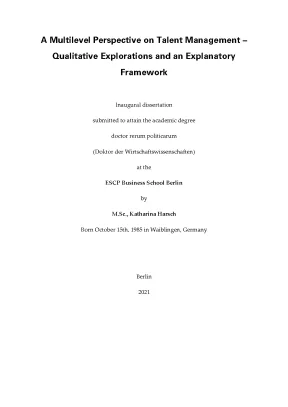
Tải xuống để đọc toàn bộA Multilevel Perspective on Talent Management – Qualitative Explorations and an Explanatory Framework Inaugural dissertation submitted to attain the academic degree doctor rerum politicarum (Doktor der Wirtschaftswissenschaften) at the ESCP Business School Berlin by M., Katharina Harsch Born October 15th, 1985 in Waiblingen, Germany Berlin 2021 Doctoral examination committee: Prof. Matthias Mrożewski Prof. Marion Festing Prof. Helen De Cieri Day of disputation: September 7, 2021 Table of Contents List of Figures.
III List of Tables. III List of Abbreviations. Relevance in business practice and research. Delimitations and definition of talent and talent management.
Definition of talent. Definition of talent management. Scope of talent management. The current state of research, and the aim of the thesis.
Talent management in different contexts. Outcomes and values of talent management. Theoretical frameworks in talent management research. The call for multilevel talent management research, and the aim of the thesis.
Fundamental elements of the multilevel perspective. Overview of the research manuscripts. Overview of Manuscript 1: Focus, theoretical foundations and findings. Overview of Manuscript 2: Focus, theoretical foundations and findings.
Overview of Manuscript 3: Focus, theoretical foundations and findings. Research designs and methods. Ontological and epistemological assumption. Manuscript 1: Macro talent management in Germany.
Manuscript 2: Managing non-family talent. Manuscript 3: Dynamic talent management capabilities and organisational agility. Multilevel talent management – synthesis of the key findings and an explanatory framework. Theoretical justification for talent management as a nested system.
The three levels of talent management as a nested system. The macro level. The meso level. The micro level.
Interrelations within the nested talent management system. Influence of the macro level. Influence of the meso level. Influence of the micro level.
Conceptual and empirical contribution. Limitations and implications for further research. 70 II List of Figures Figure 1: Multilevel nesting arrangement. 23 Figure 2: Levels of talent management examined by the manuscripts.
26 Figure 3: Conceptual macro talent management framework. 28 Figure 4: Talent management as a nested system. 48 Figure 5: The macro level of talent management as a nested system. 49 Figure 6: The meso level of talent management as a nested system.
51 List of Tables Table 1: Overview of the manuscripts. 25 III List of Abbreviations CEO(s) chief executive officers (CEOs) DMGT Differentiated Model of Giftedness and Talent Ed(s). editor(s) et al. et alii (and others) etc.
exempli gratia (for example) EUR Euro (currency) EIASM European Institute for Advanced Studies in Management GLOBE global leadership and organisational behaviour effectiveness HR human resources HRM human resource management i. id est (that is) MNE(s) multinational enterprise(s) NFT(s) non-family talent(s) SME(s) small- and medium-sized enterprise(s) TM talent management IV 1. Introduction Talents are considered a key source of sustainable competitive advantage for companies (Collings & Mellahi, 2009; Gallardo-Gallardo, Thunnissen, & Scullion, 2020; Sparrow & Makram, 2015), and they are characterised by both excellent inputs, i. potential, ability and motivation, and outstanding outputs in the form of performance (Gallardo-Gallardo & Thunnissen, 2016).
Even though it is two decades since talent management (TM) was introduced as a hot topic in business practice (Chambers, Foulon, Handfield-Jones, & Michaels, 1998), the attraction and retention of talent is now more topical than ever, and it is seen as one of the most important human resource (HR) functions (Strack, 2014), as the filling of key positions (Collings & Mellahi, 2009) is both a success factor and an increasing challenge for companies (Gallardo-Gallardo, et al., 2020; KPMG, 2019; McDonnell, Collings, Mellahi, & Schuler, 2017). The environment in which companies operate today is exemplified by an unprecedented level of complexity and dynamism, advancing digitisation, increasing globalisation and socio-economic and demographic changes increasing demand and shortening the supply of talent, due to new requirements they need to fulfil (PwC, 2014, 2019). This makes the availability of suitable talent not only all the more important, but also significantly more difficult to achieve (Gallardo-Gallardo, et al., 2020; Schwartz, Collins, Stockton, Wagner, & Walsh, 2017). The current Covid-19 crisis has resulted in special challenges in this regard, and talent deficits are becoming more apparent (Caligiuri, De Cieri, Minbaeva, Verbeke, & Zimmermann, 2020).
TM’s mission is to provide companies with the right talent, i. to attract, select, develop and retain them, in order to meet specific company needs (Collings & Mellahi, 2009; Stahl et al. Thus, TM creates value and contributes to the competitive advantage of a company through the appropriate reconfiguration of the talent resource (Collings, Mellahi, & Cascio, 2019; Harsch & Festing, 2020; Linden & Teece, 2014; Sparrow & Makram, 2015). 1 TM is a rapidly growing field of research that has made some progress in the last decade.
Research to date has mainly focused on the definition of talent and TM, as well as its practices, their implementation and effects in a wide variety of contexts (Gallardo-Gallardo & Thunnissen, 2016; McDonnell, et al., 2017; Thunnissen & Gallardo-Gallardo, 2019). Today, there is broad consensus that TM is context- dependent (Sparrow & Makram, 2015; Sparrow, Vaiman, Schuler, & Collings, 2019; Thunnissen, Boselie, & Fruytier, 2013b) and shows up in different orientations, talent definitions and practices in relation to a range of environments, companies or target groups. Hence, TM effectiveness seems to depend on alignment with the context in which it is embedded (King & Vaiman, 2019) and, albeit indirectly, on the talent on which the emphasis is placed (Thunnissen, 2016). This assumption corresponds with the ‘best fit’ approach to TM (Gallardo-Gallardo, et al., 2020), which is based on contingency theory (Drazin & Van de Ven, 1985; Van de Ven & Drazin, 1985).
However, the influences on TM, in particular of different factors on several levels, as well as their interrelationships, have not yet been sufficiently investigated (Gallardo- Gallardo, et al. To date, the TM system at the macro (i. the country) level and its influence on TM on the organisational level have been largely neglected in TM research (Khilji & Schuler, 2017; Khilji, Tarique, & Schuler, 2015). Furthermore, the influence and interaction between several differentiating organisational contextual factors at the meso level, such as organisational culture, structure or ownership, also do not seem to have been sufficiently illuminated, and a further contextualisation of TM should therefore be sought (Sparrow & Makram, 2015; Sparrow, Scullion, & Tarique, 2014).
Additionally, talent at the micro (i. individual) level and its influence on TM at the organisational level have not been given sufficient importance in research (Collings, 2014; Farndale, Pai, Sparrow, & Scullion, 2014; Thunnissen, 2016). Overall, increasingly more researchers are calling for multilevel TM research that also takes into account the interrelationships between the levels, in order to attain a more comprehensive understanding of the phenomenon (Collings, 2014; Gallardo-Gallardo, et al. TM research in this regard is only at the beginning, and so far only a few academics have viewed the topic from a multilevel perspective (for instance Collings, et al., 2019; Muratbekova-Touron, Kabalina, & Festing, 2018).
This thesis seeks to contribute to the field in these respects. The overarching aim of this thesis is to draw a comprehensive picture of TM and to explore and explain what factors on the macro, meso and micro levels influence it, and vice versa. Taking a multilevel perspective, incorporating influencing factors on multiple levels and explaining their interrelations as well as their influences on TM at the organisational level and its effects should lead to recommendations for actions. To reach this research goal, the following three manuscripts, which this thesis comprises, investigate different aspects in this regard: ▪ Manuscript 1 deals with macro TM in the German context and compiles information on a number of environmental contextual factors, such as cultural and socio-economic conditions and macro TM functions and processes, as well as macro TM outcomes.
▪ Manuscript 2 takes a multilevel perspective and examines TM in the German- speaking region in the context of family businesses, concentrating solely on non- family members. Based on empirical findings from qualitative interviews with owners and non-family top managers of family businesses, and a conceptual examination using stewardship theory, a framework is suggested that incorporates influencing factors on the micro, meso and macro levels and thus explains TM in this specific context. ▪ Manuscript 3, as a qualitative cross-level study, focuses on macro- and meso-level factors. It examines the influence and interrelations of a dynamic, competitive environment and internal agility differentiating factors on organisational TM and its contribution to organisational agility – and thus the potential to add to competitive advantage – by applying dynamic capabilities theory to TM research.
3 The key findings of the manuscripts are synthesised and enriched with findings from the latest TM research while taking a multilevel perspective and considering the principles of contingency theory. As a result, a framework is developed that incorporates factors on the macro, meso and micro levels and explains their interactions and their influence on organisational TM, as well as value creation. Therefore, this thesis not only contributes conceptually and empirically to the research field of TM through the individual three manuscripts, but it also offers a multilevel perspective on TM in the form of an explanatory framework. The remainder of the thesis is as follows.
In Chapter 2, the relevance of TM in business practice and in academia is outlined, the definition of talent and TM and its scope is discussed and a rough overview of the current state of TM research is provided, with a focus on the research gaps addressed by this thesis. This is followed in Chapter 3 by an outline of the theoretical foundations of multilevel research. Chapter 4 gives an overview on the three manuscripts regarding research focus, theoretical foundations and findings before the research design and method as well as ontological and epistemological assumptions are discussed. The three manuscripts are then presented in Chapter 5.
In the following Chapter 6, the key findings taken from the three manuscripts are synthesised and enriched with current research on TM, taking the lens of contingency theory to develop an explanatory framework for TM that considers influencing factors at the macro, meso and micro levels, as well as their interrelationships, thus providing a comprehensive picture of the phenomenon under investigation. Chapter 7 finally deals with the contribution made by this thesis, its limitations and implications for further research as well as managerial practice. Relevance in business practice and research TM is one of the most discussed HR-related topics in business practice and in academia in recent years, as the attraction and retention of suitable employees for key positions contribute significantly to the success of a company (Collings, et al., 2019; PwC, 2019; Schwartz, et al. Around two decades ago, McKinsey management consultants opened the debate when they pointed out that social developments such as demographic changes in many developed countries, e.
falling birth rates and an aging workforce, as well as changing demands on employees due to the increasingly complex and dynamic economy would lead to a 'war for talent' (Chambers, et al. These developments are still present, and the talent shortage problem is acute. Due to increasing global competition, faster changes in customer needs and markets and the growing importance of digitalisation, companies lack respective highly competent employees (McDonnell, et al. Furthermore, the workforce today is increasingly diverse, which in addition to many advantages also brings challenges regarding the attraction and retention of such individuals when dealing with different values and needs (Festing & Schäfer, 2014; McDonnell, et al.
Hence, there are several factors – on multiple levels – fuelling interest in the topic of TM, and they will probably continue to do so in the future. Reports and studies by major business consultancies on current challenges and trends in this area are published annually.
Nội dung được bảo vệ bản quyền — Tải xuống đầy đủ
Trích dẫn luận án này
Katharina Harsch (2021). Dissertation katharina harsch 2021 online [Luận án tiến sĩ, ESCP Business School Berlin]. LuanAn.net. https://luanan.net/ly-luan-va-lich-su-giao-duc/dissertation-katharina-harsch-2021-online
Câu hỏi thường gặp
Luận án "Dissertation katharina harsch 2021 online" nghiên cứu về vấn đề gì?
Luận văn Katharina Harsch 2021 trực tuyến.
Luận án "Dissertation katharina harsch 2021 online" được bảo vệ tại trường nào?
Luận án này được bảo vệ tại ESCP Business School Berlin. Năm bảo vệ: 2021.
Luận án "Dissertation katharina harsch 2021 online" thuộc chuyên ngành gì?
Luận án "Dissertation katharina harsch 2021 online" thuộc chuyên ngành Wirtschaftswissenschaften (Kinh tế học / Quản trị kinh doanh). Danh mục: Lý Luận và Lịch Sử Giáo Dục.
Luận án "Dissertation katharina harsch 2021 online" có bao nhiêu trang?
Luận án "Dissertation katharina harsch 2021 online" có 90 trang. Bạn có thể xem trước một phần tài liệu ngay trên trang web trước khi tải về.
Cách tải luận án "Dissertation katharina harsch 2021 online" về máy như thế nào?
Để tải luận án về máy, bạn nhấn nút "Tải xuống ngay" trên trang này, sau đó hoàn tất thanh toán phí lưu trữ. File sẽ được tải xuống ngay sau khi thanh toán thành công. Hỗ trợ qua Zalo: 0559 297 239.