Coleman latta dissertation final final for submission 9 9 20
Luận văn của Coleman Latta, bản cuối cùng, sẵn sàng nộp ngày 9/9/2020. Chủ đề chi tiết và kết quả nghiên cứu.
Xavier University
Leadership Studies
Luan An
Luận án tiến sĩ
Năm xuất bản
Số trang
66
Thời gian đọc
10 phút
Lượt xem
0
Lượt tải
0
Phí lưu trữ
40 Point
Tổng quan nhanh
- Chủ đề:
- 1. Ohio's CCP Program: Impact on College Success Examined
- Số trang:
- 66 trang
- Trường:
- Xavier University
- Chuyên ngành:
- Leadership Studies
- Tác giả:
- Joshua Randall Coleman
- Năm:
- 2020
Tóm tắt nội dung luận án
I. Ohio s CCP Program Impact on College Success Examined
The Coleman Latta dissertation examines Ohio's College Credit Plus (CCP) program. This program, implemented in the 2015-2016 school year, offers high school students college credits. The PhD thesis 2020 investigates CCP's influence on college success. Success is measured by first-year GPA upon university matriculation. This academic research Coleman Latta explores unique features of the CCP program. It aims to determine specific relationships between program participation and student outcomes. The final dissertation submission provides critical insights for educators and policymakers. Understanding these impacts helps optimize student preparedness and academic transitions. This scholarly work submission contributes significantly to discussions on accelerated learning pathways.
1.1. CCP Program Overview and Research Focus
The College Credit Plus (CCP) program allows students to earn college credits in high school. This initiative provides unique opportunities for early college exposure. The Latta doctoral thesis specifically examines three features of CCP. The study investigates how these features relate to a participant's future college success. Focus remains on tangible academic results. This research addresses long-standing challenges in preparing students for higher education. The academic writing final version highlights a prevailing strategy for improving college readiness nationwide.
1.2. Measuring College Success First Year GPA
College success is quantified by the first-year GPA. This metric provides a clear, objective measure of academic performance. Upon matriculation at a university, student GPA is tracked. The study uses this data to assess the CCP program's impact. This approach offers a direct correlation between early credit programs and subsequent academic achievement. The dissertation guidelines mandate clear outcome measures. The selected metric allows for rigorous statistical analysis. It offers a robust indicator for evaluating program effectiveness.
1.3. Dissertation Final Submission 2020 Context
This document represents the final dissertation submission from Joshua Randall Coleman. It was submitted in August 2020. Dr. Latta supervised this significant academic work. The PhD thesis 2020 fulfills requirements for a Doctor of Education degree. This graduate studies Latta contributes new knowledge to leadership studies. The university dissertation archive will house this comprehensive research. The scholarly work submission follows strict academic protocols. It reflects years of dedicated research and writing.
II. Key Findings CCP Credit Hours Coursework Impact
Correlational analysis revealed significant relationships. The number of credit hours completed through CCP positively correlated with first-year GPA. This finding indicates a tangible benefit of increased CCP participation. The Latta doctoral thesis provides empirical evidence for these connections. Course type also demonstrated a positive significant relationship. Both General Education and Career Pathway courses showed influence. These results offer specific insights into program strengths. The academic research Coleman Latta meticulously processed data to uncover these findings. The study contributes valuable data for ongoing educational reforms.
2.1. Correlational Analysis Credit Hours and GPA
Correlational analysis was the primary statistical method. It examined relationships between dependent and independent variables. A strong, positive relationship existed between CCP credit hours and first-year GPA. Students completing more CCP credits tended to have higher GPAs. This suggests a direct academic advantage for active CCP participants. The findings align with the purpose of accelerated credit programs. This part of the Coleman Latta dissertation provides actionable data.
2.2. Course Type Influence General Education vs. Career Pathway
The study analyzed the impact of different course types. General Education and Career Pathway courses were examined. Both types showed a positive significant relationship with first-year GPA. However, a Fisher's Z-Test found no significant difference between their impacts. This indicates both types of CCP coursework contribute similarly to college success. The analysis confirms the broad benefits of diverse CCP offerings. This scholarly work submission explores nuance in program design.
2.3. Latta Doctoral Thesis Research Contributions
The Latta doctoral thesis makes significant contributions to educational research. It provides empirical data on a critical state-level program. The findings clarify the benefits of early college credit. This work supports informed decision-making for policymakers and school administrators. The study's rigor reinforces its findings. This academic writing final version adds a key piece to the larger body of knowledge on college readiness and acceleration programs. It also sets a benchmark for future research.
III. Methodology Data Academic Research Coleman Latta
The academic research Coleman Latta utilized specific data. The Ohio Department of Higher Education compiled and granted access to this data file. Jill Dannemiller served as a key liaison. The study employed a correlational design. This methodology investigated existing relationships between CCP participation and college success. Independent variables included the number of CCP credit hours and course types. The dependent variable was first-year GPA. Human Subject Protections (IRB) were strictly adhered to. Assumptions and potential research biases were thoroughly considered. This scholarly work submission upholds rigorous academic standards.
3.1. Data Sources and Access Ohio Department of Higher Education
The Ohio Department of Higher Education provided crucial data. This comprehensive data file enabled the study's analysis. Accessing this information required collaboration and approval. The department's assistance was instrumental. This data formed the foundation for the Latta doctoral thesis. Reliability and breadth of data ensured robust analysis. This partnership exemplifies how state agencies can support graduate studies Latta and academic inquiry.
3.2. Research Approach and Variables
The study utilized a correlational research approach. This method identifies statistical relationships between variables. Independent variables included the total CCP credit hours completed. The type of CCP coursework (General Education or Career Pathway) was also an independent variable. First-year GPA served as the single dependent variable. This clear delineation of variables allowed for focused analysis. The research design is outlined in the Coleman Latta dissertation.
3.3. Scholarly Work Submission and Review Process
The dissertation committee provided invaluable insight and encouragement. Dr. Shirley Curtis and Dr. David Tobergte contributed significantly. Dr. Latta, the dissertation advisor, guided the entire process. Her tireless work ensured project completion. The scholarly work submission underwent thorough review. This process adheres to strict dissertation guidelines. It guarantees the academic integrity and quality of the PhD thesis 2020. The final academic writing final version reflects this collaborative effort.
IV. Implications Future Research Graduate Studies Latta
The study offers significant interpretations of its findings. Increased CCP credit hours positively influence first-year GPA. Both types of CCP courses contribute to this success. These results carry important implications for educational stakeholders. Policy decisions regarding accelerated credit programs can benefit from this data. The graduate studies Latta recommends several avenues for future research. This will further enhance understanding of CCP's long-term impacts. The university dissertation archive gains a valuable resource. The academic writing final version prompts continued scholarly inquiry.
4.1. Interpretations of Study Findings
The research indicates a clear positive association. More CCP engagement correlates with better initial college performance. This supports the value proposition of the CCP program. It suggests students gain measurable advantages. The interpretations inform conversations about college readiness strategies. These insights from the Coleman Latta dissertation are critical for program evaluation. They highlight the program's role in easing the high school-to-college transition.
4.2. Practical Implications for Education Policy
The findings hold practical implications for education policy. Policymakers can leverage this data to strengthen CCP programs. Enhancing access to CCP credits appears beneficial for student outcomes. Emphasis on either General Education or Career Pathway courses can continue. Both contribute to college success. The Latta doctoral thesis provides an evidence base for program advocacy and resource allocation. This helps shape effective educational strategies.
4.3. Suggestions for Future Academic Writing
Future research could explore several areas. Long-term college success beyond the first year warrants investigation. Examining the impact of CCP on specific student demographics is also valuable. The study initially aimed to analyze the number of years spent in CCP. Data limitations prevented this; future studies could address it. This PhD thesis 2020 establishes a foundation for ongoing academic research Coleman Latta. It guides subsequent inquiries into accelerated credit programs.
Mục lục chi tiết luận án
Tải xuống file đầy đủ để xem toàn bộ nội dung
Tải đầy đủ (66 trang)Trích đoạn nội dung luận án
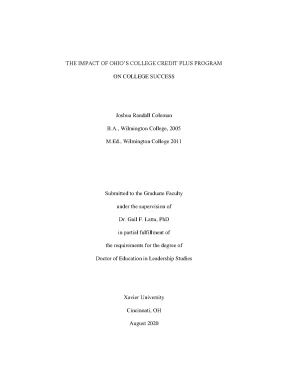
Tải xuống để đọc toàn bộTHE IMPACT OF OHIO’S COLLEGE CREDIT PLUS PROGRAM ON COLLEGE SUCCESS Joshua Randall Coleman B., Wilmington College 2011 Submitted to the Graduate Faculty under the supervision of Dr. Latta, PhD in partial fulfillment of the requirements for the degree of Doctor of Education in Leadership Studies Xavier University Cincinnati, OH August 2020 EXAMINATION OF CCP AND COLLEGE SUCCESS i EXAMINATION OF CCP AND COLLEGE SUCCESS THE IMPACT OF OHIO’S COLLEGE CREDIT PLUS PROGRAM ON COLLEGE SUCCESS Joshua Randall Coleman Dissertation Advisor: Gail F. Abstract The College Credit Plus (CCP) program, adopted and implemented by the state of Ohio in the 2015-2016 school year, presents some unique opportunities for examining the impact of accelerated college credit on preparing students for success in college. This study attempts to examine three of these unique features to examine the relationship that the CCP program might have on its participants’ success in college, measured by first year GPA upon matriculation at a university.
Correlational analysis was first applied to examine any relationships that might exist among the dependent and independent variables. The number of credit hours a student completed through CCP demonstrated a positive significant relationship with first year GPA, while the type of course work (General Education and Career Pathway) demonstrated a positive significant relationship but no significance was found between the two types of courses according to a Fisher’s Z-Test. The researcher wanted to examine the number of years spent taking CCP courses to see if the amount of exposure of time to these types of courses demonstrated any relationship, but the data could not be determined to examine that relationship. ii EXAMINATION OF CCP AND COLLEGE SUCCESS Acknowledgments The author would like to acknowledge the Ohio Department of Higher Education for compiling and granting access to the data file used in analysis for this study, in particular Jill Dannemiller who worked with us as liaison and kept pushing to get the data request approved.
The author would also like to acknowledge the dissertation committee members, Dr. Shirley Curtis and Dr. David Tobergte for their insight, encouragement, and assistance in the dissertation process, and especially Dr. Latta, my dissertation advisor, for her tireless work in navigating the dissertation process, editing, and finding a way to persevere when it looked like this study might not be possible.
Thanks also go out to all of the Leadership Studies faculty. Most of all the author wishes to thank and acknowledge his family, especially his wife and children, who adjusted schedules to provide time to research and write, dealt with the hours locked in the office, and put up with a grouchy husband and father when things got to be too much. Thank you to everyone who helped make this study possible. iii EXAMINATION OF CCP AND COLLEGE SUCCESS Table of Contents Chapter 1 – Overview of the Study…………………………………………………….
Research Topic and Background…………………………. Statement of the Problem. Purpose of the Study. Definition of Terminology.
Significance of Study. Organization of Study.13 Chapter 2 – Literature Review…………………………………………………………. Need for Accelerated Credit. Models of Accelerated Credit Programs.
Previous Study Contributions. Population and Data Sources. Human Subject Protections (IRB). Assumptions and Research Bias.38 Chapter 4 – Data Analysis……………………………………………………………….
Summary of Findings.45 Chapter 5 – Interpretation and Implications……………………………………………. Interpretations of Research Questions. Discussion of Implications.49 iv EXAMINATION OF CCP AND COLLEGE SUCCESS C. Suggestions for Future Research.54 v EXAMINATION OF CCP AND COLLEGE SUCCESS List of Figures Figure 1 – Theoretical Framework …….………………8 Figure 2 – Theoretical Framework……………………………………………….32 vi EXAMINATION OF CCP AND COLLEGE SUCCESS List of Tables Table 1 – Descriptive Statistics…………………………………………………….42 Table 2 – Correlation Analysis of CCP Hours and GPA………………………….43 Table 3 – Correlation Analysis of General Education Courses and GPA…………….43 Table 4 – Correlation Analysis of Career Pathway Courses and GPA……………….44 Table 5 – Logistical Regression Model…………………………………………………45 vii EXAMINATION OF CCP AND COLLEGE SUCCESS Chapter 1 OVERVIEW OF THE STUDY Research Topic and Background Previous Dual Enrollment Research The issue of better preparing students for transitioning from high school to an institute of higher education (IHE) has been plaguing American schools for decades.
Hebert (2001) indicates that efforts to address this issue can be traced back as early as 1971. Many attempts to improve college readiness have been developed over the year at the national level (Luna, Rush, Gramer, and Stewart, 2014). One prevailing strategy developed to help better prepare students to be successful in college upon graduating high school is to offer an opportunity for students to earn college credits while still in high school. This option has taken many forms, under multiple names including Post- Secondary Enrollment Option (PSEO), Dual Enrollment (DE), Joint Enrollment, and Concurrent Enrollment, all of which can be applied to courses where students are taking college courses while in high school.
College courses taken prior to high school graduation may be taken on or off the college campus: College in High School are college courses offered in the high school setting; Dual Credit specifically refers to courses that will count towards both high school requirements and college course work requirements (Hoffman, Vargas, and Santos; 2009). Other accelerated credit options include Advanced Placement (AP) and International Baccalaureate (IB), which offer other methods of earning college credit in the high school setting. Various studies such as those by Hoffman, Vargas, and Santos (2009); Shaw (2014); Kanny (2015); Pierson, Hodara, and Luke (2017); and Vargas, 1 EXAMINATION OF CCP AND COLLEGE SUCCESS Hooker, and Gerwin, (2017) have been conducted on each of these different types of accelerated credit programs showing that they have a tendency to greatly improve college readiness and student confidence. Each of these programs demonstrates its own benefits and drawbacks, but up to this point, no program in the state of Ohio had attempted to collect all of these options under a single umbrella until the creation of Ohio’s College Credit Plus program.
College Credit Plus College Credit Plus (CCP) is a program which was instituted in the state of Ohio to fulfill the requirements of Ohio Revised Code (ORC) section 3365.15 and went into effect in the 2015-2016 school year (CCP 2018 Report). According to recommendations for the program by Chancellor of the Ohio Department of Higher Education, John Carey (2014), the CCP program is defined as a program that, will govern those arrangements where a student is engaged in nonsectarian, non- remedial educational coursework while in high school that automatically results in transcripted high school and college credit at the successful conclusion of that coursework…[and] will be the primary mechanism to pay for earned, transcripted college credit while in high school…” (pg. The recommendations also distinguish Advanced Placement (AP) and International Baccalaureate (IB) programs that are not recommended to be counted as CCP course options. The CCP initiative has replaced all other Dual Enrollment options in Ohio public schools (Carey, 2014).
The function of this program is to provide gateways to college credit for high school students to enhance college readiness and to ease financial burdens, 2 EXAMINATION OF CCP AND COLLEGE SUCCESS making college a viable pathway for all Ohio students. Nearly all funding is paid for by the state of Ohio; however, students in private schools or home school students may encounter some fees. This includes the cost of tuition, fees, instructor pay, and books. All public-school students admitted to public universities will always have zero costs for their CCP courses.
Private universities can negotiate with secondary schools to determine the cost to students based on a formula used to determine a minimum and maximum price range. All public schools are required to offer two pathways through the CCP program: one that results in 15 transcripted credit hours of accumulation, and one that results in 30 transcripted credit hours of accumulation (Carey, 2014). The courses offered in these pathways must contribute to a degree or a professional certificate. Ohio students may enroll in any college and in any courses they wish as long as the courses selected contribute to a degree or professional certificate and as long as all pre-requisites for their chosen course are met; only remedial courses are not permitted to be taken as a part of CCP.
These students have the option to attend classes at their high school taught by either post-secondary faculty member or a certified secondary faculty member, attend class on the college campus, or take the courses online. Courses offered that take place off the college campus must be the same as the courses that take place on campus. Secondary faculty teaching CCP courses must be provided annual professional development by the sponsoring post-secondary institute, and the partnering post-secondary institute must conduct at least one observation of all courses taught to ensure that they match the quality and culture of the post-secondary course. 3 EXAMINATION OF CCP AND COLLEGE SUCCESS Those students that apply for post-secondary courses must be deemed college ready (Carey, 2014).
This measurement may be determined by a remediation free score on a standardized instrument designed to measure college readiness, such as the ACT, Compass, or Accuplacer test. However, in order to better meet the spirit of the function of the CCP program, schools must also look at a wholistic profile of the applicants, including GPA and teacher recommendations. Once accepted, students may earn up to 30 transcripted credit hours a year, and up to 120 transcripted credit hours throughout their enrollment period in the program which may begin as early as 7th grade. CCP also stipulates that when students graduate from their secondary education and enroll in college that they do so as first year student status for sake of determining scholarship eligibility, housing, and any other considerations.
Statement of the Problem Because Ohio’s new CCP program will be replacing all of the dual enrollment options in Ohio schools, there is a need for scholarly research to determine the program’s effectiveness in preparing students for the college experience. Currently, there is little scholarly research, currently consisting of two dissertations by Wilson (2016) and Roberts (2019) and an article by Dever (2017), to develop a clear understanding of what effects the various aspects of individualization of this program has on its participants’ preparation for enrolling and being successful in college. There is a need for research to help determine what CCP factors contribute to a significant impact on a student’s readiness for completing a college program. The flexibility of the program affords researchers a wide range of variables to study, with the goal of identifying aspects of the program that enable students to identify a pathway to achieve desired outcomes.
4 EXAMINATION OF CCP AND COLLEGE SUCCESS While schools do build out a 15-credit hour pathway and a 30-credit hour pathway, these are merely ready-made examples for students to take or at least to use as a model for how to build their own path. Students have the option of building any sort of schedule they wish beginning as early as 7th grade. Reports from CCP (2017) show that the average number of hours students took during the 2016-2017 school year was 2.58 credit hours of course work. Harper, current Director of the College Credit Plus program, has indicated a rise in the number of students taking course loads that qualify them as full-time enrollment status (personal communication, 9/20/2018).
While Adelman (2006) reports that students who earn at least 20 credit hours of course work in their first year of college increases the likelihood of persistence towards a degree, it is unclear how this trend would be influenced by credit hours gained prior to enrollment, nor does it address how this might influence student success in relation to performance. It is also reported that students who fall in to the top 40% GPA in the first year are more likely to persist (Adelman, 2006), but it is not clear how credit hours earned, and GPA interact with each other. There is a need to understand the impact students’ course loads prior to matriculation has on their future post-secondary success.
Nội dung được bảo vệ bản quyền — Tải xuống đầy đủ
Trích dẫn luận án này
Joshua Randall Coleman (2020). Coleman latta dissertation final final for submission 9 9 20 [Luận án tiến sĩ, Xavier University]. LuanAn.net. https://luanan.net/ly-luan-va-lich-su-giao-duc/coleman-latta-dissertation-final-final-for-submission-9-9-20
Câu hỏi thường gặp
Luận án "Coleman latta dissertation final final for submission 9 9 20" nghiên cứu về vấn đề gì?
Luận văn của Coleman Latta, bản cuối cùng, sẵn sàng nộp ngày 9/9/2020. Chủ đề chi tiết và kết quả nghiên cứu.
Luận án "Coleman latta dissertation final final for submission 9 9 20" được bảo vệ tại trường nào?
Luận án này được bảo vệ tại Xavier University. Năm bảo vệ: 2020.
Luận án "Coleman latta dissertation final final for submission 9 9 20" thuộc chuyên ngành gì?
Luận án "Coleman latta dissertation final final for submission 9 9 20" thuộc chuyên ngành Leadership Studies. Danh mục: Lý Luận và Lịch Sử Giáo Dục.
Luận án "Coleman latta dissertation final final for submission 9 9 20" có bao nhiêu trang?
Luận án "Coleman latta dissertation final final for submission 9 9 20" có 66 trang. Bạn có thể xem trước một phần tài liệu ngay trên trang web trước khi tải về.
Cách tải luận án "Coleman latta dissertation final final for submission 9 9 20" về máy như thế nào?
Để tải luận án về máy, bạn nhấn nút "Tải xuống ngay" trên trang này, sau đó hoàn tất thanh toán phí lưu trữ. File sẽ được tải xuống ngay sau khi thanh toán thành công. Hỗ trợ qua Zalo: 0559 297 239.