Boyer final dissertation
Luận án tiến sĩ cuối cùng của Boyer.
University of Michigan-Dearborn
Luan An
Luận án tiến sĩ
Năm xuất bản
Số trang
436
Thời gian đọc
1 giờ 6 phút
Lượt xem
0
Lượt tải
0
Phí lưu trữ
60 Point
Tổng quan nhanh
- Chủ đề:
- 1. Unpacking Educational Leadership and Strategic Capital
- Số trang:
- 436 trang
- Trường:
- University of Michigan-Dearborn
- Chuyên ngành:
- Educational Leadership
- Tác giả:
- K. Page Boyer
- Năm:
- 2016
Tóm tắt nội dung luận án
I. Unpacking Educational Leadership and Strategic Capital
This dissertation introduces a critical re-examination of higher education research. Historically, studies on socioeconomic status (SES) and social capital rely heavily on quantitative data. This quantitative focus provides ample demographic and economic information. However, it often misses nuanced understandings. Specifically, the intricate dynamics of social networks and 'strategic capital' remain underexplored. This gap in qualitative inquiry limits a complete picture. The study identifies a need for deeper qualitative insights. It seeks to illuminate how strategic capital functions within educational leadership contexts. This approach aims to move beyond simple correlations. It investigates the mechanisms through which leaders leverage various forms of capital. This research offers a fresh perspective. It challenges existing paradigms in educational administration and leadership theory.
1.1. Defining the Core Problem in Higher Education Research
Historical research on socioeconomic status (SES) and social capital in higher education predominantly uses quantitative data. This approach offers demographic, economic, and educational information. However, it lacks a nuanced understanding of social networks and 'strategic capital.' Existing quantitative methods provide a broad view. They often miss the intricate dynamics of individual connections and their influence. This dissertation identifies a gap. Qualitative insights are necessary for a comprehensive view. A deeper exploration moves beyond statistical correlation. It seeks to understand the mechanisms of capital accumulation and deployment. The problem centers on the limited qualitative perspective on strategic capital's role in educational leadership. The study aims to fill this void.
1.2. Purpose of the Study Qualitative Insights on Strategic Capital
This study aims to provide a nuanced understanding. It focuses on social networks and 'strategic capital' in educational leadership. The research moves beyond traditional quantitative analysis. It explores qualitative dimensions of these concepts. A primary goal involves discerning how strategic capital operates within academic institutions. The dissertation investigates its impact on educational outcomes. It examines the mechanisms through which leaders leverage strategic capital. This includes examining historical contexts and institutional developments. The study's purpose is to illuminate the intricate interplay between leadership decisions and capital accumulation. This research contributes a new perspective. It reframes discussions on equity and access in higher education. The intent is to inform future leadership practices.
II. Reviewing Educational Theory and Social Capital Frameworks
The dissertation conducts an extensive literature review. It establishes the theoretical framework for understanding strategic capital. This review spans historical curriculum development, social stratification, and the evolution of social justice concepts. It delves into social network theory, examining both strong and weak ties. The study incorporates systems thinking. This provides a holistic view of complex educational environments. It also addresses the multicultural and multilingual landscape of modern education. Various theoretical lenses combine. They create a comprehensive framework. This framework underpins the analysis of leadership and strategic capital. It demonstrates the intricate connections between historical context, social dynamics, and contemporary educational challenges.
2.1. Historical Context Curriculum and Social Stratum
The dissertation reviews the history of curriculum development. It traces its evolution from 1638 to 1950. A key focus involves the role of religion and its connection to social stratum. Early educational practices often reinforced existing social hierarchies. Schools sometimes acted as 'great equalizers.' Conversely, they also served as archetypes of social stratification. Curriculum decisions historically reflected societal values and power structures. This historical lens reveals persistent patterns. It shows how educational content influenced social mobility. The study explores these foundational relationships. It highlights the enduring tension between equality and hierarchy in education. This historical review establishes a critical backdrop. It informs understanding of contemporary educational challenges.
2.2. Evolving Concepts Social Justice and Network Theory
The literature review examines the evolution of social justice. This is viewed through a curricular lens. It explores how notions of fairness and equity have shaped educational content. Social network theory provides a critical analytical framework. It investigates connections between individuals and groups. The theory elucidates how these ties facilitate or hinder access to resources. Strong ties and weak ties are discussed. Their respective positive and negative externalities are analyzed. Network theory illuminates the flow of information and influence. It clarifies how capital is exchanged. The study integrates these concepts. It shows how social networks underpin educational structures and opportunities. This framework is vital for understanding strategic capital.
2.3. Systems Thinking for 21st Century Education
The dissertation incorporates systems thinking. This approach views educational institutions as complex, interconnected systems. It recognizes that changes in one area impact others. Systems thinking provides a holistic perspective. It moves beyond isolated problems. It helps understand emergent properties and feedback loops. The study applies this framework to the multicultural and multilingual landscape of contemporary education. It addresses the challenges and opportunities presented by diverse student populations. This perspective acknowledges the dynamic nature of educational environments. It prepares for future complexities. Systems thinking offers tools for diagnosing issues. It guides the development of comprehensive solutions. This theoretical lens is crucial for effective educational leadership in the 21st century.
III. Analyzing Leadership Curriculum through Historical Lenses
This research utilizes ethnographic content analysis as its primary methodology. This qualitative approach allows for deep dives into historical records. The study examines specific case studies of prominent university leaders. Leaders from Harvard, Dartmouth, and the University of Chicago are analyzed. Their tenures provide rich data on leadership styles and institutional impact. The dissertation also investigates the ongoing struggle for curriculum control. It identifies various interest groups shaping the 21st-century American curriculum. This section details the methods employed. It outlines the specific historical contexts and leaders chosen for analysis. The methodological rigor ensures a robust interpretation of historical and contemporary educational dynamics.
3.1. Methodological Approach Ethnographic Content Analysis
This study employs ethnographic content analysis. It systematically examines textual and visual data. The method involves deep immersion into the content. It seeks to uncover underlying patterns and meanings. This qualitative approach allows for rich, detailed interpretations. It moves beyond surface-level observations. The analysis focuses on historical documents, speeches, and institutional records. This method identifies key themes. It clarifies the historical context of educational leadership decisions. It provides a robust framework for interpreting qualitative data. The method is particularly suited for understanding complex social phenomena. It offers a structured way to analyze narrative content. The research uses this approach to trace the evolution of strategic capital.
3.2. Case Studies Prominent University Leaders Impact
The dissertation analyzes the tenures of prominent university presidents. Specific examples include leaders from Harvard, Dartmouth, and the University of Chicago. James Bryant Conant and Nathan Marsh Pusey from Harvard are examined. Their leadership profoundly shaped the institution. John Sloan Dickey and John George Kemeny from Dartmouth also feature. Their administrations defined critical periods for the university. Robert Maynard Hutchins from the University of Chicago offers another key case. These case studies illuminate different leadership styles. They show how leaders influenced curriculum and strategic direction. The analysis considers how these leaders navigated complex challenges. It explores their use of strategic capital. Each leader's impact on institutional development is assessed.
3.3. Curriculum Control Competing Groups Influence
The study investigates the ongoing competition for control of the 21st-century American curriculum. Numerous interest groups exert influence. These groups include government bodies, philanthropic organizations, and professional associations. Their differing agendas shape educational content and policy. The dissertation examines how these groups vie for power. It explores the mechanisms they use to influence curricular decisions. Understanding these dynamics is crucial. It reveals the complex interplay of forces shaping higher education. The analysis identifies key stakeholders. It clarifies their motivations and strategies. This section provides insights into the political landscape of curriculum development. It highlights the challenges educational leaders face in navigating these competing demands.
IV. Research Findings on University Leadership and SES Impact
This section presents the core results and data analysis. It details findings from specific university leadership case studies. The research examines Harvard University leaders, from Conant to Faust. It then moves to Dartmouth College presidents, from Dickey to Kim. Finally, it analyzes University of Chicago leadership, from Hutchins to Randel. These case studies illustrate diverse approaches to educational leadership. They reveal how strategic decisions influenced institutional development and curriculum. The analysis connects leadership actions to socioeconomic changes and educational outcomes. It identifies patterns in the application of strategic capital across different eras. This empirical data forms the basis for connecting theoretical frameworks with practical leadership realities.
4.1. Harvard University Leaders Conant to Faust Eras
Research findings present an analysis of Harvard University leadership. This spans from James Bryant Conant (1933-1953) to Drew Gilpin Faust (2007-Present). Conant's era focused on meritocracy and national service. Pusey's tenure (1953-1971) navigated Cold War politics and student activism. Faust's leadership addressed issues of gender, diversity, and global engagement. Each leader confronted unique institutional and societal pressures. The study details their specific contributions. It examines how their decisions impacted the university's trajectory. This includes curriculum changes and strategic investments. The analysis connects leadership actions to the university's evolving role. It highlights the strategic use of institutional capital across different eras.
4.2. Dartmouth College Presidents Dickey to Kim Era
The dissertation presents findings on Dartmouth College leadership. It covers the period from John Sloan Dickey (1945-1970) to Jim Yong Kim (2009-2012). Dickey transformed Dartmouth into a more international institution. Kemeny (1970-1981) introduced coeducation and computer literacy. McLaughlin (1981-1987) focused on fundraising and modernization. Freedman (1987-1998) emphasized liberal arts and intellectual rigor. Wright (1998-2009) expanded research and graduate programs. Kim led during a period of global health focus. These analyses reveal how different leaders adapted to changing educational landscapes. They showcase varied approaches to leveraging strategic capital. The findings detail the impact of these presidencies on Dartmouth's academic and social fabric.
4.3. University of Chicago Leadership Hutchins to Randel
Findings from the University of Chicago leadership are examined. This covers Robert Maynard Hutchins (1929-1951) to Don Michael Randel (2000-2006). Hutchins championed a "Great Books" curriculum and intellectual rigor. Hanna Holborn Gray (1978-1993) was the university's first female president. She focused on academic excellence and financial stability. Randel emphasized interdisciplinary research and global engagement. The study explores these distinct periods. It illustrates how leadership philosophies influenced institutional identity. It details the strategic decisions made by each president. The analysis connects these leadership actions to the university's enduring legacy. It highlights how intellectual capital and strategic vision shaped the institution.
V. Connecting Data to Theory Future Educational Leadership Paths
This concluding section integrates the research findings with the established theoretical frameworks. It identifies key connections between the analyzed historical data and concepts like social network theory and systems thinking. The study acknowledges its limitations, particularly concerning generalizability. Based on these insights, concrete recommendations for future research are provided. These recommendations aim to deepen the understanding of strategic capital and its role in educational leadership. The section also conceptualizes the future implications of strategic capital. It proposes how this model can guide proactive and adaptive leadership practices. This vision aims for sustained institutional growth and societal benefit in a rapidly evolving educational landscape.
5.1. Synthesizing Results with Theoretical Frameworks
The dissertation connects the collected data to its theoretical frameworks. Findings are integrated with social network theory. They also relate to systems thinking and historical curriculum analysis. This synthesis illuminates the practical application of theoretical concepts. It shows how strategic capital manifests in real-world leadership scenarios. The study demonstrates the interplay between individual leadership, institutional structures, and societal influences. It identifies patterns linking historical decisions to contemporary outcomes. The goal involves building a robust conceptual map. This map illustrates the dynamics of strategic capital. The synthesis provides a deeper understanding of educational leadership effectiveness.
5.2. Study Limitations and Research Recommendations
The study acknowledges specific limitations. Its qualitative nature, while providing depth, limits generalizability. The focus on historical cases offers context. However, it may not fully capture contemporary complexities. Recommendations for future research are presented. Future studies could expand the scope. They might include a broader range of institutions or incorporate quantitative methods. Longitudinal studies could track the long-term impacts of strategic capital. Research could also explore the specific mechanisms of capital transfer. Further investigation into negative externalities of strong ties is suggested. The recommendations aim to advance understanding of educational leadership and strategic capital.
5.3. Conceptualizing Strategic Capital s Future Role
This section conceptualizes the future role of strategic capital. It proposes how this framework can guide future educational leadership. The study suggests that leaders must intentionally cultivate and leverage diverse networks. Strategic capital moves beyond traditional financial or social capital. It encompasses intellectual, cultural, and political dimensions. A forward-looking perspective envisions strategic capital as a tool for innovation. It aids in fostering equitable educational environments. Recommendations for policy and practice are derived from the research. They aim to empower leaders. This enables them to navigate complex challenges effectively. The vision for strategic capital involves proactive, adaptive leadership. It ensures sustained institutional growth and societal benefit.
VI. Exploring Strategic Capital A New Educational Leadership Model
Strategic capital represents a novel conceptualization. It expands upon traditional understandings of resources available to educational leaders. This model integrates various forms of capital: intellectual, cultural, and political, alongside social and economic. The dissertation elucidates how leaders strategically mobilize these diverse assets. It highlights the importance of network dynamics, including the interplay of strong and weak ties. Visual aids and historical metaphors further clarify this complex concept. This section explores the theoretical underpinnings and practical implications of strategic capital. It positions this framework as essential for effective leadership in the 21st century, offering a pathway for future research and practice in educational administration.
6.1. Strategic Capital A Nuanced Understanding
Strategic capital offers a nuanced understanding of resources available to leaders. It extends beyond traditional social or economic capital definitions. This concept encompasses the ability to mobilize diverse forms of capital. These include intellectual, cultural, and political capital. It involves recognizing and leveraging both strong and weak ties within a network. The dissertation argues for its critical importance in educational leadership. Strategic capital enables leaders to adapt to change. It allows them to foster innovation. It helps them achieve long-term institutional goals. Understanding strategic capital means recognizing the interconnectedness of various resources. It highlights the strategic deployment of these assets for maximum impact.
6.2. Visualizing Strategic Capital and Network Dynamics
The dissertation includes conceptual maps. These maps visualize strategic capital. They illustrate the dynamics of social networks. Appendices provide visual representations of strong and weak ties. They also detail negative externalities. The Porphyrian Tree and Aristotle’s Hierarchical Ontological Schema offer historical knowledge metaphors. The transformation from tree to network metaphor is explored. This shift highlights a modern understanding of knowledge and connections. These visual aids clarify complex theoretical concepts. They help readers grasp the interplay of various forms of capital. Visualizing these dynamics supports a deeper comprehension of how strategic capital functions. It underscores the importance of network structures in educational leadership.
6.3. Evolution of Leadership Theories and Knowledge
The study traces the development of leadership theories through history. It provides a historical overview of leadership models. From Egyptian hieroglyphs to the Four-Frame Model of Organizations, evolution is presented. The dissertation also explores how knowledge itself has been conceptualized. It moves from hierarchical structures like the Great Chain of Being. It progresses to more networked models. This evolution reflects changing societal understandings. It influences how educational leaders operate. The analysis shows the continuous adaptation of leadership approaches. It highlights the shift towards more complex, systems-oriented views. This historical context enriches the understanding of contemporary educational leadership challenges.
Tải xuống file đầy đủ để xem toàn bộ nội dung
Tải đầy đủ (436 trang)Trích đoạn nội dung luận án
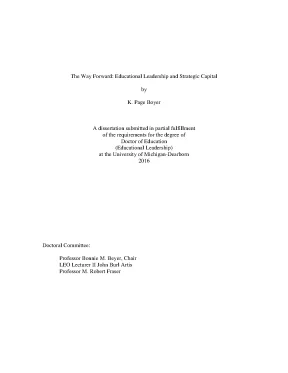
Tải xuống để đọc toàn bộThe Way Forward: Educational Leadership and Strategic Capital by K. Page Boyer A dissertation submitted in partial fulfillment of the requirements for the degree of Doctor of Education (Educational Leadership) at the University of Michigan-Dearborn 2016 Doctoral Committee: Professor Bonnie M. Beyer, Chair LEO Lecturer II John Burl Artis Professor M. Robert Fraser Copyright 2016 by K.
Page Boyer All Rights Reserved i Dedication To my family “To know that we know what we know, and to know that we do not know what we do not know, that is true knowledge.” ~ Nicolaus Copernicus ii Acknowledgements I would like to thank Dr. Beyer, Chair of my dissertation committee, for her probity and guidance concerning theories of school administration and leadership, organizational theory and development, educational law, legal and regulatory issues in educational administration, and curriculum deliberation and development. Thank you to Dr. John Burl Artis for his deep knowledge, political sentience, and keen sense of humor concerning all facets of educational leadership.
Thank you to Dr. Robert Fraser for his rigorous theoretical challenges and intellectual acuity concerning the history of Christianity and Christian Thought and how both pertain to teaching and learning in America’s colleges and universities today. I am indebted to Baker Library at Dartmouth College, Regenstein Library at The University of Chicago, the Widener and Houghton Libraries at Harvard University, and the Hatcher Graduate Library at the University of Michigan for their stewardship of inestimably valuable resources. Finally, I want to thank my family for their enduring faith, hope, and love, united with a formidable sense of humor, passion, optimism, and a prodigious ability to dream.
To my mother and father, Penelope J. Boyer and Duane O. Boyer—O Captain! My Captain!—thank you for teaching me that anything that I can imagine is possible, modeling this truth with your own lives and allowing me to stand upon your shoulders to bring my dream to fruition. Children do learn what they live.
To my wife, Kathleen P. Boyer, thank you for your deep and abiding love and support. To my sister, Shereen D. Boyer, dreams do come true.
To my nieces, Sophia C. Boyer and Olivia G. Boyer, always keep learning and dare to dream! “The untold want, by life and land ne’er granted, Now, Voyager, sail thou forth, to seek and find.” ~Walt Whitman, The Untold Want iii Table of Contents Dedication. ii List of Appendices .2 Statement of the Problem .6 Purpose of the Study .11 Chapter 2: Literature Review and Theoretical Framework .12 Curriculum 1638-1950: Religion via Social Stratum .12 Schools: “Great Equalizer” or Social Stratum Archetype?.49 Social Network Theory .62 Evolution of Social Justice through a Curricular Lens .78 iv Systems Thinking.80 Multicultural and Multilingual Landscape.83 Groups Competing for Control of the 21st Century American Curriculum .115 Ethnographic Content Analysis .117 Chapter 4: Results and Data Analysis .127 James Bryant Conant (1933-1953) .133 Nathan Marsh Pusey (1953-1971) .169 Drew Gilpin Faust (2007-Present) .188 John Sloan Dickey (1945-1970) .196 John George Kemeny (1970-1981) .199 v David Thomas McLaughlin (1981-1987) .202 James Oliver Freedman (1987-1998).206 James Edward Wright (1998-2009) .209 Jim Yong Kim (2009-2012) .217 University of Chicago: 1950-Present .221 Robert Maynard Hutchins (1929-1951) .261 Hanna Holborn Gray (1978-1993) .275 Don Michael Randel (2000-2006) .287 Chapter 5: Conclusion, Limitations, and Recommendations.294 Connecting the Data to Theoretical Frameworks .412 vi List of Appendices Appendix A Conceptual Map of Strategic Capital .412 Appendix B Strong and Weak Ties .413 Appendix C Negative Externalities of Strong Ties .414 Appendix D Egyptian Hieroglyphs for Leadership, Leader, and Follower .415 Appendix E Development of Leadership Theories through History .416 Appendix F Leadership: Four-Frame Model of Organizations .417 Appendix G Porphyrian Tree: First Tree of Knowledge .418 Appendix H Aristotle’s Hierarchical Ontological Schema, Categories .419 Appendix I Great Chain of Being (Scala Naturae).420 Appendix J Discrete Domains of Knowledge: Branches on a Tree .421 Appendix K Knowledge Metaphor Transformation from Tree to Network .422 Appendix L PERL Development Network .423 Appendix M 21st Century Curriculum: Interest Groups Competing for Control .424 Appendix N Taxonomy: Qualitative Codes .425 Appendix O Grounded Theory’s Recursive Analytic Operations .426 Appendix P Enlightenment Philosophers and Democratic Government .427 Appendix Q Immigration: Ended 30 September 1977 and 30 June 1965 .428 1 Abstract The vast majority of historical research on socioeconomic status (hereafter SES) and social capital in the field of higher education has utilized quantitative data, providing a rich source of demographic, economic, and educational information.
A more nuanced understanding of social networks and the “strategic capital” that such networks leverage—namely synergized forms of capital (e. human, cultural, and social) that are deployed to achieve a strategic objective—may emerge from an qualitative analytical methodology that investigates college presidential leadership through historical, legal, and policy artifacts at three elite institutions. Elite institution is defined here using the Carnegie Classification Undergraduate Profile: full-time four-year, more selective, lower transfer-in (2015). Through exploration of the historical educational leadership demonstrated by the presidents of Harvard University, Dartmouth College, and the University of Chicago—either encouraging or discouraging various social networks and their medium of exchange, social capital—one may gain a deeper insight into the mechanisms that foster social networks and the strategic deployment of social capital.
Why is this inquiry important? Presidential leadership at institutions of this ilk often set the pace for the field, serving as bellwethers or leading indicators of future trends at colleges and universities nationally. Keywords: educational leadership; elite colleges; cultural capital; human capital; social capital; social networks. EDUCATIONAL LEADERSHIP AND STRATEGIC CAPITAL 2 Chapter 1: Introduction During the sixteenth and seventeenth centuries, a multitude of Christian factions fought in Europe; those groups rejecting the both Roman Catholic and Protestant State Churches—such as the Congregationalists, the Anabaptists, the Society of Friends, and the Moravians—were the object of both political and religious persecution. In the conventional university survey course, Martin Luther leaps onto the historical stage out of nowhere: an unknown monk in an obscure German provincial town who, by performing the rather routine academic exercise of nailing a thesis to the doors of the local church, triggers the Protestant Reformation.
Woodward (2015, December 18) reveals a central and heretofore little-appreciated aspect: “Luther’s master role in the imagination and execution of what had to have been the world’s first mass-media-driven revolution. Luther didn’t just reimagine the Christian faith, he figured out how to share his vision through the innovative use and manipulation of a nascent communications technology: the printing press.” When Luther nailed his 95 theses to the door in the Saxon backwater town of Wittenberg nearly 500 years ago, moveable type was a useful and expensive tool used by academics and elite institutions. Most customers were churchmen, scholars, or students, with a smattering of rich collectors from the nobility. The first printers aligned their production to the established best sellers in these customers’ favored fields, typically works that were long, expensive, and in Latin.
“Luther recognized the untapped potential of print as a mass medium and used it to broadcast his message to lay readers across the German states, bypassing the traditional gatekeepers via this new social media. He responded to the first scholarly criticism of EDUCATIONAL LEADERSHIP AND STRATEGIC CAPITAL 3 his theses not in Latin, the language of scholarship, but in German, with a clear, straightforward 1,500-word essay that could be read aloud in 10 minutes. It fit perfectly into an eight-page pamphlet that could be quickly and cheaply printed and reprinted, each copy using but a single sheet of paper, folded in quarto” Woodward (2015, December 18). The moniker “Protestant”—literally, “to protest” the hated practice of the selling of indulgences—was applied to members or followers of any of the Western Christian churches who were separate from the Roman Catholic Church and followed the principles of the Reformation.
Protestants were instrumental in establishing colonies in what became the United States. Colonial European settlers, for the most part, did not come to England’s North American colonies seeking religious freedom writ large. Rather, the majority who came for religious reasons came for the freedom to practice their own form of religion and to impose it on all other residents of their colony. As Fraser (1999) notes, “And when they founded schools, which most of them did rather quickly, they expected the schools to raise up the next generation in the faith of the established church, whether it was the Congregationalism of Puritan Massachusetts or the Anglicanism of Virginia or the Dutch Reformed tradition of New Netherlands” (p.
A decade after the Mayflower sailed from England, the Winthrop Fleet, comprised of 11 ships, followed in 1630 with the charter for the Massachusetts Bay Colony and a bold vision. John Winthrop, the future governor of the Colony, wrote A Model of Christian Charity while aboard the Arabella during the voyage to Massachusetts: “For we must consider that we shall be as a City upon a hill. The eyes of all people are upon us” (Winthrop, 1867, p. As Tiryakian (1993) notes, America was from its very beginning a Protestant majority nation.
Whereas Protestants were persecuted across Europe as dissidents against the established hierarchical church and Crown-mandated social order, “Protestants in America were from the beginning the EDUCATIONAL LEADERSHIP AND STRATEGIC CAPITAL 4 arbiters and formulators of the norms of social life” (p. Tocqueville, during his travels to America, noted the exceptional coexistence of the spirit of religion and the spirit of freedom, elements that in European societies were in constant conflict, one with the other. As Tocqueville (1835-1840/2013) wrote: Every religion is to be found in juxtaposition to a political opinion which is connected with it by affinity. If the human mind be left to follow its own bent, it will regulate the temporal and spiritual institutions of society upon one uniform principle; and man will endeavor, if I may use the expression, to harmonize the state in which he lives upon earth with the state which he believes to await him in heaven.
The greatest part of British America was peopled by men who, after having shaken off the authority of the Pope, acknowledged no other religious supremacy; they brought with them into the New World a form of Christianity which I cannot better describe than by styling it a democratic and republican religion. 330-331) The European immigrants arrived on a continent whose indigenous inhabitants had both highly developed forms of faith and government. Soon after their arrival, the Europeans also began importing African slaves, adding yet another set of cultural and religious traditions to the North American mix. As Fraser (1999) notes, “The American religious scene cannot be understood without paying serious attention to the contribution of indigenous American, African, and more recently Asian traditions as well as those of European Christianity, Judaism, and Enlightenment secularism.
And these diverse contributions had powerful implications for the relationship of religion and education” (p. Nine colleges, referred to here as the Colonial Colleges, existed in the British colonies at the opening salvo of the American Revolution. While one might entertain the notion that EDUCATIONAL LEADERSHIP AND STRATEGIC CAPITAL 5 America’s institutions of higher learning exist in rarefied air, beyond the reach of pedestrian concerns and invigorated solely by a dynamic, impartial exchange of ideas in pursuit of truth, such thinking is naïve. Higher education in America is and always has been political.
Hoeveler (2002) notes that while Harvard, Yale, and Dartmouth were all Congregational colleges, they had clearly demarcated intellectual affiliations. Princeton (The College of New Jersey at its founding) was Presbyterian, but catered to a particular branch of American Presbyterianism. Similarly, Rutgers (Queen’s College) was formed by a faction of the Dutch Reformed church. The Colonial Colleges, mediators and transmitters of norms, played a vital role in the American Revolution and in forming an American intellectual culture.
While all of the Colonial Colleges were founded by Protestants, there existed intellectual warfare between and among the institutions and their founding faith traditions to define the American Mind.
Nội dung được bảo vệ bản quyền — Tải xuống đầy đủ
Trích dẫn luận án này
K. Page Boyer (2016). Boyer final dissertation [Luận án tiến sĩ, University of Michigan-Dearborn]. LuanAn.net. https://luanan.net/ly-luan-va-lich-su-giao-duc/boyer-final-dissertation
Câu hỏi thường gặp
Luận án "Boyer final dissertation" nghiên cứu về vấn đề gì?
Luận án tiến sĩ cuối cùng của Boyer.
Luận án "Boyer final dissertation" được bảo vệ tại trường nào?
Luận án này được bảo vệ tại University of Michigan-Dearborn. Năm bảo vệ: 2016.
Luận án "Boyer final dissertation" thuộc chuyên ngành gì?
Luận án "Boyer final dissertation" thuộc chuyên ngành Educational Leadership. Danh mục: Lý Luận và Lịch Sử Giáo Dục.
Luận án "Boyer final dissertation" có bao nhiêu trang?
Luận án "Boyer final dissertation" có 436 trang. Bạn có thể xem trước một phần tài liệu ngay trên trang web trước khi tải về.
Cách tải luận án "Boyer final dissertation" về máy như thế nào?
Để tải luận án về máy, bạn nhấn nút "Tải xuống ngay" trên trang này, sau đó hoàn tất thanh toán phí lưu trữ. File sẽ được tải xuống ngay sau khi thanh toán thành công. Hỗ trợ qua Zalo: 0559 297 239.