Luận án: Bịt lỗ hổng hệ thống giáo dục - Câu chuyện văn hóa về sức bật và trách nhiệm tập thể của Latina
Khám phá những câu chuyện đối lập hàn gắn lỗ hổng trong hệ thống giáo dục, mang đến góc nhìn mới về bất bình đẳng và giải pháp.
University of San Francisco
International and Multicultural Education
Luan An
Luận án tiến sĩ
Năm xuất bản
Số trang
192
Thời gian đọc
29 phút
Lượt xem
0
Lượt tải
0
Phí lưu trữ
50 Point
Tổng quan nhanh
- Chủ đề:
- Thành công Latina: Vượt rào cản hệ thống giáo dục
- Số trang:
- 192 trang
- Trường:
- University of San Francisco
- Chuyên ngành:
- International and Multicultural Education
- Tác giả:
- Angela Leslie Shaw
- Năm:
- 2012
Tóm tắt nội dung luận án
I.Thành công Latina Vượt rào cản hệ thống giáo dục
Tài liệu này khám phá những thành công đáng kể của phụ nữ Latina. Nó cũng phân tích các rào cản tồn tại trong hệ thống giáo dục Hoa Kỳ. Nghiên cứu tập trung vào những Latina là thế hệ đầu tiên hoàn thành bằng cử nhân. Đây là một phân tích định tính sâu sắc. Mục tiêu là hiểu rõ hơn về con đường học vấn của họ. Tài liệu làm nổi bật khả năng phục hồi văn hóa và trách nhiệm tập thể. Những yếu tố này góp phần vào thành tích học tập K-16. Sau đó, họ tiếp tục đạt được giáo dục đại học. Sự thiếu vắng các nghiên cứu chuyên sâu về đối tượng này là đáng kể. Công trình này cố gắng lấp đầy khoảng trống đó.
1.1. Mục đích nghiên cứu về phụ nữ Latina K 16
Nghiên cứu này có mục đích rõ ràng. Nó tìm hiểu những thành công của phụ nữ Latina. Đồng thời, nó mô tả các rào cản thể chế. Những rào cản này xuất hiện dọc theo "đường ống giáo dục". Các đối tượng nghiên cứu là những người đầu tiên trong gia đình hoàn thành bằng cử nhân. Cho đến nay, chưa có nghiên cứu nào xem xét cụ thể phụ nữ Latina qua từng cấp học K-16. Đây là một khoảng trống lớn cần được giải quyết.
1.2. Khoảng trống nghiên cứu và định kiến xã hội
Hiện có sự thiếu hụt nghiên cứu. Nghiên cứu tập trung cụ thể vào trải nghiệm của phụ nữ Latina. Điều này đặc biệt đúng ở các cấp tiểu học và trung học. Nó kéo dài cho đến khi hoàn thành bằng cử nhân. Thêm vào đó, tài liệu hiếm khi đề cập đến yếu tố giới. Các vấn đề như xã hội hóa vai trò giới và định kiến xã hội thường bị bỏ qua. Những yếu tố này ảnh hưởng lớn đến việc duy trì và hoàn thành giáo dục.
II.Phương pháp độc đáo Phân tích câu chuyện văn hóa
Công trình này sử dụng phương pháp luận nghiên cứu định tính. Nó khai thác sức mạnh của "phản chuyện" (counterstories). Đây là một chiến lược điều tra mạnh mẽ. Các phản chuyện thách thức các câu chuyện thống trị. Chúng cung cấp cái nhìn sâu sắc từ góc độ của phụ nữ Latina. Nghiên cứu này cung cấp một diễn giải khác về thực tế. Nó cho thấy cách các cá nhân trải nghiệm và vượt qua hệ thống giáo dục.
2.1. Tiếp cận nghiên cứu định tính và phản chuyện
Phương pháp nghiên cứu định tính được áp dụng. Nó sử dụng các phản chuyện làm chiến lược chính. Các câu chuyện này tiết lộ khả năng phục hồi văn hóa. Chúng cũng làm rõ trách nhiệm tập thể. Mục tiêu là thành công của phụ nữ Latina từ K-16. Phương pháp này cho phép đi sâu vào trải nghiệm cá nhân. Nó cung cấp một cái nhìn toàn diện hơn.
2.2. Khung lý thuyết và đối thoại chuyên sâu
Thuyết Phê phán chủng tộc nữ quyền (CRF) làm cơ sở lý thuyết. CRF đóng vai trò công cụ. Nó giúp kiểm tra sự phức tạp của bản sắc Latina. Khung lý thuyết này cho phép phân tích sâu sắc. Chín phụ nữ Latina đã tham gia đối thoại. Họ là những người đầu tiên trong gia đình hoàn thành bằng cử nhân. Các cuộc đối thoại này mang lại dữ liệu phong phú.
III.Yếu tố văn hóa Thúc đẩy thành tích học tập Latina
Các phát hiện của nghiên cứu cho thấy nhiều yếu tố văn hóa quan trọng. Những yếu tố này thúc đẩy thành công giáo dục của phụ nữ Latina. Trong suốt thời thơ ấu, cha mẹ đóng vai trò trung tâm. Họ truyền đạt những bài học quý giá. Những bài học này giúp con cái vượt qua rào cản. Đó là những rào cản về chủng tộc và kinh tế xã hội. Sự khuyến khích bằng lời nói là rất quan trọng. Các câu chuyện về đấu tranh của cha mẹ cũng vậy. Chúng là nguồn cảm hứng lớn.
3.1. Vai trò gia đình trong vượt khó khăn và giáo dục
Phụ huynh là tấm gương về đạo đức làm việc. Họ đề cao giá trị giáo dục. Điều này tạo nền tảng vững chắc. Cha mẹ cũng thúc đẩy con cái. Mục tiêu là có một cuộc sống thoải mái hơn. Cuộc sống tài chính ổn định hơn. Những điều này là động lực mạnh mẽ. Chúng giúp các em vượt qua khó khăn.
3.2. Khả năng phục hồi văn hóa và mục tiêu giáo dục
Khả năng phục hồi văn hóa mang lại động lực. Nó thúc đẩy các đối tượng nghiên cứu phấn đấu. Mục tiêu là thành công trong giáo dục. Yếu tố văn hóa này là một nguồn sức mạnh nội tại. Nó giúp họ kiên trì vượt qua mọi chướng ngại vật. Sự bền bỉ này là chìa khóa. Nó giúp họ tiến xa trên con đường học vấn.
IV.Trách nhiệm cộng đồng Latina Vượt khó khăn giáo dục
Trách nhiệm tập thể là một chủ đề nổi bật. Nó ảnh hưởng đến các đối tượng nghiên cứu. Cảm giác này không chỉ thúc đẩy thành công cá nhân. Nó còn truyền cảm hứng để họ vượt qua các rào cản. Những rào cản này xuất hiện dọc theo "đường ống giáo dục". Ngay cả khi đã là người lớn có bằng đại học, trách nhiệm vẫn tiếp tục. Nó định hình các lựa chọn trong cuộc sống.
4.1. Tầm quan trọng của trách nhiệm tập thể
Trách nhiệm tập thể là động lực mạnh mẽ. Nó khuyến khích phụ nữ Latina phấn đấu. Nó cũng truyền cảm hứng cho họ. Họ vượt qua những trở ngại trong giáo dục. Khái niệm này vượt ra ngoài thành công cá nhân. Nó hướng tới sự phát triển chung. Nó gắn liền với cộng đồng Latinh của họ.
4.2. Ảnh hưởng sau đại học đến gia đình và cộng đồng
Sau khi tốt nghiệp đại học, trách nhiệm vẫn tiếp diễn. Nó ảnh hưởng đến lựa chọn nghề nghiệp. Họ tích cực giúp đỡ gia đình. Họ cũng hỗ trợ cộng đồng của mình. Đây là một minh chứng rõ ràng. Nó cho thấy sự cam kết với phúc lợi chung.
4.3. Lan tỏa giá trị giáo dục đại học
Các cựu sinh viên truyền đạt tầm quan trọng của giáo dục đại học. Họ chia sẻ điều này cho các thành viên gia đình trẻ hơn. Cũng như bạn bè và đồng nghiệp. Điều này diễn ra trong các cộng đồng tương ứng. Nó giúp tạo ra một chu kỳ tích cực. Giáo dục trở thành một giá trị được trân trọng.
V.Kết luận về thành công Latina và hệ thống giáo dục
Nghiên cứu này mang lại những hiểu biết quan trọng. Nó lấp đầy khoảng trống trong tài liệu hiện có. Công trình làm nổi bật những câu chuyện thành công của phụ nữ Latina. Đồng thời, nó phơi bày các rào cản thể chế. Nó cũng cung cấp bằng chứng về khả năng phục hồi. Đó là khả năng phục hồi văn hóa và trách nhiệm tập thể. Đây là những yếu tố then chốt giúp các em vượt qua khó khăn.
5.1. Đóng góp của nghiên cứu này cho giáo dục
Nghiên cứu là một đóng góp quan trọng. Nó làm phong phú thêm hiểu biết về thành công của Latina. Đặc biệt trong hệ thống giáo dục. Nó mở ra hướng nghiên cứu mới. Nó khuyến khích việc xem xét yếu tố văn hóa kỹ lưỡng hơn. Điều này giúp phát triển các chiến lược hỗ trợ hiệu quả.
5.2. Khuyến nghị cho chính sách giáo dục đại học
Cần có sự công nhận rõ ràng hơn. Chính sách giáo dục cần nhận biết yếu tố văn hóa. Cần có sự hỗ trợ cụ thể cho phụ nữ Latina. Các chương trình cần giảm thiểu rào cản giáo dục. Việc khuyến khích sự phát triển bền vững là cần thiết. Điều này sẽ đảm bảo cơ hội bình đẳng hơn.
Tải xuống file đầy đủ để xem toàn bộ nội dung
Tải đầy đủ (192 trang)Trích đoạn nội dung luận án
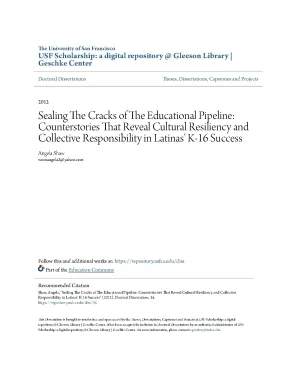
Tải xuống để đọc toàn bộThe University of San Francisco USF Scholarship: a digital repository @ Gleeson Library | Geschke Center Doctoral Dissertations Theses, Dissertations, Capstones and Projects 2012 Sealing The Cracks of The Educational Pipeline: Counterstories That Reveal Cultural Resiliency and Collective Responsibility in Latinas’ K-16 Success Angela Shaw womangela2@yahoo.com Follow this and additional works at: https://repository.edu/diss Part of the Education Commons Recommended Citation Shaw, Angela, "Sealing The Cracks of The Educational Pipeline: Counterstories That Reveal Cultural Resiliency and Collective Responsibility in Latinas’ K-16 Success" (2012).edu/diss/35 This Dissertation is brought to you for free and open access by the Theses, Dissertations, Capstones and Projects at USF Scholarship: a digital repository @ Gleeson Library | Geschke Center. It has been accepted for inclusion in Doctoral Dissertations by an authorized administrator of USF Scholarship: a digital repository @ Gleeson Library | Geschke Center. For more information, please contact repository@usfca. The University of San Francisco SEALING THE CRACKS OF THE EDUCATIONAL PIPELINE: COUNTERSTORIES THAT REVEAL CULTURAL RESILIENCY AND COLLECTIVE RESPONSIBILITY IN LATINAS’ K-16 SUCCESS A Dissertation Presented to The Faculty of the School of Education International and Multicultural Education Department In Partial Fulfillment of the Requirements for the Degree Doctor of Education by Angela Leslie Shaw San Francisco May 2012 Copyright © Angela Leslie Shaw 2012 ii THE UNIVERSITY OF SAN FRANCISCO Dissertation Abstract Sealing The Cracks of The Educational Pipeline: Counterstories That Reveal Cultural Resiliency and Collective Responsibility in Latinas’ K-16 Success The purpose of this qualitative research is to discover and describe the successes and institutional barriers along the educational pipeline for Latinas who are the first in their families to have successfully completed their undergraduate degrees.
No study to date has looked specifically at Latinas through each level of K-16 schooling. There is a lack of research that focuses specifically on Latinas’ experiences through each stage of development in the K-16 educational pipeline, particularly in elementary or secondary school, onto completion of an undergraduate degree. Due to the lack of literature that focuses specifically on Latinas, there is a need for research that includes the unique elements of gender such as gender role socialization and stereotyping under the context of student retention and successful completion of a baccalaureate degree. My methodological approach is qualitative narrative research using counterstories as a strategy of inquiry.
I utilized Critical Race Feminism (CRF) as my theoretical rationale as it serves as a tool to examine the complexities and fluid identities of Latinas’ stories. I had dialogues with nine Latinas who were the first in their families to have successfully completed their undergraduate degrees. The results of this study find that throughout childhood, many participants’ parents taught their children how to overcome race and socioeconomic barriers through their verbal encouragement, parents’ stories of struggles, role modeling of a strong work ethic, parents’ value of education, and parents motivating their children to have a more iii comfortable and financially stable life. Cultural resiliency gave participants the impetus to strive for success in education and also inspired a sense of collective responsibility to transcend obstacles they faced throughout the educational pipeline.
As college educated adults, the participants continue to be influenced by collective responsibility in their choice of careers, helping out their families and communities, and instilling the importance of higher education into their younger family members, friends, and peers in their respective communities. iv This dissertation, written under the direction of the candidate’s dissertation committee and approved by the members of the committee, has been presented to and accepted by the Faculty of the School of Education. The content and research methodologies presented in this work represent the work of the candidate alone. Angela Leslie Shaw March 19, 2012 Candidate Date Dissertation Committee Dr.
Emma Fuentes March 19, 2012 Chairperson Date Dr. Shabnam Koirala-Azad March 19, 2012 Second Reader Date Dr. Elena Flores March 19, 2012 Third Reader Date v To Andre’ who faithfully nurtures and relishes my dreams as if they were his own To my Mamacita whose sacrifices, fierce determination and unconditional love inspired me to exceed my own academic aspirations vi ACKNOWLEDGEMENTS I am especially grateful for the members of my dissertation committee, Dr. Emma Fuentes, Dr.
Shabnam Koirala-Azad, and Dr. Their expertise, insights, and guidance undoubtedly made my research and work a richer experience. A special thanks to Dr. Emma Fuentes, whose nurturing and positive support always inspired and challenged me, whether it was in the classroom or through the dissertation process.
I am deeply honored that Alejandra, Bianca, Elizabeth, Gabriela, Gloria, Isaura, Kristina, Lori, and Sophia participated in this study. This research would not have been possible without their inspirational and poignant stories. vii TABLE OF CONTENTS ABSTRACT.1 THE RESEARCH PROBLEM .1 Statement of the Problem .2 Purpose of the Study .9 Background and Need for the Study .16 Definition of Terms.18 CHAPTER II REVIEW OF THE LITERATURE .20 Gendered Experiences: Theoretical and Historical Perspectives.21 The Miseducation of Latinos Throughout Education .24 Gender, Race, and Class Stereotyping in Education.36 Latinas’ Success and Barriers Through the Educational Pipeline .50 Navigating College: Latinas Activate Social Capital .61 CHAPTER III METHODOLOGY .77 Data Collection and Analysis.82 Questions to Guide the Initial Dialogue.83 Profile of Participants .84 Profile of the Researcher .88 Protection of Human Subjects .90 CHAPTER IV FINDINGS .91 Parental Support: Teaching Cultural Resiliency .91 Heightened Aspirations Through Familial Reinforcement .103 Peers as Social Capital and Support.114 Parents Lack of Education .114 Fitting in With Peers .119 Lack of Information/Tracking.124 Traditional Gender Roles in The Home .125 Racist Experiences in School and Cultural Adjustments .129 Economic Obstacles and Educational Stability .138 Familial and Personal Empowerment .140 CHAPTER V DISCUSSION, RECOMMENDATIONS, AND CONCLUSION .143 Barriers in The Educational Pipeline .143 Parents’ Lack of Educational Knowledge.144 Lack of Information/Tracking.146 Factors That Contributed to Latinas’ Success in School .146 Parents’ Teaching Cultural Resiliency.146 Giving Back to Families and Communities .150 Peers as Invaluable Resources and Support .151 The Impact of Gender, Race, and Class Through The Educational Pipeline .157 Socioeconomic Status Matters .158 Contradictions of Gender, Race, and Class Issues .160 Recommendations For Future Research .166 APPENDICES Appendix A: Email Approval of Human Subjects Request.178 Appendix B: Consent Letter .179 Appendix C: Informed Consent Form .180 ix 1 CHAPTER I THE RESEARCH PROBLEM As a Latina and the first in my family to earn a baccalaureate degree, I know the challenges of navigating through an unfamiliar academic system. Despite these challenges, I have been inspired to pursue a doctoral degree and teach at the collegiate level.
Throughout my educational experiences from elementary school through obtaining my undergraduate degree, there were many ways that educational institutions tried to push me out. In high school, I was discouraged from taking upper division math and science classes and encouraged to take typing and home economics classes as if to prepare me for impending motherhood or a future secretarial career. When I think of all the times when I could have failed and fallen through the cracks, I am reminded of my main motivation to persevere, my immigrant mother. She consistently struggled to make ends meet and stressed the importance of a good college education as a bridge to success.
Those efforts helped me on my own journey through the educational pipeline. When looking at the numbers of Latino/a youth who drop out somewhere along the educational pipeline, the statistics are astounding. Yosso (2006) defines the educational pipeline as a system of interrelated institutions where students move from one level to the next. The journey is varied and determined by school structures, policies, and culture.
Howard (2007) describes the educational pipeline as a metaphor: The idea of a pipeline in its most basic definition is that it is a mechanism that allows the successful matriculation of any material, object, or individual to pass through a particular area to another. The matriculation through the pipeline is contingent upon each of the areas of the pipe to be unobstructed and working in proper order, which allows for a free- flowing exchange from point to point. 18) 2 The successful culture of the school and its ability to reach underrepresented students depends on the lack of obstructions in the educational pipeline, which is key for student retention and completion. Yosso finds that: Only 26 of every 100 Chicana/o elementary school students continue on to college with 17 of the 26 students starting at community college.
Nationally, 70% of Chicanas/os who enroll in community colleges aspire to transfer to a 4-year college or university. However, one of these students makes it to a 4-year college. Only 7 students out of the original 26 graduate with a baccalaureate degree. 99) Furthermore, Latinas face greater odds due to a myriad of barriers related to gender, race, and class issues as well as sometimes being the first in their family to attend college.
My research focus is on those Latinas who are the first in their families to complete a baccalaureate degree and how they transcended past obstacles to achieve academic success throughout the educational pipeline. Specifically, this qualitative study hopes to uncover the various factors that lead to Latinas’ successful educational experiences, culminating in a collegiate degree. Statement of the Problem Latino/as encounter numerous barriers on the pathway to college. According to Yosso and Solórzano (2006), the leaks in the Latino/a educational pipeline are systemic and start with the inequities found in K-12 schools.
The authors emphasize the fact that many Latino/as attend racially segregated schools with new and often untrained teachers. Dilapidated buildings, a lack of resources for new classroom materials and inadequate bilingual programs exacerbate the obstacles Latino/as face in education. Additionally, Yosso and Solórzano have found that Latino/a students continue to be tracked in remedial and/or vocational classes. This in many ways sends the message to Latino/as that college 3 is not a viable option.
Valenzuela’s (1999) research found that a lack of resources, tracking, and lowered expectations set Latino/as up for educational failure, rather than success. Latinas are severely underrepresented in high school and college. According to the National Center for Educational Statistics (2010a), Latinas have the highest high school dropout rate at 16. Additionally, Latinas’ college completion rates are 8.1 % in the 2008-2009 academic year, which falls significantly lower than White females at 71.5 % and Black females at 9.
Ginorio and Huston (2001) assert that a college education is a gateway to expanded career opportunities and increased financial possibilities. The researchers found that Latinas with baccalaureate degrees earned 82% more than those with high school diplomas. It is important to look at the obstacles Latinas’ face in completing undergraduate degrees and how societal racism and sexism contribute to these barriers. Latino/as who defy these odds and make it to college continue to experience institutional neglect.
According to Yosso and Solórzano (2006), many Latino/as begin their college studies at a community college with the hopes of transferring to a four-year college; however, less than 10% actually make it. Those who are able to transfer to a four-year university are often met with racial discrimination from peers and professors and a lack of resources and mentors to guide them through the college going process. These feelings of alienation are intensified when students are the first in their family to attend college and are trying to learn how to navigate the university system. Furthermore, Wycoff (1996) affirms that Latinas specifically may have a harder time 4 navigating the educational pipeline and succeeding in college, due to stereotypes and discrimination based on their gender and race.
Although there are studies that focus on the Latino/as experience along the K-16 educational pipeline such as Yosso’s (2006) investigation, there is a general lack of research that focus specifically on Latinas’ experiences through this same pipeline, particularly in elementary or secondary school. Due to the lack of literature that focuses specifically on Latinas, there is a need for research that includes the unique elements of gender such as gender role socialization and stereotyping within the context of student retention and successful completion of a baccalaureate degree.
Nội dung được bảo vệ bản quyền — Tải xuống đầy đủ
Trích dẫn luận án này
Angela Leslie Shaw (2012). Thành công của Latina trong hệ thống giáo dục: Câu chuyện văn hóa [Luận án tiến sĩ, University of San Francisco]. LuanAn.net. https://luanan.net/ly-luan-va-lich-su-giao-duc/bi-lo-hong-he-thong-giao-duc-cau-chuyen-van-hoa-latina
Câu hỏi thường gặp
Luận án "Thành công của Latina trong hệ thống giáo dục: Câu chuyện văn hóa" nghiên cứu về vấn đề gì?
Khám phá những câu chuyện đối lập hàn gắn lỗ hổng trong hệ thống giáo dục, mang đến góc nhìn mới về bất bình đẳng và giải pháp.
Luận án "Thành công của Latina trong hệ thống giáo dục: Câu chuyện văn hóa" được bảo vệ tại trường nào?
Luận án này được bảo vệ tại University of San Francisco. Năm bảo vệ: 2012.
Luận án "Thành công của Latina trong hệ thống giáo dục: Câu chuyện văn hóa" thuộc chuyên ngành gì?
Luận án "Thành công của Latina trong hệ thống giáo dục: Câu chuyện văn hóa" thuộc chuyên ngành International and Multicultural Education. Danh mục: Lý Luận và Lịch Sử Giáo Dục.
Luận án "Thành công của Latina trong hệ thống giáo dục: Câu chuyện văn hóa" có bao nhiêu trang?
Luận án "Thành công của Latina trong hệ thống giáo dục: Câu chuyện văn hóa" có 192 trang. Bạn có thể xem trước một phần tài liệu ngay trên trang web trước khi tải về.
Cách tải luận án "Thành công của Latina trong hệ thống giáo dục: Câu chuyện văn hóa" về máy như thế nào?
Để tải luận án về máy, bạn nhấn nút "Tải xuống ngay" trên trang này, sau đó hoàn tất thanh toán phí lưu trữ. File sẽ được tải xuống ngay sau khi thanh toán thành công. Hỗ trợ qua Zalo: 0559 297 239.