Bagherzadeh dissertation 2017
Luận án: Bagherzadeh dissertation 2017. Xem tóm tắt và tải về tại LuanAn.net
University of Illinois at Chicago
Luan An
Luận án tiến sĩ
Năm xuất bản
Số trang
259
Thời gian đọc
39 phút
Lượt xem
0
Lượt tải
0
Phí lưu trữ
50 Point
Tổng quan nhanh
- Chủ đề:
- Addressing Greenhouse Gases: N2O and CO2 Focus
- Số trang:
- 259 trang
- Trường:
- University of Illinois at Chicago
- Chuyên ngành:
- Chemistry
- Tác giả:
- Sharareh Bagherzadeh
- Năm:
- 2017
Tóm tắt nội dung luận án
I.Addressing Greenhouse Gases N2O and CO2 Focus
This section introduces the critical environmental challenge posed by nitrous oxide (N2O) and carbon dioxide (CO2). Both are potent greenhouse gases. This doctoral thesis explores their impact on climate change. It examines biological activation and reduction pathways for these molecules. The study highlights natural enzymatic processes involved in N2O and CO2 conversion. Understanding these natural systems provides a foundation. This foundation guides the development of synthetic inorganic models. This academic research sets the stage for advanced catalytic investigations into greenhouse gas mitigation.
1.1. Impact of N2O and CO2 on Climate Change
Nitrous oxide and carbon dioxide are significant contributors to global warming. Their accumulation in the atmosphere drives climate change. This PhD dissertation investigates their environmental implications. The study emphasizes the urgent need for effective reduction strategies. It reviews the atmospheric chemistry of N2O and CO2. Strategies for mitigating their effects are paramount.
1.2. Biological Reduction of Nitrous Oxide
Nature offers solutions. The enzyme nitrous oxide reductase (N2OR) biologically reduces N2O. This process is crucial in the nitrogen cycle. The study details N2OR's structure and active site. It analyzes the enzymatic mechanism for N2O reduction. This bio-inspired approach informs synthetic model design. This literature review provides essential context.
1.3. Enzymatic Conversion of Carbon Dioxide
Carbon dioxide also undergoes enzymatic conversion. Metal-dependent formate dehydrogenases reversibly interconvert CO2 and formate. Carbon monoxide dehydrogenases (CODHs) convert CO2 to CO. The theoretical framework explores CO2 activation at various metal clusters. This understanding is vital for catalytic design in academic research.
II.Synthetic Models for N2O and CO2 Activation
This part of the PhD dissertation focuses on creating synthetic inorganic models. These models mimic the activity of natural enzymes. Chapter 2 details experiments involving a [Cu2S] complex. This complex activates both N2O and CO2. The empirical study investigates how these small molecules interact. Observations suggest oxidation or expulsion of sulfur. This provides insights into the role of tetranuclearity. The CuZ site of nitrous oxide reductase offers inspiration. The research methodology for synthesizing and testing these models is critical. This section presents key research findings on reactivity.
2.1. Cu2S Complex for Small Molecule Activation
A specific complex, [(IPr*)Cu]2(µ-S), is central to this study. It serves as a model for catalytic activation. Its interactions with N2O and CO2 are thoroughly examined. This complex's structure is important for its reactivity profile. The synthetic routes for related copper complexes are also discussed. This forms a core part of the academic research.
2.2. Nitrous Oxide Reaction Mechanisms
The reaction of [(IPr*)Cu]2(µ-S) with N2O is explored in depth. Experiments reveal specific reaction products and pathways. The presence of additives like PPh3 influences the outcome. A proposed mechanism explains the activation of N2O. Insights into sulfur oxidation are gained. This data analysis is crucial for understanding the process.
2.3. Carbon Dioxide Reaction with Copper Complexes
Similar studies are conducted for CO2 activation. The reactivity of [(IPr*)Cu]2(µ-S) with carbon dioxide is analyzed. Comparisons are drawn between N2O and CO2 activation. The generation of specific copper-containing products from CO2 reactions is noted. This extends understanding of small molecule interactions with copper centers. These research findings are significant.
III.Catalytic CO2 Reduction Heterobimetallic Approach
This section, derived from Chapter 3, explores advanced strategies for carbon dioxide reduction. The academic research focuses on catalyst control and selectivity. It introduces tunable heterobimetallic complexes. These catalysts, specifically (NHC)Cu-[M] systems, facilitate CO2 reduction. The theoretical framework behind these systems is discussed. The research aims to achieve highly efficient and selective conversion of CO2. Empirical study results demonstrate the catalytic activity. This contributes significantly to sustainable chemistry solutions. The academic writing details these developments.
3.1. Tunable Heterobimetallic Catalysts
Various heterobimetallic complexes are synthesized and tested. Examples include (IMes)Cu-Mp, (IMes)Wp, and (IMes)Cu-Fp. The copper component is combined with different metal fragments. This modular approach allows for fine-tuning catalyst properties. The impact of different metal centers on reactivity is investigated. This forms a key part of the research methodology.
3.2. Mechanism of CO2 Reduction
A proposed mechanism for carbon dioxide reduction is presented. This mechanism describes electron transfer and bond formation steps. CO2 trapping experiments provide evidence for intermediates. The data analysis supports the proposed catalytic cycle. Understanding the mechanism is crucial for catalyst optimization. This is a central element of the doctoral thesis.
3.3. CO2 Reduction Procedures and Analysis
Detailed procedures for catalytic CO2 reduction are outlined. Gas chromatography-mass spectrometry (GC-MS) detects reduction products like CO. The efficiency of different catalysts is compared. Experiments include in situ generation of intermediates. The reduction of ketones and aldehydes is also explored. These research findings are validated through rigorous analysis.
IV.Advancing Sustainable Chemistry Through Bio Inspired Catalysis
This doctoral thesis significantly advances the field of sustainable chemistry. It integrates insights from biological systems with synthetic inorganic chemistry. The research develops novel catalysts for N2O and CO2 transformation. It addresses critical environmental challenges directly. The research findings provide new avenues for greenhouse gas mitigation. This academic writing showcases meticulous experimental work and clear mechanistic understanding. The overarching goal is to contribute to a greener future. This PhD dissertation marks a notable contribution to the field.
4.1. Novel Insights into N2O and CO2 Activation
The study reveals unprecedented insights into how N2O and CO2 interact with metal centers. Specifically, the role of sulfur in copper complexes is elucidated. This expands the fundamental understanding of small molecule activation. These discoveries are crucial for designing next-generation catalysts. This is a primary achievement of the academic research.
4.2. Development of Efficient CO2 Reduction Catalysts
The dissertation presents highly efficient catalytic systems for CO2 reduction. The tunable heterobimetallic approach proves successful. Control over selectivity is demonstrated. This represents a significant step towards practical CO2 utilization technologies. The focus is on increasing both activity and selectivity. These are key research findings.
4.3. Future Directions in Greenhouse Gas Mitigation
The research findings open new pathways for future investigations. Further optimization of catalyst systems is suggested. Exploration of alternative metal combinations and ligands is encouraged. This PhD dissertation establishes a strong foundation for continued efforts in reducing atmospheric N2O and CO2. It guides future academic research endeavors.
V.Robust Research Methodology and Analytical Techniques
This doctoral thesis is underpinned by a robust research methodology. It combines synthetic chemistry with advanced spectroscopic and analytical techniques. The experimental design ensures reliable and reproducible empirical study results. From catalyst synthesis to product analysis, each step is rigorously executed. This approach ensures the validity of the research findings. The academic writing reflects a systematic investigation into complex chemical processes. Attention to detail is evident throughout the experimental sections. This thoroughness strengthens the entire academic research project.
5.1. Comprehensive Literature Review and Theoretical Framework
The study begins with an extensive literature review. This review covers the chemistry of N2O and CO2, enzymatic systems, and existing synthetic models. A solid theoretical framework guides the experimental design. This ensures the research builds upon established knowledge while pushing boundaries. This foundational work is critical.
5.2. Experimental Design and Data Collection
Detailed procedures for synthesizing novel copper and heterobimetallic complexes are provided. Experiments for small molecule activation and CO2 reduction are meticulously designed. Spectroscopic methods (e.g., NMR, IR) and mass spectrometry (GC-MS) are employed for data analysis. This ensures accurate identification of products and intermediates. Precision is paramount in this research methodology.
5.3. Advanced Analytical Characterization
The characterization of new compounds is comprehensive. This includes elemental analysis and X-ray crystallography when applicable. Precise quantification of reaction products and catalyst turnover is performed. These advanced analytical techniques validate the proposed mechanisms and catalytic efficiencies. These methods underpin the credibility of the research findings.
Mục lục chi tiết luận án
Tải xuống file đầy đủ để xem toàn bộ nội dung
Tải đầy đủ (259 trang)Trích đoạn nội dung luận án
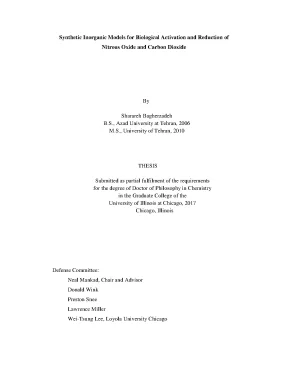
Tải xuống để đọc toàn bộSynthetic Inorganic Models for Biological Activation and Reduction of Nitrous Oxide and Carbon Dioxide By Sharareh Bagherzadeh B., Azad University at Tehran, 2006 M., University of Tehran, 2010 THESIS Submitted as partial fulfilment of the requirements for the degree of Doctor of Philosophy in Chemistry in the Graduate College of the University of Illinois at Chicago, 2017 Chicago, Illinois Defense Committee: Neal Mankad, Chair and Advisor Donald Wink Preston Snee Lawrence Miller Wei-Tsung Lee, Loyola University Chicago This thesis is dedicated to my husband, Ali Mohamadi, without his love, support, and encouragement it would have been a much longer road to success. II ACKNOWLEDGEMENTS I would like to express my sincere gratitude to my advisor Prof. Mankad for the continuous support of my Ph.D study and research, for his patience, motivation, enthusiasm, and immense knowledge. He was there all the time to listen whenever I needed to ask a question or simply to suggest an idea.
His guidance helped me in all the time of research and writing of this thesis. I would also like to express my gratitude to my thesis committee members. Lawrence Miller, and Dr. Wei-Tsung Lee, to be there for my thesis defense and for their wonderful scientific suggestions and good advice.
I am also grateful for a fantastic group of lab mates in the Mankad group. They have been my tutors, companions and supporters in the midst of all the difficult and cheerful times. My sincere thanks also go to the staff at the department of Chemistry at UIC. Thank you, Rhonda, Silvia, Maggie, Shirley, Jennifer, Tanya, Randy, Miranda and Don for helping me out in several ways.
I would like to thank my husband for walking this journey along with me, and sharing my joy as well as sadness. Thank you for standing by me whenever I needed your support, technically, and spiritually. III Table of contents 1. Impact of CO2 and N2O on climate change as greenhouse gases……………….1 Chemistry of nitrous oxide.2 Nitrous oxide reductase.1 Structure of nitrous oxide reductase (N2OR)…………………………………………….2 Active site in N2OR……………………………………………………………………….3 Mechanism of N2O reduction by nitrous oxide reductase……………………………….3 Bio-inspired approach toward replicating nitrous oxide reductase activity.1 Chemistry of carbon dioxide.2 Enzymatic conversion of carbon dioxide .1 Reversible interconversion of CO2 and formate by metal-dependent formate dehydrogenases………………………………………………………………………………….2 Reversible interconversion of CO2 and CO by carbon monoxide dehydrogenase (CODHs)…………………………………………………………………………………………17 1.1 Carbon dioxide activation at the Ni, Fe-cluster of anaerobic carbon monoxide dehydrogenase……………………………………………………………………………………18 IV Table of contents (Continued) 1.2 Carbon dioxide activation at the Mo, Cu-cluster of aerobic carbon monoxide dehydrogenase……………………………………………………………………………………20 1.
Synthetic Models of [MoCu] CO dehydrogenases. Reaction of CO2 with heterobimetallic complexes. Chapter 2: Activation of N2O and CO2 induces oxidation or expulsion of the sulfur in a [Cu2S] complex: cnsights into a role of tetranuclearity in the CuZ site of nitrous oxide reductase 2. Reaction of [(IPr*)Cu]2(µ-S) with nitrous oxide.
Reaction of [(IPr*)Cu]2(µ-S) with carbon dioxide. Reaction of [(IPr)Cu]3(µ3-S) with nitrous oxide and carbon dioxide. Reaction of [(IPr*)Cu]2(µ-S) with carbon disulfide. Proposed mechanism for the activation of small molecules by [(IPr*)Cu]2(µ-S).44 V Table of contents (Continued) 2.
Generation of [(IPr*)Cu]2(μ-SO4) from (IPr*)CuCl. Preparation of (IPr*)CuOH. Preparation of [(IPr*)Cu]2(μ-O) from (IPr*)CuOH. Reaction of IPr*carbene with CO2.
Reaction of [(IPr*)Cu]2(μ-S) with N2O .10 Reaction of [(IPr*)Cu]2(μ-S) with N2O in the presence of PPh3. Reaction of [(IPr*)Cu]2(μ-S) with N2O and addition of PPh3 after 24h. Reaction of [(IPr*)Cu]2(μ-S) with CO2. Reaction of [(IPr*)Cu]2(μ-S) with CO2 in the presence of PPh3.
Reaction of [(IPr*)Cu]2(μ-S) with PPh3. Chapter 3: Catalyst control of selectivity in CO2 reduction using a tunable heterobimetallic effect 3. CO2 reduction with (NHC)Cu-[M] catalysts. Proposed mechanism for carbon dioxide reduction .69 VI Table of contents (Continued) 3.
Procedures for catalytic CO2 reduction using heterobimetallic complexes as a catalyst .1 Catalytic reduction of CO2 by (IMes)Cu-Mp……………………………………………70 3.2 Catalytic reduction of CO2 by (IMes)Wp……………………………………………….3 Catalytic reduction of CO2 by (IMes)Cu-Fp…………………………………………….4 Catalytic reduction of CO2 by (IPr)Cu-Mp…………………………………………….5 Catalytic reduction of CO2 by (IPr)Cu-Wp…………………………………………….6 Catalytic reduction of CO2 by (IPr)Cu-Fp………………………………………………72 3. CO trapping experiment…………………………………………………………………. GC-MS detection of CO…………………………………………………………………. Catalytic reduction of CO2 by (IPr)CuOtBu and FpBpin…………………………………78 3.
In situ generation of HCO2Bpin, and its decarbonylation by FpBpin……………………78 4. Chapter 4: Extremely efficient hydroboration of ketones and aldehydes by copper carbene catalysis 4. Transition metal catalyzed hydroboration of carbonyl compounds………………………. Ti complex catalyzed hydroboration of C=O………………………………………….86 VII Table of contents (Continued) 4.
Zn complex catalyzed hydroboration of C=O…………………………………………. Ru complex catalyzed hydroboration of C=O…………………………………………. Main group compounds in catalytic hydroboration of C=O………………………………86 4. Mechanism of hydroboration of ketones and aldehydes………………………….
Additive screen in hydroboration reaction…………………………………………………. General catalytic procedure………………………………………………………………. Isolation of 2-(1-(4-iodophenyl) ethoxy)-4,4,5,5-tetramethyl-1,3,2-dioxaborolane………96 4. Isolation of 2-(benzhydryloxy)-4,4,5,5-tetramethyl-1,3,2-dioxaborolane……………….
Appendix Crystallographic data of Cu2SO4 and Cu2CS3 structures……………………………….106 Coordinates for DFT optimized structures…………….240 VIII List of tables Table 1. 1H NMR chemical shifts for different species formed in the N2O reaction. 1H NMR chemical shifts for different species formed in the CO2 reaction. Catalytic CO2 reduction results with pinacolborane (HBpin).
Hydroboration of carbonyl compounds by copper carbene catalysis. Robustness of ketone hydroboration towards reducible functional groups.94 IX List of figures Figure 1. Homodimer structure of nitrous oxide reductase. Crystal structures of CuZ* derived from aerobically prepared N2OR (A) and CuZ derived from anaerobically prepared N2OR (B).
Structure of sulfide bridging tricopper cluster. Structure of [1-(CF3SO3)2] (A) and [2. The active site of [NiFe]CO dehydrogenase. Active site in the Mo, Cu-cluster of aerobic carbon monoxide dehydrogenase.
The n-butylisocyanide-containing active site site. Selected model complexes for the active site of [MoCu]-CODH. Reaction coordinate for N-O bond cleavage by the binuclear [Cu2SH(im)3] + and teranuclear [Cu4S(im)7] 2+ clusters. Solid-state structures of [(IPr*Cu)2] (µ-SO4) determined by X-ray crystallography.
Solid-state structures of [(IPr*)Cu)2] (µ-CS3) determined by X-ray crystallography. DFT-optimized structures of dicopper complexes relevant to the small-molecule activation chemistry of [(IPr*)Cu]2(µ-S)………………………………………………………. Comparison of 1H NMR spectra resulting from reaction of {(IPr*)Cu}2(μ-S) with nitrous oxide in three different conditions. (a) Proposed monometallic CO2 activation by a [Mo] formic acid dehydrogenase; proposed bimetallic CO2 activation at the active sites of (b) [NiFe] and (c) [MoCu] carbon monoxide dehydrogenases.
Mononuclear (A) and dinuclear (B) palladium complexes .59 X List of figures (Continued) Figure 16. Observed decarbonylation activity of Fp-Bpin on formate HCO2Bpin. Hypothetical mechanism: (a) catalyst activation, followed by autotandem (b) CO2 hydroboration, and (c) CO2-assisted formate decarbonylation. Experimental apparatus for CO trapping experiment……………………………….
31P NMR spectra of the resulting mixture of Cp*RuCl(PCy3). GC-MS analysis of CO2 reduction without catalyst (top) and in the presence of. Ti-complexes used in catalytic hydroboration of ketones. Zn complexes used in reduction of ketones.
Selected examples of main group catalysts for hydroboration aldehydes and ketones. Proposed mechanism for hydroboration by copper carbene catalysis.93 XI List of schemes Scheme 1. Reaction of (tpaMes)V(THF) with N2O. Mechanism of N2O reduction by the Cu4S active site of N2OR.
Proposed reaction pathway for N2O reduction by [2. Synthetic cycle for N2O reduction by 1-hole model omplex…………………………………. The proposed mechanism for the reduction of CO2 to formate by molybdenum- or tungsten- containing FateDH……………………………………………………………………………. Proposed mechanism for the reduction of CO2 to CO by [NiFe] CODH…………………….
Proposed mechanism of MoCu-CODH from (a) X-ray data (b) DFT calculations …. CO2 activation by an early–late heterobimetallic Zr–Ir complex………………. Insertion of CO2 into the M–Zr bond in [Cp(CO)2M–Zr(Cl)Cp2] complex…………………. Oxidative addition of the C=O bond in CO2 to the highly polar metal- metal multiple bonds in reduced Zr/Co complexe………………………………………………………………………………….
Proposed mechanism of CO2 reduction by the hydrogen-bonded heterobimetallic active species. N2O binding and reduction at CuZ……………………………………………………………32 Scheme 13. Reduction of N2O by [Cu2O]2+ active site in Cu−ZSM-5. The reaction of nucleophilic sulfido ligand in [(IPr*)Cu]2(µ-S) with haloalkyl electrophiles.
Reaction of [(IPr*)Cu]2(µ-S) with N2O in the absence (a) and in the presence (b) of PPh3. Reaction of [(IPr*)Cu]2(µ-S) with CO2……………………………………………………. Reaction of [(IPr)Cu]3(µ3-S) with N2O and CO2……………………………………………38 XII List of schemes (continued) Scheme 18. Activation of carbo n disulfide by [(IPr*)Cu]2(µ-S)…………………………………………39 Scheme 19.
Hypothetical mechanism for the activation of small molecules by [(IPr*)Cu]2(µ-S) complex……………………………………………………………………………………………………42 Scheme 20. Carbon dioxide fixation by “bifunctional complex” with nucleophilic cobalt(I) and an alkali cation ……………………………………………………………………………………………………. Proposed mechanism of CO2 hydrogenation and decomposition of formic acid catalysed by bimetallic Ru-M (M= Mo, W)……………………………………………………………………………. Reaction of [K(18C6)] [U(OSi(OtBu)3)4] (A) and [U(OSi(OtBu)3)4K] (B) with CO2.
Electrocatalytic reduction of CO2 with unimolecular and bimolecular ReI(bpy) complexes………………………………………………………………………………………. Interaction between two palladium sites and CO2 in electrochemical reduction of CO2 catalyzed by a dinuclear palladium complex. Proposed mechanism for (RPNP)Fe(H)CO/Li+ catalyzed CO2 hydrogenation……………. Proposed pathway for catalytic CO2 hydrogenation using (iPrPNMeP)Fe(H)CO(BH4).
Previously established reagent control of CO2 reduction with (NHC)Cu catalysts. General synthesis of heterobimetallic complexes…………………………. Established catalyst control by introducing a heterobimetallic effect. Hydroboration of acetophenone catalyzed by Ti complexes.
Proposed mechanism for Cp2Ti(HBcat)2-catalyzed hydroboration reaction .82 XIII List of schemes (continued) Scheme 32. Hydroboration of α-methoxyacetophenone in the presence of bis(oxazoline) Zn(II) complex…………………………………………………………………………………………. Synthesis of the boron-substituted Shvo’s catalyst. Proposed catalytic cycle for hydroboration of carbonyl compounds catalyzed by boron-substituted Shvo’s catalyst.
Reaction of [Ru(p-cymene) Cl2]2 with pinacolborane. Plausible mechanism for the hydroboration of carbonyl compounds with [Ru(p- cymene) Cl2]2. Enantioselective reduction of prochiral ketones catalyzed by LiGa(MTB)2. Formation of [(DipNacnac)MgnH]2 by reaction between HBpin and (DipNacnac)MgnBu.
Proposed Cycle for the hydroboration of harbonyl compounds catalyzed by LMH (M = Ge or Sn) .89 XIV List of abbreviations Å Angstrom Ar Aryl Cat Catalyst CODH Carbon monoxide dehydrogenase Cp Cyclopentadienyl Cp* Pentamethylcycopentadienyl Cy Cyclohexyl D Doublet DCM Dichloromethane DFT Density Functional Theory equiv equivalent Fp FeCp(CO)2 FT-IR Fourier Transform Infra-Red h hours HOMO Highest Occupied Molecular Orbital IMe N, N’-dimethylimidazol-2-ylidene IMes N, N’-bis(2,4,6-trimethylphenyl) imidazol-2-ylidine IPr N, N’-bis(2,6-diisopropylphenyl)-imidazol-2-ylidine IPr* 1,3-bis(2,6-bis(diphenylmethyl)-4-methylphenyl) imidazo- 2- ylidene) IR Infra-Red XV List of abbreviations (Continued) J NMR coupling constant K Kelvin kcal Kilocalorie L Ligand LUMO Lowest Unoccupied Molecular Orbital M Metal Me Methyl Mes Mesityl MHz Mega Hertz mL mililiter Mp MoCp(CO)3 NHC N-heterocyclic carbene NHis Histidine NMR Nuclear magnetic resonance NO2OR Nitrous oxide reductase o- ortho p- para Ph Phenyl pin pinacol py pyridine RT Room Temperature s singlet XVI List of abbreviations (Continued) s-1 per second t Bu tertbutyl THF Tetrahydrofuran TMS Trimethylsilane TS Transition State UV Ultra Violet Wp WCp(CO)3 ◦ degree ‡ Transition State δ Chemical shift ν Frequency XVII Summary Synthetic inorganic models for biological activation and reduction of nitrous oxide and carbon dioxide is presented in this thesis. Chapter one discusses reduction and conversion of nitrous oxide and carbon dioxide gases to control their impacts on the earth atmosphere by nitrous oxide reductase and CO dehydrogenase. In this chapter we also discuss the important role of bimetallic cooperative effect in both multimetallic nitrous oxide and reductase CO dehydrogenase enzymes in the activation and reduction of N2O and CO2, respectively. Chapter two examines the small- molecule activation by Hillhouse’s carbene-supported [Cu2(µ-S)] complex as a model of CuZ site to add further insight into possible roles of tetranuclearity in CuZ and its effect on unsupported sulfide ligand in the active site.
Chapter three investigates a tunable bimetallic effect on product selectivity in catalytic CO2 reduction by using N-heterocyclic carbene-ligated Cu complexes. Introducing a bimetallic effect with analogous Cu−Fe, Cu−W, and Cu−Mo catalysts produces mixtures of formate and CO. Within a series of isosteric catalysts, the selectivity of CO versus formate can be controlled by tuning the electronic nature of the Cu/M (M= Fe, W, Mo) pairing. Chapter four discusses catalytic hydroboration of ketones and aldehydes by readily available copper carbene complex, (IPr)CuOtBu, at very low catalyst loadings (0.1 mol%), in some cases with turnover frequencies exceeding 6000 h-1.
The hydroboration of ketones and aldehydes occurs selectively in the presence of other reducible functional groups including alkenes, nitriles, esters, and alkyl chlorides. XVIII Chapter 1: Introduction 1 1.1 Impact of CO2 and N2O on climate change as greenhouse gases Greenhouse gases (GHG) are the gases in the atmosphere that absorb radiation and they are mainly responsible for the greenhouse effect. The greenhouse effect is one of the leading causes of global warming.
Nội dung được bảo vệ bản quyền — Tải xuống đầy đủ
Trích dẫn luận án này
Sharareh Bagherzadeh (2017). Bagherzadeh dissertation 2017 [Luận án tiến sĩ, University of Illinois at Chicago]. LuanAn.net. https://luanan.net/ly-luan-va-lich-su-giao-duc/bagherzadeh-dissertation-2017
Câu hỏi thường gặp
Luận án "Bagherzadeh dissertation 2017" nghiên cứu về vấn đề gì?
Luận án: Bagherzadeh dissertation 2017. Xem tóm tắt và tải về tại LuanAn.net
Luận án "Bagherzadeh dissertation 2017" được bảo vệ tại trường nào?
Luận án này được bảo vệ tại University of Illinois at Chicago. Năm bảo vệ: 2017.
Luận án "Bagherzadeh dissertation 2017" thuộc chuyên ngành gì?
Luận án "Bagherzadeh dissertation 2017" thuộc chuyên ngành Chemistry. Danh mục: Lý Luận và Lịch Sử Giáo Dục.
Luận án "Bagherzadeh dissertation 2017" có bao nhiêu trang?
Luận án "Bagherzadeh dissertation 2017" có 259 trang. Bạn có thể xem trước một phần tài liệu ngay trên trang web trước khi tải về.
Cách tải luận án "Bagherzadeh dissertation 2017" về máy như thế nào?
Để tải luận án về máy, bạn nhấn nút "Tải xuống ngay" trên trang này, sau đó hoàn tất thanh toán phí lưu trữ. File sẽ được tải xuống ngay sau khi thanh toán thành công. Hỗ trợ qua Zalo: 0559 297 239.