Tetdedxconley temple 0225e 11794
Khám phá Đền Tetdedxconley 0225e 11794, kiến trúc độc đáo và ý nghĩa lịch sử. Tìm hiểu về di sản văn hóa nơi đây.
Temple University
Dance
Luan An
Luận án
Năm xuất bản
Số trang
206
Thời gian đọc
31 phút
Lượt xem
0
Lượt tải
0
Phí lưu trữ
50 Point
Tổng quan nhanh
- Chủ đề:
- Exploring Earth Through Dance: Temple University Research
- Số trang:
- 206 trang
- Trường:
- Temple University
- Chuyên ngành:
- Dance
- Tác giả:
- Jennifer L. Conley
- Năm:
- 2014
Tóm tắt nội dung luận án
I.Exploring Earth Through Dance Temple University Research
This dissertation investigates the profound connection between Earth's dynamic processes and human movement. It presents a vision of Earth as a constantly shifting, living body. This research emerges from Temple University, exploring the idea of terrestrial resonance. Geologic theories, like plate tectonics, describe Earth's motion. This study translates these scientific concepts into anthropomorphic movement. The work establishes a unique interdisciplinary approach, linking the earth sciences with the art of dance. It challenges traditional academic boundaries. The dissertation represents a significant contribution to both dance scholarship and environmental humanities from Temple University. It offers new perspectives on understanding our planet.
1.1. Dynamic Earth Body Theory
Earth functions as a dynamic body in constant motion. Plate tectonics offers a scientific model for this global dance. Geophysical research from the 1950s and 1960s provided crucial evidence. Harry Hess's seafloor spreading and Fred Vine's geomagnetic reversal hypothesis contributed significantly. J. Tuzo Wilson's fault classification further solidified the theory. This scientific consensus shaped the dissertation's foundation.
1.2. Human Body Connection
The dissertation explores the link between Earth's motion and personal bodily experience. It connects geologic shifts with individual movement practices. Movement offers a way to embody terrestrial forces. Geologic structures find expression through human form. This connection provides a deeper understanding of environmental interaction.
1.3. Dissertation from Temple University
This doctoral thesis originated at Temple University. It fulfills requirements for a Doctor of Philosophy in Dance. Jennifer L. Conley authored this scholarly work. The research reflects advanced academic inquiry within the Temple University framework. It contributes to a legacy of innovative studies.
II.Geosomatic Movement Connecting Body Planet at Temple
The dissertation develops a unique pedagogical application: geosomatic movement practices. This innovative approach fosters a profound body-mind-environment connection. It emerges from extensive work as an artist and educator. The research analyzes creative processes of geologically inspired dances. It translates scientific understanding into felt physical experience. This methodology offers a new form of experiential learning. Students engage with geological concepts through movement at Temple University. The practice aims to awaken an intrinsic connection to the planet. It offers a tangible method for environmental awareness.
2.1. Developing Movement Practices
Geosomatic movement practices form a core component. These practices bridge geological concepts and bodily sensation. They combine scientific knowledge with somatic experiences. The goal is to embody Earth's forces. This innovative technique offers a new educational paradigm.
2.2. Undergraduate Course Dancing Earth Dancing Body
A specific undergraduate course applies these practices. "Dancing Earth, Dancing Body" serves as a pedagogical framework. Students explore geologic concepts through dance. The course provides experiential learning opportunities. It encourages active engagement with the subject matter.
2.3. Fostering Body Mind Environment Links
The practices aim to deepen body-mind-environment connections. Somatic exercises and refocused dance tasks facilitate this. A specific technique fosters this development. It promotes holistic understanding of our place in the world. This approach originated from rigorous research at Temple.
III.Phenomenological Dance Analysis Earth Forms Movement
This study employs a rigorous phenomenological method for analysis. It investigates what embodying terrestrial forces truly means. Geologic structures find translation into anthropomorphic movement. Two geologically inspired dances undergo deep scrutiny. "Pieces of Pele" and "Tectonic Suite" provide case studies. Max van Manen and Clark Moustakas inform the analytical framework. This approach uncovers the essence of creative processes. It illuminates how choreographers construct meaning. The analysis offers new insights into artistic creation and interpretation. It provides a unique lens for understanding movement's connection to Earth forms.
3.1. Analyzing Geologically Inspired Dances
The research provides phenomenological analysis of two key dances. "Pieces of Pele" explores volcanic processes. "Tectonic Suite" investigates continental shifts. Both pieces serve as primary subjects for examination. Their creative origins and viewer experiences are dissected.
3.2. Meta Choreographic Process
A meta-choreographic process is devised. This theoretical structure aids critical reflection for choreographers. It allows deeper understanding of creative processes. Aesthetic criteria also become clearer. This hermeneutic method helps construct meaning through movement.
3.3. Metaphor s Role in Creative Process
Metaphor plays a profound role in dance creation and viewing. George Lakoff and Mark Johnson's work on metaphor provides a framework. Dance functions to create coherent metaphors. This analysis illuminates metaphor's power. It connects abstract ideas to concrete movement.
IV.Experiential Learning Geological Insight at Temple
The dissertation examines student perspectives on "Dancing Earth, Dancing Body." An ethnographic framework guides this analysis. Students applied three distinct modes of creative inquiry. Imagistic, language-based, and collaborative methods emerged. The instructor fostered these innovative approaches. A variety of somatic experiences enhanced learning. Refocused dance-based exercises provided practical application. These elements coalesced into a unique geosomatic movement practice. The specific goal was awakening the body-mind-environment connection. This experiential learning model offers valuable geological insight. It represents a novel pedagogical contribution from Temple University. The findings highlight effective teaching strategies for complex concepts.
4.1. Student Perspectives Examination
An ethnographic study explores student views. It focuses on the "Dancing Earth, Dancing Body" course. Student experiences offer direct feedback. This analysis reveals the impact of geosomatic practices.
4.2. Creative Inquiry Modes in Classroom
Three distinct creative inquiry modes emerged. Students utilized imagistic, language-based, and collaborative approaches. These methods supported diverse learning styles. They fostered deeper engagement with geological themes.
4.3. Somatic Experiences Dance Exercises
The course integrated various somatic experiences. Refocused dance exercises formed a specific technique. These activities aimed to develop body-mind-environment links. They provided a practical, embodied understanding of Earth's processes.
V.Interdisciplinary Study Dance Geology Somatics Synergy
This dissertation exemplifies truly interdisciplinary inquiry. It draws from diverse fields to build its theoretical framework. Key sources span dance, geology, somatics, ecology, and phenomenology. Eco-phenomenology and ethnography also contribute significant insights. This broad approach highlights the study's comprehensive nature. It reveals a fundamental awareness of integrated experience. Our bodies, atmosphere, terrain, and gravitation are interconnected. Deepening understanding of environmental physical aspects is crucial. This leads to a deeper comprehension of Earth and its processes. The research offers a holistic view of human-planet interaction. It showcases academic rigor from Temple University.
5.1. Key Sources from Diverse Fields
The study integrates knowledge from many disciplines. Dance scholarship informs movement theory. Geological science provides Earth's context. Somatics explores bodily awareness. Ecology considers environmental systems. Phenomenology examines lived experience.
5.2. Integrated Body Environment Awareness
A core awareness drives the research. Body experience integrates with environment experience. Atmosphere, terrain, and gravitation are part of this whole. This holistic view shapes the study's conclusions.
5.3. Deepening Earth Understanding
Understanding how bodies cope with physical environment deepens Earth comprehension. This dissertation offers pathways to this deeper understanding. It connects personal experience with planetary processes. The work promotes environmental empathy.
Mục lục chi tiết luận án
Tải xuống file đầy đủ để xem toàn bộ nội dung
Tải đầy đủ (206 trang)Trích đoạn nội dung luận án
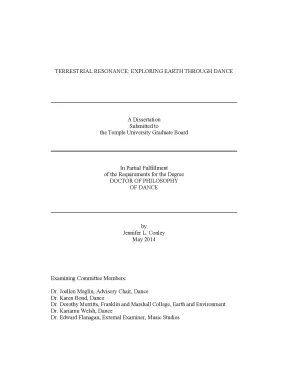
Tải xuống để đọc toàn bộTERRESTRIAL RESONANCE: EXPLORING EARTH THROUGH DANCE A Dissertation Submitted to the Temple University Graduate Board In Partial Fulfillment of the Requirements for the Degree DOCTOR OF PHILOSOPHY OF DANCE by Jennifer L. Conley May 2014 Examining Committee Members: Dr. Joellen Meglin, Advisory Chair, Dance Dr. Karen Bond, Dance Dr.
Dorothy Merritts, Franklin and Marshall College, Earth and Environment Dr. Kariamu Welsh, Dance Dr. Edward Flanagan, External Examiner, Music Studies © Copyright 2014 by JenniferL.Conley All Rights Reserved ii ABSTRACT The geologic theory of plate tectonics, sometimes referred to as “the dance of the continents,” proposes a vision of Earth as dynamic body in motion that is constantly shifting and altering its form. Geophysical research during the 1950s and 1960s, especially in relation to Harry Hess’s seafloor spreading hypothesis, Fred Vine and D.
Matthews’ geomagnetic reversal hypothesis, and J. Tuzo Wilson’s classification of new faults in Earth’s crust, established enough scientific evidence to suggest a viable model of this dance of the continents. This led to the geoscientific community widely accepting the theory of plate tectonics by the end of the 1960s. The purpose of this dissertation is to investigate how the idea of Earth as a dynamic body in motion can be connected to the experience of one’s own body in motion and in movement practice.
Emerging from my work as an artist and an educator, this research analyzes the creative processes and the phenomenological essences of two geologically inspired dances, and develops a pedagogical application of geosomatic movement practices in an undergraduate course entitled Dancing Earth, Dancing Body. I use a phenomenological method of analysis informed by Max van Manen and Clark Moustakas to examine what it means to embody terrestrial forces, entities, and landscapes, and how geologic structures and scientific ideas can be translated into anthropomorphic movement. In chapter 4, “Sediments of Meaning: Phenomenological Analysis of Pieces of Pele,” I devise a theoretical structure for critical reflection upon and development of the choreographer’s creativity, which I call a meta-choreographic process. This essentially hermeneutic method of reflection allows choreographers to more deeply understand their creative process and aesthetic criteria, and how they iii construct meaning through movement.
The analysis in chapter 5, “Continental Shift: Phenomenological Analysis of Tectonic Suite,” illuminates the profound role of metaphor in both the creative process and the viewing experience in relation to this particular dance from my GeoDance repertoire. Using the framework of George Lakoff and Mark Johnson’s analysis in Metaphors We Live By, I demonstrate how dance can function to create coherent metaphors. In chapter 6, “Dancing Earth, Dancing Body: Experiential Learning of Geologic Concepts,” I use an ethnographic framework to examine student perspectives of Dancing Earth, Dancing Body. This analysis reveals that, as the instructor of the course, I fostered, and students applied, three distinct modes of creative inquiry in the classroom: imagistic, language-based, and collaborative.
Embedded within these three modes of creative inquiry were a variety of somatic experiences and refocused dance-based exercises that amounted to a technique of sorts, with the specific goal of awakening and fostering the development of our body-mind-environment connection. I theorize this collection of experiences and exercises as a geosomatic movement practice. Illuminated throughout this dissertation are key sources from the fields of dance, geology, somatics, ecology, phenomenology, eco-phenomenology, and ethnography— evincing the interdisciplinary nature of this study. At the heart of this interdisciplinary inquiry lies a fundamental awareness that our experience of our bodies is integrated with our experience of atmosphere, terrain, and gravitation.
Therefore, by deepening our understanding of how we can cope with these physical aspects of our environment, we can deepen our understanding of Earth and its processes. iv For Rex. “The earth and myself are of one mind. The measure of the land the measure of our bodies are the same.” Chief Joseph of the Nez Perce Nation v ACKNOWLEDGMENTS The ideas presented in this dissertation developed over the course of the seven years, while I was conducting research as a doctoral student at Temple University.
I am indebted to the following dance faculty at Temple for their guidance and enlightenment: Dr. Karen Bond, Dr. Luke Kalich, Dr. Sarah Hilsendager, Dr.
Joellen Meglin, and Dr. I consider it a gift that they perceive the potential for creative and pedagogical processes to inform scholarly investigations, and never once questioned the notion of being both an artist and a scholar. I also recognize each of my committee members for helping me to find my voice in this research: Dr. Bond for illuminating phenomenological methodology and always encouraging an experiential voice to emerge in my research; Dr.
Kariamu for nourishing the poetic nature of this work and reminding me to give voice to the cultural context that informs this investigation; Dr. Dorothy Merritts for bringing a geomorphic expertise to this study that has inspired me to visualize static motion in rocks; and Dr. Edward Flanagan for graciously joining this committee and bringing a musical mind to this research. Lastly, I am especially grateful for the generous contributions of my primary advisor, Dr.
To use a geologic metaphor, I have learned from her how to crystallize my ideas. I would also like to mention the Temple University Provost’s Commission on the Arts for granting me the unique opportunity to stage the evening-length concert, GeoDance Theatre, at the Conwell Dance Theatre in Philadelphia in February 2009. The dance community at Franklin and Marshall College has also provided a fertile ground for the experimentation and implementation of my geosomatic vi ideas. In particular, professors Dr.
Lynn Brooks and Pamela Vail have been incredibly supportive. They commissioned my first GeoDance piece for their annual Fall Dance Concert in 2008, and invited me to teach my course Dancing Earth, Dancing Body in the Spring of 2010. A special thank you to this first class of students in Dancing Earth, Dancing Body whose enthusiasm for this material gave me the spark I needed to complete this research. The geologists in the Earth and Environment Department at Franklin and Marshall College delighted me with their interest in my artistic interpretations of their field.
The truly liberal arts of vision of geologist-educators Dr. Robert Sternberg, and Dr. Roger Thomas inspires me to believe in an ecological model of academic disciplines where the boundaries between fields are more like pervious membranes rather than walls. I would also like to acknowledge geologists Dr.
Myer at Temple University and Dr. Laura Serpa at University of Texas in El Paso. There are many artists that I have collaborated with on GeoDance projects, and their contributions deeply enhanced the vision of each work. A very special thank you to lighting designers Leigh Mumford and John Whiting, costume designers Gregory Powell and Virginia West, and composer Pat Daugherty.
Lastly, a choreographer is forever indebted to the dancers who literally breathe life into the work. With all of my heart, thank you to my dancers who have emboldened, empowered, and inspired this vision. It is my distinct joy and privilege to be able to collaborate with each of these artists. It may be unusual to acknowledge someone whom I have never met in person, but I would be amiss if I did not mention Martha Graham whose work and ideas have deeply vii inspired this research.
A special thank you to Terese Capucilli, Christine Dakin, Ellen Graff, Stuart Hodes, Pearl Lang, Yuriko, Ethel Winter, Marnie Thomas Wood, and Yuriko—the keepers of the flame. I acknowledge my entire extended Graham family including past and current company members, ensemble members, teachers, and students. I hope this work resonates with you and illuminates a new understanding of our inner landscape. Lastly, a very loving thank you to my family.
I would like to especially mention my late grandfather, George Taylor, for instilling in me a connection with the outdoors at a young age. To my Mom and Dad, I carry their endless love and support with me no matter how far from home I may travel. For my dearest friend and lifetime collaborator, Pat Daugherty, your unbridled creativity is a shining example of our greatest potential. viii TABLE OF CONTENTS Page ABSTRACT.
vi LIST OF FIGURES. A MOUNTAIN RISING: AN INTRODUCTION .1 Coming into Focus .4 Defining Purpose and Readership. TOPOGRAPHIC SURVEY: A RESEARCH PLAN .11 Embodying Ideas of Earth .11 Method of Analysis: Phenomenology in Relation to Two GeoDances .13 Sample Phenomenological Analysis of “Planetary Body” .20 Method of Analysis: Ethnography of Dancing Earth, Dancing Body .23 Sample Ethnographic Analysis of Student Fieldnotes. SEISMIC ECHOES: REVIEW OF LITERATURE .33 Arriving at a Dynamic View of Earth .33 Developing a Somatic Approach to Earth .37 Shaping an Ecological Approach to Body .40 ix Analysis of GeoDance Repertoire in Chapter 4 and Chapter 5 .45 Analysis of Dancing Earth, Dancing Body in Chapter 6.
SEDIMENTS OF MEANING: PHENOMENOLOGICAL ANALYSIS OF “PIECES OF PELE” .56 Pieces of Pele .56 Arriving at Sediments of Analysis .58 Geologic Sediment and the Creative Process .65 Sediment of Imagery for Transformation .78 A Meta-Choreographic Process. CONTINENTAL SHIFT: PHENOMENOLOGICAL ANALYSIS OF “TECTONIC SUITE” .86 Process of Analysis .89 A Collective Body Emerges.91 A Geologic Narrative Emerges .96 Metaphors for Geologic Theory. DANCING EARTH, DANCING BODY: EXPERIENTIAL LEARNING OF GEOLOGIC CONCEPTS.114 Dancing Earth, Dancing Body .116 Experiencing Earth Through Dance.120 Language-Based Modes of Creative Inquiry .125 Imagistic Modes of Creative Inquiry .135 Collaborative Modes of Creative Inquiry. CONCLUSION: GEOSOMATICE MOVEMENT PRACTICES AND ECOLOGICAL PERSPECTIVES .149 Evoking Geologic Forms .151 Emergent Processes for Critical and Reflective Evaluation of Choreography.157 “Geosomatic” Movement Practices .160 Earth as Body, Body as Earth.
COMPLETE LIST OF GEODANCE REPERTOIRE. DANCING EARTH, DANCING BODY SYLLABUS, 2010. DANCING EARTH, DANCING BODY SYLLABUS, 2013. IRB PROPOSAL AND CONSENT FORMS .187 xi LIST OF FIGURES Figure Page 1.
Phenomenological process of analysis…………………………. Ethnographic process of analysis…. Microcosmic and macrocosmic imagery evoked in Pieces of Pele……. Meta-choreographic process……………….
Student rendering of an imagined experience with Earth’s geothermal cycle…141 6. Student rendering of our evolutionary primitive fish body…………………….141 xii CHAPTER 1 A MOUNTAIN RISING: AN INTRODUCTION Introduction This journey begins with an account from my first travels across the western United States in the summer of 2002, where I experienced a seismic shift in my understanding of Earth. I was enjoying the long drive across South Dakota with my husband-to-be, gazing out the window at herds of buffalo stretched across the prairie, when I was suddenly struck by an abrupt change in the landscape. The rolling prairie had given way to something else, an otherworldly place known as the Badlands National Park.
Pinnacles, buttes, and spires carved out of sand appeared to be painted in layers of pink, coral, and brown. These mysterious formations looked like the ruins of an ancient sand castle. We entered the park, got out of the car, and proceeded to follow a narrow sandy trail. I soon found myself standing at the precipice of a sharply eroded butte and looking upon an expansive landscape that overwhelmed my senses.
I recall feeling a trembling energy surge through my muscles and noticing that my breath was caught in my chest—it was a breathtaking experience. I was compelled to continue walking deeper into this landscape; before I knew it my companion and the car were tiny dots on the horizon behind me. There was a spirit to this land that I had never encountered before; it was magnetic, energizing, and awe-inspiring. In the presence of this landscape, my vision of an animate Earth began to materialize.
My companion and I wanted to know more about this landscape and the people who inhabited it. I was drawn to investigate its geologic history, while he was drawn to 1 investigate its social and cultural history.
Nội dung được bảo vệ bản quyền — Tải xuống đầy đủ
Trích dẫn luận án này
Jennifer L. Conley (2014). Tetdedxconley temple 0225e 11794 [Luận án tiến sĩ, Temple University]. LuanAn.net. https://luanan.net/lich-su/khao-co-hoc/tetdedxconley-temple-0225e-11794
Câu hỏi thường gặp
Luận án "Tetdedxconley temple 0225e 11794" nghiên cứu về vấn đề gì?
Khám phá Đền Tetdedxconley 0225e 11794, kiến trúc độc đáo và ý nghĩa lịch sử. Tìm hiểu về di sản văn hóa nơi đây.
Luận án "Tetdedxconley temple 0225e 11794" được bảo vệ tại trường nào?
Luận án này được bảo vệ tại Temple University. Năm bảo vệ: 2014.
Luận án "Tetdedxconley temple 0225e 11794" thuộc chuyên ngành gì?
Luận án "Tetdedxconley temple 0225e 11794" thuộc chuyên ngành Dance. Danh mục: Khảo Cổ Học.
Luận án "Tetdedxconley temple 0225e 11794" có bao nhiêu trang?
Luận án "Tetdedxconley temple 0225e 11794" có 206 trang. Bạn có thể xem trước một phần tài liệu ngay trên trang web trước khi tải về.
Cách tải luận án "Tetdedxconley temple 0225e 11794" về máy như thế nào?
Để tải luận án về máy, bạn nhấn nút "Tải xuống ngay" trên trang này, sau đó hoàn tất thanh toán phí lưu trữ. File sẽ được tải xuống ngay sau khi thanh toán thành công. Hỗ trợ qua Zalo: 0559 297 239.