John randolph of roanoke and the politics of doom slavery secti
Tìm hiểu John Randolph xứ Roanoke và "chính trị diệt vong" của ông về chế độ nô lệ. Phân tích sâu sắc lịch sử và tư tưởng.
Luan An
Dissertation
Năm xuất bản
Số trang
340
Thời gian đọc
51 phút
Lượt xem
0
Lượt tải
0
Phí lưu trữ
60 Point
Tổng quan nhanh
- Chủ đề:
- John Randolph of Roanoke: Chính trị miền Nam Hoa Kỳ
- Số trang:
- 340 trang
- Trường:
- University of Tennessee, Knoxville
- Chuyên ngành:
- History
- Tác giả:
- Aaron Scott Crawford
- Năm:
- 2012
Tóm tắt nội dung luận án
I.John Randolph of Roanoke Chính trị miền Nam Hoa Kỳ
John Randolph of Roanoke nổi bật như một nhân vật quan trọng trong lịch sử chính trị Hoa Kỳ thời kỳ đầu. Ông đại diện cho một tiếng nói bảo thủ mạnh mẽ từ miền Nam. Tư tưởng của ông định hình Chính trị miền Nam Hoa Kỳ trong giai đoạn quan trọng. Randolph thường xuyên phê phán sự phát triển quyền lực liên bang. Ông kiên định bảo vệ các nguyên tắc của Đảng Cộng hòa Cũ. Điều này khiến ông trở thành người ủng hộ mạnh mẽ cho Quyền của các bang. Sự nghiệp của Randolph kéo dài qua nhiều thập kỷ biến động. Nó ảnh hưởng sâu sắc đến tranh luận về nô lệ, chủ nghĩa liên bang và bản chất của liên minh.
1.1. Khái quát chân dung chính trị John Randolph
John Randolph of Roanoke là một nghị sĩ kiệt xuất. Sự nghiệp của ông kéo dài gần ba mươi năm. Ông phục vụ cả Hạ viện và Thượng viện. Randolph được biết đến với khả năng diễn thuyết sắc bén và tính khí thất thường. Ông không ngại đứng một mình chống lại các phe phái lớn. Randolph thường xuyên thách thức quyền lực của tổng thống và quốc hội. Quan điểm độc lập của ông định hình hình ảnh công chúng. Nó cũng ảnh hưởng đến các mối quan hệ chính trị của ông.
1.2. Vai trò lãnh đạo trong chính trị miền Nam
Randolph đóng vai trò trung tâm trong Chính trị miền Nam Hoa Kỳ. Ông là người ủng hộ không khoan nhượng cho lợi ích miền Nam. Đặc biệt là về vấn đề Nô lệ ở Virginia. Ông tin rằng chế độ nô lệ là một phần không thể thiếu của nền kinh tế và xã hội miền Nam. Các bài phát biểu của ông thường phản ánh sự lo sợ về sự can thiệp của liên bang. Randolph xem xét mọi chính sách qua lăng kính bảo vệ miền Nam. Vai trò của ông củng cố lập trường của miền Nam trong các cuộc tranh luận quốc gia.
1.3. Tư tưởng bảo thủ của Đảng Cộng hòa Cũ
Randolph là đại diện tiêu biểu của Đảng Cộng hòa Cũ. Ông tuân thủ chặt chẽ các nguyên tắc của Jefferson. Ông nhấn mạnh sự hạn chế của chính phủ liên bang. Quyền của các bang được đặt lên hàng đầu trong triết lý của ông. Randolph phản đối mạnh mẽ các chính sách quốc gia. Ông coi đó là sự vi phạm hiến pháp. Quan điểm này đặt nền móng cho những cuộc tranh luận sau này. Điều đó bao gồm cả Cuộc khủng hoảng hủy bỏ. Tư tưởng của ông ảnh hưởng đến những người theo chủ nghĩa ly khai.
II.Nô lệ ở Virginia Gốc rễ xung đột Thời kỳ Antebellum
Nô lệ là vấn đề trung tâm trong cuộc đời và sự nghiệp của John Randolph of Roanoke. Nó là nguồn gốc của nhiều mâu thuẫn cá nhân và chính trị của ông. Tài liệu này khám phá cách Nô lệ ở Virginia định hình tư tưởng của Randolph. Nó cũng làm sáng tỏ vai trò của ông trong việc châm ngòi các cuộc tranh luận quốc gia. Nô lệ không chỉ là một vấn đề kinh tế. Nó còn là một vấn đề đạo đức và hiến pháp. Vấn đề này làm sâu sắc thêm sự chia rẽ giữa các bang. Điều này đẩy đất nước đến Thời kỳ Antebellum đầy căng thẳng.
2.1. Nô lệ và mâu thuẫn nội tại của Randolph
John Randolph sở hữu một số lượng lớn nô lệ. Ông sống phụ thuộc vào lao động nô lệ. Điều này tạo ra một mâu thuẫn sâu sắc. Randolph nhận thức được sự bất công của chế độ nô lệ. Ông từng thể hiện ý định trả tự do cho nô lệ của mình. Tuy nhiên, ông không thực hiện được điều này trong phần lớn cuộc đời. Mâu thuẫn này phản ánh sự "tự lừa dối" mà tiêu đề tài liệu đề cập. Nó cho thấy sự phức tạp của vấn đề nô lệ đối với giới tinh hoa miền Nam. Họ bị mắc kẹt giữa lý tưởng và thực tế kinh tế.
2.2. Tầm quan trọng của nô lệ đối với Virginia
Chế độ nô lệ là nền tảng của nền kinh tế Virginia. Nó đặc biệt quan trọng đối với các đồn điền thuốc lá và bông. Các bang miền Nam phụ thuộc nặng nề vào lao động nô lệ. Điều này tạo ra một hệ thống xã hội phức tạp. Các chính trị gia Virginia như Randolph phải bảo vệ lợi ích này. Mất đi nô lệ đồng nghĩa với sự sụp đổ kinh tế. Nó cũng đồng nghĩa với sự thay đổi trật tự xã hội. Do đó, việc bảo vệ chế độ nô lệ trở thành ưu tiên hàng đầu. Nó là một phần không thể tách rời của Chính trị miền Nam Hoa Kỳ.
2.3. Dẫn đến xung đột Thời kỳ Antebellum
Sự phụ thuộc vào nô lệ ở Virginia và các bang miền Nam khác đã tạo ra căng thẳng. Căng thẳng này bùng phát thành xung đột khu vực. Thời kỳ Antebellum chứng kiến sự gia tăng tranh cãi về nô lệ. Mọi vấn đề chính trị đều bị ảnh hưởng bởi nó. Từ thuế quan đến mở rộng lãnh thổ. Những cuộc tranh luận này đặt nền móng cho Chủ nghĩa ly khai. Chúng cuối cùng dẫn đến Nội chiến Hoa Kỳ. Randolph sống và chết trong giai đoạn này. Ông là một phần của quá trình hình thành cuộc xung đột lớn.
III.Quyền của các bang Chủ nghĩa ly khai trong kỷ nguyên
John Randolph of Roanoke là người kiên định bảo vệ Quyền của các bang. Ông xem đây là bức tường thành chống lại sự chuyên chế của liên bang. Tư tưởng của Randolph có ảnh hưởng sâu rộng. Nó định hình các cuộc tranh luận về hiến pháp trong giai đoạn sau. Ông phản đối bất kỳ động thái nào nhằm tăng cường quyền lực trung ương. Randolph tin rằng các bang có quyền tự quyết lớn. Niềm tin này đặt nền móng cho các phong trào sau này. Nó góp phần vào Chủ nghĩa ly khai và Cuộc khủng hoảng hủy bỏ.
3.1. Randolph và việc bảo vệ quyền của các bang
Randolph nổi tiếng với lập trường cứng rắn về Quyền của các bang. Ông lập luận rằng Hiến pháp đã tạo ra một liên minh các bang có chủ quyền. Ông phản đối mạnh mẽ học thuyết quyền lực ngụ ý. Randolph tin rằng chính phủ liên bang chỉ có thể thực hiện những quyền được ủy quyền rõ ràng. Bất kỳ sự mở rộng nào ngoài giới hạn đó đều là vi hiến. Ông sử dụng diễn đàn quốc hội để bảo vệ nguyên tắc này. Điều này ảnh hưởng đến nhiều chính trị gia miền Nam khác.
3.2. Ảnh hưởng đến chủ nghĩa ly khai sau này
Tư tưởng của Randolph về Quyền của các bang cung cấp cơ sở lý luận. Nó được các nhà ly khai sau này sử dụng. Các nhà lãnh đạo Chủ nghĩa ly khai ở miền Nam trích dẫn Randolph. Họ lập luận về quyền của các bang rời khỏi Liên minh. Ông đã gieo những hạt mầm cho ý tưởng này. Mặc dù ông qua đời trước Nội chiến Hoa Kỳ. Quan điểm của ông về liên bang tự nguyện là một yếu tố quan trọng. Nó thúc đẩy các bang miền Nam hành động.
3.3. Cuộc khủng hoảng hủy bỏ như một hệ quả
Mặc dù Randolph qua đời trước khi Cuộc khủng hoảng hủy bỏ bùng nổ. Tuy nhiên, các lý thuyết của ông về quyền lực bang là tiền thân. Cuộc khủng hoảng này xoay quanh quyền của một bang bác bỏ luật liên bang. John C. Calhoun sau này là người ủng hộ chính. Các lập luận của Calhoun có nguồn gốc từ những người tiền nhiệm. Trong đó có Randolph và James Madison thời kỳ đầu. Randolph đã thiết lập một khuôn khổ. Nó cho phép các bang thách thức quyền lực của liên bang.
IV.Luật Missouri Compromise và khủng hoảng chia rẽ
Luật Missouri Compromise năm 1820 là một sự kiện lịch sử quan trọng. Nó đánh dấu một bước ngoặt trong cuộc tranh luận về nô lệ. John Randolph of Roanoke đã có phản ứng mạnh mẽ. Ông coi đó là một sự vi phạm trắng trợn quyền của các bang. Luật này tìm cách cân bằng quyền lực giữa các bang tự do và nô lệ. Nó làm trầm trọng thêm sự chia rẽ khu vực. Cuộc khủng hoảng chia rẽ do luật này gây ra là một điềm báo. Nó dự báo những xung đột lớn hơn trong tương lai. Điều này cuối cùng dẫn đến Nội chiến Hoa Kỳ.
4.1. Phản ứng của Randolph trước Luật Missouri Compromise
Randolph kịch liệt phản đối Luật Missouri Compromise. Ông coi nó là một hành vi xâm phạm quyền của các bang. Ông lập luận rằng Quốc hội không có thẩm quyền cấm nô lệ ở các vùng lãnh thổ. Randolph coi luật này là một mối đe dọa trực tiếp. Nó đe dọa quyền tự quyết của miền Nam. Ông tin rằng nó mở đường cho sự can thiệp của liên bang vào chế độ Nô lệ ở Virginia. Phản ứng của ông phản ánh nỗi sợ hãi sâu sắc của Chính trị miền Nam Hoa Kỳ.
4.2. Khủng hoảng chia rẽ và vấn đề nô lệ
Luật Missouri Compromise làm sâu sắc thêm khủng hoảng chia rẽ. Nó chia đất nước thành các khu vực đối lập. Các bang miền Bắc ủng hộ việc cấm nô lệ ở các vùng lãnh thổ mới. Các bang miền Nam yêu cầu quyền mở rộng chế độ nô lệ. Vấn đề nô lệ không còn là vấn đề riêng của các bang. Nó trở thành vấn đề quốc gia. Điều này làm tăng căng thẳng giữa Bắc và Nam. Nó tạo ra một tiền lệ nguy hiểm cho các cuộc tranh luận trong tương lai. Thời kỳ Antebellum ngày càng trở nên chia rẽ.
4.3. Dự báo về Nội chiến Hoa Kỳ
Các cuộc tranh luận xung quanh Luật Missouri Compromise là điềm báo. Chúng báo trước cuộc xung đột lớn hơn là Nội chiến Hoa Kỳ. Sự thỏa hiệp chỉ là một giải pháp tạm thời. Nó không giải quyết được vấn đề cơ bản của nô lệ. Randolph và những người cùng quan điểm nhận ra điều này. Họ thấy được mối nguy hiểm tiềm tàng. Sự bất đồng về nô lệ tiếp tục leo thang. Cuối cùng, nó dẫn đến sự tan rã của Liên minh. Di sản của luật này là một lời nhắc nhở. Nó nhắc nhở về những rạn nứt sâu sắc trong quốc gia.
V.Di sản tư tưởng Randolph Tiền đề Nội chiến Hoa Kỳ
Di sản chính trị của John Randolph of Roanoke vẫn còn vang vọng lâu dài. Nó vượt xa cái chết của ông. Tư tưởng của ông về Quyền của các bang và vấn đề nô lệ đã định hình sâu sắc Chính trị miền Nam Hoa Kỳ. Tài liệu khám phá "sự tự lừa dối" của Randolph. Nó cho thấy cách ông đối phó với thực tế khắc nghiệt của chế độ nô lệ. Các quan điểm của ông, mặc dù gây tranh cãi, đã trở thành tiền đề quan trọng. Chúng đóng góp vào sự phát triển của Chủ nghĩa ly khai. Cuối cùng, chúng là một yếu tố dẫn đến Nội chiến Hoa Kỳ.
5.1. Randolph s self deception và hậu quả chính trị
Tài liệu nhấn mạnh khía cạnh "tự lừa dối" của Randolph. Nó liên quan đến việc ông nắm giữ nô lệ. Randolph nhận thức được sự sai trái của chế độ này. Tuy nhiên, ông vẫn tiếp tục sống với nó. Sự mâu thuẫn này phản ánh sự phức tạp của giới tinh hoa miền Nam. Họ lý giải việc nắm giữ nô lệ. Họ bảo vệ chế độ nô lệ bằng cách viện dẫn hiến pháp và quyền của các bang. Sự tự lừa dối này có hậu quả chính trị. Nó cho phép tiếp tục một hệ thống bất công.
5.2. Ảnh hưởng đến tư tưởng miền Nam Hoa Kỳ
Các lập luận của Randolph đã ảnh hưởng đến tư tưởng miền Nam sau này. Ông là một người tiên phong trong việc bảo vệ chế độ nô lệ. Ông viện dẫn Quyền của các bang. Quan điểm của ông cung cấp cơ sở lý luận cho những người miền Nam. Họ chống lại sự can thiệp của liên bang. Tư tưởng này trở thành trụ cột của Chính trị miền Nam Hoa Kỳ. Nó củng cố niềm tin vào tính hợp pháp của chế độ nô lệ. Nó nuôi dưỡng tâm lý chống lại miền Bắc.
5.3. Vai trò trong việc định hình xung đột Nội chiến
Mặc dù John Randolph of Roanoke qua đời trước Nội chiến Hoa Kỳ. Tuy nhiên, những đóng góp của ông đã đặt nền móng. Ông đã làm sâu sắc thêm sự chia rẽ khu vực. Ông thúc đẩy Chủ nghĩa ly khai và làm bùng lên các cuộc tranh luận về nô lệ. Các chính sách và lập luận của ông về Quyền của các bang. Chúng tạo ra tiền lệ cho các cuộc xung đột hiến pháp. Cuối cùng, những xung đột này dẫn đến việc các bang miền Nam ly khai. Di sản của ông là một lời cảnh báo. Nó cho thấy tác động lâu dài của những lựa chọn chính trị.
Mục lục chi tiết luận án
Tải xuống file đầy đủ để xem toàn bộ nội dung
Tải đầy đủ (340 trang)Trích đoạn nội dung luận án
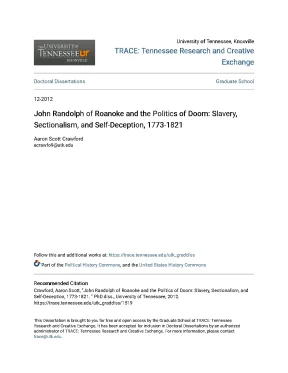
Tải xuống để đọc toàn bộUniversity of Tennessee, Knoxville TRACE: Tennessee Research and Creative Exchange Doctoral Dissertations Graduate School 12-2012 John Randolph of Roanoke and the Politics of Doom: Slavery, Sectionalism, and Self-Deception, 1773-1821 Aaron Scott Crawford acrawfo9@utk.edu Follow this and additional works at: https://trace.edu/utk_graddiss Part of the Political History Commons, and the United States History Commons Recommended Citation Crawford, Aaron Scott, "John Randolph of Roanoke and the Politics of Doom: Slavery, Sectionalism, and Self-Deception, 1773-1821., University of Tennessee, 2012.edu/utk_graddiss/1519 This Dissertation is brought to you for free and open access by the Graduate School at TRACE: Tennessee Research and Creative Exchange. It has been accepted for inclusion in Doctoral Dissertations by an authorized administrator of TRACE: Tennessee Research and Creative Exchange. For more information, please contact trace@utk. To the Graduate Council: I am submitting herewith a dissertation written by Aaron Scott Crawford entitled "John Randolph of Roanoke and the Politics of Doom: Slavery, Sectionalism, and Self-Deception, 1773-1821." I have examined the final electronic copy of this dissertation for form and content and recommend that it be accepted in partial fulfillment of the requirements for the degree of Doctor of Philosophy, with a major in History.
Daniel Feller, Major Professor We have read this dissertation and recommend its acceptance: Stephen Ash, Ernest Freeberg, Michael Fitzgerald Accepted for the Council: Carolyn R. Hodges Vice Provost and Dean of the Graduate School (Original signatures are on file with official student records.) John Randolph of Roanoke and the Politics of Doom: Slavery, Sectionalism, and Self-Deception, 1773-1821 A Dissertation Presented for the Doctor of Philosophy Degree The University of Tennessee, Knoxville Aaron Scott Crawford December 2012 Copyright ©2012 Aaron Scott Crawford. All rights reserved. ii Dedication This dissertation is dedicated to my father, William B.
Crawford, and my advisor, Daniel Feller. iii Acknowledgments Completing this dissertation had been a lengthy and collaborative effort, and many people have assisted me. My advisor, Dr. Daniel Feller, has proven far more patient than should be expected.
His insights have been valuable and his guidance has been critical. I have, in part, dedicated this dissertation to him as an appreciative gesture for his all he has done for me in the past decade. Stephen Ash and Ernest Freeberg offered invaluable advice to me during their seminars, and their assistance with the dissertation is greatly appreciated. I had the pleasure of working with Michael Fitzgerald at the Howard H., Center for Public Policy, and I have valued his support and kindness.
Marszalek has been an important mentor, and I thank him and his wife, Jeanne, for everything they have done for me. The colleagues that have endured incessant talk of John Randolph have been innumerable, but I want to recognize three of them. Will Bolt’s knowledge of the Early American politics has been incredibly helpful. Tom Coens’ criticisms have been insightful.
John Kvach has been encouraging and thoughtful in his advice, particularly about Southern history. All three gentlemen have generously shared important sources and documents throughout the project. I also want to thank Padraig Riley for his comments on a portion of the dissertation presented at the 2010 Society for Historians of the Early American Republic meeting. Nicholas Wood shared critical Randolph documents.
Bethany Keiper, Erin Scanlon, Dr. Mike Ballard, and Dr. Cadra McDaniel all read portions of the dissertation and helped correct numerous errors. Rachel Cannady helped untangle many grammatical problems.
I also want to express my appreciation to several other people who have assisted in very important ways, particularly Dr. Fashion Bowers, Elizabeth Coggins, Dr. Travis Hardy, Dr. Paul Coker, Dr.
Aaron Purcell, Dr. Tim Jenness, Patti Rebholz, Dr. Nissa Dahlin- Brown, Carl Pierce, David Nolen, and Kim Harrison. I need to especially thank Alan Lowe for his guidance and leadership.
Bobby Holt, my oldest friend, has encouraged me for years in this work and always been there for me. Lisa Crawford’s emotional support and impeccable research skills were crucial. For years, she supported my research and listened to more Randolph stories than a person should have to. Fortunately, she still greets me in good humor and kindness.
Virginia Historical Society and Nelson Lankford offered valuable support for this project. Librarians and archivists from numerous institutions have aided in my attempt to accumulate Randolph’s letters and documents. In particular, I want to thank the archives and special collections staffs at several institutions including the University of Virginia, the Library of Virginia, the Library of Congress, Randolph College, Duke University, the University of North Carolina at Chapel Hill, the New York Public Library, the Massachusetts Historical Society. Laurel Sammonds has been the most patient and understanding partner that I could have hoped for, and I am glad that she has been there as I complete the dissertation.
Finally, I want to thank my mother, Pat Crawford, who will be glad that I am finally out of school. I dedicate this dissertation to my late father, William B. Crawford, a Virginia public servant for thirty-five years. He introduced me to the world of Thomas Jefferson, and for that I will be forever grateful.
iv Abstract In 1979, Robert Dawidoff wrote that it “was on the question of slavery that John Randolph contributed most decisively to American history.” Randolph’s stance on slavery has perplexed historians and biographers since his death in 1833. This dissertation examines the paradox of slavery in the life and career of John Randolph from the American Revolution until the Missouri Compromise. In an attempt to understand his public and private contradictions concerning slavery and the role of intense sectionalism in his politics, I have attempted to correlate his words with his actions. An examination of his letters reveal a man decidedly devoted to the belief that slavery was wrong, but a closer look of his public actions expose his commitment to preventing anyone from challenging that institution.
Randolph’s cognitive dissonance over slavery is revealed in his letters and speeches, which often display alternating strands of brutal honesty and masterful self-deception. In his life as a member of the Virginia gentry, he struggled with deep-seated feelings of regret and angst over holding slaves. In his public career, Randolph’s attitudes about slavery, slaveholding, and sectionalism cultivated countless public debates in which he participated. Randolph considered the interests of Southern slaveholders above all else during his political career.
Though in September 1815, he insisted that he wanted to be the American counterpart to British abolitionist William Wilberforce, he resisted any public effort to free American slaves. He devoted himself to the public defense of slavery, while privately planning the freedom for his own slaves. He saw himself as slavery’s severest critic while he acted as the most ardent defender of Virginia’s slave power. For Randolph, that transformation occurred primarily in the political realm and was informed by the declining fortunes of Virginia’s planter gentry.
Examining Randolph’s contradictions on slavery is a means of examining the transformation of antislavery principles in the South during the Early Republic. v Table of Contents Chapter 1: Introduction .1 Chapter 2: “Abilities and Exertions:” John Randolph and the Crisis of the Virginia Gentry .15 Chapter 3: The Inconsistent Education of John Randolph, 1789-1799 .51 Chapter 4: “The Interest and Feelings of the Southern States:” John Randolph and the Congressional Defense of Slavery and Slaveholders, 1799-1807 .113 Chapter 5: “Outcast of the World:” Sectionalism and Nationalism in John Randolph’s War of 1812.175 Chapter 6: “Chapter of Contradictions:” Slavery, Decay, and Salvation During the War of 1812 and its Aftermath.281 vi Chapter 1: Introduction In January 1824, the United States Congress prepared to pass The General Survey Act, which would create a system of internal improvements. Secretary of War John C. Calhoun, a staunch nationalist, had for years advocated a program to build roads and canals across the states, conquering the space of the expanding republic.
The bill would give the president and the central government unprecedented power in planning and executing public works projects. Calhoun and his fellow nationalists believed that the bill was necessary to strengthen the economy and the political Union. Stronger transportation and communication systems would connect sections, peoples, and ideas. In the House of Representatives, John Randolph of Roanoke rejected this vision of the nation’s future and warned of the bill’s true ramifications.
“I ask the attention of every gentleman who happens to stand in the same unfortunate predicament with myself—of every man who has the misfortune to be, and to have been born, a slaveholder,” Randolph said. “If Congress possesses the power to do what is proposed in this bill,” he argued, “they may emancipate every slave in the United States.”1 Though Congress passed the General Survey Act, Randolph’s warning became the clarion call that defined the struggle of slaveholders in American politics until the Civil War. Indeed, his 1824 internal improvements speech has been widely viewed as a pivotal statement that defined the antebellum proslavery effort. Cooper has argued that Randolph’s “doom-laden” prophecy emerged from “two decades of constitutional foreboding.” James Oakes claimed that the 1824 statement demonstrated the “portents of disunity in the face 1 Annals of Congress, 18:1, 1308.
1 of a rising antislavery threat.” Historians have correctly positioned Randolph as a pivotal figure in the proslavery political movement that led to the Civil War.2 During the antebellum period, rabid sectionalists promoted the image of John Randolph as the South’s first sentinel against antislavery forces. In 1860, one commentator chided fellow Southerners for ignoring “the Cassandra voice of honest John Randolph.” Beverly Tucker cast Randolph, his stepbrother, as the South’s original fire-eater. In Tucker’s writings, Randolph became the archetypal Southern gentleman defending the interest of his hamlet, a precursor to the most tragic creations of William Faulkner. A committed Southern nationalist, Tucker romanticized his kinsman as the most committed defender of the South.
In his 1836 Southern dystopian political novel, The Partisan Leader, Tucker imagined a civil war, which drove the Deep South out of the Union and led Virginia to defy the tyranny of a fictional President Martin Van Buren, then in his fourth term. As the fictional Virginians finally stepped forward to defend their rights, it seemed as “if the spirit of John Randolph had risen from the sleep of death.” Tucker believed that Randolph had handed Southerners a charge to defend slavery from Northerners and abolitionists.3 In August 1836, the same year that Tucker published his novel, William Lloyd Garrison’s The Liberator portrayed a very different John Randolph. After his death in 1833, the public learned that the arch-defender of slavery had granted freedom to his slaves and provided for their 2 William J. Cooper, Liberty and Slavery; Southern Politics to 1860 (New York: Knopf, 1983), 151; James Oakes, Slavery and Freedom: An Interpretation of the Old South (New York: Knopf, 1990), 128.
Quitman Moore, “The Attitude of the South,” Debow’s Review: Agricultural, Commercial, Industrial Progress and Resources (July 1860), 26; William R. Taylor, Cavalier and Yankee: The Old South and American National Character (New York: G. Braziller, 1961), 159; Nathaniel Beverley Tucker, The Partisan Leader, A Novel, And An Apocalypse of the Origin and Struggles of the Southern Confederacy (Richmond: Thomas A. 2 resettlement in free Ohio.
“I give to my slaves their freedom, to which my conscience tells me they are justly entitled,” his will declared. Furthermore, Randolph had expressed the “deepest regret” of ever inheriting them. His closest relatives, the Tucker family, insisted that he had been insane when he wrote the will and contested it in the Virginia courts. In coverage of the litigation, The Liberator and many other Northern papers offered anecdotal evidence that the South’s most ardent slavemaster had really been an antislavery man.
In one colorful anecdote, a stranger appeared at his plantation, where Randolph served him dinner. During the meal, his guest inquired about buying one of Randolph’s favorite servants. Realizing that his guest was a slavetrader, Randolph drew his pistols and chased the man out of his house. Following the stranger on horseback with guns pointed, Randolph shouted—“Off my grounds, you rascal!
Nội dung được bảo vệ bản quyền — Tải xuống đầy đủ
Trích dẫn luận án này
Aaron Scott Crawford (2012). John randolph of roanoke and the politics of doom slavery se [Luận án tiến sĩ, University of Tennessee, Knoxville]. LuanAn.net. https://luanan.net/lich-su/john-randolph-of-roanoke-and-the-politics-of-doom-slavery-secti
Câu hỏi thường gặp
Luận án "John randolph of roanoke and the politics of doom slavery se" nghiên cứu về vấn đề gì?
Tìm hiểu John Randolph xứ Roanoke và "chính trị diệt vong" của ông về chế độ nô lệ. Phân tích sâu sắc lịch sử và tư tưởng.
Luận án "John randolph of roanoke and the politics of doom slavery se" được bảo vệ tại trường nào?
Luận án này được bảo vệ tại University of Tennessee, Knoxville. Năm bảo vệ: 2012.
Luận án "John randolph of roanoke and the politics of doom slavery se" thuộc chuyên ngành gì?
Luận án "John randolph of roanoke and the politics of doom slavery se" thuộc chuyên ngành History. Danh mục: Lịch Sử.
Luận án "John randolph of roanoke and the politics of doom slavery se" có bao nhiêu trang?
Luận án "John randolph of roanoke and the politics of doom slavery se" có 340 trang. Bạn có thể xem trước một phần tài liệu ngay trên trang web trước khi tải về.
Cách tải luận án "John randolph of roanoke and the politics of doom slavery se" về máy như thế nào?
Để tải luận án về máy, bạn nhấn nút "Tải xuống ngay" trên trang này, sau đó hoàn tất thanh toán phí lưu trữ. File sẽ được tải xuống ngay sau khi thanh toán thành công. Hỗ trợ qua Zalo: 0559 297 239.