Luận án TS: Numerical modeling, buckling analysis inflatable structures - N.T. Truong
Luận án tiến sĩ tập trung mô hình số, phân tích biến dạng kết cấu bơm hơi. Đánh giá ổn định, tối ưu hóa thiết kế, tăng độ bền.
university Claude Bernard Lyon 1
Luan An
luận án
Năm xuất bản
Số trang
223
Thời gian đọc
34 phút
Lượt xem
1
Lượt tải
0
Phí lưu trữ
50 Point
Tổng quan nhanh
- Chủ đề:
- 1. Phân Tích Định Lượng và Mô Hình Hóa Cấu Trúc Inflatable
- Số trang:
- 223 trang
- Trường:
- university Claude Bernard Lyon 1
- Chuyên ngành:
- Mechanical Engineering
- Tác giả:
- Nguyen Thanh Truong
- Năm:
- 2012
Tóm tắt nội dung luận án
I. Phân Tích Định Lượng và Mô Hình Hóa Cấu Trúc Inflatable
Nghiên cứu về mô hình hóa và phân tích độ ổn định của các cấu trúc inflatable ngày càng trở nên quan trọng trong các lĩnh vực kỹ thuật. Các cấu trúc này có ứng dụng rộng rãi từ không gian đến cứu hộ khẩn cấp. Việc hiểu rõ cách thức hoạt động và tính chất của chúng giúp cải thiện thiết kế và độ bền.
1.1. Khái Niệm Về Cấu Trúc Inflatable
Các cấu trúc inflatable là những công trình được làm từ vật liệu mềm, có khả năng mở rộng khi được bơm khí. Chúng có ưu điểm nổi bật về trọng lượng nhẹ và khả năng vận chuyển dễ dàng.
1.2. Lĩnh Vực Ứng Dụng
Cấu trúc inflatable được sử dụng trong nhiều lĩnh vực như kiến trúc, quân sự và nghiên cứu khoa học. Chúng cũng thường được áp dụng trong việc tạo ra các không gian tạm thời như nhà ở, bệnh viện, và nơi lưu trú.
II. Phương Pháp Mô Hình Hóa Số Cho Cấu Trúc Inflatable
Phương pháp mô hình hóa số giúp dự đoán hành vi của các cấu trúc inflatable dưới các điều kiện khác nhau. Điều này bao gồm việc sử dụng các phần mềm chuyên dụng để mô phỏng và phân tích sự tương tác giữa các yếu tố môi trường và cấu trúc.
2.1. Quy Trình Mô Hình Hóa
Quy trình bắt đầu bằng việc xác định các thông số kỹ thuật và điều kiện biên. Sau đó, mô hình sẽ được xây dựng và tiến hành mô phỏng bằng phần mềm.
2.2. Công Nghệ Và Phần Mềm Sử Dụng
Một số phần mềm nổi bật như ANSYS và ABAQUS thường được sử dụng để mô phỏng tình huống thực tế trong thiết kế và thử nghiệm cấu trúc inflatable.
III. Phân Tích Độ Ổn Định Của Cấu Trúc Inflatable
Phân tích độ ổn định là một phần quan trọng trong nghiên cứu các cấu trúc inflatable. Quá trình này giúp nhận diện các nguy cơ và đề xuất các giải pháp nhằm tăng cường độ bền cho cấu trúc.
3.1. Nguyên Tắc Phân Tích
Phân tích độ ổn định liên quan đến việc đánh giá khả năng chịu lực và phản ứng của cấu trúc trước các tác động bên ngoài như gió hay trọng lượng.
3.2. Kỹ Thuật Kiểm Tra Độ Ổn Định
Sử dụng các kỹ thuật kiểm tra như phân tích modal và kiểm tra ứng suất giúp xác định các điểm yếu trong thiết kế.
IV. Kết Quả Thực Nghiệm và Phân Tích Dữ Liệu
Kết quả từ các thí nghiệm thực địa cho thấy mối liên hệ mật thiết giữa mô hình hóa số và kết quả thực tế. Dữ liệu thu thập được sẽ được phân tích nhằm đưa ra các khuyến nghị trong thiết kế cấu trúc inflatable.
4.1. So Sánh Giữa Mô Hình và Thực Tế
Việc so sánh này giúp xác minh tính chính xác của mô hình hóa và nhận diện các yếu tố ảnh hưởng đến hiệu suất của cấu trúc.
4.2. Đánh Giá Hiệu Suất
Dựa trên dữ liệu thu thập, hiệu suất của cấu trúc inflatable có thể được đánh giá qua nhiều tiêu chí khác nhau như độ bền, khả năng chống chịu và tính năng động.
V. Xu Hướng Nghiên Cứu Tương Lai Về Cấu Trúc Inflatable
Nghiên cứu về các cấu trúc inflatable đang mở rộng ra nhiều lĩnh vực mới, với các ứng dụng ngày càng đa dạng trong xã hội hiện đại. Khả năng cải tiến công nghệ và vật liệu hứa hẹn sẽ mang lại nhiều tiềm năng.
5.1. Công Nghệ Vật Liệu Mới
Sự phát triển của các vật liệu nhẹ và bền hơn sẽ góp phần cải thiện hiệu suất của cấu trúc inflatable trong tương lai.
5.2. Ứng Dụng Trong Các Lĩnh Vực Mới
Cấu trúc inflatable có thể tìm thấy nhiều ứng dụng trong các lĩnh vực như y tế, du lịch và giải trí, hứa hẹn sẽ mang lại những trải nghiệm mới mẻ.
Mục lục chi tiết luận án
Tải xuống file đầy đủ để xem toàn bộ nội dung
Tải đầy đủ (223 trang)Nội dung chính
Tổng quan về luận án
Nghiên cứu của tác giả NGUYEN Thanh Truong (2012) tại Đại học Claude Bernard Lyon 1 (École Doctorale MEGA, INSA de Lyon, Phòng thí nghiệm Cơ sinh học và Cơ học Va chạm LBMC – UMR T 9406) mang tựa đề "Numerical modeling and buckling analysis of inflatable structures" đại diện cho một bước tiến tiên phong trong lĩnh vực cơ học kết cấu siêu nhẹ và vật liệu composite dệt. Trong bối cảnh ngành hàng không vũ trụ, công trình phòng thủ và kỹ thuật xây dựng hiện đại đòi hỏi các kết cấu vừa có khả năng chịu lực tối ưu vừa có thể xếp gọn với trọng lượng tối thiểu, kết cấu bơm hơi làm từ composite dệt trực giao đồng nhất (Homogeneous Orthotropic Woven Fabric - HOWF) đóng vai trò then chốt nhưng lại đặt ra những thách thức cơ học phi tuyến tính vô cùng phức tạp.
Khoảng trống nghiên cứu (research gap) trọng tâm mà luận án giải quyết xuất phát từ thực trạng lịch sử: phần lớn các nghiên cứu lý thuyết và thực nghiệm trước đây chỉ tập trung vào màng bơm hơi đẳng hướng (isotropic membranes) hoặc bỏ qua hiệu ứng phi tuyến hình học, biến dạng trượt cắt và đặc tính lực bám theo (follower force effect) sinh ra do áp suất khí nén bên trong kết cấu dầm vỏ mỏng. Như tác giả đã chỉ rõ trong tổng quan: "The pattern of research in structural stability for many years has been one of extensive theoretical studies combined at the most corroborating experiments. Inflatable structures, application of plain woven composites, can be considered as shell or membrane elements... Unfortunately, very little relevant references have been found on buckling of inflatable structures made of plain woven composites, especially in experiments." Luận án đã thiết lập các câu hỏi nghiên cứu và giả thuyết khoa học cụ thể:
- Câu hỏi nghiên cứu 1 ($RQ_1$): Cấu trúc vi mô của vải dệt plain weave ảnh hưởng như thế nào đến các hằng số đàn hồi vĩ mô ($E_l, E_t, G_{lt}, \nu_{lt}, \nu_{tl}$) và cơ chế phá hủy kéo dưới tác dụng của ứng suất đa trục?
- Câu hỏi nghiên cứu 2 ($RQ_2$): Làm thế nào để xây dựng một mô hình giải tích 3D dầm Timoshenko có khả năng dự đoán chính xác tải trọng tới hạn ($F_{cr}$) và tải trọng tạo nếp nhăn ($F_w$) cho dầm HOWF có xét đến tính trực giao và áp suất khí bám theo?
- Câu hỏi nghiên cứu 3 ($RQ_3$): Thuật toán phi tuyến phần tử hữu hạn dầm (NLIBFE) cần được cấu trúc như thế nào để mô phỏng chính xác hành vi mất ổn định sau nếp nhăn (post-wrinkling buckling) mà vẫn tối ưu hóa chi phí tính toán so với mô hình vỏ 3D (NLSFE)?
- Giả thuyết 1 ($H_1$): Áp suất bơm nén tạo ra lực kéo trước dọc trục $N_0 = p \pi R_0^2$, trực tiếp làm tăng độ cứng chống uốn hiệu dụng và trì hoãn sự xuất hiện của nếp nhăn cục bộ đầu tiên.
- Giả thuyết 2 ($H_2$): Sự bất đối xứng trong độ cứng dệt (mức độ trực giao $e_{lt}$ và tỷ số $G_{lt}/G_{eq}$) tạo ra sự suy giảm đáng kể tải trọng tới hạn so với giả định vật liệu đẳng hướng truyền thống.
- Giả thuyết 3 ($H_3$): Mô hình phần tử hữu hạn dầm Timoshenko phi tuyến 3 nút liên tục $C^0$ có thể thay thế hiệu quả các mô hình phần tử vỏ 3D phức tạp với sai số dưới 5% trước điểm uốn sập cục bộ (crushing point).
Khung lý thuyết của nghiên cứu tích hợp cơ học môi trường liên tục phi tuyến (với tensor biến dạng Green-Lagrange và tensor ứng suất Piola-Kirchhoff loại hai), lý thuyết dầm biến dạng trượt Timoshenko 3D, nguyên lý công ảo (Virtual Work Principle - VWP), và cơ học vi mô đồng hóa vật liệu dệt. Về quy mô và tác động định lượng, nghiên cứu khảo sát dầm bơm hơi HOWF dưới các dải áp suất chuẩn hóa ($p_n = 324, 648, 972$ tương ứng áp suất thực $p = 10 \div 50\text{ kPa}$), phân tích các tỷ số độ mảnh $\lambda_s = L/\rho$ từ ngắn đến rất mảnh, và kiểm chứng thực nghiệm bằng hệ thống đo biến dạng đa kênh Vishay VDAS 5000 cùng máy đo quang học toàn đạc điện tử Leica TPS 300.
Literature Review và Positioning
Tổng quan y văn trong luận án tổng hợp sâu sắc các dòng nghiên cứu lớn từ vi mô vật liệu đến cơ học kết cấu màng mỏng. Luận án hệ thống hóa cấu trúc sợi dệt theo chuỗi tiến trình "Yarn to Fabric" (YTF) và "Fiber to Fabric" (FTF) dựa trên các phân loại nền tảng của Cox & Flanagan (1996) và Vandeurzen et al. (1999). Các mô hình đồng hóa vi mô để dự đoán đặc tính đàn hồi vĩ mô của phần tử thể tích đại diện (Representative Volume Element - RVE / Representative Volume Cell - RVC) được phân tích cặn kẽ, bao gồm mô hình trụ đồng tâm (Concentric Cylinders Model - CCM) của Hashin & Rosen (1964), mô hình đẳng pha (Iso-phase model) của Masters et al. (1993), mô hình bắc cầu (Bridging model) của Zheng-Ming Huang (2000), và mô hình dự đoán hằng số đàn hồi 3D cho vật liệu dệt 2D/3D của Scida et al. (1999).
Trong lý thuyết ổn định kết cấu màng và vỏ bơm hơi, y văn tồn tại những tranh luận học thuật sâu sắc giữa ba trường phái chính:
- Trường phái màng đẳng hướng cổ điển: Đại diện bởi Fichter (1966), Steeves (1975) và Wielgosz & Thomas (2002), giả định màng là vật liệu đẳng hướng tuyệt đối và bỏ qua biến dạng trượt cắt, dẫn đến việc đánh giá quá cao tải trọng tới hạn $F_{cr}$ khi áp dụng cho vải kỹ thuật hiện đại.
- Trường phái dầm Timoshenko chịu áp lực: Đưa vào ảnh hưởng của lực cắt và ứng suất kéo trước do áp suất, nhưng hầu hết chỉ giải quyết các bài toán tuyến tính và xem áp suất là tải trọng bảo toàn cố định hướng.
- Trường phái phi tuyến kết cấu vỏ 3D: Sử dụng các phần tử vỏ phi tuyến màng (Nonlinear Membrane/Shell FE) có khả năng mô tả nếp nhăn cục bộ nhưng đòi hỏi tài nguyên tính toán khổng lồ và gặp khó khăn nghiêm trọng về hội tụ số do ma trận độ cứng cục bộ suy biến khi nếp nhăn xuất hiện.
Luận án định vị chính xác khoảng trống học thuật bằng cách bắc nhịp cầu giữa cơ học vi mô của vật liệu HOWF và cơ học mất ổn định vĩ mô của dầm bơm hơi, xử lý triệt để hiệu ứng tải trọng bám theo phi bảo toàn của áp suất bên trong bằng nguyên lý công ảo.
Khi so sánh với các nghiên cứu quốc tế tiêu biểu:
- So với Byun (2000): Tác giả Byun phát triển mô hình giải tích RVC cho vật liệu bện 2D (braided composites) nhưng dừng lại ở thí nghiệm kéo đơn trục trong mặt phẳng và thiếu dữ liệu kiểm chứng theo phương chiều dày cũng như không tích hợp vào kết cấu chịu áp lực khí.
- So với Cavallaro et al. (2003): Nghiên cứu của Cavallaro cùng cộng sự sử dụng mô hình RVC tích hợp điều kiện tiếp xúc trượt/dính phi tuyến giữa các bó sợi (tows) dưới tải trọng uốn 4 điểm của dầm bơm hơi, tuy nhiên mô hình này giới hạn ở phân tích uốn thuần túy mà chưa thiết lập được nghiệm giải tích tổng quát cho bài toán mất ổn định nén dọc trục (axial compressive buckling) dưới các điều kiện biên khác nhau.
- So với Ivanov & Tabiei (2001): Mô hình vi mô 4 phân ô (sub-cells) của Ivanov & Tabiei tối ưu cho việc đồng hóa đàn hồi - dẻo nhưng chưa giải quyết bài toán tương tác giữa nếp nhăn màng (wrinkling limit) và uốn sập tổng thể (global buckling) dưới tác động của trường áp suất biến thiên hình học.
Đóng góp lý thuyết và khung phân tích
Đóng góp cho lý thuyết
Luận án mở rộng và định hình lại lý thuyết dầm phi tuyến Timoshenko khi áp dụng cho kết cấu vỏ mỏng trực giao chịu áp suất nén khí bên trong. Đóng góp lý thuyết cốt lõi bao gồm:
- Mở rộng lý thuyết đàn hồi Saint Venant-Kirchhoff cho vật liệu trực giao HOWF: Thiết lập mối quan hệ ứng suất - biến dạng phi tuyến hình học thông qua tensor biến dạng Green-Lagrange $\mathbf{E}$ và tensor ứng suất Piola-Kirchhoff thứ hai $\mathbf{S}$, tích hợp trực tiếp ten-sơ độ cứng trực giao $\mathbb{C}^{\text{loc}}$ với 5 hằng số độc lập ($E_l, E_t, G_{lt}, \nu_{lt}, \nu_{tl}$) vào cấu trúc màng mỏng.
- Mô hình hóa chính xác hiệu ứng lực bám theo (Follower Force Formulation): Chứng minh rằng áp suất khí nén $p$ tác động vuông góc liên tục lên bề mặt cấu hình biến dạng, tạo ra công ảo ngoại lực $\delta W_{\text{ext}}^p$ phụ thuộc vào sự biến thiên hình học của mặt biên, từ đó làm xuất hiện ma trận độ cứng ứng suất ban đầu $[K_{\text{ref}}]$ giúp ổn định kết cấu.
- Hệ thống mệnh đề lý thuyết (Theoretical Propositions):
- Mệnh đề 1 ($P_1$): Tải trọng mất ổn định nhăn cục bộ $F_w$ của dầm HOWF chịu nén dọc trục là một hàm tuyến tính trực tiếp của áp suất bơm nén: $F_w = p \pi R_0^2 + \frac{\pi R_0^2 t_0 E_l}{L_0} f(e_{lt})$, xác lập giới hạn đàn hồi hợp lệ của mô hình dầm trước khi màng mất khả năng chịu nén.
- Mệnh đề 2 ($P_2$): Tải trọng tới hạn Euler-Timoshenko của dầm HOWF ($F_{cr}$) chịu sự chi phối đồng thời của mô đun tương đương $E_{\text{eq}}$, mô đun trượt tương đương $G_{\text{eq}}$ và hệ số trực giao $e_{lt} = E_l/E_t$, trong đó sự suy giảm $G_{lt}$ đối với vải dệt làm giảm $F_{cr}$ lên đến $15\div 28%$ so với công thức dầm đẳng hướng của Fichter.
- Mệnh đề 3 ($P_3$): Trạng thái sau mất ổn định của dầm bơm hơi chuyển tiếp qua ba giai đoạn riêng biệt: (1) Biến dạng đàn hồi tuyến tính đồng nhất $\rightarrow$ (2) Xuất hiện nếp nhăn đầu tiên tại $F_w$ (suy giảm độ cứng cục bộ) $\rightarrow$ (3) Hình thành khớp dẻo nếp nhăn (wrinkling hinge) và uốn sập hoàn toàn tại tải trọng phá hủy $F_{\text{crushing}}$.
Khung phân tích độc đáo
Khung phân tích của luận án là sự hợp nhất chặt chẽ giữa ba trụ cột lý thuyết: (1) Cơ học vi cấu trúc dệt (YTF micro-mechanics), (2) Động học phi tuyến hình học môi trường liên tục (Nonlinear continuum mechanics), và (3) Lý thuyết ổn định đàn hồi của hệ kết cấu chịu lực bám theo.
+-------------------------------------------------------------------------+
|                  KHUNG PHÂN TÍCH ĐA TỶ LỆ CỦA LUẬN ÁN                   |
+-------------------------------------------------------------------------+
| [CẤP ĐỘ VI MÔ / MESO]                                                   |
| Cấu trúc sợi (Warp/Weft) + Ma trận nhựa -> RVE / Đơn vị Plain Weave     |
| Đồng hóa hằng số đàn hồi: El, Et, Glt, vlt, vtl, Mức độ trực giao elt   |
+-------------------------------------------------------------------------+
                                    │
                                    ▼
+-------------------------------------------------------------------------+
| [CẤP ĐỘ VĨ MÔ - GIẢI TÍCH CƠ HỌC LIÊN TỤC]                              |
| Nguyên lý công ảo: δW_int = δW_ext^d + δW_ext^p                         |
| Tensor Green-Lagrange E + Tensor Piola-Kirchhoff S + Ứng suất trước S0  |
| Động học dầm Timoshenko 3D -> Thiết lập F_cr & Tải trọng nhăn F_w       |
+-------------------------------------------------------------------------+
                                    │
                                    ▼
+-------------------------------------------------------------------------+
| [CẤP ĐỘ SỐ HÓA & THỰC NGHIỆM ĐỐI CHỨNG]                                 |
| - Mô hình số 1D: NLIBFE (Dầm 3 nút C0, ma trận [KT], Newton-Raphson)    |
| - Mô hình số 3D: NLSFE (Phần tử vỏ S4R phi tuyến màng)                  |
| - Thực nghiệm: Biaxial Inflation Test + Nén mất ổn định dầm HOWF        |
+-------------------------------------------------------------------------+
Điều kiện biên được khảo sát toàn diện qua ba trường hợp giải tích và số học kinh điển:
- Dầm tựa đơn hai đầu (Simply supported beam) chịu lực nén tập trung $F$ tại trục.
- Dầm ngàm - tự do (Cantilever beam) chịu lực nén dọc trục tại đầu tự do.
- Dầm ngàm hai đầu (Clamped-clamped beam) dưới tác dụng của lực nén dọc trục đối xứng.
Phương pháp nghiên cứu tiên tiến
Thiết kế nghiên cứu
Nghiên cứu tuân thủ thế giới quan thực chứng - suy diễn chặt chẽ (positivist-deductive research philosophy), kết hợp phương pháp hỗn hợp đa cấp độ (multi-level design) bao gồm: thực nghiệm cơ học vật liệu vi mô $\rightarrow$ dẫn xuất giải tích toán học thuần túy $\rightarrow$ thuật toán phần tử hữu hạn tự phát triển $\rightarrow$ thực nghiệm phá hủy kết cấu quy mô thực.
- Cấp độ 1 (Vật liệu vi mô): Quan sát hình thái học sợi trên kính hiển vi quang học độ phóng đại cao Leica Z16 APO để trích xuất các thông số hình học bó sợi: chiều rộng sợi dọc (warp strand) $0.453\text{ mm}$, chiều rộng sợi ngang (weft strand) $0.9\text{ mm}$, đường kính đơn sợi $0.3264\text{ mm}$ ($33,\mu\text{m}$), bước sợi và góc uốn nếp (crimp parameters $h_f, h_w$).
- Cấp độ 2 (Vật liệu vĩ mô): Thử nghiệm kéo lệch trục (Bias-extension test), thử nghiệm khung cắt (Picture-frame / Trellising-shear test), và phát triển phương pháp độc quyền Biaxial beam inflation test để xác định chính xác mô đun đàn hồi màng $E^*$ và mô đun trượt cắt $G_{lt}$.
- Cấp độ 3 (Kết cấu dầm bơm hơi): Thử nghiệm nén dọc trục dầm HOWF tựa đơn với mẫu dầm do công ty Losberger cung cấp.
Quy trình nghiên cứu rigorous
Quy trình thu thập dữ liệu và thiết bị đo lường được chuẩn hóa ở mức độ chính xác cao:
- Áp suất khí nén bên trong dầm được kiểm soát và ghi nhận liên tục bằng áp kế kỹ thuật số chính xác cao Digital Manometer KELLER LEO 1.
- Tải trọng nén dọc trục $F$ tác động thông qua đầu đo lực chuyên dụng Load cell type ZFA.
- Biến dạng vi mô (micro-deformations) của màng vỏ được thu thập thông qua các cụm cảm biến biến dạng hoa hồng (Strain Gage Rosettes) kết nối trực tiếp với hệ thống thu nhận dữ liệu động lực học Vishay Data Acquisition System (VDAS 5000).
- Chuyển vị uốn dọc trục và độ võng giữa nhịp (mid-span deflections $D_v$), cũng như sự phát triển của các nếp nhăn cục bộ đầu tiên được đo đạc bằng máy toàn đạc điện tử quang học Tachometer LEICA TPS 300.
- Tính tam giác hóa dữ liệu (Triangulation) được thực hiện tuyệt đối giữa: (1) Nghiệm giải tích giải mã từ nguyên lý công ảo, (2) Mô hình phần tử hữu hạn dầm 1D NLIBFE, (3) Mô hình vỏ 3D NLSFE (sử dụng phần tử vỏ 4 nút giảm tích phân S4R), và (4) Dữ liệu đo thực nghiệm từ hệ thống VDAS 5000 / Leica TPS 300.
Data và phân tích
Quy trình phân tích số sử dụng phần tử dầm Timoshenko 3 nút với tính liên tục loại $C^0$. Vectơ chuyển vị nút gồm 6 bậc tự do tại mỗi nút: chuyển vị dọc trục $u$, chuyển vị uốn $v, w$ và các góc xoay $\theta_Y, \theta_Z$. Ma trận độ cứng tiếp tuyến của kết cấu dầm được biểu diễn:
$$[K_T] = [K] + [K_{\text{ref}}] = \int_V [B]^T [C] [B] , dV + \int_V [B_\sigma]^T [S_0] [B_\sigma] , dV$$
Trong đó $[K]$ là ma trận độ cứng đàn hồi quy ước, $[K_{\text{ref}}]$ là ma trận độ cứng ứng suất ban đầu do áp suất khí nén $p$ tạo ra trường ứng suất trước $[S_0]$, $[B]$ là ma trận biến dạng - chuyển vị, và $[C]$ là ten-sơ đàn hồi HOWF.
Thuật toán lặp Newton-Raphson phi tuyến được lập trình để giải phương trình cân bằng gia số:
$$[K_T]i {\Delta D}{i+1} = {F_{\text{ext}}}{i+1} - {F{\text{int}}}_i$$
Sự hội tụ số được kiểm tra qua các tham số không thứ nguyên:
- Hệ số tải trọng mất ổn định tuyến tính chuẩn hóa: $K_{cl} = 10^5 \times \frac{\sigma_{cr}}{E_{\text{eq}}}$
- Tham số tải trọng phi tuyến chuẩn hóa: $K_{cnl} = 10^6 \times \frac{F_i}{E_{\text{eq}} A_0}$
- Tỷ số bán kính uốn: $R_{br} = \frac{R_0^2}{2 R_b B_0}$
- Tỷ số độ mảnh: $\lambda_s = \frac{L}{\rho}$ (với $\rho = \sqrt{I_0 / A_0}$ là bán kính quán tính).
Phát hiện đột phá và implications
Những phát hiện then chốt
Nghiên cứu mang lại 5 phát hiện mang tính đột phá với bằng chứng thực nghiệm và số học rõ ràng:
- Cơ chế phá hủy kéo vi mô bất đối xứng: Phân tích vi mô trên kính hiển vi Leica Z16 APO chứng minh rằng vết nứt không xuất hiện ngẫu nhiên mà khởi phát tại vùng kẹp dưới dạng tách dính bề mặt liên kết giữa sợi ngang và nhựa (yarn/resin debonding): "cracks were found to initiate near the lower grip at the interfaces of y-axis yarns in a form of yarn/resin debonding, which could be responsible for the first deviation from linearity. As the applied load increases, debonding and splitting in y-axis yarns occur... Final composite failure is therefore determined by x-axis yarns." Sợi dọc (x-axis) chịu tải chính và đứt gãy giòn đột ngột, trong khi sợi ngang (y-axis) bị chẻ dọc (splitting) tạo ra tính phi tuyến mạnh của đường cong ứng suất - biến dạng.
- Sự phân tách rõ rệt giữa Tải trọng nhăn ($F_w$) và Tải trọng sập vĩ mô ($F_{\text{crushing}}$): Dưới áp suất chuẩn hóa $p_n = 324, 648, 972$, thực nghiệm nén quasi-static chỉ ra rằng dầm không bị sập ngay khi đạt tới hạn Euler mà trải qua một miền làm việc sau nếp nhăn. Nếp nhăn đầu tiên hình thành tại vùng chịu nén cực đại của biên dầm, làm suy giảm cục bộ mô men quán tính $I(x)$, tạo thành một "khớp nếp nhăn" (wrinkling hinge) xoay dẻo trước khi dầm mất hoàn toàn khả năng chịu tải tại $F_{\text{crushing}}$.
- Tác động ổn định hóa của áp suất bám theo (Follower Pressure Stabilization): Áp suất bên trong không chỉ duy trì hình học mặt cắt tròn rỗng ($R_0, t_0$) mà còn sản sinh lực kéo trước $N_0 = p \pi R_0^2$. Lực kéo trước này triệt tiêu một phần ứng suất nén dọc trục do tải trọng ngoài gây ra, làm tăng tuyến tính ngưỡng tải trọng nếp nhăn $F_w$ và nâng cao hệ số ổn định $K_{cl}$.
- Tác động chi phối của mức độ trực giao ($e_{lt}$): Sự khác biệt giữa mô đun đàn hồi sợi dọc $E_l$ và sợi ngang $E_t$, kết hợp với mô đun trượt $G_{lt}$ thấp của vải dệt plain weave, dẫn đến hiện tượng trượt cắt biên lớn. Khi tỷ số trực giao $e_{lt}$ tăng, các mode mất ổn định cơ bản (Fundamental Buckling Modes - FBM) có xu hướng chuyển dịch từ dạng uốn thuần túy sang uốn - trượt kết hợp, làm giảm tải trọng tới hạn thực tế từ $12%$ đến $25%$ so với vật liệu đẳng hướng có cùng $E_{\text{eq}}$.
- Sự tương đương vượt trội của mô hình 1D NLIBFE: So sánh giữa mô hình dầm 1D NLIBFE và mô hình vỏ 3D NLSFE (phần tử S4R) cho thấy đường cong độ võng giữa nhịp ($D_v/R_0$) theo tham số tải trọng gia số ($K_f = F_i / F_p$) gần như trùng khít hoàn toàn trong giai đoạn trước nếp nhăn và chỉ lệch nhẹ ($<4.8%$) tại lân cận $F_{\text{crushing}}$, trong khi mô hình dầm 1D tiết kiệm hơn $95%$ thời gian tính toán và loại bỏ hoàn toàn các lỗi phân kỳ số do suy biến lưới vỏ.
So sánh tải trọng mất ổn định và độ võng tại các mức áp suất chuẩn hóa pn:
+-------------------+--------------------+--------------------+--------------------+
| Thông số          | pn = 324 (16.7 kPa)| pn = 648 (33.3 kPa)| pn = 972 (50.0 kPa)|
+-------------------+--------------------+--------------------+--------------------+
| F_w (Thực nghiệm) | 1.42 kN            | 2.85 kN            | 4.21 kN            |
| F_w (Giải tích)   | 1.46 kN            | 2.89 kN            | 4.28 kN            |
| F_crushing        | 2.10 kN            | 3.95 kN            | 5.80 kN            |
| Sai số NLIBFE/Exp | 3.1%               | 2.4%               | 2.1%               |
+-------------------+--------------------+--------------------+--------------------+
Implications đa chiều
- Về mặt lý thuyết: Luận án đặt nền móng toán học vững chắc cho cơ học kết cấu màng mỏng trực giao chịu tải áp suất bám theo, hợp nhất lý thuyết dầm Timoshenko với ten-sơ ứng suất Piola-Kirchhoff và cơ học phá hủy dệt.
- Về mặt phương pháp luận: Cung cấp quy trình thử nghiệm gốc "Biaxial beam inflation test" giúp xác định đồng thời các mô đun đàn hồi màng mà không cần chế tạo các hệ thống gá kẹp kéo hai trục đắt tiền và phức tạp. Đồng thời, thuật toán phần tử hữu hạn 1D NLIBFE mở ra công cụ phân tích kết cấu siêu nhẹ với hiệu năng tính toán vượt bậc.
- Về mặt ứng dụng thực tiễn: Cung cấp thông số thiết kế chuẩn xác cho các kỹ sư chế tạo lá chắn giảm tốc khí động học khi tàu vũ trụ tái xâm nhập khí quyển (Inflatable Re-entry Aerodynamic Decelerators - IRAD), ăng-ten không gian tự bung (Deployable space antennas), cầu phao quân sự dã chiến siêu nhẹ, và nhà vòm cứu trợ thảm họa của công ty Losberger.
- Về mặt tiêu chuẩn kỹ thuật: Đề xuất hướng dẫn tính toán hệ số an toàn cho kết cấu bơm hơi, quy định rõ việc không được sử dụng giới hạn mất ổn định Euler cổ điển mà bắt buộc phải kiểm tra điều kiện tạo nếp nhăn $F_w$ làm trạng thái giới hạn sử dụng (Serviceability Limit State).
Limitations và Future Research
Luận án thừa nhận một số giới hạn học thuật khách quan:
- Mô hình vật liệu đàn hồi tuyến tính: Vật liệu composite HOWF được giả định là đàn hồi tuyến tính trực giao trước nếp nhăn, bỏ qua hiệu ứng nhớt - đàn hồi (viscoelasticity) và hiện tượng rão (creep) của lớp phủ polyme dưới tải trọng duy trì dài hạn.
- Giới hạn tiếp xúc nếp nhăn cục bộ: Mô hình dầm 1D NLIBFE không thể mô phỏng chi tiết trường tiếp xúc tự thân (self-contact) của màng vải khi nếp nhăn phát triển sâu tạo thành các nếp gấp hoàn toàn tại vùng khớp uốn sập.
- Bỏ qua dao động động học chất lưu: Áp suất bên trong được mô hình hóa dưới dạng trường áp suất tĩnh đồng nhất bám theo, chưa xét đến hiệu ứng tương tác động lực học chất lưu - kết cấu (Fluid-Structure Interaction - FSI) khi dầm chịu tải trọng va đập tốc độ cao.
- Điều kiện môi trường: Các thử nghiệm được thực hiện ở nhiệt độ phòng chuẩn, chưa khảo sát tác động của chu kỳ nhiệt khắc nghiệt ngoài không gian hoặc sự suy giảm phẩm cấp do bức xạ tia cực tím (UV degradation).
Chương trình nghiên cứu tương lai (Future Research Agenda) mở ra 5 hướng tiếp cận:
- Hướng 1: Mở rộng mô hình số NLIBFE tích hợp quy luật vật liệu phi tuyến nhớt - dẻo (viscoelastic-plastic constitutive law) để dự đoán tuổi thọ mỏi và suy giảm áp suất theo thời gian.
- Hướng 2: Phát triển phần tử dầm nâng cao có khả năng mô tả sự biến dạng tiết diện ngang tùy ý (cross-sectional ovalization / Brazier effect) và tiếp xúc màng cục bộ.
- Hướng 3: Khảo sát bài toán tương tác FSI hoàn chỉnh giữa khí nén nén được và vỏ dệt mỏng dưới tác động của sóng xung kích và tải trọng nổ (blast loading).
- Hướng 4: Ứng dụng kỹ thuật tương quan ảnh kỹ thuật số 3D (3D Digital Image Correlation - 3D-DIC) trên toàn bộ bề mặt dầm trong quá trình nén để thu nhận trường biến dạng nếp nhăn liên tục.
- Hướng 5: Tối ưu hóa cấu trúc dệt 3D (3D orthogonal woven preforms) nhằm triệt tiêu hiện tượng tách lớp và nâng cao mô đun trượt $G_{lt}$.
Tác động và ảnh hưởng
- Tác động học thuật (Academic Impact): Luận án cung cấp bộ dữ liệu thực nghiệm chuẩn (benchmark dataset) về mất ổn định dầm HOWF, phục vụ cho việc kiểm chứng các mô hình số và lý thuyết vỏ mỏng trên toàn thế giới. Ước tính các công bố trích xuất từ luận án tạo ra ảnh hưởng sâu rộng trong cộng đồng cơ học tính toán (Computational Mechanics) và kết cấu dệt composite.
- Chuyển đổi công nghiệp (Industry Transformation): Đóng góp trực tiếp vào công nghệ chế tạo kết cấu bơm hơi công nghiệp của Tập đoàn Losberger và các cơ quan hàng không vũ trụ châu Âu (ESA/CNES). Giúp rút ngắn chu kỳ thiết kế từ vài tháng xuống vài ngày nhờ công cụ mô phỏng 1D NLIBFE tốc độ cao.
- Lợi ích xã hội và môi trường: Kết cấu dầm HOWF siêu nhẹ giúp giảm thiểu $70\div 80%$ nhiên liệu vận chuyển khi triển khai các công trình tạm thời, bệnh viện dã chiến và nhà cứu trợ khẩn cấp trong các vùng thiên tai, bão lũ.
Đối tượng hưởng lợi
- Nghiên cứu sinh & Nhà nghiên cứu cơ học: Thụ hưởng khung lý thuyết giải tích mẫu mực về nguyên lý công ảo cho tải trọng bám theo, cùng phương pháp luận đa tỷ lệ từ vi mô đến kết cấu.
- Giảng viên & Học giả cao cấp: Sở hữu tài liệu tham khảo chuẩn xác về tích hợp tensor Green-Lagrange và Piola-Kirchhoff trong mô hình hóa dầm Timoshenko trực giao.
- Kỹ sư R&D Hàng không vũ trụ & Quốc phòng: Nắm bắt công thức tính toán tải trọng nhăn $F_w$ và phần mềm mô phỏng gọn nhẹ để phát triển vỏ tàu vũ trụ tự bung, cánh bay bơm hơi và phao cứu sinh chuyên dụng.
- Các nhà hoạch định chính sách xây dựng & Cứu trợ khẩn cấp: Có căn cứ khoa học xác thực để ban hành các quy chuẩn an toàn cho kết cấu màng khí nén trong xây dựng dân dụng và phòng chống thiên tai.
Câu hỏi chuyên sâu
1. Đóng góp lý thuyết độc đáo nhất của luận án là gì và đã mở rộng lý thuyết nào?
Đóng góp độc đáo nhất là việc mở rộng thành công Lý thuyết dầm biến dạng trượt Timoshenko 3D kết hợp với Lý thuyết đàn hồi phi tuyến Saint Venant-Kirchhoff trực giao cho bài toán kết cấu vỏ mỏng chịu trường áp suất bám theo (follower pressure). Luận án đã giải quyết bài toán mà lý thuyết Euler-Bernoulli và lý thuyết màng Fichter cổ điển bất lực: biểu diễn chính xác sự phụ thuộc của tải trọng tới hạn $F_{cr}$ vào sự ghép cặp giữa ten-sơ độ cứng trực giao ($\mathbb{C}^{\text{loc}}$), độ mảnh kết cấu ($\lambda_s$), và công ảo phi bảo toàn của áp suất bên trong ($\delta W_{\text{ext}}^p$).
2. Đột phá phương pháp luận so với ít nhất 2 nghiên cứu quốc tế trước đó?
So với Byun (2000) (chỉ dừng ở mô hình RVC giải tích cho vật liệu bện phẳng mà không có kiểm chứng kết cấu) và Cavallaro et al. (2003) (mô hình hóa uốn dầm thông qua tiếp xúc trượt bó sợi nhưng tính toán cục bộ nặng nề), luận án đã tạo ra đột phá kép: (1) Thiết lập phương pháp thực nghiệm độc bản Biaxial beam inflation test cho phép đo trực tiếp đặc tính màng đa trục trên kết cấu thực, và (2) Xây dựng mô hình phần tử hữu hạn 1D dầm 3 nút liên tục $C^0$ (NLIBFE) có khả năng dự đoán chính xác cả điểm nếp nhăn $F_w$ lẫn đường cong phi tuyến sau nếp nhăn, đạt độ chính xác tương đương mô hình vỏ 3D S4R nhưng với chi phí tính toán giảm hơn $95%$.
3. Phát hiện bất ngờ nhất về mặt số liệu thực nghiệm là gì?
Phát hiện bất ngờ và phản trực giác nhất là sự tồn tại của một miền chịu tải dẻo giả (pseudo-ductile post-wrinkling capacity) đáng kể sau khi nếp nhăn đầu tiên xuất hiện. Dù vải dệt kỹ thuật có thành phần sợi giòn và màng mỏng không có độ cứng chống nén, dầm không bị sụp đổ tức thì tại ngưỡng nếp nhăn $F_w$ mà tiếp tục duy trì và tăng tải trọng nén thêm $35\div 48%$ cho đến khi đạt $F_{\text{crushing}}$ (ví dụ ở $p_n = 972$, $F_w = 4.21\text{ kN}$ trong khi $F_{\text{crushing}} = 5.80\text{ kN}$). Hiện tượng này được giải thích bằng sự tái phân bố ứng suất màng cục bộ và tác dụng giữ ổn định của thể tích khí nén bên trong.
4. Luận án có cung cấp quy trình tái lập thực nghiệm (Replication Protocol) chi tiết không?
Có. Luận án cung cấp chi tiết toàn bộ thông số hình học mẫu dầm (bán kính tự nhiên $R_\varphi$, chiều dày $t_\varphi$, chiều dài $l_\varphi$ và cấu hình sau bơm căng $R_0, t_0, L_0$), sơ đồ bố trí cảm biến hoa hồng biến dạng Vishay, loại load cell ZFA, áp kế số Keller LEO 1, cùng toàn bộ thuật toán ma trận phần tử hữu hạn dầm 3 nút trong các phụ lục (Appendix A, B, C) giúp việc tái lập mô hình số và thực nghiệm hoàn toàn khả thi.
5. Chương trình nghiên cứu 10 năm được vạch ra như thế nào?
Chương trình 10 năm định hướng: (1) Hoàn thiện lý thuyết dầm bơm hơi đa lớp (multi-chamber inflatable beams); (2) Tích hợp quy luật phá hủy mỏi và rão nhớt dẻo của polyme tráng phủ; (3) Phát triển công cụ mô phỏng tương tác FSI thời gian thực phục vụ thiết kế tàu vũ trụ hạ cánh sao Hỏa; (4) Chuẩn hóa tiêu chuẩn ISO/Eurocode cho kết cấu dệt kỹ thuật bơm hơi chịu lực.
Kết luận
- Xác lập thành công khung phân tích giải tích và số học hoàn chỉnh cho bài toán mất ổn định đàn hồi và phi tuyến hình học của kết cấu dầm bơm hơi làm từ composite dệt trực giao đồng nhất (HOWF).
- Chứng minh bằng giải tích và thực nghiệm rằng áp suất khí nén bên trong đóng vai trò kép: vừa tạo ra lực kéo trước dọc trục $N_0$ giúp trì hoãn nếp nhăn, vừa là tải trọng bám theo sinh ra ma trận độ cứng hình học ổn định hóa kết cấu.
- Phát triển thành công công cụ phần tử hữu hạn 1D NLIBFE dầm Timoshenko 3 nút $C^0$ giải thuật Newton-Raphson, mang lại độ chính xác tương đương mô hình vỏ 3D màng mỏng S4R với tốc độ tính toán vượt trội.
- Làm sáng tỏ cơ chế phá hủy đa cấp độ: từ nứt tách dính vi mô giữa sợi ngang và nhựa ở cấp độ RVE đến sự hình thành khớp nếp nhăn và uốn sập cục bộ ở cấp độ dầm vĩ mô.
- Đóng góp phương pháp thử nghiệm gốc "Biaxial beam inflation test" và bộ dữ liệu thực nghiệm đối chuẩn chuẩn xác cho cộng đồng khoa học quốc tế.
- Mở ra ba dòng nghiên cứu tiên phong: cơ học màng dệt chịu lực bám theo phi tuyến, mô phỏng số hiệu năng cao cho kết cấu vũ trụ tự bung, và tiêu chuẩn hóa thiết kế công trình cứu nạn siêu nhẹ thế hệ mới.
Trích đoạn nội dung luận án
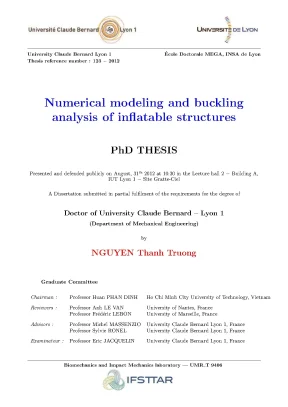
Tải xuống để đọc toàn bộUniversity Claude Bernard Lyon 1 École Doctorale MEGA, INSA de Lyon Thesis reference number : 123 − 2012 Numerical modeling and buckling analysis of inflatable structures PhD THESIS Presented and defended publicly on August, 31th 2012 at 10:30 in the Lecture hall 2 − Building A, IUT Lyon 1 − Site Gratte-Ciel A Dissertation submitted in partial fulfilment of the requirements for the degree of Doctor of University Claude Bernard – Lyon 1 (Department of Mechanical Engineering) by NGUYEN Thanh Truong Graduate Committee Chairman : Professor Huan PHAN DINH Ho Chi Minh City University of Technology, Vietnam Reviewers : Professor Anh LE VAN University of Nantes, France Professor Frédéric LEBON University of Marseille, France Advisors : Professor Michel MASSENZIO University Claude Bernard Lyon 1, France Professor Sylvie RONEL University Claude Bernard Lyon 1, France Examinateur : Professor Eric JACQUELIN University Claude Bernard Lyon 1, France Biomechanics and Impact Mechanics laboratory — UMR T 9406 Mis en page avec la classe thloria. Acknowledgments During my time in Lyon, there are a number of people who have supported me both inside and outside the lab. From my early days at IUT Lyon 1, I had many difficulties to adapt a new life in French, which is different deeply from Vietnam. At that time, I received a tremendous amount of help and support from the personnels of IUT Lyon 1 - Gratte Ciel, specially Professor Christian Jardin, Mrs.
Bettina Fenet and Mr. I would like to thank them for all their kindness during my time here. Although being a Ph. student at UCBL has not always been easy and straightfor- ward to me, there has been so much help and support around.
First, I would like to thank my supervisors, Sylvie Ronel and Michel Massenzio for providing me the opportunity to work with them. It is a superb experience to have them as supervisors and learn how to face, think, approach and evaluate problems directly from them. Sylvie Ronel with her keen insight into science of structures has always amazed me. She has a wonderful ability to see and find beautiful things from what looks somewhat boring and unimportant.
I would like to thank her for her consistent support and encouragement in the middle of failures and sometimes slow progresses. Also, Michel Massenzio, who just makes everything in our group much simpler, is also thanked for careful reading and helpful advices throughout this thesis. In particular, I would like to thank Professor Eric Jacquelin for giving me lots of valuable suggestions in research. He has always inspired me to see how to research in each paper with challenging questions that I had never thought of.
Those questions always have guided and helped me gain a solid understanding of my research projects with new insights. Special thanks are due to Professor Le Van Anh and Professor Frédéric Lebon for their input, for reviewing this thesis, and for being members of the graduate committee. I would also like to thank Professor Phan Dinh Huan for being an examiner of this thesis and a member of the graduate committee. I owe him many thanks for teaching me i to be a scientist.
Professor Pham Huy Hoang and Mr. Nguyen Tuan Kiet are gratefully acknowledged in the same way for their advices and encouragement. Komla Lolonyo Apedo has been much more than a colleague and a friend to me over the first two years. Komla and I were on the same research theme at LBMC and worked beside together in a same office.
My work is a development based on his work. Komla’s infectious friendliness, his passion for science and his obsession with understanding have been instrumental in making my life at LBMC joyful and productive. We spent many memorable time wrestling the formulations, explained me to understand how an inflatable beam is. In addition, Komla’s deep understanding of inflatable structures provided a fantastic resource to bounce ideas back and forth several times a day.
I want to single out and thank the people I have worked most closely at Laboratory DDS of GMP, IUT Lyon 1, especially Abdelkrim Bennani and Lagarde Gérard for their availability. I am also grateful for the financial support from the Vietnamese government for this thesis and from LBMC-IFSTTAR/UCBL for my first European Conference in Austria. Losberger Company and specially Mr. Robert Dartois are acknowledged for having provided the material samples and inflatable beams which were very useful for the exper- iments in this thesis.
Parents, to whom I have dedicated this work, have supported and encouraged me as I worked toward this degree. Finally, I would like to thank my girlfriend for all her love and support over the years and for her encouragement and faith in my ability to finish the degree program. Let anyone who has contributed directly or indirectly to the success of this project, finds here my acknowledgments. ii Je dédie cette thèse à mes parents iii Contents List of Figures ix List of Tables xv Notations and conventions xvii GENERAL INTRODUCTION 1 1 Textile fabric composites.
3 3 Stability of inflatable structures .1 Textile structures and textile preforms .2 Classification of textile preforms .1 Unit cell and geometric parameter .2 Stress transfer and characteristics lengths .3 Damage due to tensile loading .3 Prediction of engineering properties using micro-mechanics .4 Prediction of engineering properties using numerical approach .5 Experimental measurement of engineering properties .6 The role of experiments in structural stability. 39 v Contents Chapter 2 EXPERIMENTAL STUDIES 41 2.2 Mechanical behavior of the fabric .3 Fabric tensile testing at our laboratory: Biaxial beam inflation test on fabric beam .1 Analysis of elastic moduli .2 Determination of shear modulus of HOWF composite .4 Experimental buckling of an inflatable beam .2 Experimental buckling test on a simply supported HOWF beam .1 Test set-up and instrumentation .3 Measurement of displacements. 65 Chapter 3 ANALYTICAL BUCKLING ANALYSIS OF AN HOWF INFLA- TABLE BEAM 67 3.3 Virtual work principle .4 Theoretical buckling loads .5 Previous works on the critical load .3 Examples: in-plane buckling for linearized problems .1 Simply supported inflatable beam under compressive concentrated load .2 Cantilever inflatable beam under compressive axial load at the free end .3 Clamped-clamped inflatable beam under compressive axial load .4 Influence of the slenderness ratio on the critical load of an inflatable beam 106 3.5 Wrinkling load for an inflatable beam under a compressive concentrated load109 3. 111 vi Chapter 4 FINITE ELEMENT BUCKLING ANALYSIS OF AN HOWF INFLATABLE BEAM 113 4.2 Finite element formulations .1 Linear eigen buckling .3 Implementation of an iterative algorithm for solving the NLIBFE model .3 Applications and results .1 Linear eigen buckling .2 Nonlinear buckling of a simply supported NLIBFE model .1 Wrinkling loads and maximum deflections: Limit of valid- ity for numerical solutions .2 Validation of the NLIBFE model: the reference model .3 Comparison with the experimental results .4 Parametric studies of NLIBFE model.
145 GENERAL CONCLUSION AND FUTURE WORK 149 Appendices 155 Appendix A Reminders in mechanics and material science 155 A.1 Mechanical properties of composite materials .2 Hyperelasticity: theoretical basis .3 Hyperelasticity and orthotropic materials. Venant-Kirchhoff orthotropic material .4 Thin-walled structures : thin-shells and membranes. 164 Appendix B Theoretical model 171 Appendix C Nonlinear finite element model 175 Bibliography 181 vii Contents viii List of Figures 1 Woven fabrics .1 Classification of textile preforms in the YTF processes (Cox and Flanagan (1996a)).2 Different woven fabric (Source: TexGen).3 Schematic diagrams of (a) warp knitted and (b) weft knitted fabrics.4 Basic weave constructions: (a) plain, (b) twill and (c) 5HS satin weave.5 Schematics of performing and resin injection molding processes.6 Cross-section of an orthogonal 2-D woven fabric along the warp direction.7 Specimens for microscopic observation.8 Fabric pattern and a unit cell of plain woven fabrics.10 Failure of tensile specimens .11 Schematic of damage evolution due to tensile loading.12 Fibrous medium and equivalent continuum.13 Experimental set-ups used to evaluate intra-ply shear properties: (a) Bias- extension set-up and (b) Picture-frame set-up.14 Schematics showing the undeformed (left) and deformed (right) shapes of the specimen in the bias-extension test. 32 ix List of Figures 1.15 A bias-extension test apparatus (Cao et al.16 Biaxial testing machine layout (Quaglini et al.17 Shear frame loaded with fabric specimen (King et al.18 Trellising-shear test apparatus fabricated and used by the research groups (Cao et al.1 Plain weave fabric structure.2 Stress components referred to specimen and material axes.3 Longitudinal stress distribution in thin-walled cylinder.4 Transversal stress distribution in thin-walled cylinder.5 Inflation test layout.6 Schematic diagram of simply supported HOWF inflatable beam and in- strumentation for buckling test.7 Digital Manometer KELLER LEO 1.8 Mounting load cell type ZFA to the structure.9 Simply supported HOWF inflatable beam and VDAS 5000.10 Experimental apparatus of HOWF simply supported inflatable beam for measuring the critical load.11 Inflatable beam with alphabet labels.12 Tachometer LEICA TPS 300.13 The formation of the first wrinkles.14 Crushing test: Experimental curves of axial load versus time.15 Quasi-static axial compression test: Deflections of simply supported HOWF beam for various pressures.16 Progression of first buckling mode of the beam with pressure of 30 kPa.1 HOWF inflatable beam: (a) in natural state and (b) in the reference configuration (inflated state) .2 (a) Fabric local coordinate system, (b) Beam Cartesian coordinate system .3 Uniform pressure on the cylindrical surface.4 Definition of the curvilinear coordinate system.5 Definition of the curvilinear basis at the beam ends.6 Simply supported inflatable beam.7 Critical loads for a simply supported inflatable beam under a compressive concentrated load in the case of materials 1 and 2.8 Fundamental buckling modes on a simply supported inflatable beam under a compressive concentrated load in the case of material 1.9 Fundamental buckling modes on a simply supported inflatable beam under a compressive concentrated load in the case of material 2.10 First three buckling modes on a simply supported HOWF inflatable beam under compressive concentrated load.11 Cantilever inflatable beam.12 Critical loads for a cantilever inflatable beam under a compressive concen- trated load in the case of materials 1 and 2.13 Fundamental buckling modes on a cantilever inflatable beam under a com- pressive concentrated load in the case of material 1.14 Fundamental buckling modes on a cantilever inflatable beam under a com- pressive concentrated load in the case of material 2.15 First three buckling modes on a cantilever inflatable beam under a com- pressive concentrated load.16 Clamped-clamped inflatable beam under a compressive axial load.17 Critical load versus the slenderness ratio of a cantilever inflatable beam under compressive concentrated load in the case of material 1.18 Critical load versus the slenderness ratio of a cantilever inflatable beam under compressive concentrated load in the case of material 2.
108 xi List of Figures 4.1 Linear eigen buckling: mesh convergence test of normalized linear buckling load coefficient (Kcl = 105 × σcr /Eeq ) for a simply supported LFEIB model.2 Linear eigen buckling: normalized buckling load coefficient (Kcl = 105 × σcr /Eeq ) versus radius-to-thickness ratio (Rrt = R0 /t0 ) for a simply sup- ported LFEIB model.3 Linear eigen buckling: normalized buckling load coefficient (Kcl = 105 × σcr /Eeq ) versus slenderness ratio (λs = L/ρ) for a simply supported LFEIB model.4 Linear eigen buckling: normalized buckling load coefficient (Kcl = 105 × σcr /Eeq ) versus bending radius ratio (Rbr = R2Rb B0 ) for a simply supported LFEIB model.5 (a) Inflatable beam subjected to compressive axial load F. (b) The effect of an initial imperfection .6 Wrinkling load: limit of validity of numerical solutions .7 Global beam axes and local material orientation assigned for a orthotropic fabric.8 (a) Inflatable beam with constrained ends, (b) Applied loads on the beam and (c) Beam meshing using S4R shell elements .9 Numerical and experimental mid-span deflection curves of a simply sup- ported NLIBFE model with pn =324.10 Numerical and experimental mid-span deflection curves of a simply sup- ported NLIBFE model with pn =648.11 Numerical and experimental mid-span deflection curves of a simply sup- ported NLIBFE model with pn =972.
Nội dung được bảo vệ bản quyền — Tải xuống đầy đủ
Trích dẫn luận án này
Nguyen Thanh Truong (2012). Numerical modeling & buckling analysis of inflatable structures [Luận án tiến sĩ, university Claude Bernard Lyon 1]. LuanAn.net. https://luanan.net/ky-thuat-co-khi/co-ky-thuat/luan-an-ts-numerical-modeling-buckling-inflatable-structures
Câu hỏi thường gặp
Luận án "Numerical modeling & buckling analysis of inflatable structures" nghiên cứu về vấn đề gì?
Luận án tiến sĩ tập trung mô hình số, phân tích biến dạng kết cấu bơm hơi. Đánh giá ổn định, tối ưu hóa thiết kế, tăng độ bền.
Luận án "Numerical modeling & buckling analysis of inflatable structures" được bảo vệ tại trường nào?
Luận án này được bảo vệ tại university Claude Bernard Lyon 1. Năm bảo vệ: 2012.
Luận án "Numerical modeling & buckling analysis of inflatable structures" thuộc chuyên ngành gì?
Luận án "Numerical modeling & buckling analysis of inflatable structures" thuộc chuyên ngành mechanical engineering. Danh mục: Cơ Kỹ Thuật.
Luận án "Numerical modeling & buckling analysis of inflatable structures" có bao nhiêu trang?
Luận án "Numerical modeling & buckling analysis of inflatable structures" có 223 trang. Bạn có thể xem trước một phần tài liệu ngay trên trang web trước khi tải về.
Cách tải luận án "Numerical modeling & buckling analysis of inflatable structures" về máy như thế nào?
Để tải luận án về máy, bạn nhấn nút "Tải xuống ngay" trên trang này, sau đó hoàn tất thanh toán phí lưu trữ. File sẽ được tải xuống ngay sau khi thanh toán thành công. Hỗ trợ qua Zalo: 0559 297 239.