Luận án Hiệp định Đối tác Xuyên Thái Bình Dương (TPP) và Diện mạo Mới của FTA
Phân tích sâu TPP và FTA: Tác động toàn diện đến xã hội, chính trị và kinh tế. Khám phá hệ lụy và cơ hội.
Public Policy and Administration
Luan An
Doctoral Dissertation
Năm xuất bản
Số trang
212
Thời gian đọc
32 phút
Lượt xem
0
Lượt tải
0
Phí lưu trữ
50 Point
Tổng quan nhanh
- Chủ đề:
- 1. Hiệp định TPP: Hậu quả Toàn diện Thương mại Tự do
- Số trang:
- 212 trang
- Trường:
- Walden University
- Chuyên ngành:
- Public Policy and Administration
- Tác giả:
- Joseph Randolph Heyliger
- Năm:
- 2018
Tóm tắt nội dung luận án
I. Hiệp định TPP Hậu quả Toàn diện Thương mại Tự do
Hiệp định Đối tác Toàn diện và Tiến bộ xuyên Thái Bình Dương (CPTPP) hay tiền thân là TPP đã định hình lại các thỏa thuận thương mại tự do. Tài liệu này khám phá những hậu quả xã hội, chính trị, kinh tế của TPP. Đặc biệt, nghiên cứu tập trung vào tác động của các vấn đề phi thương mại đối với các quốc gia đang phát triển. Hiệp định TPP đại diện cho nỗ lực thiết lập các quy tắc thương mại tiêu chuẩn cao. Các quy tắc này đòi hỏi phải lồng ghép các vấn đề phi thương mại rộng rãi. Điều này có thể làm chệch hướng các quốc gia đang phát triển khỏi mục tiêu thương mại của họ. Các mục tiêu bao gồm giảm thuế quan, tiếp cận thị trường, tạo việc làm và tăng trưởng kinh tế.
1.1. Bản chất và phạm vi của TPP
TPP được hình thành nhằm thiết lập các tiêu chuẩn thương mại toàn diện. Hiệp định mở rộng ra ngoài các khía cạnh thương mại truyền thống. Bao gồm các lĩnh vực như quyền sở hữu trí tuệ, tiêu chuẩn lao động và bảo vệ môi trường. Các quốc gia tham gia ở khu vực châu Á - Thái Bình Dương phải tuân thủ các quy tắc này. Phạm vi rộng của Hiệp định tạo ra những thách thức mới. Thương mại tự do được thúc đẩy nhưng cũng kèm theo nhiều điều kiện.
1.2. Vấn đề phi thương mại trong thỏa thuận
Các vấn đề phi thương mại là trọng tâm của nghiên cứu. Chúng bao gồm các quy định về lao động, môi trường, và quản lý doanh nghiệp nhà nước. Việc đưa các vấn đề này vào Hiệp định gây tranh cãi. Một số ý kiến cho rằng chúng phục vụ lợi ích của các nước phát triển. Chúng có thể gây áp lực lên các nước đang phát triển. Điều này ảnh hưởng đến khả năng đạt được các mục tiêu thương mại cốt lõi.
1.3. Mục tiêu thương mại và các thách thức
Các quốc gia đang phát triển thường tham gia FTA để thúc đẩy tăng trưởng kinh tế. Họ tìm kiếm giảm thuế quan và mở rộng thị trường. TPP đặt ra thách thức đối với những mục tiêu này. Các yêu cầu về vấn đề phi thương mại có thể làm phân tán nguồn lực. Chúng tạo ra gánh nặng tuân thủ đáng kể. Điều này cản trở việc đạt được các lợi ích kinh tế mong muốn. Nó cũng ảnh hưởng đến Chính sách thương mại quốc gia.
II. Tác động Xã hội Việc làm và Phúc lợi Người lao động
Các thỏa thuận thương mại tự do như TPP có tác động đáng kể đến khía cạnh xã hội. Đặc biệt là đối với việc làm và phúc lợi của người lao động. Nghiên cứu đã nhấn mạnh những lo ngại về tiền lương, sức khỏe và an toàn của người lao động. Những vấn đề này trở thành trọng tâm quan tâm của các bên tham gia. Tác động xã hội không chỉ giới hạn ở các yếu tố kinh tế. Nó còn bao gồm chất lượng cuộc sống và điều kiện làm việc. Các chính sách thương mại cần phải cân nhắc kỹ lưỡng. Chúng phải đảm bảo lợi ích cho toàn xã hội, không chỉ riêng doanh nghiệp. Toàn cầu hóa có thể tạo ra cả cơ hội và thách thức cho người lao động.
2.1. Quan tâm về tiền lương và điều kiện lao động
Dữ liệu phân tích cho thấy sự quan tâm cao độ đến tiền lương. Điều kiện làm việc của người lao động trong FTA cũng được chú ý. Các nhà kinh tế và đại diện công đoàn đều bày tỏ lo ngại. Hiệp định có thể gây áp lực giảm tiền lương. Cạnh tranh gia tăng có thể dẫn đến suy giảm điều kiện làm việc. Bảo hộ mậu dịch trong nước có thể bị ảnh hưởng. Các tiêu chuẩn lao động quốc tế cần được đảm bảo thực thi.
2.2. Ảnh hưởng đến sức khỏe và an toàn
Sức khỏe và an toàn của người lao động là một vấn đề quan trọng. Các quy định phi thương mại thường cố gắng giải quyết điều này. Tuy nhiên, việc thực thi chúng ở các nước đang phát triển còn nhiều thách thức. Áp lực cạnh tranh có thể khiến doanh nghiệp cắt giảm chi phí. Điều này có thể ảnh hưởng tiêu cực đến môi trường làm việc. Đảm bảo an toàn lao động là cần thiết để duy trì sự bền vững.
2.3. Thay đổi cấu trúc việc làm địa phương
Thương mại tự do có thể gây ra những thay đổi lớn về việc làm. Một số ngành nghề có thể phát triển mạnh mẽ. Các ngành khác lại phải đối mặt với nguy cơ suy giảm. Điều này dẫn đến sự dịch chuyển lao động đáng kể. Người lao động cần được hỗ trợ để thích nghi với các ngành mới. Các chính sách thương mại cần có biện pháp giảm thiểu tác động tiêu cực. Điều này nhằm tránh gây ra hậu quả xã hội nghiêm trọng.
III. Ảnh hưởng Chính trị Thay đổi trong Chính sách Thương mại
Hiệp định TPP và các thỏa thuận thương mại tự do không chỉ có hậu quả kinh tế và xã hội. Chúng còn mang lại những ảnh hưởng chính trị sâu rộng. Việc lồng ghép các vấn đề phi thương mại đã làm thay đổi cách thức đàm phán và thực thi chính sách thương mại. Nó tác động đến chủ quyền quốc gia và khả năng định hình chính sách của các nước đang phát triển. Nghiên cứu đã khám phá các ý nghĩa chính trị của sự thay đổi này. Các chính sách thương mại hiện đại phức tạp hơn. Chúng đòi hỏi sự cân bằng giữa lợi ích kinh tế và các giá trị khác. Toàn cầu hóa đang thách thức các cấu trúc quản trị truyền thống.
3.1. Phân phối quyền lực trong FTA
Các thỏa thuận thương mại tự do có thể tái phân phối quyền lực. Các quốc gia lớn có thể có ảnh hưởng lớn hơn. Họ có thể định hình các quy tắc theo lợi ích của mình. Điều này ảnh hưởng đến khả năng đàm phán của các nước đang phát triển. Quyền lực chính trị có thể được chuyển giao từ các chính phủ quốc gia. Nó có thể được chuyển sang các cơ quan quốc tế hoặc các tập đoàn lớn. Điều này có thể làm suy yếu chủ quyền.
3.2. Vai trò của các bên liên quan phi nhà nước
Các tổ chức phi chính phủ, công đoàn và nhóm lợi ích có vai trò ngày càng tăng. Họ tác động đến việc hình thành và thực thi các FTA. Điều này làm phức tạp thêm quá trình ra quyết định chính trị. Các nhóm này vận động cho quyền lợi của người lao động, môi trường, v.v. Tiếng nói của họ cần được lắng nghe. Chính sách thương mại cần cân bằng các bên liên quan đa dạng.
3.3. Định hướng chính sách của các nước đang phát triển
Các vấn đề phi thương mại có thể làm chệch hướng chính sách. Các nước đang phát triển phải dành nguồn lực đáng kể. Họ phải tuân thủ các quy định phức tạp. Điều này có thể làm sao nhãng khỏi các ưu tiên phát triển quốc gia. Ảnh hưởng chính trị này tác động đến khả năng tự chủ. Các quốc gia cần cân nhắc kỹ lưỡng khi tham gia các hiệp định.
IV. Hậu quả Kinh tế Tăng trưởng và Rào cản Mậu dịch
Tác động kinh tế của Hiệp định TPP là một chủ đề trọng tâm. Nghiên cứu đã phân tích các hậu quả về tăng trưởng kinh tế, giảm thuế quan và tiếp cận thị trường. Mô hình thương mại tự do dựa trên lý thuyết lợi thế so sánh của Ricardo. Tuy nhiên, việc đưa các vấn đề phi thương mại vào FTA đã làm phức tạp hóa bức tranh này. Nó có thể tạo ra các rào cản thương mại mới hoặc làm tăng chi phí tuân thủ. Các quốc gia đang phát triển có thể phải đối mặt với những thách thức kinh tế không lường trước được. Điều này ảnh hưởng đến khả năng cạnh tranh và hội nhập toàn cầu của họ. Hậu quả kinh tế cuối cùng phụ thuộc vào việc thực thi.
4.1. Giảm thuế quan và tiếp cận thị trường
Mục tiêu truyền thống của FTA là giảm thuế quan. Điều này nhằm mở rộng tiếp cận thị trường cho hàng hóa và dịch vụ. TPP cũng hướng tới mục tiêu này. Tuy nhiên, các vấn đề phi thương mại có thể làm giảm lợi ích từ việc giảm thuế. Chúng đặt ra các yêu cầu mới. Các quốc gia phải đáp ứng để tận dụng cơ hội tiếp cận thị trường. Điều này ảnh hưởng đến hiệu quả thực tế của Hiệp định.
4.2. Rào cản thương mại mới và cũ
Mặc dù TPP hướng đến loại bỏ rào cản thuế quan, nó lại tạo ra rào cản phi thuế quan. Các quy định về tiêu chuẩn lao động, môi trường, hoặc sở hữu trí tuệ có thể hoạt động như rào cản mới. Các quốc gia đang phát triển có thể gặp khó khăn trong việc tuân thủ. Điều này làm tăng chi phí sản xuất. Nó làm giảm khả năng cạnh tranh trên thị trường quốc tế. Bảo hộ mậu dịch có thể xuất hiện dưới hình thức khác.
4.3. Tác động đến tăng trưởng kinh tế
Tăng trưởng kinh tế là mục tiêu cuối cùng của mọi FTA. Các nhà nghiên cứu thường tranh luận về tác động thực sự của TPP. Một số cho rằng nó sẽ thúc đẩy tăng trưởng thông qua mở cửa thị trường. Những người khác lo ngại về chi phí tuân thủ và tác động tiêu cực đến các ngành nhạy cảm. Hậu quả kinh tế sẽ khác nhau tùy thuộc vào cấu trúc nền kinh tế. Hiệp định có thể tạo ra cả người thắng và người thua.
V. CPTPP và Tương lai Toàn cầu hóa Thương mại Mới
Hiệp định Đối tác Toàn diện và Tiến bộ xuyên Thái Bình Dương (CPTPP) là sự kế thừa của TPP. Nó tiếp tục định hình tương lai của thương mại tự do và toàn cầu hóa. Các nghiên cứu như tài liệu này cung cấp hiểu biết sâu sắc cho các nhà hoạch định chính sách. Họ cần hiểu rõ hậu quả của các vấn đề phi thương mại trong FTA. Các khuyến nghị chính sách hướng tới việc tăng cường phúc lợi xã hội. Điều này đòi hỏi sự cân bằng giữa lợi ích kinh tế và các giá trị phi kinh tế. Tương lai của chính sách thương mại sẽ tiếp tục phát triển. Nó sẽ đối mặt với những thách thức mới của toàn cầu hóa. Các hiệp định như CPTPP là một phần quan trọng của quá trình này.
5.1. Sự phát triển của Hiệp định CPTPP
Sau khi Hoa Kỳ rút khỏi TPP, các thành viên còn lại đã sửa đổi Hiệp định. CPTPP ra đời với một số điều khoản bị đình chỉ. Đây là minh chứng cho cam kết của các quốc gia đối với thương mại tự do. CPTPP duy trì nhiều tiêu chuẩn cao của TPP. Nó vẫn tập trung vào việc tích hợp các vấn đề phi thương mại. Hiệp định tiếp tục là khuôn khổ quan trọng cho thương mại khu vực.
5.2. Các khuyến nghị chính sách và phúc lợi
Nghiên cứu đưa ra các khuyến nghị để tăng cường phúc lợi. Các nhà hoạch định chính sách cần hiểu rõ hơn về hậu quả của vấn đề phi thương mại. Họ cần phát triển các chính sách cân bằng. Các chính sách này phải bảo vệ quyền lợi của người lao động. Đồng thời, chúng cũng phải thúc đẩy tăng trưởng kinh tế. Các biện pháp hỗ trợ và đào tạo lại là cần thiết cho những người lao động bị ảnh hưởng. Điều này nhằm đạt được sự thay đổi xã hội tích cực.
5.3. Tầm nhìn cho các thỏa thuận thương mại
Tương lai của các thỏa thuận thương mại sẽ tiếp tục phức tạp hơn. Chúng sẽ bao gồm nhiều vấn đề ngoài thương mại truyền thống. Các nhà đàm phán cần có chiến lược toàn diện. Họ phải giải quyết các mối quan tâm xã hội, chính trị, kinh tế. Các FTA cần minh bạch và công bằng hơn. Điều này giúp đảm bảo rằng lợi ích được phân phối rộng rãi. Toàn cầu hóa cần có sự quản lý tốt hơn.
Mục lục chi tiết luận án
Tải xuống file đầy đủ để xem toàn bộ nội dung
Tải đầy đủ (212 trang)Trích đoạn nội dung luận án
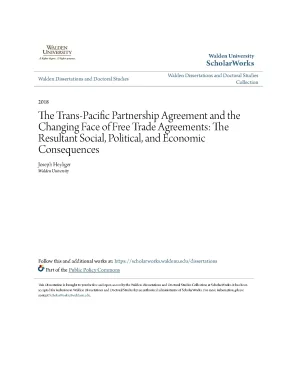
Tải xuống để đọc toàn bộWalden University ScholarWorks Walden Dissertations and Doctoral Studies Walden Dissertations and Doctoral Studies Collection 2018 The Trans-Pacific Partnership Agreement and the Changing Face of Free Trade Agreements: The Resultant Social, Political, and Economic Consequences Joseph Heyliger Walden University Follow this and additional works at: https://scholarworks.edu/dissertations Part of the Public Policy Commons This Dissertation is brought to you for free and open access by the Walden Dissertations and Doctoral Studies Collection at ScholarWorks. It has been accepted for inclusion in Walden Dissertations and Doctoral Studies by an authorized administrator of ScholarWorks. For more information, please contact ScholarWorks@waldenu. Walden University College of Social and Behavioral Sciences This is to certify that the doctoral dissertation by Joseph Randolph Heyliger has been found to be complete and satisfactory in all respects, and that any and all revisions required by the review committee have been made.
Review Committee Dr. Kevin Fandl, Committee Chairperson, Public Policy and Administration Faculty Dr. Gloria Billingsley, Committee Member, Public Policy and Administration Faculty Dr. Tanya Settles, University Reviewer, Public Policy and Administration Faculty Chief Academic Officer Eric Riedel, Ph.
Walden University 2018 Abstract The Trans-Pacific Partnership Agreement and the Changing Face of Free Trade Agreements: The Resultant Social, Political, and Economic Consequences by Joseph Randolph Heyliger MA, Brooklyn College, CUNY, 2011 MA, Brooklyn College, CUNY, 2005 LL.B, University of the West Indies, 1989 Dissertation Submitted in Partial Fulfillment of the Requirements for the Degree of Doctor of Philosophy Public Policy and Administration Walden University June 2018 Abstract Little is known about the impact of nontrade issues on developing countries entering trade agreements. The Trans-Pacific Partnership Agreement (TPPA) represents an attempt to set high-standard trade rules for participating countries in the Asian-Pacific region that require the inclusion of wide-ranging nontrade issues in the TPPA. This general qualitative study explored the economic, social, and political consequences for developing countries by including nontrade issues in Free Trade Agreements (FTAs). The overarching research question addressed whether nontrade issues in FTAs detract developing countries from achieving their trade goals.
This study was guided by the theory of comparative advantage propounded by Ricardo and the focus on trade in goods and services. This general qualitative study used multiple sources of data collection including documentation-primary and secondary online and digital archival data, bibliographies, textbooks, and scholarly trade journals; researcher’s notes; and interviews of 15 participants (13 economists and 2 trade unionists). All data were coded using open, selective, and axial coding followed by Braun and Clarke’s thematic analysis procedure. Data analysis revealed 4 themes that crystallized the findings within the context of the research; the role, ramifications of nontrade issues, trade barriers, and the distraction of developing countries from achieving their goals-tariff reductions, market access, jobs, and economic growth.
The key finding of this study was the interest of participants in wages, health, and safety of workers in FTAs. The implications for positive social change include recommendations for welfare enhancement gained by trade policymakers’ understanding of the consequences of nontrade issues in FTAs. Trans-Pacific Partnership Agreement and the Changing Face of Free Trade Agreements: The Resultant Social, Political, and Economic Consequences by Joseph Randolph Heyliger MA, Brooklyn College, CUNY, 2011 MA, Brooklyn College, CUNY, 2005 LL.B, University of the West Indies, 1989 Dissertation Submitted in Partial Fulfillment of the Requirements for the Degree of Doctor of Philosophy Public Policy and Administration Walden University June 2018 Dedication To my dear wife Paula Haywood, who captained the family ship through turbulent seas while I was confined to the role of a mere passenger. With grit, determination, tremendous sacrifice, and skill, she guided the family ship safely to our destination; ably supported by a competent crew manned by my loving daughter and son Tushana and Randall, my mother Eileen, brother Terrence, sister Lavern, and grandchildren: Jotham, Atalia, Yannis and Shaya.
Success is not measured by the heights one attains but by the obstacles one overcomes in its attainment. Washington Acknowledgments I wish to thank the many colleagues, students, and family members who have contributed to the successful completion of this dissertation. I am especially grateful to Dr. Kevin Fandl, my mentor and supervisor, for the seriousness, energy, and scholarship that he exerted on this extraordinary project.
I highly appreciate his expert guidance, advice, content direction, and encouragement that he provided me always during the process, without which, this study may not have had a semblance of academia. Thank you again Dr. Fandl for your steady ‘hand’ of wisdom and I am sure you are having a great sense of relief now that you have taken me across the finish line. Special thanks to Dr.
Gloria Billingsley, who graciously served as my method expert and committee member. Your insightful feedback enriched and dignified the study. For me, it is a fitting continuation of the professor- student relationship we shared during my course work- pre-dissertation phase and how well you have prepared us for the dissertation writing stage of the doctoral program. You are truly an inspiration to many students.
I am indebted to Tobias Ball whose suggestions added strength to the way my argument is communicated to the reader, by making the language clear, precise, and authoritative. Special thanks to Dr. Tanya Settles, who willingly accepted the laborious task of reading the entire dissertation, and whose suggestions helped me achieve the highest level of academia. I am thankful to Walden University for giving me the opportunity to pursue a Ph.D in Public Policy and Administration so that I can bring about positive social change within the community.
I owe a depth of gratitude to the hard-working faculty members and the support staff at Walden University. Without the faculty advisors, library staff, research center, writing center, academic advising, student support, and other support groups I tormented, I would not have been able to successfully complete the dissertation. They are a remarkable group of people. I am indebted to the taxpayers who have funded my tuition during my sojourn at Walden University and to assure them that every penny was well spent.
Where would I have been without their financial contributions? I am grateful to Walden University’s outside editor, Lynn Feneis, who had the tedious task of reading and correcting the entire dissertation, and whose comments significantly improved the readability of this dissertation. It would be remiss of me if I do not express my appreciation for the love support from my wife Paula; children, Tushana and Randall; grandchildren, Jotham, Atalia, Yannis, and Shaya; mother Eileen; brother Terrence; and sister Lavern. It is only fitting, therefore, that I dedicate this study to them. Lastly, but by no means the least, I give thanks to the Almighty God knowing that there is no problem, circumstance, or situation greater than God.
Table of Contents List of Figures. vi Chapter 1: Introduction to the Study.1 Background of the Study .3 Purpose and Significance of Study .6 Theoretical/Conceptual Framework.11 Nature of the Study .16 Expected Social Change .17 Summary and Transition .18 Chapter 2: Literature Review .21 International Trade Theory .25 Extensions to Viner’s Model .27 General Equilibrium Models.28 Meade–Lipsey and Wonnacott–Wonnacott Models .28 i Lloyd–Maclaren Model .31 Method of the New Trade Theory .34 Foundations of FTAs/FCNs/BITS .37 Bilateral Investment Treaties (BITs). 41 Free Trade Agreements (FTAs). 41 The Role of Developing Countries in International Trade .53 Chapter 3: Research Method .55 Justification of Design .56 Role of the Researcher .62 Subjects, Participants, Population, and Sample .79 Context of the Study .79 ii Recruitment and Selection of Participants .80 Researcher Approach to Interview Process .81 Methodology: Coding and Analysis .83 Question 1: Do you think nontrade issues should be included in FTAs?.
84 Question 2: What do you think will be the ramifications of including nontrade issues in FTAs?. 90 Question 3: What impact do you think nontrade issues will have on developing countries?. 97 Question 4: What impact do you think nontrade issues will have on the world trading system in general and the WTO in particular?. 105 Question 5: Why do you think the U.
is increasing its use of nontrade issue in FTAs?. 111 Question 6: Describe how you will defend or oppose the notion expressed by some U. trade partners that nontrade issues present new barriers to international trade?. 117 Question 7: How could the current focus on ontrade issues detract developing countries from the goals they expect to achieve through international trade?.145 Summary and Transition .147 Chapter 5: Discussion, Conclusions, and Recommendations .149 iii Interpretation of Findings and Discussion.
157 Theoretical Framework and Development of Trade Policy. 166 Recommendations for Further Research .166 Applications to Professional Practice .167 Implications for Positive Social Change .171 Reflection on the Researcher’s Experience .179 Appendix A: Interview Protocol .194 iv Appendix B: Invitation Letter to Participate in a Qualitative Research Study .196 Appendix C: Coding Sheet---------------------------------------------------------------------- 198 v List of Figures Figure 1. Viner’s Model of Free Trade Agreement. Meade-Lipsey model of a free trade agreement.
Wonnacott-Wonnacott model of free trade agreement with tariffs or transport costs on exports to the world. Triangulation by method. Braun & Clarke (2006) step-by-step analysis guidelines. Articles/Sources from which data were collected.
73 vi 1 Chapter 1: Introduction to the Study Background of the Study In recent years, economists, politicians, policymakers, and social scientists have intensified the debate about the importance and content of free trade agreements (FTAs). Free trade is a system in which goods, capital, and labor flow freely between nations without barriers to impede the trade process (Brown & Stern, 2011). FTAs are arrangements among two or more countries under which they agree to liberalize trade by reducing or removing trade barriers, and increasing market access in goods and services among themselves (Cooper, 2014). However, as much as free trade seemed to be a beneficial concept, it has become the lightning rod for criticism.
Its detractors blame free trade for the loss of manufacturing jobs in the U., while others blame free trade for exposing some U. producers to foreign competition. Proponents of free trade argued that it has been one of the most important determinants of America’s wealth and strength (Eiras, 2004; Friedman, 2005). more competitive and innovate which provide new technologies and a host of benefits, including increase in production, economic growth, cure for more diseases, improve education, better-paying jobs, and higher standards of living (Eiras, 2004).
Proponents of free trade cited the need for more FTAs and urged the 2 U. Administration to lead negotiations in the World Trade Organization (WTO) to eliminate agricultural subsidies, antidumping measures, and other protectionist policies that benefit a few at the expense of many (Eiras, 2004). Lawrence (1999) asserted that FTAs, not only enhance trade, but they also have dynamic welfare enhancing characteristics such as more economic integration than the elimination of tariffs; reduction in barriers to services trade, foreign investment, and other economic activities not covered by the GATT/WTO, as was the case with NAFTA. Hudgins (1996) argued that while it may be preferable to liberalize trade multilaterally, countries should seize the opportunity to negotiate bilateral and regional FTAs, even if they lead to some trade diversion.
Hudgins posited that FTAs can be more efficient vehicles for addressing difficult trade barriers than the WTO since compromise and consensus are easier to achieve with smaller groups rather than larger ones. This will provide momentum for WTO members to forge ahead with new trade rounds. Opponents of free trade argued that it is responsible for most of the economic woes of the country, including job losses, a sagging manufacturing sector, increase in inequality and poverty (Stiglitz, 2012). Bhagwati (2000) and Krueger (2013) opposed FTAs by asserting that FTAs undermine the development of the multilateral trading system and act as a stumbling block to global trade liberalization.
Bhagwati concluded that FTAs are discriminatory and therefore trade diverting. Another group that includes labor unions, social actions groups, and environmentalists, opposes FTAs and trade liberalization.
Nội dung được bảo vệ bản quyền — Tải xuống đầy đủ
Trích dẫn luận án này
Joseph Randolph Heyliger (2018). Hiệp định TPP và Thương mại Tự do: Hậu quả Xã hội, Chính trị, Kinh tế [Luận án tiến sĩ, Walden University]. LuanAn.net. https://luanan.net/kinh-te/hiep-dinh-tpp-thuong-mai-tu-do-hau-qua-xa-hoi-chinh-tri-kinh-te
Câu hỏi thường gặp
Luận án "Hiệp định TPP và Thương mại Tự do: Hậu quả Xã hội, Chính trị, Kinh tế" nghiên cứu về vấn đề gì?
Phân tích sâu TPP và FTA: Tác động toàn diện đến xã hội, chính trị và kinh tế. Khám phá hệ lụy và cơ hội.
Luận án "Hiệp định TPP và Thương mại Tự do: Hậu quả Xã hội, Chính trị, Kinh tế" được bảo vệ tại trường nào?
Luận án này được bảo vệ tại Walden University. Năm bảo vệ: 2018.
Luận án "Hiệp định TPP và Thương mại Tự do: Hậu quả Xã hội, Chính trị, Kinh tế" thuộc chuyên ngành gì?
Luận án "Hiệp định TPP và Thương mại Tự do: Hậu quả Xã hội, Chính trị, Kinh tế" thuộc chuyên ngành Public Policy and Administration. Danh mục: Kinh Tế.
Luận án "Hiệp định TPP và Thương mại Tự do: Hậu quả Xã hội, Chính trị, Kinh tế" có bao nhiêu trang?
Luận án "Hiệp định TPP và Thương mại Tự do: Hậu quả Xã hội, Chính trị, Kinh tế" có 212 trang. Bạn có thể xem trước một phần tài liệu ngay trên trang web trước khi tải về.
Cách tải luận án "Hiệp định TPP và Thương mại Tự do: Hậu quả Xã hội, Chính trị, Kinh tế" về máy như thế nào?
Để tải luận án về máy, bạn nhấn nút "Tải xuống ngay" trên trang này, sau đó hoàn tất thanh toán phí lưu trữ. File sẽ được tải xuống ngay sau khi thanh toán thành công. Hỗ trợ qua Zalo: 0559 297 239.