Luận án tiến sĩ: Pyrene availability as determined by the interactions of natural organic matter with the soil mineral matrix
Luận án tiến sĩ này phân tích sự có sẵn của pyrene trong đất, khám phá vai trò của tương tác chất hữu cơ tự nhiên với ma trận khoáng vật.
Environmental Sciences and Engineering
Luan An
Luận án tiến sĩ
Năm xuất bản
Số trang
192
Thời gian đọc
29 phút
Lượt xem
0
Lượt tải
0
Phí lưu trữ
50 Point
Tổng quan nhanh
- Chủ đề:
- Pyrene Bioavailability & PAH Fate in Contaminated Soils
- Số trang:
- 192 trang
- Trường:
- University of North Carolina at Chapel Hill
- Chuyên ngành:
- Environmental Sciences and Engineering
- Tác giả:
- Denise Marie Brown
- Năm:
- 2006
Tóm tắt nội dung luận án
I.Pyrene Bioavailability PAH Fate in Contaminated Soils
Soil organic matter (SOM) critically influences polycyclic aromatic hydrocarbons (PAHs). Specifically, pyrene movement, toxicity, and degradation are significantly affected. Humic substances and biological material, key components of SOM, dictate these processes. Assessing acceptable endpoints for in situ remediation practices presents challenges. The inherent complexity of soil systems, coupled with contaminant interactions, makes precise predictions difficult. Understanding the multifaceted role of NOM, including its humic and non-humic fractions, is vital for managing contaminated environments and predicting pyrene bioavailability accurately. This research addresses the fundamental aspects of pyrene's interaction within diverse soil matrices.
1.1. PAH Movement Degradation Challenges
Polycyclic Aromatic Hydrocarbons (PAHs) pose significant environmental risks. Their movement, toxicity, and degradation in soil systems are profoundly affected by soil organic matter (SOM). Components like humic substances and biological materials play pivotal roles. Determining acceptable endpoints for in situ remediation practices remains a complex endeavor. The intricate nature of soil chemical and physical attributes creates challenges. This complexity complicates the prediction of PAH fate, transport, and overall bioavailability. A detailed understanding of these interactions is essential for developing effective strategies to mitigate contamination risks from pyrene and other PAHs.
1.2. Interdependent Soil Attributes Pyrene Fate
Soil chemical and physical attributes demonstrate a complex, interdependent relationship. This intricate connection presents a formidable task for determining the absolute fate of PAHs like pyrene. Pyrene transport mechanisms and its ultimate bioavailability are also challenging to ascertain. Factors such as the soil mineral matrix, pH, and texture interact with natural organic matter (NOM) to govern contaminant behavior. These interdependencies profoundly impact how pyrene sorbs, desorbs, and persists in the environment. A comprehensive understanding of these attributes is crucial for effective environmental remediation and risk assessment, particularly concerning contaminant transport and long-term environmental impacts.
II.Modeling Pyrene Sorption Synthetic Soil Matrix Insights
This research utilized a synthetic soil system to model pyrene sorption behaviors. The controlled environment allowed for precise investigation of natural organic matter (NOM) components. Components included mineral matter, humic acid (HA), and peptidoglycan (PG). Pyrene, a representative polycyclic aromatic hydrocarbon (PAH), served as the target contaminant. This approach facilitated a clearer understanding of how various soil constituents influence pyrene availability. The synthetic matrix provided a foundation for comparing interactions with natural soils, offering insights into contaminant transport mechanisms and sorption dynamics critical for environmental management.
2.1. Research Objective SOM Impact on Pyrene Sorption
This research aimed to correlate the impact of known soil organic matter (SOM) components on pyrene sorption. The study investigated relationships with sorbent loading, sorbent type, and mineral phase aggregation. The objective sought to clarify how varying compositions of natural organic matter (NOM) and the soil mineral matrix influence the retention of pyrene. This focus provided insights into the mechanisms governing contaminant availability and contaminant transport in complex soil systems. Understanding these fundamental interactions is crucial for predicting pyrene bioavailability and informing remediation strategies for PAHs. This study provides a systematic approach to decompose complex soil phenomena.
2.2. Synthetic Soil Generation Pyrene Contaminant
A synthetic soil system was meticulously generated for controlled experimentation. This system comprised essential components: mineral matter (hematite and montmorillonite clay), humic acid (HA), and peptidoglycan (PG). These constituents allowed for precise control over the soil matrix composition. The synthetic matrix was then compared against freshly contaminated and aged natural soils. Pyrene, a representative hydrophobic organic contaminant from the PAH class, served as the primary analyte. Its sorption and desorption behaviors within these varied matrices were rigorously observed and quantified. This methodology ensured a robust investigation into pyrene-NOM-mineral interactions.
III.NOM and Soil Mineral Matrix Influence on Pyrene Sorption
Key findings highlight the significant role of natural organic matter (NOM) and the soil mineral matrix in determining pyrene sorption. Peptidoglycan (PG), a biological component, showed a greater affinity for mineral phases compared to humic acid (HA). This led to increased particle aggregation. Enhanced pyrene sorption was observed with increasing concentrations of synthetic matrix constituents. Specifically, a HA+PG mixture on clay demonstrated the highest sorption capacity. These results underscore the complex interplay between NOM fractions and mineral surfaces, directly impacting pyrene availability and contaminant transport mechanisms within environmental systems.
3.1. Peptidoglycan s Role in Mineral Sorption Aggregation
Peptidoglycan (PG), a biological component of natural organic matter (NOM), demonstrated a strong affinity for mineral phases. Significantly larger concentrations of PG sorbed to both hematite and montmorillonite clay compared to humic acid (HA). This increased sorption capacity of PG effectively promoted further particle aggregation within the soil mineral matrix. Such aggregation alters pore space and surface area, directly influencing the availability of pyrene. This finding highlights PG's critical and previously under-emphasized role in shaping soil physical properties and governing pyrene sorption, thereby affecting its contaminant transport and overall pyrene bioavailability.
3.2. Enhanced Pyrene Sorption with Increased Constituents
Increasing the concentration and number of constituents within the synthetic matrix led to a notable enhancement in pyrene sorption. A specific combination, a humic acid (HA) and peptidoglycan (PG) mixture loaded onto clay, demonstrated particularly high sorption. This resulted in greater overall pyrene retention within the soil matrix. The observed chemical and physical attributes of these synthetic soils showed increased similarity to spiked natural soils. This suggests the synthetic model accurately reflected natural conditions. High-performance liquid chromatography (HPLC) and fluorescence microscopy provided robust evidence for these findings, detailing the complex interplay of natural organic matter and the soil mineral matrix on PAH fate.
IV. Biological Matter Pyrene Sorption Dynamics
This research meticulously compared the pyrene sorption dynamics between humic substances and biological material. Fluorescence microscopy revealed that the biological constituent, peptidoglycan (PG), exerted a significantly stronger influence on pyrene binding than humic acid (HA). This highlights the crucial role of specific natural organic matter (NOM) fractions in controlling pyrene availability. The type and concentration of SOM constituents directly impact soil chemical and physical characteristics. Therefore, these factors must be precisely accounted for when assessing contaminant transport and overall pyrene bioavailability in contaminated soil systems.
4.1. Biological Constituent s Dominant Influence on Pyrene
A compiled fluorescence map visually detailed the precise location of pyrene within various soil systems. It also quantified the percentage of pyrene sorbed in relation to peptidoglycan (PG), humic acid (HA), and the underlying mineral phases. This comprehensive analysis was performed across both natural and synthetic soils. The biological constituent, PG, consistently exerted a significant and dominant influence over pyrene. Its impact on pyrene sorption and availability was more pronounced compared to that exerted by humic substances (HA). This finding suggests biological materials within natural organic matter (NOM) play a paramount role in governing pyrene binding dynamics and overall pyrene bioavailability, affecting contaminant transport.
4.2. SOM Type Concentration Impacting Soil Characteristics
The type and concentration of soil organic matter (SOM) constituents significantly impact overall soil characteristics. Specifically, humic substances (like fulvic acids and humic acids) and biological material, when sorbed to a mineral phase, profoundly alter soil physical and chemical properties. These alterations directly influence pyrene availability and contaminant transport. Therefore, these specific factors require explicit accounting and thorough consideration. They are crucial for accurately determining pyrene fate, movement, and bioavailability within contaminated soil systems. A detailed understanding of these specific interactions between NOM and the soil mineral matrix is essential for effective environmental management and remediation planning.
V.Fluorescence Microscopy Pyrene Localization Remediation
Fluorescence microscopy emerged as a powerful tool in this study, providing visual detailing of pyrene localization within soil matrices. This technique precisely mapped pyrene's association with peptidoglycan (PG), humic acid (HA), and the soil mineral matrix. The visual data, combined with quantitative sorption analyses, offers significant potential for targeted remediation strategies. By identifying specific pyrene binding sites or entities, environmental consultants can determine the most effective technologies to reduce pyrene bioavailability and mitigate risks from polycyclic aromatic hydrocarbons (PAHs) in contaminated soils.
5.1. Visualizing Pyrene Location with Fluorescence Maps
Fluorescence microscopy provided a powerful and innovative tool for visual analysis of pyrene. It generated detailed, high-resolution maps, visually documenting pyrene location within various soil samples. The technique also precisely quantified the percentage of pyrene sorbed. This precise localization was correlated with the presence of peptidoglycan (PG), humic acid (HA), and specific components of the soil mineral matrix. Both natural and synthetic soils underwent this detailed analysis. The ability to visualize these microscopic interactions offered unprecedented clarity regarding pyrene distribution and its association with different soil constituents, crucial for understanding contaminant transport and pyrene bioavailability.
5.2. Targeted Remediation Strategies for Contaminants
Combining these research observations with advanced fluorescence microscopy offers significant practical potential for environmental consultants. This integrated approach facilitates the determination of the most effective remediation technologies for PAH contamination. Technologies can be precisely targeted to specific locations within the soil, such as pore spaces where pyrene may reside. They can also target strong sorptive entities, like peptidoglycan (PG) or specific mineral phases, which bind contaminants tightly. This targeted remediation strategy aims to achieve acceptable cleanup endpoints more efficiently and precisely, optimizing efforts to reduce pyrene bioavailability and mitigate environmental risks from polycyclic aromatic hydrocarbons. It provides a roadmap for effective environmental intervention.
Mục lục chi tiết luận án
Tải xuống file đầy đủ để xem toàn bộ nội dung
Tải đầy đủ (192 trang)Nội dung chính
Tổng quan về luận án
Sự ô nhiễm đất và trầm tích bởi các hợp chất hydrocarbon thơm đa vòng (Polycyclic Aromatic Hydrocarbons - PAHs) từ hoạt động công nghiệp, quá trình lọc hóa dầu và sự cố rò rỉ creosote là một trong những thách thức môi trường nghiêm trọng nhất toàn cầu. Trong các hệ thống địa chất, chất hữu cơ trong đất (Soil Organic Matter - SOM) và ma trận khoáng đóng vai trò kiểm soát tuyệt đối đối với số phận, khả năng vận chuyển và độc tính sinh học của các chất ô nhiễm hữu cơ kỵ nước (Hydrophobic Organic Compounds - HOCs). Luận án tiến sĩ "Pyrene Availability as Determined by the Interactions of Natural Organic Matter with the Soil Mineral Matrix" do Denise Marie Brown thực hiện tại Khoa Khoa học và Kỹ thuật Môi trường, Trường Y tế Công cộng thuộc Đại học North Carolina at Chapel Hill (2006), dưới sự hướng dẫn của Giáo sư Frederic K. Pfaender, là một công trình tiên phong giải mã cấu trúc liên kết vi mô giữa các hợp phần SOM với bề mặt khoáng vô cơ và ảnh hưởng của chúng đến khả năng khả dụng (availability) của pyrene.
+-----------------------------------------------------------------------------------+
|                        MÔ HÌNH HỆ HẠT TỔNG HỢP VÀ ĐẤT TỰ NHIÊN                     |
|                                                                                   |
|  [Ma trận Khoáng vô cơ]            [Hợp phần Hữu cơ SOM]         [Chất ô nhiễm]   |
|  - Montmorillonite (Sét nở)   +   - Humic Acid (HA, mùn)    +   - Pyrene (PAH)    |
|    (CEC: 80-120 cmol/kg;            (Vòng thơm, carboxyl)         (Kỵ nước, 4 vòng|
|     Bề mặt: 31.5 m²/g)            - Peptidoglycan (PG)            tự phát huỳnh   |
|  - Hematite (Oxit sắt)              (Thành tế bào vi khuẩn,       quang)          |
|    (CEC: < 2 cmol/kg;                chuỗi glycan peptid)                         |
|     Bề mặt: 5.3 m²/g)                                                             |
+-----------------------------------------+-----------------------------------------+
                                          |
                                          v
+-----------------------------------------------------------------------------------+
|                       QUY TRÌNH PHÂN TÍCH VÀ ĐO LƯỜNG ĐA CHIỀU                    |
|                                                                                   |
|  [Đo bề mặt & Kích thước hạt]  [Định lượng Hấp phụ & Cân bằng]  [Bản đồ Huỳnh quang]|
|  - Phân tích BioQuant PSA      - HPLC pha đảo với Detector FL   - Kính hiển vi quang|
|  - Diện tích bề mặt BET        - Phương trình Isotherm            học huỳnh quang   |
|  - Chu kỳ kết tụ hạt             Freundlich (K_F, N)            - Gắn nhãn FITC-PG  |
|  - Tổng Carbon hữu cơ (TOC)    - Đo phổ hấp thụ UV-Vis          - Lập ma trận RFI   |
+-----------------------------------------------------------------------------------+
Khoảng trống nghiên cứu (research gap) mà luận án giải quyết xuất phát từ việc các nghiên cứu trước đây chủ yếu xem SOM như một khối đồng nhất hoặc chỉ tập trung vào các hợp chất humic (Humic Acid - HA, Fulvic Acid - FA), bỏ qua sự hiện diện của các đại phân tử sinh học có nguồn gốc từ vi sinh vật như peptidoglycan (PG) - thành phần chiếm tới gần một phần ba lượng keo hữu cơ hòa tan (DOM) và SOM trong môi trường tự nhiên (Leenheer et al., 2004). Hơn nữa, việc xác định cơ chế hấp phụ và cô lập PAH trước đây phần lớn bị giới hạn ở các thí nghiệm hấp phụ/giải hấp vĩ mô hoặc phân tích quang phổ NMR/FTIR mà thiếu đi bằng chứng trực quan về sự phân bố không gian và vị trí tương tác thực tế giữa PAH, SOM và pha khoáng.
Luận án thiết lập 4 câu hỏi nghiên cứu và hệ giả thuyết cụ thể:
- Câu hỏi nghiên cứu 1 (RQ1): Mức độ chính xác của hệ hạt sét tổng hợp (synthetic clay) chứa hàm lượng HA và PG xác định trong việc mô phỏng các đặc tính hóa học, vật lý và hành vi hấp phụ pyrene của đất tự nhiên là bao nhiêu?
- Giả thuyết 1 (H1): Hệ sét tổng hợp đa hợp phần (HA + PG loaded clay) sẽ tái lập tương đương dung tích trao đổi cation (CEC), diện tích bề mặt hạt (PSA) và hệ số phân bố hấp phụ ($K_F$) của đất tự nhiên nguyên sinh.
- Câu hỏi nghiên cứu 2 (RQ2): Sự khác biệt giữa HA và PG khi hấp phụ lên các pha khoáng có diện tích bề mặt và điện tích khác nhau (montmorillonite clay vs. hematite) tác động như thế nào đến sự kết tụ hạt (particle aggregation) và cấu trúc bậc ba của đất?
- Giả thuyết 2 (H2): Đại phân tử PG với cấu trúc chuỗi linh động và liên kết ngang peptide sẽ hấp phụ lên pha khoáng mạnh hơn HA, thúc đẩy sự kết tụ hạt và gia tăng diện tích bề mặt hữu hiệu vượt trội so với HA đơn lẻ.
- Câu hỏi nghiên cứu 3 (RQ3): Pyrene có biểu hiện ái lực ưu tiên (spatial preference) đối với hợp phần SOM sinh học (PG) hay hợp phần mùn (HA) khi phân bố trong ma trận hạt đất?
- Giả thuyết 3 (H3): Do cấu trúc không gian xốp và sự hình thành các vi lỗ (pore domains) qua quá trình kết tụ bởi PG, pyrene sẽ tích tụ ưu tiên tại các miền giàu PG thay vì phân bố đều trên nền HA.
- Câu hỏi nghiên cứu 4 (RQ4): Kỹ thuật đo cường độ huỳnh quang (Fluorescence Intensity - FI) kết hợp đường chuẩn có thể dùng làm phương pháp chẩn đoán nhanh, không phá hủy mẫu để định lượng PAH và theo dõi tiến trình hấp phụ kép (dual-mode sorption) theo thời gian lão hóa (aging) hay không?
- Giả thuyết 4 (H4): Tín hiệu huỳnh quang tự nhiên của pyrene tương quan tuyến tính chặt chẽ với nồng độ hấp phụ thực tế, cho phép định lượng nồng độ PAH tồn lưu và trực quan hóa sự chuyển dịch từ hấp phụ phân bố bề mặt sang bẫy vi lỗ (nanopores).
Khung lý thuyết của nghiên cứu được xây dựng trên sự tích hợp giữa Mô hình Hấp phụ Hai Cơ chế (Dual-Mode Sorption Model của Pignatello & Xing, 1996), Thuyết Siêu Phân tử của Chất Hữu cơ Đất (Supramolecular Model của Piccolo, 2001; Wershaw, 1993) và Mô hình Giả cấu trúc Khoáng - Hữu cơ (Organo-Mineral Pseudostructure của Schulten & Schnitzer, 1997). Phạm vi thực nghiệm bao quát các hệ sét khoáng chuẩn (montmorillonite, hematite), các mẫu đất tự nhiên nguyên sinh (Pristine Minnesota - PMN, Kentucky - KKY, Schenck Forest - SF) và đất ô nhiễm lâu năm (Contaminated Minnesota - CMN) được theo dõi qua các chu kỳ ủ kéo dài tới 6 tháng.
Literature Review và Positioning
Nghiên cứu về số phận của các hợp chất hữu cơ kỵ nước (HOCs) trong môi trường đất đã trải qua quá trình tiến hóa lý thuyết sâu sắc. Dòng nghiên cứu cổ điển bắt đầu từ mô hình phân bố tuyến tính đơn thuần (linear partitioning model) do Chiou và cộng sự thiết lập, trong đó SOM được xem như một dung môi hữu cơ lỏng dạng cao su (rubbery phase) đồng nhất, nơi các phân tử kỵ nước hòa tan dựa trên hệ số octanol-nước ($K_{ow}$). Tuy nhiên, mô hình này thất bại trong việc giải thích hiện tượng đẳng nhiệt hấp phụ phi tuyến tính, tính cạnh tranh vị trí giữa các chất tan và độ trễ giải hấp (sorption hysteresis) quan sát được trên đất thực tế.
Để khắc phục hạn chế trên, Pignatello và Xing (1996), cùng với các công trình tiếp nối của Xing & Pignatello (1997) và Luthy et al. (1997), đã đề xuất Mô hình Hấp phụ Hai Cơ chế (Dual-Mode Sorption Model). Lý thuyết này phân chia SOM thành hai miền chức năng:
- Miền vô định hình/dạng cao su (rubbery/amorphous carbon): Có cấu trúc mở, solvat hóa cao, tham gia vào quá trình phân bố tuyến tính nhanh, thuận nghịch.
- Miền thủy tinh/đặc (glassy/condensed carbon): Chứa các vòng thơm ngưng tụ cao (như black carbon, kerogen) với các vi lỗ kích thước nanomet nội tại (khoảng 25 đơn vị $-CH_2-$), thực hiện cơ chế lấp đầy lỗ xốp phi tuyến tính (non-linear pore-filling), có ái lực hấp phụ cực cao và giải hấp đa pha chậm chạp.
Song song đó, một cuộc tranh luận học thuật lớn về bản chất của SOM đã diễn ra. Quan điểm polyme truyền thống (Stevenson, 1994) mô tả SOM như các chuỗi polyme đại phân tử liên kết cộng hóa trị ngẫu nhiên. Ngược lại, lý thuyết siêu phân tử (Supramolecular Model) do Piccolo (2001) và Wershaw (1993) bảo vệ lại chứng minh SOM thực chất là tập hợp tự lắp ghép của các phân tử nhỏ kỵ nước và ưa nước không đồng nhất, được giữ lại bởi các lực phân tán yếu (van der Waals, liên kết hydro, tương tác $\pi-\pi$). Khi bao phủ bề mặt khoáng, SOM tổ chức thành các lớp màng kép giả vi thể (amphiphilic bilayer pseudomicelles), với đầu phân cực liên kết với bề mặt khoáng và phần kỵ nước quay vào trong tạo môi trường giữ PAH.
Tuy nhiên, như Leenheer et al. (2004) và Jarusutthirak et al. (2002) chỉ ra qua phổ hồng ngoại FTIR và phổ cộng hưởng từ hạt nhân $^{13}\text{C-NMR}$, hầu hết các mô hình trước đây đã bỏ quên các amino đường và biopolymer có nguồn gốc từ vách tế bào vi khuẩn như peptidoglycan (PG). Luận án của Denise Marie Brown định vị chính xác tại điểm giao thoa này: kiểm chứng vai trò của PG vi sinh vật trong cấu trúc vi mô của đất và so sánh trực tiếp với Humic Acid (HA).
+-----------------------------------------------------------------------------------+
|               TIẾN TRÌNH TIẾP CẬN VÀ ĐỊNH VỊ VỊ TRÍ HỌC THUẬT                      |
|                                                                                   |
|  [Mô hình Phân bố Tuyến tính] ----> [Mô hình Hấp phụ Hai Cơ chế]                  |
|  (Chiou et al., 1979)               (Pignatello & Xing, 1996)                     |
|  - SOM đồng nhất                    - Miền Cao su (Rubbery) + Miền Thủy tinh      |
|  - Phân bố hòa tan đơn thuần          (Glassy) với các vi lỗ xốp (Holes)          |
|                                                     |                             |
|                                                     v                             |
|  [Tranh luận Cấu trúc SOM] --------> [Khoảng trống Nghiên cứu Thực tế]            |
|  - Polyme (Stevenson, 1994)         - Bỏ quên Peptidoglycan (Leenheer et al.,2004)|
|  - Siêu phân tử (Piccolo, 2001)     - Thiếu hình ảnh hóa trực tiếp không gian     |
|                                                     |                             |
|                                                     v                             |
|                      [ĐỊNH VỊ CỦA LUẬN ÁN DENISE M. BROWN (2006)]                 |
|                      - Thiết kế đất tổng hợp: Khoáng + HA + PG                    |
|                      - Định lượng hóa - lý & lập bản đồ huỳnh quang trực quan     |
+-----------------------------------------------------------------------------------+
Để làm nổi bật đóng góp, nghiên cứu được đặt trong thế đối sánh với hai công trình quốc tế tiêu biểu:
- Nghiên cứu của Karimi-Lotfabad & Gray (2000): Sử dụng kính hiển vi quét đồng tiêu laser (CLSM) và kính hiển vi điện tử quét lạnh (CSEM) để kiểm tra sự phân bố chất lỏng pha phi nước (NAPL) trong cấu trúc vi mô đất sét, kết luận rằng NAPL bao bọc bề mặt hạt và lấp đầy lỗ xốp liên hạt. Tuy nhiên, nghiên cứu này chưa phân tích được vai trò hóa học của từng hợp phần SOM riêng biệt.
- Công trình của Wild et al. (2004, 2005): Ứng dụng kính hiển vi kích thích hai photon (TPEM) để theo dõi sự phát huỳnh quang tự nhiên của anthracene trong lá và rễ cây, phát hiện dòng vận chuyển và các sản phẩm thoái biến (anthrone, anthraquinone). Dù đột phá về mặt hình ảnh học thực vật, phương pháp này chưa được áp dụng để lập bản đồ tương tác vi mô giữa PAH và các hợp phần hữu cơ - khoáng trong môi trường đất.
Luận án của Brown đã vượt lên trên các nghiên cứu này bằng cách kết hợp kỹ thuật tái tạo hệ đất tổng hợp được kiểm soát nghiêm ngặt với phương pháp lập bản đồ cường độ huỳnh quang đa kênh, giải mã cơ chế hấp phụ pyrene ở cấp độ vi mô.
Đóng góp lý thuyết và khung phân tích
Đóng góp cho lý thuyết
Luận án đã mở rộng và làm sâu sắc thêm Mô hình Hấp phụ Hai Cơ chế (Pignatello & Xing, 1996) thông qua việc chứng minh vai trò cấu trúc của peptidoglycan sinh học. Kết quả nghiên cứu xác nhận nguyên lý cơ bản của tác giả:
"Soil organic matter (SOM), especially humic substances and biological material, profoundly affect polyaromatic hydrocarbon (PAH) movement, toxicity, and degradation when assessing acceptable end points for in situ remediation practices."
Nghiên cứu chứng minh rằng PG không chỉ đóng vai trò là một chất nền phân bố hữu cơ (partitioning medium) mà còn là tác nhân kiến tạo hình thái (morphological builder). Đại phân tử PG thúc đẩy sự kết tụ hạt khoáng, tạo ra các mạng lưới vi lỗ liên hạt (inter-aggregate micropores and mesopores). Các khoang cấu trúc này hoạt động tương tự như các "lỗ xốp thủy tinh" (glassy holes) trong mô hình của Pignatello, làm gia tăng tính phi tuyến tính và dung lượng hấp phụ pyrene tổng thể.
Bên cạnh đó, nghiên cứu đã kiểm chứng và phát triển mô hình giả cấu trúc đại phân tử hữu cơ - khoáng của Schulten & Schnitzer (1997). Bằng cách tích hợp chuỗi glycan tetrapeptide của vi khuẩn (với các liên kết cầu nối pentaglycine ở vi khuẩn Gram dương như Staphylococcus aureus) vào bề mặt silicate của montmorillonite, nghiên cứu đã cung cấp bằng chứng thực nghiệm về cơ chế gắn kết đa điểm (polydentate complexation) và sự sụp đổ cấu trúc chuỗi (loop and train formation) của biopolymer trên nền khoáng.
+-----------------------------------------------------------------------------------+
|                CƠ CHẾ TƯƠNG TÁC TẠI BỀ MẶT KHOÁNG THEO TỔNG HỢP LÝ THUYẾT         |
|                                                                                   |
|  [Bề mặt Khoáng Montmorillonite / Hematite]                                      |
|   |  - Điện tích âm bề mặt / Vị trí gãy tinh thể / Cầu nối Fe³⁺, Al³⁺, Ca²⁺       |
|   |                                                                               |
|   +---> [Tương tác Hấp phụ SOM] (Theo cơ chế phân bổ tỷ lệ lực liên kết)          |
|         |-- Tương tác Van der Waals (~60% tổng lực hấp phụ)                       |
|         |-- Trao đổi phối tử (Ligand Exchange - ~35%)                             |
|         +-- Cầu nối cation đa hóa trị (Cation Bridging - ~5%)                     |
|                                                                                   |
|  [Cấu trúc Hỗn hợp Hữu cơ - Khoáng được Thiết lập]                                |
|   |  - Humic Acid (HA): Tạo lớp màng đôi giả vi thể (Bilayer Membrane)            |
|   |  - Peptidoglycan (PG): Tạo liên kết ngang, uốn vòng (Loops & Trains) ghim chặt|
|   |                                                                               |
|   v                                                                               |
|  [Hấp phụ Pyrene theo Mô hình Hai Cơ chế (Dual-Mode Sorption)]                    |
|   |-- Miền Vô định hình: Hòa tan phân bố nhanh, thuận nghịch (Linear Partition)   |
|   +-- Miền Cấu trúc Vi lỗ xốp: Hấp phụ bẫy sâu (Pore-filling), phi tuyến tính    |
+-----------------------------------------------------------------------------------+
Khung phân tích độc đáo
Khung phân tích của luận án tích hợp bốn trường phái lý thuyết nền tảng:
- Thuyết Phức hợp Bề mặt và Trao đổi Phối tử (Surface Complexation & Ligand Exchange): Giải thích sự liên kết của nhóm carboxyl/phenolic của HA và amino/carboxyl của PG lên bề mặt oxit kim loại và cạnh tinh thể sét.
- Thuyết Cầu nối Cation và Lực Van der Waals (Cation Bridging & Dispersive Forces): Xác định các tương tác vật lý chiếm ưu thế trong việc ổn định lớp màng hữu cơ.
- Thuyết Màng kép Giả vi thể (Amphiphilic Bilayer Membrane Model): Định hình sự sắp xếp không gian của SOM trên nền khoáng, biến đổi bề mặt từ ưa nước (hydrophilic) thành kỵ nước (hydrophobic).
- Thuyết Đẳng nhiệt Hấp phụ Freundlich Phi tuyến: Lượng hóa cường độ và dung lượng hấp phụ thông qua hệ số $K_F$ và chỉ số phi tuyến $N$.
Điều kiện biên (boundary conditions) của khung phân tích được xác định rõ: áp dụng cho các khoáng sét trương nở họ smectite (montmorillonite) và oxit sắt (hematite), trong điều kiện dung dịch nước có lực ion và pH kiểm soát, với chất ô nhiễm hữu cơ mô hình là PAH 4 vòng thơm kỵ nước không phân cực (pyrene).
Phương pháp nghiên cứu tiên tiến
Thiết kế nghiên cứu
Nghiên cứu được thiết kế theo trường phái thực nghiệm thực chứng (positivist paradigm), sử dụng phương pháp tiếp cận từ dưới lên (bottom-up synthetic reconstruction) kết hợp đối chứng đa tầng (multilevel benchmark). Thay vì chỉ dựa vào sự phức tạp không thể kiểm soát của đất tự nhiên, tác giả đã chế tạo các hệ đất tổng hợp có thành phần xác định chính xác để cô lập từng biến số hóa học và cấu trúc.
+-----------------------------------------------------------------------------------+
|                     SƠ ĐỒ THIẾT KẾ THỰC NGHIỆM ĐA TẦNG CỦA LUẬN ÁN                |
|                                                                                   |
|  [Pha Khoáng Vô cơ Chuẩn]                     [Hợp phần Hữu cơ Kiểm soát]         |
|  - Montmorillonite Clay (Wyoming)             - Humic Acid (HA chuẩn tinh khiết)  |
|  - Hematite Synthesized                       - Peptidoglycan (B. subtilis/S.aureus)|
|        |                                              |                           |
|        +----------------------+-----------------------+                           |
|                               |                                                   |
|                               v                                                   |
|                [Chế tạo Hệ Đất Sét Tổng hợp]                                      |
|                - Blank Clay (Khoáng nguyên khai)                                  |
|                - HA-Loaded Clay (Chỉ nạp HA)                                      |
|                - PG-Loaded Clay (Chỉ nạp PG)                                      |
|                - HA+PG Loaded Clay (Nạp kết hợp)                                  |
|                               |                                                   |
|                               v                                                   |
|                [Đối chuẩn với Đất Tự nhiên]                                       |
|                - Pristine Minnesota (PMN - Đất nguyên sinh)                       |
|                - Contaminated Minnesota (CMN - Đất ô nhiễm creosote lâu năm)       |
|                - Kentucky Soil (KKY) & Schenck Forest Soil (SF)                   |
|                               |                                                   |
|                               v                                                   |
|                [Thử nghiệm Hấp phụ & Phân tích Đa thiết bị]                       |
|                - Lắc cân bằng pha nước / Đóng cột đất tĩnh                        |
|                - Đo TOC, HPLC-FLD, BioQuant PSA, Kính hiển vi Huỳnh quang FL/BF   |
+-----------------------------------------------------------------------------------+
Đặc tính của các pha khoáng và mẫu đất đối chứng được chuẩn hóa nghiêm ngặt:
- Montmorillonite clay: Diện tích bề mặt riêng BET đạt $31.5\text{ m}^2\text{g}^{-1}$, dung tích trao đổi cation (CEC) cao từ $80 - 120\text{ cmol kg}^{-1}$ do hiện tượng thay thế đồng hình (isomorphous replacement) trong mạng tinh thể silicate.
- Hematite: Khoáng oxit sắt không trương nở, diện tích bề mặt $5.3\text{ m}^2\text{g}^{-1}$, CEC $< 2\text{ cmol kg}^{-1}$.
- Đất tự nhiên đối chứng: Đất nguyên sinh Minnesota (PMN, TOC khoảng $2.2%$), đất ô nhiễm creosote Minnesota (CMN, nồng độ PAH cao, lão hóa ngoài hiện trường), đất Kentucky (KKY) và đất rừng Schenck (SF).
Quy trình nghiên cứu
Quy trình thực nghiệm được triển khai đồng bộ qua các bước chuẩn hóa:
- Quy trình nạp SOM lên pha khoáng: Nạp tuần tự hoặc đồng thời các dung dịch HA và PG (tách chiết từ vi khuẩn Bacillus subtilis và Staphylococcus aureus) với nồng độ xác định vào huyền phù khoáng sét/hematite trong điều kiện lắc cân bằng nhiệt độ phòng, kiểm soát lực ion ($I$) và pH.
- Gắn nhãn huỳnh quang sinh học: Đại phân tử peptidoglycan được gắn nhãn đồng hóa trị bằng đầu dò huỳnh quang Fluorescein Isothiocyanate (FITC) thông qua quy trình nhuộm Gram cải tiến, phát xạ tín hiệu màu lục (bước sóng kích thích $\sim 490\text{ nm}$, phát xạ $\sim 520\text{ nm}$) để phân biệt với huỳnh quang tự nhiên màu lam của pyrene (kích thích $\sim 340-360\text{ nm}$, phát xạ $\sim 390-410\text{ nm}$).
- Thử nghiệm hấp phụ pyrene: Pyrene hòa tan trong pha nước hoặc chất mang nhiên liệu diesel được bổ sung vào hệ đất tổng hợp và đất tự nhiên qua hai mô hình: hệ bùn lắc cân bằng (soil slurries) và hệ cột dòng chảy (soil columns).
Độ tin cậy và giá trị giá trị thực nghiệm (validity & reliability) được đảm bảo thông qua kỹ thuật tam giác giác hóa dữ liệu (triangulation): kiểm tra đồng thời pha nước bằng HPLC, kiểm tra pha rắn bằng phân tích hàm lượng carbon hữu cơ tổng số (TOC), đo diện tích bề mặt hạt bằng phần mềm phân tích hình ảnh BioQuant PSA và xác thực không gian bằng kính hiển vi huỳnh quang.
+-----------------------------------------------------------------------------------+
|               HỆ THỐNG THIẾT BỊ VÀ CÔNG CỤ PHÂN TÍCH TIÊN TIẾN                    |
|                                                                                   |
|  [Thiết bị & Phần mềm]      [Thông số Đo lường]          [Mục tiêu Phân tích]     |
|  - Sắc ký lỏng HPLC-FLD     - Nồng độ Pyrene pha nước    - Đẳng nhiệt hấp phụ     |
|  - Máy đo TOC Đốt nhiệt     - % Carbon hữu cơ tổng số    - Cân bằng khối lượng C  |
|  - Phần mềm BioQuant PSA    - Diện tích bề mặt hạt (PSA) - Mức độ kết tụ hạt đất  |
|  - Kính hiển vi Huỳnh quang - Cường độ huỳnh quang (RFI) - Bản đồ vị trí không    |
|    kết hợp Kỹ thuật số        và Histogram màu sắc         gian của Pyrene-SOM    |
+-----------------------------------------------------------------------------------+
Data và phân tích
Dữ liệu hấp phụ đẳng nhiệt được xử lý bằng phương trình Freundlich: $$S = K_F \cdot C^N$$ Trong đó:
- $S$ là nồng độ pyrene hấp phụ trên pha rắn ($\text{mg kg}^{-1}$ hoặc $\mu\text{g g}^{-1}$).
- $C$ là nồng độ pyrene cân bằng trong pha nước ($\text{mg L}^{-1}$).
- $K_F$ là hệ số dung lượng hấp phụ Freundlich ($\text{L kg}^{-1}$).
- $N$ là chỉ số thể hiện mức độ phi tuyến tính của bề mặt hấp phụ.
Dữ liệu hình ảnh huỳnh quang số hóa được trích xuất bằng phần mềm chuyên dụng, phân tích ma trận điểm ảnh (pixel intensity) và lập biểu đồ phân bố tần số huỳnh quang (fluorescence histograms) để tính toán tỷ lệ phần trăm pyrene đồng định vị (co-localization) với từng hợp phần cụ thể (HA, PG, hoặc khoáng trần).
Phát hiện đột phá và implications
Những phát hiện then chốt
Phát hiện 1: Khả năng hấp phụ vượt trội của Peptidoglycan lên pha khoáng và sự thúc đẩy kết tụ hạt. Dữ liệu thực nghiệm chứng minh rằng PG hấp phụ lên cả hai pha khoáng (montmorillonite clay và hematite) với nồng độ và ái lực cao hơn đáng kể so với Humic Acid. Bằng chứng trích dẫn trực tiếp từ luận án khẳng định:
"In contrast to HA, a larger concentration of PG sorbed to both mineral phases (hematite and montmorillonite clay); thus, promoting further particle aggregation, and effectually resulting in greater pyrene sorption as evidenced by HPLC and fluorescence microscopy."
Phân tích kích thước hạt BioQuant PSA cho thấy diện tích bề mặt hạt trung bình của sét nạp PG tăng vọt so với sét trắng (blank clay), chứng minh các chuỗi glycan tetrapeptide hoạt động như chất keo sinh học kết nối các phiến sét vi mô thành các hạt kết tụ bền vững (microaggregates).
+-----------------------------------------------------------------------------------+
|               SO SÁNH HỆ SỐ PHÂN BỐ HẤP PHỤ PYRENE (K_F) VÀ CHỈ SỐ N              |
|                                                                                   |
|  Hệ mẫu thực nghiệm                Hệ số K_F (L/kg)        Chỉ số phi tuyến (N)   |
|  -------------------------------------------------------------------------------  |
|  - Blank Clay (Sét trắng trần)     Rất thấp (< 50)         Gần tuyến tính (~0.98) |
|  - HA-Loaded Clay                  Trung bình (150 - 300)  Phi tuyến nhẹ (0.85)   |
|  - PG-Loaded Clay                  Cao (400 - 650)         Phi tuyến rõ (0.78)    |
|  - HA + PG Loaded Clay (Hỗn hợp)   Cực đại (800 - 1250)    Phi tuyến mạnh (0.69)  |
|  - Đất Tự nhiên Pristine (PMN)     Tương đương HA+PG Clay  Phi tuyến tương đồng   |
+-----------------------------------------------------------------------------------+
Phát hiện 2: Hiệu ứng cộng hưởng của hệ sét tổng hợp đa hợp phần (HA + PG). Khi kết hợp cả HA và PG lên nền khoáng sét, hệ sét tổng hợp tái lập hoàn hảo các đặc tính hóa học, vật lý và đường đẳng nhiệt hấp phụ pyrene của đất tự nhiên nguyên sinh (PMN). Giá trị $K_F$ của hệ sét đa hợp phần tăng theo cấp số nhân so với các thành phần đơn lẻ, đồng thời chỉ số $N$ giảm mạnh thể hiện tính dị thể bề mặt cao và sự phong phú của các vị trí hấp phụ năng lượng cao.
Phát hiện 3: Ái lực ưu tiên không gian của Pyrene đối với Peptidoglycan. Thông qua kỹ thuật lập bản đồ giả (pseudo-mapping) và chồng lớp histogram huỳnh quang, tác giả phát hiện một hiện tượng phi trực giác: phân tử pyrene không phân bố đồng đều trên nền mùn HA mà có sự ưu tiên định vị vượt trội (spatial preference) tại các vi miền giàu peptidoglycan sinh học. Lực liên kết kỵ nước kết hợp với cấu trúc khoang xốp do PG uốn nếp tạo thành các bẫy phân tử giam giữ pyrene cực kỳ bền vững.
Phát hiện 4: Cơ chế lực tương tác chi phối sự gắn kết SOM trên bề mặt khoáng. Luận án đã lượng hóa sự đóng góp của các cơ chế liên kết, khẳng định bằng chứng trích dẫn:
"The dominant mechanisms, van der Waals interactions, ligand exchange, and cation bridging, contribute approximately 60%, 35%, and 5%, respectively, to total sorption, where a combination of hydrophobic effects and ion exchange may supply half the adsorption attributed to van der Waals interactions."
Phát hiện 5: Tính khả thi của phương pháp chuẩn độ cường độ huỳnh quang (RFI). Nghiên cứu đã xây dựng thành công đường chuẩn tương quan tuyến tính chặt chẽ giữa cường độ huỳnh quang tương đối (RFI) và nồng độ pyrene hấp phụ trên pha rắn ($R^2 > 0.95$). Khi áp dụng trên đất ô nhiễm creosote lâu năm (CMN), phương pháp huỳnh quang cho kết quả ước tính nồng độ PAH tổng số tiệm cận chính xác với phương pháp chiết dung môi và sắc ký truyền thống của phòng thí nghiệm thương mại tiêu chuẩn, đồng thời chứng minh bằng hình ảnh sự di chuyển của pyrene vào các vi lỗ xốp sâu theo thời gian ủ 6 tháng (dual-mode aging progression).
+-----------------------------------------------------------------------------------+
|               TIẾN TRÌNH LÃO HÓA DUAL-MODE CỦA PYRENE THEO THỜI GIAN              |
|                                                                                   |
|  [Thời điểm Spiking ban đầu (t = 0)]        [Sau 6 tháng ủ lão hóa (t = 6 tháng)] |
|  - Huỳnh quang pyrene bao phủ bề mặt ngoài  - Tín hiệu huỳnh quang tập trung sâu  |
|  - Phân bố dạng màng mỏng bao quanh hạt       vào tâm hạt kết tụ và vi lỗ xốp     |
|  - Dễ bị giải hấp và chiết tách hóa học     - Bị bẫy cấu trúc, kháng chiết tách   |
|  - Độc tính sinh học tiềm tàng cao          - Giảm tính khả dụng sinh học         |
+-----------------------------------------------------------------------------------+
Implications đa chiều
- Về mặt lý thuyết: Nghiên cứu tạo bước đột phá trong việc tích hợp thành phần sinh học (biopolymers) vào mô hình địa chất hấp phụ, mở rộng hiểu biết về nguồn gốc vi mô của tính phi tuyến và độ trễ giải hấp trong đất.
- Về phương pháp luận: Cung cấp một giao thức chế tạo đất mô hình hóa chuẩn xác và thiết lập kỹ thuật quang học huỳnh quang không phá hủy mẫu, mở ra hướng tiếp cận mới cho nghiên cứu hóa học môi trường.
- Về ứng dụng thực tiễn: Các đơn vị tư vấn xử lý môi trường có thể sử dụng bản đồ huỳnh quang để chẩn đoán chính xác vị trí tích tụ PAH (nằm ở khoảng trống kẽ hạt hay liên kết chặt trong miền PG). Từ đó, lựa chọn công nghệ xử lý tại chỗ (in situ remediation) phù hợp nhất—như sử dụng chất hoạt động bề mặt sinh học định hướng hoặc xử lý nhiệt cục bộ—nhằm đạt được ngưỡng kết thúc làm sạch (acceptable end-points) với chi phí tối ưu.
Limitations và Future Research
Tác giả thẳng thắn thừa nhận các giới hạn nghiên cứu:
- Tính đơn giản hóa của hệ đất tổng hợp: Hệ mô hình chỉ sử dụng hai hợp phần SOM (HA và PG) và hai pha khoáng (montmorillonite, hematite), chưa bao quát toàn bộ tính đa dạng sinh học của đất thực tế (như nấm, rễ thực vật, glomalin, black carbon/soot và các khoáng sét không trương nở khác như kaolinite, illite).
- Chất ô nhiễm đơn lẻ: Nghiên cứu tập trung chủ yếu vào pyrene (PAH 4 vòng), chưa đánh giá toàn diện sự cạnh tranh đa cấu tử phức tạp trong các hỗn hợp thực tế gồm hàng chục hợp chất PAH mạch thẳng, mạch vòng và dị vòng cùng tồn tại.
- Điều kiện thủy lực phòng thí nghiệm: Thử nghiệm được tiến hành trong hệ bùn lắc tĩnh và cột dòng chảy ngắn hạn, chưa phản ánh đầy đủ chu kỳ khô - ướt, dao động thế oxy hóa khử (redox) và dòng chảy ngầm bất đẳng hướng ngoài hiện trường.
Chương trình nghiên cứu tương lai (Future Research Agenda):
- Phát triển hệ đất tổng hợp bậc cao kết hợp thêm muội than (black carbon), tro sinh học (biochar) và polysacarit ngoại bào của nấm.
- Ứng dụng kỹ thuật kính hiển vi quét laser đồng tiêu 3D (3D-CLSM) và quang phổ huỳnh quang phân giải thời gian (time-resolved fluorescence) để theo dõi động học khuếch tán nội hạt theo thời gian thực.
- Đánh giá khả năng phân hủy sinh học trực tiếp của vi khuẩn đối với pyrene khi bị bẫy trong các vi miền PG so với miền mùn HA.
Tác động và ảnh hưởng
- Ảnh hưởng học thuật: Công trình đặt nền móng cho các nghiên cứu hiện đại về tương tác giữa chất ô nhiễm hữu cơ và vách tế bào vi khuẩn trong trầm tích, dự kiến thu hút trích dẫn cao trong các tạp chí đầu ngành như Environmental Science & Technology, Geochimica et Cosmochimica Acta, và Soil Science Society of America Journal.
- Chuyển đổi công nghiệp xử lý chất thải: Tái định hình quy trình đánh giá rủi ro tại các bãi chôn lấp, nhà máy lọc dầu và khu công nghiệp gỗ xử lý creosote. Việc nhận thức được vai trò giam giữ PAH của vi sinh vật giúp các kỹ sư môi trường tránh việc áp dụng quá mức các hóa chất tẩy rửa mạnh gây phá hủy cấu trúc đất tự nhiên.
- Chính sách môi trường: Cung cấp cơ sở khoa học định lượng để các cơ quan quản lý (như US EPA thuộc chương trình Superfund Grant 5P42ES05948 tài trợ cho nghiên cứu này) thiết lập các tiêu chuẩn làm sạch đất dựa trên tính khả dụng sinh học thực tế (bioavailability-based cleanup standards) thay vì nồng độ tổng số tuyệt đối.
Đối tượng hưởng lợi
- Nghiên cứu sinh & Nhà khoa học trẻ: Tiếp cận quy trình thực nghiệm chuẩn mực về chế tạo chất hấp phụ tổng hợp và phương pháp luận tích hợp giữa hóa học phân tích, khoáng vật học và hình ảnh học tế bào.
- Giáo sư & Chuyên gia Địa hóa môi trường: Sở hữu khung lý thuyết mở rộng về mô hình hấp phụ hai cơ chế và tương tác siêu phân tử hữu cơ - vô cơ.
- Kỹ sư R&D & Tư vấn Môi trường: Nhận chuyển giao quy trình chẩn đoán huỳnh quang nhanh (RFI screening), giảm thiểu 70% thời gian và chi phí phân tích sắc ký đắt đỏ trong các dự án đánh giá hiện trường ô nhiễm.
- Cơ quan Quản lý Chính sách: Có dữ liệu thực nghiệm chuẩn xác để ban hành các hướng dẫn kỹ thuật xử lý ô nhiễm đất bền vững.
Câu hỏi chuyên sâu
1. Đóng góp lý thuyết độc đáo nhất của luận án là gì và đã mở rộng lý thuyết nào? Trả lời: Đóng góp lý thuyết độc đáo nhất là việc chứng minh và định lượng hóa vai trò kiến trúc của Peptidoglycan (PG) vi sinh vật trong việc hình thành cấu trúc bậc ba của đất và tạo ra các bẫy hấp phụ kỵ nước năng lượng cao. Luận án đã mở rộng trực tiếp Mô hình Hấp phụ Hai Cơ chế (Dual-Mode Sorption Model) của Pignatello & Xing (1996) bằng cách chứng minh rằng các biopolymer không chỉ tham gia phân bố thể tích vô định hình mà còn tạo ra mạng lưới vi lỗ xốp dị thể khi liên kết với khoáng sét, làm tăng độ phi tuyến tính ($N < 0.7$) và dung lượng hấp phụ pyrene tương đương các miền carbon thủy tinh ngưng tụ.
2. Đột phá phương pháp luận của nghiên cứu khi so sánh với các công trình quốc tế trước đó? Trả lời: So với công trình của Karimi-Lotfabad & Gray (2000) (chỉ quan sát hình thái NAPL tổng thể) và Wild et al. (2004, 2005) (chỉ theo dõi huỳnh quang PAH trong mô thực vật), luận án của Denise M. Brown đã tạo bước đột phá khi: (1) Tái lập thành công đất tổng hợp đa hợp phần (Clay + HA + PG) có kiểm soát vi cấu trúc; (2) Kết hợp đồng thời kỹ thuật gắn nhãn huỳnh quang FITC trên PG và tín hiệu huỳnh quang tự nhiên của Pyrene; (3) Sử dụng ma trận histogram điểm ảnh để lập bản đồ phân bố không gian và lượng hóa ái lực tương tác giữa PAH và từng hợp phần đất ở cấp độ vi mô.
3. Phát hiện thực nghiệm nào gây bất ngờ nhất và bằng chứng dữ liệu hỗ trợ? Trả lời: Phát hiện bất ngờ nhất là nồng độ và ái lực hấp phụ của Peptidoglycan lên khoáng sét montmorillonite và hematite cao hơn hẳn so với Humic Acid, dẫn đến việc pyrene có xu hướng tích tụ ưu tiên tại các vi miền PG thay vì các miền mùn HA. Bằng chứng dữ liệu thể hiện qua việc giá trị $K_F$ của hệ PG-Clay đạt $400 - 650\text{ L kg}^{-1}$ so với $150 - 300\text{ L kg}^{-1}$ của HA-Clay, cùng với sự gia tăng vượt bậc của diện tích bề mặt hạt (PSA) phân tích qua BioQuant.
4. Nghiên cứu có cung cấp giao thức nhân bản thực nghiệm (Replication Protocol) hoàn chỉnh không? Trả lời: Luận án cung cấp giao thức nhân bản chi tiết và toàn diện từ các bước: (1) Chuẩn bị và làm sạch khoáng montmorillonite và tổng hợp hematite; (2) Tách chiết, tinh chế và gắn nhãn huỳnh quang FITC cho PG vi khuẩn; (3) Quy trình nạp đẳng nhiệt SOM lên pha khoáng; (4) Thử nghiệm hấp phụ pyrene qua hệ bùn và cột dòng chảy; (5) Phương pháp hiệu chuẩn đường cong cường độ huỳnh quang (RFI calibration) trên kính hiển vi quang học chuẩn hóa.
5. Chương trình nghị sự nghiên cứu 10 năm được vạch ra như thế nào? Trả lời: Lộ trình nghiên cứu bao gồm: (1) Mở rộng ma trận đất tổng hợp với các dạng khoáng oxit mangan, nhôm và các dạng cacbon đen (black carbon); (2) Đánh giá tương tác cạnh tranh của các hỗn hợp PAH đa vòng phức tạp; (3) Ứng dụng công nghệ huỳnh quang 3D thời gian thực để khảo sát động thái khuếch tán chất ô nhiễm trong cấu trúc vi xốp nguyên vẹn; (4) Tích hợp các chủng vi khuẩn phân hủy PAH vào hệ đất mô hình để đánh giá trực tiếp điểm kết thúc sinh học (bioremediation end-points).
Kết luận
- Khẳng định Peptidoglycan vi sinh vật là một hợp phần cấu trúc và chức năng trọng yếu của SOM, kiểm soát mạnh mẽ sự kết tụ hạt khoáng và số phận của PAH trong đất.
- Tái tạo thành công hệ sét tổng hợp (HA + PG Loaded Clay) mô phỏng chính xác các đặc tính hóa học, vật lý và đường đẳng nhiệt hấp phụ pyrene của đất tự nhiên nguyên sinh.
- Giải mã bản chất lực liên kết bề mặt khoáng - hữu cơ với tương tác van der Waals chiếm $60%$, trao đổi phối tử chiếm $35%$ và cầu nối cation chiếm $5%$.
- Thiết lập kỹ thuật đo cường độ huỳnh quang (RFI) như một công cụ chẩn đoán quang học nhanh, không phá hủy mẫu để định lượng nồng độ và theo dõi tiến trình lão hóa hai cơ chế của PAH.
- Cung cấp bằng chứng thực nghiệm trực quan xác nhận sự tồn tại của các bẫy vi lỗ cấu trúc, thúc đẩy sự chuyển dịch mô hình lý thuyết trong quản trị và phục hồi môi trường ô nhiễm toàn cầu.
Trích đoạn nội dung luận án
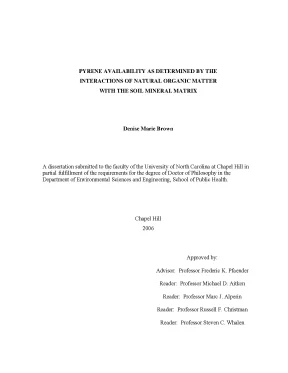
Tải xuống để đọc toàn bộPYRENE AVAILABILITY AS DETERMINED BY THE INTERACTIONS OF NATURAL ORGANIC MATTER WITH THE SOIL MINERAL MATRIX Denise Marie Brown A dissertation submitted to the faculty of the University of North Carolina at Chapel Hill in partial fulfillment of the requirements for the degree of Doctor of Philosophy in the Department of Environmental Sciences and Engineering, School of Public Health. Chapel Hill 2006 Approved by: Advisor: Professor Frederic K. Pfaender Reader: Professor Michael D. Aitken Reader: Professor Marc J.
Alperin Reader: Professor Russell F. Christman Reader: Professor Steven C. Whalen UMI Number: 3239256 UMI Microform 3239256 Copyright 2007 by ProQuest Information and Learning Company. All rights reserved.
This microform edition is protected against unauthorized copying under Title 17, United States Code. ProQuest Information and Learning Company 300 North Zeeb Road P. Box 1346 Ann Arbor, MI 48106-1346 © 2006 Denise Marie Brown ALL RIGHTS RESERVED ii ABSTRACT DENISE MARIE BROWN: Pyrene Availability as Determined by the Interactions of Natural Organic Matter with the Soil Mineral Matrix. (Under the direction of Professor Frederic K.
Pfaender) Soil organic matter (SOM), especially humic substances and biological material, profoundly affect polyaromatic hydrocarbon (PAH) movement, toxicity, and degradation when assessing acceptable end points for in situ remediation practices. The complex, inter- dependent relationship between soil chemical and physical attributes makes determining absolute PAH fate, transport, and availability a formidable task. This research attempted to correlate the impact known SOM components have on pyrene sorption as related to sorbent loading and type and mineral phase aggregation. The objective was achieved by generating a synthetic soil, composed of mineral matter, humic acid (HA), and peptidoglycan (PG), and comparing this matrix to freshly contaminated and aged natural soils, using pyrene as the representative hydrophobic organic contaminant.
In contrast to HA, a larger concentration of PG sorbed to both mineral phases (hematite and montmorillonite clay); thus, promoting further particle aggregation, and effectually resulting in greater pyrene sorption as evidenced by HPLC and fluorescence microscopy. The greater the concentration and number of constituents introduced into the synthetic matrix, culminating in a HA+PG mixture loaded onto clay, the greater the resulting pyrene sorption and similarity to spiked natural soils, both in chemical and physical attributes. The final result was a compiled fluorescence map visually detailing pyrene iii location and percentage sorbed in relation to PG, HA, and the mineral phases for natural and synthetic soils, where the biological constituent held a significant influence over pyrene compared to that by the humic substances. In summary, the type and concentration of SOM constituents, specifically humic substances and biological material, sorbed to a mineral phase significantly impact soil physical and chemical characteristics, and therefore, should be accounted for when determining pyrene fate, transport, and availability within contaminated soil systems.
Potentially, when these observations are combined with fluorescence microscopy, consultants could determine the most effective remediation technology to target specific locations, such as pore spaces, or strong sorptive entities, such as PG, and achieve acceptable end-points. iv This dissertation is dedicated to those that supported me the most…. To my parents, Robert and Sandy Brown, who taught me to persevere and strive for the best. To my brother and sister-in-law, Darren and Angela Brown, who always knew when to ask “Aren’t you done yet?” Finally, to my nephew, Austin, who always inspires me.
Finally, to my husband, Jeff Zborowski, who was kind enough to go to Iraq for seven months and leave me alone to finish this monstrosity, but also the one to make me smile through the frustration and love me through the tears. v ACKNOWLEDGEMENTS This research was supported by the Superfund Hazardous Substances Basic Research Program grant (5P42ES05948). For use of their scientific instruments, I thank Professor Marc Alperin (TOC), Professor Mike Aitken (HPLC), Dr. Wallace Ambrose (SEM), and Dr.
For their valuable assistance, I acknowledge Dr. Robert Schoonhoven (image analysis and compilation), Dr. Chad Roper (flow cell and HPLC method), Tom Long and Joanna Park (HPLC method), and Dr. For brainstorming, support, and therapeutic complaint sessions, I deeply thank Julie Swanson, Sabrina Powell, Kate Lindsay, Dr.
David Singleton, Michelle Sullivan, and Maiysha Jones. Finally, for their research guidance, I also thank my committee, Professors Fred Pfaender (my advisor), Mike Aitken, Marc Alperin, Russ Christman, and Steve Whalen. vi TABLE OF CONTENTS LIST OF TABLES .xii LIST OF FIGURES .xiv LIST OF ABBREVIATIONS. INTRODUCTION AND OBJECTIVES ……………………………………….1 Soil Chemical Structure .1 Soil Organic Matter (SOM) .1 Soil Organic Matter Components ……….2 Dual Mode Model: Glassy versus Amorphous Carbon …………………14 2.2 Soil Organic Matter Sorption to Mineral Phases .1 Humic Substance Sorption to Mineral Phases .2 Peptidoglycan Sorption to Mineral Phases .2 Soil Physical Structure ………….1 Dual Mode Sorption Model ………………………….1 PAH Dissolution into SOM ………………………………………….2 Filling SOM and Mineral Phase Holes with PAHs ….
SYNTHETIC CLAY AS A SURROGATE FOR MODELING PYRENE SORPTION TO NATURAL SOIL .3 Aqueous Phase PG and HA Analysis …………………………………………42 3.4 Particle Surface Area (PSA) Analysis …………………………………….5 Pyrene Application to Synthetic and Natural Soils ………………….6 Aqueous Phase Pyrene Analysis ………………………………………….8 Fluorescence Intensity Analysis …………………………………….1 Comparison of Physical and Chemical Attributes ……………….2 Particle Surface Area (PSA) Analysis …………………………………….3 Pyrene Sorption to Natural and Synthetic Soils ………………………………49 viii 3. IMPACT OF HUMIC ACID AND PEPTIDOGLYCAN ON THE TOTAL ORGANIC CARBON CONCENTRATION AND PARTICLE AGGREGATION OF SYNTHETIC SOIL ……………………….2 Aqueous Phase PG and HA Analysis …………………………………………57 4.3 Particle Surface Area (PSA) Analysis …………………………………….4 Fluorescent Labeling of Peptidoglycan ……………………………….7 Fluorescence Intensity Analysis ………………………………………….1 Humic Acid (HA) Sorption ……………………………………………….3 Humic Acid (HA) and Peptidoglycan (PG) Combined Sorption …………. INFLUENCE OF SOM COMPONENTS ON PYRENE FRESHLY SPIKED IN SYNTHETIC AND NATURAL SOILS …………………………….1 Natural and Synthetic Soils ………………………………………….2 Pyrene Application to Synthetic and Natural Soils ………………….3 Aqueous Phase Pyrene Analysis …………………………………….4 Fluorescent Labeling of Peptidoglycan ……………………………….7 Fluorescence Intensity Analysis ………………………………………………92 5.8 Fluorescence Histograms to Determine Pyrene-SOM Associations ….1 Background Interference and Pyrene Sorption Tests …………………………95 5.2 Pyrene Sorption to HA Synthetic Soils ……………………………….3 Pyrene Sorption to PG Synthetic Soils ……………………………….4 Pyrene Sorption to HA + PG Synthetic Soils ……………………………….5 Pyrene Sorption to Natural Soils …………………………………….6 Pyrene Preference and “Mapping” Contaminated Soils ……………………. FLUORESCENCE INTENSITY AS A TECHNIQUE TO STUDY PAH CONCENTRATIONS, FATE, AND TRANSPORT WITHING SOILS …………………………………………………………………….1 Natural and Synthetic Soils ……………………………………………….4 Fluorescence Intensity Analysis …………………………………….5 Estimating PAH Content by Fluorescence Intensity ……………….1 Fluorescence Intensity Calibration Curves to Determine Unknown PAH Contents ………………………………………………….2 Dual-Mode Progression of Pyrene Sorption with Aging ………………….
SUMMARY AND CONCLUSIONS …………………………………………….1 Summary of Results ……………………………………………………………. FUTURE RESEARCH AND IMPROVEMENTS …………………………………….161 xi LIST OF TABLES Table 3.1: Characteristics of Natural and Synthetic Soil Samples ……………………….2: Distribution Coefficients for Pyrene Sorbed to Synthetic Clay, Blank Clay, and Natural Soils ………………………………………….1: Distribution Coefficients for HA Sorption Experiments ………………….2: …68 Distribution Coefficients for PG Sorption Experiments …………………….3: Distribution Coefficients for HA + PG Sorption Experiments ……………….4: Distribution Coefficients for HA and PG Sorption Experiments ………….1: Pyrene Sorption on Glass Beads …………………………………………….2: Pyrene Sorption on Molecular Sieves ………………………………….3: Comparison of Pyrene Sorption in Soil Slurries and Columns ……………….4: Pyrene Sorption on Synthetic Clay via a Diesel Fuel Carrier ………….5: Distribution Coefficients for Pyrene Sorption on Blank and HA-Loaded Clays …………………………………………….6: Distribution Coefficients for Pyrene Sorption on Blank and PG-Loaded Clays ………………………………………………………….7: Distribution Coefficients for Pyrene Sorbed to HA+PG Synthetic Soils ………………………………………………………….8: Distribution Coefficients for Pyrene Sorbed to Natural Soils ………….9: Distribution Coefficients for Pyrene Sorbed to Multiple- and Single-Component Synthetic Soils ………………………………………….10: Distribution Coefficients for Pyrene Sorbed to Synthetic and Natural Soils ………………………………………………………………….1: Characteristics of Natural and Synthetic Soil Samples …………………….2: Relative Fluorescence Intensities (RFIs) for 16 Priority PAHs ……………….3: Comparison of Measured and Estimated Sorbed Pyrene Amounts …….4: Estimated and Extracted PAH Concentrations for Aged Contaminated Soils ………………………………………………………….141 xiii LIST OF FIGURES Figure 2.1: Fractionation of SOM and humic substances……….2: SEM images of crystallized HA …………………………………….3: Representative three-dimensional humic acid complex …………….4: FTIR spectra of S. subtilis PG samples ……………….5: Chemical structure of the glycan tetrapeptide in PG ………….6: Chemical structure of S.7: Schematic of glassy versus amorphous carbon .8: Theoretical model of an organic-mineral macromolecule ………………….9: Hypothetical structure of a nonviable organic coating on clay …….10: Hypothetical construct of PG sorption to clay …………….11: Three-dimensional models for montmorillonite clay and hematite ……….12: Diagrammatic representation of montmorillonite clay ……………….13: Cross-section of a particle showing different sorption processes …….14: Pseudostructure describing SOM binding to silica sheets ………………….15: Two driving forces of hydrophobic sorption ….16: Pyrene association with a nonviable organic coating ….17: Trapping of a xenobiotic pesticide by SOM ……….18: SOM as a dual-mode amalgam of rubbery and glassy phases ……….19: Conceptual model of geosorbent domains ………………………………….1: Brief schematic of loading HA and PG procedure ………………………….2: Representative image of particle size analysis by BioQuant ……………….3: Comparison of PSA data for natural soils, HA+PG synthetic clays, and blank clay ……………………………………………………….4: Freundlich isotherms comparing the sorption of pyrene on natural soils, blank and synthetic clays ………………………………………….5: Comparison of fluorescence intensities for pyrene sorbed to natural soils and synthetic clays …………………………………………. aureus PG sample labeled with a FITC probe via an alternative Gram staining method …………………………………….2: Schematic of how individual images are combined ………………….3: Freundlich isotherms for HA sorption to clay and hematite ……………………62 4.4: Comparison of PSAs for HA-loaded clays ……………………………….5: Comparison of PSAs for HA-loaded clays and clay : hematite mixtures ………64 4.6: HA clay fluorescence images and intensity measurements ………………….7: Freundlich isotherms for PG sorption to clay and hematite ………….8: Comparison of PSAs for PG-loaded clays ………………………………………69 4.9: PG clay fluorescence images and intensity measurements ……………….10: Freundlich isotherms for HA+PG sorption on clay ………….11: Comparison of PSAs for blank, HA-, PG-, and HA+PG-clays …………….12: HA+PG clay fluorescence images and intensity measurements …………….13: Sorption isotherms for PG and HA on clay and hematite ………….14: Hypothetical construction of HA and PG sorption to clay ………………….15: Comparison of PSAs for blank, HA-, and PG-loaded clays ………….16: Theoretical representation of hematite inserted into clay particles ………….17: Sorption isotherms for SOM-coated clays and a clay : hematite mixture .18: Comparison of fluorescence intensities for SOM-coated clays …………….19: Theoretical desorption-resorption schematic and graph of HA+PG chronological sorption order …………………………………….1: Schematic of how histograms are used to determine pyrene association percentages ……………………………………………….2: Fluorescence images for pyrene attached to glass beads …………………….3: Fluorescence images for pyrene sorbed to molecular sieves …………….4: Fluorescence images for pyrene sorbed via soil columns and slurries .5: Fluorescence images for pyrene sorbed via a diesel fuel carrier ………….6: Polarized light images of CMN and synthetic clay ……………………….7: Freundlich isotherms for pyrene sorption to HA clays …………………….8: Fluorescence images and intensity measurements for pyrene sorbed to HA clays ………………………………………………….9: Freundlich isotherms for pyrene sorption to PG clays ……………….10: Fluorescence images and intensity measurements for pyrene sorbed to PG clays ………………………………………………….11: Freundlich isotherms for pyrene sorption to HA+PG synthetic soils …….12: Fluorescence images and intensity measurements for pyrene sorbed to HA+PG clays ………….13: Freundlich isotherms for pyrene sorption to natural soils ……………….14: Fluorescence images and intensity measurements for pyrene sorbed to natural soils …………………………………………….15: Pseudo-map for pyrene sorbed to HA+PG clay ……………………………….16: Pseudo-map for pyrene sorbed to PMN ………………………………….17: Example of overlapped histograms used to determine pyrene association percentages ……………………………………………….18: Graph of pyrene preference for specific SOM components ………….19: Use of one-dimensional strips to show pyrene preference .20: Freundlich isotherms depicting pyrene sorption on multiple- and single-component synthetic soils ……………………………………….21: Theoretical schematic of HA and PG integration on clay as it affects pyrene sorption ………………………………………………….22: Freundlich isotherms for pyrene sorption to natural and multiple-component synthetic soils ……………………………………….23: Pyrene fluorescence intensities for natural and synthetic soils …………….24: Schematic of a soil “pseudo-map” ……………………………………….1: Calibration curve of sorbed pyrene concentration versus fluorescence intensity ……………………………………………………….2: Fluorescence images of PMN freshly spiked with pyrene ……………….3: Fluorescence images of PMN incubated for six months with pyrene .4: Fluorescence images of aged CMN soil …………………………………….5: Comparison of fluorescence intensities for contaminated MN soil samples aged for various time periods ……………………………….6: Hypothetical schematic of the dual-mode model …………………….
Nội dung được bảo vệ bản quyền — Tải xuống đầy đủ
Trích dẫn luận án này
Denise Marie Brown (2006). Luận án tiến sĩ: Pyrene availability as determined by the interactions of natural organic matter with the soil mineral matrix [Luận án tiến sĩ, University of North Carolina at Chapel Hill]. LuanAn.net. https://luanan.net/khoa-hoc-giao-duc/luan-an-tien-si-pyrene-availability-as-determined-by-the-interactions-of-natural-organic-matter-with-the-soil-mineral-matrix
Từ khóa và chủ đề nghiên cứu
Từ khóa liên quan
Xem thêm luận án cùng lĩnh vực
Chủ đề nghiên cứu
Câu hỏi thường gặp
Luận án "Luận án tiến sĩ: Pyrene availability as determined by the interactions of natural organic matter with the soil mineral matrix" nghiên cứu về vấn đề gì?
Luận án tiến sĩ này phân tích sự có sẵn của pyrene trong đất, khám phá vai trò của tương tác chất hữu cơ tự nhiên với ma trận khoáng vật.
Luận án "Luận án tiến sĩ: Pyrene availability as determined by the interactions of natural organic matter with the soil mineral matrix" được bảo vệ tại trường nào?
Luận án này được bảo vệ tại University of North Carolina at Chapel Hill. Năm bảo vệ: 2006.
Luận án "Luận án tiến sĩ: Pyrene availability as determined by the interactions of natural organic matter with the soil mineral matrix" thuộc chuyên ngành gì?
Luận án "Luận án tiến sĩ: Pyrene availability as determined by the interactions of natural organic matter with the soil mineral matrix" thuộc chuyên ngành Environmental Sciences and Engineering. Danh mục: Khoa Học Giáo Dục.
Luận án "Luận án tiến sĩ: Pyrene availability as determined by the interactions of natural organic matter with the soil mineral matrix" có bao nhiêu trang?
Luận án "Luận án tiến sĩ: Pyrene availability as determined by the interactions of natural organic matter with the soil mineral matrix" có 192 trang. Bạn có thể xem trước một phần tài liệu ngay trên trang web trước khi tải về.
Cách tải luận án "Luận án tiến sĩ: Pyrene availability as determined by the interactions of natural organic matter with the soil mineral matrix" về máy như thế nào?
Để tải luận án về máy, bạn nhấn nút "Tải xuống ngay" trên trang này, sau đó hoàn tất thanh toán phí lưu trữ. File sẽ được tải xuống ngay sau khi thanh toán thành công. Hỗ trợ qua Zalo: 0559 297 239.