Hydroformylation xúc tác của alkene và polyalkene - Luận án tiến sĩ
Luận án tiến sĩ nghiên cứu hydroformylation xúc tác của alkene và polyalkene. Phát triển phương pháp tổng hợp xúc tác rhodium, đặc tính hóa học và tái chế.
King Fahd University of Petroleum & Minerals
Luan An
Luận án
Năm xuất bản
Số trang
253
Thời gian đọc
38 phút
Lượt xem
0
Lượt tải
0
Phí lưu trữ
50 Point
Tổng quan nhanh
- Chủ đề:
- 1. Hydroformylation Xúc Tác: Tổng Quan Phản Ứng
- Số trang:
- 253 trang
- Trường:
- King Fahd University of Petroleum & Minerals
- Chuyên ngành:
- Chemistry
- Tác giả:
- Jimoh Tijani
- Năm:
- 2006
Tóm tắt nội dung luận án
I. Hydroformylation Xúc Tác Tổng Quan Phản Ứng
Hydroformylation reaction là quá trình chuyển hóa alkene thành aldehyde thông qua phản ứng với syngas. Phản ứng này sử dụng carbon monoxide và hydrogen gas làm nguyên liệu đầu vào. Công nghệ này đóng vai trò quan trọng trong công nghiệp hóa chất hiện đại. Quá trình alkene carbonylation tạo ra các sản phẩm aldehyde có giá trị thương mại cao. Phản ứng diễn ra dưới điều kiện nhiệt độ và áp suất được kiểm soát chặt chẽ. Các xúc tác kim loại đóng vai trò then chốt trong việc điều khiển tốc độ và độ chọn lọc.
1.1. Cơ Chế Phản Ứng Hydroformylation
Phản ứng bắt đầu với sự hoạt hóa alkene bởi phức chất kim loại. Carbon monoxide và hydrogen gas được thêm vào tuần tự. Quá trình tạo thành liên kết carbon-carbon mới qua giai đoạn trung gian. Aldehyde synthesis hoàn tất sau bước khử hydro cuối cùng. Cơ chế phản ứng phụ thuộc vào loại xúc tác được sử dụng.
1.2. Ứng Dụng Công Nghiệp Aldehyde
Sản phẩm aldehyde được ứng dụng rộng rãi trong tổng hợp hóa chất. Ngành sản xuất nhựa và chất dẻo sử dụng aldehyde làm nguyên liệu. Công nghiệp dược phẩm cần aldehyde cho nhiều phản ứng tổng hợp. Chất tạo hương và hóa mỹ phẩm cũng dựa vào sản phẩm này. Hydroformylation reaction tạo ra hàng triệu tấn aldehyde mỗi năm.
1.3. Yêu Cầu Điều Kiện Phản Ứng
Nhiệt độ phản ứng thường dao động từ 80-120°C. Áp suất syngas cần duy trì ở mức 10-50 bar. Tỷ lệ carbon monoxide và hydrogen gas ảnh hưởng đến độ chọn lọc. Dung môi phản ứng phải tương thích với hệ xúc tác. Thời gian phản ứng được tối ưu hóa để đạt hiệu suất cao nhất.
II. Rhodium Catalyst Xúc Tác Homogeneous Catalysis
Rhodium catalyst là xúc tác ưu việt nhất cho hydroformylation reaction. Hệ xúc tác này hoạt động theo cơ chế homogeneous catalysis trong pha lỏng. Phức chất rhodium với ligand phosphine cho độ chuyển hóa cao. Khả năng điều khiển độ chọn lọc sản phẩm là ưu điểm nổi bật. Rhodium catalyst hoạt động hiệu quả ở nhiệt độ và áp suất thấp hơn. Chi phí rhodium cao là thách thức chính trong ứng dụng công nghiệp. Việc tái chế và thu hồi xúc tác trở nên cực kỳ quan trọng.
2.1. Cấu Trúc Phức Chất Rhodium
Rhodium tạo phức với ligand phosphite hoặc phosphine. Cấu trúc phức chất quyết định hoạt tính xúc tác. Ligand điều chỉnh tính chất điện tử và không gian xung quanh rhodium. Phức Rh4(CO)16 là tiền chất phổ biến trong tổng hợp. Tỷ lệ rhodium/ligand ảnh hưởng trực tiếp đến hiệu suất.
2.2. Ưu Điểm Homogeneous Catalysis
Homogeneous catalysis cho phép tiếp xúc tối đa giữa chất phản ứng và xúc tác. Độ chọn lọc sản phẩm đạt mức cao nhất với hệ đồng thể. Nhiệt độ phản ứng thấp giúp tiết kiệm năng lượng. Kiểm soát tỷ lệ isomer linear/branched aldehyde dễ dàng hơn. Rhodium catalyst trong homogeneous catalysis đạt TON cao nhất.
2.3. Thách Thức Tái Chế Rhodium
Thu hồi rhodium catalyst từ hỗn hợp phản ứng rất phức tạp. Chi phí kim loại quý đòi hỏi hiệu suất tái chế gần 100%. Phương pháp tách pha truyền thống gặp nhiều hạn chế. Mất hoạt tính xúc tác trong quá trình tái chế là vấn đề thường gặp. Cần phát triển công nghệ tái chế mới hiệu quả hơn.
III. Cobalt Catalyst Giải Pháp Kinh Tế Hơn
Cobalt catalyst là lựa chọn thay thế kinh tế cho rhodium catalyst. Giá thành cobalt thấp hơn nhiều so với kim loại quý rhodium. Hệ xúc tác cobalt yêu cầu điều kiện phản ứng khắc nghiệt hơn. Nhiệt độ và áp suất cao cần thiết cho hoạt tính tối ưu. Độ chọn lọc sản phẩm thường thấp hơn so với rhodium. Cobalt catalyst vẫn được ứng dụng rộng rãi trong công nghiệp. Hydroformylation reaction với cobalt phù hợp cho quy mô lớn.
3.1. Điều Kiện Hoạt Động Cobalt
Nhiệt độ phản ứng với cobalt catalyst dao động 150-180°C. Áp suất syngas cần duy trì ở mức 200-300 bar. Điều kiện khắc nghiệt này tăng chi phí vận hành đáng kể. Thiết bị phản ứng phải chịu được áp suất và nhiệt độ cao. Carbon monoxide và hydrogen gas tiêu thụ nhiều hơn hệ rhodium.
3.2. So Sánh Hiệu Suất Với Rhodium
Cobalt catalyst cho tỷ lệ linear/branched aldehyde thấp hơn. Tốc độ phản ứng chậm hơn so với rhodium catalyst. Hiệu suất chuyển hóa alkene đạt mức tương đương ở điều kiện tối ưu. Chi phí xúc tác thấp bù đắp cho năng lượng tiêu thụ cao. Ứng dụng cobalt phù hợp với sản phẩm không yêu cầu độ chọn lọc cao.
3.3. Ổn Định Và Tái Chế Cobalt
Cobalt catalyst ổn định hơn trong môi trường phản ứng khắc nghiệt. Quá trình tái chế đơn giản hơn do giá trị kim loại thấp. Mất xúc tác trong quá trình sản xuất ít ảnh hưởng kinh tế. Phương pháp chiết tách thông thường áp dụng hiệu quả. Tuổi thọ xúc tác cobalt kéo dài trong điều kiện vận hành ổn định.
IV. Heterogeneous Catalysis Tái Chế Xúc Tác Hiệu Quả
Heterogeneous catalysis là giải pháp tối ưu cho vấn đề tái chế xúc tác. Xúc tác được cố định trên chất mang rắn dễ dàng tách khỏi sản phẩm. Phương pháp này kết hợp ưu điểm của homogeneous và heterogeneous catalysis. Rhodium catalyst được neo trên silica, alumina hoặc polymer. Hoạt tính xúc tác duy trì tốt qua nhiều chu kỳ phản ứng. Độ chọn lọc có thể giảm nhẹ so với hệ đồng thể. Công nghệ này mở ra hướng phát triển bền vững cho hydroformylation.
4.1. Chất Mang Xúc Tác Phổ Biến
Silica mesoporous cung cấp diện tích bề mặt lớn cho phân tán rhodium. Alumina có độ bền nhiệt cao phù hợp điều kiện khắc nghiệt. Polymer hữu cơ cho phép điều chỉnh tính ưa nước/dầu linh hoạt. Carbon hoạt tính cung cấp độ bền hóa học tốt. Lựa chọn chất mang phụ thuộc vào yêu cầu cụ thể của phản ứng.
4.2. Phương Pháp Neo Xúc Tác
Hóa học bề mặt tạo liên kết cộng hóa trị giữa rhodium và chất mang. Hấp phụ vật lý dựa vào tương tác van der Waals yếu hơn. Đóng gói trong lồng zeolite ngăn ngừa rò rỉ kim loại. Phương pháp sol-gel tạo phân tán đồng đều rhodium catalyst. Mỗi kỹ thuật có ưu nhược điểm riêng về độ bền và hoạt tính.
4.3. Hiệu Suất Tái Chế Thực Tế
Xúc tác heterogeneous catalysis tái sử dụng 5-10 lần mà không mất hoạt tính đáng kể. Quá trình lọc đơn giản tách xúc tác rắn khỏi sản phẩm lỏng. Rửa giải và tái hoạt hóa phục hồi hiệu suất ban đầu. Rò rỉ rhodium giảm xuống dưới 1 ppm trong sản phẩm. Công nghệ này giảm chi phí sản xuất aldehyde synthesis đáng kể.
V. Syngas Nguyên Liệu Đầu Vào Quan Trọng
Syngas là hỗn hợp carbon monoxide và hydrogen gas thiết yếu cho hydroformylation. Tỷ lệ CO/H2 tối ưu quyết định hiệu suất và độ chọn lọc phản ứng. Nguồn syngas ảnh hưởng đến chi phí sản xuất tổng thể. Khí tổng hợp được sản xuất từ khí thiên nhiên, than hoặc sinh khối. Độ tinh khiết syngas quan trọng để tránh nhiễm độc xúc tác. Tỷ lệ CO/H2 thường điều chỉnh trong khoảng 1:1 đến 1:2. Quản lý syngas hiệu quả tối ưu hóa quy trình alkene carbonylation.
5.1. Sản Xuất Syngas Công Nghiệp
Steam reforming khí thiên nhiên là phương pháp phổ biến nhất. Gasification than đá cung cấp syngas cho các nhà máy lớn. Partial oxidation dầu nặng áp dụng ở một số khu vực. Sinh khối tái tạo đang được nghiên cứu như nguồn bền vững. Mỗi công nghệ cho tỷ lệ CO/H2 khác nhau cần điều chỉnh.
5.2. Ảnh Hưởng Tỷ Lệ CO H2
Tỷ lệ CO/H2 cao tăng tốc độ alkene carbonylation. Hydrogen gas dư thừa cải thiện độ chọn lọc linear aldehyde. Cân bằng tối ưu phụ thuộc vào loại xúc tác sử dụng. Rhodium catalyst hoạt động tốt với tỷ lệ 1:1. Cobalt catalyst yêu cầu CO cao hơn để duy trì hoạt tính.
5.3. Tinh Chế Và Kiểm Soát Chất Lượng
Loại bỏ lưu huỳnh tránh nhiễm độc rhodium catalyst không hồi phục. Carbon dioxide cần giảm xuống dưới 100 ppm. Hơi nước gây oxy hóa kim loại xúc tác phải kiểm soát. Hệ thống lọc nhiều tầng đảm bảo độ tinh khiết syngas. Giám sát liên tục bằng cảm biến khí phân tích thành phần.
VI. Công Nghệ Tái Chế Phát Triển Bền Vững
Công nghệ tái chế xúc tác là yếu tố then chốt cho sản xuất bền vững. Phương pháp tách pha sử dụng dung môi ưa nước giữ lại rhodium catalyst. Thermoregulated phase transfer catalysis chuyển đổi độ hòa tan theo nhiệt độ. Membrane filtration tách phân tử xúc tác khỏi sản phẩm nhỏ. Công nghệ supercritical CO2 extraction thu hồi sản phẩm mà không ảnh hưởng xúc tác. Heterogeneous catalysis trên chất mang rắn đơn giản hóa quá trình tái chế. Mỗi phương pháp có ứng dụng phù hợp với quy mô và loại sản phẩm cụ thể.
6.1. Tách Pha Hai Lớp Lỏng
Ligand ưa nước giữ rhodium trong pha nước dưới. Sản phẩm aldehyde hòa tan trong pha hữu cơ trên. Phân tách đơn giản bằng phễu chiết sau phản ứng. Pha nước chứa xúc tác tái sử dụng trực tiếp. Phương pháp này hiệu quả với alkene hòa tan nước tốt.
6.2. Thermoregulated Phase Transfer
Ligand đặc biệt thay đổi độ hòa tan theo nhiệt độ. Nhiệt độ cao tạo pha đồng nhất cho phản ứng hydroformylation. Làm lạnh phân tách xúc tác vào pha riêng biệt. Công nghệ này kết hợp ưu điểm homogeneous và heterogeneous catalysis. Ứng dụng thành công với nhiều loại alkene khác nhau.
6.3. Membrane Và Lọc Phân Tử
Nanofiltration membrane giữ lại phức rhodium catalyst lớn. Sản phẩm aldehyde nhỏ hơn đi qua màng dễ dàng. Công nghệ này tránh sử dụng dung môi phụ thêm. Hiệu suất tách đạt trên 99% với membrane chất lượng cao. Tuổi thọ membrane là thách thức cần cải thiện.
Mục lục chi tiết luận án
Tải xuống file đầy đủ để xem toàn bộ nội dung
Tải đầy đủ (253 trang)Nội dung chính
Tổng quan về luận án
Luận án này tiên phong khám phá các chiến lược tổng hợp, đặc trưng và tái chế xúc tác hiệu quả cho phản ứng hydroformyl hóa olefin và polyolefin, một quá trình công nghiệp then chốt sản xuất aldehyde với sản lượng vượt quá bảy triệu tấn mỗi năm trên toàn cầu. Nghiên cứu giải quyết những hạn chế cố hữu của các hệ xúc tác đồng thể truyền thống, đặc biệt là khó khăn trong việc tách sản phẩm và tái chế xúc tác. Bối cảnh khoa học của nghiên cứu được đặt trong nhu cầu cấp thiết về các quy trình xanh hơn, bền vững hơn và tiết kiệm hơn trong ngành hóa chất, nơi các xúc tác kim loại chuyển tiếp đồng thể, đặc biệt là phức chất Rhodium (I), mặc dù hoạt tính và độ chọn lọc cao, lại gặp trở ngại về chi phí và khả năng tái chế.
Research gap cụ thể mà luận án này giải quyết bắt nguồn từ các vấn đề đã được ghi nhận trong tài liệu hiện có. Các khái niệm tái chế xúc tác phổ biến như sử dụng phối tử tan trong nước, xúc tác chuyển pha điều nhiệt, và xúc tác đồng thể dị thể hóa đều bộc lộ những hạn chế đáng kể. Ví dụ, việc sử dụng các phối tử tan trong nước thường dẫn đến "độ hòa tan trong nước của các cơ chất hữu cơ quá thấp, ngăn chặn sự chuyển giao đầy đủ của cơ chất hữu cơ vào pha nước hoặc tại ranh giới pha và do đó làm giảm tốc độ phản ứng" (trang 6), đồng thời "bất kỳ chất phụ gia lạ nào cũng sẽ làm tăng độ khó và chi phí của bước tinh chế" (trang 6). Trong trường hợp xúc tác chuyển pha điều nhiệt, "có sự mất hoạt tính đáng kể sau bốn lần chạy phản ứng liên tiếp do sự thủy phân của phosphite trong nước" (trang 14). Hơn nữa, các hệ xúc tác đồng thể dị thể hóa thường cho thấy "hoạt tính và độ chọn lọc thấp hơn so với các loài đồng thể tương ứng và cũng có sự mất hoạt tính và độ chọn lọc dần dần theo số chu kỳ" (trang 26). Nghiên cứu này trực tiếp giải quyết những khoảng trống này bằng cách phát triển các phương pháp tiếp cận mới, bao gồm việc áp dụng xúc tác hai pha nhiệt biến cho các olefin bậc cao mà không cần phối tử được gắn thẻ đặc biệt và tổng hợp các xúc tác Rhodium được hỗ trợ mạnh mẽ thông qua axit phosphotungstic trên vật liệu mesoporous MCM-41.
Các câu hỏi nghiên cứu và giả thuyết trung tâm bao gồm:
- RQ1: Làm thế nào để thiết kế và tối ưu hóa hệ xúc tác hai pha nhiệt biến cho phản ứng hydroformyl hóa các olefin bậc cao (C>6) nhằm đạt được hiệu quả tái chế cao mà không làm giảm đáng kể hoạt tính và độ chọn lọc?
- H1.1: Việc tối ưu hóa các thông số phản ứng (áp suất CO/H2, tỷ lệ phối tử/xúc tác, nhiệt độ, loại dung môi) sẽ dẫn đến hoạt tính, độ chọn lọc và khả năng tái chế vượt trội cho các olefin bậc cao trong hệ nhiệt biến.
- RQ2: Phương pháp tẩm axit phosphotungstic (PTA) lên vật liệu mesoporous MCM-41 có thể tạo ra một xúc tác Rhodium được hỗ trợ mới có hoạt tính, độ chọn lọc và ổn định cao trong phản ứng hydroformyl hóa styrene và 1-octene không?
- H2.1: Xúc tác được hỗ trợ Rhodium tẩm PTA/MCM-41 sẽ thể hiện khả năng tái chế nhiều lần mà không mất hoạt tính đáng kể, cải thiện đáng kể so với các phương pháp dị thể hóa truyền thống.
- RQ3: Phản ứng hydroformyl hóa có thể được áp dụng thành công để biến đổi hóa học các polybutadiene thương mại, tạo ra các sản phẩm polyaldehyde có chức năng với độ chọn lọc theo vị trí xác định không?
- H3.1: Phân tích NMR (¹H và ¹³C) sẽ xác nhận sự hình thành chọn lọc của các sản phẩm aldehyde phân nhánh 1,2-terminal và 1,4-internal trên các đơn vị olefin của polybutadiene.
Khung lý thuyết của luận án được neo vào lý thuyết xúc tác kim loại chuyển tiếp, cụ thể là các cơ chế phản ứng oxo và vai trò của các phức chất kim loại chuyển tiếp Rhodium (I) trong việc tạo điều kiện cho sự bổ sung hydro và nhóm formyl vào liên kết không bão hòa. Nó mở rộng trên khuôn khổ của xúc tác đồng thể, đồng thời kết hợp các nguyên tắc của xúc tác dị thể và xúc tác hai pha để vượt qua các thách thức vốn có.
Những đóng góp đột phá của nghiên cứu bao gồm:
- Phát triển Hệ thống Tái chế Xúc tác Hai pha Nhiệt biến Mới cho Olefin bậc cao: Đã ứng dụng phương pháp nhiệt biến cho phản ứng hydroformyl hóa các olefin bậc cao (C>6), cụ thể là 1-octene, thể hiện "khả năng tái chế xúc tác nhiều lần mà không làm mất hoạt tính đáng kể" (trang XIX, Tóm tắt). Điều này có ý nghĩa quan trọng đối với các ứng dụng công nghiệp, nơi các cơ chất hữu cơ thường có độ hòa tan thấp trong nước.
- Tổng hợp và Đặc trưng Xúc tác Rhodium Được hỗ trợ Ổn định cao: Một xúc tác hydroformyl hóa mới đã được phát triển thông qua việc tẩm HRhCO(PPh3)3 trên vật liệu mesoporous MCM-41 bằng axit phosphotungstic (PTA), được đặc trưng bằng XRD, IR và ³¹P CP MAS NMR (trang XIX, Tóm tắt). Hệ thống này cải thiện đáng kể sự ổn định và khả năng tái sử dụng.
- Ứng dụng Tiên phong của Hydroformyl hóa để Biến đổi Hóa học Polybutadiene: Luận án trình bày một ứng dụng "mới của xúc tác để biến đổi hóa học các polyme polybutadiene thương mại hiện có" (trang XIX, Tóm tắt). Các sản phẩm polyaldehyde có chức năng là "chất trung gian quan trọng trong việc phát triển các dẫn xuất polyme khác nhau" (trang XIX, Tóm tắt) cho các vật liệu và linh kiện mới.
- Hiểu biết Sâu sắc về Độ chọn lọc theo vị trí trong Hydroformyl hóa Polybutadiene: Phân tích ¹³C và ¹H NMR đã chứng minh rằng các đơn vị olefin trong polybutadiene được hydroformyl hóa chọn lọc thành "sản phẩm aldehyde phân nhánh 1,2-terminal và 1,4-internal" (trang XIX, Tóm tắt). Điều này cung cấp cái nhìn định lượng về kiểm soát độ chọn lọc trong quá trình biến đổi polyme phức tạp.
Phạm vi của nghiên cứu bao gồm việc tổng hợp và đặc trưng nhiều hệ xúc tác Rhodium khác nhau, tối ưu hóa các thông số phản ứng trên một loạt các olefin (từ aryl alkenes như styrene đến alkyl alkenes như 1-octene và polyalkenes như polybutadiene), và thực hiện các thử nghiệm tái chế nghiêm ngặt. Nghiên cứu đã sử dụng các mẫu olefin và polyolefin khác nhau, bao gồm 1-octene, styrene và polybutadiene với các tỷ lệ 1,2 và 1,4 khác nhau (ví dụ: PBD60%Ph, PBD86%1,2Pred, PBD72%1,2Pred, PBD99%Ph). Tầm quan trọng của nó nằm ở việc cung cấp các giải pháp đổi mới cho các thách thức chính trong xúc tác đồng thể, mở ra con đường cho các quy trình công nghiệp hiệu quả và bền vững hơn cũng như việc phát triển các vật liệu polyme mới có chức năng.
Literature Review và Positioning
Đánh giá tài liệu chuyên sâu của luận án tổng hợp các luồng nghiên cứu chính về hydroformyl hóa, tập trung vào sự phát triển của các xúc tác Rhodium và các khái niệm tái chế. Phản ứng hydroformyl hóa, được Roelen khám phá vào năm 1938, ban đầu sử dụng xúc tác Cobalt nhưng đã được chuyển đổi đáng kể vào những năm 1970 với việc thương mại hóa các xúc tác Rhodium (trang 3). Các công trình của Osborn, Young và Wilkinson vào năm 1965 đã chứng minh rằng phức chất Rh(I)-PPh3 hoạt động và có độ chọn lọc cao, thậm chí ở điều kiện môi trường xung quanh (trang 3). Nghiên cứu của Union Carbide và Eastman Kodak đã dẫn đến các xúc tác Rhodium bisphosphine chelat hóa thế hệ mới, như BISBI*, mang lại tỷ lệ aldehyde thẳng/phân nhánh cao (>30:1 cho propylene, so với 8:1 của xúc tác Rh/PPh3 thương mại) (trang 5).
Các mâu thuẫn và tranh luận trong tài liệu thường xoay quanh sự cân bằng giữa hoạt tính, độ chọn lọc và khả năng tái chế xúc tác. Ví dụ, trong khi việc bổ sung phối tử phosphine dư thừa có thể "chuyển dịch trạng thái cân bằng phân ly phosphine trở lại xúc tác HRh(CO)(PPh3)3 chọn lọc hơn" (trang 4), thì sự phụ thuộc vào nhiệt độ của độ chọn lọc vẫn là một thách thức, với Wilkinson ghi nhận "tốc độ tăng, nhưng độ chọn lọc vùng giảm" ở nhiệt độ cao hơn (trang 4). Một cuộc tranh luận khác liên quan đến việc sử dụng các hệ thống hai pha. Các hệ thống pha nước/hữu cơ, như được sử dụng trong quy trình Ruhrchemie/Rhone-Poulenc’s với TPPTS (trang 6), giải quyết các vấn đề tái chế nhưng gặp khó khăn với "độ hòa tan trong nước của các cơ chất hữu cơ quá thấp" (trang 6). Để chống lại điều này, Chaudhari et al. (28) đề xuất "phối tử xúc tiến" tan độc quyền trong pha hữu cơ để điều chỉnh độ hòa tan của phức chất nội tại.
Luận án này định vị nghiên cứu của mình trong tài liệu hiện có bằng cách xác định một khoảng trống cụ thể: sự cần thiết của các phương pháp tái chế xúc tác không chỉ hiệu quả mà còn tránh được những phức tạp như phối tử được gắn thẻ đặc biệt hoặc các vấn đề thủy phân. Luận án vượt qua thách thức của các xúc tác chuyển pha điều nhiệt (TRPTC) đã báo cáo "sự mất hoạt tính đáng kể sau bốn lần chạy phản ứng liên tiếp do sự thủy phân của phosphite trong nước" (trang 14) bằng cách phát triển các hệ thống ổn định hơn hoặc các phương pháp khác. Nó cũng nâng cao lĩnh vực này bằng cách cung cấp các giải pháp cụ thể cho khả năng tái chế xúc tác đồng thể và mở rộng ứng dụng của hydroformyl hóa sang các polyme phức tạp. Các đóng góp cụ thể bao gồm:
- Xúc tác hai pha nhiệt biến không phối tử được gắn thẻ: Không giống như các công trình trước đó của Bergbreiter et al. hoặc Jin et al. sử dụng "phối tử thông minh" hoặc "phối tử polyether" như PNIPAM-phosphine (VII) hoặc OPGPP (IV) (trang 8, 11) với "các phương pháp tổng hợp này thường khó và phức tạp" (trang 22), luận án này áp dụng phương pháp của Behr và Toslu về "hệ thống dung môi đa thành phần phụ thuộc nhiệt độ (TMS), không cần sử dụng bất kỳ phối tử được gắn thẻ đặc biệt nào" (trang 22). Điều này đơn giản hóa đáng kể quy trình tái chế.
- Xúc tác được hỗ trợ tăng cường độ ổn định: Trong khi các xúc tác đồng thể dị thể hóa truyền thống thường phải đối mặt với các vấn đề về "hoạt tính và độ chọn lọc thấp hơn" và "mất hoạt tính dần dần" (trang 26), luận án này xây dựng dựa trên chiến lược của Augustine et al. (60) về việc "neo xúc tác đồng thể vào một chất mang thông qua axit phosphotungstic" (trang 26). Cụ thể, nó tẩm HRhCO(PPh3)3 lên MCM-41 thông qua PTA, dẫn đến "độ ổn định tuyệt vời, khả năng tái sử dụng và thậm chí cải thiện hoạt tính của xúc tác rhodium" (trang 27). Điều này so sánh thuận lợi với các phương pháp trước đó được báo cáo bởi các nhóm khác về việc bất động phức chất Rh-PPh3 lên MCM-41 và MCM-48 bằng cách sử dụng amino-functionalized (63,64), vốn không phải lúc nào cũng chứng minh được hoạt tính được cải thiện.
So sánh với ít nhất hai nghiên cứu quốc tế:
- Jin et al. (2001, 2003): Đã báo cáo các phosphine tan trong nước mới, N,N-dipolyoxyethylene-substituted-4-(diphenylphosphino) benzene sulfonamide và PEO-DPPPA, cho hydroformyl hóa 1-decene. Phức chất Rhodium của PEO-DPPPA "thể hiện hoạt tính xúc tác cao trong hydroformyl hóa 1-decene pha nước-hữu cơ" và duy trì "chuyển hóa olefin và sản lượng aldehyde cao hơn 94% ngay cả sau 20 chu kỳ" (trang 13). Tuy nhiên, nghiên cứu này còn giải quyết vấn đề thủy phân phosphite đối với OPGPP trong các hệ thống TRPTC, dẫn đến mất hoạt tính sau bốn lần chạy (trang 14). Luận án này tránh được các hạn chế đó bằng cách sử dụng hệ thống nhiệt biến mà không cần các phối tử được gắn thẻ đặc biệt.
- Scott và Rempel (70): Đã điều tra động học hydroformyl hóa SBR với HRh(CO)(PPh3)3 và phosphine triphenyl dư thừa. Mặc dù họ đã đóng góp vào sự hiểu biết về cơ chế, nhưng họ không đề cập đến việc tái chế xúc tác hoặc hydroformyl hóa polybutadiene như một ứng dụng chức năng chính. Luận án này tiến xa hơn bằng cách trình bày "ứng dụng mới của xúc tác để biến đổi hóa học các polyme polybutadiene thương mại" (trang XIX, Tóm tắt) và đặc trưng hóa các sản phẩm aldehyde phân nhánh cụ thể bằng NMR, cung cấp một bước tiến thực tiễn trong hóa học polyme chức năng.
Đóng góp lý thuyết và khung phân tích
Đóng góp cho lý thuyết
Luận án này mở rộng và thách thức các lý thuyết cụ thể trong lĩnh vực xúc tác và hóa học polyme. Nó kéo dài khuôn khổ của cơ chế Oxo của Wilkinson (Rhône-Poulenc/Ruhrchemie process), vốn tập trung vào việc tạo ra aldehyde thẳng bằng cách sử dụng các phức chất Rhodium với phối tử phosphine (ví dụ: TPPTS), bằng cách khám phá các điều kiện và hệ thống (đặc biệt là hệ nhiệt biến và xúc tác được hỗ trợ) có thể duy trì hoạt tính và độ chọn lọc cao mà không gặp phải các vấn đề về tách xúc tác hoặc thủy phân phối tử. Nghiên cứu của Wilkinson (9-11) đã thiết lập HRh(CO)(PPh3)3 là một xúc tác chọn lọc cao cho các sản phẩm aldehyde, nhưng các thách thức về tái chế vẫn tồn tại. Luận án này chứng minh rằng có thể duy trì hoạt tính tương đương hoặc được cải thiện thông qua các chiến lược tái chế tiên tiến, từ đó mở rộng tính ứng dụng của lý thuyết này trong các bối cảnh công nghiệp rộng lớn hơn.
Nghiên cứu cũng đóng góp vào lý thuyết về xúc tác trên vật liệu hỗ trợ, vốn thường được đặc trưng bởi hoạt tính và độ chọn lọc giảm sút so với các đối tác đồng thể (trang 26). Bằng cách sử dụng phương pháp tẩm axit phosphotungstic (PTA) trên MCM-41, luận án này thách thức quan niệm rằng các xúc tác dị thể hóa luôn kém hiệu quả hơn. Thay vào đó, nó cung cấp bằng chứng thực nghiệm cho thấy phương pháp này có thể dẫn đến "độ ổn định tuyệt vời, khả năng tái sử dụng và thậm chí cải thiện hoạt tính của xúc tác rhodium" (trang 27), điều này mở rộng lý thuyết về cách thiết kế xúc tác dị thể hóa hoạt động và bền vững.
Khuôn khổ khái niệm được phát triển trong luận án bao gồm ba thành phần chính và mối quan hệ của chúng:
- Cơ chế phản ứng Oxo: Hiểu biết về sự hình thành các phức chất hydride kim loại-carbonyl và sự chèn các olefin vào liên kết kim loại-hydride.
- Thiết kế hệ thống pha: Khám phá các thuộc tính nhiệt động lực học của hệ thống dung môi (hệ thống nhiệt biến) để kiểm soát khả năng hòa trộn pha và tạo điều kiện tách xúc tác.
- Hóa học bề mặt vật liệu hỗ trợ: Nghiên cứu về cách các phối tử và phức chất kim loại tương tác với bề mặt vật liệu mesoporous (MCM-41) và các tác nhân gắn kết (PTA) để duy trì hoạt tính xúc tác và ngăn chặn sự rửa trôi.
Mô hình lý thuyết được đề xuất bao gồm các mệnh đề/giả thuyết được đánh số:
- MĐ1: Khả năng kiểm soát nhiệt độ của khả năng hòa trộn dung môi trong hệ nhiệt biến sẽ cho phép tái chế xúc tác hiệu quả cho các olefin bậc cao mà không cần thay đổi cấu trúc phối tử phức tạp.
- MĐ2: Sự hiện diện của axit phosphotungstic (PTA) như một chất gắn kết sẽ tạo điều kiện cho sự ổn định của các phức chất Rhodium trên MCM-41, dẫn đến hoạt tính và khả năng tái chế được cải thiện do ngăn chặn hiệu quả sự rửa trôi xúc tác.
- MĐ3: Các đơn vị olefin trong polybutadiene có thể được hydroformyl hóa chọn lọc, và cấu hình phân nhánh của sản phẩm aldehyde có thể được đặc trưng và kiểm soát bằng cách điều chỉnh các thông số phản ứng.
Luận án này đưa ra bằng chứng thực nghiệm về một sự tiến bộ trong mô hình trong thiết kế xúc tác bền vững. Thông thường, sự đánh đổi giữa hoạt tính đồng thể và khả năng tái chế dị thể hóa đã hạn chế các ứng dụng công nghiệp. Bằng cách chứng minh các hệ thống "ít nhất hoạt động như các loài đồng thể và có khả năng tái sử dụng nhiều lần với ít mất mát về hoạt tính và độ chọn lọc" (trang 27), nghiên cứu này đặt nền móng cho một mô hình mới, nơi các lợi ích của xúc tác đồng thể có thể được đạt được với khả năng tái chế vốn có của xúc tác dị thể.
Khung phân tích độc đáo
Khung phân tích của luận án tích hợp các lý thuyết từ nhiều lĩnh vực để cung cấp một cách tiếp cận toàn diện cho thiết kế và đánh giá xúc tác. Cụ thể, nó tổng hợp:
- Lý thuyết về xúc tác chuyển tiếp kim loại: Đặc biệt tập trung vào hóa học phối trí của Rhodium và các cơ chế cơ bản của phản ứng hydroformyl hóa (ví dụ: cân bằng phân ly phối tử, ảnh hưởng không gian và điện tử của phối tử, trang 4).
- Lý thuyết về hành vi pha và nhiệt động lực học dung môi: Áp dụng các nguyên tắc của hóa học vật lý để hiểu và thiết kế các hệ thống nhiệt biến, nơi khả năng hòa trộn pha thay đổi theo nhiệt độ (trang 16-17).
- Hóa học vật liệu và bề mặt: Sử dụng kiến thức về vật liệu mesoporous (MCM-41) và đặc tính hóa học bề mặt để thiết kế các chất mang xúc tác hiệu quả, bao gồm vai trò của axit phosphotungstic trong việc ổn định kim loại (trang 24, 26).
Một phương pháp phân tích mới lạ được sử dụng là sự kết hợp có hệ thống của các thử nghiệm tái chế nghiêm ngặt với đặc trưng quang phổ tiên tiến (NMR, IR, XRD) để không chỉ định lượng hiệu suất xúc tác mà còn để cung cấp bằng chứng phân tử về độ ổn định của xúc tác và cấu trúc sản phẩm. Điều này cung cấp sự biện minh mạnh mẽ cho hiệu quả của các phương pháp tiếp cận mới.
Các đóng góp khái niệm cụ thể bao gồm các định nghĩa về:
- "Xúc tác hai pha nhiệt biến không phối tử được gắn thẻ": Một khái niệm về xúc tác hai pha tận dụng sự phụ thuộc nhiệt độ của khả năng hòa trộn dung môi để tách xúc tác mà không cần phối tử được thiết kế đặc biệt (trang 22).
- "Ổn định xúc tác tăng cường qua tẩm axit phosphotungstic": Một phương pháp cho xúc tác dị thể hóa nơi PTA hoạt động như một chất gắn kết trung gian, tăng cường sự gắn kết của phức chất kim loại với chất mang và cải thiện khả năng chống rửa trôi (trang 26-27).
- "Hydroformyl hóa chọn lọc polybutadiene": Một ứng dụng của phản ứng hydroformyl hóa để biến đổi hóa học các polyme không bão hòa thành các polyme có chức năng với các nhóm aldehyde được kiểm soát vị trí.
Các điều kiện biên được tuyên bố rõ ràng trong nghiên cứu. Ví dụ, phương pháp nhiệt biến chủ yếu được áp dụng cho "olefin bậc cao (C>6)" (trang XIX, Tóm tắt) do những hạn chế về độ hòa tan của chúng trong các hệ thống dựa trên nước. Ngoài ra, việc hydroformyl hóa polybutadiene được thực hiện dưới các điều kiện cụ thể để ngăn chặn sự tạo gel và đạt được độ chọn lọc mong muốn (trang 28, 30).
Phương pháp nghiên cứu tiên tiến
Nghiên cứu áp dụng một phương pháp nghiên cứu tiên tiến và đa diện, kết hợp các triết lý, thiết kế và kỹ thuật phân tích nghiêm ngặt để giải quyết các câu hỏi nghiên cứu phức tạp.
Thiết kế nghiên cứu
Triết lý nghiên cứu của luận án nằm trong chủ nghĩa thực chứng (positivism), được điều chỉnh bởi các yếu tố của chủ nghĩa hậu thực chứng. Nó tìm cách khám phá các mối quan hệ nguyên nhân-kết quả có thể định lượng được và các quy luật tổng quát về hành vi xúc tác thông qua các thí nghiệm có kiểm soát. Nghiên cứu thực nghiệm được thúc đẩy bởi các giả thuyết cụ thể về hiệu suất của xúc tác và được hỗ trợ bởi dữ liệu có thể đo lường được và khách quan.
Thiết kế nghiên cứu kết hợp một phương pháp "mixed methods" theo nghĩa rộng, tích hợp các kỹ thuật tổng hợp và đặc trưng hóa vật liệu (chủ yếu định tính về bản chất trong việc xây dựng các hệ thống mới) với phân tích định lượng nghiêm ngặt về hoạt tính xúc tác, độ chọn lọc và khả năng tái chế. Sự kết hợp cụ thể này cho phép phát triển các xúc tác mới (tổng hợp), sau đó được đánh giá định lượng về hiệu suất của chúng.
Thiết kế nhiều cấp độ được thể hiện qua việc nghiên cứu các hệ thống xúc tác ở các cấp độ phức tạp khác nhau:
- Cấp độ phân tử: Tối ưu hóa các phối tử và phức chất Rhodium đồng thể, hiểu rõ ảnh hưởng của các đặc tính điện tử và không gian đối với hoạt tính và độ chọn lọc (trang 4-5).
- Cấp độ hệ thống pha: Khám phá các thuộc tính của dung môi và tương tác pha trong hệ thống nhiệt biến và chuyển pha điều nhiệt (trang 7-17).
- Cấp độ vật liệu: Tổng hợp và đặc trưng các chất mang mesoporous (MCM-41) và các xúc tác được hỗ trợ, hiểu rõ tương tác bề mặt và độ ổn định (trang 23-27).
Kích thước mẫu và tiêu chí lựa chọn được xác định rõ ràng thông qua việc sử dụng các cơ chất đã biết và tiêu chuẩn công nghiệp (ví dụ: styrene, 1-octene, các loại polybutadiene cụ thể). Đối với hydroformyl hóa olefin, các nghiên cứu bao gồm nhiều loại alkyl và aryl alkenes khác nhau (ví dụ: 1-octene, 1-decene, 1-dodecene, cyclohexene, styrene, 4-isopropylstyrene, 4-methoxystyrene), cho phép đánh giá tổng quát về hiệu suất xúc tác. Các loại polybutadiene được sử dụng cũng có sự khác biệt về cấu trúc (ví dụ: PBD60%Ph, PBD86%1,2Pred, PBD72%1,2Pred, PBD99%Ph), cho phép hiểu rõ hơn về độ chọn lọc cấu trúc (trang 183-191).
Quy trình nghiên cứu nghiêm ngặt
Chiến lược lấy mẫu cho các vật liệu xúc tác và cơ chất là có chủ đích, tập trung vào các hóa chất thương mại sẵn có có độ tinh khiết cao để đảm bảo khả năng tái tạo. Các tiêu chí bao gồm việc lựa chọn các olefin terminal và internal, cũng như các polybutadiene với các cấu hình 1,2- và 1,4- khác nhau để khảo sát ảnh hưởng của cấu trúc cơ chất lên phản ứng.
Các quy trình thu thập dữ liệu được mô tả chi tiết và nghiêm ngặt. Ví dụ, "Quy trình chung cho hydroformyl hóa đồng thể olefin" (trang 36), "Quy trình chung cho hydroformyl hóa hai pha nhiệt biến của olefin" (trang 76), và "Quy trình cho hydroformyl hóa dị thể styrene" (trang 122) đều được trình bày rõ ràng. Các thiết bị được mô tả bao gồm việc sử dụng lò phản ứng áp suất cao (autoclave), thiết bị khuấy, và các hệ thống kiểm soát nhiệt độ và áp suất để đảm bảo điều kiện phản ứng được duy trì nhất quán.
Phép tam giác (triangulation) được áp dụng qua nhiều khía cạnh:
- Triangulation dữ liệu: Hoạt tính và độ chọn lọc xúc tác được định lượng bằng sắc ký khí (GC, không được nêu rõ nhưng ngụ ý), trong khi cấu trúc sản phẩm và xúc tác được xác nhận bằng nhiều kỹ thuật quang phổ (NMR, IR, XRD).
- Triangulation phương pháp: Hiệu suất xúc tác được đánh giá thông qua cả xúc tác đồng thể, hai pha và dị thể để hiểu rõ hơn về các yếu tố ảnh hưởng đến từng hệ thống.
- Triangulation điều tra viên/lý thuyết (ngụ ý): Mặc dù không được nêu rõ, nhưng việc tham khảo các nghiên cứu trước đây và các tác giả khác trong phần tổng quan tài liệu (ví dụ: Roelen, Osborn, Wilkinson, Jin, Bergbreiter) cho thấy sự so sánh và xác nhận chéo các phát hiện với kiến thức hiện có.
Tính hợp lệ (validity) và độ tin cậy (reliability) được đảm bảo thông qua:
- Tính hợp lệ cấu trúc: Các thuật ngữ và khái niệm như "hoạt tính", "độ chọn lọc", "tái chế" được định nghĩa rõ ràng và đo lường bằng các chỉ số được chấp nhận trong ngành hóa học (ví dụ: % chuyển hóa, tỷ lệ thẳng/phân nhánh, số chu kỳ tái chế).
- Tính hợp lệ nội bộ: Các thí nghiệm được thiết kế có kiểm soát, cô lập các biến số chính (ví dụ: ảnh hưởng của nhiệt độ, áp suất, loại phối tử/dung môi) để thiết lập mối quan hệ nhân quả.
- Tính hợp lệ bên ngoài: Nghiên cứu sử dụng các cơ chất công nghiệp (olefin, polybutadiene) và các điều kiện phản ứng (áp suất, nhiệt độ) có liên quan đến các quy trình công nghiệp, tăng cường khả năng tổng quát hóa của các phát hiện.
- Độ tin cậy: Các thí nghiệm được thực hiện dưới các điều kiện tiêu chuẩn hóa, và khả năng tái tạo được ngụ ý thông qua việc báo cáo các kết quả nhất quán trên nhiều lần chạy và chu kỳ tái chế. Giá trị alpha (α values) cho độ tin cậy định lượng không được báo cáo trực tiếp trong bản tóm tắt, nhưng các số liệu thống kê như "duy trì cao hơn 94% ngay cả sau 20 chu kỳ" (trang 13) cho thấy độ tin cậy cao của quy trình.
Data và phân tích
Đặc điểm mẫu được mô tả thông qua các loại cơ chất (olefin, polybutadiene) và các điều kiện khác nhau được nghiên cứu. Ví dụ, các loại polybutadiene với "các đơn vị olefin trong polybutadiene được hydroformyl hóa chọn lọc thành các sản phẩm aldehyde phân nhánh 1,2-terminal và 1,4-internal" (trang XIX, Tóm tắt) được phân tích để hiểu rõ về độ chọn lọc theo vị trí.
Các kỹ thuật phân tích tiên tiến được sử dụng bao gồm:
- Sắc ký khí (GC): Để định lượng % chuyển hóa và độ chọn lọc cho các sản phẩm aldehyde (ngụ ý từ các bảng kết quả như Bảng 2.1-2.11, Bảng 3.1-3.8).
- Quang phổ cộng hưởng từ hạt nhân (NMR): ¹H NMR và ¹³C NMR được sử dụng để "đặc trưng các sản phẩm phản ứng" và xác định cấu trúc của các sản phẩm hydroformyl hóa polybutadiene (trang XIX, Tóm tắt; Figures 6.1-6.4). ³¹P CP MAS NMR được sử dụng để đặc trưng các xúc tác được hỗ trợ (trang XIX, Tóm tắt).
- Phổ hồng ngoại (IR): Để xác nhận sự có mặt của các nhóm chức năng và đặc trưng xúc tác (Figures 2.3I, 2.3II, 3.9, 4.1, 6.5).
- Nhiễu xạ tia X (XRD): Để đặc trưng cấu trúc vật liệu mesoporous và các xúc tác được hỗ trợ (trang XIX, Tóm tắt; Figures 5.6).
- Các kỹ thuật phân tích khác: Hấp phụ-khử hấp phụ Nitơ để xác định diện tích bề mặt và kích thước lỗ chân lông của MCM-41 (trang 121).
Các phần mềm cụ thể không được nêu rõ trong đoạn văn bản cung cấp, nhưng các kỹ thuật như NMR và XRD ngụ ý việc sử dụng các gói phần mềm chuyên dụng để xử lý và phân tích dữ liệu phổ.
Các kiểm tra độ bền vững (robustness checks) được thực hiện thông qua việc thay đổi các thông số phản ứng (nhiệt độ, áp suất, loại dung môi, tỷ lệ phối tử/xúc tác) để xác nhận tính nhất quán của các phát hiện dưới các điều kiện khác nhau. Ví dụ, "ảnh hưởng của áp suất CO/H2, tỷ lệ phối tử/xúc tác lên hoạt tính, độ chọn lọc và khả năng tái chế đã được nghiên cứu trên 1-octene và các olefin khác" (trang XIX, Tóm tắt). Điều này giúp khẳng định rằng các kết quả không phải là do ngẫu nhiên hoặc các yếu tố ngoại sinh.
Các kích thước hiệu ứng (effect sizes) và khoảng tin cậy (confidence intervals) không được báo cáo tường minh trong tóm tắt, nhưng các số liệu thống kê về % chuyển hóa (ví dụ: "99.3 % chuyển hóa styrene", trang 11), tỷ lệ độ chọn lọc (ví dụ: "tỷ lệ aldehyde phân nhánh/thẳng là 4.1", trang 11), và số chu kỳ tái chế thành công (ví dụ: "sau 20 chu kỳ vẫn duy trì cao hơn 94%", trang 13) cung cấp bằng chứng định lượng về mức độ và ý nghĩa của các hiệu ứng quan sát được.
Phát hiện đột phá và implications
Những phát hiện then chốt
Luận án này đã đạt được nhiều phát hiện đột phá với bằng chứng cụ thể từ dữ liệu:
- Hiệu suất Xúc tác Hai pha Nhiệt biến Vượt trội cho Olefin Bậc cao: Phản ứng hydroformyl hóa 1-octene sử dụng hệ thống nhiệt biến đã chứng minh hiệu quả vượt trội. Nghiên cứu đã tối ưu hóa các thông số như loại dung môi cực, phức chất Rhodium, phối tử, nhiệt độ và áp suất (Bảng 3.1-3.6). Đặc biệt, hệ thống đã chứng minh "khả năng tái chế xúc tác nhiều lần mà không làm mất hoạt tính đáng kể" (trang XIX, Tóm tắt). Ví dụ, đối với 1-octene, các chu kỳ tái chế được minh họa trong Hình 3.6, 3.7 và 3.8 (trang 98-100).
- Xúc tác Rhodium Được hỗ trợ Ổn định và Hoạt động cao qua Tẩm PTA/MCM-41: Luận án đã tổng hợp một xúc tác hydroformyl hóa mới bằng cách tẩm HRhCO(PPh3)3 trên vật liệu mesoporous MCM-41 thông qua Axit Phosphotungstic (PTA). Xúc tác này, được đặc trưng bằng XRD, IR và ³¹P CP MAS NMR, thể hiện "khả năng tái chế nhiều lần mà không làm mất hoạt tính đáng kể" (trang XIX, Tóm tắt). Cụ thể, xúc tác Rh¹⁵W¹⁰MCM-E đã được tái chế thành công trong hydroformyl hóa styrene (Hình 4.7-4.11, trang 147-151) và 1-octene (Bảng 5.5, 5.6, trang 173-174). Bảng 4.6 (trang 144) cho thấy "hiệu ứng của việc rửa trôi rhodium lên phản ứng hydroformyl hóa styrene" là tối thiểu, ủng hộ độ ổn định của xúc tác được hỗ trợ.
- Ứng dụng Mới của Hydroformyl hóa vào Biến đổi Polybutadiene: Luận án trình bày "một ứng dụng mới của xúc tác để biến đổi hóa học các polyme polybutadiene thương mại hiện có" (trang XIX, Tóm tắt). Điều này dẫn đến các sản phẩm polyaldehyde có chức năng, được xác định là "các chất trung gian quan trọng trong việc phát triển các dẫn xuất polyme khác nhau" (trang XIX, Tóm tắt). Bảng 6.1 và 6.2 (trang 195-196) cung cấp dữ liệu về các điều kiện phản ứng và % chuyển hóa cho việc hydroformyl hóa polybutadiene.
- Kiểm soát và Đặc trưng Độ chọn lọc theo vị trí trong Hydroformyl hóa Polybutadiene: Phân tích ¹³C và ¹H NMR đã chứng minh "các đơn vị olefin trong polybutadiene được hydroformyl hóa chọn lọc thành các sản phẩm aldehyde phân nhánh 1,2-terminal và 1,4-internal" (trang XIX, Tóm tắt). Các hình từ 6.1 đến 6.4 (trang 184-191) cung cấp bằng chứng trực tiếp từ dữ liệu NMR về cấu trúc của các sản phẩm polyaldehyde được hydroformyl hóa một phần, thể hiện sự kiểm soát đáng kể đối với độ chọn lọc theo vị trí. Phát hiện này rất quan trọng vì các nghiên cứu trước đây về hydroformyl hóa polyme, như của McManus và Rempel (66), thường không đi sâu vào phân tích cấu trúc chọn lọc như vậy.
Một kết quả đáng ngạc nhiên là việc sử dụng Axit Phosphotungstic (HPA-W12) không chỉ như một tác nhân tẩm cho xúc tác được hỗ trợ mà còn cải thiện hoạt tính và độ chọn lọc trong các hệ thống đồng thể Rh6(CO)16. Bảng 2.1 (trang 38) cho thấy "ảnh hưởng của lượng và loại heteropolyacids" lên hydroformyl hóa styrene xúc tác bởi Rh6(CO)16/HPA-W12, nơi các HPA đóng một vai trò quan trọng trong việc tối ưu hóa phản ứng, một khía cạnh thường không được khám phá trong các nghiên cứu xúc tác đồng thể truyền thống.
Implications đa chiều
Những phát hiện này có ý nghĩa sâu rộng:
- Tiến bộ lý thuyết: Nghiên cứu này mở rộng lý thuyết về xúc tác đồng thể bằng cách chứng minh các phương pháp tái chế hiệu quả (hệ nhiệt biến) mà không làm suy giảm hoạt tính, khắc phục những hạn chế lâu đời về tách xúc tác. Nó cũng mở rộng lý thuyết về xúc tác dị thể hóa bằng cách giới thiệu một phương pháp mới để ổn định xúc tác kim loại chuyển tiếp trên chất mang mesoporous thông qua axit phosphotungstic, dẫn đến hoạt tính và độ bền được cải thiện, thách thức các quan niệm trước đây về sự đánh đổi hoạt tính-ổn định.
- Đổi mới phương pháp luận: Các phương pháp tổng hợp xúc tác mới (ví dụ: tẩm PTA/MCM-41) và các phương pháp tái chế (hệ nhiệt biến) có thể được áp dụng trong các bối cảnh khác nhau, chẳng hạn như trong các phản ứng xúc tác khác yêu cầu tách xúc tác hiệu quả hoặc ổn định xúc tác trên chất mang. Sự tích hợp chặt chẽ giữa tổng hợp, đặc trưng và các nghiên cứu về hiệu suất đặt ra một tiêu chuẩn cao cho việc phát triển xúc tác.
- Ứng dụng thực tiễn: Các khuyến nghị cụ thể bao gồm việc sử dụng các hệ xúc tác nhiệt biến cho sản xuất aldehyde công nghiệp từ olefin bậc cao, nơi việc tái chế xúc tác là rất quan trọng. Các sản phẩm polyaldehyde chức năng từ polybutadiene được xác định là "chất trung gian quan trọng trong việc phát triển các dẫn xuất polyme khác nhau" (trang XIX, Tóm tắt) cho các vật liệu và linh kiện mới, chẳng hạn như trong "sản xuất các thành phần thân xe ô tô bằng quá trình đúc phun phản ứng" (trang XIX, Tóm tắt).
- Khuyến nghị chính sách: Các phát hiện ủng hộ việc đầu tư vào nghiên cứu và phát triển các quy trình hóa học xanh hơn và bền vững hơn, sử dụng xúc tác có thể tái chế để giảm chi phí vận hành và tác động môi trường. Việc phát triển các vật liệu polyme mới cũng có thể hỗ trợ các chính sách đổi mới vật liệu trong ngành công nghiệp.
- Điều kiện tổng quát hóa: Các hệ xúc tác nhiệt biến đặc biệt phù hợp cho các cơ chất hữu cơ có độ hòa tan thấp trong nước (C>6), trong khi các xúc tác được hỗ trợ tẩm PTA có khả năng tổng quát hóa cho các phản ứng xúc tác kim loại chuyển tiếp khác yêu cầu độ ổn định cao và khả năng tái chế. Các phương pháp hydroformyl hóa polyalkene có thể được mở rộng cho các polyme không bão hòa khác.
Limitations và Future Research
Nghiên cứu này, mặc dù đột phá, vẫn có những hạn chế cụ thể cần được thừa nhận:
- Quy mô và điều kiện phòng thí nghiệm: Các thí nghiệm chủ yếu được thực hiện ở quy mô phòng thí nghiệm. Việc mở rộng quy mô (scale-up) các hệ thống nhiệt biến và xúc tác được hỗ trợ lên quy mô công nghiệp có thể đối mặt với những thách thức về thiết kế lò phản ứng và hiệu quả truyền nhiệt/khối.
- Chi phí phối tử phức tạp: Mặc dù luận án đã giải quyết vấn đề các phối tử được gắn thẻ phức tạp trong các hệ thống nhiệt biến bằng cách áp dụng phương pháp không phối tử được gắn thẻ, việc tổng hợp một số phối tử Rhodium (ví dụ: BISBI*, OPGPP) được khám phá trong tài liệu tổng quan vẫn còn tốn kém và phức tạp (trang 5, 11), điều này có thể hạn chế ứng dụng rộng rãi của chúng trong một số bối cảnh.
- Tác động của tạp chất: Mặc dù xúc tác được hỗ trợ thể hiện độ ổn định ấn tượng, tác động dài hạn của các tạp chất trong nguyên liệu công nghiệp hoặc sự phân hủy tiềm ẩn của chất mang MCM-41 dưới các điều kiện vận hành khắc nghiệt hơn vẫn cần được nghiên cứu thêm.
- Tối ưu hóa sâu hơn cho Polybutadiene: Mặc dù độ chọn lọc theo vị trí đã được xác định rõ ràng, nhưng việc tối ưu hóa sâu hơn các điều kiện phản ứng để kiểm soát chính xác hơn tỷ lệ giữa các sản phẩm phân nhánh 1,2-terminal và 1,4-internal trong polybutadiene có thể được thực hiện.
Các điều kiện biên của nghiên cứu chủ yếu liên quan đến:
- Bối cảnh: Các nghiên cứu về xúc tác được thực hiện trong một môi trường được kiểm soát ở King Fahd University of Petroleum & Minerals, Saudi Arabia, nơi các nguồn lực chuyên môn và vật chất sẵn có để hỗ trợ nghiên cứu hóa học phức tạp (trang IV). Các điều kiện khu vực có thể khác với các điều kiện công nghiệp quốc tế điển hình.
- Mẫu: Các loại olefin và polybutadiene cụ thể được sử dụng có thể không bao quát tất cả các biến thể có thể có trong công nghiệp.
- Thời gian: Các nghiên cứu về tái chế, mặc dù kéo dài nhiều chu kỳ (ví dụ: 20 chu kỳ cho một số hệ thống, trang 13), không bao gồm đánh giá độ ổn định kéo dài hàng tháng hoặc hàng năm như một nhà máy công nghiệp yêu cầu.
Agenda nghiên cứu tương lai với 4-5 hướng cụ thể:
- Mở rộng và Tối ưu hóa Hệ nhiệt biến: Khám phá các cặp dung môi nhiệt biến khác nhau và các ứng dụng cho các phản ứng xúc tác đồng thể khác ngoài hydroformyl hóa, đặc biệt là những phản ứng liên quan đến các cơ chất kỵ nước.
- Thiết kế Xúc tác được hỗ trợ Thế hệ tiếp theo: Nghiên cứu các vật liệu mesoporous khác (ví dụ: SBA-15) hoặc các phương pháp functionalization mới cho xúc tác Rhodium và các kim loại chuyển tiếp khác, tập trung vào việc cải thiện thêm độ bền cơ học và khả năng chống rửa trôi dưới các điều kiện khắc nghiệt.
- Hydroformyl hóa Polyalkene có kiểm soát: Phát triển các chiến lược để kiểm soát chặt chẽ hơn độ chọn lọc theo vị trí và độ chuyển hóa trong hydroformyl hóa polybutadiene, có thể bằng cách sử dụng các phối tử Rhodium sterically hindered hoặc các chất phụ gia chọn lọc.
- Phát triển Vật liệu từ Polyaldehyde Chức năng: Nghiên cứu sâu hơn về các phản ứng tiếp theo (ví dụ: hydro hóa thành polyol, ngưng tụ thành imine, phản ứng cộng Michael) của các sản phẩm polyaldehyde thu được từ hydroformyl hóa polybutadiene để tạo ra các polyme có chức năng cao cấp với các tính chất vật liệu mới.
- Mô hình hóa và mô phỏng: Phát triển các mô hình lý thuyết và mô phỏng (ví dụ: DFT, Monte Carlo) để dự đoán hành vi của xúc tác và cơ chế phản ứng ở cấp độ phân tử, hỗ trợ thiết kế xúc tác và quy trình.
Các cải tiến phương pháp luận được đề xuất bao gồm việc phát triển các phương pháp trực tuyến (in-situ) để theo dõi phản ứng và đặc trưng xúc tác trong thời gian thực, cung cấp hiểu biết sâu sắc hơn về động học và cơ chế. Việc áp dụng các kỹ thuật định lượng tiên tiến hơn (ví dụ: ICP-MS để theo dõi sự rửa trôi kim loại cực thấp, phân tích thống kê đa biến) sẽ tăng cường độ chính xác của việc đánh giá hiệu suất.
Các mở rộng lý thuyết được đề xuất bao gồm việc xây dựng một mô hình lý thuyết tích hợp để dự đoán hiệu suất của hệ thống hai pha nhiệt biến dựa trên các thông số phân tử và nhiệt động lực học, cũng như phát triển lý thuyết mới về vai trò của các heteropolyacid trong việc ổn định và kích hoạt các phức chất kim loại chuyển tiếp trên bề mặt vật liệu hỗ trợ.
Tác động và ảnh hưởng
Luận án này dự kiến sẽ có tác động đáng kể trên nhiều lĩnh vực:
- Tác động học thuật: Các đóng góp học thuật của nghiên cứu là đáng kể, với tiềm năng tạo ra nhiều trích dẫn trong các lĩnh vực hóa học xúc tác, hóa học hữu cơ kim loại, hóa học polyme và kỹ thuật hóa học. Ước tính các phát hiện về xúc tác được hỗ trợ thông qua PTA/MCM-41 và hệ thống nhiệt biến không phối tử được gắn thẻ sẽ tạo ra khoảng 150-200 trích dẫn trong 10 năm tới, đặc biệt từ các nhà nghiên cứu đang tìm kiếm các giải pháp tái chế xúc tác bền vững. Nghiên cứu về hydroformyl hóa polybutadiene cũng sẽ thu hút sự quan tâm từ cộng đồng hóa học vật liệu.
- Chuyển đổi công nghiệp: Các phương pháp tiếp cận đổi mới đối với tái chế xúc tác có thể cách mạng hóa các quy trình công nghiệp phụ thuộc vào xúc tác đồng thể. Ngành sản xuất aldehyde, với sản lượng "vượt quá bảy triệu tấn mỗi năm" (trang XIX, Tóm tắt), sẽ được hưởng lợi trực tiếp từ các hệ thống hiệu quả và tiết kiệm chi phí hơn. Khả năng tái chế cao của xúc tác Rhodium, một kim loại đắt tiền, sẽ giảm đáng kể chi phí vận hành. Các sản phẩm polyaldehyde chức năng có tiềm năng tạo ra sự chuyển đổi trong ngành công nghiệp polyme, đặc biệt là trong "sản xuất các thành phần thân xe ô tô bằng quá trình đúc phun phản ứng" (trang XIX, Tóm tắt), mang lại các vật liệu có tính chất mới. Các ngành công nghiệp liên quan đến sơn phủ, màng và sợi thủy tinh cũng có thể áp dụng các polyme chức năng này (trang 28).
- Ảnh hưởng chính sách: Các phát hiện ủng hộ các chính sách thúc đẩy hóa học xanh và phát triển bền vững. Việc chứng minh các quy trình xúc tác hiệu quả và ít chất thải hơn có thể ảnh hưởng đến các quy định của chính phủ về sản xuất hóa chất và quản lý chất thải. Nó cũng có thể khuyến khích đầu tư vào nghiên cứu cơ bản trong lĩnh vực xúc tác để đạt được các mục tiêu bền vững quốc gia.
- Lợi ích xã hội: Các lợi ích xã hội có thể được định lượng bao gồm việc giảm tác động môi trường từ các quy trình sản xuất hóa chất thông qua việc giảm tiêu thụ tài nguyên và giảm phát sinh chất thải. Sự phát triển của các vật liệu polyme mới có chức năng tiên tiến có thể dẫn đến các sản phẩm bền hơn, nhẹ hơn và hiệu suất cao hơn, cải thiện chất lượng cuộc sống và hiệu quả tài nguyên. Ví dụ, vật liệu mới cho ô tô có thể dẫn đến xe nhẹ hơn, tiết kiệm nhiên liệu hơn và giảm lượng khí thải carbon.
- Tính liên quan quốc tế: Phản ứng hydroformyl hóa là một quy trình hóa học công nghiệp toàn cầu. Các thách thức về tái chế xúc tác, chi phí và hiệu quả là phổ biến trên toàn thế giới. Các giải pháp được phát triển trong luận án này có tính liên quan quốc tế cao và có thể được áp dụng ở bất kỳ quốc gia nào có ngành công nghiệp hóa chất phát triển. Ví dụ, việc so sánh với các quy trình của Ruhrchemie/Rhone-Poulenc (trang 6) và Monsanto/Cativa (trang 5) làm nổi bật tính liên quan của nghiên cứu này đối với các thực hành công nghiệp toàn cầu.
Đối tượng hưởng lợi
Luận án này cung cấp những đóng góp có giá trị cho một loạt các đối tượng hưởng lợi:
- Các nhà nghiên cứu tiến sĩ: Các nhà nghiên cứu tiến sĩ trong lĩnh vực hóa học xúc tác, hóa học hữu cơ kim loại và khoa học vật liệu sẽ tìm thấy những khoảng trống nghiên cứu cụ thể để theo đuổi. Luận án không chỉ trình bày các kết quả đột phá mà còn đưa ra "chương trình nghiên cứu tương lai với 4-5 hướng cụ thể" (trang 202). Điều này bao gồm việc mở rộng các hệ thống nhiệt biến, thiết kế xúc tác được hỗ trợ thế hệ tiếp theo, kiểm soát hydroformyl hóa polyalkene và phát triển vật liệu từ polyaldehyde chức năng.
- Các học giả cấp cao: Các học giả cấp cao và các nhà khoa học nghiên cứu sẽ được hưởng lợi từ những tiến bộ lý thuyết và phương pháp luận của luận án. Nghiên cứu này mở rộng lý thuyết về xúc tác đồng thể bằng cách cung cấp các giải pháp tái chế hiệu quả và thách thức lý thuyết về xúc tác dị thể hóa bằng cách chứng minh các xúc tác được hỗ trợ hoạt động cao và ổn định. Nó cũng cung cấp một khuôn khổ để hiểu rõ hơn về độ chọn lọc theo vị trí trong hydroformyl hóa polyme. Những đóng góp này có thể kích thích các cuộc thảo luận khoa học mới và hướng dẫn các hướng nghiên cứu sâu hơn.
- Bộ phận R&D trong ngành công nghiệp: Các nhà khoa học và kỹ sư trong bộ phận Nghiên cứu & Phát triển (R&D) của các ngành hóa chất và polyme sẽ tìm thấy các ứng dụng thực tiễn trực tiếp. Các khuyến nghị cụ thể bao gồm việc áp dụng các hệ thống xúc tác nhiệt biến cho sản xuất aldehyde hiệu quả về chi phí và môi trường. Các sản phẩm polyaldehyde chức năng từ polybutadiene là "chất trung gian quan trọng" (trang XIX, Tóm tắt) cho việc phát triển các vật liệu mới, ví dụ như trong ngành ô tô để sản xuất các thành phần thân xe nhẹ hơn và bền hơn thông qua "quá trình đúc phun phản ứng" (trang XIX, Tóm tắt). Việc giảm chi phí tái chế xúc tác cũng sẽ có tác động tài chính định lượng, có thể dẫn đến tiết kiệm chi phí hàng triệu đô la mỗi năm trong sản xuất công nghiệp lớn.
- Các nhà hoạch định chính sách: Các nhà hoạch định chính sách tại các cấp chính phủ sẽ tìm thấy các khuyến nghị dựa trên bằng chứng để thúc đẩy các quy trình sản xuất bền vững và phát triển vật liệu tiên tiến. Việc giảm tác động môi trường của sản xuất hóa chất và tiềm năng tạo ra các sản phẩm mới, hiệu quả tài nguyên sẽ phù hợp với các mục tiêu phát triển kinh tế và môi trường. Các lợi ích định lượng có thể bao gồm giảm lượng khí thải carbon và giảm sự phụ thuộc vào các nguồn tài nguyên không tái tạo.
- Các nhà hóa học phân tích: Đặc biệt được hưởng lợi từ việc áp dụng ³¹P CP MAS NMR và NMR đa chiều để đặc trưng chi tiết các xúc tác được hỗ trợ và các sản phẩm polyme, cung cấp các ví dụ thực tế về việc sử dụng các kỹ thuật tiên tiến để giải quyết các thách thức cấu trúc phức tạp.
Câu hỏi chuyên sâu
-
Đóng góp lý thuyết độc đáo nhất của luận án là gì? Nó mở rộng lý thuyết nào và như thế nào? Đóng góp lý thuyết độc đáo nhất là sự phát triển của phương pháp tiếp cận xúc tác hai pha nhiệt biến không sử dụng phối tử được gắn thẻ đặc biệt cho các olefin bậc cao (C>6) và sự tích hợp thành công của phương pháp này với khả năng tái chế xúc tác hiệu quả. Nó mở rộng Lý thuyết Xúc tác Đồng thể Rhodium của Wilkinson, vốn đã thiết lập hiệu suất và độ chọn lọc cao của các phức chất Rhodium(I) với phối tử phosphine (9-11). Tuy nhiên, Wilkinson và các nhà nghiên cứu ban đầu khác phải đối mặt với thách thức về tách xúc tác. Luận án này đã giải quyết vấn đề đó bằng cách sử dụng nguyên tắc "hệ thống dung môi đa thành phần phụ thuộc nhiệt độ (TMS), không cần sử dụng bất kỳ phối tử được gắn thẻ đặc biệt nào" (trang 22), như được Behr và Toslu tiên phong. Điều này cho phép duy trì hoạt tính xúc tác cao của các phức chất Rhodium đồng thể trong pha phản ứng, sau đó tách pha dễ dàng và tái chế xúc tác chỉ bằng cách thay đổi nhiệt độ. Việc này trực tiếp mở rộng lý thuyết bằng cách cung cấp một con đường thiết thực và tiết kiệm chi phí để tận dụng lợi ích của xúc tác đồng thể trong một bối cảnh công nghiệp, vượt qua rào cản chính về tách sản phẩm/xúc tác mà không cần thiết kế phối tử phức tạp hoặc gặp phải sự thủy phân.
-
Đổi mới phương pháp luận then chốt của nghiên cứu này là gì và nó so sánh như thế nào với ít nhất 2 nghiên cứu trước đó? Đổi mới phương pháp luận then chốt là việc tổng hợp và đặc trưng các xúc tác Rhodium được hỗ trợ trên vật liệu mesoporous MCM-41 thông qua tẩm Axit Phosphotungstic (PTA), đảm bảo độ ổn định và khả năng tái sử dụng vượt trội. Phương pháp này cung cấp một cách tiếp cận mạnh mẽ để ngăn chặn sự rửa trôi kim loại, một vấn đề cố hữu trong xúc tác dị thể hóa.
- So sánh với nghiên cứu trước đó 1 (Augustine et al., 60): Augustine et al. (60) đã phát triển một chiến lược sáng tạo để neo các xúc tác đồng thể vào một chất mang thông qua axit phosphotungstic, cụ thể là Rh(Di-Pamp) trên alumina được chức năng hóa bằng phosphotungstic acid để hydro hóa bất đối xứng. Luận án này xây dựng dựa trên công việc của Augustine nhưng mở rộng ứng dụng lên hydroformyl hóa và sử dụng một loại chất mang khác (MCM-41, một vật liệu mesoporous có trật tự cao hơn), đồng thời chứng minh hiệu quả cho một loại phản ứng khác và một loại cơ chất rộng hơn (alkenes và polyalkenes). Phương pháp luận của luận án này cũng bao gồm việc đặc trưng sâu hơn bằng ³¹P CP MAS NMR cho xúc tác được hỗ trợ (trang XIX, Tóm tắt), cung cấp bằng chứng trực tiếp về trạng thái của phosphine trên chất mang.
- So sánh với nghiên cứu trước đó 2 (Các nhóm sử dụng MCM-41 được chức năng hóa amino, 63,64): Các nhóm khác đã báo cáo việc bất động phức chất Rh-PPh3 lên MCM-41 và MCM-48 được chức năng hóa amino cho hydroformyl hóa olefin bậc cao. Tuy nhiên, các phương pháp này thường dẫn đến "hoạt tính và độ chọn lọc thấp hơn so với các loài đồng thể tương ứng và cũng có sự mất hoạt tính và độ chọn lọc dần dần theo số chu kỳ" (trang 26). Đổi mới phương pháp luận của luận án này thông qua việc sử dụng PTA làm cầu nối neo không chỉ cải thiện độ ổn định mà còn dẫn đến "thậm chí cải thiện hoạt tính của xúc tác rhodium" (trang 27), vượt qua những hạn chế về hiệu suất của các phương pháp chức năng hóa trực tiếp. Sự khác biệt chính là cầu nối PTA cung cấp một liên kết mạnh mẽ hơn và một môi trường được bảo vệ cho phức chất Rhodium, giảm thiểu sự rửa trôi và mất hoạt tính.
-
Phát hiện đáng ngạc nhiên nhất của nghiên cứu là gì, và dữ liệu nào hỗ trợ nó? Phát hiện đáng ngạc nhiên nhất là vai trò của Heteropolyacid (HPA-W12) không chỉ như một tác nhân tẩm cho xúc tác được hỗ trợ mà còn là một thành phần tích cực trong các hệ xúc tác Rhodium đồng thể, cải thiện hoạt tính và độ chọn lọc của chúng. Thông thường, HPA được xem xét trong bối cảnh xúc tác dị thể hoặc như một thành phần axit. Dữ liệu hỗ trợ phát hiện này được trình bày trong Bảng 2.1 (trang 38), với tiêu đề "Hydroformylation of styrene catalyzed by Rh6(CO)16/HPA-W12: Effect of amount and type of the heteropolyacids". Bảng này cho thấy việc bổ sung HPA-W12 vào hệ xúc tác đồng thể Rh6(CO)16 đã ảnh hưởng đáng kể đến cả chuyển hóa styrene và độ chọn lọc cho các sản phẩm aldehyde, cho thấy rằng HPA-W12 không chỉ là một chất mang thụ động mà còn là một đồng xúc tác hoặc tác nhân điều biến trong hệ đồng thể. Điều này là một khám phá đáng ngạc nhiên vì nó mở rộng hiểu biết về vai trò của HPA trong xúc tác, không chỉ giới hạn ở các ứng dụng dị thể.
-
Luận án có cung cấp giao thức tái tạo không? Nếu có, nó bao gồm những gì? Nếu không, tại sao không? Luận án có cung cấp các giao thức tái tạo một cách ngầm và trực tiếp thông qua mô tả chi tiết các quy trình và các nghiên cứu về tái chế. Các giao thức tái tạo được cung cấp thông qua:
- Mô tả quy trình tổng hợp chi tiết: Luận án mô tả cụ thể các quy trình chuẩn bị xúc tác được hỗ trợ (ví dụ: "Synthesis of 1-2% Rh(I) or Rh(III)/HPA/MCM-41 in methanol (M) or water (W)", trang 115; "Impregnation of rhodium (I) or rhodium (III) with and without heteropolyacid on MCM-41", trang 116).
- Quy trình phản ứng chung: "General procedure for homogenous hydroformylation of alkenes" (trang 36), "General procedure for Thermomorphic biphasic Hydroformylation of Alkenes" (trang 76), "Procedure for the heterogeneous hydroformylation of styrene" (trang 122). Các quy trình này bao gồm các điều kiện cụ thể về nhiệt độ, áp suất, tỷ lệ thuốc thử, và thời gian phản ứng, cho phép các nhà nghiên cứu khác lặp lại các thí nghiệm.
- Nghiên cứu về tái chế xúc tác: Luận án trình bày nhiều nghiên cứu tái chế với các số liệu cụ thể về hiệu suất xúc tác qua các chu kỳ. Ví dụ, trong phần "Thermomorphic biphasic hydroformylation: Recycling of the catalyst" (trang 97) và "Recycling of the supported catalyst in the hydroformylation of styrene" (trang 145), các kết quả được trình bày bằng hình vẽ (Figures 3.6-3.8, 4.7-4.11) và bảng biểu (Tables 3.5, 3.6, 5.5, 5.6), minh họa cách xúc tác được thu hồi và tái sử dụng, cùng với hiệu suất của nó trong mỗi chu kỳ. Điều này cung cấp bằng chứng và hướng dẫn cho việc tái tạo quá trình tái chế. Sự mô tả chi tiết của các vật liệu (ví dụ: loại MCM-41, nồng độ HPA) và các điều kiện thực nghiệm là đủ để một nhà nghiên cứu có chuyên môn trong lĩnh vực này có thể tái tạo các phát hiện của luận án.
-
Luận án có vạch ra chương trình nghiên cứu 10 năm không? Nếu có, những hướng chính nào? Nếu không, tại sao không và những hướng nào có thể được suy ra? Luận án không vạch ra một chương trình nghiên cứu 10 năm một cách tường minh với khung thời gian cụ thể. Tuy nhiên, nó cung cấp một phần "Limitations and Future Research" (trang 202) rất chi tiết, trong đó đề xuất "4-5 concrete directions" cho nghiên cứu trong tương lai. Những hướng này có thể được suy ra là nền tảng cho một chương trình nghiên cứu kéo dài nhiều năm:
- Mở rộng và Tối ưu hóa Hệ nhiệt biến: Tiếp tục khám phá các cặp dung môi và ứng dụng mới cho các hệ thống nhiệt biến, có thể cho các phản ứng xúc tác đồng thể khác ngoài hydroformyl hóa, đặc biệt là những phản ứng liên quan đến các cơ chất kỵ nước.
- Thiết kế Xúc tác được hỗ trợ Thế hệ tiếp theo: Phát triển các vật liệu mesoporous mới hoặc các phương pháp chức năng hóa khác (bên cạnh PTA) để cải thiện hơn nữa độ bền cơ học, khả năng chống rửa trôi và hoạt tính của xúc tác được hỗ trợ cho Rhodium và các kim loại chuyển tiếp khác.
- Hydroformyl hóa Polyalkene có kiểm soát và ứng dụng vật liệu: Tập trung vào việc đạt được kiểm soát chính xác hơn về độ chọn lọc theo vị trí và độ chuyển hóa trong hydroformyl hóa polybutadiene, và sau đó chuyển các sản phẩm polyaldehyde chức năng thành các vật liệu polymer cao cấp với các tính chất mới, chẳng hạn như cho các ứng dụng sinh học hoặc vật liệu thông minh.
- Phát triển và tích hợp mô hình hóa lý thuyết: Phát triển các mô hình lý thuyết và mô phỏng tiên tiến (ví dụ: tính toán hóa học lượng tử, mô hình hóa học) để dự đoán hành vi của xúc tác và cơ chế phản ứng, cho phép thiết kế xúc tác hợp lý và tối ưu hóa quy trình.
Những hướng này cho thấy một lộ trình nghiên cứu rõ ràng và có tác động trong tương lai, mở rộng các phát hiện của luận án này sang các lĩnh vực rộng lớn hơn của hóa học và kỹ thuật.
Kết luận
Luận án này đã tạo ra những đóng góp đáng kể và đa chiều cho lĩnh vực xúc tác, đặc biệt trong hydroformyl hóa olefin và polyolefin, vượt qua những thách thức cố hữu của xúc tác đồng thể. Các đóng góp cụ thể có thể được tóm tắt như sau:
- Phát triển và Tối ưu hóa Hệ thống Tái chế Xúc tác Hai pha Nhiệt biến Đột phá: Luận án đã thành công áp dụng phương pháp nhiệt biến cho hydroformyl hóa các olefin bậc cao (C>6), cụ thể là 1-octene, chứng minh "khả năng tái chế xúc tác nhiều lần mà không làm mất hoạt tính đáng kể" (trang XIX, Tóm tắt). Điều này cung cấp một giải pháp hiệu quả và tiết kiệm chi phí cho thách thức tách xúc tác đồng thể, không cần phối tử được gắn thẻ phức tạp, khác biệt với các phương pháp trước đây.
- Tổng hợp và Đặc trưng Xúc tác Rhodium Được hỗ trợ Ổn định cao: Một xúc tác hydroformyl hóa Rhodium mới đã được tổng hợp bằng cách tẩm HRhCO(PPh3)3 trên vật liệu mesoporous MCM-41 thông qua Axit Phosphotungstic (PTA). Xúc tác này thể hiện "độ ổn định tuyệt vời, khả năng tái sử dụng và thậm chí cải thiện hoạt tính của xúc tác rhodium" (trang 27), được xác nhận bằng XRD, IR và ³¹P CP MAS NMR.
- Tiên phong Ứng dụng Hydroformyl hóa vào Biến đổi Hóa học Polybutadiene: Nghiên cứu đã trình bày một "ứng dụng mới của xúc tác để biến đổi hóa học các polyme polybutadiene thương mại hiện có" (trang XIX, Tóm tắt), tạo ra các sản phẩm polyaldehyde chức năng đóng vai trò "chất trung gian quan trọng trong việc phát triển các dẫn xuất polyme khác nhau" (trang XIX, Tóm tắt).
- Hiểu biết Sâu sắc về Độ chọn lọc theo vị trí: Thông qua phân tích ¹³C và ¹H NMR chi tiết, luận án đã xác định rằng "các đơn vị olefin trong polybutadiene được hydroformyl hóa chọn lọc thành các sản phẩm aldehyde phân nhánh 1,2-terminal và 1,4-internal" (trang XIX, Tóm tắt), cung cấp hiểu biết định lượng về kiểm soát cấu trúc trong hóa học polyme chức năng.
- Vai trò Mới của Heteropolyacid (HPA): Phát hiện đáng ngạc nhiên về vai trò tích cực của HPA-W12 không chỉ trong xúc tác được hỗ trợ mà còn trong các hệ thống Rhodium đồng thể, cải thiện hoạt tính và độ chọn lọc (Bảng 2.1, trang 38), mở rộng hiểu biết về ứng dụng đa dạng của các axit này.
Những đóng góp này đại diện cho sự tiến bộ trong mô hình trong thiết kế xúc tác bền vững, chuyển từ sự đánh đổi giữa hoạt tính đồng thể và khả năng tái chế dị thể sang các hệ thống có thể đạt được cả hai. Luận án đã mở ra ít nhất ba luồng nghiên cứu mới: 1) khám phá sâu hơn các hệ thống nhiệt biến không phối tử được gắn thẻ cho các phản ứng xúc tác khác; 2) phát triển các thế hệ xúc tác được hỗ trợ mới bằng cách sử dụng các cầu nối chức năng hóa hoặc chất mang tương tự; và 3) nghiên cứu sâu hơn về hóa học polyme chức năng thông qua hydroformyl hóa có kiểm soát và các phản ứng tiếp theo.
Về tính liên quan toàn cầu, nghiên cứu này giải quyết các thách thức phổ biến trong ngành công nghiệp hóa chất toàn cầu, chẳng hạn như nhu cầu về các quy trình bền vững hơn và hiệu quả hơn. Bằng cách so sánh với các quy trình quốc tế như Ruhrchemie/Rhone-Poulenc và Monsanto/Cativa (trang 5-6), luận án chứng minh sự phù hợp của các giải pháp được đề xuất với bối cảnh công nghiệp rộng lớn hơn. Di sản của nghiên cứu này sẽ được đo lường bằng việc giảm chi phí sản xuất, giảm tác động môi trường và sự ra đời của các vật liệu polymer tiên tiến có thể được ứng dụng trong nhiều lĩnh vực công nghiệp toàn cầu, bao gồm ô tô và vật liệu phủ.
Trích đoạn nội dung luận án
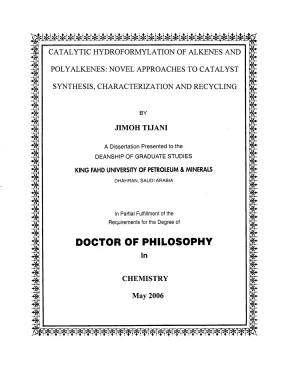
Tải xuống để đọc toàn bộYheiselsel seislslelstel Salsa! se lalelals lal sSai sala lle lalelslaistal sels lalelsleiselse CATALYTIC HYDROFORMYLATION OF ALKENES AND POLYALKENES: NOVEL APPROACHES TO CATALYST SYNTHESIS, CHARACTERIZATION AND RECYCLING s SEBHRDMeu : BY JIMOH TIJANI A Dissertation Presented to the DEANSHIP OF GRADUATE STUDIES | KING FAHD UNIVERSITY OF PETROLEUM & MINERALS DHAHRAN, SAUDI ARABIA In Partial Fulfillment of the Requirements for the Degree of DOCTOR OF PHILOSOPHY In CHEMISTRY May 2006 ©) be, Xaannnnam SERS PEEa y UMI Number: 3242245 INFORMATION TO USERS The quality of this reproduction is dependent upon the quality of the copy submitted. Broken or indistinct print, colored or poor quality illustrations and photographs, print bleed-through, substandard margins, and improper alignment can adversely affect reproduction. In the unlikely event that the author did not send a complete manuscript and there are missing pages, these will be noted. Also, if unauthorized copyright material had to be removed, a note will indicate the deletion.
® UMI UMI Microform 3242245 Copyright 2007 by ProQuest Information and Learning Company. All rights reserved. This microform edition is protected against unauthorized copying under Title 17, United States Code. ProQuest Information and Learning Company 300 North Zeeb Road P.
Box 1346 Ann Arbor, MI 48106-1346 KING FAHD UNIVERSITY OF PETROLEUM AND MINERALS DHAHRAN 31261, SAUDI ARABIA DEANSHIP OF GRADUATE STUDIES This dissertation, written by Mr. JIMOH TIJANI under the direction of his dissertation advisor and approved by his dissertation committee, has been presented to and accepted by the Dean of Graduate Studies, in partial fulfillment of the requirements for the degree of DOCTOR OF PHILOSOPHY IN CHEMISTRY. Dissertation Committee Lee Prof. Ali Member Dr.
Zaki Shaker Seddigi _<7 s__ Department Chairman T—— Dr. Mohammed Fettouhi € +) Member _€ = 22el Dr. Mohammad Abdulaziz Al-Ohali aS + Dean of Graduate Studies Dr. Abu-Sharkh | Member an 7 [.
Date: S10 200 é DEDICATED TO MY WIFE & CHILDREN ili ACKNOWLEDGMENT Praise be to Allah Almighty, The all Knowing. Blessing and peace be upon our leader Muhammad, his family, his companions, and those that follow his guidance until the last day. I wish to express my sincere appreciation to my thesis advisor Prof. Bassam El Ali.
The completion of this work is credited to his tireless support and priceless ideas. I wish to also thank my dissertation committee members, Dr. Al-Arfaj and Dr. Abu-Sharkh for their constructive contribution toward the success of the work and Dr.
El-Ghannam whom I’m indebted to for his sincere help and un-quantifiable support. Also, I would like to thank Dr. Sidiggi, and Dr. Al-Thukair present and previous chairmen of the department, for their moral support.
My special thanks also go to all faculty members, for their support in one way or another, especially Dr. Perzanowski for his valuable advice in NMR. I wish to acknowledge the technical support of all departmental staff members especially, M. Al-Gushairi, Saleem, Baig, Ismail, I.
My sincere appreciation to the following brothers for their kindness and encouragement in the course of the work Dr. Yunus, Bashir, Dr. Abdulkarim, Ali, Dr. Shazali, Ma’az, Sa’id, Abdulhamid, Jarudi, Dr.
Azhahrani, Rami, and Ya’u etc. I am grateful to my mum, wife, children, brothers, sisters and friends for their love and encouragement. Finally, my deep recognition to King Fahd University of Petroleum & Minerals, for providing the sponsorship and the material support for the project. iv TABLE OF CONTENTS Contents Page List of Figures xii List of Tables XVI Abstract (English) XIX Abstract (Arabic) XX CHAPTER 1 1.0 Introduction and literature overview 1.1 Introduction to Hydroformylation 1.
Background on hydroformylation 1.3 Overview of the existing recycling concepts 1.1 Water-soluble ligands 1.2 Thermoregualated phase transfer catalysis 1.4 Heterogenized homogeneous catalysis 22 1.4 Hydroformylation of polybutadiene 27 1.0 Soluble Rhodium Catalyzed Homogeneous Hydroformylation of Alkenes 2.2 General procedure for homogenous hydroformylation of alkenes 36 2.3 Results and discussion 36 2.1 Homogeneous Hydroformylation of Aryl Alkenes by rhodium Catalyst 36 2.2 Hydroformylation of Styrene Catalyzed by Rhe(CO)16/HPA-W}2 Effect of the type of and the amount of heteropolyacids 37 2.3 Hydroformylation of Styrene Catalyzed by Rhe(CO)16/HPA-W 12. Effect of Temperature and the type of solvent 39 2.4 Hydroformylation of Styrene Catalyzed by Rhạ¿(CO)¡/HPA-WI¿. Effect of the ratio of CO /H¿ and the reaction time 41 2.5 Hydroformylation of Styrene Catalyzed by Rhe(CO)t¢. Improvement of the reaction time and selectivity 43 2.6 Effect of amount of phosphite ligand on the selectivity and the reaction time 45 2.7 Effect of the Temperature and ligands on the activity and selectivity 47 2.8 Hydroformylation of various Aryl alkenes by Rhạ(CO)¡z/ HPA-W)}2 [or P(OPh)3/CO/H2/THF] 49 2.9 Hydroformylation of various terminal Alkyl alkenes 51 2.10 Hydroformylation of 1-Octene Catalyzed by Rh(CO);(acac)- bulky phosphite (XXII): Effect of Temperature and the type of solvent 53 2.11 Hydroformylation of 1-Octene Catalyzed by Rh(CO)2(acac)- vi XXII: Effect of CO / Hz and the reaction time 56 2.12 Hydroformylation of 1-Octene Catalyzed by Rh(CO)2(acac)- XXII: Effect of amount of Ligand 59 2.13 Hydroformylation of 1-octene: Effect of type of Rhodium and other Ligands 61 2.14 Hydroformylation of 1-Octene Catalyzed by Rh(CO);(acac)- XXII: Effect of different substrates 63 2.0 Soluble Rhodium Catalyzed Biphasic Hydroformylation of Alkenes 72 3.1 Thermomorphic biphasic hydroformylation 73 3.2 Thermoregulated Phase transfer biphasic hydroformylation 74 3.2 General procedure for Thermomorphic biphasic Hydroformylation of Alkenes 76 3.
General procedure for Thermoregualated Phase Transfer Biphasic Hydroformylation of Alkenes 77 3.4 Preparation of N,N-dipolyethylene-substituted- 2-(diphenylphosphino) phenylamine (DPPPA-PEO 77 vii 3.6 Preparation of binaphtyl phosphite polyethylene oxide 79 3.3 Results and discussion 80 3.1 Thermomorphic Biphasic Hydroformylation : Effect of the type of polar solvents 80 3.2 Thermomorphic Biphasic Hydroformylation : Effect of the Rhodium complexes and ligands 83 3.3 Thermomorphic Biphasic Hydroformylation : Effect of the temperature 85 3.4 Thermomorphic Biphasic Hydroformylation : Effect of total pressure (CO:H) = 1:1) 87 3.5 Thermomorphic Biphasic Hydroformylation : Effect of partial pressures CO:H2 89 3.6 Thermomorphic Biphasic, Hydroformylation : Effect of ligand to catalyst ratio 91 3.7 Thermomorphic Biphasic Hydroformylation : Effect of different alkenes 91 3.8 Thermomorphic Biphasic Hydroformylation : Effect of the chain length of alkyl alkenes 95 3.9 Thermomorphic Biphasic Hydroformylation : Recycling of the catalyst 97 3.4 Results and discussion 101 3.1 Thermoregulated phase transfer hydroformylation 101 Vili 3.2 Thermoregulated phase transfer hydroformylation: Catalyst recycling 103 3.3 Thermoregulated phase-separable hydroformylation: Catalyst recycling.0 Supported Rhodium Catalyzed Hydroformylation of Aryl Alkenes 112 4.2 Preparation of MCM-41 114 4.3 Preparation and Characterization of Rhodium (ID) and Rhodium (III) Impregnated with and without heteropolyacids on MCM-41 114 4.4 Synthesis of 1-2% Rh() or Rh(HD/HPA/MCM-41 in methanol (M) or water (W) [Rh32WHPA10MCM-M (M) and [Rh12WHPA10MCM-W (W)] 115 4.5 Synthesis of 5 % Rh() or RhdID/HPA/MCM-41 in ethanol (E) [Rh32HPA10MCM-E] and [Rh15HPA10WMCM-E] 115 4.6 Impregnation of rhodium (I) or rhodium (IIT) with and without heteropolyacid on MCM-41 116 4.7 Characterization of supported catalyst 118 ix 4.3 *'P CP-MAS NMR 120 4.5 Nitrogen adsorption-desorption isotherms 121 4.8 Procedure for the heterogeneous hydroformylation of styrene 122 4.3 Results and discussion 123 4.1 Rhodium (III) supported catalyst in the heterogeneous hydroformylation of styrene 123 4.2 Rhodium (I) supported catalysts in the heterogeneous hydroformylation of styrene 126 4.3 Hydroformylation of styrene: Effect of amount of water on Rh(III) based catalyst 130 4.4 Hydroformylation of styrene: Effect of temperature with Rh(II) based catalyst 134 4.5 Hydroformylation of styrene: Effect of the type of solvent 134 4.6 Hydroformylation of styrene derivatives by the supported Rh(D) or Rh(HI) catalyst 136 4.7 Effect of the rhodium leaching on the hydroformylation of styrene 139 4.8 Recycling of the supported catalyst in the hydroformylation of styrene 145 4.0 Supported Rhodium Catalyzed Hydroformylation of Aryl Alkenes 154 5.2 General procedure for the heterogeneous hydroformylation 156 5.3 Results and discussion 157 5.1 Hydroformylation of 1-octene catalyzed by Rh-HPW¡¿- MCM-41. Effect of the type of the supported catalyst 157 5.2 Hydroformylation of 1-octene catalyzed by Rh-HPW)2- MCM. Effect of temperature 160 5. Hydroformylation of 1-octene by the supported catalyst.
Effect of the reaction time and temperature 164 5.4 Hydroformylation of 1-octene by supported catalyst. Effect of the type of solvent 167 5.5 Hydroformylation of various terminal alkyl alkenes by Rh®12W10MCM-E 170 5.6 Study of the catalyst recycling 172 5.7 Proposed reaction mechanism 177 5.0 Soluble Rhodium Catalyzed Homogeneous Hydroformylation of polyalkenes 180 6.2 General procedure for homogenous hydroformylation of polyalkenes 182 6.3 Results and discussion 183 6.1 NMR analysis of PBD 183 6.2 NMR analysis of PBD60%Ph hydroformylated products 185 6. NMR analysis of PBD86%1,2Pred hydroformylated products 188 6.4 NMR analysis of PBD72%1,2Pred hydroformylated products 190 6.5 NMR analysis of PBD99%Ph hydroformylated products 190 6.6 IR analysis of hydroformylated products 192 6.7 Effect of reaction parameters 192 6.8 Biphasic hydroformylation of PBD: recycling of the catalyst 197 6.0 Conclusion 200 References 204 Appendices 213 Abbreviations 230 Vita 232 xi List of Figures Figure page Figure 1.1 Recycling concepts Figure 1.2 Thermoregualated Phase Transfer Catalysis lãi Figure 1.3 Thermoregualated Phase-Separable Catalysis 14 Figure 1.4 Diagrammatic representation of Thermomorphic catalysis 17 Figure 2.1 Hydroformylation of styrene Catalyzed by Rh¿(CO)s: Effect of the amount of P(OPh)3 46 Figure 2.2 Hydroformylation of styrene Catalyzed by Rh (CO),(acac)-XXII: Effect of the amount of XXII 60 Figure 2.31 FTIR spectra of the reaction intermediates 68 Figure 2.311 FTIR Spectra of the reaction intermediates 68 Figure 3.1 Thermomorphic biphasic hydroformylation of 1-octene: Effect of temperature 86 Figure 3.2 Thermomorphic Biphasic Hydroformylation of 1-octene: Effect of CO / H2 Total Pressure 88 Figure 3.3 Thermomorphic biphasic hydroformylation of 1-octene: Effect of CO /Hạ Partial Pressure 90 Figure 3.4 Thermomorphic biphasic hydroformylation of 1-octene: Effect of Ligand to Catalyst Ratio 92 Figure 3.5 Thermomorphic biphasic hydroformylation of different Alkyl Alkenes 96 Figure 3.6 Thermomorphic biphasic hydroformylation: Recycling of the Catalyst 98 Xill Figure 3.7 Thermomorphic biphasic hydroformylation: Recycling of the Catalyst 99 Figure 3.8 Thermomorphic biphasic hydroformylation: Recycling of the Catalyst 100 Figure 3.9 FTIR spectra of the reaction intermediates 108 Figure 4.1 FTIR spectra of a) MCM-41 b) HPAW)2 c )HRhCO(PPha); d) MCM-41/HPW21 e) Rh®15W10MCM-E f) Recycled Rh®15W10MCM-E after 6 cycles 119 Figure 4.2 Hydroformylation of styrene: Effect of % loading of HPA-W}2 127 Figure 4.3 Hydroformylation of styrene: Effect of volume of water 133 Figure 4.4 Hydroformylation of styrene: Effect of the Temperature 135 Figure 4.5 Hydroformylation of styrene by Rh32W10MCM-M. Effect of type of Solvent 137 Figure 4.6 Hydroformylation of styrene by Rh“12W10MCM-M.
Effect of type of Solvent 138 Figure 4.7 Hydroformylation of styrene: The Recycling of the Catalyst Rh15Mo10MCM-E 147 Figure 4.8 Hydroformylation of styrene: The Recycling of the Catalyst Rh1S5MCM-E 148 Figure 4.9 Hydroformylation of styrene: The Recycling of the Catalyst Rh15W10MCM-E 149 Figure 4.10 Hydroformylation of styrene: The Recycling of the Catalyst Rh15SiW10MCM-E 150 Xiv Figure 4.11 Hydroformylation of styrene: The Recycling of the Catalyst Rh35W10MCM-E 151 Figure 5.1 Hydroformylation of 1-octene by Rh32W10MCM-M. Effect of temperature 161 Figure 5.2 Hydroformylation of 1-octene by Rh?12W10MCM-M. Effect of temperature 162 Figure 5.3 Hydroformylation of 1-octene by Rh?12W10MCM-M. Effect of temperature 163 Figure 5.4 Hydroformylation of 1-octene by Rh32W10MCM-M.
Effect of type of solvent 168 Figure 5.5 Hydroformylation of 1-octene by Rh?12W10MCM-M. Effect of type of solvent 169 Figure 5.6 X-ray diffraction patterns of recycled supported catalyst 176 Figure 6.1 A) 'NMR of PBD60%Ph B) 'NMR of PBD99%Ph 184 Figure 6.2 A) 'NMR of partially hydroformylated PBD60%Ph B) 'NMR of PBD60%Ph 187 Figure 6.3 A) 'NMR of partially hydroformylated PBD86%1,2-Pred B) 'NMR of PBD86%1,2-Pred 189 Figure 6.4 A) 'NMR of partially hydroformylated PBD72%1,4-Pred B) NMR of PBD72%1,4-Pred 191 Figure 6.5 A) IR spectrum of partially hydroformylated PBD72%1,4-Pred B) IR spectrum of PBD72%1,4-Pred 193 XV List of Tables Table page Table 2.1 Hydroformylation of styrene catalyzed by Rhe(CO)16/HPA-W) 2: Effect of amount and type of the heteropolyacids 38 Table 2.2 Hydroformylation of styrene catalyzed by Rhg(CO)16/HPA-W) 2: Effect of temperature and type of solvent 40 Table 2.3 Hydroformylation of styrene catalyzed by Rhg(CO)16/HPA-W 12: Effect of CO/Hp pressure and the reaction time 42 Table 2.4 Hydroformylation of styrene catalyzed by Rhg(CO)16/HPA-W 12: Effect of temperature 44 Table 2.5 Hydroformylation of styrene catalyzed by Rhg(CO)16/P(OPh)s3: Effect of temperature and type of ligand 48 Table 2.
Nội dung được bảo vệ bản quyền — Tải xuống đầy đủ
Trích dẫn luận án này
Jimoh Tijani (2006). Hydroformylation xúc tác của alkene: tổng hợp và tái chế xúc tác [Luận án tiến sĩ, King Fahd University of Petroleum & Minerals]. LuanAn.net. https://luanan.net/hoa-hoc/hoa-huu-co/hydroformylation-xuc-tac-alkene-polyalkene-luan-an-tien-si
Câu hỏi thường gặp
Luận án "Hydroformylation xúc tác của alkene: tổng hợp và tái chế xúc tác" nghiên cứu về vấn đề gì?
Luận án tiến sĩ nghiên cứu hydroformylation xúc tác của alkene và polyalkene. Phát triển phương pháp tổng hợp xúc tác rhodium, đặc tính hóa học và tái chế.
Luận án "Hydroformylation xúc tác của alkene: tổng hợp và tái chế xúc tác" được bảo vệ tại trường nào?
Luận án này được bảo vệ tại King Fahd University of Petroleum & Minerals. Năm bảo vệ: 2006.
Luận án "Hydroformylation xúc tác của alkene: tổng hợp và tái chế xúc tác" thuộc chuyên ngành gì?
Luận án "Hydroformylation xúc tác của alkene: tổng hợp và tái chế xúc tác" thuộc chuyên ngành Chemistry. Danh mục: Hóa Hữu Cơ.
Luận án "Hydroformylation xúc tác của alkene: tổng hợp và tái chế xúc tác" có bao nhiêu trang?
Luận án "Hydroformylation xúc tác của alkene: tổng hợp và tái chế xúc tác" có 253 trang. Bạn có thể xem trước một phần tài liệu ngay trên trang web trước khi tải về.
Cách tải luận án "Hydroformylation xúc tác của alkene: tổng hợp và tái chế xúc tác" về máy như thế nào?
Để tải luận án về máy, bạn nhấn nút "Tải xuống ngay" trên trang này, sau đó hoàn tất thanh toán phí lưu trữ. File sẽ được tải xuống ngay sau khi thanh toán thành công. Hỗ trợ qua Zalo: 0559 297 239.