Unto Perfect Manhood: An Instrumental Case Study of Leadership Formation in an African American Boys Catholic High School - Daniel Ivan MacKinney
Khám phá cách hình thành lãnh đạo cho nam giới Mỹ gốc Phi trong "Unto Perfect Manhood". Nghiên cứu sâu sắc về sự phát triển, thách thức và tiềm năng.
Luan An
Luận án tiến sĩ
Năm xuất bản
Số trang
254
Thời gian đọc
39 phút
Lượt xem
0
Lượt tải
0
Phí lưu trữ
50 Point
Tổng quan nhanh
- Chủ đề:
- Nurturing African American Male Leadership Development
- Số trang:
- 254 trang
- Trường:
- Loyola University Chicago
- Chuyên ngành:
- Curriculum and Instruction
- Tác giả:
- Daniel Ivan MacKinney
- Năm:
- 2010
Tóm tắt nội dung luận án
I.Nurturing African American Male Leadership Development
This section introduces the critical need for leadership formation among African American boys. It highlights the historical context of single-sex education and its potential benefits. The study aims to explore how specific educational environments foster strong leaders. Understanding these mechanisms is vital for future educational strategies. The research addresses a gap in the literature regarding targeted leadership development for this demographic. It emphasizes the importance of specialized programs.
1.1. Context of Single Sex Education
Single-sex education boasts a significant history. It often provides focused developmental environments. These environments cater to specific needs of students. However, this educational format has experienced a decline. This decline limits opportunities for specialized leadership formation. A thorough study of its impact becomes crucial. Understanding its benefits is paramount for educational policy and practice. The traditional model offers unique advantages for youth leadership development.
1.2. Purpose of Leadership Formation Study
This study specifically investigates leadership formation in African American boys. It examines how a single-sex high school environment cultivates leaders. The research aims to identify effective strategies. These strategies can inform contemporary youth leadership development programs. The findings highlight the unique needs of Black boys leadership. The work contributes to a deeper understanding of African American male development. It seeks to empower future generations through informed educational practices.
1.3. Decline of Nurturing Educational Formats
The current educational landscape often overlooks formats truly nurturing leadership. A continued decline in single-sex schools exacerbates this problem. This trend reduces specialized support for African American male development. Effective manhood formation programs face significant challenges. Addressing this decline is vital for youth empowerment (African American). Reversing this trend could unlock greater potential. Tailored educational settings are critical for optimal growth.
II.Foundations for Black Boys Leadership Manhood
This part delves into the theoretical underpinnings and existing literature regarding leadership development for African American boys. It identifies the concerns surrounding at-risk youth and the crucial role of positive mentors. The section also explores various theoretical frameworks that inform the study's approach, including servant-leadership and self-efficacy. It highlights the proven success of single-sex schools, particularly for minority students, in fostering both academic achievement and leadership qualities. This provides a strong rationale for the research.
2.1. Addressing At Risk Youth Concerns
Many African American boys face unique societal challenges. They are often unfairly labeled as 'at-risk' or disadvantaged. Positive mentors and strong role models are essential for their success. This study explores educational formats providing such critical support. It emphasizes the need for targeted interventions. These interventions contribute significantly to positive masculinity (African American). Nurturing environments mitigate negative influences. Structured programs guide personal growth effectively.
2.2. Theoretical Frameworks Guiding Research
Several robust theories underpin this research. Institutional characteristics profoundly influence student post-baccalaureate success. Self-efficacy behavior correlates strongly with the presence of positive role models. Servant-leadership principles guide the school's ethos investigated here. These frameworks explain effective leadership development. They offer deep insights into character education (African American boys). A multi-faceted theoretical lens strengthens research findings. Understanding these theories informs practical application.
2.3. Benefits of Single Sex Education
Single-sex schools demonstrate clear evidence of student success. This includes robust leadership development. Men's colleges and boys' schools show positive academic and personal outcomes. Evidence is particularly strong for minority students. This educational format can be crucial for identity formation (Black males). Such schools often provide structured rites of passage (male youth). They cultivate an environment conducive to holistic growth. The benefits extend beyond academics into character development.
III.Investigating Youth Leadership Development Programs
The methodology section details the research design and execution. An instrumental case study approach was chosen for its ability to provide in-depth understanding of a specific phenomenon. The selection process for the case study school is outlined, emphasizing its relevance to African American male development. This section also describes the data generation tools and procedures employed to ensure validity and reliability of the findings. The rigorous methodology supports the study's conclusions.
3.1. Research Design Instrumental Case Study
An instrumental case study approach was utilized. This design allows for in-depth exploration. It focuses on a specific instance to understand a broader phenomenon. The method provides rich, qualitative data. It illuminates the nuances of youth leadership development. The design justifies the chosen research questions. This approach offers detailed insights into complex social processes. It is ideal for exploring context-dependent issues.
3.2. Case Selection Process and Context
The study selected an African American boys' Catholic high school. This institution serves as the bounded case for the research. Its specific context is crucial for understanding the findings. The school's unique environment allows for detailed observation. This selection ensures relevance to Black boys leadership. It provides a focused lens on manhood formation programs. The case offers a rich environment for exploring leadership dynamics.
3.3. Data Generation Tools and Procedures
Data was generated through various robust tools. Interviews provided student, faculty, and administration perspectives. Observations captured daily interactions and the overall school culture. Document analysis supplemented other data sources. Procedures ensured both validity and reliability of findings. This multi-faceted approach gathered comprehensive insights. It informed understanding of character education (African American boys). Careful data collection strengthened the study's conclusions.
IV.Defining Leadership for African American Youth
This section presents the core findings regarding how leadership is defined and cultivated within the studied school environment. It highlights the comprehensive understanding of leadership, moving beyond mere authority to encompass personal growth and moral values. The concepts of 'perfect manhood,' service, character, perseverance, and wisdom are explored as foundational elements. These definitions directly contribute to positive masculinity (African American) and holistic development.
4.1. Leadership as Unto Perfect Manhood
The school defines leadership profoundly. It aligns with the concept of 'perfect manhood.' This definition emphasizes holistic personal development. It goes beyond mere authority or position. It signifies deep personal growth and unwavering responsibility. This vision profoundly shapes identity formation (Black males). It offers a clear pathway for youth leadership development. This ethos guides every aspect of student life.
4.2. Leadership as Service and Character
Leadership at the school inherently involves service. It means active contribution to the wider community. Strong character and moral values are paramount. Being a 'family man' is an essential element of this definition. These traits build positive masculinity (African American). They are instilled through focused character education (African American boys). Service and character form the bedrock of true leadership. These principles foster responsible community members.
4.3. Leadership as Perseverance and Wisdom
Leaders demonstrate unwavering perseverance. They overcome challenges with remarkable resilience. Wisdom and foresight are also key attributes. These qualities enable informed, ethical decision-making. Success often comes through sustained effort and determination. These elements empower youth empowerment (African American) within their community. The development of wisdom guides students towards impactful leadership. Grit is celebrated as a pathway to achievement.
V.Impact of Single Sex Schools on Black Male Identity
This final section synthesizes the environmental and institutional factors that contribute to leadership formation and positive identity in African American boys. It highlights the nurturing environment provided by single-sex schools, the crucial role of mentors, and the deliberate cultivation of positive masculinity. The findings underscore how such specialized settings facilitate African American male development and prepare students for responsible adulthood through structured programs akin to rites of passage (male youth).
5.1. Nurturing Environment for Leadership
The school environment actively encourages leadership qualities. Specific institutional factors contribute significantly to this. A supportive atmosphere fosters student confidence and growth. Academic success is closely linked to leadership development within this context. This setting provides tailored, focused support. It directly addresses the unique developmental needs of African American male development. The environment is engineered for optimal growth.
5.2. Role of Mentors and Role Models
Mentors play a critical, foundational role. Teachers, administrators, and older students serve as positive examples. Positive role models are abundant and accessible. They guide students towards the ideal of 'perfect manhood.' This mentoring Black youth is fundamental to their progress. It shapes their understanding of leadership and personal responsibility. Strong role models provide clear pathways to success.
5.3. Fostering Positive Masculinity
The school deliberately cultivates positive masculinity (African American). It actively counters negative societal stereotypes. It emphasizes strength, unwavering responsibility, and community service. This approach fosters a strong, healthy identity formation (Black males). Such programs often incorporate elements similar to rites of passage (male youth). They prepare boys for responsible adulthood effectively. The goal is well-rounded, contributing members of society.
Mục lục chi tiết luận án
Tải xuống file đầy đủ để xem toàn bộ nội dung
Tải đầy đủ (254 trang)Trích đoạn nội dung luận án
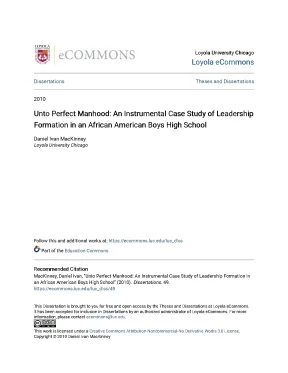
Tải xuống để đọc toàn bộLoyola University Chicago Loyola eCommons Dissertations Theses and Dissertations 2010 Unto Perfect Manhood: An Instrumental Case Study of Leadership Formation in an African American Boys High School Daniel Ivan MacKinney Loyola University Chicago Follow this and additional works at: https://ecommons.edu/luc_diss Part of the Education Commons Recommended Citation MacKinney, Daniel Ivan, "Unto Perfect Manhood: An Instrumental Case Study of Leadership Formation in an African American Boys High School" (2010).edu/luc_diss/49 This Dissertation is brought to you for free and open access by the Theses and Dissertations at Loyola eCommons. It has been accepted for inclusion in Dissertations by an authorized administrator of Loyola eCommons. For more information, please contact ecommons@luc. This work is licensed under a Creative Commons Attribution-Noncommercial-No Derivative Works 3.
Copyright © 2010 Daniel Ivan MacKinney LOYOLA UNIVERSITY CHICAGO UNTO PERFECT MANHOOD: AN INSTRUMENTAL CASE STUDY OF LEADERSHIP FORMATION IN AN AFRICAN AMERICAN BOYS CATHOLIC HIGH SCHOOL A DISSERTATION SUBMITTED TO THE FACULTY OF THE GRADUATE SCHOOL OF EDUCATION IN CANDIDACY FOR THE DEGREE OF DOCTOR OF EDUCATION PROGRAM IN CURRICULUM AND INSTRUCTION BY DANIEL IVAN MACKINNEY CHICAGO, ILLINOIS MAY 2010 Copyright by Daniel MacKinney, 2010 All rights reserved. ACKNOWLEDGMENTS The completion of this work would not have been possible without the help and support of many people. First of all I would like to express my appreciation to my wife for her patience and loving support throughout this project. Secondly I would like to thank my dissertation committee chair, Dr.
David Ensminger, and the other members of my committee, Dr. Leanne Kallemeyn and Dr. Mark Senter for the many hours they spent reading and listening as well as the time they spent giving me guidance and support. Each one was very helpful and patient as they counseled me.
Finally I would like to express how very grateful I am to the administration, faculty, and students of Assisi Franciscan High School. Their assistance and cooperation throughout the study was invaluable. May God continue to bless the work that they do there. iii DEDICATION This dissertation is dedicated to my parents David and Betty Lou MacKinney for their loving guidance through the years, to my wife, Marilynn, who is my greatest joy and a constant source of serenity, beauty, stability, and great cookies.
It is her love, patience and faith that have held the family together through many difficult times. Above all this is dedicated to the Lord Jesus Christ, the author and finisher of our faith and the one who calls us unto perfect manhood. TABLE OF CONTENTS ACKNOWLEDGMENTS iii ABSTRACT viii CHAPTER ONE: INTRODUCTION 1 Background of Single-Sex Education 9 Current State of Single-Sex Schools 12 The Problem: Decline of an Educational Format that Nurtures Leadership Formation 13 The Importance and Purpose of this Study 14 The Need for a Study of the Impact of Single-Sex Education 16 A Brief Overview of the Research Method 17 Research Questions 19 Theoretical Framework 20 Contributions and Limitations of this Study 24 CHAPTER TWO: LITERATURE REVIEW 26 The Concern: At-Risk and Disadvantaged Boys 26 The Goal: Providing Positive Mentors and Role Models for At-Risk Boys 30 The Need: An Educational Format that Nurtures Success and Leadership Formation 34 Theoretical Framework Part I: Institutional Characteristics as a Means to Explain Student Post Baccalaureate Success 37 Theoretical Framework II: The Correlation Between Self-Efficacy Behavior and Role Models 40 Theoretical Framework III: Servant-Leadership 42 Association Between Single-Sex Schools and Success and Leadership in the Literature 45 Women’s Colleges 46 Men’s Colleges 51 Girls’ Schools 54 Boys’ Schools 59 Evidence of Success with Minorities 62 Why Gender Matters 66 Ambiguous and Negative Findings 72 Summary of the Literature Review 77 Rationale for this Study 79 CHAPTER THREE: METHODOLOGY 81 Brief Overview of the Purpose of Study 81 Research Questions 83 Research Design, Including Justification for the Methods 83 Case Selection Process 85 v Description of the Case, Including How the Case and Context are Bounded 86 Data Generation Tools 92 Procedures for Doing Data Generation 95 Ensuring Validity 99 Data Analysis 101 Description of the Final Report—Plan for the Organization and Format of the Final Report 103 Strengths and Limitations of the Study 104 CHAPTER FOUR: RESULTS 108 How is Leadership Defined at this School? 109 Definition 1: Leadership and Unto Perfect Manhood 110 Definition 2: Leadership as Service 114 Definition 3: Leadership as Character and Moral Values 118 Family Man: An Essential Element of Character 122 Definition 4: Leadership as Success Through Perseverance 123 Definition 5: Leadership as Wisdom and Foresight 126 Summary of the Definition of Leadership at Assisi 127 What Environmental or Institutional Factors Encourage or Nurture Leadership Development? 129 Institutional Factor 1: The Number of Positive Male Role Models 130 How do the Different Role Models Impact Leadership Development at Assisi? 136 How the Religious Role Models Impact Leadership Formation 137 How the Faculty Role Models Impact Leadership Formation 138 How the Student and Alumni Role Models Impact Leadership Formation 141 How the Role Models in the Curriculum Impact Leadership Formation 144 Summary of How Leadership is Modeled at Assisi 145 Institutional Factor 2: The Values Taught and Modeled 146 Institutional Factor 3: High Expectations and a Strong Academic Environment 151 Institutional Factor 4: The Single-Sex Environment 154 Institutional Factor 5: Small School/Family Environment 158 Institutional Factor 6: An All African American School 162 Summary of Institutional Factors that Encourage or Nurture Leadership Development 163 To What Extent do Students and Graduates Exhibit Leadership? 164 Evidence That Graduates Exhibit Leadership Beyond Assisi 168 Summary of the Extent to Which Students and Graduates Exhibit Leadership 171 CHAPTER V: DISCUSSION AND CONCLUSIONS 173 The Problem and Purpose of this Study 173 vi The Case and Theoretical Framework 174 Discussion of Findings 177 Conclusions 180 Alternative Explanations 187 Implications of this Study 190 Legal Ramifications 192 Limitations and Recommendations 193 APPENDIX A: STUDENT INTERVIEW QUESTIONS 195 APPENDIX B: FACULTY AND ADMINISTRATION INTERVIEW QUESTIONS 198 APPENDIX C: PARENT INTERVIEW QUESTIONS 200 APPENDIX D: ALUMNI INTERVIEW QUESTIONS 203 APPENDIX E: OBSERVATION PROTOCOL 206 APPENDIX F1: STUDENT LEADERSHIP SURVEY 211 APPENDIX F2: RESULTS OF STUDENT SURVEY PRIORITIZED BY STRONGEST TO WEAKEST ATTRIBUTES 214 APPENDIX G: NOTABLE AFRICAN AMERICAN LEADERS WHO ARE GRADUATES OF SINGLE-SEX SCHOOLS 216 APPENDIX H: NOTABLE WOMEN LEADERS WHO ARE GRADUATES OF SINGLE-SEX SCHOOLS 218 APPENDIX I: FACULTY SURVEY: SINGLE-SEX V COED GRADUATES 220 APPENDIX J: RESULTS OF FACULTY SURVEY USING CHI SQUARE 222 APPENDIX K: QUALITIES OF SUCCESSFUL LEADERS FOUND IN THREE STUDIES ON LEADERSHIP 224 APPENDIX L: AFRICAN AMERICAN MANHOOD PLEDGE 226 APPENDIX M: ASSISI FRANCISCAN HIGH SCHOOL PROFILE 228 REFERENCES 231 VITA 243 vii ABSTRACT This qualitative study investigates the influence of single-sex education on leadership formation at an all boys, urban Catholic high school where a majority of the students come from disadvantaged backgrounds. The researcher has found an association between graduation from a single-sex school and leadership attainment.
In order to understand what it is about a single-sex education that might nurture leadership development the author completed an instrumental case study of the school seeking to identify those elements that might nurture leadership formation. The theoretical framework for this study is based on the research of Wolf-Wendel (1998) who relies on institutional characteristics as one means to explain students’ post baccalaureate success, Bandura (1997) who identified the influence of role models on self-efficacy behavior, and Greenleaf (1977) who contends that the most effective leaders are servant-leaders. The author identified six environmental or institutional factors that encouraged or nurtured leadership development. They were the number of positive male role models, the values taught and modeled, the high expectations and strong academic environment, the single-sex environment, the small school/family environment and the all African American environment.
viii CHAPTER ONE INTRODUCTION Please allow this introduction to include a personal journey of discovery to explain some of the thought and experiences that led to this dissertation topic as well as the need for it. I entered my doctoral studies with no particular intention other than to acquire a position at a college or university that would allow me to help aspiring students prepare for a career in education, a career that I have enjoyed immensely. About the same time as I was preparing for doctoral studies I read a book by the late Senator Daniel Moynihan (1996), considered an astute observer of society and a competent policy analyst. In one chapter of the book Moynihan addressed the problem of at-risk and disadvantaged boys and it struck me both profoundly and deeply.
Suddenly I had a cause, an inspired motivation to attempt to find a way, through education, to help those boys of whom Moynihan spoke with such passion. At the beginning of my studies I happened across another book, this one regarding the advantages of girls’ schools and single-sex education (Salomone, 2003). I had up to that time attended only coed schools and universities and had taught at a coed high school rather happily for over 30 years. Beyond knowing a few guys who had attended boys’ high schools I had never discussed nor considered such schools to be of any particular advantage.
On the contrary, if I had ever thought of them at all it was to think of them as dreary places too full of testosterone and void of those charms and gifts that males tend to 1 2 find so attractive in females, but are too many to list within the limits of this study. Intrigued by this first article on single-sex education I began to read more on the subject and to discuss the merits of single-sex education with graduates of such schools. During this time of informal investigation I discovered two things; one was that the graduates of single-sex schools consistently spoke very highly of the experience with no remorse about missing the opposite sex during that time. The second discovery, mostly from anecdotal evidence, was that there seemed to be a rather strong association between having graduated from a single-sex school and being in a position of leadership.
This discovery piqued my interest. Believing that leadership skills such as accepting challenges, commitment, communication, goal setting, perseverance, and vision (Kouzes & Pozner, 2000; Locke, Kirkpatrick, Wheeler, Schneider, 1991) would be helpful to anyone, especially disadvantaged and at-risk boys, I began to wonder if single-sex education might be one way of helping such boys lead more positive and fulfilling lives, and less likely to turn to self-destructive behavior such as drugs and gang activity that so many of them tend to do (McLanahan & Sandefur, 1994; Mortenson, 2006; Moynihan, 1996). My feeling was that I had stumbled upon something that might be of great value, something that might be more than a little help to at-risk and disadvantaged boys. This led to more formal investigation and eventually to the topic of this study, the impact on leadership development of an inner city boys’ high school with a significant number of disadvantaged and at-risk boys.
3 I am aware that the excitement and enthusiasm of a discovery, of an “aha!” experience may lead me to slant the evidence and be somewhat biased. I will attempt to guard against that and present the evidence as it falls. We are aware that much has been written by writers with a cause or researchers with an agenda. If the preponderance of the evidence in this study favors single-sex education it is because that is what the evidence has lead me to believe, and not some preconceived notion of my own.
The fact that I recently completed my sixth decade of life, and a long career in public education should also help temper my excitement. I do not believe that there is a “silver bullet” or any easy answer to difficult problems. The purpose of this investigation is to explore one educational format that might be of help to children in need of it. Continuing my investigation of single-sex education I came across the lead story of the October 12, 2007 issue of Newsweek magazine.
Nội dung được bảo vệ bản quyền — Tải xuống đầy đủ
Trích dẫn luận án này
Daniel Ivan MacKinney (2010). Unto Perfect Manhood: Leadership Formation in African American Boys [Luận án tiến sĩ, Loyola University Chicago]. LuanAn.net. https://luanan.net/giao-duc-hoc/tam-ly-hoc-giao-duc/unto-perfect-manhood-an-instrumental-case-study-of-leadership-formation
Câu hỏi thường gặp
Luận án "Unto Perfect Manhood: Leadership Formation in African American Boys" nghiên cứu về vấn đề gì?
Khám phá cách hình thành lãnh đạo cho nam giới Mỹ gốc Phi trong "Unto Perfect Manhood". Nghiên cứu sâu sắc về sự phát triển, thách thức và tiềm năng.
Luận án "Unto Perfect Manhood: Leadership Formation in African American Boys" được bảo vệ tại trường nào?
Luận án này được bảo vệ tại Loyola University Chicago. Năm bảo vệ: 2010.
Luận án "Unto Perfect Manhood: Leadership Formation in African American Boys" thuộc chuyên ngành gì?
Luận án "Unto Perfect Manhood: Leadership Formation in African American Boys" thuộc chuyên ngành Curriculum and Instruction. Danh mục: Tâm Lý Học Giáo Dục.
Luận án "Unto Perfect Manhood: Leadership Formation in African American Boys" có bao nhiêu trang?
Luận án "Unto Perfect Manhood: Leadership Formation in African American Boys" có 254 trang. Bạn có thể xem trước một phần tài liệu ngay trên trang web trước khi tải về.
Cách tải luận án "Unto Perfect Manhood: Leadership Formation in African American Boys" về máy như thế nào?
Để tải luận án về máy, bạn nhấn nút "Tải xuống ngay" trên trang này, sau đó hoàn tất thanh toán phí lưu trữ. File sẽ được tải xuống ngay sau khi thanh toán thành công. Hỗ trợ qua Zalo: 0559 297 239.