Tác giả Lê Thị Tuyết Hạnh - Nghiên cứu trí thông minh đa dạng và chiến lược học từ vựng tiếng Anh
Luận văn: Đa trí năng & học từ vựng tiếng Anh cho SV đại học. Chiến thuật hiệu quả, ứng dụng thực tế.
Đại học Ngoại ngữ Huế
Lý thuyết và phương pháp giảng dạy tiếng Anh
Luan An
Luận án tiến sĩ
Năm xuất bản
Số trang
196
Thời gian đọc
30 phút
Lượt xem
0
Lượt tải
0
Phí lưu trữ
50 Point
Tổng quan nhanh
- Chủ đề:
- 1. Nghiên cứu Trí Thông Minh Đa Dạng & Học Từ Vựng EFL
- Số trang:
- 196 trang
- Trường:
- Đại học Ngoại ngữ Huế
- Chuyên ngành:
- Lý thuyết và phương pháp giảng dạy tiếng Anh
- Tác giả:
- Lê Thị Tuyết Hạnh
- Năm:
- 2018
Tóm tắt nội dung luận án
I. Nghiên cứu Trí Thông Minh Đa Dạng Học Từ Vựng EFL
Nghiên cứu này khám phá mối quan hệ giữa Trí thông minh đa dạng (MI) và Chiến lược học từ vựng (VLS) của sinh viên đại học tiếng Anh như một ngoại ngữ (EFL). Mục tiêu tìm hiểu cách sinh viên khám phá, ghi nhớ và thực hành từ mới. Đồng thời, nghiên cứu phân tích sự tương quan giữa điểm MI và việc sử dụng VLS. Tổng cộng 213 sinh viên đại học EFL tham gia. Đây là một nỗ lực để cung cấp cái nhìn sâu sắc về "Lý thuyết đa trí tuệ Gardner" và ảnh hưởng của nó đến "Phát triển ngôn ngữ tiếng Anh". Kết quả hỗ trợ việc phát triển "Giáo dục cá nhân hóa" trong môi trường học thuật.
1.1. Mục tiêu nghiên cứu chính
Nghiên cứu đặt mục tiêu kép. Đầu tiên, khảo sát việc sử dụng các chiến lược học từ vựng của sinh viên EFL. Việc này bao gồm cách họ tìm từ, ghi nhớ từ, và thực hành từ mới. Thứ hai, xác định mối liên hệ giữa các loại hình trí thông minh đa dạng của sinh viên và tần suất sử dụng các chiến lược học từ vựng của họ. Mục tiêu này nhấn mạnh tầm quan trọng của "Đánh giá trí thông minh" trong việc hiểu "Phong cách học tập" của sinh viên. Phân tích này đóng góp vào "Tối ưu hóa học tập" ngôn ngữ.
1.2. Đối tượng và phương pháp thu thập dữ liệu
213 sinh viên đại học EFL tham gia vào nghiên cứu. Giai đoạn định lượng sử dụng bảng câu hỏi VLS của Schmitt (1997) và khảo sát Trí thông minh đa dạng của McKenzie (1999). Đây là các công cụ nghiên cứu chính. Giai đoạn định tính thu thập dữ liệu từ 35 người viết nhật ký và 65 người phỏng vấn. Các dữ liệu được thu thập từ nhật ký, phỏng vấn và bảng câu hỏi. Các phương pháp này đảm bảo một cái nhìn toàn diện về "Chiến lược ghi nhớ từ vựng" và "Năng lực ngôn ngữ" của sinh viên.
II. Chiến Lược Học Từ Vựng Tiếng Anh Sinh Viên Đại Học
Sinh viên đại học EFL sử dụng nhiều "Chiến lược ghi nhớ từ vựng" khác nhau. Các chiến lược này được phân loại theo cách khám phá, ghi nhớ và thực hành từ mới. Việc sử dụng từ điển song ngữ là chiến lược được báo cáo thường xuyên nhất. Sinh viên cũng sử dụng các "Kỹ thuật học từ vựng" khác. Các phương pháp này cho thấy sinh viên chủ động trong quá trình "Phát triển ngôn ngữ tiếng Anh" của mình. Nghiên cứu cung cấp thông tin chi tiết về các "Phong cách học tập" chiếm ưu thế.
2.1. Kỹ thuật khám phá từ mới hiệu quả
Việc sử dụng từ điển song ngữ là chiến lược được sử dụng thường xuyên nhất để tìm hiểu từ mới. Sau đó là phân tích các loại từ, đoán nghĩa từ ngữ cảnh văn bản. Hỏi bạn cùng lớp về nghĩa cũng là một phương pháp phổ biến. Điều này cho thấy sự kết hợp giữa kỹ năng tự học và học tập hợp tác. Các "Kỹ thuật học từ vựng" này giúp sinh viên xây dựng vốn từ. Chúng phản ánh nhu cầu cá nhân trong việc tiếp cận thông tin mới. "Năng lực ngôn ngữ" được hỗ trợ bởi các phương pháp đa dạng này.
2.2. Chiến lược ghi nhớ và thực hành từ vựng
Để ghi nhớ từ mới, sinh viên báo cáo tần suất cao trong việc sử dụng các chiến lược liên quan đến âm thanh. Sau đó, họ đặt từ mới vào ngữ cảnh. Các ngữ cảnh bao gồm hội thoại, đoạn văn hoặc câu chuyện. Sổ tay từ vựng và danh sách từ cũng được sinh viên đại học ưa chuộng. Đối với việc đánh giá từ mới, cả kết quả định lượng và định tính đều cho thấy việc sử dụng ở mức trung bình. Thực hành tiếp thu từ mới bằng cách làm bài kiểm tra từ vựng là phổ biến. Sách giáo khoa và phương tiện truyền thông là hai nguồn chính để sinh viên mở rộng vốn từ. Điều này chứng tỏ vai trò của tài liệu học tập và các nguồn bên ngoài trong "Tối ưu hóa học tập" từ vựng. Những "Chiến lược ghi nhớ từ vựng" này rất quan trọng.
III. Đánh Giá Trí Thông Minh Đa Dạng Kết Quả Nổi Bật
Trước khi phân tích mối tương quan, nghiên cứu đã xác định các loại hình trí thông minh chiếm ưu thế ở sinh viên. "Lý thuyết đa trí tuệ Gardner" cung cấp một khung lý thuyết cho việc này. Trí tuệ Nội tâm (Intrapersonal intelligence) là loại hình nổi bật nhất trong số những người tham gia. Ngược lại, Trí tuệ Toán học (Mathematical Intelligence) là loại hình được sử dụng ít nhất. Những phát hiện này cung cấp cái nhìn quan trọng về "Phong cách học tập" của sinh viên EFL. Chúng cũng nhấn mạnh sự đa dạng trong "Đánh giá trí thông minh" của một nhóm sinh viên.
3.1. Loại hình trí tuệ ưu thế trong nhóm sinh viên
Trí tuệ Nội tâm được xác định là loại hình trí tuệ nổi bật nhất ở những người tham gia. Loại hình này liên quan đến khả năng tự nhận thức và hiểu bản thân. Ngược lại, Trí tuệ Toán học được ghi nhận là loại hình trí tuệ ít được sử dụng nhất. Sự khác biệt này cho thấy sự đa dạng trong năng lực nhận thức của sinh viên. Nó ảnh hưởng đến "Phong cách học tập" và "Chiến lược ghi nhớ từ vựng" mà họ có thể áp dụng hiệu quả nhất. "Đánh giá trí thông minh" này là một bước quan trọng.
3.2. Mối liên hệ giữa MI và việc sử dụng VLS
Phân tích tương quan Pearson đã được thực hiện để xem xét mối quan hệ tiềm năng giữa các biến. Các phát hiện cho thấy các loại hình trí thông minh khác nhau có tương quan với các loại VLS khác nhau. Điều này chứng tỏ rằng "Lý thuyết đa trí tuệ Gardner" có ứng dụng trực tiếp trong việc hiểu "Phương pháp giảng dạy tiếng Anh". Mối liên hệ này rất quan trọng để phát triển "Giáo dục cá nhân hóa". Nó giúp "Tối ưu hóa học tập" cho từng sinh viên.
IV. Mối Quan Hệ Trí Tuệ Đa Dạng Và Kỹ Thuật Học Từ
Nghiên cứu đã phát hiện ra các mối quan hệ đa dạng giữa Trí thông minh đa dạng và việc sử dụng "Chiến lược ghi nhớ từ vựng". Mối tương quan này bao gồm cả mối quan hệ dương và âm. Điều này cho thấy mỗi loại hình trí tuệ có thể ảnh hưởng đến cách tiếp cận học từ của sinh viên. Các phát hiện này rất quan trọng cho "Giáo dục cá nhân hóa". Chúng giúp giáo viên hiểu rõ hơn "Phong cách học tập" của từng học sinh. Từ đó, họ có thể áp dụng "Phương pháp giảng dạy tiếng Anh" phù hợp.
4.1. Tương quan dương giữa Trí tuệ và VLS hiệu quả
Mối tương quan dương đáng kể nhất được tìm thấy giữa Trí tuệ Âm nhạc (Musical intelligence) và các chiến lược Quyết tâm (Determination - DET) cũng như chiến lược Ghi nhớ (Memory - MEM). Trí tuệ Không gian (Spatial intelligence) cũng có mối quan hệ tích cực với các chiến lược DET. Điều này gợi ý rằng sinh viên có trí tuệ âm nhạc phát triển có thể sử dụng các chiến lược ghi nhớ hiệu quả hơn. Họ cũng có sự kiên trì cao hơn trong việc học từ. Phát hiện này rất có giá trị cho "Tối ưu hóa học tập" và "Kỹ thuật học từ vựng" phù hợp với từng cá nhân. Các giáo viên có thể khuyến khích các hoạt động âm nhạc để nâng cao "Năng lực ngôn ngữ".
4.2. Tương quan âm và không liên quan đến VLS
Nghiên cứu cũng chỉ ra các mối quan hệ tiêu cực. Trí tuệ Tự nhiên (Naturalist intelligence) có mối quan hệ tiêu cực với chiến lược Nhận thức (Cognitive - COG). Trí tuệ Toán học có tương quan tiêu cực với chiến lược Xã hội #2 (Social #2) và COG. Trí tuệ Hiện sinh (Existentialist intelligence) và COG cũng có mối quan hệ tiêu cực. Trí tuệ Vận động (Kinesthetic intelligence) có mối quan hệ tiêu cực với chiến lược Xã hội #1 (Social #1). Trí tuệ Nội tâm có mối quan hệ tiêu cực với Xã hội #1, Xã hội #2 và COG. Đáng ngạc nhiên, Trí tuệ Giao tiếp (Interpersonal) và Ngôn ngữ-Từ vựng (Verbal-linguistic) không có mối liên hệ với bất kỳ loại VLS nào. Các nhóm MI khác nhau cũng có các VLS yêu thích khác nhau. Những phát hiện này có thể định hình lại "Phương pháp giảng dạy tiếng Anh" và hỗ trợ "Giáo dục cá nhân hóa".
V. Hàm Ý Sư Phạm Phương Pháp Giảng Dạy Tiếng Anh
Dựa trên những phát hiện, các hàm ý sư phạm đã được đề xuất cho việc dạy và học từ vựng trong các lớp học EFL. Nghiên cứu này cung cấp cơ sở để phát triển các "Phương pháp giảng dạy tiếng Anh" hiệu quả hơn. Việc hiểu rõ mối quan hệ giữa Trí thông minh đa dạng và các chiến lược học từ vựng là rất quan trọng. Nó giúp giáo viên thiết kế các hoạt động phù hợp với "Phong cách học tập" đa dạng của học sinh. Mục tiêu là "Tối ưu hóa học tập" và cải thiện "Năng lực ngôn ngữ" của sinh viên.
5.1. Ứng dụng kết quả trong lớp học EFL
Các nhà giáo dục có thể sử dụng những phát hiện này để cá nhân hóa việc giảng dạy từ vựng. Giáo viên nên tạo ra các hoạt động học tập đa dạng. Các hoạt động này cần phù hợp với các loại hình trí thông minh khác nhau của học sinh. Ví dụ, đối với sinh viên có trí tuệ âm nhạc cao, việc sử dụng các bài hát hoặc vần điệu để học từ vựng có thể hiệu quả. Đối với sinh viên có trí tuệ không gian mạnh, việc sử dụng sơ đồ tư duy hoặc thẻ ghi nhớ trực quan có thể hữu ích. "Giáo dục cá nhân hóa" là chìa khóa để hỗ trợ tất cả học sinh. "Chiến lược ghi nhớ từ vựng" cần được điều chỉnh linh hoạt.
5.2. Tối ưu hóa học tập cá nhân hóa và phát triển ngôn ngữ
Việc nhận diện và tận dụng các loại hình trí thông minh của sinh viên có thể "Tối ưu hóa học tập". Giáo viên có thể khuyến khích sinh viên tự khám phá các "Phong cách học tập" phù hợp với họ nhất. Điều này không chỉ nâng cao hiệu quả "Kỹ thuật học từ vựng" mà còn thúc đẩy sự tự chủ trong học tập. Các "Phương pháp giảng dạy tiếng Anh" cần tích hợp các hoạt động khuyến khích sự phát triển của nhiều loại hình trí tuệ, đồng thời hỗ trợ "Phát triển ngôn ngữ tiếng Anh" toàn diện. Việc này giúp nâng cao "Năng lực ngôn ngữ" của sinh viên một cách bền vững.
Mục lục chi tiết luận án
Tải xuống file đầy đủ để xem toàn bộ nội dung
Tải đầy đủ (196 trang)Trích đoạn nội dung luận án
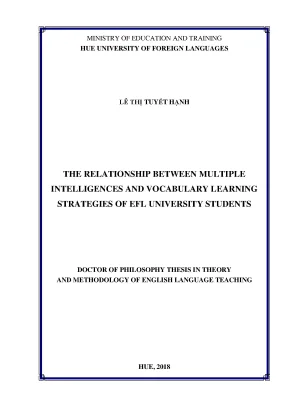
Tải xuống để đọc toàn bộMINISTRY OF EDUCATION AND TRAINING HUE UNIVERSITY OF FOREIGN LANGUAGES LÊ THỊ TUYẾT HẠNH THE RELATIONSHIP BETWEEN MULTIPLE INTELLIGENCES AND VOCABULARY LEARNING STRATEGIES OF EFL UNIVERSITY STUDENTS DOCTOR OF PHILOSOPHY THESIS IN THEORY AND METHODOLOGY OF ENGLISH LANGUAGE TEACHING HUE, 2018 MINISTRY OF EDUCATION AND TRAINING HUE UNIVERSITY OF FOREIGN LANGUAGES LÊ THỊ TUYẾT HẠNH THE RELATIONSHIP BETWEEN MULTIPLE INTELLIGENCES AND VOCABULARY LEARNING STRATEGIES OF EFL UNIVERSITY STUDENTS DOCTOR OF PHILOSOPHY THESIS IN THEORY AND METHODOLOGY OF ENGLISH LANGUAGE TEACHING CODE: 62. Dr LÊ PHẠM HOÀI HƯƠNG HUE, 2018 STATEMENT OF AUTHORSHIP I certify my authorship of the PhD thesis submitted today entitled: “THE RELATIONSHIP BETWEEN MULTIPLE INTELLIGENCES AND VOCABULARY LEARNING STRATEGIES OF EFL UNIVERSITY STUDENTS” for the degree of Doctor of Education, is the result of my own research, except where otherwise acknowledged, and that this thesis has not been submitted for a higher degree at any other institution. To the best of my knowledge, the thesis contains no material previously published or written by other people except where the reference is made in the thesis itself.…, 2018 Author’s signature Lê Thị Tuyết Hạnh i ABSTRACT This study was an attempt to explore EFL university students’ use of vocabulary learning strategies to discover, memorize and practise new words, and then find out the relationship between students’ Multiple Intelligences (MI) scores and their vocabulary learning strategy (VLS) use. To this end, 213 EFL university students were invited to take part in the study.
The quantitative phase utilized Schmitt’s (1997) VLS questionnaire and McKenzie’s (1999) Multiple Intelligences survey as the two main research tools. Besides, the qualitative phase collected data from 35 diarists and 65 interviewees out of the total number of all the participants. The findings from questionnaires, interviews, and students’ diaries revealed that using a bilingual dictionary was reported to be the most frequently used strategy to find out the new word knowledge, followed by analyzing parts of speech, guessing from textual context and asking classmates for meaning. For memorizing new words, participants reported a high frequency in using sound- related strategies, and then put new words in contexts, including conversation, paragraphs or stories.
In addition, vocabulary notebooks and word lists were also preferred by university students. For evaluating new words, both quantitative and qualitative findings showed a medium use of these strategies. The results indicated a receptive practice of new words by doing word tests by students. The study also found that textbooks and media were two main resources on which students relied to expand vocabulary size.
The second aim of the study was to find out the correlation between students’ MI scores and their vocabulary learning strategy use. Before analyzing the correlation, it was found that Intrapersonal intelligence was the most dominant type among participants, while Mathematical Intelligence was the least used one. Pearson correlation was performed to see the potential relation between two variables. The findings showed that different intelligences correlated with different types of VLS use frequency.
The highest significant correlation was found between Musical intelligence and Determination (DET) strategies and the lowest correlation between Spatial Intelligence and DET strategies. Surprisingly, Interpersonal and Verbal-linguistic intelligences had no relationship with any types of VLS. Positive relationships were found between Musical Intelligence and DET, memory (MEM) strategies; Spatial intelligence and DET strategies. Negative relationships were found ii between Naturalist intelligence and Cognitive (COG) strategies; Mathematical intelligence and Social (SOC) #2 and COG strategies; Existentialist intelligence and COG strategies; Kinesthetic intelligence and SOC#1 strategies; Intrapersonal intelligence SOC#1, SOC#2 and COG strategies.
Moreover, it was found that different MI groups have different favorite VLS. On the basis of the findings, pedagogical implications were recommended for vocabulary teaching and learning in EFL classrooms. iii ACKNOWLEDGEMENTS Many people have helped me make this thesis possible. First, I would like to express immense gratitude to my supervisor, Assoc.Dr Le Pham Hoai Huong, who has generously supported my work by giving directions and priceless advice to fuel my continued involvement in the research, and from whom I have learnt a lot for my future research career.
She has always helped me stay on track whenever I was about to change direction. She has also showed a great sense of patience with a busy-with-everything student like me. I would also like to thank Assoc. Dr Ngo Dinh Phuong, Vice-Rector of Vinh University, for introducing me to my supervisor and providing a great number of relating documents since my MA program, which inspired me to do this PhD thesis.
He has supported me from the beginning until the end of my PhD study. My special thanks to Assoc. Dr Tran Van Phuoc, the former Rector of Hue University of Foreign Languages and Assoc.Dr Pham Thi Hong Nhung, Vice- Rector of Hue University of Foreign Languages, and other committee members from Hue University, who gave me many insightful comments and feedback on my three PhD projects. They have always supported PhD students in many ways.
My thanks also to Dr Tran Ba Tien, the former Dean of Foreign Languages Department, and Dr Vu Thi Ha, the former Vice Dean, who gave me the chance and the time to come to the end of this study. Without their support, I am sure that my thesis would not have been completed in time. I would like to express my sincere appreciation to Prof. Dr Tran Dinh Thang and Assoc.
Dr Luu Tien Hung, Dr Le Cao Tinh, who have stayed by my side and empowered me during the program. Special thanks to my two sisters, Dr Truong Thi Dung and Dr Nguyen My Hang, from whom I gained a lot of experience for managing time to complete the thesis. Moreover, I highly appreciate the times they cheered me up when I felt stressed. I am grateful to all the participants who took the time to take part in the questionnaire surveys, interviews, diaries and other activities related to this research.
Without their involvement and assistance, the thesis would not have been possible. I would like to thank my family, who have always provided me with unconditional love and support during my course, and my lovely daughter, Bui Thao My, who offered me time by being independent. My thanks also come to all the teachers who taught me during the PhD program and my students, my friends who helped me in different ways. iv TABLE OF CONTENTS STATEMENT OF AUTHORSHIP.
iv LIST OF ABBREVIATIONS. viii LIST OF TABLES. ix LIST OF FIGURES AND PICTURES. xi CHAPTER 1: INTRODUCTION.
Significance of the study. Structure of the thesis .5 CHAPTER 2: LITERATURE REVIEW. Vocabulary learning strategies. Language learning strategy.
Vocabulary learning strategies. Multiple Intelligences Theory. Concepts of intelligence. Gardner and Multiple Intelligences theory.
Multiple Intelligences Theory and Culture. MI theory in education. English Teaching and Learning in the Vietnamese context. Adoption of MI theory.
Previous studies on MI theory and vocabulary learning strategies. Previous studies on vocabulary learning strategies. MI theory and vocabulary learning. MI Theory and vocabulary learning strategies.
Rationale for the mixed methods approach. Participants’ background and English proficiency. Criteria for sampling. The researcher’s role.
Data collection tools. Data collection procedure. Research reliability and validity .63 CHAPTER 4: FINDINGS AND DISCUSSION. EFL university students’ VLS use.
The relationship between EFL university students’ MI scores and VLS use. 127 CHAPTER 5: CONCLUSIONS AND IMPLICATIONS. Summary of key findings. Limitations of the study.
Implications for vocabulary teaching and learning. Suggestions for further study. 138 APPENDICES APPENDIX A: VOCABULARY LEARNING STRATEGY QUESTIONNAIRE. 151 APPENDIX B: MULTIPLE INTELLIGENCES INVENTORY.
155 APPENDIX C: INTERVIEW QUESTIONS. 160 vi APPENDIX D: A SAMPLE OF FOCUS GROUP INTERVIEW THROUGH FACEBOOK MESSENGER. 162 APPENDIX E: A SAMPLE FROM THE INDIVIDUAL INTERVIEW THROUGH FACEBOOK. 166 APPENDIX F: DIARY KEEPING INSTRUCTION.
168 APPENDIX G: AN EXAMPLE FROM A STUDENT’S DIARY. 169 APPENDIX I: A SAMPLE OF GENERAL INTERVIEW ON FACEBOOK. 171 APPENDIX J : VLS QUESTIONNAIRE CRONBACH’S ALPHA RELIABILITY. 176 APPENDIX K : MI QUESTIONNAIRE CRONBACH’S ALPHA RELIABILITY.
178 APPENDIX L: DESCRIPTIVE STATISTICS OF VLS GROUPS. 179 APPENDIX M: MEAN OF VLS IN MI GROUPS. 181 APPENDIX N: CORRELATION BETWEEN STUDENTS’ MI SCORES AND VLS USE. 183 vii LIST OF ABBREVIATIONS COG Cognitive strategies DET Determination strategies EFL English foreign language ELT English language teaching ESL English second language LLS Language learning strategies MEM Memory strategies MET Metacognitive strategies MI Multiple Intelligences MIDAS Multiple Intelligences Developmental and Assessment Scales MIT Multiple Intelligences Theory SOC Social strategies VLS Vocabulary learning strategies viii LIST OF TABLES Table 2.
Classifying Language Learning Strategies. A taxonomy of kinds of vocabulary learning strategies (Nation, 2001, p. Schmitt’s (1997) VLS taxonomy. Participants’ demographic information.
Number of participants in the second and third groups. Number of VLS in Schmitt’s VLS taxonomy. Pilot testing plan for the study. Number of questions for each type of Intelligence in MIDAS.
Mean and standard deviation of VLS group’s use frequency. VLS in three stages. Mean and standard deviation of Discovery strategies. Mean and standard deviation of mnemonic strategies.
Mean of frequency use of six Memory strategy types. Evaluating strategies used by EFL university students. Most frequently used VLS to discover new words. EFL university students’ most frequently used strategies to memorize new words.
Mean and Standard Deviation of MI. The number of students with their dominant intelligences. Correlation between students’ MI scores and VLS types. The most used and the least used strategies among different MI groups.
Correlation between Naturalist intelligence’s score and VLS use. Naturalist students’ mnemonic strategy use. Correlation between Musical students’ MI profiles and VLS use. Musical students’ examples of learning new words.
Correlation between Mathematical students and VLS use. Mathematical students’ strategy presentation. Correlation between Existentialist students and VLS use. Existentialist students’ reported VLS use.
Correlation between Interpersonal students and VLS use. Correlation between Kinesthetic students and VLS use. Correlation between Linguistic students and VLS use. Linguistic students’ VLS use.
Correlation between Intrapersonal students and VLS use. Correlation between Spatial students and VLS use. Spatial students’ VLS use examples .117 x LIST OF FIGURES AND PICTURES Figure: Figure 3. Data collection procedure.
Data analysis framework. EFL university students’ MI scores. Example from web-based vocabulary learning. Example from K3_20’s diary.
An example from student’s diary. An example of student’s diary. An example of student’s diary. An example of student’s diary .101 xi CHAPTER 1: INTRODUCTION 1.
Rationale Vocabulary plays an indispensable role in language learning and is assumed to be a good indicator of language proficiency (Steahr, 2008). It is also generally believed that if language structures make up the skeleton of language, then it is vocabulary that provides the vital organ and flesh (Harmer, 1997). This is probably one of the reasons why English foreign language (hereafter EFL) vocabulary teaching has become the focus of several studies in EFL teaching and learning for the last thirty years. The growth of interest in vocabulary has also been reflected in many books (Nation, 1990, 2001, 2014; Rebecca, 2017; Schmitt, 1997, 2000).
Although research has demonstrated the key role of vocabulary learning, the practice of EFL vocabulary teaching has not been always responsive to such knowledge. It seems that some teachers have not fully recognized the tremendous communicative advantages of developing an extensive vocabulary. Moreover, vocabulary learning has not been specified as a training program in the Vietnamese tertiary training framework. Vocabulary teaching is usually integrated into other skills, especially in reading, for a limited time.
Nội dung được bảo vệ bản quyền — Tải xuống đầy đủ
Trích dẫn luận án này
Lê Thị Tuyết Hạnh (2018). Nghiên cứu trí thông minh đa dạng và chiến lược học từ vựng tiếng Anh [Luận án tiến sĩ, Đại học Ngoại ngữ Huế]. LuanAn.net. https://luanan.net/giao-duc-hoc/tam-ly-hoc-giao-duc/nghien-cu-tri-thong-minh-da-dan-va-chien-luoc-hoc-tu-vung-tieng-anh
Câu hỏi thường gặp
Luận án "Nghiên cứu trí thông minh đa dạng và chiến lược học từ vựng tiếng Anh" nghiên cứu về vấn đề gì?
Luận văn: Đa trí năng & học từ vựng tiếng Anh cho SV đại học. Chiến thuật hiệu quả, ứng dụng thực tế.
Luận án "Nghiên cứu trí thông minh đa dạng và chiến lược học từ vựng tiếng Anh" được bảo vệ tại trường nào?
Luận án này được bảo vệ tại Đại học Ngoại ngữ Huế. Năm bảo vệ: 2018.
Luận án "Nghiên cứu trí thông minh đa dạng và chiến lược học từ vựng tiếng Anh" thuộc chuyên ngành gì?
Luận án "Nghiên cứu trí thông minh đa dạng và chiến lược học từ vựng tiếng Anh" thuộc chuyên ngành Lý thuyết và phương pháp giảng dạy tiếng Anh. Danh mục: Tâm Lý Học Giáo Dục.
Luận án "Nghiên cứu trí thông minh đa dạng và chiến lược học từ vựng tiếng Anh" có bao nhiêu trang?
Luận án "Nghiên cứu trí thông minh đa dạng và chiến lược học từ vựng tiếng Anh" có 196 trang. Bạn có thể xem trước một phần tài liệu ngay trên trang web trước khi tải về.
Cách tải luận án "Nghiên cứu trí thông minh đa dạng và chiến lược học từ vựng tiếng Anh" về máy như thế nào?
Để tải luận án về máy, bạn nhấn nút "Tải xuống ngay" trên trang này, sau đó hoàn tất thanh toán phí lưu trữ. File sẽ được tải xuống ngay sau khi thanh toán thành công. Hỗ trợ qua Zalo: 0559 297 239.