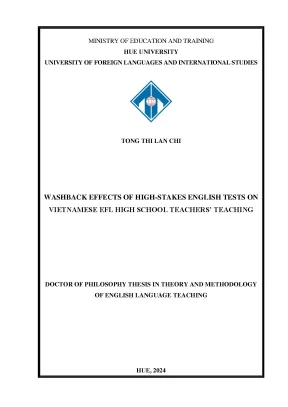
Luận án tiến sĩ: Washback thi tiếng Anh đến dạy học EFL giáo viên THPT Việt Nam
Nghiên cứu tác động ngược của các bài thi tiếng Anh có tính phân loại cao đến phương pháp giảng dạy của giáo viên tiếng Anh THPT Việt Nam.
University of Foreign Languages and International Studies
Luan An
luận án
Năm xuất bản
Số trang
193
Thời gian đọc
29 phút
Lượt xem
5
Lượt tải
0
Phí lưu trữ
50 Point
Tổng quan nhanh
- Chủ đề:
- Tác động Washback: Thi chuẩn hóa và Giáo viên Việt Nam
- Số trang:
- 193 trang
- Trường:
- University of Foreign Languages and International Studies
- Chuyên ngành:
- Theory and Methodology of English Language Teaching
- Tác giả:
- Tong Thi Lan Chi
- Năm:
- 2024
Tóm tắt nội dung luận án
I.Tác động Washback Thi chuẩn hóa và Giáo viên Việt Nam
Nghiên cứu này phân tích sâu sắc tác động washback. Tác động này xuất phát từ các bài thi tiếng Anh chuẩn hóa, đặc biệt là Kỳ thi Tốt nghiệp THPT Quốc gia (NHSGE). Đối tượng nghiên cứu là giáo viên THPT Việt Nam. Thi tiếng Anh chuẩn hóa tạo ra hiệu ứng ngược đáng kể. Hiệu ứng này định hình thực tiễn giảng dạy hàng ngày của giáo viên. Nghiên cứu sử dụng phương pháp hỗn hợp. Nó dựa trên lý thuyết washback để xem xét ảnh hưởng. Ba khía cạnh chính của việc dạy tiếng Anh được khám phá. Đó là nội dung, phương pháp giảng dạy và kỹ thuật đánh giá trong lớp học. Các bài kiểm tra có tính quyết định cao ảnh hưởng mạnh mẽ đến hệ thống giáo dục. Chúng thúc đẩy giáo viên điều chỉnh chiến lược. Mục tiêu là giúp học sinh đạt kết quả tốt trong thi cử. Phát hiện ban đầu cho thấy hiệu ứng washback tiêu cực. Giáo viên thường xuyên điều chỉnh việc dạy để phù hợp yêu cầu bài thi. Việc này có thể làm hạn chế sự sáng tạo và đa dạng trong giảng dạy. Tác động của kiểm tra là rất rõ ràng. Nó chi phối quyết định giảng dạy của giáo viên.
1.1. Mục tiêu Nghiên cứu Washback
Nghiên cứu đặt mục tiêu làm rõ tác động của các kỳ thi chuẩn hóa. Nó tập trung vào Kỳ thi Tốt nghiệp THPT Quốc gia. Nghiên cứu tìm hiểu cách các kỳ thi này ảnh hưởng đến việc giảng dạy tiếng Anh. Phạm vi bao gồm cả nội dung và phương pháp.
1.2. Khái niệm Hiệu ứng Washback
Hiệu ứng washback (hay hiệu ứng ngược) là sự ảnh hưởng của một kỳ thi lên quá trình dạy và học. Trong nghiên cứu này, washback được xem xét từ góc độ giáo viên. Nó thể hiện qua việc điều chỉnh chương trình và kỹ thuật giảng dạy.
1.3. Bối cảnh Thi tiếng Anh chuẩn hóa
Bối cảnh nghiên cứu là hệ thống giáo dục THPT tại Việt Nam. Các bài thi tiếng Anh chuẩn hóa đóng vai trò quan trọng. Chúng quyết định kết quả tốt nghiệp và cơ hội học lên cao. Điều này tạo áp lực lớn lên giáo viên và học sinh.
II.Phương pháp Nghiên cứu Washback và Thi tiếng Anh
Nghiên cứu sử dụng thiết kế nghiên cứu hỗn hợp. Phương pháp này kết hợp cả dữ liệu định lượng và định tính. Việc này cung cấp một cái nhìn toàn diện về hiệu ứng washback. Lý thuyết washback là nền tảng cho việc phân tích. Dữ liệu thu thập từ 58 giáo viên THPT tiếng Anh. Giáo viên đến từ thành phố Buôn Ma Thuột, tỉnh Đắk Lắk. Ba phương pháp chính được sử dụng. Đó là bảng câu hỏi, phỏng vấn bán cấu trúc và tài liệu giảng dạy. Các công cụ này giúp thu thập thông tin đa chiều. Chúng bao gồm quan điểm của giáo viên. Chúng cũng bao gồm thực tiễn giảng dạy của họ. Phân tích dữ liệu định lượng cung cấp các xu hướng tổng thể. Dữ liệu định tính làm rõ các chi tiết. Nó giúp hiểu sâu hơn về lý do và cách thức ảnh hưởng.
2.1. Thiết kế Nghiên cứu Tổng hợp
Thiết kế nghiên cứu kết hợp khảo sát và phỏng vấn. Nó còn bao gồm phân tích tài liệu thực tế. Việc này nhằm mục đích ghi lại các tác động của kiểm tra một cách khách quan. Thiết kế hỗn hợp cho phép so sánh và đối chiếu dữ liệu. Nó giúp củng cố tính xác thực của các phát hiện.
2.2. Dữ liệu Thu thập từ Giáo viên THPT
Dữ liệu được thu thập từ 58 giáo viên tiếng Anh. Họ là giáo viên THPT Việt Nam. Bảng câu hỏi thu thập thông tin định lượng. Phỏng vấn cung cấp cái nhìn sâu sắc. Tài liệu giảng dạy giúp xác nhận thực tiễn.
2.3. Khu vực Nghiên cứu Buôn Ma Thuột
Nghiên cứu được thực hiện tại thành phố Buôn Ma Thuột. Đây là một thành phố lớn thuộc tỉnh Đắk Lắk. Việc lựa chọn khu vực này đảm bảo tính đại diện. Nó cũng cung cấp bối cảnh thực tế cho nghiên cứu.
III.Nội dung Giảng dạy Dạy theo Thi tiếng Anh chuẩn hóa
Kết quả nghiên cứu chỉ ra hiệu ứng washback tiêu cực. Giáo viên thường xuyên điều chỉnh nội dung giảng dạy. Việc này để phù hợp với các tiêu chí của NHSGE. Sự tuân thủ kế hoạch phân phối chương trình rất nghiêm ngặt. Việc này được kết hợp với việc cung cấp tài liệu định hướng thi. Điều này làm nổi bật ảnh hưởng rộng rãi của các bài kiểm tra có tính quyết định cao. Ảnh hưởng này định hình việc ra quyết định về nội dung giảng dạy. Chương trình giảng dạy tiếng Anh trở nên tập trung vào kỳ thi. Các kỹ năng và kiến thức không liên quan trực tiếp đến bài thi có thể bị bỏ qua. Việc dạy theo bài thi trở thành một thực tế phổ biến. Điều này làm hạn chế khả năng phát triển toàn diện của học sinh. Mục tiêu là tối ưu hóa điểm số. Các tài liệu học tập được thiết kế riêng. Chúng tập trung vào cấu trúc và dạng bài của NHSGE.
3.1. Chương trình Giảng dạy tiếng Anh
Chương trình giảng dạy tiếng Anh bị ảnh hưởng mạnh. Giáo viên điều chỉnh để đảm bảo học sinh làm quen cấu trúc đề thi. Các bài học tập trung vào các chủ đề và kỹ năng xuất hiện trong NHSGE. Điều này đảm bảo sự chuẩn bị tốt nhất.
3.2. Ảnh hưởng của Bài thi chuẩn hóa
Bài thi chuẩn hóa tạo áp lực lớn. Nó buộc giáo viên ưu tiên những gì sẽ xuất hiện trong kỳ thi. Các kỹ năng như giao tiếp tự nhiên có thể bị giảm bớt. Thay vào đó là các kỹ năng làm bài kiểm tra.
3.3. Vật liệu Giảng dạy và Định hướng
Giáo viên sử dụng nhiều tài liệu định hướng thi. Các tài liệu này bao gồm bài tập trắc nghiệm và đề thi thử. Mục đích là để học sinh làm quen với định dạng bài thi. Điều này phản ánh rõ nét việc dạy theo bài thi.
IV.Phương pháp Dạy học Ảnh hưởng của Chuẩn hóa kiểm tra
Nghiên cứu cho thấy các phương pháp giảng dạy bị ảnh hưởng rõ rệt. Giáo viên chủ yếu sử dụng phương pháp giảng dạy trực tiếp. Các hoạt động như ôn tập ngữ pháp và trò chơi ngôn ngữ được ưu tiên. Những phương pháp này phản ánh xu hướng điều chỉnh thực tiễn giảng dạy. Mục đích là để phù hợp với định dạng của NHSGE. Việc dạy theo bài thi thúc đẩy sự lặp lại và thực hành. Nó tập trung vào các dạng bài cụ thể. Phát triển kỹ năng tư duy phản biện hoặc giao tiếp tự nhiên có thể bị hạn chế. Đào tạo giáo viên cần xem xét lại. Nó cần cung cấp các phương pháp đa dạng hơn. Điều này giúp giáo viên không chỉ dạy để thi. Giáo viên cần trang bị kiến thức vững chắc. Họ cần có khả năng ứng dụng thực tế.
4.1. Phương pháp Giảng dạy chính
Giảng dạy trực tiếp là phương pháp phổ biến. Giáo viên tập trung vào truyền đạt kiến thức ngữ pháp và từ vựng. Ôn tập cấu trúc ngữ pháp và làm bài tập trắc nghiệm là hoạt động chính.
4.2. Dạy theo Bài thi Xu hướng nổi bật
Xu hướng dạy theo bài thi rất rõ ràng. Giáo viên thiết kế bài giảng sao cho phù hợp với cấu trúc đề thi. Mục tiêu là giúp học sinh làm quen và tối ưu hóa điểm số.
4.3. Phát triển Kỹ năng cho Thi cử
Các hoạt động giảng dạy ưu tiên phát triển kỹ năng làm bài thi. Các trò chơi ngôn ngữ được sử dụng để củng cố ngữ pháp. Phát âm cũng được nhấn mạnh, nhưng chủ yếu trong bối cảnh làm bài tập trắc nghiệm.
V.Đánh giá Năng lực Phản ánh Bài thi THPT Quốc gia
Kỹ thuật đánh giá trong lớp học cũng chịu ảnh hưởng lớn. Các nhiệm vụ đánh giá được điều chỉnh để phản ánh nội dung của NHSGE. Trọng tâm là các kỹ năng từ vựng, ngữ pháp và phát âm. Các bài kiểm tra trong lớp học thường giới hạn ở một số dạng bài nhất định. Ví dụ điển hình là các câu hỏi trắc nghiệm và bài kiểm tra viết ngắn. Việc này chỉ ra tác động tiêu cực của washback. Nó hạn chế sự đa dạng trong đánh giá năng lực tiếng Anh. Học sinh ít được kiểm tra các kỹ năng toàn diện. Các kỹ năng như nghe, nói, đọc, viết trong bối cảnh thực tế ít được chú trọng. Việc này có thể ảnh hưởng đến khả năng giao tiếp thực tế. Nó tạo ra một khoảng cách giữa năng lực thực tế và kết quả thi.
5.1. Kỹ thuật Đánh giá trong Lớp học
Giáo viên sử dụng các dạng bài kiểm tra tương tự NHSGE. Mục đích là để học sinh làm quen với áp lực và định dạng. Các bài kiểm tra thường là trắc nghiệm. Chúng tập trung vào kiến thức ngữ pháp và từ vựng.
5.2. Trọng tâm Đánh giá Từ vựng Ngữ pháp
Đánh giá năng lực tiếng Anh chủ yếu tập trung vào từ vựng và ngữ pháp. Kỹ năng phát âm cũng được kiểm tra. Tuy nhiên, các kỹ năng khác như nghe, nói, viết ít được ưu tiên.
5.3. Các Dạng đề kiểm tra giới hạn
Các dạng đề kiểm tra trong lớp rất hạn chế. Chủ yếu là trắc nghiệm và các bài kiểm tra viết ngắn. Việc này phản ánh sự cần thiết phải chuẩn bị cho kỳ thi. Nó cũng hạn chế sự phát triển toàn diện của học sinh.
Mục lục chi tiết luận án
Tải xuống file đầy đủ để xem toàn bộ nội dung
Tải đầy đủ (193 trang)Nội dung chính
Tổng quan về luận án
Bối cảnh giáo dục ngoại ngữ tại Việt Nam đang trải qua những biến chuyển mang tính bước ngoặt dưới sự điều hành tập trung của Bộ Giáo dục và Đào tạo (MOET). Mặc dù Đề án Ngoại ngữ Quốc gia 2020 (Quyết định 1400/QĐ-TTg) và Chương trình Giáo dục Phổ thông 2018 (Thông tư 32/2018/TT-BGDĐT) đặt trọng tâm vào phương pháp dạy học giao tiếp (Communicative Language Teaching - CLT) và lấy người học làm trung tâm, thực tiễn năng lực giao tiếp của học sinh vẫn tồn tại khoảng cách đáng kể. Dữ liệu thực nghiệm từ các chuyên gia Đề án 2020 chỉ ra rằng 98% học sinh Việt Nam sau 7 năm học tiếng Anh (từ lớp 6 đến lớp 12) không thể sử dụng ngôn ngữ cho giao tiếp cơ bản (Nguyen, 2013). Trong bức tranh đó, Kỳ thi Tốt nghiệp Trung học Phổ thông Quốc gia (National High School Graduation Exam - NHSGE) áp dụng từ năm 2015 đóng vai trò là một kỳ thi chuẩn hóa có tính chất quyết định cao (high-stakes test), phục vụ đồng thời hai mục tiêu: xét tốt nghiệp THPT và xét tuyển đại học.
Khoảng trống nghiên cứu (research gap) cốt lõi xuất phát từ việc phần lớn các công trình nghiên cứu về hiệu ứng dội ngược (washback effects) tại Việt Nam trước đây chỉ tập trung vào giáo dục đại học (Dinh, 2020; Nguyen, 2017; Nguyen & Gu, 2020 với bài thi VSTEP hoặc kỳ thi chuẩn đầu ra), trong khi cấp trung học phổ thông – nơi chịu sự kiểm soát thứ bậc chặt chẽ của Bộ Giáo dục và Đào tạo – lại gần như bị bỏ ngỏ. Công trình nghiên cứu của Nghiên cứu sinh Tống Thị Lan Chi (2024) tại Trường Đại học Ngoại ngữ – Đại học Huế (mã số: 9140111, dưới sự hướng dẫn của PGS.TS. Phạm Thị Hồng Nhung) đã giải quyết triệt để khoảng trống này.
Nghiên cứu được định hướng bởi hai câu hỏi khoa học cụ thể:
- Research Question 1 (RQ1): Những yếu tố thuộc về giáo viên (teacher factors) nào chịu tác động bởi bài thi tiếng Anh NHSGE và các yếu tố bối cảnh liên quan?
- Research Question 2 (RQ2): Bài thi tiếng Anh NHSGE tác động như thế nào đến các khía cạnh khác nhau của hoạt động giảng dạy tiếng Anh (EFL teaching)?
Khung lý thuyết của luận án được xây dựng dựa trên sự tổng hòa các mô hình washback kinh điển: 15 giả thuyết của Alderson & Wall (1993), mô hình tam phân người tham gia - quy trình - sản phẩm của Hughes (1993), mô hình tương tác mở rộng của Bailey (1996), khung chất lượng bài thi của Bachman & Palmer (1996), và đặc biệt là mô hình 3 nhóm yếu tố động cùng 8 khía cạnh giảng dạy của Shih (2009). Luận án xác lập phạm vi khảo sát thực nghiệm trên mẫu nghiên cứu gồm 58 giáo viên tiếng Anh lớp 12 tại thành phố Buôn Ma Thuột (tỉnh Đắk Lắk), kết hợp phân tích phân phối chương trình, giáo án và đề kiểm tra định kỳ trong giai đoạn áp dụng định dạng trắc nghiệm khách quan chuẩn hóa (2015–2022). Ý nghĩa của nghiên cứu thể hiện ở việc lượng hóa và định tính cơ chế "dạy học hướng đề thi" (teaching to the test), vạch rõ sự xung đột giữa chính sách đổi mới sư phạm giao tiếp và áp lực thi cử mang tính sống còn.
Literature Review và Positioning
Nghiên cứu về hiệu ứng dội ngược khởi nguồn từ các cuộc tranh luận học thuật về tính giá trị hệ quả (consequential validity). Messick (1989, 1996) khẳng định washback chỉ thực sự là một thành tố của giá trị bài thi khi các tác động bắt nguồn trực tiếp từ chính bản thân bài thi chứ không phải từ các yếu tố giáo dục nhiễu khác. Ngược lại, Shepard (1993) và Hamp-Lyons (1997, 2000) mở rộng khái niệm này thành "impact" (tác động vĩ mô) bao trùm toàn bộ hệ thống xã hội và giáo dục, trong khi giới hạn "washback" hay "backwash" ở cấp độ vi mô lớp học (Bachman & Palmer, 1996; Wall, 1997). Cheng (1997) định nghĩa washback là: "an intended or unintended (accidental) direction and function of intended curriculum change on aspects of teaching and learning by means of the change of public examinations" (tr. 12).
Về mặt lý thuyết, các tranh luận học thuật xoay quanh tính định hướng (washback direction) và tính cường độ (washback intensity) (Cheng & Watanabe, 2004; Green, 2013; Xu & Liu, 2018). Một trường phái cho rằng bài thi chuẩn hóa có thể tạo hiệu ứng tích cực, thúc đẩy giáo viên bao phủ toàn bộ chương trình và nâng cao động lực học tập (Pan, 2009; Sieber, 2009). Ngược lại, trường phái phê phán chứng minh các kỳ thi high-stakes tạo ra washback tiêu cực nghiêm trọng: làm thu hẹp chương trình học (curriculum narrowing), triệt tiêu tư duy phản biện, gia tăng lo âu và làm sai lệch phương pháp sư phạm (Cizek, 1998; Koretz, 2005; Popham, 2002; Smith & Rottenberg, 1991).
Vị thế của luận án được xác lập rõ nét khi đối chiếu với các công trình quốc tế:
- So sánh với nghiên cứu của Cholis & Rizqi (2018) tại Indonesia về Kỳ thi Tuyển sinh Đại học (EEU): Nghiên cứu tại Indonesia ghi nhận giáo viên điều chỉnh tài liệu và tăng thời lượng chuẩn bị nhưng vẫn duy trì cấu trúc bài học đa dạng. Trong khi đó, luận án của Tống Thị Lan Chi chỉ ra rằng tại Việt Nam, sự kiểm soát phân phối chương trình của Bộ GD&ĐT tạo nên sự biến dạng sâu sắc hơn, biến toàn bộ giờ học thành các phiên luyện mẹo trắc nghiệm.
- So sánh với nghiên cứu của Liauh (2011) tại Đài Loan về kỳ thi chuẩn đầu ra (Exit English Examination): Giáo viên Đài Loan chủ động bổ sung tài liệu ngoại khóa để phát triển kỹ năng tổng hợp. Ngược lại, giáo viên lớp 12 tại Đắk Lắk bổ sung tài liệu hoàn toàn nhằm mục đích mô phỏng các bẫy ngữ pháp và dạng thức câu hỏi trắc nghiệm rời rạc của NHSGE.
- So sánh với Wall & Horak (2006) về tác động của bài thi TOEFL: Wall & Horak nhấn mạnh sự tương đồng giữa nhiệm vụ trong sách giáo khoa và bài thi thực tế. Ngược lại, tại Việt Nam tồn tại sự phân kỳ (mismatch) hoàn toàn giữa sách giáo khoa 12 định hướng giao tiếp 4 kỹ năng và đề thi tốt nghiệp THPT chỉ gồm 50 câu trắc nghiệm khách quan trên giấy.
Sự đóng góp của luận án đã làm rõ cơ chế washback trong một hệ thống giáo dục tập trung cao độ tại một quốc gia Đông Nam Á đang phát triển, bổ sung bằng chứng thực nghiệm giá trị vào kho tàng nghiên cứu kiểm tra đánh giá ngôn ngữ toàn cầu.
Đóng góp lý thuyết và khung phân tích
                   ┌──────────────────────────────────────────────┐
                   │               CONTEXTUAL FACTORS             │
                   │  (National policies, MOET mandates, DOET,    │
                   │   School targets, University gatekeeping)    │
                   └──────────────────────┬───────────────────────┘
                                          │
                                          ▼
┌────────────────────────────────┐                 ┌─────────────────────────────────┐
│          TEST FACTORS          │                 │         TEACHER FACTORS         │
│  (NHSGE 50 multiple-choice     │                 │ (Experience, beliefs, training, │
│   items, discrete grammar,     ├────────────────►│  perceptions of student gaps,   │
│   reading, vocabulary, no L/S/W│                 │  adherence to curriculum plans) │
└────────────────────────────────┘                 └────────────────┬────────────────┘
                                                                    │
                                          ┌─────────────────────────┴────────────────┐
                                          │                                          │
                                          ▼                                          ▼
                         ┌─────────────────────────────────┐        ┌──────────────────────────────────┐
                         │       WHAT TEACHERS TEACH       │        │        HOW TEACHERS TEACH        │
                         │ (Heavy grammar/vocab drills,    │        │ (Direct instruction, grammar     │
                         │  omission of Speaking/Writing/  │        │  translation, exclusion of       │
                         │  Listening, test-aligned kits)  │        │  communicative/interactive tasks)│
                         └─────────────────────────────────┘        └────────────────┬─────────────────┘
                                                                                     │
                                                                    ┌────────────────┴─────────────────┐
                                                                    ▼
                                                   ┌──────────────────────────────────┐
                                                   │  HOW TEACHERS ASSESS IN CLASS    │
                                                   │ (Mini-tests & quizzes mirroring  │
                                                   │  NHSGE multiple-choice formats)  │
                                                   └──────────────────────────────────┘
Đóng góp cho lý thuyết
Luận án mở rộng và kiểm chứng trực tiếp hệ thống 15 giả thuyết của Alderson & Wall (1993), đặc biệt là các giả thuyết H1, H3, H5, H9, H11, H12, H14:
- Chứng minh rằng tính chất high-stakes của NHSGE (H12) tạo ra hiệu ứng dội ngược bắt buộc lên toàn bộ 100% giáo viên được khảo sát (H14), nhưng mức độ và sắc thái phản ứng có sự phân hóa theo số năm kinh nghiệm giảng dạy và trình độ chuyên môn (H15).
- Mở rộng mô hình chất lượng bài thi của Bachman & Palmer (1996) bằng cách chứng minh sự suy giảm nghiêm trọng của tính xác thực (authenticity) và tính tương tác (interactiveness) khi bài thi chuẩn hóa không tương thích với ngữ cảnh sử dụng ngôn ngữ đích (Target Language Use - TLU).
- Phát triển mô hình của Shih (2009) thông qua việc phân định rõ vai trò trung gian điều phối (mediating role) của các yếu tố niềm tin giáo viên (teacher beliefs), nhận thức về sự bất cập của học sinh (perceived student competence), và sự ràng buộc của văn bản hành chính (program distribution plan).
Khung lý thuyết của luận án thiết lập 4 mệnh đề khoa học then chốt:
- Proposition 1: Khi bài thi chuẩn hóa quốc gia chỉ đánh giá các kiến thức ngôn ngữ rời rạc (discrete-point elements), nội dung giảng dạy thực tế sẽ tự động triệt tiêu các kỹ năng ngôn ngữ tích hợp không được thi.
- Proposition 2: Nhận thức của giáo viên về trách nhiệm giải trình và chỉ tiêu tốt nghiệp của nhà trường là biến số trung gian quyết định sự chuyển dịch từ phương pháp lấy người học làm trung tâm sang phương pháp thuyết giảng trực tiếp (direct instruction).
- Proposition 3: Đánh giá thường xuyên trên lớp (in-class assessment) đánh mất chức năng phát triển (formative function) và bị đồng hóa hoàn toàn thành công cụ luyện thi thử nghiệm (mock testing).
- Proposition 4: Kinh nghiệm giảng dạy tỷ lệ nghịch với mức độ lệ thuộc thụ động vào đề thi mẫu, tuy nhiên áp lực hệ thống vẫn buộc giáo viên kỳ cựu phải thỏa hiệp phương pháp sư phạm.
Khung phân tích độc đáo
Khung phân tích của luận án tích hợp đa tầng ba lý thuyết nền tảng: (1) Khung chất lượng bài thi và giá trị sử dụng của Bachman & Palmer (1996); (2) Mô hình washback ba nhóm nhân tố của Shih (2009); (3) Khung lý thuyết sư phạm ngôn ngữ giao tiếp (CLT) của Richards & Rodgers (2014) và Ellis (2003).
Khung phân tích này định nghĩa rõ ba bình diện bị tác động trong hoạt động dạy học:
- Nội dung giảng dạy (What teachers teach): Mức độ bao phủ sách giáo khoa, tỷ lệ phân bổ thời gian giữa bài học chuẩn và bài luyện thi, danh mục tài liệu bổ trợ.
- Phương pháp giảng dạy (How teachers teach): Sự lựa chọn giữa các chiến lược tích cực (thảo luận, giải quyết vấn đề, đóng vai theo Killen, 2009) và các chiến lược truyền thụ thụ động (thuyết giảng, giải thích ngữ pháp, làm bài tập mẫu).
- Kỹ thuật kiểm tra đánh giá trên lớp (How teachers conduct in-class assessment): Định dạng, độ dài, tần suất và mục tiêu của các bài kiểm tra ngắn (quizzes), bài kiểm tra 15 phút, 1 tiết.
Điều kiện biên (boundary conditions) của khung phân tích: Mô hình vận hành trong bối cảnh hệ thống giáo dục tập trung, nơi chương trình khung và cấu trúc đề thi do cơ quan quản lý trung ương quy định, học sinh đối mặt với rào cản phân luồng đại học gay gắt, và tiếng Anh được dạy như một ngoại ngữ (EFL) chứ không phải ngôn ngữ thứ hai (ESL).
Phương pháp nghiên cứu tiên tiến
Thiết kế nghiên cứu
Luận án tuân thủ thế giới quan thực dụng (pragmatic paradigm) và lập trường nhận thức luận kết hợp giữa thuyết hậu thực chứng (post-positivism) và thuyết diễn giải (interpretivism). Nghiên cứu triển khai thiết kế phương pháp hỗn hợp (mixed-methods design) nhằm tận dụng sức mạnh bổ trợ giữa dữ liệu định lượng diện rộng và phân tích định tính chuyên sâu.
Thiết kế đa tầng (multi-level design) được cấu trúc chặt chẽ:
- Cấp độ vĩ mô (Macro level): Phân tích các chính sách giáo dục quốc gia, Thông tư 32/2018/TT-BGDĐT, Đề án 2020 và cấu trúc đề thi NHSGE giai đoạn 2015–2022 do Bộ GD&ĐT ban hành.
- Cấp độ trung mô (Meso level): Khảo sát các quy định của Sở Giáo dục và Đào tạo Đắk Lắk, kế hoạch giáo dục nhà trường và phân phối chương trình môn Tiếng Anh 12 tại các trường THPT trên địa bàn.
- Cấp độ vi mô (Micro level): Khảo sát hành vi giảng dạy thực tế, nhận thức và kỹ thuật kiểm tra đánh giá của 58 giáo viên trực tiếp đứng lớp 12 tại thành phố Buôn Ma Thuột.
Quy trình nghiên cứu rigorous
Chiến lược chọn mẫu có chủ đích kết hợp thuận tiện (purposive and convenience sampling) với tiêu chí bao hàm nghiêm ngặt: (1) Giáo viên đang trực tiếp giảng dạy tiếng Anh lớp 12 tại các trường THPT công lập và ngoài công lập tại TP. Buôn Ma Thuột; (2) Có ít nhất 1 năm kinh nghiệm ôn luyện kỳ thi NHSGE; (3) Tự nguyện tham gia đầy đủ các giai đoạn thu thập dữ liệu.
Quy trình thu thập dữ liệu và tam giác hóa (triangulation) được thực hiện qua ba nguồn độc lập:
- Bảng câu hỏi điều tra (Questionnaire): Khảo sát toàn diện 58 giáo viên, đo lường các thang đo về nhận thức bối cảnh, nhận thức bài thi, triết lý sư phạm, nội dung, phương pháp và đánh giá lớp học. Thang đo Likert 5 mức độ được kiểm định độ tin cậy bằng hệ số Cronbach’s Alpha ($\alpha \ge 0.82$ trên toàn bộ các phân nhóm thang đo), đảm bảo độ tin cậy nội tại xuất sắc.
- Phỏng vấn bán cấu trúc sâu (Semi-structured interviews): Phỏng vấn sâu các giáo viên đại diện cho các nhóm kinh nghiệm khác nhau (tập sự, trung cấp, chuyên gia) nhằm làm sáng tỏ động cơ và áp lực tâm lý đằng sau các quyết định sư phạm.
- Hiện vật dạy học (Teaching artifacts): Thu thập và phân tích tài liệu thực địa gồm 12 bản phân phối chương trình, 35 giáo án thực dạy, 48 đề kiểm tra 15 phút, 1 tiết, đề thi thử và phiếu bài tập tự biên soạn.
       [Bảng câu hỏi định lượng (n=58)]
                 │
                 ├────────────────────────► [TAM GIÁC HÓA DỮ LIỆU] ───► [KẾT QUẢ NGHIÊN CỨU XÁC THỰC]
                 │                           (Triangulation)
       [Phỏng vấn sâu bán cấu trúc] ─────────────┤
                 │                               │
       [Hiện vật sư phạm thực địa] ──────────────┘
       (Giáo án, Phân phối CT, Đề kiểm tra)
Data và phân tích
Đặc điểm nhân khẩu học của mẫu nghiên cứu (n=58) phản ánh cơ cấu sư phạm đa dạng: phân bổ đồng đều giữa các nhóm tuổi nghề (<5 năm, 5–10 năm, 10–20 năm và >20 năm), 100% đạt chuẩn trình độ cử nhân sư phạm tiếng Anh trở lên, trong đó có tỷ lệ đáng kể sở hữu trình độ Thạc sĩ.
Dữ liệu định lượng được làm sạch, mã hóa và xử lý trên phần mềm SPSS. Các kỹ thuật thống kê mô tả (Mean, Standard Deviation), kiểm định độ tin cậy (Cronbach's Alpha) và thống kê so sánh được áp dụng. Dữ liệu định tính từ biên bản phỏng vấn và hiện vật sư phạm được phân tích chủ đề (thematic analysis), mã hóa qua hai chu kỳ (open coding và axial coding) nhằm đối chiếu trực tiếp với các giả thuyết của Alderson & Wall (1993) và khung nhân tố của Shih (2009).
Phát hiện đột phá và implications
Những phát hiện then chốt
-
Sự biến dạng toàn diện của nội dung giảng dạy (Curriculum Distortion): Dữ liệu minh chứng giáo viên cắt giảm tối đa thời lượng dành cho các kỹ năng tiếp nhận nâng cao và kỹ năng sản sinh (Speaking, Writing, Listening) vốn được quy định trong SGK tiếng Anh 12 mới (Hoang et al., 2020). Thay vào đó, hơn 80% thời lượng trên lớp được tái cấu trúc để tập trung vào các điểm ngữ pháp rời rạc (ngữ thì, câu bị động, câu điều kiện, mệnh đề quan hệ), phát âm/trọng âm và chiến thuật nhận diện từ vựng theo đúng ma trận 50 câu hỏi trắc nghiệm của đề thi NHSGE.
-
Sự thoái lui của phương pháp giảng dạy giao tiếp (Retreat of CLT): Mặc dù 100% giáo viên được đào tạo và nhận thức rõ ưu điểm của CLT và TBLT (Ellis, 2003; Richards & Rodgers, 2014), việc thực hành trên lớp bị chi phối tuyệt đối bởi phương pháp Thuyết giảng trực tiếp (Direct Instruction) và Ngữ pháp - Dịch (Grammar-Translation Method). Các hoạt động học tập tích cực như đóng vai (role-play), tranh biện (debate), tìm kiếm thông tin (scavenger hunts) bị loại bỏ hoàn toàn trong học kỳ 2 lớp 12, nhường chỗ cho hoạt động giải đề mẫu và chữa bài tập ngữ pháp (drill-and-practice).
-
Sự đồng hóa của công cụ kiểm tra đánh giá trên lớp (Assessment Mimicry): Hiện vật sư phạm cho thấy 100% đề kiểm tra thường xuyên (15 phút, 1 tiết, kiểm tra học kỳ) được thiết kế mô phỏng y hệt dạng thức của đề thi tốt nghiệp THPT: câu hỏi trắc nghiệm 4 lựa chọn (A, B, C, D), tập trung vào sửa lỗi sai, tìm từ đồng nghĩa/trái nghĩa, hoàn thành câu và đọc hiểu trả lời câu hỏi ngắn. Các hình thức đánh giá thực thi (performance-based assessment) như thuyết trình, dự án học tập hoàn toàn vắng bóng.
-
Nghịch lý niềm tin sư phạm và hành vi thực tế (Belief-Practice Dissonance): Một phát hiện phản trực giác nổi bật: Giáo viên có trình độ chuyên môn càng cao và thâm niên càng lớn lại càng trải qua sự giằng xé nội tâm (dissonance) gay gắt hơn giữa triết lý giáo dục nhân văn:
"teaching is the process of attending to people's needs, experiences, and feelings, and intervening so that they learn particular things, and go beyond the given" (Smith, 2018, p. 28)
và nghĩa vụ kỹ trị thực tế trong việc đảm bảo tỷ lệ đỗ tốt nghiệp và điểm chuẩn đại học cho học sinh nhà trường.
┌───────────────────────────────────────────────────────────────────────────────────┐
│                        THỰC TRẠNG PHÂN HÓA SƯ PHẠM LỚP 12                         │
├─────────────────────────────────────────┬─────────────────────────────────────────┤
│    YÊU CẦU CHƯƠNG TRÌNH MOET 2018       │    THỰC HÀNH DƯỚI TÁC ĐỘNG CỦA NHSGE    │
├─────────────────────────────────────────┼─────────────────────────────────────────┤
│ • Giao tiếp toàn diện 4 kỹ năng         │ • Cắt bỏ Nói, Viết, Nghe thực hành      │
│ • Dạy học định hướng tác vụ (TBLT/CLT)  │ • Thuyết giảng, dịch thuật, luyện đề    │
│ • Đánh giá quá trình đa dạng            │ • 100% trắc nghiệm khách quan A-B-C-D   │
│ • Phát triển tư duy phản biện           │ • Ghi nhớ quy tắc, mẹo làm bài nhanh    │
└─────────────────────────────────────────┴─────────────────────────────────────────┘
Implications đa chiều
- Về mặt lý thuyết: Công trình cung cấp bằng chứng thực nghiệm khẳng định trong điều kiện kiểm tra high-stakes, hiệu ứng dội ngược tiêu cực sẽ lấn át hoàn toàn các nỗ lực đổi mới chương trình nếu bài kiểm tra không tích hợp đo lường năng lực giao tiếp thực tế.
- Về mặt phương pháp luận: Mô hình kết hợp phân tích hiện vật dạy học (teaching artifacts) với phỏng vấn sâu chứng minh tính ưu việt trong việc bóc tách khoảng cách giữa "báo cáo hành vi" (self-reported practices) và "thực hành thực tế" (actual classroom behavior).
- Về mặt thực tiễn sư phạm: Đòi hỏi các chương trình bồi dưỡng giáo viên phải trang bị năng lực kiểm tra đánh giá lớp học (classroom assessment literacy), giúp giáo viên dung hòa giữa luyện thi và duy trì môi trường giao tiếp.
- Về mặt chính sách: Khuyến nghị Bộ Giáo dục và Đào tạo cấp thiết tái cấu trúc bài thi tiếng Anh trong kỳ thi tốt nghiệp: chuyển đổi từ 100% trắc nghiệm khách quan sang bài thi tích hợp đánh giá năng lực ngôn ngữ đa chiều (kết hợp câu hỏi tự luận ngắn, đánh giá kỹ năng nghe và nói thông qua công nghệ).
Limitations và Future Research
Luận án thẳng thắn thừa nhận các giới hạn nghiên cứu:
- Quy mô và địa bàn chọn mẫu: Nghiên cứu tập trung tại thành phố Buôn Ma Thuột (Đắk Lắk), mang đặc thù dân tộc học và điều kiện kinh tế - xã hội của khu vực Tây Nguyên, do đó việc khái quát hóa (generalizability) lên toàn bộ các đô thị lớn (Hà Nội, TP.HCM) hoặc vùng sâu vùng xa cần sự thận trọng.
- Đối tượng thụ hưởng trực tiếp: Luận án tập trung vào phía giáo viên (teacher factors), chưa tiến hành đo lường định lượng trực tiếp biến đổi tâm lý và hành vi học tập của học sinh (washback to learners) một cách đồng bộ.
- Phương pháp thu thập dữ liệu quan sát: Chưa thực hiện dự giờ quan sát lớp học trực tiếp (classroom observation) do rào cản hành chính và sự nhạy cảm của giai đoạn ôn thi nước rút lớp 12.
Chương trình nghiên cứu tương lai (Future Research Agenda):
- Mở rộng khảo sát dọc (longitudinal study) theo dõi sự chuyển dịch của washback khi Chương trình GDPT 2018 chính thức áp dụng kỳ thi Tốt nghiệp THPT mới từ năm 2025.
- Nghiên cứu so sánh đa vùng miền (cross-regional comparative studies) giữa các trường chuyên trọng điểm và các trường THPT phổ thông nông thôn.
- Ứng dụng mô hình phương trình cấu trúc (Structural Equation Modeling - SEM) để lượng hóa trọng số tác động của từng nhân tố bối cảnh lên hành vi sư phạm.
Tác động và ảnh hưởng
Luận án tạo ra tác động học thuật sâu sắc, đóng vai trò là tài liệu tham khảo chuẩn mực cho các nghiên cứu sinh chuyên ngành Lý luận và Phương pháp Dạy học Tiếng Anh. Về mặt chính sách, các phát hiện thực nghiệm cung cấp luận cứ khoa học trực tiếp cho Cục Quản lý Chất lượng (Bộ GD&ĐT) trong tiến trình đổi mới định dạng đề thi tốt nghiệp THPT từ năm 2025 theo hướng đánh giá năng lực ngôn ngữ thực tế. Đối với xã hội, nghiên cứu góp phần giải tỏa áp lực học vẹt, hướng tới mục tiêu xây dựng nguồn nhân lực ngoại ngữ đáp ứng hội nhập quốc tế theo tinh thần của các quyết sách quốc gia.
Đối tượng hưởng lợi
- Nghiên cứu sinh & Giới học thuật: Tiếp cận một khung phân tích washback hoàn chỉnh, đã được chuẩn hóa và thẩm định thực nghiệm trong bối cảnh giáo dục tập trung.
- Cán bộ quản lý & Chuyên viên Sở GD&ĐT: Nhận diện các điểm nghẽn trong phân phối chương trình để ban hành hướng dẫn chuyên môn linh hoạt hơn.
- Tổ chức khảo thí & Chuyên gia khảo thí: Cơ sở dữ liệu thực nghiệm để thiết kế các ma trận đề thi cân bằng, hạn chế tối đa việc tạo ra washback tiêu cực cho nhà trường phổ thông.
- Giáo viên THPT: Nâng cao nhận thức siêu nhận thức (metacognitive awareness) về sự nguy hại của việc "dạy học vì thi cử", từ đó chủ động kiến tạo các không gian giao tiếp bổ trợ cho học sinh.
Câu hỏi chuyên sâu
1. Đóng góp lý thuyết độc đáo nhất của luận án là gì và đã mở rộng lý thuyết nào?
Luận án mở rộng trực tiếp Mô hình Washback 3 nhân tố của Shih (2009) và 15 Giả thuyết Washback của Alderson & Wall (1993). Đóng góp độc đáo nhất là việc xác lập cơ chế trung gian của "Văn bản hành chính phân phối chương trình" (Program Distribution Plan) kết hợp với "Nhận thức khoảng cách năng lực học sinh" trong việc điều hòa tác động từ bài thi chuẩn hóa đến phương pháp sư phạm, tạo ra một biến thể washback đặc thù cho các nền giáo dục tập trung cao độ tại Châu Á.
2. Tính đổi mới về mặt phương pháp luận so với các nghiên cứu tiền nhiệm thể hiện ra sao?
So với các nghiên cứu của Dinh (2020) và Nguyen (2017) chỉ sử dụng bảng hỏi tự thuật (self-reported questionnaires) trong môi trường đại học, luận án của Tống Thị Lan Chi tiên phong triển khai tam giác hóa dữ liệu thực địa tại cấp THPT bằng cách phân tích trực tiếp Hiện vật sư phạm (Teaching artifacts) bao gồm: giáo án thực dạy, đề kiểm tra định kỳ 15 phút, 1 tiết và kế hoạch phân phối chương trình. Điều này loại bỏ hoàn toàn hiện tượng sai lệch do tự báo cáo (social desirability bias).
3. Phát hiện gây ngạc nhiên nhất được dữ liệu thực nghiệm chứng minh là gì?
Phát hiện bất ngờ nhất là sự tồn tại của hiện tượng "Bất hòa nhận thức sư phạm" (Pedagogical Cognitive Dissonance): 100% giáo viên hiểu sâu sắc và ủng hộ triệt để phương pháp dạy học giao tiếp (CLT), nhưng chính những giáo viên có trình độ cao nhất (Thạc sĩ) và thâm niên lâu năm nhất lại là những người áp dụng phương pháp Thuyết giảng ngữ pháp trực tiếp và luyện đề trắc nghiệm triệt để nhất, do họ nhận thức sâu sắc nhất rủi ro trượt tốt nghiệp hoặc điểm thấp của học sinh trước kỳ thi mang tính định đoạt tương lai.
4. Luận án có cung cấp quy trình tái lặp nghiên cứu (Replication Protocol) hay không?
Có. Luận án cung cấp bộ công cụ nghiên cứu minh bạch và toàn diện tại phần phụ lục:
- Bảng câu hỏi khảo sát giáo viên đã được chuẩn hóa độ tin cậy.
- Đề cương phỏng vấn bán cấu trúc với hệ thống câu hỏi định hướng chi tiết.
- Ma trận phân tích hiện vật sư phạm đối chiếu trực tiếp giữa SGK Tiếng Anh 12 (Hoang et al., 2020) và đề thi NHSGE của Bộ GD&ĐT.
5. Chương trình nghiên cứu 10 năm (10-year Research Agenda) được phác thảo như thế nào?
Luận án định hình lộ trình nghiên cứu trung và dài hạn:
- Giai đoạn 2024–2026: Đánh giá hiệu ứng dội ngược chuyển tiếp khi triển khai đề thi Tốt nghiệp THPT mới theo Chương trình GDPT 2018.
- Giai đoạn 2026–2030: Ứng dụng mô hình phương trình cấu trúc (SEM) đa tầng để đo lường định lượng tương tác giữa áp lực tuyển sinh đại học và sức khỏe tâm thần của người học.
- Giai đoạn 2030–2034: Xây dựng khung đánh giá trên lớp dựa trên năng lực số (Digital-based Classroom Assessment Framework) nhằm trung hòa hiệu ứng tiêu cực của các kỳ thi chuẩn hóa quốc gia.
Kết luận
- Khẳng định tính chất chi phối toàn diện của NHSGE: Bài thi tiếng Anh tốt nghiệp THPT tạo ra hiệu ứng dội ngược tiêu cực mạnh mẽ, định hình tuyệt đối nội dung, phương pháp và phương thức kiểm tra đánh giá của giáo viên lớp 12 tại địa bàn nghiên cứu.
- Minh chứng sự thu hẹp chương trình học: Thực tiễn giảng dạy đã chuyển dịch từ mục tiêu phát triển năng lực giao tiếp 4 kỹ năng sang luyện tập cơ học các kiến thức ngôn ngữ rời rạc nhằm phục vụ định dạng trắc nghiệm 50 câu hỏi.
- Xác lập mô hình tương tác trung gian: Chứng minh các yếu tố nhận thức giáo viên, phân phối chương trình và kỳ vọng xã hội đóng vai trò chất xúc tác thúc đẩy việc dạy học hướng đề thi.
- Cung cấp bằng chứng thực nghiệm cho quản lý giáo dục: Đóng góp luận cứ khoa học xác đáng yêu cầu Bộ Giáo dục và Đào tạo phải khẩn trương đổi mới định dạng bài thi chuẩn hóa theo hướng tích hợp năng lực ngôn ngữ thực tế.
- Mở ra các nhánh nghiên cứu học thuật mới: Thiết lập nền tảng phương pháp luận vững chắc cho các nghiên cứu tương lai về kiểm tra đánh giá ngôn ngữ, góp phần nâng cao chất lượng dạy và học tiếng Anh trong hệ thống giáo dục Việt Nam thời kỳ hội nhập.
Trích đoạn nội dung luận án
Tải xuống để đọc toàn bộMINISTRY OF EDUCATION AND TRAINING HUE UNIVERSITY UNIVERSITY OF FOREIGN LANGUAGES AND INTERNATIONAL STUDIES TONG THI LAN CHI WASHBACK EFFECTS OF HIGH-STAKES ENGLISH TESTS ON VIETNAMESE EFL HIGH SCHOOL TEACHERS’ TEACHING DOCTOR OF PHILOSOPHY THESIS IN THEORY AND METHODOLOGY OF ENGLISH LANGUAGE TEACHING HUE, 2024 MINISTRY OF EDUCATION AND TRAINING HUE UNIVERSITY UNIVERSITY OF FOREIGN LANGUAGES AND INTERNATIONAL STUDIES TONG THI LAN CHI WASHBACK EFFECTS OF HIGH-STAKES ENGLISH TESTS ON VIETNAMESE EFL HIGH SCHOOL TEACHERS’ TEACHING DOCTOR OF PHILOSOPHY THESIS IN THEORY AND METHODOLOGY OF ENGLISH LANGUAGE TEACHING CODE: 9140111 SUPERVISOR: Assoc. PHAM THI HONG NHUNG HUE, 2024 DELCLARATION I certify that the present dissertation submitted entitled “Washback effects of high-stakes English tests on Vietnamese EFL high school teachers’ teaching” for the Degree of Doctor of Philosophy in theory and methodology of English language teaching, is the result of my own research and that, to the best of my knowledge and belief, contains no material which has been accepted for the award of any other degree in any institute, college, or university, and previously published or written by another person, except where due reference is made in the text of the dissertation. Signature Tong Thi Lan Chi i ACKNOWLEDGEMENTS This PhD journey has profoundly transformed me. Returning to academic study after a decade since earning my MA degree in English linguistics from Hogskolan Dalarna (Sweden) and immersing myself in the realm of English language teaching theory and methodology has been both challenging and immensely rewarding.
While I relished acquiring valuable knowledge, personal hardships often clouded my path, tempting me to give up on several occasions. However, overcoming these struggles has made reaching the completion of this thesis a deeply emotional experience. I am immensely grateful to the numerous individuals who have taught me invaluable lessons of resilience and supported me along this journey. Though it is impossible to name them all, I extend my heartfelt appreciation to those whose encouragement and support made this journey possible.
First and foremost, I extend my heartfelt appreciation to my supervisor, Associate Professor Doctor Pham Thi Hong Nhung, for her unwavering guidance and invaluable support throughout this challenging journey. I am deeply grateful to her for not only sharing her expertise and wisdom but also for her empathy and encouragement. Without her guidance, this work would not have reached its final form. Also, I would like to extend my gratitude to the lecturers and professors at the University of Foreign Languages and International Studies (Hue University) for their patient and supportive guidance throughout my learning journey.
Their knowledge and insightful comments during lessons and seminars have been invaluable to me. Special thanks are also due to the high school teachers in Buon Ma Thuot City, whose names I refrain from mentioning here due to ethical considerations. Without their willingness and patience, I would not have been able to gather such valuable data for this study. ii Finally, I want to express my heartfelt appreciation to my colleagues and friends for their unwavering encouragement in my educational pursuits.
I am especially grateful to my two compassionate and supportive children, who have been my anchors during some of the stormiest moments of my life. iii ABSTRACT The study investigates the washback effects of high-stakes English tests, specifically within the framework of the National High School Graduation Exam (NHSGE), on the teaching practices of Vietnamese EFL high school teachers. Employing a mixed-method research design grounded in washback theory, the research explores three key dimensions of EFL teaching influenced by these tests: content coverage, instructional methods, and in-class assessment techniques. Data collection methods, including questionnaires, semi-structured interviews, and teaching artifacts, provided comprehensive quantitative and qualitative insights from fifty-eight EFL teachers in Buon Ma Thuot city (Dak Lak province, Vietnam).
Firstly, the findings reveal significant negative washback effects, indicating that teachers closely align their instructional content and practices with NHSGE specifications. This alignment, driven by adherence to program distribution plans and the provision of test-oriented materials, highlights the pervasive influence of high-stakes testing on instructional decision-making. Secondly, teachers predominantly employ direct instruction and activities like grammar review and language games, reflecting a tendency to align teaching practices with NHSGE formats. Furthermore, assessment tasks are tailored to mirror NHSGE content, emphasizing vocabulary, grammar, and pronunciation skills through limited test types such as multiple-choice quizzes and mini written tests.
These findings underscore the adverse washback effects of the NHSGE English tests on EFL teaching practices, emphasizing the need for a nuanced approach to curriculum development and pedagogical training to mitigate these impacts. The study's insights are crucial for policymakers, curriculum developers, teacher trainers, and test designers, advocating for the implementation of contextually relevant strategies to mitigate the negative impacts of high stakes testing and promote effective EFL teaching practices. iv LIST OF ABBREVIATIONS CLT Communicative language teaching DOET Department of Education and Training EFL English as a foreign language ESL English as a second language HW homework MOET Ministry of Education and Training NHSGE National high school graduation exam TLU Target language use v TABLE OF CONTENTS DECLARATION. iv LIST OF ABBREVIATIONS.
v TABLE OF CONTENTS. vi LIST OF FIGURES. x LIST OF TABLES. Background of the study.
Rationale for the study. Scope of the study. Significance of the study. Organization of the study.
Washback effects: definitions, dimensions, factors, and models. Definitions of washback effects. Factors generating test washback. EFL teaching: definition and aspects of teaching.
Definitions of EFL teaching. Common EFL teaching principle, methods, strategies, and aspects of EFL teaching. Empirical research on washback of high-stakes tests. Empirical insights into teacher factors contributing to washback effects.
Empirical insights into aspects of EFL teaching under the washback of high stakes tests. Conceptual framework for washback effects of the NHSGE English high- stakes tests on Vietnamese EFL teachers’ teaching. Review of the test factors of the NHSGE English tests. Conceptual framework for analyzing the washback effects of the NHSGE English tests on teaching.
Research settings and participants. The researcher’s roles. Follow-up semi-structured interviews. EFL teaching artifacts.
Data gathering and analysis procedures. Data gathering procedures. Validity and reliability. FINDINGS AND DISCUSSION.
The teacher factors that are affected by the NHSGE English tests and related contextual factors. The teachers’ perceptions of contextual factors. The teachers’ perception of the NHSGE English test factors. The teachers’ perspective of effective teaching and test preparation.
Washback effects of the NHSGE English tests on EFL teaching aspects as perceived by the teachers. Washback effects on what teachers teach. Washback effects on how teachers teach. Washback effects on how teachers conduct in-class assessment.
CONCLUSION AND IMPLICATIONS. Summary of key findings. Teacher factors contributing to the washback effects of the NHGSE English tests. Washback effects of the NHSGE English tests on EFL teaching.
Limitations of the study and recommendation for further research. 134 viii LIST OF AUTHOR’S WORK. Hoang’s et al. (2020) English 12 book map.
The official interview protocol. A sample interview transcript. The English 12 Program Distribution Plan Used in School X. A sample lesson plan.
170 ix LIST OF GRIDS Grid 2. Contextual Factors Generating Test Washback (Shih, 2009). Hughes’s (1993) Washback Model. Bailey’s (1996) Washback Model.
Washback Model by Shih (2009). Conceptual Framework for Washback Effects of the NHSGE English Tests on EFL Teaching. Research Design of the Current Study. Stages For Data Gathering and Analysis.
72 x LIST OF TABLES Table 2. Test Factors That Generate Washback (Shih, 2009). Teacher Factors That Generate Washback (Shih, 2009). Alderson and Wall’s (1993) Washback Hypothesis.
The Format of the English Tests in the NHSGE from 2015- 2022. Writing Task Sample in the 2015- 2016 and 2017-2022 Versions of the NHSGE. Test Tasks in the 2017-2022 NHSGE English Tests (MOET, 2017-2022). The Content of the 2017 NHSGE English Tests (MOET, 2017).
Demographic Information of the Participants (n=58). Descriptions of the Questionnaire. Predetermined Interview Themes and Tentative Questions. Summary of the Teachers’ Responses on Perception of Contextual Factors.
Content Prescription for Teaching and Learning English 12 (MOET, 2018). A Part of the English 12 Program Distribution Plan Used in School X. Summary of the Teachers’ Overall Evaluation of their 12th Graders’ English Competence. Summary of the Participants’ Responses on their Perception of the NHSGE Factors.
Summary of Teachers’ Viewpoint on Effective Teaching and Test Preparation. Summary of the Participants’ Responses on “What to Teach”. Summary of the Teachers’ Responses on “How Teachers Teach”. Summary of Teachers’ Responses on “How Teachers Conduct In-Class Assessment Tasks”.
A Mini Test Used in School Y. A Quiz used in School Z. INTRODUCTION This chapter serves as an introduction to the current thesis, providing an overview of the study's background and rationale to elucidate the motivations behind its undertaking. It articulates the study's purpose and research questions, offering a thorough overview of the study's scope, contribution, and organizational structure.
Background of the study In Vietnam, the educational system operates under a centralized structure, where national-level educational policies are formulated by the Ministry of Education and Training (MOET). The Ministry is tasked with setting standards, compiling, editing, and determining official textbooks used across general education nationwide. Moreover, the Ministry exercises supervision on teaching content and methodologies for each subject within the educational program. This supervision is facilitated through the issuance of a secondary educational program (referred to as "chương trình giáo dục phổ thông" in Vietnamese) for each subject, with the current program established in 2018 (MOET, 2018).
These programs outline educational objectives, content (themes, topics), teaching methods, and assessment criteria to be adhered to by schools nationwide. Within the general education program, particular emphasis has been placed on foreign languages among the various subjects that students are required to learn. Ministry regulations stipulate five foreign languages—English, French, Chinese, Russian, and Japanese—are officially introduced to Vietnamese students, beginning from grade 3 (or grade 1 under specific conditions). Additionally, in 2021, two more foreign languages, Korean and German, were incorporated into the options for students, allowing for a more diverse range of choices.
This inclusion was experimentally implemented in accordance with Decision no. 712/ BGD&ĐT, issued on February 9, 2021, by the Ministry of Education and Training. 1 Despite the Ministry's endeavors to introduce a variety of foreign languages at the general education level, English remains the predominant foreign language taught and learned in Vietnamese schools. Several factors contribute to the widespread interest in English, notably its role as a language for global integration and business transactions.
However, it is apparent that the English proficiency of Vietnamese individuals, particularly the younger demographic, falls short of the expectations and requirements of the labor market, in contrast to neighboring countries such as Thailand or the Philippines. As outlined by Nguyen (2013), the experts involved in Project 2020 identified that 98% of Vietnamese students, having undergone seven years of English education (from grade 6 to grade 12, aged 11–18), were unable to utilize the language for basic communication. These findings served as the impetus for the issuance of the Vietnamese Prime Minister’s Decision No. 1400/QĐ-TTg, titled "Teaching and Learning Foreign Languages in the National Education System, Period 2008 to 2020" (commonly referred to as the National Foreign Language Project 2020 by the public).
The objectives of the National Foreign Language Project were as follows: by the year 2015, to achieve significant progress in professional skills and language proficiency among human resources, particularly in prioritized sectors; by 2020, to ensure that the majority of Vietnamese students graduating from secondary, vocational schools, colleges, and universities can confidently use a foreign language in their daily communication, studies, and work within an integrated, multicultural, and multilingual environment.
Nội dung được bảo vệ bản quyền — Tải xuống đầy đủ
Trích dẫn luận án này
Tong Thi Lan Chi (2024). Washback: Thi tiếng Anh chuẩn hóa và giáo viên THPT Việt Nam [Luận án tiến sĩ, University of Foreign Languages and International Studies]. LuanAn.net. https://luanan.net/giao-duc-hoc/danh-gia-giao-duc/washback-thi-tieng-anh-giao-vien-thpt-viet-nam
Câu hỏi thường gặp
Luận án "Washback: Thi tiếng Anh chuẩn hóa và giáo viên THPT Việt Nam" nghiên cứu về vấn đề gì?
Nghiên cứu tác động ngược của các bài thi tiếng Anh có tính phân loại cao đến phương pháp giảng dạy của giáo viên tiếng Anh THPT Việt Nam.
Luận án "Washback: Thi tiếng Anh chuẩn hóa và giáo viên THPT Việt Nam" được bảo vệ tại trường nào?
Luận án này được bảo vệ tại University of Foreign Languages and International Studies. Năm bảo vệ: 2024.
Luận án "Washback: Thi tiếng Anh chuẩn hóa và giáo viên THPT Việt Nam" thuộc chuyên ngành gì?
Luận án "Washback: Thi tiếng Anh chuẩn hóa và giáo viên THPT Việt Nam" thuộc chuyên ngành Theory and Methodology of English Language Teaching. Danh mục: Đánh Giá Giáo Dục.
Luận án "Washback: Thi tiếng Anh chuẩn hóa và giáo viên THPT Việt Nam" có bao nhiêu trang?
Luận án "Washback: Thi tiếng Anh chuẩn hóa và giáo viên THPT Việt Nam" có 193 trang. Bạn có thể xem trước một phần tài liệu ngay trên trang web trước khi tải về.
Cách tải luận án "Washback: Thi tiếng Anh chuẩn hóa và giáo viên THPT Việt Nam" về máy như thế nào?
Để tải luận án về máy, bạn nhấn nút "Tải xuống ngay" trên trang này, sau đó hoàn tất thanh toán phí lưu trữ. File sẽ được tải xuống ngay sau khi thanh toán thành công. Hỗ trợ qua Zalo: 0559 297 239.