Luận án đánh giá chương trình toán học ở cấp 3 - Một nghiên cứu tại một quận cấp 3
Đánh giá chi tiết chương trình toán THPT: Phân tích ưu nhược điểm, đề xuất cải tiến phương pháp giảng dạy và học tập hiệu quả.
National Louis University
Luan An
Dissertation
Năm xuất bản
Số trang
236
Thời gian đọc
36 phút
Lượt xem
0
Lượt tải
0
Phí lưu trữ
50 Point
Tổng quan nhanh
- Chủ đề:
- Đánh giá Chương trình Toán THPT: Tổng quan phương pháp
- Số trang:
- 236 trang
- Trường:
- National Louis University
- Chuyên ngành:
- Educational Leadership
- Tác giả:
- Lawrence T. Cook
- Năm:
- 2015
Tóm tắt nội dung luận án
I.Đánh giá Chương trình Toán THPT Tổng quan phương pháp
Việc đánh giá chương trình toán học ở cấp 3 là cần thiết. Hoạt động này đảm bảo chất lượng giáo dục toán và hiệu quả chương trình học. Một phương pháp đánh giá chương trình toán THPT hiệu quả dựa trên quan sát thực tế. Việc thu thập dữ liệu khách quan hỗ trợ phát triển chuyên môn. Kết quả đánh giá cung cấp thông tin quý giá. Thông tin này định hướng cải tiến giảng dạy và học tập.
1.1. Mục tiêu Đánh giá Giáo dục Toán học
Mục tiêu chính là nâng cao chất lượng giáo dục toán học. Đánh giá xác định điểm mạnh, điểm yếu của chương trình. Nó giúp đo lường sự phù hợp của nội dung chương trình toán cấp 3. Đồng thời, đánh giá kiểm tra mức độ đạt được mục tiêu học tập môn toán. Mục tiêu cuối cùng là cải thiện kết quả học tập toán của học sinh. Chương trình cần liên tục được xem xét và điều chỉnh.
1.2. Kỹ thuật Quan sát Lớp học Hiệu quả
Kỹ thuật quan sát lớp học thường xuyên là một công cụ mạnh mẽ. Quan sát không báo trước, tập trung và ngắn gọn. Chúng cung cấp cái nhìn chân thực về phương pháp giảng dạy toán. Các quan sát này hỗ trợ giáo viên và cải thiện hiệu quả chương trình học. Dữ liệu thu thập được giúp xác định nhu cầu đào tạo. Nó cũng làm rõ các lĩnh vực cần cải tiến trong thực hành giảng dạy.
1.3. Vai trò của Đánh giá trong Cải tiến
Đánh giá đóng vai trò then chốt trong quá trình cải tiến liên tục. Nó cung cấp cơ sở dữ liệu để đưa ra quyết định. Quyết định liên quan đến chương trình toán THPT và chính sách giáo dục. Kết quả đánh giá giáo dục toán học dẫn đến kế hoạch hành động cụ thể. Kế hoạch này nhằm nâng cao chất lượng giáo dục. Nó cũng hỗ trợ sự phát triển chuyên môn của đội ngũ giáo viên.
II.Tiêu chí Chất lượng Giáo dục Toán học cấp 3
Chất lượng giáo dục toán ở cấp 3 đòi hỏi nhiều tiêu chí. Các tiêu chí này đảm bảo học sinh nhận được nền tảng vững chắc. Chúng bao gồm sự rõ ràng của mục tiêu học tập môn toán và nội dung chương trình toán cấp 3. Hiệu quả của phương pháp giảng dạy toán cũng là một yếu tố quan trọng. Các tiêu chí này định hướng việc đánh giá và cải tiến chương trình. Chúng giúp đảm bảo chuẩn đầu ra môn toán được đáp ứng.
2.1. Xác định Chuẩn Chương trình Toán
Chuẩn chương trình toán rõ ràng là nền tảng. Nó định hình kỳ vọng về kiến thức và kỹ năng. Chuẩn này bao gồm cả chuẩn đầu ra môn toán. Chương trình toán THPT cần có các mục tiêu cụ thể. Những mục tiêu này phải khả thi và đo lường được. Chúng là cơ sở để đánh giá sự thành công của chương trình.
2.2. Đảm bảo Hiệu quả Chương trình Học
Hiệu quả chương trình học được đánh giá qua nhiều yếu tố. Chúng bao gồm mức độ tiếp thu kiến thức của học sinh. Khả năng áp dụng toán học vào các tình huống thực tế cũng quan trọng. Chương trình cần thúc đẩy tư duy phản biện. Nó cũng cần khuyến khích giải quyết vấn đề. Điều này đảm bảo học sinh phát triển toàn diện.
2.3. Liên kết Mục tiêu Học tập Môn Toán
Các mục tiêu học tập môn toán phải gắn kết với nhau. Chúng cần tạo thành một lộ trình học tập logic. Mục tiêu này phải rõ ràng cho cả giáo viên và học sinh. Sự liên kết này giúp tối ưu hóa quá trình giảng dạy. Nó cũng hỗ trợ học sinh đạt được kết quả học tập toán cao nhất. Mục tiêu rõ ràng dẫn dắt quá trình học và kiểm tra.
III.Nội dung Chương trình Toán THPT Phân tích và hiệu quả
Nội dung chương trình toán cấp 3 là yếu tố cốt lõi. Việc phân tích kỹ lưỡng nội dung giúp xác định sự phù hợp. Chương trình cần cập nhật và đáp ứng yêu cầu thực tiễn. Nó phải trang bị cho học sinh những kiến thức và kỹ năng cần thiết. Đánh giá này xem xét tính logic, độ sâu và phạm vi của các chủ đề. Điều này đảm bảo hiệu quả chương trình học tối ưu.
3.1. Phân tích Nội dung Chương trình Toán Cấp 3
Phân tích nội dung bao gồm việc xem xét từng chủ đề. Đánh giá sự liên kết giữa các phần trong chương trình toán THPT. Kiểm tra tính hiện đại, phù hợp với xu thế giáo dục. Nó đảm bảo nội dung không quá tải hoặc thiếu hụt kiến thức. Mục tiêu là tạo ra một chương trình cân bằng và toàn diện.
3.2. Đánh giá Sách Giáo Khoa Toán Cấp 3
Sách giáo khoa toán cấp 3 là công cụ chính. Đánh giá chất lượng sách giáo khoa là cần thiết. Sách cần rõ ràng, dễ hiểu, và cung cấp đủ bài tập. Hình ảnh minh họa và ví dụ thực tế cũng quan trọng. Sách giáo khoa phải hỗ trợ phương pháp giảng dạy toán hiệu quả. Nó cần giúp học sinh nắm vững kiến thức và kỹ năng.
3.3. Tối ưu hóa Nội dung để Tăng Hiệu suất
Tối ưu hóa nội dung chương trình toán cấp 3 liên quan đến việc điều chỉnh. Nó dựa trên kết quả đánh giá giáo dục toán học. Loại bỏ các phần không cần thiết. Bổ sung kiến thức mới, phù hợp. Đảm bảo nội dung hỗ trợ mục tiêu học tập môn toán. Điều chỉnh này tăng cường hiệu quả chương trình học và kết quả học tập toán.
IV.Phương pháp Giảng dạy Toán Cải thiện kết quả học tập
Phương pháp giảng dạy toán đóng vai trò then chốt. Nó ảnh hưởng trực tiếp đến kết quả học tập toán của học sinh. Việc đổi mới và cải tiến phương pháp là cần thiết. Giáo viên cần được hỗ trợ để áp dụng các kỹ thuật giảng dạy hiện đại. Điều này thúc đẩy sự tham gia của học sinh. Nó cũng khuyến khích tư duy sáng tạo và giải quyết vấn đề. Hiệu quả chương trình học tăng lên đáng kể.
4.1. Đổi mới Phương pháp Giảng dạy Toán
Đổi mới phương pháp giảng dạy toán bao gồm sử dụng công nghệ. Nó cũng bao gồm các hoạt động học tập tương tác. Giảng dạy cần lấy học sinh làm trung tâm. Điều này khuyến khích sự chủ động. Các phương pháp như học tập dự án, thảo luận nhóm mang lại hiệu quả cao. Chúng giúp học sinh phát triển kỹ năng mềm.
4.2. Hỗ trợ Giáo viên Nâng cao Kỹ năng
Giáo viên cần được đào tạo liên tục. Các buổi tập huấn chuyên sâu giúp nâng cao kỹ năng giảng dạy. Cần cung cấp tài liệu và nguồn lực hỗ trợ. Việc chia sẻ kinh nghiệm giữa các giáo viên cũng rất quan trọng. Điều này đảm bảo phương pháp giảng dạy toán luôn được cập nhật. Nó cũng giúp duy trì chất lượng giáo dục toán.
4.3. Tác động đến Kết quả Học tập Toán
Phương pháp giảng dạy hiệu quả có tác động lớn. Nó cải thiện kết quả học tập toán của học sinh. Học sinh hiểu sâu hơn về kiến thức. Họ có thể áp dụng kiến thức vào thực tế. Sự hứng thú với môn học cũng tăng lên. Điều này góp phần đạt được chuẩn đầu ra môn toán. Nó cũng nâng cao chất lượng giáo dục tổng thể.
V.Chuẩn đầu ra môn Toán Đo lường tiến độ học sinh
Xác định chuẩn đầu ra môn toán là một bước quan trọng. Nó giúp đo lường chính xác tiến độ học sinh. Chuẩn này phải rõ ràng, cụ thể và khả thi. Các công cụ đánh giá kết quả học tập toán cần được phát triển. Chúng phải phù hợp với chuẩn đã đặt ra. Việc phân tích dữ liệu từ các đánh giá cung cấp cái nhìn toàn diện. Nó hỗ trợ cải thiện chất lượng giáo dục toán học.
5.1. Thiết lập Chuẩn Đầu Ra Môn Toán Rõ ràng
Chuẩn đầu ra môn toán cần phản ánh kiến thức và kỹ năng cần thiết. Học sinh cần đạt được sau khi hoàn thành chương trình toán THPT. Chuẩn này bao gồm khả năng giải quyết vấn đề. Nó cũng bao gồm năng lực tư duy logic. Sự rõ ràng giúp giáo viên định hướng giảng dạy. Nó cũng giúp học sinh biết mình cần đạt được gì.
5.2. Công cụ Đánh giá Kết quả Học Tập Toán
Các công cụ đánh giá đa dạng là cần thiết. Chúng bao gồm bài kiểm tra, dự án, và các hoạt động thực hành. Công cụ này phải phù hợp với nội dung chương trình toán cấp 3. Nó cần đo lường được các khía cạnh khác nhau của học tập. Đánh giá này cung cấp dữ liệu về kết quả học tập toán. Dữ liệu giúp xác định hiệu quả chương trình học.
5.3. Phân tích Dữ liệu để Cải thiện
Phân tích dữ liệu từ các đánh giá giúp xác định xu hướng. Nó phát hiện những lĩnh vực học sinh gặp khó khăn. Thông tin này hỗ trợ điều chỉnh phương pháp giảng dạy toán. Nó cũng giúp tinh chỉnh nội dung chương trình. Việc phân tích dữ liệu là bước quan trọng để nâng cao chất lượng giáo dục toán. Nó đảm bảo sự cải tiến liên tục.
Mục lục chi tiết luận án
Tải xuống file đầy đủ để xem toàn bộ nội dung
Tải đầy đủ (236 trang)Trích đoạn nội dung luận án
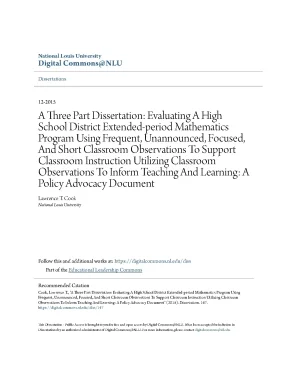
Tải xuống để đọc toàn bộNational Louis University Digital Commons@NLU Dissertations 12-2015 A Three Part Dissertation: Evaluating A High School District Extended-period Mathematics Program Using Frequent, Unannounced, Focused, And Short Classroom Observations To Support Classroom Instruction Utilizing Classroom Observations To Inform Teaching And Learning: A Policy Advocacy Document Lawrence T. Cook National Louis University Follow this and additional works at: https://digitalcommons.edu/diss Part of the Educational Leadership Commons Recommended Citation Cook, Lawrence T., "A Three Part Dissertation: Evaluating A High School District Extended-period Mathematics Program Using Frequent, Unannounced, Focused, And Short Classroom Observations To Support Classroom Instruction Utilizing Classroom Observations To Inform Teaching And Learning: A Policy Advocacy Document" (2015).edu/diss/147 This Dissertation - Public Access is brought to you for free and open access by Digital Commons@NLU. It has been accepted for inclusion in Dissertations by an authorized administrator of Digital Commons@NLU. For more information, please contact digitalcommons@nl.
A THREE PART DISSERTATION: EVALUATING A HIGH SCHOOL DISTRICT EXTENDED-PERIOD MATHEMATICS PROGRAM USING FREQUENT, UNANNOUNCED, FOCUSED, AND SHORT CLASSROOM OBSERVATIONS TO SUPPORT CLASSROOM INSTRUCTION UTILIZING CLASSROOM OBSERVATIONS TO INFORM TEACHING AND LEARNING: A POLICY ADVOCACY DOCUMENT Lawrence T. Cook Educational Leadership Doctoral Program Submitted in partial fulfillment of the requirements of Doctor of Education in the Foster G. McGaw Graduate School National College of Education National Louis University December, 2015 Copyright by Lawrence T. Cook, 2016 All rights reserved DISSERTATION ORGANIZATION STATEMENT This document is organized to meet the three-part dissertation requirement of the National Louis University (NLU) Educational Leadership (EDL) Doctoral Program.
The National Louis Educational Leadership Ed.D is a professional practice degree program (Shulman, Golde, Bueschel, & Garabedian, 2006). For the dissertation requirement, doctoral candidates are required to plan, research, and implement three major projects, one each year, within their school or district with a focus on professional practice. The three projects are: Program Evaluation Change Leadership Plan Policy Advocacy Document For the Program Evaluation, candidates are required to identify and evaluate a program or practice within their school or district. The program can be a current initiative, a grant project, a common practice, or a movement.
Focused on utilization, the evaluation can be formative, summative, or developmental (Patton, 2008). The candidate must demonstrate how the evaluation directly relates to student learning. In the Change Leadership Plan, candidates develop a plan that considers organizational possibilities for renewal. The plan for organizational change may be at the building or district level.
It must be related to an area in need of improvement with a clear target in mind. Candidate must be able to identify noticeable and feasible differences that should exist as a result of the change plan (Wagner, Kegan, Lahey, Lemons, Garnier, Helsing, Howell, & Rasmussen, 2006). In the Policy Advocacy Document, candidates develop and advocate for a policy at the local, state, or national level using reflective practice and research as a means for supporting and promoting reforms in education. Policy advocacy dissertations use critical theory to address moral and ethical issues of policy formation and administrative decision making (i., what ought to be).
The purpose is to develop reflective, humane, and social critics; moral leaders; and competent professionals, guided by a critical practical rational model (Browder, 1995). Works Cited: Browder, L. An alternative to the doctoral dissertation: The policy advocacy concept and the policy document. Journal of School Leadership, 5, 40-69.
Utilization-focused evaluation (4th ed. Thousand Oaks, CA: Sage. Reclaiming education’s doctorates: A critique and a proposal. Change leadership: A practical guide to transforming our schools.
San Francisco: Jossey-Bass. Acknowledgements I thank my wife, Catherine, for allowing me to work long nights and weekends while she kept house and cared for our children. She has been a rock throughout this entire process. I know I appeared to always have it together; however, your support helped me focus on the work that needed to be accomplished.
Thanks and gratitude goes to my mentor and friend, Dr. Thank you for encouraging me to enroll in college and becoming a first generation university graduate. Thanks for supporting and growing me throughout my entire professional career. Thanks for the time and energy you have given me throughout this doctoral process.
I truly appreciate all you do. I thank my dissertation chair, Dr. Tina Nolan, for all the meetings, telephone conferences, updates, revisions, suggestions, advice, and support. I would also like to thank all the program professors for their time, energy, and professional and educational perspectives and insights.
So, thank you Dr. Harrington Gibson, Dr. Vicki Gunther, Dr. Norman Weston, Dr.
Elizabeth Minor, Dr. Jack Denny, Dr. Richard Best, and Dr. Finally, I would like to thank my program colleagues for the support, discussions, perspectives, and insights given.
I have grown personally and professionally in our time together. Thank you Ruqia, Carol, Diallo, Jodi, Brad, Craig, Patricia, Michelle, Marcella, Anthony, Lisa, Erin, Cynthia, Hanan, Nicole, Guillermo, Sharon, William, John, Tamara, Christine, Zipporah, Gladys, and Paige. This work is dedicated with love to my Catherine and my children Lauryn Trinity Lawrence IV Logan EVALUATING A HIGH SCHOOL DISTRICT EXTENDED-PERIOD MATHEMATICS PROGRAM Lawrence T. Cook Educational Leadership Doctoral Program Submitted in partial fulfillment of the requirements of Doctor of Education in the Foster G.
McGaw Graduate School National College of Education National Louis University December, 2015 Abstract This paper involved evaluating the extended-period mathematics program of Above Average Means High School (AAMHS, pseudonym). This study used quantitative and qualitative methods of inquiry to investigate the effectiveness of the extended-period mathematics courses offered at AAMHS. Specifically, statistical measures on placement test data, end-of-the-year standardized test data, and survey data to evaluate its validity were used. In addition, teacher interviews and classroom observations to find characteristics of the program beyond only measured values were conducted.
Although this study showed that the students in the extended program scored higher on standardized tests, the findings were not statistically significant. i Preface Lessons learned in year one were equitable education for all students, instructional leadership, and engaging more stakeholders in the decision making processes. Wagner’s (2008) concept of the 21st century curriculum and the seven survival skills solidified my belief that educational entities should focus more on students learned it rather than I taught it. More importantly, to ensure that all students learn at high levels, supports must be scaffold, the environment needs to promote equity and access, and students required to participate in the most rigorous course of study.
Thus, the implementation of a high-quality core curriculum and an establishment of an accountability system with action steps is necessary for high-academic achievement for all students. Administrators are to be seen as instructional leaders and required to engage in leadership training and coaching. In the role of the instructional leader, administrators are obligated to utilize data to implement programmatic changes, and data should be used to determine the types of professional development opportunities. In addition, qualitative and quantitative data are necessary—numbers alone do not always completely represent a concept, an idea, or a program.
Other lessons learned in year one when evaluating programs or initiating change involved engaging key stakeholders in the planning processes and recognizing the roles stakeholders would play in the process. Further, teams must consist of members with complimentary skills and be treated with dignity and respect. ii TABLE OF CONTENTS ABSTRACT i PREFACE ii LIST OF TABLES v SECTION ONE: INTRODUCTION 1 Purpose 1 Rationale 2 Goals 3 Research Questions 6 SECTION TWO: REVIEW OF LITERATURE 7 Introduction 7 Various Schedules 7 Scheduling Observations 9 Discipline and Student Conduct 9 Teachers’ Training 10 Instructional Strategies 10 Student Achievement 12 Curriculum 13 SECTION THREE: METHODOLOGY 16 Research Design Overview 16 Participants 16 Data Gathering 17 Data Analysis Techniques 19 iii SECTION FOUR: FINDINGS AND INTERPRETATION 21 Introduction 21 Findings 21 Test Score Data 21 Summary of Test Data 28 Classroom Observations 28 Teacher Survey 30 Teacher Interviews 31 Expectations for Student’s Learning 31 Instructional Strategies 32 Communications with Parents 33 Instructional Leader Interviews 33 Professional Development Expectations 34 Instructional Strategies 34 Observing Classroom Instruction 34 Interpretation 35 Meaning of the Results 35 SECTION FIVE: JUDGMENT AND RECOMMENDATIONS 36 Judgment 36 Recommendations 37 REFERENCES 39 iv APPENDICES APPENDIX A: Extended-Period Mathematics—Teacher 46 APPENDIX B: Extended-Period Mathematics—Instructional Leader 49 APPENDIX C: Extended-Period Mathematics—Teacher Interview 50 APPENDIX D: DBL Students for CP Comparison 51 APPENDIX E: CP Students for DBL Comparison 53 v List of Tables Table Page 1: AC Students for DBL Comparison 23 2: DBL Students for DBL Comparison 23 3: AC Students for CP Comparison 24 4: CP Students for AC Comparison 25 5: DBL (Two or More) Students for CP Comparison 26 6: CP Students for DBL (Two or More) Comparison 27 vi SECTION ONE: INTRODUCTION Purpose The purpose of this study was to determine whether the implementation of the Excellence Achievement for Some High School (EASHS, pseudonym) extended-period mathematics program increases student achievement for low-performing students in mathematics. The extended-period mathematics program caters to students who experience difficulty in mathematics.
Specifically, these students are given an additional 225 minutes of instruction per week compared to a regular period of mathematics. Most of the learning, guided practice, instruction, and assessments take place in the classroom. The Excellence Achievement for Some High School believes that when students are given more instruction and seat time, students will be actively engaged and learn more content; hence, increasing their mathematical achievement. This belief is supported by Rolfhus and Ackerman (1999) who report that it is alleged that learned intelligence has a stronger correlation to success in schools, then innate intelligence.
Marzano (2004) also supports the EASHS notion when he purported that schools must dedicate the time, resources, and academically enriching experiences to enhance the academic background knowledge of students. The single most important factor in student achievement is the quality of classroom instruction (Marshall, 2013; Marzano, Frontier & Livingston, 2011). Further, every student must have access to rigorous, grade-level curriculum and highly effective initial teaching (Buffum, Mattos, & Weber, 2010). Thus, EASHS gives students with deficits in mathematics access to grade-level and rigorous curriculum through its extended-period mathematics program.
Students are provided with extended time and 1 other resources to learn and engage in mathematics to improve their mathematic achievement. Students are expected to follow the same scope and sequence as regular- period college preparatory level students, and they are expected to take the same common assessments and final exams. I propose to increase the awareness of the extended-period mathematics program and the impact it has on students’ achievement. Rationale In the fall of 2004, the lowest and basic mathematics track was eliminated at EASHS.
This elimination resulted in the increase range of students’ ability and skill set to do mathematics. Consequently, many students failed algebra, geometry, and advanced algebra at worrying rates. Students were expected to meet rigorous academic standards with few supports in place, and teachers received little to no training in differentiated instruction. However, students and teachers were held to the high academic standards and expectation of the college preparatory mathematics curriculum.
About three years ago, the number of students who failed the core mathematics course significantly declined. It has been touted that the students who were enrolled in the extended-period mathematics courses were outperforming the students in the regular- period courses on common assessments and final exams; thus, earning better marks. At the same time, it was discussed that although students enrolled in the extended-period courses outperformed students enrolled in the regular-period course on criterion-based assessments that the extended-period students made little to no gains on norm-referenced assessments. This program evaluation is important to me and other stakeholders because a great deal of time and other resources are invested in it.
If the program is found to be 2 significantly impactful to the mathematical achievement of underperforming students, then the program may be replicated in the other departments where students are struggling with college preparatory curriculum. However, if the study produces findings that display no significant improvements, then recommendations for improving the program’s efforts need to be communicated and provided.
Nội dung được bảo vệ bản quyền — Tải xuống đầy đủ
Trích dẫn luận án này
Lawrence T. Cook (2015). Đánh giá chương trình toán học ở cấp 3 [Luận án tiến sĩ, National Louis University]. LuanAn.net. https://luanan.net/giao-duc-hoc/danh-gia-giao-duc/danh-gia-chuong-trinh-toan-hoc-o-cap-3
Câu hỏi thường gặp
Luận án "Đánh giá chương trình toán học ở cấp 3" nghiên cứu về vấn đề gì?
Đánh giá chi tiết chương trình toán THPT: Phân tích ưu nhược điểm, đề xuất cải tiến phương pháp giảng dạy và học tập hiệu quả.
Luận án "Đánh giá chương trình toán học ở cấp 3" được bảo vệ tại trường nào?
Luận án này được bảo vệ tại National Louis University. Năm bảo vệ: 2015.
Luận án "Đánh giá chương trình toán học ở cấp 3" thuộc chuyên ngành gì?
Luận án "Đánh giá chương trình toán học ở cấp 3" thuộc chuyên ngành Educational Leadership. Danh mục: Đánh Giá Giáo Dục.
Luận án "Đánh giá chương trình toán học ở cấp 3" có bao nhiêu trang?
Luận án "Đánh giá chương trình toán học ở cấp 3" có 236 trang. Bạn có thể xem trước một phần tài liệu ngay trên trang web trước khi tải về.
Cách tải luận án "Đánh giá chương trình toán học ở cấp 3" về máy như thế nào?
Để tải luận án về máy, bạn nhấn nút "Tải xuống ngay" trên trang này, sau đó hoàn tất thanh toán phí lưu trữ. File sẽ được tải xuống ngay sau khi thanh toán thành công. Hỗ trợ qua Zalo: 0559 297 239.