Can thiệp cá nhân hóa kết hợp MI & DBT cho thanh niên uống rượu, trầm cảm, lo âu
Nhận phản hồi cá nhân hóa, ngắn gọn về luận án Whiteside năm 2010. Tối ưu hóa quá trình xem xét và cải thiện nội dung.
Năm xuất bản
Số trang
96
Thời gian đọc
15 phút
Lượt xem
0
Lượt tải
0
Phí lưu trữ
40 Point
Tổng quan nhanh
- Chủ đề:
- Personalized Feedback for Heavy Drinking Young Adults
- Số trang:
- 96 trang
- Trường:
- University of Washington
- Chuyên ngành:
- Psychology
- Tác giả:
- Ursula Whiteside
- Năm:
- 2010
Tóm tắt nội dung luận án
I.Personalized Feedback for Heavy Drinking Young Adults
This 2010 Whiteside dissertation explores brief personalized feedback interventions. The research targets depressed or anxious heavy-drinking young adults, specifically college students. The study integrates motivational interviewing and dialectical behavioral therapy skills. This academic work addresses a critical public health issue. Customized feedback is crucial for behavior change. The intervention aims to reduce problematic alcohol use. It also seeks to improve mental health outcomes. This dissertation research offers valuable insights into effective treatment strategies. The personalized feedback approach focuses on individual needs and behaviors. It provides a targeted method for support.
1.1. Targeting College Student Challenges
The study population consists of college students exhibiting heavy drinking patterns. These students also experience symptoms of depression and anxiety. This demographic often faces unique challenges. Effective interventions are necessary for this group. The research focuses on a vulnerable population. Providing appropriate educational feedback is paramount. The intervention design considers the specific context of university life. This graduate thesis contributes to student mental health resources.
1.2. Integrating Therapeutic Styles
The intervention blends two established therapeutic approaches. Motivational Interviewing (MI) promotes intrinsic motivation for change. Dialectical Behavioral Therapy (DBT) skills enhance emotional regulation and coping. This integration creates a comprehensive treatment model. The combination aims for greater feedback effectiveness. The therapeutic style is client-centered. It empowers individuals to make positive changes. This approach offers a robust framework for intervention delivery.
II.Whiteside Dissertation Intervention Effectiveness Study
The 2010 Whiteside dissertation meticulously evaluated intervention effectiveness. It compared three conditions in a randomized clinical trial. These included the Brief Alcohol Screening and Intervention for College Students (BASICS), a DBT skills-enhanced version (DBT-BASICS), and a Relaxation Control Condition (RCC). This dissertation research rigorously assessed the impact. Each intervention aimed to provide brief feedback. The study design provides a strong basis for conclusions. It measures outcomes over time. This graduate thesis contributes significantly to behavioral science. It details various aspects of feedback effectiveness.
2.1. Comparing Intervention Approaches
BASICS is a standard, widely used alcohol intervention. DBT-BASICS introduces specific dialectical behavioral therapy skills. The RCC serves as a baseline comparison. The comparison illuminates the added value of DBT components. This allows for clear differentiation of effects. Understanding these differences is key to optimizing personalized feedback interventions. The methodological rigor enhances the credibility of the 2010 research.
2.2. Delivery of Feedback Sessions
Both BASICS and DBT-BASICS interventions were delivered one-on-one. Each session lasted approximately 60 minutes. The delivery incorporated a motivational interviewing style. Feedback covered drinking behavior, norms, consequences, and risk reduction tips. This customized feedback approach ensures relevance. The direct interaction facilitates personalized communication. The structured format ensures consistent brief feedback delivery across participants.
III.DBT BASICS Enhanced Personalized Feedback Approach
DBT-BASICS offered an enhanced personalized feedback experience. This intervention provided specific feedback on depression and anxiety levels. It also included relevant norms for these conditions. A key element was the identification and reinforcement of existing coping skills. Therapists utilized self-disclosure during skills training. Brief training in three specific skills from the DBT skills group component was also included. This comprehensive approach differentiates it from standard interventions. The enhanced feedback aims for broader impact. It addresses underlying emotional regulation challenges. This customized feedback is designed for optimal feedback effectiveness.
3.1. Core Components of DBT BASICS
The core of DBT-BASICS involved tailored feedback. Participants received information on their mental health status. Normative data helped contextualize their experiences. Skills training focused on practical, actionable strategies. These components synergistically support behavior change. The structured yet personalized delivery enhances engagement. It moves beyond generic academic feedback.
3.2. Broader Scope of Enhanced Feedback
Beyond alcohol use, DBT-BASICS addressed mental health. Feedback on depression and anxiety broadened the intervention's scope. Reinforcing existing coping skills builds on client strengths. Therapist self-disclosure normalizes struggles and builds rapport. The integration of DBT skills provides concrete tools. This holistic approach makes the brief feedback highly impactful. It supports overall well-being, not just substance use reduction.
IV.Research Findings Impact of Brief Feedback Intervention
Research findings demonstrate the significant impact of the brief feedback intervention. DBT-BASICS surpassed both RCC and standard BASICS. This superiority was observed in reducing alcohol-related problems at the three-month follow-up. The feedback effectiveness was clearly established. DBT-BASICS also outperformed RCC regarding improvements in depression, anxiety, coping drinking, and emotion regulation. These positive changes were noted at both one and three-month follow-ups. The 2010 research provides robust evidence for its efficacy. Personalized feedback yielded measurable improvements. The results support targeted interventions.
4.1. Superiority of DBT BASICS Outcomes
DBT-BASICS consistently showed stronger positive effects. Its ability to reduce alcohol-related problems was superior. This sustained effect at three months highlights its lasting impact. The enhanced personalized feedback demonstrated clear advantages. It suggests the integrated approach is more potent. The findings underline the value of specialized intervention components. This makes it a standout in academic feedback studies.
4.2. Specific Areas of Improvement
Beyond alcohol issues, DBT-BASICS improved mental health metrics. Participants showed significant reductions in depression and anxiety. Improvements in coping drinking behaviors were also evident. Emotion regulation skills saw notable gains. These multi-faceted improvements indicate a comprehensive intervention. The customized feedback addressed several critical areas simultaneously. This breadth of impact strengthens its overall feedback effectiveness profile.
V.Key Insights Addressing Depression and Anxiety Nexus
Key insights highlight the interplay between depression, anxiety, and drinking behaviors. DBT-BASICS' effects on three-month drinking-related problems were mediated. This mediation occurred through improvements in depression, difficulties regulating emotions, and coping drinking. This suggests the intervention works by addressing these underlying factors. BASICS was associated with fewer difficulties regulating emotions at one-month follow-up. It also decreased drinking to cope at three-month follow-up. However, these effects were not as strong as those observed with DBT-BASICS. Personalized feedback needs to target these interlinked issues for maximal impact. The Whiteside dissertation sheds light on crucial pathways.
5.1. Mediating Factors in Problem Reduction
The mediation analysis reveals the 'how' of the intervention's success. By improving depression, emotion regulation, and coping drinking, DBT-BASICS indirectly reduces alcohol problems. This demonstrates a sophisticated understanding of behavioral change. The intervention tackles root causes, not just symptoms. This graduate thesis offers a nuanced view of feedback effectiveness. It emphasizes the importance of psychological mechanisms.
5.2. Relative Efficacy of BASICS
While not as powerful as DBT-BASICS, standard BASICS showed some benefits. It positively influenced emotion regulation and coping drinking. This confirms BASICS as a valuable intervention. However, its effects were less pronounced and widespread. This underscores the added value of DBT components. The comparative analysis is crucial for developing future brief feedback strategies. The 2010 research provides a benchmark.
VI.Future Implications of Academic Feedback Research
This 2010 research provides initial support for the efficacy of DBT-BASICS. The intervention effectively reduces drinking problems and coping drinking. It also significantly improves depression, anxiety, and emotion regulation. These findings apply to depressed and/or anxious coping-drinking college students. The Whiteside dissertation offers valuable insights for clinical practice. This academic feedback model holds promise for widespread application. It demonstrates the power of customized feedback. Further dissertation research can expand on these foundational findings. The potential for enhancing educational feedback models is substantial.
6.1. Initial Support for Efficacy
The study provides a strong evidence base for DBT-BASICS. Its efficacy across multiple outcome measures is clear. This initial support is critical for further development. The findings encourage broader implementation in university settings. The feedback effectiveness is well-documented within this specific population. It highlights a promising direction for intervention design.
6.2. Broader Application of Findings
The principles behind DBT-BASICS could extend beyond college students. Similar personalized feedback approaches might benefit other populations. Addressing co-occurring mental health and substance use is vital. The integration of therapeutic skills into brief feedback interventions offers a powerful model. This graduate thesis contributes to a broader understanding of behavioral health interventions. The implications for customized educational feedback are far-reaching.
Mục lục chi tiết luận án
Tải xuống file đầy đủ để xem toàn bộ nội dung
Tải đầy đủ (96 trang)Trích đoạn nội dung luận án
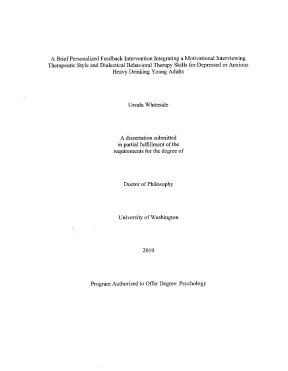
Tải xuống để đọc toàn bộA Brief Personalized Feedback Intervention Integrating a Motivational Interviewing Therapeutic Style and Dialectical Behavioral Therapy Skills for Depressed or Anxious Heavy Drinking Young Adults Ursula Whiteside A dissertation submitted in partial fulfillment of the requirements for the degree of Doctor of Philosophy University of Washington 2010 Program Authorized to Offer Degree: Psychology UMI Number: 3431523 All rights reserved INFORMATION TO ALL USERS The quality of this reproduction is dependent upon the quality of the copy submitted. In the unlikely event that the author did not send a complete manuscript and there are missing pages, these will be noted. Also, if material had to be removed, a note will indicate the deletion. UMI Dissertation Publishing UMI 3431523 Copyright 2010 by ProQuest LLC.
All rights reserved. This edition of the work is protected against unauthorized copying under Title 17, United States Code. A ® Pro uest ProQuest LLC 789 East Eisenhower Parkway P. Box 1346 Ann Arbor, Ml 48106-1346 University of Washington Graduate School This is to certify that I have examined this copy of a doctoral dissertation by Ursula Whiteside and have found that it is complete and satisfactory in all respects, and that any and all revisions required by the final examining committee have been made.
Chair of Supervisory Committee: 7^|Ujk Mary E. Larimer Reading Committee: ? ' ¡OAAJr ¡OAAjhC · CT\CiSUsfHJS\s Mary E. Alan Marlatt ^ Clayto/i Neighbors Date: 08/16/2010 In presenting this dissertation in partial fulfillment of the requirements for the doctoral degree at the University of Washington, I agree that the Library shall make its copies freely available for inspection. I further agree that extensive copying of the dissertation is allowable only for scholarly purposes, consistent with "fair use" as prescribed in the U.
Requests for copying or reproduction of this dissertation may be referred to ProQuest Information and Learning, 300 North Zeeb Road, Ann Arbor, MI 48106-1346, 1-800-521-0600, to whom the author has granted "the right to reproduce and sell (a) copies of the manuscript in microform and/or (b) printed copies of the manuscript made from microform." Signature U/yi^àJj^&i¿k. Date 08/16/2010 University of Washington Abstract A Brief Personalized Feedback Intervention Integrating a Motivational Interviewing Therapeutic Style and Dialectical Behavioral Therapy Skills for Depressed or Anxious Heavy Drinking Young Adults Ursula Whiteside Chair of the Supervisory Committee: Professor Mary E. Larimer Department of Psychiatry and Behavioral Sciences This randomized clinical trial assessed the impact of two interventions for depressed and/or anxious heavy drinking college students.0% female) students who completed one of three conditions: the Brief Alcohol Screening and Intervention for College Students (BASICS; n=49); a Dialectical Behavioral Therapy (DBT) skills enhanced version of BASICS (DBT-BASICS; n=43); or a Relaxation Control Condition (RCC; n=53). DBT-BASICS and BASICS were delivered one-on-one in a 60-minute session including feedback regarding drinking behavior, norms, consequences, and risk reduction tips, and conducted in a motivational interviewing style.
DBT-BASICS also included feedback regarding depression and anxiety levels and related norms, identification and reinforcement of existing coping skills, therapist self-disclosure via skills training, and brief training in three skills from the skills group component of DBT. DBT-BASICS surpassed RCC and BASICS for reducing alcohol related problems at three-month follow-up. DBT-BASICS outperformed RCC based on improvements in depression, anxiety, coping drinking, and emotion regulation, at one and three-month follow-ups. DBT-BASICS' effects on three- month drinking related problems was mediated by improvements in depression, difficulties regulating emotions, and coping drinking.
Relative to RCC, BASICS was associated with fewer difficulties regulating emotions at one-month follow-up, and decreased drinking to cope at three-month follow-up, but these effects were not as strong as they were for DBT- BASICS. Findings provide initial support for the efficacy of DBT-BASICS in reducing drinking problems, coping drinking, depression, and anxiety and improving emotion regulation among depressed and/or anxious coping drinking college students. TABLE OF CONTENTS Page List of Figures ii List of Tables hi Introduction 1 Methods 7 Results 21 Discussion 32 Bibliography 55 ? LIST OF FIGURES Figure Number Page 1. Flow of participants through study protocol 38 2.
Depression outcomes at 1 -month 39 3. Depression outcomes at 3-month 40 4. Anxiety outcomes at 1-month 41 5. Anxiety outcomes at 3-month 42 6.
Difficulties regulating emotions at 1-month 43 7. Difficulties regulating emotions at 3-month 44 8. Alcohol related problems at 3-month 45 9. Coping drinking motives at 1-month 46 10.
Coping drinking motives at 3-month 47 11. Past month binge drinking episodes at 1-month 48 12. Past month binge drinking episodes at 3-month 49 13. Drinks per week at 1-month 50 14.
Drinks per week at 3-month 51 15. Past month peak BAL at 1-month 52 16. Past month peak BAL at 3-month 53 17. Emotion regulation as mediator of DBT-BASICS efficacy 54 18.
Coping drinking motives as mediator of DBT-BASICS efficacy 54 19 Depression as mediator of DBT-BASICS efficacy 54 11 LIST OF TABLES Table Number Page 1. Means and standard deviations of outcome measures 37 m 1 Introduction Heavy drinking and alcohol-related problems are both commonly reported among U. Over 80% of students report drinking alcohol, and almost half report heavy episodic drinking (4+/5+ drinks per occasion for women and men, respectively; U. Department of Health and Human Services, 1997).
Peak lifetime alcohol use generally occurs in late teens and early 20s, but college students drink more and experience more alcohol- related problems in comparison to non-students (Hingson, Heeren, Winter, & Wechsler, 2005; Johnston, O'Malley, Bachman, & Schulenberg, 2008). Heavy drinking is associated with harmful consequences among students including unwanted, unplanned, and unprotected sexual experiences; physical injuries or illness, and significant legal, academic and psychological difficulties (Abbey, 2002; Cooper, 2002; Larimer, Lydum, Anderson, & Turner, 1999; Leibsohn, 1994; Perkins, 2002, Schulenberg et al., 1996; Wechsler et al. College Drinking Patterns and Coping Drinking Motives In a review of drinking rates and related problems, Baer (2002) suggested two primary patterns of heavy drinking among college students, based upon Zucker and colleagues' model of alcoholism risk (Zucker, 1987, 1994; Zucker, Fitzgerald, & Moses, 1995). The first group includes those who are impulsive, sensation seeking, and drink primarily for social reasons.
This category is hypothesized to account for most students who drink heavily during their college years and then "mature out" of heavy drinking (Baer, 2002; Brennen, Walfish, & Aubuchon, 1986; Ham & Hope, 2003). The second, smaller group includes those whose drinking is related to negative mood, and who are motivated to drink in 2 order to gain relief from negative emotions such as those related to depression and anxiety (Ham & Hope, 2003). These drinking motives are referred to as coping motives. The presence of high coping motives is associated with greater drinking quantity and frequency, adult alcohol dependence, and increased likelihood of developing long term drinking problems (Britton, 2004; Cooper, 1994; Cooper et al, 1995).
Drinking to cope is related to a number of other difficulties, including anxiety and anxiety sensitivity (Carrigan, Drobes, & Randall, 2004; Carrigan, & Randall, 2003; Novak, Burgess, Clark, & Zvolensky, 2003; Stewart, Samoluk, & MacDonald, 1998), depression (Holahan et al., 2004, Wood, Nagoshi & Dennis, 1992), insecure attachment style and a negative model of self (McNaIIy, Palfai, Levine & Moore, 2003). Further, drinking to cope is the drinking motive repeatedly and most strongly associated with drinking related problems - or life problems caused by alcohol use (Britton, 2004, Kuntsche, Knibbe, Gmel, & Engels, 2005). College Coping Drinkers at Riskfor Long Term Problems Reported rates of alcohol use disorders among college students vary, with rates indicating that approximately 8 to 32% of college students meet criteria for alcohol abuse and 6-13% for alcohol dependence (Clements, 1999; Dawson, Grant, Stinson, & Chou, 2004; Knight et al. Of students diagnosed during college with alcohol abuse or dependence, 30 to 43% will continue to meet these criteria after college graduation (Fillmore & Madanik, 1984; Grant, 1997; Kilbey, Downey & Breslau, 1998; Temple & Fillmore, 1985).
It is unclear how to distinguish between college students who will maintain alcohol use disorders and those who will not (Schulenberg et al. However, several risk factors for long-term problems have been identified. Initial findings suggest heavy 3 solitary drinking (Christiansen, Vik, & Jarchow, 2002), while atypical of college student drinkers, is related to greater risk for future alcohol problems. These solitary drinkers tend to be more likely to use alcohol to cope, have more depressive symptoms, and have less confidence in their own abilities to regulate their negative emotions.
The presence of an anxiety disorder during freshman year also increases risk for alcohol dependence even four and seven years later (Kushner, Sher & Erickson, 1999). In summary, research to date indicates that coping motives and mood related problems are important variables to consider in targeting those at risk of alcohol use disorders. Intervention and prevention efforts aimed at detouring long-term alcohol problems in college students should be guided by our understanding of these findings. BASICS Interventions Many students who drink heavily and experience alcohol related problems, if identified early in their college careers, respond successfully to brief interventions (Mariait et al.
Interventions incorporating motivational interviewing (Miller & Rollnick, 2002), alcohol related skills training, and personalized feedback have the most support for efficacy among college students (Larimer & Cronce, 2002; 2007). Brief motivational or skills based approaches have been designated as Tier 1 interventions by National Institute on Alcohol Abuse and Alcoholism (NIAAA, 2002), indicating strong support for their efficacy. The prototypical example of this type of brief intervention is the Brief Alcohol Screening and Intervention for College Students (BASICS) curriculum (Dimeff, Baer, Kivlahan, & Marlatt, 1999) which incorporates motivational enhancement, risk awareness, expectancy information, and personalized normative feedback, as well as suggestions for less risky drinking habits. 4 BASICS, identified by the Substance Abuse and Mental Health Services Administration (SAMHSA, 2003) as a Model Program and a member of their National Registry of Evidence- based Programs and Practices (SAMHSA, 2008), has been shown to reduce frequency and quantity of drinking and reduce alcohol related problems in comparison to assessment only control (e., Baer et al., 2001; Larimer et al.
Although students often show significant reductions in drinking rates and related problems over time regardless of intervention or control group status (e., Marlatt et al., 1998), BASICS appears to accelerate the maturational process, resulting in fewer alcohol related problems and less consumption over the course of a student's college career (Baer et al. For some college students, even the most efficacious treatments, such as those involving brief motivational or skills-based interventions, are not helpful in the long-term. In a four year follow-up of a BASICS intervention, 2.6% of high-risk drinkers who received BASICS became worse, and 36.5% reported no drinking changes after four years (Baer et al. Thus, despite the overall efficacy of BASICS and the fact that on the whole four year outcomes compared favorably to the control group, these results indicate that for some individuals, BASICS is not successful at producing or maintaining post-intervention behavior change and thus could be improved.
Given these rates, it is possible that those students who are unresponsive to BASICS and similar interventions, as well as those who continue or go on to have alcohol disorders, constitute significantly overlapping groups. BASICS Adaptationfor Coping Drinkers Research indicates college students who have higher self-efficacy in regulating negative emotions are less likely to report either drinking problems (Kassel, Jackson, Unrod, 5 2000) or maladaptive coping patterns, such as drinking to cope. Coping drinkers may lack skills to otherwise functionally modulate their moods (Cooper et al., 1995; Kuntsche et al. This is hypothesized to lead to a problematic cycle where the individual's life problems remain unresolved (due to lack of skillful coping) and therefore feed the cycle of drinking to cope (Cooper et al., 1995; Kassel et al.
One route for reducing risk for long term alcohol problems may be to target vulnerable individuals (i., those with mood problems and who drink to cope), and to reinforce skillful means of regulating emotions and offer additional emotion regulation skills.
Nội dung được bảo vệ bản quyền — Tải xuống đầy đủ
Trích dẫn luận án này
Ursula Whiteside (2010). Can thiệp cá nhân hóa cho thanh niên uống nhiều rượu [Luận án tiến sĩ, University of Washington]. LuanAn.net. https://luanan.net/giao-duc-hoc/danh-gia-giao-duc/2010-whiteside-dissertation-a-brief-personalized-feedback-reduced-file-size
Câu hỏi thường gặp
Luận án "Can thiệp cá nhân hóa cho thanh niên uống nhiều rượu" nghiên cứu về vấn đề gì?
Nhận phản hồi cá nhân hóa, ngắn gọn về luận án Whiteside năm 2010. Tối ưu hóa quá trình xem xét và cải thiện nội dung.
Luận án "Can thiệp cá nhân hóa cho thanh niên uống nhiều rượu" được bảo vệ tại trường nào?
Luận án này được bảo vệ tại University of Washington. Năm bảo vệ: 2010.
Luận án "Can thiệp cá nhân hóa cho thanh niên uống nhiều rượu" thuộc chuyên ngành gì?
Luận án "Can thiệp cá nhân hóa cho thanh niên uống nhiều rượu" thuộc chuyên ngành Psychology. Danh mục: Đánh Giá Giáo Dục.
Luận án "Can thiệp cá nhân hóa cho thanh niên uống nhiều rượu" có bao nhiêu trang?
Luận án "Can thiệp cá nhân hóa cho thanh niên uống nhiều rượu" có 96 trang. Bạn có thể xem trước một phần tài liệu ngay trên trang web trước khi tải về.
Cách tải luận án "Can thiệp cá nhân hóa cho thanh niên uống nhiều rượu" về máy như thế nào?
Để tải luận án về máy, bạn nhấn nút "Tải xuống ngay" trên trang này, sau đó hoàn tất thanh toán phí lưu trữ. File sẽ được tải xuống ngay sau khi thanh toán thành công. Hỗ trợ qua Zalo: 0559 297 239.