Nghiên cứu vai trò của hiệu trưởng trong việc tạo dựng văn hóa sử dụng công nghệ
"Phân tích ứng dụng khoa học công nghệ trong giáo dục, nhằm nâng cao chất lượng và hiệu quả giảng dạy."
Educational Studies (Educational Leadership Specialization)
Luan An
Dissertation (Doctor of Philosophy / Luận án tiến sĩ)
Năm xuất bản
Số trang
217
Thời gian đọc
33 phút
Lượt xem
0
Lượt tải
0
Phí lưu trữ
50 Point
Tổng quan nhanh
- Chủ đề:
- Công nghệ Giáo dục: Tối ưu hóa vai trò lãnh đạo hiệu trưởng
- Số trang:
- 217 trang
- Trường:
- Lesley University
- Chuyên ngành:
- Educational Studies (Educational Leadership Specialization)
- Tác giả:
- Darlene A. Foley
- Năm:
- 2016
Tóm tắt nội dung luận án
I.Công nghệ Giáo dục Tối ưu hóa vai trò lãnh đạo hiệu trưởng
Sự tích hợp khoa học công nghệ trong giáo dục đòi hỏi vai trò lãnh đạo hiệu trưởng mạnh mẽ. Hiệu trưởng là người định hình văn hóa sử dụng công nghệ tại trường học. Khả năng tối đa hóa công nghệ để hỗ trợ học tập của học sinh phụ thuộc vào họ. Cách tiếp cận lấy học sinh làm trung tâm, thúc đẩy tư duy cấp cao, cần được ưu tiên. Điều này đối lập với các phương pháp truyền thống, lấy giáo viên làm trung tâm, thường chỉ dừng lại ở tư duy cấp thấp. Tài liệu này khám phá những hành động, quyết định, và mối quan hệ mà hiệu trưởng nhận thấy đóng góp vào văn hóa lớp học sử dụng công nghệ cấp cao. Đây là yếu tố then chốt để đáp ứng các tiêu chuẩn giáo dục hiện đại và thúc đẩy EdTech hiệu quả.
1.1. Tầm quan trọng lãnh đạo trong tích hợp công nghệ.
Lãnh đạo hiệu trưởng định hướng việc tích hợp công nghệ. Họ chuyển đổi tầm nhìn thành hành động cụ thể trong lớp học. Vai trò này bao gồm việc đưa ra các quyết định tổ chức. Các quyết định này ảnh hưởng đến việc sử dụng công nghệ như thế nào. Năng lực của hiệu trưởng trong việc tạo ra một môi trường khuyến khích sử dụng công nghệ cấp cao là vô cùng quan trọng. Sự lãnh đạo hiệu quả đảm bảo công nghệ không bị bỏ quên. Công nghệ cần được khai thác tối đa tiềm năng phục vụ mục tiêu giáo dục.
1.2. Phân tích tác động của hiệu trưởng đến EdTech.
Hiệu trưởng tác động trực tiếp đến việc triển khai Công nghệ Giáo dục (EdTech). Họ đưa ra các quyết định về tài nguyên và định hướng sư phạm. Hiệu trưởng cần có kiến thức về các công cụ hợp tác thời gian thực. Những công cụ này hỗ trợ mạnh mẽ việc học tập của học sinh. Việc áp dụng kiến thức này vào các quyết định và hành động tổ chức là rất cần thiết. Điều này tạo ra một môi trường giáo dục đổi mới. Nó khuyến khích sự tích hợp công nghệ sâu rộng, vượt ra ngoài các ứng dụng cơ bản.
II.Chuyển đổi Số Giáo dục Thúc đẩy ứng dụng công nghệ cấp cao
Chuyển đổi số trong giáo dục yêu cầu việc thúc đẩy ứng dụng công nghệ cấp cao. Điều này vượt ra ngoài việc sử dụng công nghệ như một công cụ hỗ trợ đơn thuần. Nó hướng tới việc thay đổi cách học sinh tư duy và tương tác với kiến thức. Các phương pháp lấy học sinh làm trung tâm, khuyến khích tư duy mở, là mục tiêu chính. Công nghệ cần tạo điều kiện cho sự hợp tác, sáng tạo và giải quyết vấn đề. Hiệu trưởng có vai trò then chốt trong việc định hướng chiến lược này. Họ đảm bảo rằng các sáng kiến số hóa được thực hiện hiệu quả, mang lại lợi ích thực sự cho người học và phù hợp với mục tiêu Giáo dục 4.0.
2.1. Nâng cao tư duy học tập thông qua công nghệ.
Công nghệ cần được sử dụng để phát triển tư duy cấp cao. Điều này bao gồm khả năng phân tích, tổng hợp và đánh giá thông tin. Các công cụ hợp tác thời gian thực hỗ trợ học sinh học tập tương tác. Chúng thúc đẩy kỹ năng giải quyết vấn đề và tư duy phản biện. Mục tiêu là tạo ra một môi trường học tập năng động. Học sinh chủ động trong quá trình khám phá và xây dựng kiến thức. Đây là một phần quan trọng của đổi mới sáng tạo giáo dục.
2.2. Quyết định chiến lược cho tích hợp công nghệ sâu rộng.
Hiệu trưởng đưa ra các quyết định chiến lược về tích hợp công nghệ. Những quyết định này định hình cách công nghệ được sử dụng trong trường. Họ cần hiểu rõ các nền tảng học tập số và học liệu điện tử hiệu quả. Các hành động cụ thể bao gồm khuyến khích thử nghiệm công nghệ mới. Họ cũng hỗ trợ tính linh hoạt trong sử dụng công nghệ. Điều này thúc đẩy sự tự chủ của giáo viên, tạo điều kiện cho chuyển đổi số trong giáo dục diễn ra mạnh mẽ và bền vững.
III.Đổi mới Sáng tạo Giáo dục Chiến lược vượt rào cản EdTech
Đổi mới sáng tạo trong giáo dục thường gặp phải nhiều rào cản khi triển khai Công nghệ Giáo dục (EdTech). Các rào cản này có thể là về tài nguyên, kỹ năng, hoặc thái độ. Hiệu trưởng có vai trò quan trọng trong việc xây dựng chiến lược để vượt qua chúng. Họ cần tạo ra một môi trường khuyến khích thử nghiệm. Điều này bao gồm việc hỗ trợ giáo viên trong quá trình học hỏi và áp dụng công nghệ mới. Việc nhận diện và giải quyết các rào cản một cách có hệ thống là cần thiết. Điều này đảm bảo rằng sự đổi mới không bị đình trệ. Thay vào đó, nó thúc đẩy một văn hóa học tập liên tục phát triển, phù hợp với yêu cầu của Giáo dục 4.0.
3.1. Khuyến khích thử nghiệm và tự chủ trong sử dụng công nghệ.
Hiệu trưởng tạo điều kiện cho giáo viên thử nghiệm công nghệ mới. Họ khuyến khích sự linh hoạt trong các ứng dụng EdTech. Sự tự chủ của giáo viên trong việc lựa chọn công cụ là quan trọng. Điều này thúc đẩy đổi mới sáng tạo giáo dục. Nó giúp giáo viên tìm ra phương pháp tốt nhất cho lớp học của mình. Môi trường này nuôi dưỡng sự sáng tạo và khả năng thích ứng của đội ngũ sư phạm.
3.2. Giải quyết rào cản tích hợp công nghệ hiệu quả.
Nhiều rào cản ngăn cản việc tích hợp công nghệ hiệu quả. Các rào cản cấp một bao gồm thiếu tài nguyên và tiếp cận. Rào cản cấp hai liên quan đến niềm tin sư phạm và sự kháng cự thay đổi. Hiệu trưởng cần nhận thức rõ những thách thức này. Họ hỗ trợ giáo viên vượt qua chúng. Điều này có thể thông qua việc triển khai chậm rãi. Hỗ trợ từ đồng nghiệp và huấn luyện ngang hàng là cần thiết. Nó giúp những người chậm thích ứng hòa nhập tốt hơn.
3.3. Đảm bảo nguồn lực và sự liên tục trong ứng dụng.
Việc có đủ nguồn lực là nền tảng cho tích hợp công nghệ. Sự liên tục của các tài nguyên công nghệ là yếu tố quan trọng. Hiệu trưởng đảm bảo rằng giáo viên có quyền truy cập ổn định. Các nền tảng học tập số và học liệu điện tử cần hoạt động hiệu quả. Điều này xây dựng niềm tin và năng lực số cho giáo viên. Nó giảm thiểu sự gián đoạn và tối ưu hóa quá trình học tập.
IV.Phát triển Năng lực Số Đào tạo giáo viên và hỗ trợ học tập
Phát triển năng lực số cho cả giáo viên và học sinh là một mục tiêu cốt lõi của khoa học công nghệ trong giáo dục. Điều này đòi hỏi các chương trình đào tạo chuyên sâu và liên tục cho đội ngũ giáo viên, giúp họ thành thạo các công cụ và phương pháp giảng dạy mới. Đồng thời, công nghệ cần được sử dụng để hỗ trợ học sinh phát triển các kỹ năng cần thiết cho kỷ nguyên số, từ tư duy phản biện đến khả năng sử dụng các công cụ như Trí tuệ nhân tạo trong giáo dục (AI in Ed) và Thực tế ảo (VR)/Thực tế tăng cường (AR) trong học tập. Hiệu trưởng đóng vai trò thiết yếu trong việc đảm bảo các chương trình đào tạo và hỗ trợ này được triển khai hiệu quả, góp phần vào sự chuyển đổi số toàn diện trong nhà trường.
4.1. Đào tạo chuyên sâu về Công nghệ Giáo dục cho giáo viên.
Đào tạo chuyên sâu, bền vững cho giáo viên là yếu tố then chốt. Việc này trang bị cho họ kỹ năng sử dụng EdTech cấp cao. Các chương trình phát triển nghề nghiệp cần được lập kế hoạch toàn diện. Tuy nhiên, việc này thường chưa phổ biến. Đào tạo cần tập trung vào các công cụ hợp tác. Nó cần giúp giáo viên khám phá các phương pháp sư phạm mới. Điều này xây dựng năng lực số cho toàn bộ đội ngũ.
4.2. Hỗ trợ học sinh phát triển kỹ năng số và tư duy sáng tạo.
Công nghệ là công cụ mạnh mẽ để phát triển kỹ năng số ở học sinh. Nó thúc đẩy tư duy sáng tạo và khả năng giải quyết vấn đề. Học trực tuyến (E-learning) và nền tảng học tập số mở rộng cơ hội học tập. Trí tuệ nhân tạo trong giáo dục (AI in Ed) cá nhân hóa lộ trình học. Thực tế ảo (VR) và Thực tế tăng cường (AR) trong học tập tạo ra trải nghiệm sống động. Các công nghệ này hỗ trợ học sinh đạt được các tiêu chuẩn tư duy cấp cao.
V. Xây dựng văn hóa ứng dụng công nghệ bền vững
Để thực hiện thành công Giáo dục 4.0, việc xây dựng một văn hóa ứng dụng công nghệ bền vững là điều kiện tiên quyết. Điều này không chỉ liên quan đến việc cung cấp thiết bị, mà còn là việc thay đổi tư duy và phương pháp giảng dạy. Hiệu trưởng cần đóng vai trò là kiến trúc sư cho một môi trường học tập chuyển đổi, nơi công nghệ được tích hợp một cách tự nhiên và hiệu quả vào mọi khía cạnh của giáo dục. Việc này đòi hỏi sự áp dụng các chuẩn mực lãnh đạo giáo dục. Các tiêu chuẩn này giúp định hướng các quyết định chiến lược. Điều này đảm bảo rằng mọi nỗ lực đều hướng tới việc tạo ra một hệ thống giáo dục năng động, thích ứng và liên tục đổi mới, đáp ứng nhu cầu của tương lai.
5.1. Kiến tạo môi trường học tập chuyển đổi.
Hiệu trưởng tạo ra một văn hóa lớp học sử dụng công nghệ cấp cao. Đây là một điều kiện thiết yếu cho học tập chuyển đổi. Mục tiêu là biến công nghệ thành một phần không thể thiếu của việc dạy và học. Môi trường này khuyến khích sự tương tác và khám phá. Nó vượt qua các phương pháp giảng dạy truyền thống. Việc này thúc đẩy đổi mới sáng tạo giáo dục. Nó giúp học sinh phát triển toàn diện trong kỷ nguyên số.
5.2. Áp dụng chuẩn lãnh đạo để định hướng EdTech.
Các chuẩn mực chuyên môn cho lãnh đạo giáo dục định hướng hiệu trưởng. Các chuẩn mực này giúp họ điều hướng sự phức tạp. Việc đạt được tích hợp công nghệ cấp cao đòi hỏi tầm nhìn chiến lược. Nó cũng đòi hỏi nỗ lực bền bỉ. Hiệu trưởng cần áp dụng các nguyên tắc này trong mọi quyết định. Điều này đảm bảo rằng công nghệ giáo dục được triển khai hiệu quả. Nó hỗ trợ mục tiêu phát triển năng lực số và Giáo dục 4.0.
Mục lục chi tiết luận án
Tải xuống file đầy đủ để xem toàn bộ nội dung
Tải đầy đủ (217 trang)Trích đoạn nội dung luận án
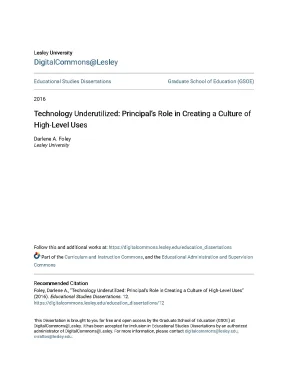
Tải xuống để đọc toàn bộLesley University DigitalCommons@Lesley Educational Studies Dissertations Graduate School of Education (GSOE) 2016 Technology Underutilized: Principal’s Role in Creating a Culture of High-Level Uses Darlene A. Foley Lesley University Follow this and additional works at: https://digitalcommons.edu/education_dissertations Part of the Curriculum and Instruction Commons, and the Educational Administration and Supervision Commons Recommended Citation Foley, Darlene A., "Technology Underutilized: Principal’s Role in Creating a Culture of High-Level Uses" (2016). Educational Studies Dissertations.edu/education_dissertations/12 This Dissertation is brought to you for free and open access by the Graduate School of Education (GSOE) at DigitalCommons@Lesley. It has been accepted for inclusion in Educational Studies Dissertations by an authorized administrator of DigitalCommons@Lesley.
For more information, please contact digitalcommons@lesley.edu, cvrattos@lesley. Running head: HIGH-LEVEL INTEGRATION Technology Underutilized: Principal’s Role in Creating a Culture of High-Level Uses A Dissertation Presented by Darlene Foley Submitted to the Graduate School of Education Lesley University in partial fulfillment of the requirements for the degree of DOCTOR OF PHILOSOPHY December 2016 Ph. Educational Studies Educational Leadership Specialization HIGH-LEVEL INTEGRATION ii Technology Underutilized: Principal’s Role in Creating a Culture of High-Level Uses Darlene Foley Graduate School of Education Lesley University Ph. Educational Studies Educational Leadership Specialization Approvals In the judgment of the following signatories, this Dissertation meets the academic standards that have been established for the Doctor of Philosophy degree.
HIGH-LEVEL INTEGRATION iii Copyright 2016 Darlene Foley HIGH-LEVEL INTEGRATION iv Dedication This dissertation is dedicated to my husband and children, John, Matt, and Maddy, for giving me love and support throughout this journey. We all sacrificed in various ways because of my commitment to public education and my commitment to finish this program in a reasonable amount of time. It was not easy, but it was possible with the three of them. HIGH-LEVEL INTEGRATION v Abstract Teachers need to maximize technology to support student learning by drawing upon varying pedagogical orientations; however, teacher-centered, highly structured approaches that foster low-level thinking is more prevalent.
Although highly structured approaches help develop students’ foundational skills and content knowledge, student-centered, open-ended approaches foster high-level thinking aimed by the Common Core State Standards (CCSS). Literature suggests principals have an important role in the implementation of the CCSS and technology integration, but it does not capture the ways principals help teachers adopt high-level uses of technology. This research asks the overarching question, “What actions, decisions, and relationships do principals perceive contributed to a classroom culture that utilizes high-levels of technology to meet the expectations of the CCSS?” A qualitative research design with a phenomenological approach was utilized to discover the knowledge, dispositions, and actions of principals who were successful in creating a culture of high-levels of technology integration. Interviews with 12 public middle school principals in Massachusetts and Rhode Island with ample technology resources reaffirm literature and add new understandings.
Findings show that these technology-oriented principals: (a) were knowledgeable about ways real-time collaborative tools supported student learning; (b) applied their knowledge about high-levels of technology integration in organizational decisions and actions; (c) encouraged experimentation with technology; (d) supported flexible uses of technology and teacher autonomy but continuity with some resources was needed; (e) provided teachers sustained technology-related professional development but comprehensive planning was not common; (f) recognized that first-order barriers continued to persist in their school; and (g) believed that slow implementation and colleagues helped slow adopters overcome second-order barriers but peer coaching was needed. HIGH-LEVEL INTEGRATION vi The findings suggest that these principals provided most Essential Conditions of Transformational Learning and applied Professional Standards for Educational Leaders to create a culture of high-level technology use. The outcomes of this study call attention to the complexity of achieving high-levels of technology integration in schools with or without sufficient resources and technology-oriented leadership. Keywords: Common Core State Standards; essential conditions of transformational learning; middle school; principal; Professional Standards for Educational Leaders; sustained professional development; technology HIGH-LEVEL INTEGRATION vii Table of Contents List of Tables .x List of Figures.
xi CHAPTER ONE: INTRODUCTION .1 Statement of the Problem .6 Theoretical Orientations Held by Teachers .8 Other Contributing Factors. 10 Purpose of Study. 13 Definition of Terms. 15 Significance of Study.
17 Review of the Literature. 18 Design of the Study Overview. 20 Delimitations of Study. 22 Dissertation Chapter Outline.
23 CHAPTER TWO: LITERATURE REVIEW. 24 Educational Reform and Technology Integration. 24 No Child Left Behind. 25 Common Core State Standards (CCSS).
28 Race to the Top (RTTT). 32 The Role of Principal. 34 School Leadership Frameworks. 35 Principal’s Role in Effective Technology Integration.
37 Transformational Learning and Essential Conditions. 45 Essential Conditions for Transformational Learning. 47 Gaps in the Literature. 53 CHAPTER THREE: METHODS AND PROCEDURES.
55 HIGH-LEVEL INTEGRATION viii Design of the Study. 60 Data Collection Methods. 75 Issues of Trustworthiness. 77 CHAPTER FOUR: FINDINGS.
79 Guiding Question One: Can you tell me about your understanding of real-time collaborative tools and their applications for learning to meet the CCSS?. 80 Finding One: Principals Were Knowledgeable about the Ways Real-Time Collaborative Tools Supported Student Learning. 81 Finding Two: Principals’ Knowledge about High-Level Uses Influenced Organizational Actions and Decisions. 86 Guiding Question Two: How Do You See Yourself Helping Teachers Integrate Real-Time Collaborative Tools to Meet the CCSS?.
97 Finding Three: Principals Encouraged Experimenting with Technology. 98 Finding Four: Principals Supported Flexible Uses of Technology and Teacher Autonomy but Continuity of Resources Needed. 100 Finding Five: Principals Provided Teachers Sustained Technology-Related Professional Development but Comprehensive Planning Was Not Common. 104 Guiding Question Three: Can You Tell Me about Helping Teachers Overcome Barriers to Technology Integration?.
108 Finding Six: First-Order Barriers Continued to Persist in Schools with Ample Technology Resources. 109 Finding Seven: Slow Implementation and Colleagues Help Slow Adopters Overcome Second-Order Barriers but Additional Peer Coaching Was Needed. 115 CHAPTER FIVE: STUDY SUMMARY, DISCUSSION, FUTURE RESEARCH, AND FINAL REFLECTION. 117 HIGH-LEVEL INTEGRATION ix Statement of the Problem.
117 Purpose of the Study. 118 Review of the Literature. 119 Design of the Study. 121 Practical Implications to Stakeholders.
134 Guiding Question One: Can You Tell Me about Your Understanding of Real-Time Collaborative Tools and Their Applications for Learning to Meet the CCSS?. 135 Guiding Question Two: How Do You See Yourself Helping Teachers Integrate Real-Time Collaborative Tools to Meet the CCSS?. 138 Guiding Question Three: Can You Tell Me about Helping Teachers Overcome Barriers to Technology Integration?. 148 Reaffirmation of Existing Literature.
158 Limitations and Delimitations of the Study Revisited. 203 HIGH-LEVEL INTEGRATION x List of Tables Table 1: Example Approaches to Technology Integration .0 Examples that Promote Sharing and Real-Time Collaboration. 15 Table 3: PSEL and ISTE for Administrators Alignment. 36 Table 4: Participant Demographics.
62 Table 5: Primary Code List and Definition. 70 Table 6: Management of Trustworthiness by Criterion. 77 HIGH-LEVEL INTEGRATION xi List of Figures Figure 1: Perceived Benefits of Real-Time Collaborative Tools .80 Figure 2: Real-Time Collaborative Tools Used in Schools. 82 Figure 3: Principals Continual Learning Resources.
84 Figure 4: Classroom Tools Used for Modeling. 86 Figure 5: Purposes of Modeling. 87 Figure 6: School-Wide Pedagogical Shift by Principal. 89 Figure 7: Five Principals Referred to a Technology Integration Continuum Framework.91 Figure 8: District Vision and School Improvement Plan .92 Figure 9: Realignment of Courses.
93 Figure 10: Ways Principals Engaged Family and Community to Improve Technology Integration. 94 Figure 11: Principal Encouraged Experimenting with Technology. 97 Figure 12: Principals Supported Flexible Uses of Technology. 100 Figure 13: Technology-Related Professional Development Models.
104 Figure 14: Principal Perceptions of Teachers' Second-Order Barriers. 109 Figure 15: Principal Perceptions of Second-Order Barriers. 110 Figure 16: Principal Methods to Overcome Second-Order Barriers. 112 Figure 17: Principal Methods to Slow Implementation.
114 Figure 18: Principal Reported Activities that Support PSEL. 129 HIGH-LEVEL INTEGRATION xii Acknowledgements When I received my acceptance letter into the Ph. program at Lesley University, my husband’s first response was, “We can talk about it,” as if we had a choice to make. After a short discussion about the importance of this opportunity, we held on tight and never looked back.
My husband and children, John, Matt, and Maddy provided unconditional love and support that I needed to complete this journey. My mother, father, sister, grandmother, in-laws, and close friends showed never-ending love and understanding. Visits and phone calls were not as frequent, but we all did our best to make it work. Cohort 2013 is a group of dedicated individuals with diverse experiences, talents, and interests.
I learned so much about the field of education and cultural diversity through their stories and our work together. Their humor, dedication, and candor helped see me through this challenging process. They have become life-long friends. #phdproblems The professors in the Educational Studies Program at Lesley University provided me with the resources to build my knowledge and skills so that I could become confident in my educational leadership capabilities.
Each of them, especially Dr. Gould, and Dr. Naso, had an influence on my professional growth. At the start, I could not articulate what I meant by the phrase ‘curriculum delivery’ the summer of 2013 when asked to state my potential dissertation topic in the amphitheater.
At the conclusion of this journey, I fully understand the meaning and I look forward to the next chapter in my professional career when I help teachers develop a deeper understanding of pedagogy. My dissertation committee included Dr. Nancy Wolf, Dr. Brenda Matthis, and Dr.
Each of them brought something different to my dissertation journey and I appreciated all their gifts. Nancy, my senior advisor, gave me a perfect balance of autonomy and guidance that allowed me to build a study that was truly meaningful to my professional practice. Brenda HIGH-LEVEL INTEGRATION xiii brought her wealth of technology integration knowledge and positive attitude to push my thinking. She introduced new ideas and questioned my assumptions so that no stone was left unturned.
Jim’s years of experience as a leader in public education brought new thoughts and clarity in my writing. These committee members embraced this topic from the beginning and helped me develop a complex understanding of the issue. A special thank you goes to Jim Parsons who helped me clean up those annoying typos and unnecessary words. I needed a fresh set of eyes on this paper at a time when my own eyes were as weary as could be.
I learned so much from his edits and I now have a short list of words that will never appear in another academic paper. Lastly, I am incredibly grateful for the participants in this study. I learned so much from their experiences, examples, and strategies. They taught me to lead by trusting teachers and providing them with autonomy, while, at the same time, promoting new classroom approaches and providing the organizational resources to support their growth and development throughout the school year.
Each principal had an immediate impact on my thinking and professional growth. HIGH-LEVEL INTEGRATION 1 CHAPTER ONE: INTRODUCTION This chapter includes a personal statement that motivated me to pursue the topic of high- levels of technology integration, a statement of the problem, the purpose of the study, definition of terms, significance of the study, review of the literature, and design of the study overview. The delimitations of the study and my assumptions follow to acknowledge the constraints and personal influences on this study. The dissertation chapter outline concludes the chapter.
Personal Statement Teaching with technology has always been important to me because of my belief that technology can engage students in the learning process. I believe that technology can be a powerful resource for students when they are trying to contextualize abstract concepts and developing authentic, technology-related assessment products; however, in my roles as classroom teacher and technology integration specialist, I have seen technology used inconsistently across classrooms.
Nội dung được bảo vệ bản quyền — Tải xuống đầy đủ
Trích dẫn luận án này
Darlene A. Foley (2016). Khoa học công nghệ trong giáo dục [Luận án tiến sĩ, Lesley University]. LuanAn.net. https://luanan.net/cong-nghe-thong-tin/khoa-hoc-cong-nghe-trong-giao-duc
Câu hỏi thường gặp
Luận án "Khoa học công nghệ trong giáo dục" nghiên cứu về vấn đề gì?
"Phân tích ứng dụng khoa học công nghệ trong giáo dục, nhằm nâng cao chất lượng và hiệu quả giảng dạy."
Luận án "Khoa học công nghệ trong giáo dục" được bảo vệ tại trường nào?
Luận án này được bảo vệ tại Lesley University. Năm bảo vệ: 2016.
Luận án "Khoa học công nghệ trong giáo dục" thuộc chuyên ngành gì?
Luận án "Khoa học công nghệ trong giáo dục" thuộc chuyên ngành Educational Studies (Educational Leadership Specialization). Danh mục: Công Nghệ Thông Tin.
Luận án "Khoa học công nghệ trong giáo dục" có bao nhiêu trang?
Luận án "Khoa học công nghệ trong giáo dục" có 217 trang. Bạn có thể xem trước một phần tài liệu ngay trên trang web trước khi tải về.
Cách tải luận án "Khoa học công nghệ trong giáo dục" về máy như thế nào?
Để tải luận án về máy, bạn nhấn nút "Tải xuống ngay" trên trang này, sau đó hoàn tất thanh toán phí lưu trữ. File sẽ được tải xuống ngay sau khi thanh toán thành công. Hỗ trợ qua Zalo: 0559 297 239.