Tác động của toàn cầu hóa tới Trung Đông - Nghiên cứu của David Lee Richardson
Toàn cầu hóa tác động kinh tế, chính trị, văn hóa Trung Đông: phân tích các cơ hội, thách thức và sự biến đổi xã hội sâu sắc.
Naval Postgraduate School
Security Studies (Middle East, South Asia, Sub-Saharan Africa)
Luan An
Master’s Thesis
Năm xuất bản
Số trang
137
Thời gian đọc
21 phút
Lượt xem
0
Lượt tải
0
Phí lưu trữ
40 Point
Tổng quan nhanh
- Chủ đề:
- Tác động toàn cầu hóa: Trung Đông hội nhập thế giới
- Số trang:
- 137 trang
- Trường:
- Naval Postgraduate School
- Chuyên ngành:
- Security Studies (Middle East, South Asia, Sub-Saharan Africa)
- Tác giả:
- David Lee Richardson Jr.
- Năm:
- 2009
Tóm tắt nội dung luận án
I.Tác động toàn cầu hóa Trung Đông hội nhập thế giới
Toàn cầu hóa ảnh hưởng sâu sắc đến Trung Đông. Nghiên cứu này phân tích tác động chính trị, kinh tế và văn hóa. Mục tiêu tìm hiểu cách Trung Đông có thể hội nhập quốc tế tích cực. Điều này nhằm tăng cường thịnh vượng và ổn định khu vực. Toàn cầu hóa mang lại cả cơ hội và thách thức lớn. Việc thích nghi là cần thiết cho sự phát triển bền vững.
1.1. Phạm vi nghiên cứu tác động toàn cầu hóa
Luận văn tập trung vào ba trụ cột toàn cầu hóa: dân chủ, chủ nghĩa tư bản, và biến đổi văn hóa. Phạm vi nghiên cứu cụ thể là các xã hội Ả Rập Hồi giáo. Các chế độ độc tài thế tục và các tổ chức Hồi giáo đối lập là đối tượng chính. Đây là cách xem xét toàn diện tác động của toàn cầu hóa Trung Đông. Nghiên cứu xác định các yếu tố then chốt.
1.2. Mục tiêu Thịnh vượng và ổn định khu vực
Mục đích là làm rõ tầm quan trọng của việc tạo ra điều kiện thuận lợi. Điều này giúp các quốc gia Trung Đông nắm bắt toàn cầu hóa hiện tại. Việc chấp nhận các yếu tố toàn cầu hóa có thể tăng cường thịnh vượng. Đồng thời, nó góp phần củng cố ổn định chính trị khu vực. Nghiên cứu tìm kiếm con đường phát triển tích cực cho Trung Đông.
II.Toàn cầu hóa ảnh hưởng chính trị Trung Đông
Toàn cầu hóa mang theo khái niệm dân chủ. Điều này tạo ra ảnh hưởng đáng kể đến chính trị Trung Đông toàn cầu hóa. Nghiên cứu xem xét sự tương thích của dân chủ với các xã hội Ả Rập Hồi giáo. Nó cũng phân tích những thách thức đối với các chế độ hiện hành. Sự chấp nhận dân chủ có thể định hình lại cảnh quan chính trị.
2.1. Dân chủ và định hình chính trị khu vực
Việc chấp nhận dân chủ có thể mang lại ổn định. Tuy nhiên, nó cũng có thể dẫn đến bất ổn Trung Đông trong giai đoạn chuyển đổi. Các chế độ độc tài thế tục thường chống lại sự thay đổi này. Sự phổ biến của các ý tưởng dân chủ từ toàn cầu hóa tạo áp lực. Điều này đặt ra câu hỏi về tương lai chính trị Trung Đông. Thách thức lớn là dung hòa các hệ tư tưởng khác biệt.
2.2. Xung đột tư tưởng Chế độ và lực lượng Hồi giáo
Xung đột Trung Đông thường xoay quanh quyền lực. Các chế độ độc tài và tổ chức Hồi giáo có quan điểm khác biệt về dân chủ. Sự chấp nhận dân chủ có làm tăng thịnh vượng và ổn định không? Hay nó sẽ kích hoạt thêm bất ổn Trung Đông? Các rào cản chính trị tồn tại rất rõ rệt. Giải quyết các rào cản này là trọng tâm nghiên cứu.
2.3. Ảnh hưởng đến ổn định chính trị khu vực
Việc chấp nhận các nguyên tắc dân chủ có thể tác động lớn. Nó có khả năng thay đổi động lực quyền lực khu vực. Một mặt, nó có thể dẫn đến sự tham gia rộng rãi hơn. Mặt khác, nó có thể gây ra bất ổn Trung Đông nếu quá trình không được quản lý tốt. Tối ưu hóa các điều kiện thuận lợi là cần thiết để đạt được ổn định chính trị khu vực.
III.Kinh tế Trung Đông Thách thức từ toàn cầu hóa
Chủ nghĩa tư bản là một yếu tố kinh tế chính của toàn cầu hóa. Nó tác động mạnh mẽ đến kinh tế Trung Đông toàn cầu hóa. Sự hội nhập kinh tế quốc tế Trung Đông mang lại cả lợi ích và rủi ro. Các quốc gia trong khu vực đối mặt với nhu cầu cải cách cấu trúc. Điều này nhằm tối đa hóa cơ hội từ thị trường toàn cầu.
3.1. Chủ nghĩa tư bản và thị trường khu vực
Chủ nghĩa tư bản toàn cầu thúc đẩy hội nhập thị trường. Nó tạo ra cạnh tranh và cơ hội đầu tư mới. Tuy nhiên, nó cũng có thể làm tăng khoảng cách giàu nghèo. Điều này đặc biệt đúng với các nền kinh tế chưa phát triển. Các quốc gia Trung Đông cần chiến lược để thích ứng. Họ cần tận dụng các lợi ích kinh tế mà không gây bất ổn xã hội.
3.2. Vai trò dầu mỏ trong bối cảnh toàn cầu
Dầu mỏ và toàn cầu hóa Trung Đông gắn liền với nhau. Tài nguyên năng lượng Trung Đông là huyết mạch của nhiều nền kinh tế khu vực. Biến động giá dầu toàn cầu ảnh hưởng trực tiếp đến thu nhập. Sự đa dạng hóa kinh tế là thách thức lớn. Nó giảm bớt sự phụ thuộc vào nguồn tài nguyên này. Điều này giúp tăng khả năng chống chịu trước các cú sốc kinh tế.
3.3. Hội nhập kinh tế quốc tế Trung Đông
Việc hội nhập kinh tế quốc tế Trung Đông mở ra cánh cửa cho thương mại và đầu tư. Tuy nhiên, nó cũng yêu cầu cải cách thể chế và pháp lý. Các nền kinh tế cần minh bạch hơn. Điều này thu hút vốn đầu tư nước ngoài. Các chính sách kinh tế bền vững là cần thiết để đạt được tăng trưởng lâu dài. Điều này giúp củng cố vị thế khu vực trên bản đồ kinh tế toàn cầu.
IV.Văn hóa Trung Đông Biến đổi trong toàn cầu hóa
Toàn cầu hóa cũng mang đến sự biến đổi văn hóa. Văn hóa Trung Đông toàn cầu hóa đang trải qua nhiều thay đổi. Các giá trị truyền thống và bản sắc địa phương phải đối mặt với các xu hướng toàn cầu. Sự tương tác này có thể tạo ra cả sự phong phú và căng thẳng xã hội. Nền văn hóa khu vực phải tìm cách cân bằng.
4.1. Chuyển đổi văn hóa và bản sắc khu vực
Sự giao thoa văn hóa toàn cầu đặt ra câu hỏi về bản sắc. Các giá trị Hồi giáo truyền thống có tương thích với các yếu tố văn hóa toàn cầu không? Điều này là một trong những điểm chính của luận văn. Việc dung hòa giữa truyền thống và hiện đại là thách thức lớn. Nó định hình lại đời sống văn hóa Trung Đông. Duy trì bản sắc trong khi tiếp thu điều mới là mục tiêu.
4.2. Tác động xã hội từ xu hướng toàn cầu
Toàn cầu hóa tác động đến mọi mặt của xã hội Trung Đông toàn cầu hóa. Nó thay đổi lối sống, cách giao tiếp và hệ thống giá trị. Sự chấp nhận những thay đổi văn hóa này có thể dẫn đến thịnh vượng hơn. Tuy nhiên, nó cũng có thể gây ra bất ổn xã hội nếu không được quản lý cẩn thận. Hiểu rõ các tác động này là cần thiết để định hướng phát triển.
V.Thúc đẩy ổn định thịnh vượng Toàn cầu hóa Trung Đông
Việc chấp nhận dân chủ, chủ nghĩa tư bản, và thay đổi văn hóa có thể tăng cường ổn định và thịnh vượng. Tuy nhiên, nhiều rào cản vẫn tồn tại. Nghiên cứu này làm rõ những chướng ngại vật đó. Đồng thời, nó đưa ra các gợi ý để thúc đẩy một Trung Đông toàn cầu hóa tích cực. Hướng tới một tương lai bền vững là mục tiêu cuối cùng.
5.1. Điều kiện tiên quyết cho thịnh vượng bền vững
Thịnh vượng bền vững đòi hỏi một môi trường ổn định. Điều này bao gồm cải cách chính trị, mở cửa kinh tế, và cởi mở văn hóa. Các điều kiện tích cực cần được tạo ra. Chúng thúc đẩy sự tham gia của người dân. Đồng thời, chúng giúp xây dựng lòng tin vào các thể chế. Hội nhập quốc tế Trung Đông cần được thực hiện một cách có trách nhiệm và chiến lược.
5.2. Chướng ngại vật trên con đường hội nhập
Các chướng ngại vật bao gồm kháng cự từ các chế độ bảo thủ. Các yếu tố khác là bất đồng tư tưởng sâu sắc. Cùng với đó là xung đột nội bộ và bất ổn Trung Đông. Việc vượt qua những rào cản này là rất quan trọng. Nó đòi hỏi sự lãnh đạo mạnh mẽ và tầm nhìn dài hạn. Đây là cách để khu vực có thể tiến lên và hội nhập.
5.3. Hướng tới tương lai ổn định phát triển
Để Trung Đông đạt được ổn định chính trị khu vực và phát triển, cần có sự thay đổi. Điều này đòi hỏi đối thoại, hợp tác và sẵn sàng thích nghi. Các quốc gia cần xây dựng năng lực tự chủ. Đồng thời, họ cần tham gia vào các cơ chế toàn cầu. Việc này giúp tạo ra một tương lai tươi sáng hơn cho toàn khu vực. Đây là kết quả của việc toàn cầu hóa Trung Đông tích cực.
Tải xuống file đầy đủ để xem toàn bộ nội dung
Tải đầy đủ (137 trang)Trích đoạn nội dung luận án
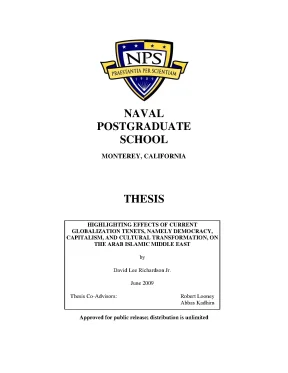
Tải xuống để đọc toàn bộNAVAL POSTGRADUATE SCHOOL MONTEREY, CALIFORNIA THESIS HIGHLIGHTING EFFECTS OF CURRENT GLOBALIZATION TENETS, NAMELY DEMOCRACY, CAPITALISM, AND CULTURAL TRANSFORMATION, ON THE ARAB ISLAMIC MIDDLE EAST by David Lee Richardson Jr. June 2009 Thesis Co-Advisors: Robert Looney Abbas Kadhim Approved for public release; distribution is unlimited THIS PAGE INTENTIONALLY LEFT BLANK REPORT DOCUMENTATION PAGE Form Approved OMB No. 0704-0188 Public reporting burden for this collection of information is estimated to average 1 hour per response, including the time for reviewing instruction, searching existing data sources, gathering and maintaining the data needed, and completing and reviewing the collection of information. Send comments regarding this burden estimate or any other aspect of this collection of information, including suggestions for reducing this burden, to Washington headquarters Services, Directorate for Information Operations and Reports, 1215 Jefferson Davis Highway, Suite 1204, Arlington, VA 22202-4302, and to the Office of Management and Budget, Paperwork Reduction Project (0704-0188) Washington DC 20503.
AGENCY USE ONLY (Leave blank) 2. REPORT TYPE AND DATES COVERED June 2009 Master’s Thesis 4. TITLE AND SUBTITLE Highlighting Effects of Current Globalization 5. FUNDING NUMBERS Tenets, Namely Democracy, Capitalism, and Cultural Transformation, on the Arab Islamic Middle East.
PERFORMING ORGANIZATION NAME(S) AND ADDRESS(ES) 8. PERFORMING ORGANIZATION Naval Postgraduate School REPORT NUMBER Monterey, CA 93943-5000 9. SPONSORING /MONITORING AGENCY NAME(S) AND ADDRESS(ES) 10. SPONSORING/MONITORING N/A AGENCY REPORT NUMBER 11.
SUPPLEMENTARY NOTES The views expressed in this thesis are those of the author and do not reflect the official policy or position of the Department of Defense or the U. DISTRIBUTION / AVAILABILITY STATEMENT 12b. DISTRIBUTION CODE Approved for public release; distribution is unlimited 13. ABSTRACT (maximum 200 words) This thesis examines the shape of globalization in the Middle East, specifically with respect to three major elements of globalization, those of politics, economics, and culture.
This thesis attempts to shed light on the importance and difficulties of fostering positive conditions, which could facilitate favorable terms for Islamic Arabs in the Middle East to fully embrace current globalization, thus increasing the region’s and inevitably the world’s prosperity and stability. Moreover, this thesis also addresses and analyzes the compatibility of Islamic Arabs in the Middle East with current globalization trends. Acknowledging that Middle Eastern globalization is a fairly large subject to cover, the scope of this research has been narrowed to answer the question of whether or not the acceptance of democracy, capitalism and cultural changes by Arab Islamic Middle Eastern societies, specifically the secular authoritarian regimes and the opposing Islamists organizations, could increase the prosperity and stability within the region, and if so, bring to light the obstacles which stand in the way of such progress. SUBJECT TERMS Middle East, Globalization, Democracy, Capitalism, Cultural, Islam, 15.
NUMBER OF Arabs, Muslims, Terrorism PAGES 137 16. LIMITATION OF CLASSIFICATION OF CLASSIFICATION OF THIS CLASSIFICATION OF ABSTRACT REPORT PAGE ABSTRACT Unclassified Unclassified Unclassified UU NSN 7540-01-280-5500 Standard Form 298 (Rev. 2-89) Prescribed by ANSI Std. 239-18 i THIS PAGE INTENTIONALLY LEFT BLANK ii Approved for public release; distribution is unlimited HIGHLIGHTING EFFECTS OF CURRENT GLOBALIZATION TENETS, NAMELY DEMOCRACY, CAPITALISM, AND CULTURAL TRANSFORMATION, ON THE ARAB ISLAMIC MIDDLE EAST David L.
Lieutenant Commander, United States Navy B., United States Naval Academy, 1996 Submitted in partial fulfillment of the requirements for the degree of MASTER OF ARTS IN SECURITY STUDIES (MIDDLE EAST, SOUTH ASIA, SUB-SAHARAN AFRICA) from the NAVAL POSTGRADUATE SCHOOL June 2009 Author: David L. Approved by: Robert Looney Thesis Co-Advisor Abbas Kadhim Thesis Co-Advisor Harold A. Trinkunas, PhD Chairman, Department of National Security Affairs iii THIS PAGE INTENTIONALLY LEFT BLANK iv ABSTRACT This thesis examines the shape of globalization in the Middle East, specifically with respect to three major elements of globalization, those of politics, economics, and culture. This thesis attempts to shed light on the importance and difficulties of fostering positive conditions, which could facilitate favorable terms for Islamic Arabs in the Middle East to fully embrace current globalization, thus increasing the region’s and inevitably the world’s prosperity and stability.
Moreover, this thesis also addresses and analyzes the compatibility of Islamic Arabs in the Middle East with current globalization trends. Acknowledging that Middle Eastern globalization is a fairly large subject to cover, the scope of this research has been narrowed to answer the question of whether or not the acceptance of democracy, capitalism and cultural changes by Arab Islamic Middle Eastern societies, specifically the secular authoritarian regimes and the opposing Islamists organizations, could increase the prosperity and stability within the region, and if so, bring to light the obstacles which stand in the way of such progress. v THIS PAGE INTENTIONALLY LEFT BLANK vi TABLE OF CONTENTS I. MAJOR RESEARCH QUESTION.
PROBLEMS AND HYPOTHESES. METHODS AND SOURCES. GLOBALIZATION AND THE MIDDLE EAST. CULTURAL MODERNITY AND GLOBALIZATION.
IS GLOBALIZATION A PARADOX OR AN ANSWER?. GLOBALIZATION AND THE ISLAMIC “FATS”. CAN GLOBALIZATION ADDRESS THE CAUSES OF MIDDLE EAST TERRORISM?. EFFECTS OF GLOBALIZATION ON MIDDLE EAST POLITICS.
POLITICS AND GLOBALIZATION. DEMOCRATIZATION WITH PROPER AND IMPROPER POLITICAL LEARNING. IS DEMOCRATIZATION DOOMED IN THE MIDDLE EAST?. Islamists and Democracy.
Is Democratization Really Doomed in the Middle East?. Authoritarian Elites and Power in the Middle East. Are Middle Eastern Societies Trapped?. DEMOCRATIC POLITICS AND TERRORISM.
IS DIPLOMACY USEFUL WHEN CONFRONTING VIOLENT EXTREMIST GROUPS?. The Difference between Dealing with State and Non State Organizations. The Islamic Political Spectrum. Realistic and Unrealistic Objectives.
STRONG AND WEAK STATES IN THE MIDDLE EAST. EFFECTS OF GLOBALIZATION ON MIDDLE EAST ECONOMICS. ECONOMICS AND GLOBALIZATION. MIDDLE EASTERN ECONOMICS.
DEMOCRACY TO CAPITALISM. I Need You, You Need Me. Balancing the Power of Influence. WHY HAVE MIDDLE EAST ECONOMIES NOT DIVERSIFIED?.
IS THE MIDDLE EAST AT A TIPPING POINT?. Are Arab Economies at a Tipping Point?. Can We Speak of Arab Economies as a Whole?. CASE STUDY: COMPARING AND CONTRASTING HOW SAUDI ARABIA AND QATAR HAVE DEALT WITH THE THREATS AND OPPORTUNITIES OF ECONOMIC GLOBALIZATION.
Domestic, Regional and International Factors which Induced the Selection of this Combination of Models. Opposition to Models within Saudi Arabia and Qatar. Weaknesses of Models. How Have Saudi Arabia and Qatar Dealt with Key Developmental Challenges?.
Comparing the Suitability and Sustainability of Saudi Arabia’s and Qatar’s Strategies by in Grappling with Globalization. GLOBAL DATA ANALYSIS. EFFECTS OF GLOBALIZATION ON MIDDLE EAST CULTURE. GETTING ON THE GLOBALIZATION TRAIN.
MEDIA AND THE MIDDLE EAST. Middle Eastern Love and Hate. Western Love and Hate. ADDRESSING THE CAUSES AND CONDITIONS OF TERRORISM.
UNDERSTANDING THE ISRAELI-PALESTINIAN CONFLICT. Periods of Conflict. Pre-20th Century. British Directive Period (1920–1948).
United Nations partition (1948–2000). The Twenty-First Century and the Second Intifada (2000–Present) .113 LIST OF REFERENCES .117 INITIAL DISTRIBUTION LIST .121 viii LIST OF FIGURES Figure 1. Political Islamic Spectrum. The Islamic Right Wing.
The Violent Islamic Right Wing. The Strong State. The Weak State. Top Ten World Religions.
Country Muslim Percentage (2000). State Muslim Percentage (2007). Globalization Index vs. State Muslim Percentages (2007).70 ix THIS PAGE INTENTIONALLY LEFT BLANK x LIST OF TABLES Table 1.
2000 GDP and Muslim Percentage Data (Continued from Table 1). 2007 GDP and Muslim Percentage Data. 2007 GDP and Muslim Percentage Data (Continued from Table 3). Globalization Index and Muslim Percentage 2007 Data .76 xi THIS PAGE INTENTIONALLY LEFT BLANK xii ACKNOWLEDGMENTS I would like to thank my family and friends for their support and patience during the work in performing this thesis.
I also would like to acknowledge and thank Professor Robert Looney and Professor Abbas Kadhim for their guidance, counseling, and leadership of which they provided an immense amount. xiii THIS PAGE INTENTIONALLY LEFT BLANK xiv I. INTRODUCTION In Search of World Peace and Prosperity through the Embracement of Globalization in the Arab Islamic Middle East A steadfast concert for peace can never be maintained except by a partnership of democratic nations. (world) peace must be planted upon the tested foundations of political liberty.1 President Woodrow Wilson A.
MAJOR RESEARCH QUESTION This thesis examines the shape of globalization in the Middle East, specifically with respect to three major elements of globalization, those of politics, economics, and culture. This thesis attempts to shed light on the importance and difficulties of fostering positive conditions, which could facilitate favorable terms for Islamic Arabs in the Middle East to fully embrace current globalization, thus increasing the region’s and inevitably the world’s prosperity and stability. Moreover, this thesis also addresses and analyzes the compatibility of Islamic Arabs in the Middle East with current globalization trends. Acknowledging that Middle Eastern globalization is a fairly large subject to cover, the scope of this research has been narrowed to answer the question of whether or not the acceptance of democracy, capitalism and cultural changes by Arab Islamic Middle Eastern societies, specifically the secular authoritarian regimes and the opposing Islamists organizations, could increase the prosperity and stability within the region, and if so, bring to light the obstacles which stand in the way of such progress.
IMPORTANCE The topic of this thesis originates from the issues which the world community, in general, has encountered due to the regional stagnation of the Middle East, which is attributable to the increased political, economic, and cultural turmoil created partly by the Islamists and the reactionary and irreversible military and police retaliatory actions that 1 President Woodrow Wilson's “Declaration of War Message to Congress,” April 2, 1917; Records of the United States Senate; Record Group 46; National Archives. 1 have occurred within the Muslim population of the Middle East. The objective of this thesis is to highlight the affects of current globalization and bring to ideas and solutions which could potentially help to marginalize or moderate hostility within the region, leaving more time, energy, and resources for the enrichment of the Muslim population at large, the Middle East region, and the world as a whole. If we look at this crisis through a political, economical, and cultural lens, we may be able to postulate that Islamic Arabs could eventual and fully accept the influence of current globalization into the societies in which they reside.
If acceptance of globalization can be obtained successfully in the Middle East, the effects of positive economic growth, political autonomy, and cultural modernity could light the pathway for Islamic Arab populations on the road to a better quality of life. Although easier said than done, in order to pursue this path to a better life, among many other issues, secular authoritarian regimes will need to adjust the political structure, Islamists will need to moderate there political agendas, and culture shifts within the populous will need to take place. On the other hand, globalization is not just a one way street, and there is another variable in this equation. The states which are encouraging, fostering, and promoting current globalization and all its elements around the world have a responsibility too.
Globalization will not be accepted at face value nor will it be accepted voluntarily, and by no means should it be forced upon the Middle East. Forcing globalization onto societies that are neither prepared for nor educated to the political, economical, and cultural changes that must preemptively take place in order to successfully globalize, will not only be counter productive to the globalization process, but will make it more difficult and possibly impossible to construct the necessary foundation upon which productivity and prosperity are in present day being built upon. Therefore, it is the responsibility of those encouraging globalization, in this case mainly western powers, to study and understand the Middle Eastern societies which hinder globalization. Those powers must understand the history, personality, and culture of those societies, and create relationships which will aid in the coordination of society tailored globalization learning.
Lastly, and more importantly, Middle Eastern societies must be made aware and see the benefits of 2 fostering current globalization.
Nội dung được bảo vệ bản quyền — Tải xuống đầy đủ
Trích dẫn luận án này
David Lee Richardson Jr. (2009). Tác động của toàn cầu hóa tới Trung Đông [Luận án tiến sĩ, Naval Postgraduate School]. LuanAn.net. https://luanan.net/chinh-tri-hoc/tac-dong-cua-toan-cau-hoa-toi-trung-dong
Câu hỏi thường gặp
Luận án "Tác động của toàn cầu hóa tới Trung Đông" nghiên cứu về vấn đề gì?
Toàn cầu hóa tác động kinh tế, chính trị, văn hóa Trung Đông: phân tích các cơ hội, thách thức và sự biến đổi xã hội sâu sắc.
Luận án "Tác động của toàn cầu hóa tới Trung Đông" được bảo vệ tại trường nào?
Luận án này được bảo vệ tại Naval Postgraduate School. Năm bảo vệ: 2009.
Luận án "Tác động của toàn cầu hóa tới Trung Đông" thuộc chuyên ngành gì?
Luận án "Tác động của toàn cầu hóa tới Trung Đông" thuộc chuyên ngành Security Studies (Middle East, South Asia, Sub-Saharan Africa). Danh mục: Chính Trị Học.
Luận án "Tác động của toàn cầu hóa tới Trung Đông" có bao nhiêu trang?
Luận án "Tác động của toàn cầu hóa tới Trung Đông" có 137 trang. Bạn có thể xem trước một phần tài liệu ngay trên trang web trước khi tải về.
Cách tải luận án "Tác động của toàn cầu hóa tới Trung Đông" về máy như thế nào?
Để tải luận án về máy, bạn nhấn nút "Tải xuống ngay" trên trang này, sau đó hoàn tất thanh toán phí lưu trữ. File sẽ được tải xuống ngay sau khi thanh toán thành công. Hỗ trợ qua Zalo: 0559 297 239.