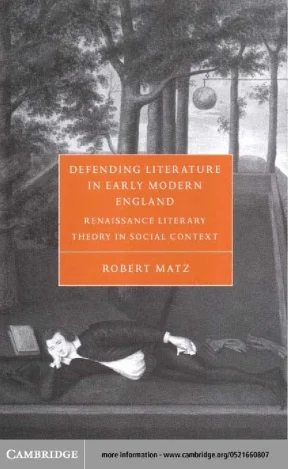
Cambridge university press defending literature in early modern england renaissa
Tài liệu: Cambridge university press defending literature in early modern england renaissance literary theory in social context sep 2000. Tải miễn phí tại TaiLi
George Mason University
English Literature; Renaissance Literary Theory
Luan An
Book
Năm xuất bản
Số trang
204
Thời gian đọc
31 phút
Lượt xem
0
Lượt tải
0
Phí lưu trữ
50 Point
Tóm tắt nội dung
I.Early Modern Literary Defense Profit Pleasure
Robert Matz's study, published by Cambridge University Press, explores the persistent defense of literature in early modern England. The document highlights why literary works were frequently justified by their adherence to the Horatian ideal: the ability to provide both 'profit' (instruction) and 'pleasure' (delight). This foundational concept shaped Renaissance literary theory. It addressed the need to validate literature's societal role during a period of significant cultural transformation. The text delves into the rhetorical strategies employed by literary defenders. It examines how they articulated literature's value. The focus remains on understanding the historical and theoretical underpinnings of this persistent literary apologia. The discussion clarifies the intellectual landscape in which early modern literature functioned and was perceived.
1.1. Horatian Ideal in Renaissance Poetics
Early modern literature often faced scrutiny. Its value required clear articulation. Defenders frequently invoked the Horatian ideal. This framework emphasized literature's dual capacity. It could both 'prodesse' (profit, instruct) and 'delectare' (please, delight). This ideal formed a cornerstone of Renaissance poetics. It provided a rhetorical strategy for validating literary works. The period's literary defense revolved around this ancient principle. This history of criticism reveals evolving views on poetics and rhetoric. The value of literature was tied to these classical foundations.
1.2. Literature s Dual Purpose Profit and Pleasure
The defense of literature highlighted two primary functions. First, it offered intellectual and moral profit. Readers gained wisdom, virtue, and knowledge. Second, it provided pleasure and entertainment. Engaging narratives and beautiful language delighted the audience. This blend of instruction and enjoyment justified literature's existence. It countered potential criticisms of idleness or frivolity. The value of literature was thus presented as comprehensive. Defenders used rhetoric to explain this dual benefit, solidifying literature's place in society.
1.3. Historical Context of Early Modern Apologia
The constant need for literary defense reflected societal changes. Early modern England experienced significant cultural shifts. These transformations influenced the perception of art. Literature's role was not always self-evident. Defenders articulated its importance within this dynamic environment. This history of criticism reveals evolving views on poetics and rhetoric. The period's apologia for literature shaped its future reception. Academic publishing by Cambridge University Press ensures these historical arguments receive thorough examination.
II.Social Dynamics in Renaissance Literature s Value
The study positions Renaissance literary theory within its broader social context. It examines how literature responded to and mediated the profound transformations of the period. A central theme involves the evolving concept of gentility. The English aristocracy transitioned from a feudal warrior class to a more refined, civil elite. This shift created conflicting ideas about social status and ideal behavior. Robert Matz argues that early modern literature actively engaged with these contradictions. It offered narratives and prescriptive texts that helped define and negotiate new social expectations. This analysis deepens understanding of how the value of literature was constructed in dialogue with societal developments. Humanism played a significant role in this intellectual reorientation, influencing the perception of literary works.
2.1. Aristocracy s Evolution and Literary Status
Renaissance literature existed within a complex social matrix. The English aristocracy underwent profound changes. It transitioned from a feudal warrior class. It became a more civil, educated elite. This evolution impacted the definition of gentility. Literature played a crucial role in shaping these new ideals. Its narratives often reflected and influenced social expectations. The status of literature intertwined with aristocratic identity. This historical change provided fertile ground for literary defense arguments.
2.2. Conflicting Ideas about Gentility s Definition
The concept of gentility was not static. Different factions held conflicting views. Some emphasized birth and martial prowess. Others stressed education, virtue, and courtly manners. Humanism contributed to this intellectual discourse. Literature engaged with these debates directly. It presented models of ideal gentlemen and gentlewomen. These works explored the very essence of nobility during the early modern period. This exploration contributed to the ongoing literary defense.
2.3. Literature Mediating Societal Expectations
Robert Matz argues literature mediated these contradictions. It offered a space for negotiating social tensions. Literary defense often positioned works as guides. They could navigate the complexities of an evolving society. Literature's value derived partly from this mediating function. It provided frameworks for understanding new social roles. The period's poetics reflected these intricate connections to societal norms. This understanding is key to early modern literature studies.
III.Key Renaissance Authors Literary Defense Theory
The study employs close readings of canonical works to illustrate its arguments. Robert Matz focuses on texts by prominent Renaissance authors: Thomas Elyot, Philip Sidney, and Edmund Spenser. Through these analyses, the book demonstrates how literature attempted to reconcile contradictory social expectations. Elyot’s 'The Governour' shows literature's role in shaping civil leadership. Sidney's 'Defence of Poetry' provides a robust philosophical and rhetorical justification for poetic art. Spenser’s 'The Faerie Queene' exemplifies how epic poetry could instill 'gentle discipline.' These authors' contributions were central to the literary defense efforts of the time. Their works offer invaluable insights into poetics and the broader history of criticism during the early modern period.
3.1. Thomas Elyot s The Governour and Reading
Robert Matz examines specific canonical works. Thomas Elyot's 'The Boke Named the Governour' is one focus. This text explored ideal education for rulers. It emphasized the role of classical literature. Elyot's work advocated for virtuous reading. It defined how literature could cultivate civil elites. This analysis sheds light on early modern humanism. It links reading practices to societal governance. The value of literature was clear in its ability to shape leaders.
3.2. Philip Sidney s Defence of Poetry Analysis
Philip Sidney's 'An Apology for Poetry' receives close attention. This foundational text is a prime example of literary defense. Sidney argued for poetry's moral superiority. It could move readers to virtuous action more effectively than history or philosophy. Matz analyzes Sidney's rhetoric and poetics. The defense highlights literature's capacity to inspire civic virtue. It positions poetry as a vital tool for national well-being. This is a crucial text in the history of criticism.
3.3. Edmund Spenser s Faerie Queene and Discipline
Edmund Spenser's 'The Faerie Queene' also features prominently. This epic poem aimed to fashion a 'gentleman or noble person in virtuous and gentle discipline.' Matz explores how Spenser's work performs this task. It presents allegorical narratives of moral development. The poem functions as a form of 'gentle discipline.' This literary defense demonstrates the active role of narrative. It shapes character and ideal social conduct, solidifying the value of literature.
IV.Critiquing New Historicism in Early Modern Studies
The study engages critically with prominent theoretical frameworks. Robert Matz draws upon Pierre Bourdieu’s work to inform his analysis of early modern literature. Simultaneously, the book offers a substantial critique of New Historicist theory. It challenges earlier accounts that may have presented a narrow or anecdotal view of historical context. The critique extends to recent interpretations regarding the power and agency of Renaissance authorship. Matz emphasizes the uncertain status of literature during a period of significant cultural change. This approach helps illuminate how certain canonical works achieved their enduring status. It redirects the history of criticism towards a more nuanced understanding of literary production and reception.
4.1. Engagement with Bourdieu s Theoretical Work
The study engages with significant theoretical frameworks. Pierre Bourdieu's work informs Matz's analysis. Bourdieu's concepts offer tools for understanding cultural fields. They explain the interplay of social structures and artistic production. This theoretical engagement provides a fresh perspective. It moves beyond traditional literary interpretations. The application of Bourdieu clarifies the forces shaping early modern literature. This contributes to academic publishing insights.
4.2. Challenges to New Historicist Interpretations
Matz offers a substantial critique of New Historicist theory. Early New Historicist work was sometimes criticized. It presented a narrow, anecdotal view of history. This study challenges recent accounts of Renaissance authorship. It re-evaluates the power attributed to authors. The critique emphasizes the uncertain status of literature. It provides a more nuanced understanding of cultural change. This is a key contribution to the history of criticism.
4.3. Reassessing Renaissance Authorship s Power
The study highlights the precarious position of literature. Authorship during the Renaissance faced inherent uncertainties. Power structures were complex and evolving. This perspective re-evaluates past interpretations. It questions assumptions about authors' agency. It emphasizes how canonical works became canonical. The history of criticism benefits from this critical re-evaluation. The value of literature in this context is re-examined.
V.Cambridge University Press Renaissance Literary Insights
This publication, 'Defending Literature in Early Modern England,' is part of the esteemed 'Cambridge Studies in Renaissance Literature and Culture' series. Cambridge University Press is a leading academic publishing house for such scholarship. The series, guided by General Editor Stephen Orgel and a distinguished editorial board, aims to offer historically oriented studies of Renaissance literature and theatre. It makes use of insights afforded by contemporary theoretical perspectives. The broader scope of the series reflects a significant reinterpretation of literary texts since the 1970s, moving beyond formalism to see literature as deeply embedded in social, economic, political, and cultural history. This commitment to rigorous scholarship ensures profound insights into early modern literature.
5.1. Cambridge Studies in Renaissance Literature Focus
'Defending Literature in Early Modern England' belongs to a prestigious series. Cambridge University Press publishes 'Cambridge Studies in Renaissance Literature and Culture.' This series is overseen by general editor Stephen Orgel. It features a distinguished editorial board. The series aims for historically oriented studies. These studies utilize modern theoretical perspectives. It represents a key contribution to academic publishing. This supports the ongoing literary defense.
5.2. Broader Reinterpretation of Literary Texts
The series reflects a significant shift since the 1970s. Literary studies moved away from pure formalism. There is now a vital reinterpretation of literary texts. Literature is viewed as an aspect of social, economic, and political history. This broader understanding informs the series' approach. It offers fresh insights into Renaissance literature. This academic publishing fosters interdisciplinary scholarship. It enriches the history of criticism.
5.3. Publishing Historically Oriented Renaissance Studies
Cambridge University Press provides a platform for critical inquiry. It publishes work that reads the Renaissance from our own time. The series includes diverse titles. These explore topics like eroticism, theatre finance, and body rhetoric. Matz's book aligns with this focus. It offers historically grounded analysis. The press champions rigorous scholarship in early modern studies. This affirms the enduring value of literature.
Tải xuống file đầy đủ để xem toàn bộ nội dung
Tải đầy đủ (204 trang)Trích đoạn nội dung luận án
Tải xuống để đọc toàn bộThis page intentionally left blank Why was literature so often defended and defined in early modern England in terms of its ability to provide the Horatian ideal of both profit and pleasure? Robert Matz analyzes Renaissance literary theory in the context of social transformations of the period, focusing on conflicting ideas about gentility that emerged as the English aristocracy evolved from a feudal warrior class to a civil elite. Through close readings centered on works by Thomas Elyot, Philip Sidney, and Edmund Spenser, Matz argues that literature attempted to mediate a complex set of contradictory social expectations. His original study engages with important theoretical work such as Pierre Bourdieu’s and offers a substantial critique of New Historicist theory. It challenges recent accounts of the power of Renaissance authorship, emphasizing the uncertain status of literature during this time of cultural change, and sheds light on why and how canonical works became canonical.
is Assistant Professor of English at George Mason University. Cambridge Studies in Renaissance Literature and Culture 37 Defending Literature in Early Modern England Cambridge Studies in Renaissance Literature and Culture General editor STEPHEN ORGEL Jackson Eli Reynolds Professor of Humanities, Stanford University Editorial board Anne Barton, University of Cambridge Jonathan Dollimore, University of York Marjorie Garber, Harvard University Jonathan Goldberg, Johns Hopkins University Nancy Vickers, Bryn Mawr College Since the 1970s there has been a broad and vital reinterpretation of the nature of literary texts, a move away from formalism to a sense of literature as an aspect of social, economic, political and cultural history. While the earliest New Historicist work was criticized for a narrow and anecdotal view of history, it also served as an important stimulus for post-structuralist, feminist, Marxist and psychoanalytical work, which in turn has increasingly informed and redirected it. Recent writing on the nature of representation, the historical construction of gender and of the concept of identity itself, on theatre as a political and economic phenomenon and on the ideologies of art generally, reveals the breadth of the field.
Cambridge Studies in Renaissance Literature and Culture is designed to offer historically oriented studies of Renaissance literature and theatre which make use of the insights afforded by theoretical perspectives. The view of history envisioned is above all a view of our own history, a reading of the Renaissance for and from our own time. Recent titles include 29. Dorothy Stephens The limits of eroticism in post-Petrarchan narrative: conditional pleasure from Spenser to Marvell 30.
Daileader Eroticism on the Renaissance stage: transcendance, desire, and the limits of the visible 31. Leinwand Theatre, finance and society in early modern England 32. Heather Dubrow Shakespeare and domestic loss: forms of deprivation, mourning, and recuperation 33. Posner The performance of nobility in early modern European literature 34.
Schoenfeldt Bodies and selves in early modern England: physiology and inwardness in Spenser, Shakespeare, Herbert, and Milton 35. Lynn Enterline The rhetoric of the body from Ovid to Shakespeare 36. Brooks From playhouse to printing house: drama and authorship in early modern England A complete list of books in the series is given at the end of the volume. Defending Literature in Early Modern England Renaissance Literary Theory in Social Context Robert Matz Assistant Professor of English George Mason University The Pitt Building, Trumpington Street, Cambridge, United Kingdom The Edinburgh Building, Cambridge CB2 2RU, UK 40 West 20th Street, New York, NY 10011-4211, USA 477 Williamstown Road, Port Melbourne, VIC 3207, Australia Ruiz de Alarcón 13, 28014 Madrid, Spain Dock House, The Waterfront, Cape Town 8001, South Africa http://www.org © Robert Matz 2004 First published in printed format 2000 ISBN 0-511-03338-9 eBook (Adobe Reader) ISBN 0-521-66080-7 hardback For my parents, Joseph and Lorraine Matz Pastance with good company I love and shall until I die Grudge who will, but none deny, So God be pleased this life will I For my pastance, Hunt, sing and dance, My heart is set, All goodly sport To my comfort Who shall me let? Henry VIII, “Pastance with good company” (from Williams, Henry VIII and His Court, p.
34) Contents Acknowledgments page xi 1 Introduction: “aut prodesse. aut delectare” 1 2 Recreating reading: Elyot’s Boke Named the Governour 25 3 Heroic diversions: Sidney’s Defence of Poetry 56 4 A “gentle discipline”: Spenser’s Faerie Queene 88 5 Epilogue: from text to work? 128 Notes 137 Bibliography 172 Index 182 ix Acknowledgments A number of friends and colleagues at Johns Hopkins and George Mason University kindly read and helpfully commented on sections of this work. Many thanks to Denise Albanese, David Baker, Charles Dove, Dorice Elliott, David Glimp, Elaine Hadley, Devon Hodges, Rosemary Jann, Barbara Melosh, Cynthia Rogers, Jennifer Summit, and Ned Weed. I’ve also had the pleasure of wonderful teachers in the English departments at Johns Hopkins and Cornell.
I want particularly to express my appreciation to Jonathan Goldberg. As advisor to my dissertation at Johns Hopkins, not to mention through his own critical work, he has taught me a great deal, and provided me with a model of scholarly generosity and energy that I greatly admire. I am glad to have a chance to thank him in print. As my dis- sertation’s second reader, John Guillory provided valuable advice and clear formulations.
Thanks also to the George Mason University College of Arts and Sciences, which provided financial support for the completion of this book through its Summer Stipend for Junior Faculty Work. A portion of chapter 3 originally appeared in English Literary Renaissance 25 (1995): 131–47. Thanks to the journal for permission to reprint it here. Stephen Orgel was generous with his time and support during this book’s publica- tion.
At Cambridge University Press, Josie Dixon provided invaluable edi- torial counsel, and Sue Dickinson gave keen and unflagging attention to the final preparation of the book. Teresa Michals has read or heard – and improved – every one of these pages. She has been a wonderful companion not only through the difficult passages, but the happy ones as well. My new son David has helped me think further about the meaning of play.
Finally, this book could not have been completed without the loving and unfalter- ing support that I have received from the rest of my family and especially from my parents. This book is dedicated to them. xi 1 Introduction: “aut prodesse. aut delectare” Why was poetry so frequently defended in the English Renaissance on the grounds of its “profitable pleasure,” its ability, as Philip Sidney perhaps most famously puts it, to “delight and teach; and delight, to move men to take that goodness in hand, which without delight they would fly as from a stranger”?1 The intent of Renaissance poetry to “profit and delight” restates classical doctrine, Horace’s “aut prodesse.
aut delectare” or Lucretius’ metaphor for his instructional verse: wormwood daubed with honey. An intellectual historical account of the prevalence of this doctrine in the Renaissance would not explain, however, why the inheritors of this classical tradition suddenly recognized themselves as such and claimed their inheritance. The problem requires instead a social historical account if it is to avoid effacing the social and cultural contradictions that this Horatian poetics itself worked to efface in Renaissance England. Forwarding such an account, I argue that this Horatian poetics marks a struggle between dominant and subordinate members of the sixteenth- century elite.
The construction of the very category of “literature” in Horatian terms, I will argue, was responsive to this struggle, which created a conflict over the value of labor or leisure, and an uncertainty about which activities constituted either. The intent of poetry to “profit and delight” would mask this conflict – strategically – within that “and.”2 It should be observed that an intellectual historical account of Horatian influence would beg the question of the “and” even in its return to the clas- sics, since, as Madeleine Doran has noted, the “aut. aut” of Horace’s definition presents a choice of “either/or.” Renaissance interpreters fre- quently shift from a decision between alternatives to the decision for both.3 Though this shift may be warranted by other passages in Horace and Lucretius that do not demand a choice between profit or pleasure, the conflict between a choice of “either/or” or “both/and” in the classical sources suggests what will be demonstrated at length throughout this work, that the relations between profitable and pleasurable activity are subject to potentially contradictory, potentially strategic interpretation. For Horace, these relations are tied to the place of poetry within Roman 1 2 Defending Literature in Early Modern England culture.
Horace’s lines of advice on pleasure and profit come out of a specifically identified social context. On the one hand, Horace considers that while the Greeks were greedy for glory, the Romans are greedy busi- nessmen who teach their children to count coins and add fractions. Such an audience, concerned with getting and spending, is not likely to immortal- ize the Roman poet. For this reason, poets wish their poetry “aut prodesse.
/ aut simul et iucunda et idonea dicere vitae” [either to benefit, or to amuse, or to utter words at once both pleasing and helpful to life].4 It may be that Horace links the benefit of poetry to the Romans con- cerned only with material benefits. But that Horace also has moral profit in mind is suggested by his second reference to mixing profit and pleasure, some ten lines later, in which profit becomes clearly moral rather than pecu- niary, and is associated with Roman elders. Pleasure, on the other hand, comes to be associated specifically with the young (and putatively business- minded) members of the Roman aristocracy, who scorn poems devoid of pleasure. Faced with the contradictory demands of his audience, and perhaps with contradictory values within elite Roman culture, the poet must seek to satisfy two constituencies at once: “Omne tulit punctum qui miscuit utile dulci” [he has won every vote who has blended profit and pleasure].5 Horace’s imperative in these lines depends primarily on the social and cultural context of poetry, rather than on an abstract sense of the demands of morality or on a psychology of learning.
The metaphor that Horace uses, “omne tulit punctum,” comes from the public action of voting, and the “vote” is finally over the success of the poet: will his words be purchased, disseminated, and celebrated? Or as Thomas Drant’s 1567 translation rendered it, if the poet mixes sweet with good, “His bookes the stationers will bye, / beyonte Sea it will goe, / And will conserue the authors name, / a thowsand yeare, and mo.”6 Of course, notions of literary profit and pleasure in the Renaissance did not come only through Horace, but were mediated in particular through Italian humanism. Nor were these notions of profit and pleasure wholly removed from questions of morality and psychology, either in Horace and Lucretius or in Renaissance defenses of poetry. Without suggesting that the social concerns of Horace’s poetic theory determine similar concerns in the Renaissance, rather than providing one language for their articulation; and without suggesting even that the brief reading of Horace offered here was necessarily a Renaissance reading of Horace – though Spenser comes pretty close to it in a Latin poem to Gabriel Harvey – I want nonetheless to locate our understanding of Horatian constructions of Renaissance poetry within the kind of specific concerns about the social situation of poem and audi- ence that these passages in Horace raise.7 This book has two goals. First, I want to argue that the works I consider, Aut prodesse.
aut delectare 3 Thomas Elyot’s Boke Named the Governour, Philip Sidney’s Defence of Poetry, and Edmund Spenser’s The Faerie Queene, reflect in their Horatian doctrine conflicts in standards of aristocratic conduct during the social and cultural transitions of the sixteenth century.
Nội dung được bảo vệ bản quyền — Tải xuống đầy đủ
Câu hỏi thường gặp
Luận án "Cambridge university press defending literature in early mod" nghiên cứu về vấn đề gì?
Tài liệu: Cambridge university press defending literature in early modern england renaissance literary theory in social context sep 2000. Tải miễn phí tại TaiLi
Luận án "Cambridge university press defending literature in early mod" được bảo vệ tại trường nào?
Luận án này được bảo vệ tại George Mason University. Năm bảo vệ: 2000.
Luận án "Cambridge university press defending literature in early mod" thuộc chuyên ngành gì?
Luận án "Cambridge university press defending literature in early mod" thuộc chuyên ngành English Literature; Renaissance Literary Theory. Danh mục: Văn Học Nước Ngoài.
Luận án "Cambridge university press defending literature in early mod" có bao nhiêu trang?
Luận án "Cambridge university press defending literature in early mod" có 204 trang. Bạn có thể xem trước một phần tài liệu ngay trên trang web trước khi tải về.
Cách tải luận án "Cambridge university press defending literature in early mod" về máy như thế nào?
Để tải luận án về máy, bạn nhấn nút "Tải xuống ngay" trên trang này, sau đó hoàn tất thanh toán phí lưu trữ. File sẽ được tải xuống ngay sau khi thanh toán thành công. Hỗ trợ qua Zalo: 0559 297 239.