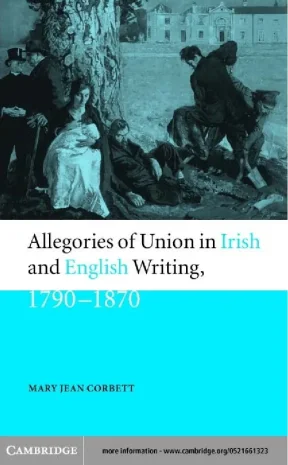
Cambridge university press allegories of union in irish and english writing 1790
Tài liệu: Cambridge university press allegories of union in irish and english writing 1790 1870 politics history and the family from edgeworth to arnold oct 200
cambridge university
english literature
Luan An
book
Năm xuất bản
Số trang
240
Thời gian đọc
36 phút
Lượt xem
0
Lượt tải
0
Phí lưu trữ
50 Point
Mục lục chi tiết
Tóm tắt nội dung
I.Exploring Anglo Irish Relations Allegories of Union
This book delves into representations of Ireland's relationship with England. The analysis spans the nineteenth century, from 1790 to 1870. Fictional and non-fictional writings are examined. Allegories of union form the core of this exploration. These allegories illuminate complex Anglo-Irish relations. The work considers cross-cultural contact negotiation. Tropes of marriage and family are central to this understanding. These rhetorical devices often sustained colonial inequality. Sometimes, they contested it. The study provides a fresh perspective on Victorian culture. It revises critical orthodoxies regarding colonial discourse. The historical and ideological contexts shaping these writings are crucial. The Act of Union 1800 serves as a significant backdrop. Understanding this period is vital for grasping modern Irish and English studies. This comprehensive study enhances scholarship on Unionism and national identity literature.
1.1. Nineteenth Century Perspectives on Union
Allegories of union shaped perceptions of Anglo-Irish relations. The period 1790–1870 saw intense debates. These discussions centered on Ireland's place within the British Empire. Literary works reflected these political tensions. They offered symbolic narratives. These narratives often allegorized the legal Act of Union 1800. Political symbolism became intertwined with everyday life portrayals. This book unpacks those intricate connections. It reveals how writers contributed to public discourse. Their works either supported or challenged imperial structures. The impact on cultural identity Ireland was profound. This analysis provides insights into 19th-century Ireland history. It reveals literary responses to significant historical events.
1.2. Fictional Non Fictional Representations
The book analyzes a broad spectrum of texts. Novels by Edgeworth and Owenson are examined. Works by Gaskell, Kingsley, and Trollope also feature. Non-fictional writings include Burke, Carlyle, and Engels. Arnold and Mill’s contributions are also considered. This diverse collection provides a rich tapestry. It illustrates the varying forms of colonial discourse. Each author contributed to the allegories of union. Their narratives offered different perspectives on Anglo-Irish relations. The chosen works span crucial decades. This allows for a detailed understanding of evolving views. Representations ranged from explicit political commentary to subtle societal critiques. The study demonstrates how diverse literary forms addressed national identity literature.
1.3. Familial Rhetoric in Colonial Contexts
Cross-cultural contact found expression through family tropes. Marriage and family served as powerful allegories. These allegories symbolized the relationship between Ireland and England. Familial rhetoric could sustain colonial inequality. It often portrayed Ireland as a dependent figure. Conversely, this rhetoric sometimes contested existing power structures. It highlighted exploitation or resistance. The analysis applies feminist theory to these dynamics. It reveals how gendered roles mirrored political hierarchies. This approach uncovers hidden layers of political symbolism. It shows the subtle ways colonial discourse operated. These familial narratives were central to shaping public opinion. They influenced perceptions of Irish nationalism and Unionism.
II.Colonial Discourse Irish Identity in 19th Century Lit
The study rigorously examines colonial discourse. It applies postcolonial and feminist theories. These frameworks illuminate the power dynamics at play. The book argues for an unrecognized element in English nation-formation. This element is the "reforming" imperative for the Irish. This imperative emerged during an age of imperial expansion. It profoundly influenced cultural identity Ireland. The analysis revises prevailing critical orthodoxies. It offers new interpretations of Victorian culture. Colonial discourse shaped perceptions of national identity literature. It dictated the terms of Anglo-Irish relations. Understanding this discourse is crucial for Irish nationalism studies. It also sheds light on the historical context of 19th-century Ireland history. The work emphasizes the enduring legacy of these literary and political projects.
2.1. Postcolonial Feminist Theoretical Frameworks
The book employs postcolonial theory, rigorously deconstructing power imbalances inherent in the colonizer-colonized relationship. Feminist theory also plays a vital role, exploring gendered representations embedded within colonial discourse. These frameworks reveal the complex ways cross-cultural contact was negotiated through writing. They expose underlying assumptions about cultural identity Ireland. The theories demonstrate how familial tropes, such as marriage, were utilized. These tropes either reinforced or challenged colonial inequality. This dual theoretical lens provides significant analytical depth. It allows for a nuanced understanding of literary allegory. The approach offers a fresh look at historical texts, highlighting previously overlooked dimensions of political symbolism. It illuminates how authors grappled with Irish nationalism and Unionism through their narratives.
2.2. The Colonizing Imperative for Reforming Ireland
An important argument concerns the "reforming" imperative. English writers often presented the Irish as needing reform. This imperative was a crucial element of imperial expansion. It served to justify colonial discourse. The narrative of reform shaped Anglo-Irish relations. It was often a disguised form of control. This concept influenced policies and public perception. It is a largely unrecognized but critical factor. It links directly to the development of national identity literature. The reform agenda became part of the political symbolism of the era. This analysis revises understandings of 19th-century Ireland history. It demonstrates how literary works contributed to these reformist ideologies.
2.3. English Nation Formation and Imperial Expansion
The imperative to "reform" Ireland linked to English nation-formation. Defining the "other" (Ireland) helped define the "self" (England). This rhetorical project solidified English national identity. It occurred during significant imperial expansion. The relationship with Ireland was central to this process. Colonial discourse shaped both countries' narratives. The perceived need to manage Ireland reinforced England's self-image. This aspect is crucial for understanding 19th-century Ireland history. It highlights how Irish nationalism often reacted to these English self-definitions. The book illuminates this intertwined development. It offers a new perspective on the motivations behind Unionism.
III.Literary Allegory Reshaping Anglo Irish Political Views
Literary allegory served as a powerful tool. It reshaped Anglo-Irish political views throughout the 19th century. Writers employed various allegorical devices. These devices commented on the complex relationship between Ireland and England. The narratives explored themes of dependence, rebellion, and integration. Political symbolism was embedded deeply within fictional and non-fictional texts. These allegories provided cultural spaces. Here, the implications of the Act of Union 1800 could be debated. The book demonstrates how literature influenced public opinion. It shows how it contributed to the ongoing colonial discourse. The study highlights the intricate connection between literary representation and political reality. It reveals how authors used their craft to engage with pressing national identity literature. This offers new insights into both Irish nationalism and Unionism.
3.1. Key Authors and Their Contributions
Numerous influential writers contributed to this discourse. Maria Edgeworth's novels explored social and political themes. Lady Morgan (Owenson) offered unique perspectives on Irish society. Elizabeth Gaskell depicted Irish immigrants in England. Charles Kingsley addressed Irish poverty and land issues. Anthony Trollope's works provided detailed portrayals of Irish life. Non-fiction writers like Edmund Burke examined political philosophy. Thomas Carlyle commented on social conditions. Friedrich Engels analyzed economic implications. Matthew Arnold pondered cultural identity Ireland. John Stuart Mill discussed political governance. Each author, through literary allegory, shaped public understanding of Anglo-Irish relations.
3.2. Marriage and Family Tropes
The recurrent use of marriage and family tropes is significant. These tropes provided a symbolic framework. They allegorized the union between Ireland and England. Marriage could represent political integration or forced subjugation. Family dynamics mirrored colonial power structures. A paternalistic England often "governed" a dependent Ireland. This familial rhetoric was not monolithic. It sometimes reinforced colonial discourse. Other times, it challenged the status quo. These allegories conveyed complex ideas about loyalty, betrayal, and reform. They deeply influenced perceptions of national identity literature. The analysis reveals the political weight carried by these seemingly domestic narratives.
3.3. Challenging Colonial Orthodoxies
This analysis directly challenges prevailing critical orthodoxies. It revises standard interpretations of colonial discourse. The book offers a fresh perspective on Victorian culture. It critiques existing views within Irish and English studies. New readings are situated within varying historical contexts. Ideological frameworks are also meticulously considered. This provides a more nuanced understanding of literary allegory. It unpacks the political symbolism often overlooked. The work encourages reconsideration of established narratives. It highlights the complex interplay between literature and history. This approach contributes to a richer understanding of Anglo-Irish relations. It deepens insights into the long-term effects of the Act of Union 1800.
IV.Analyzing National Identity English Irish Perspectives
The study meticulously analyzes national identity. It explores both English and Irish perspectives. These perspectives are presented through the writings of the period. The book highlights how each nation's identity was constructed. This construction often occurred in relation to the other. Colonial discourse played a key role in shaping these identities. Irish nationalism emerged as a powerful counter-narrative. Unionism, conversely, sought to integrate Ireland. The literature provides rich material for this examination. It reveals the fluid and contested nature of national self-definition. The texts offer insights into cultural identity Ireland. They also illuminate England's evolving sense of self. This dual focus enriches the understanding of Anglo-Irish relations. It connects literary output directly to societal self-perception.
4.1. Divergent Views on the Anglo Irish Union
The Anglo-Irish Union generated widely divergent views. English writers often presented it as a civilizing force. Irish authors, however, frequently depicted it as oppressive. These contrasting perspectives are explored. The literature served as a battleground for ideas. It debated the legitimacy and consequences of the Act of Union 1800. Political symbolism became a means of expression. It conveyed support or dissent. The book illustrates how these differing views shaped national identity literature. It provides context for the emergence of Irish nationalism. It also illuminates the arguments put forth by Unionism. This section clarifies the ideological rifts of the era.
4.2. Cultural Identity and Political Symbolism
Cultural identity Ireland was deeply intertwined with political symbolism. Literary allegories often embodied national characteristics. These characteristics were frequently stereotyped or romanticized. Political symbolism functioned on multiple levels. It could represent nationhood, grievance, or aspirations. The language used in these texts was critical. It helped forge or challenge collective identities. Colonial discourse often attempted to define Irish culture. However, Irish writers reclaimed and redefined their cultural narratives. This dynamic interplay is a central theme. It highlights the power of literature in shaping perceptions. The examination reveals the ongoing struggle for self-definition in 19th-century Ireland history.
4.3. Reinterpreting Victorian Culture
The book offers a reinterpretation of Victorian culture. It argues that Ireland was a crucial element. This connection is often overlooked in traditional studies. The colonizing imperative impacted English nation-formation significantly. Understanding Anglo-Irish relations is key to understanding Victorian values. The analysis reveals the imperial undercurrents of the era. It shows how Ireland featured in the English imagination. This new perspective challenges conventional views. It integrates colonial discourse into the mainstream of Victorian studies. The work enriches understanding of the period. It demonstrates the pervasive influence of the Irish question on English intellectual life.
V.The Act of Union 1800 Literary Historical Context
The Act of Union 1800 stands as a pivotal historical event. Its ramifications profoundly influenced Anglo-Irish relations. The book thoroughly examines this Act's impact. It shows how the Union became a dominant theme in literature. Writers used various literary allegories to interpret the Act. These allegories explored its political, social, and cultural consequences. The historical context of 19th-century Ireland history is crucial. This context provides the backdrop for understanding the period's writings. The analysis connects literary output directly to this foundational political decision. It illustrates how authors grappled with the concept of "union" itself. Their narratives reflect both the hopes and disillusionments associated with it. This study provides a comprehensive look at the intertwined historical and literary narratives surrounding the Union.
5.1. Historical Background and Literary Echoes
The Act of Union 1800 formally joined the Kingdom of Ireland with Great Britain. This political change spurred extensive literary responses. Authors explored the shift in governance and identity. Literary works became echoes of historical events. They reflected the debates surrounding Unionism and Irish nationalism. Many texts used political symbolism to convey their stance. The narratives drew on real-world political struggles. They transformed these struggles into compelling allegories. This section demonstrates the direct link between history and literature. It shows how the literary imagination processed a major political transformation. The Act's legacy shaped a century of writing.
5.2. Political and Social Ramifications
The Act of Union 1800 had far-reaching political and social effects. These ramifications are carefully detailed through the literary analysis. The book reveals how writers addressed issues like governance, economy, and social unrest. Colonial discourse often framed these issues. It shaped perceptions of Ireland's progress or decline. Authors grappled with the challenges of integration. They also explored the rise of national sentiment. The literature provides a lens. It allows examination of the social fabric under Union rule. This includes the emergence of various forms of Irish nationalism. The text shows the literary exploration of a complex political landscape. It highlights the social tensions prevalent throughout 19th-century Ireland history.
5.3. Rhetorical Projects of Union
The concept of "union" was itself a rhetorical project. It was presented in various ways by different writers. Some depicted a harmonious integration, others a forced subjugation. Literary allegory was central to these rhetorical efforts. Political symbolism allowed for nuanced discussions. These discussions often revolved around the benefits or detriments of the Act of Union 1800. The book unpacks these competing narratives. It shows how writers constructed arguments for or against the Union. Their works contributed to public understanding. They influenced the ongoing debates on Anglo-Irish relations. This rhetorical battle shaped national identity literature for generations. It reflected the deep divisions concerning Unionism.
Tải xuống file đầy đủ để xem toàn bộ nội dung
Tải đầy đủ (240 trang)Trích đoạn nội dung luận án
Tải xuống để đọc toàn bộaaaaaa This page intentionally left blank AL LEGOR IE S O F U NI ON I N I RI S H A ND EN GLI S H W R ITI NG, – In this book, Mary Jean Corbett explores fictional and non- fictional representations of Ireland’s relationship with England throughout the nineteenth century. Through postcolonial and feminist theory, she considers how cross-cultural contact is negoti- ated using tropes of marriage and family, and demonstrates how familial rhetoric sometimes works to sustain, sometimes to contest, the structures of colonial inequality. Analyzing novels by Edgeworth, Owenson, Gaskell, Kingsley, and Trollope as well as writings by Burke, Carlyle, Engels, Arnold, and Mill, Corbett argues that the colonizing imperative for ‘‘reforming’’ the Irish in an age of imperial expansion constitutes a largely unrecognized but crucial element in the rhetorical project of English nation-forma- tion. By situating her readings within the varying historical and ideological contexts that shape them, she revises the critical ortho- doxies surrounding colonial discourse that currently prevail in Irish and English studies, and offers a fresh perspective on important aspects of Victorian culture.
is Associate Professor of English and Affiliate of Women’s Studies at Miami University in Oxford, Ohio. Her publications include Representing Femininity: Middle-Class Subjec- tivity in Victorian and Edwardian Women’s Autobiographies (). Her work has also appeared in Criticism, Eighteenth-Century Life, ELH, Studies in the Novel, and Women’s Studies. aaaaaa A L L E G O R I E S O F U NI O N IN IRISH AND ENGLI SH WRITI NG, – Politics, History, and the Family from Edgeworth to Arnold M A R Y J E A N C OR B E TT The Pitt Building, Trumpington Street, Cambridge, United Kingdom The Edinburgh Building, Cambridge CB2 2RU, UK 40 West 20th Street, New York, NY 10011-4211, USA 477 Williamstown Road, Port Melbourne, VIC 3207, Australia Ruiz de Alarcón 13, 28014 Madrid, Spain Dock House, The Waterfront, Cape Town 8001, South Africa http://www.org © Mary Jean Corbett 2004 First published in printed format 2000 ISBN 0-511-03346-X eBook (Adobe Reader) ISBN 0-521-66132-3 hardback My family on both sides belonged to the toiling and dying types who made it over to America.
And once in America, people divided once again: you could say they became the poor and the rich. The losers and winners. The artists and scientists. If they were countries, they’d be Ireland and England.
Carolyn See, Dreaming: Good Luck and Hard Times in America Of the numbers who study, or at least who read history, how few derive any advantage from their labours! Maria Edgeworth, Preface to Castle Rackrent MMMM Contents Acknowledgments page ix Introduction Public affections and familial politics: Burke, Edgeworth, and Ireland in the s Allegories of prescription: engendering Union in Owenson and Edgeworth Troubling others: representing the immigrant Irish in urban England around mid-century Plotting colonial authority: Trollope’s Ireland, – England’s opportunity, England’s character: Arnold, Mill, and the Union in the s Afterword Notes Bibliography Index vii aaaaa Acknowledgments A book that has taken this long to write has run up exorbitant debts in its author’s name. First and foremost, I owe my mother, Joan; my brothers, Dennis, Bill, and Tom; my sisters, Susan and Judy; and the bright lights of the next generation – Lauren, Brendan, Conor, Mara, Liam, and Brigit – for putting up with it, and with me. Always and everywhere, Regenia Gagnier and Rob Polhemus remain what I hope to become; much love and thanks to both for their extravagant kindness and unstinting support. Shay Brawn, Alex Chasin, Ira Livingston, and Kelly Mays are still among the best friends I’ve ever made, and I feel beyond fortunate to have all of them in my life, more than ten years on.
And there will be no end to owing Brad King, Maggy Lindgren, Lucy Jackson Norvell, Nedra Reynolds, Kate Rousmaniere, and Ann Wier- wille for their care, friendship, and encouragement. I need to repay with interest those colleagues in English at Miami University who have contributed to the process and the product in either highly concrete or virtually intangible ways, often in both: Steven Bauer, Kim Dillon, Eric Goodman, Susan Jarratt, Katie Johnson, Frank Jordan, Laura Mandell, Kate McCullough, Lori Merish, Kerry Powell, and Vicki Smith, with special thanks to Tim Melley for providing a timely reading and to Barry Chabot for giving us all a local habitation. I’m obliged as well to the innumerable graduate and undergraduate students I’ve known and admired in the past ten years, who have given me way more than they realize, and to all manner of other folks with whom I’ve talked and to whom I’ve listened, especially Deborah Morse and Anca Vlasopolos, along with many other members of the Interdisci- plinary Nineteenth Century Studies Association. Two other colleagues have also enriched my work in particularly important ways, which they would fully recognize only in reading the pages of this book: my deepest gratitude for their intellectual companionship to Fran Dolan and to Susan Morgan.
ix x Acknowledgments For the gifts of time and institutional support, I thank the Committee on Faculty Research, the Department of English, and the College of Arts and Sciences at Miami University. I’m also obliged to Ray Ryan of Cambridge University Press, and to the two anonymous readers of the manuscript, who have improved it by their knowledge and rigor. An earlier version of the argument on Owenson in Chapter Two appeared as ‘‘Allegories of Prescription: Engendering Union in The Wild Irish Girl,’’ Eighteenth-Century Life (). And some of the material on Burke and Edgeworth that appears in Chapters One and Two is revised from two other essays already in print: ‘‘Public Affections and Familial Politics: Burke, Edgeworth, and the ‘Common Naturalization’ of Great Britain,’’ ELH (); and ‘‘Another Tale to Tell: Postcolonial Theory and the Case of Castle Rackrent,’’ Criticism ().
Introduction In Seamus Heaney’s allegorical lyric, ‘‘Act of Union’’ (), the coup- ling of England and Ireland issues in the conception of ‘‘an obstinate fifth column,’’ ‘‘the heaving province’’ of Ulster.¹ Identifying the mascu- line position with English imperial power, the poem links the colonized Irish land with the feminine, carrying a fetal body that will never be born into separateness; even as it marks the geopolitical site ‘‘where our past has grown’’ (), Ulster is itself a product of the past that has survived into the present, cleaving to the mother from whom it cannot be divided. With a heart that throbs like ‘‘a wardrum / Mustering force’’ (–) and ‘‘ignorant little fists’’ () that ‘‘Beat at your borders’’ (), this angry child of Union punishes its mother from within and threatens its father, too, ‘‘across the water’’ (). The ‘‘legacy’’ () of force and violence, the poem suggests, is more of the same: the crossing of two cultures under conditions of imperial masculine dominance and colon- ized feminine subordination produce only a bitter fruit, with Union’s offspring – both a part of and apart from its parents – signifying Union’s enduring brutality. Now, more than thirty years after the renewal of ‘‘the troubles,’’ it may be difficult to read the ‘‘legacy’’ of the Act of Union in any other way.
The terms that Heaney’s poem deploys, however, should make feminist readers suspicious – not of the fact of conquest the poem describes, but of the sexualized and gendered binary it superimposes on the colonial relation, and of its attendant use of rape as a metaphor of imperial exploitation. When I teach Heart of Darkness, I must often remind students that to equate the Euroconquest of Africa with hetero- sexual rape is to engage rhetorically in a version of the act they liberally claim to condemn. Similarly, Heaney’s poem aims to demystify, to reveal that the heart of an immense darkness is beating still, not just in London, but in Dublin, Derry, and Belfast as well. Yet we might better understand the gendered rhetoric of the poem as itself a product of Allegories of Union in Irish and English writing English discursive violence, another legacy of the rhetoric of empire as it has been institutionalized in ways of speaking and writing, learning and teaching.
Does Heaney’s extended use of this gendered imperial metaphor suggest that he is thoroughly ‘‘possessed by. the atavistic myth he deplores,’’ as Elizabeth Butler Cullingford implies?² Returning to the poem, I find that my interpretation of it depends on how I locate the speaker of the piece, and how I locate myself as a reader of it. The Latin Americanist Doris Sommer has made the point, in another colonial context, that ‘‘differences in evaluating nationalism’’ – or in evaluating the textual history of nation-formation – ‘‘may have less to do with which position is right or wrong than with the positionality one occu- pies.’’³ In this instance, because the ‘‘I’’ of ‘‘Act of Union’’ speaks for and as England (‘‘the tall kingdom over your shoulder’’ []), a female reader may well see herself positioned by the poem as the passive, all-too- female Irish body, raped and pregnant. And as a feminist reader embodied and culturally situated as a woman, this position, of course, is one I am inclined to refuse and resist in reading or writing the colonial relation, in that it reproduces that which it seeks to critique.
Nations and territories are not women to a feminist reader, however loudly a mascu- linist speaker might proclaim them to be. My positionality would lead me to envision the scene quite differently. Yet I also notice, on rereading, that the lyric voice marks Heaney’s speaker as English, and thus as ‘‘imperially / Male’’ (–), which complicates things, given the poet’s own divergent cultural locations. Recognizing the poetic speaker as male without adequately accounting for his Englishness, I have erred both in mistaking the ‘‘I’’ for the poet and in assigning the lyric voice to a generic man, any man, rather than to a specifically English man.
Once recognized as identifiably gendered and ethnic, the ‘‘I’’ of the poem may be seen to occupy a discursive position within a system of representation historically produced largely by English men. Enda Duffy suggests in a reading of another Heaney poem that ‘‘what is seen is always now seen partly through the op- pressor’s voice and that vision is spoken always, partly in the oppressor’s language and forms’’:⁴ today this discursive position is also potentially available to any one of us to appropriate, perhaps, or ironically to reverse, even if the different locations we occupy will differently nuance our uses of it. Thus my first reading of the poem in terms of a simple gender binary is challenged not simply by Heaney’s biographical status as an Irish man, but by his speaker’s cross-cutting identifications with both positions, (feminine) colonized and (masculine) colonizer. No bi- Introduction nary can adequately articulate the complexity of the poetic and political situation: a point those in or from the North may know especially well.
Perhaps the poet has succeeded in leading me to misread because he has learned so well the trick of throwing his voice; or maybe it is because the gendered rhetorics of the imperial indeed inhabit us all in various ways, and have at times deafened us to colonial accents. Heaney’s uncanny ability to mimic the ‘‘imperially / Male’’ colonizer suggests that even as the poem grounds itself in a hierarchical opposition between English man and Irish woman, it also invites us to question the fixity of the positions it represents and to historicize the relations it maps.
Nội dung được bảo vệ bản quyền — Tải xuống đầy đủ
Câu hỏi thường gặp
Luận án "Cambridge university press allegories of union in irish and" nghiên cứu về vấn đề gì?
Tài liệu: Cambridge university press allegories of union in irish and english writing 1790 1870 politics history and the family from edgeworth to arnold oct 200
Luận án "Cambridge university press allegories of union in irish and" được bảo vệ tại trường nào?
Luận án này được bảo vệ tại cambridge university. Năm bảo vệ: 2000.
Luận án "Cambridge university press allegories of union in irish and" thuộc chuyên ngành gì?
Luận án "Cambridge university press allegories of union in irish and" thuộc chuyên ngành english literature. Danh mục: Văn Học Nước Ngoài.
Luận án "Cambridge university press allegories of union in irish and" có bao nhiêu trang?
Luận án "Cambridge university press allegories of union in irish and" có 240 trang. Bạn có thể xem trước một phần tài liệu ngay trên trang web trước khi tải về.
Cách tải luận án "Cambridge university press allegories of union in irish and" về máy như thế nào?
Để tải luận án về máy, bạn nhấn nút "Tải xuống ngay" trên trang này, sau đó hoàn tất thanh toán phí lưu trữ. File sẽ được tải xuống ngay sau khi thanh toán thành công. Hỗ trợ qua Zalo: 0559 297 239.