Luận án: Sự trở lại của Villanelle - Nghiên cứu của Amanda French
Luận án: Amanda french villanelle dissertation. Xem tóm tắt và tải về tại LuanAn.net
University of Virginia
Department of English
Luan An
Luận án tiến sĩ
Năm xuất bản
Số trang
284
Thời gian đọc
43 phút
Lượt xem
0
Lượt tải
0
Phí lưu trữ
50 Point
Tổng quan nhanh
- Chủ đề:
- Nguồn gốc Villanelle và sự thật lịch sử
- Số trang:
- 284 trang
- Trường:
- University of Virginia
- Chuyên ngành:
- Department of English
- Tác giả:
- Amanda Lowry French
- Năm:
- 2004
Tóm tắt nội dung luận án
I.Nguồn gốc Villanelle và sự thật lịch sử
Tài liệu này thách thức những quan niệm sai lầm về lịch sử thể thơ Villanelle. Nhiều văn bản tham khảo dạy rằng cấu trúc 19 dòng, lặp lại xen kẽ của Villanelle đã được hệ thống hóa từ thời Phục hưng. Nghiên cứu sâu hơn đã bác bỏ điều này. Nhà học giả Julie Kane đã chứng minh Passerat là ví dụ duy nhất của thể thơ này vào thời Phục hưng. Phát hiện này định hình lại hiểu biết về nguồn gốc Villanelle. Nó cho thấy sự cần thiết của việc xem xét lại các kiến thức hiện có. Luận văn này khám phá sâu hơn về quá trình phát triển của thể thơ. Từ nguồn gốc được thần thoại hóa đến sự tái sinh trong thi ca hiện đại. Nó cung cấp một cái nhìn toàn diện và chính xác về hành trình của Villanelle.
1.1. Luận giải về nguồn gốc Villanelle
Tài liệu này bác bỏ quan niệm phổ biến về thể thơ Villanelle. Nhiều văn bản tham khảo dạy cấu trúc 19 dòng, lặp lại xen kẽ của Villanelle được hệ thống hóa vào thời Phục hưng. Nghiên cứu chỉ ra điều này là không chính xác. Nhà học giả Julie Kane đã chứng minh Passerat là ví dụ duy nhất của thể thơ này vào thời Phục hưng. "Villanelle" của Jean Passerat ("J'ay perdu ma Tourterelle"), viết năm 1574, xuất bản lần đầu năm 1606, là ví dụ duy nhất. Điều này thách thức những giả định cũ về nguồn gốc Villanelle.
1.2. Phát hiện về sự tái sinh Villanelle
Nghiên cứu mới khám phá sự "tái sinh" của Villanelle vào thế kỷ 19. Nguồn gốc đến từ một chuyên luận năm 1844. Tác giả là Wilhelm Ténint, một nhà thơ-phê bình lãng mạn người Pháp ít được biết đến. Cuộc nghiên cứu này theo dõi luật thơ Villanelle. Từ nguồn gốc được thần thoại hóa ở thời Phục hưng Pháp. Đến việc triển khai trong thơ ca Pháp hậu lãng mạn. Thi ca Anh Parnassian và Decadent cũng sử dụng. Sự sống sót của nó trong giai đoạn hiện đại chủ nghĩa đỉnh cao được xem xét. Sau đó là sự phục hưng nhỏ vào giữa thế kỷ. Cuối cùng, sự nổi bật trong thi ca Anh ngữ đương đại, đặc biệt sau "One Art" của Elizabeth Bishop.
II.Cấu trúc Villanelle và đặc điểm nổi bật
Thể thơ Villanelle nổi bật với cấu trúc cố định độc đáo. Nó bao gồm 19 dòng thơ, được chia thành các khổ thơ có vần và điệp khúc lặp lại. Cấu trúc này không chỉ mang tính hình thức mà còn tạo nên hiệu ứng cảm xúc sâu sắc. Sự lặp lại có chủ đích của các dòng điệp khúc là một đặc điểm chính. Điều này giúp bài thơ có âm hưởng du dương và tạo điểm nhấn cho thông điệp. Ngày nay, cấu trúc Villanelle thu hút nhiều nhà thơ. Nó mang đến sự kết hợp giữa truyền thống và sự tự do sáng tạo. Đây là một điểm mạnh khiến thể thơ này tiếp tục phát triển. Thể thơ Villanelle mang lại sự ổn định trong hình thức. Đồng thời, nó cho phép sự biến hóa trong nội dung.
2.1. Định nghĩa và luật thơ Villanelle
Thể thơ Villanelle có cấu trúc độc đáo. Đó là một hình thức 19 dòng. Các dòng được chia thành năm khổ thơ ba dòng (tercet) và một khổ thơ bốn dòng (quatrain) cuối cùng. Hai dòng thơ lặp lại xuất hiện xen kẽ ở cuối mỗi khổ thơ ba dòng. Sau đó, chúng tạo thành hai dòng kết thúc của khổ thơ bốn dòng cuối. Dòng đầu tiên của khổ thơ đầu tiên lặp lại làm dòng cuối của khổ hai và bốn. Dòng thứ ba của khổ thơ đầu tiên lặp lại làm dòng cuối của khổ ba và năm. Cả hai dòng lặp lại xuất hiện như hai dòng cuối cùng của khổ thơ cuối. Đây là một cấu trúc Villanelle chặt chẽ.
2.2. Hấp dẫn của thể thơ Villanelle hiện đại
Villanelle được xem là hình thức cố định của sáng tạo đương đại trong tiếng Anh. Các nhà thơ đương đại bị thu hút bởi hình thức này. Nó gợi lên truyền thống. Nhưng không mang gánh nặng của truyền thống. Các nhà thơ không cần biết Villanelle không phải là một hình thức cổ xưa, nước ngoài. Sự phổ biến hiện tại của Villanelle 19 dòng cố định trong thi ca Anh ngữ được ghi nhận. Đồng thời, sự vắng mặt của nó trong thi ca Pháp ngữ cũng được chú ý. Thể thơ này mang lại sự kết hợp giữa sự quen thuộc và sự đổi mới. Điều này lý giải sức hút của cấu trúc Villanelle trong văn học hiện đại.
III.Lịch sử Villanelle Từ Pháp đến thi ca Anh
Lịch sử Villanelle là một hành trình phức tạp, bắt đầu từ Pháp và lan rộng sang thi ca Anh. Nghiên cứu này theo dõi thể thơ từ nguồn gốc được thần thoại hóa ở thời Phục hưng Pháp. Nó đi qua giai đoạn hậu lãng mạn Pháp và thi ca Anh Parnassian, Decadent. Thể thơ đã trải qua nhiều biến động. Trong thế kỷ 19, các nhà thơ-phê bình đã tạo ra một lịch sử giả mạo cho nó. Mặc dù có những thách thức, Villanelle vẫn tồn tại. Nó tìm thấy con đường vào thi ca Anh. Nó dần được các nhà thơ hiện đại chấp nhận và biến đổi. Đây là một minh chứng cho sự bền bỉ của thể thơ. Villanelle vượt qua các rào cản văn hóa và thời gian.
3.1. Hành trình lịch sử thơ ca Pháp
Nghiên cứu theo dõi Villanelle từ nguồn gốc được thần thoại hóa. Đó là chủ nghĩa nhân văn thời Phục hưng Pháp. Chương một tập trung vào "J'ay perdu ma Tourterelle" của Jean Passerat. Nó cung cấp lịch sử, đối chiếu, giải thích và bản dịch mới cho bản Villanelle gốc này. Chương hai mô tả bối cảnh thẩm mỹ mang tính chính trị cao. Đó là thời kỳ hậu lãng mạn Pháp và Anh thế kỷ 19. Các nhà thơ-phê bình chuyên nghiệp như Théodore de Banville và Edmund Gosse đã đưa ra một lịch sử giả mạo cho thể thơ Villanelle. Lịch sử thơ ca Pháp bị xuyên tạc trong quá trình này.
3.2. Sự lan tỏa vào thi ca Anh
Villanelle được triển khai trong thơ ca Pháp hậu lãng mạn. Sau đó là thi ca Anh Parnassian và Decadent. Chương ba xem xét vị thế thấp của các hình thức Pháp. Điều này diễn ra trong giai đoạn hiện đại chủ nghĩa đỉnh cao và Thế chiến thứ nhất. Các tác phẩm của Joyce và Pound được thảo luận. Các bài thơ yêu nước cũng được xem xét. Villanelle chỉ sống sót một cách khó khăn. Nhưng nó đã tồn tại qua những thay đổi lớn. Thi ca Anh đã đón nhận và biến đổi thể thơ này theo cách riêng.
IV.Villanelle trong thơ hiện đại Dylan Thomas Elizabeth Bishop
Villanelle đã tìm thấy một vị trí quan trọng trong thơ ca hiện đại. Các tác phẩm của Dylan Thomas và Elizabeth Bishop là minh chứng rõ ràng. "Do not go gentle into that good night" của Dylan Thomas đã đưa luật thơ Villanelle lên tầm cao mới. Bài thơ này mạnh mẽ và đầy cảm xúc. Nó cho thấy sức mạnh của sự lặp lại trong cấu trúc Villanelle. Elizabeth Bishop tiếp tục phát triển thể thơ này với "One Art". Bài thơ của Bishop thể hiện sự tinh tế và khả năng ứng dụng của Villanelle trong các chủ đề đương đại. Những tác phẩm này không chỉ là những bài thơ nổi tiếng. Chúng còn là cột mốc quan trọng trong sự tái sinh của Villanelle. Chúng khẳng định vị thế của thể thơ này trong thi ca Anh ngữ.
4.1. Tác động của Dylan Thomas và Do not go gentle
Chương bốn khám phá các nguồn của "Do not go gentle into that good night." Đây là một Villanelle nổi tiếng của Dylan Thomas. Bài thơ này có ảnh hưởng sâu rộng. Nó ảnh hưởng đến các nhà thơ sau này. Tác phẩm của Thomas cho thấy sức mạnh của cấu trúc Villanelle. Bài thơ truyền tải cảm xúc mãnh liệt. Nó sử dụng hiệu quả sự lặp lại của luật thơ Villanelle. "Do not go gentle into that good night" trở thành một biểu tượng. Nó chứng minh khả năng của thể thơ này trong việc truyền đạt thông điệp mạnh mẽ.
4.2. One Art của Elizabeth Bishop và sự ảnh hưởng
Elizabeth Bishop là một nhân vật quan trọng. "One Art" của Bishop (1976) đưa Villanelle lên một tầm cao mới. Tác phẩm này đóng vai trò quyết định. Nó làm nổi bật Villanelle trong thi ca Anh ngữ. "One Art" thể hiện sự tinh tế. Nó sử dụng thành thạo cấu trúc Villanelle. Bài thơ này là lý do cho sự nổi bật của Villanelle. Nó xuất hiện trong "cuộc chiến văn hóa đa giọng" của thơ ca Anh ngữ. Villanelle của Bishop chứng minh tính linh hoạt của thể thơ. Nó cũng thể hiện khả năng phù hợp với những chủ đề phức tạp.
V.Villanelle Thể thơ vượt thời gian và tái sinh
Villanelle là một thể thơ độc đáo. Nó được coi là hình thức cố định của sáng tạo đương đại trong tiếng Anh. Điều này trái ngược với quan niệm về nguồn gốc cổ xưa của nó. Thể thơ này mang ý nghĩa truyền thống. Nhưng nó không bị gánh nặng bởi những quy tắc cứng nhắc của quá khứ. Đây là một trong những lý do chính cho sức hút của nó. Villanelle vẫn tiếp tục phát triển. Nó truyền cảm hứng cho các nhà thơ hiện đại. Sự tái sinh của Villanelle là một câu chuyện thành công. Nó cho thấy cách một hình thức thơ ca có thể thích nghi và phát triển qua các thời đại. Vị thế của nó trong thi ca đương đại là một minh chứng cho sức sống lâu bền. Villanelle thực sự là một thể thơ vượt thời gian.
5.1. Vị thế độc đáo của thể thơ Villanelle
Villanelle có thể được gọi một cách chính xác. Nó là hình thức cố định duy nhất của sáng tạo đương đại trong tiếng Anh. Thể thơ này mang ý nghĩa truyền thống. Nhưng không mang gánh nặng của truyền thống. Điều này tạo nên sức hấp dẫn. Các nhà thơ và học giả không cần biết Villanelle không phải là một hình thức cổ xưa. Nó không phải một hình thức nước ngoài. Sự hiểu biết mới này thay đổi cách nhìn. Nó định vị lại luật thơ Villanelle trong lịch sử văn học.
5.2. Sự hiện diện trong thi ca đương đại
Kết luận đặt Villanelle vững chắc. Nó nằm trong bối cảnh văn hóa thơ ca chuyên nghiệp đương đại. Sự phổ biến của thể thơ Villanelle 19 dòng cố định trong thi ca Anh ngữ được tài liệu hóa. Điều này trái ngược với sự vắng mặt của nó trong thi ca Pháp ngữ. Thể thơ này tiếp tục thu hút sự chú ý. Nó truyền cảm hứng cho các nhà thơ. Villanelle là một minh chứng. Nó cho thấy sức sống và khả năng thích nghi của thơ ca. Sự tái sinh của Villanelle là một câu chuyện độc đáo.
Mục lục chi tiết luận án
Tải xuống file đầy đủ để xem toàn bộ nội dung
Tải đầy đủ (284 trang)Trích đoạn nội dung luận án
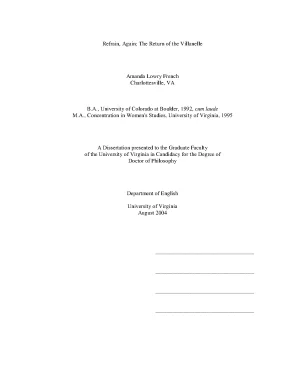
Tải xuống để đọc toàn bộRefrain, Again: The Return of the Villanelle Amanda Lowry French Charlottesville, VA B., University of Colorado at Boulder, 1992, cum laude M., Concentration in Women's Studies, University of Virginia, 1995 A Dissertation presented to the Graduate Faculty of the University of Virginia in Candidacy for the Degree of Doctor of Philosophy Department of English University of Virginia August 2004 ___________________________________ ___________________________________ ___________________________________ ___________________________________ ABSTRACT Poets and scholars are all wrong about the villanelle. While most reference texts teach that the villanelle's nineteen-line alternating-refrain form was codified in the Renaissance, the scholar Julie Kane has conclusively shown that Jean Passerat's "Villanelle" ("J'ay perdu ma Tourterelle"), written in 1574 and first published in 1606, is the only Renaissance example of this form. My own research has discovered that the nineteenth-century "revival" of the villanelle stems from an 1844 treatise by a little- known French Romantic poet-critic named Wilhelm Ténint. My study traces the villanelle first from its highly mythologized origin in the humanism of Renaissance France to its deployment in French post-Romantic and English Parnassian and Decadent verse, then from its bare survival in the period of high modernism to its minor revival by mid-century modernists, concluding with its prominence in the polyvocal culture wars of Anglophone poetry ever since Elizabeth Bishop’s "One Art" (1976).
The villanelle might justly be called the only fixed form of contemporary invention in English; contemporary poets may be attracted to the form because it connotes tradition without bearing the burden of tradition. Poets and scholars have neither wanted nor needed to know that the villanelle is not an archaic, foreign form. The introduction documents the current popularity of the nineteen-line fixed-form villanelle in Anglophone poetry and its absence in Francophone poetry. The first chapter focuses on Jean Passerat's "J'ay perdu ma Tourterelle," offering a history, collation, interpretation, and new translation of this ignored original villanelle.
The second chapter describes the highly politicized aesthetic context of nineteenth-century French and English post-Romanticism, when professional poet-critics Théodore de Banville and Edmund Gosse claimed a false history for the villanelle. The third chapter examines the low status of the French forms in the period of high modernism and the Great War, discussing works by Joyce and Pound as well as patriotic poems. The fourth chapter explores the sources of Dylan Thomas's "Do not go gentle into that good night" and its influence on later poets, especially Elizabeth Bishop. The conclusion places the villanelle firmly within the context of contemporary professional poetry culture.
TABLE OF CONTENTS ABSTRACT. ii TABLE OF CONTENTS.10 CHAPTER ONE: The Lost Turtledove .31 CHAPTER TWO: Young Men of Talent .62 CHAPTER THREE: Ardent Ways.109 CHAPTER FOUR: Grave Truths, Grave Men .185 APPENDIX I: Anthologies Examined .193 APPENDIX II: List of Villanelles.199 APPENDIX III: Historical Collation of Passerat's "J'ay perdu ma Tourterelle" .228 APPENDIX IV: Comparisons.241 ACKNOWLEDGMENTS I could scarcely believe how simultaneously comfortable and productive the first meeting of my dissertation committee was. My advisor, Professor Stephen Cushman, introduced me to the villanelle and to the work of Elizabeth Bishop in his superb lectures for History of Twentieth-Century Literature in English, and his Fictions of Form was highly important to my thinking. He also took me on as a dissertation student when I half expected him to turn me down, and when he was very busy with other commitments.
Like Professor Cushman, my second reader, Professor Mark Edmundson, gave me by example the courage to be unfashionably individualist in my scholarship with great books like Nightmare on Main Street and Teacher. He also came to hear me play the guitar once, which was cool. Professor Lisa Russ Spaar of the Creative Writing Program offered a friendly ear and insight into the culture of creative writing, and Professor Mary McKinley of the French Department was particularly indispensable when I was preparing to write Chapter One. Professor Alison Booth was a role model from the very first.
Professor Jerome McGann offered advice on directions for a project and read my attempts to formulate one. Professor David Vander Meulen first introduced me to the principles of bibliography and was no less than essential to the development of the historical collation that forms Appendix III. Professor Michael Bishop of Dalhousie University at Halifax, Nova Scotia in Canada answered my questions on contemporary French poetry via e-mail. Professor Julie Kane of Northwestern State University at Natchitoches in Lousiana wrote a great dissertation that sparked my imagination, wrote a great manuscript of poetry that ditto, vi and wrote me very fully and satisfyingly back when I wrote to her, which she certainly didn't have to do.
The English Department gave me employment as well as education for many years: first as a work-study student with office jobs, research assistantships, and graderships, then as a graduate instructor. In conjunction with the Teaching + Technology Initiative, they funded my position as Teaching with Technology Support Partner for three years. The Rossetti Archive and the Electronic Text Center at Alderman Library also gave me paid work marking up texts in SGML and XML. The UVa branch of the Minority Medical Education Program gave me summer work for four years teaching medical school applicants to write personal essays for their medical school applications.
Every single one of these jobs did more than pay the bills; all of them were challenging and enjoyable and sometimes moving, and all of them gave me much to ponder about life and language and the relationship between them. The Interlibrary Loan office at the University of Virginia Library labored tirelessly on my behalf. The University of Virginia Library in general amazed me with its seemingly endless resources—its stacks, its Special Collections, its diverse services, and its technological sophistication. The OCLC FirstSearch database WorldCat and the Eureka RLG Union Catalog (formerly the RLIN Bibliographic File) seemed omniscient.
ISIResearchSoft's bibliographic software program EndNote organized and formatted everything for me; I can't imagine working without it. Michelle Allen, June Griffin, Elizabeth Outka, Lisa Spiro, and Virginia Zimmerman (now all anointed Ph.s!) held my hand patiently through several years of a vii project that I eventually chose to abandon; my memories of that project are now colored with distaste, but my memories of our dissertation group are green and gold, like spinach and garlic, and are some of the best memories of my life. Gangs of women dedicated to a professional vocation are too rare; the members of that group all know how special those meetings were. My close friends Margaret Gardiner, Danny Schmidt, Janus Raphaelidis, Jan Smith, Browning Porter, Jeff Romano, Paul Curreri, and Devon Sproule, on the other hand, might not know that they've enriched my intellectual life every bit as much as they have my social life.
I appreciate and admire their talents, their ambitions, their principles, and their constancy more than I can say. Finally, I would like to thank my mother: firstly that she conceived me, secondly that she bore me, thirdly that she raised me, fourthly that she also did all the same for my beloved brother Sam, fifthly that she discreetly supplemented my income when I needed it (which was often), and lastly because she is in her own right an energetic, generous woman with the strength to start all over again. PERMISSIONS Professor Phillip K. Jason granted permission to reprint his English translation of Jean Passerat's "Villanelle" ("J'ay perdu ma Tourterelle"), which originally appeared in his article "Modern Versions of the Villanelle," College Literature 7 (1980).
Means, English and American Literature Librarian of the Brigham Young University Library granted permission to use his scanned image of "We Shall Not Sleep," Ladies' Home Journal 35. The image is also available at http://www.edu/~english/WWI/main/LHJ1918.html as part of a virtual exhibit titled "Anthem for Doomed Youth: Writers and Literature of The Great War, 1914- 1918." Whenever we think of what fulfills itself By making use of us, we are somewhat uneasy. A form is accomplished, exists, though before it was not, And we have nothing more to do with it. Others, generations, Will choose what they want, accepting or destroying it.
And instead of us, real, they will need just names. Czeslaw Milosz, from "At Yale"1 INTRODUCTION The first villanelle I ever read knowing that it was a villanelle was Elizabeth Bishop's "One Art." I read it in the fall of 1998, while in graduate school at an American university at the tail end of the twentieth century, serving as a teaching assistant in a 300- student class on twentieth-century literature in English for English majors: Elizabeth Bishop served a week's sentence on the syllabus. Until that time, I had not heard of the villanelle--or if by some chance I had, it would only have been a passing mention (immediately forgotten) in connection with Dylan Thomas's "Do not go gentle into that good night" or Theodore Roethke's "The Waking," no doubt. Even though I had always been fond of both those poems--and remembered studying the Roethke at some length in a class during my undergraduate work--I had certainly never before learned that (as these lecturers explained to these undergraduates) the villanelle was an archaic French form whose rules were strict: nineteen lines, five tercets, one quatrain, two rhymes, and two rhyming refrains alternating at fixed intervals.
Struck by Bishop's poem, I looked up the villanelle in a poetry handbook— Stephen Adams's Poetic Designs: An Introduction to Meters, Verse Forms, and Figures of Speech (1997). I happened to have this handbook on hand because it had been assigned as one of the chief texts in Studies in Poetry, a class I was to teach for the first time in the following semester. I was at that time specializing in the Victorian novel, but I had been tapped to teach Studies in Poetry chiefly on the strength of having written a few poems, which made me better qualified to teach the class than the other prose specialists bursting the seams of the department. Nevertheless, I was of course anxious to increase my authority in this relatively unexplored field before having to pose as an expert in it, and 11 the villanelle sounded like something a bit tricky that I'd need to brush up on.
That certainly served as extra incentive to look it up, even apart from the appeal "One Art" had for me. In a chapter on "Stanza and Form," in a subsection on "The French Forms," Adams reported that the villanelle is "more frequently met with" than the triolet, and like the triolet also features a double refrain, this time on the same rhyme: A'bA" abA' abA" abA' abA" abA'A". The meter can be iambic trimeter, tetrameter, or pentameter (or, I suppose, any meter a poet can sustain). Like the triolet, this form, which was associated with pastoral in French Renaissance poetry, was also imported for light verse by minor figures like Austin Dobson.
When James Joyce in his novel Portrait of the Artist as a Young Man wanted to demonstrate his hero's "arrival" as an artist, he had him produce a villanelle […]. The paragraphs on the villanelle conclude with the remark that "A more recent example, Molly Peacock's 'Little Miracle,' finds formal latitude by contrasting three-beat refrain lines against metrically variable free lines, and by other licenses with the paradigm"; "Little Miracle" is then reproduced in full (94-5). And if documentary evidence should be for some reason needed to support my own claim 12 not to have been conscious of the villanelle before 1998, I can point to my marginal note in Adams beside the quoted concluding couplet of "Do not go gentle into that good night." The note exclaims, "Oh, that's a villanelle!" I tell this tale of my own ignorance and enlightenment (and breathless marginalia) in the belief that it is essentially representative of a larger history of ignorance and enlightenment regarding the villanelle in the American academy.
Nội dung được bảo vệ bản quyền — Tải xuống đầy đủ
Trích dẫn luận án này
Amanda Lowry French (2004). Luận văn Villanelle: Lịch sử và tái sinh [Luận án tiến sĩ, University of Virginia]. LuanAn.net. https://luanan.net/van-hoc/luan-van-villanelle-lich-su-va-tai-sinh
Câu hỏi thường gặp
Luận án "Luận văn Villanelle: Lịch sử và tái sinh" nghiên cứu về vấn đề gì?
Luận án: Amanda french villanelle dissertation. Xem tóm tắt và tải về tại LuanAn.net
Luận án "Luận văn Villanelle: Lịch sử và tái sinh" được bảo vệ tại trường nào?
Luận án này được bảo vệ tại University of Virginia. Năm bảo vệ: 2004.
Luận án "Luận văn Villanelle: Lịch sử và tái sinh" thuộc chuyên ngành gì?
Luận án "Luận văn Villanelle: Lịch sử và tái sinh" thuộc chuyên ngành Department of English. Danh mục: Văn Học.
Luận án "Luận văn Villanelle: Lịch sử và tái sinh" có bao nhiêu trang?
Luận án "Luận văn Villanelle: Lịch sử và tái sinh" có 284 trang. Bạn có thể xem trước một phần tài liệu ngay trên trang web trước khi tải về.
Cách tải luận án "Luận văn Villanelle: Lịch sử và tái sinh" về máy như thế nào?
Để tải luận án về máy, bạn nhấn nút "Tải xuống ngay" trên trang này, sau đó hoàn tất thanh toán phí lưu trữ. File sẽ được tải xuống ngay sau khi thanh toán thành công. Hỗ trợ qua Zalo: 0559 297 239.