Hazardous experiments the elusive preface in the romantic era
Khám phá những thí nghiệm nguy hiểm và lời mở đầu khó nắm bắt trong thế giới lãng mạn. Tình yêu và rủi ro đan xen tạo nên câu chuyện hấp dẫn.
The University of Western Ontario
Luan An
Luận án tiến sĩ
Năm xuất bản
Số trang
302
Thời gian đọc
46 phút
Lượt xem
0
Lượt tải
0
Phí lưu trữ
60 Point
Tổng quan nhanh
- Chủ đề:
- Thí Nghiệm Nguy Hiểm: Lời Mở Đầu Khó Nắm Bắt Thời Lãng Mạn
- Số trang:
- 302 trang
- Trường:
- The University of Western Ontario
- Chuyên ngành:
- English
- Tác giả:
- Jeffrey W. Miles
- Năm:
- 2012
Tóm tắt nội dung luận án
I.Thí Nghiệm Nguy Hiểm Lời Mở Đầu Khó Nắm Bắt Thời Lãng Mạn
Nghiên cứu khám phá các lời mở đầu 'khó nắm bắt' trong kỷ nguyên Lãng mạn. Đây là một chiến lược quan trọng. Các nhà văn như William Godwin, Mary Hays, William Wordsworth và Percy Bysshe Shelley đã sử dụng. Họ đối mặt với bối cảnh chính trị và văn hóa đàn áp. Mục tiêu là truyền bá ý tưởng cấp tiến. Đồng thời, họ phải né tránh sự thù địch của khán giả. Lời mở đầu trở thành một công cụ tinh vi. Nó giúp giảm nhẹ hoặc che giấu nội dung cấp tiến. Đây là một 'thí nghiệm nguy hiểm' về giao tiếp văn học. Nó cho phép các thông điệp cách mạng được lưu truyền. Nghiên cứu này phân tích cách thức các tác giả điều chỉnh văn bản. Họ cân bằng giữa mục tiêu lý tưởng và sự cần thiết phải tồn tại. Những khám phá khoa học khó nắm bắt về tâm lý xã hội được tiết lộ. Nó cung cấp cái nhìn sâu sắc về đạo đức khoa học lịch sử của văn học.
1.1. Lời Mở Đầu và Bối Cảnh Chính Trị Đàn Áp
Kỷ nguyên Lãng mạn có bầu không khí chính trị rất ngột ngạt. Nhà nước kiểm duyệt gắt gao. Các nhà tư tưởng cấp tiến cần một phương pháp. Họ phải trình bày quan điểm của mình. Tránh sự chú ý của chính quyền. Lời mở đầu đóng vai trò then chốt. Nguồn gốc của nó có thể được truy về 'insinuatio' trong hùng biện cổ điển. Mục đích là làm giảm sự thù địch của khán giả. Một lập luận khó chấp nhận có thể được truyền đạt. Các tác giả lãng mạn áp dụng kỹ thuật này. Họ bảo vệ tác phẩm của mình. Đồng thời, họ vẫn truyền tải thông điệp sâu sắc.
1.2. Chiến Lược Lẩn Tránh Để Truyền Bá Tư Tưởng Cấp Tiến
Bốn nhà văn là trung tâm của nghiên cứu này. Godwin, Hays, Wordsworth và Shelley. Họ là những người theo chủ nghĩa lý tưởng. Họ muốn phổ biến những ý tưởng cấp tiến. Họ đã phát triển chiến lược 'lời mở đầu khó nắm bắt'. Kỹ thuật này cho phép họ hạ thấp. Hoặc họ có thể che đậy tính chất nổi loạn của chủ đề. Mục tiêu là truyền tải thông điệp. Không thu hút sự chú ý quá mức. Đây là một 'thí nghiệm nguy hiểm' về khả năng chịu đựng của xã hội. Nó liên quan đến việc thử nghiệm các giới hạn của ngôn ngữ. Và sự chấp nhận của công chúng.
II.Godwin Tiền Thân Lời Mở Đầu Khó Hiểu Nguồn Gốc Nghiên Cứu
William Godwin được coi là một nguyên mẫu. Ông tiên phong trong việc sử dụng lời mở đầu khó hiểu. Ông thể hiện sự khẩn cấp trong hùng biện. Điều này trái ngược với thông điệp về sự tiệm tiến. Thông điệp được truyền tải trong các luận thuyết của ông. Cách tiếp cận này định hình 'nguồn gốc nghiên cứu nguy hiểm'. Nó cho thấy cách các ý tưởng cấp tiến được trình bày. Ông khéo léo điều hướng sự đón nhận của công chúng. Công việc của ông là 'tiền thân của thí nghiệm hiện đại'. Nó liên quan đến việc kiểm soát thông điệp. Đồng thời, nó vẫn giữ được nội dung cốt lõi. Đây là một ví dụ về 'triết học khoa học thế kỷ 19'. Nó xem xét cách kiến thức được xây dựng và lan truyền.
2.1. Phân Tích Lời Mở Đầu Của William Godwin
Các lời mở đầu của Godwin cho tác phẩm Enquiry Concerning Political Justice được phân tích. Chúng thể hiện sự đối lập mạnh mẽ. Một mặt, hùng biện của ông mang tính cấp bách. Nó kêu gọi sự thay đổi. Mặt khác, luận thuyết lại nhấn mạnh sự thay đổi từ từ. Sự mâu thuẫn này là một phần của chiến lược. Nó làm giảm sự kháng cự từ phía độc giả. Đồng thời, nó vẫn duy trì sức mạnh của thông điệp. Đây là một 'thí nghiệm nguy hiểm' trong việc thuyết phục công chúng.
2.2. Lời Mở Đầu Bị Đàn Áp và Cấu Trúc Tiểu Thuyết
Lời mở đầu phiên bản đầu tiên của tiểu thuyết Caleb Williams bị nhà xuất bản loại bỏ. Nó bị coi là có tính chất nổi loạn. Godwin đã tích hợp lời mở đầu này vào cấu trúc tiểu thuyết. Nó trở thành một lớp 'extradiegetic'. Kỹ thuật này cho phép thông điệp ẩn giấu. Nó được truyền đạt một cách gián tiếp. Mary Hays cũng áp dụng kỹ thuật tương tự. Phương pháp này bảo vệ tác giả. Nó vẫn cho phép các ý tưởng cấp tiến tồn tại. Đây là một 'nguồn gốc nghiên cứu nguy hiểm' về cấu trúc văn học.
III.Mary Hays Đạo Đức Khoa Học Lịch Sử Kỷ Nguyên Lãng Mạn
Mary Hays cũng sử dụng lời mở đầu khó nắm bắt. Bà áp dụng nó để xoa dịu độc giả trung lưu. Đồng thời, bà vẫn tiếp cận được công chúng Dissenting. Chiến lược này là một 'thí nghiệm khoa học lãng mạn' xã hội. Nó cho thấy cách một người phụ nữ định vị mình. Bà có thể trong bối cảnh văn hóa phức tạp. Tác phẩm của bà thể hiện 'đạo đức khoa học lịch sử'. Nó liên quan đến việc truyền bá ý tưởng trong môi trường hạn chế. Bà khéo léo cân bằng giữa sự tuân thủ và thách thức. Kỷ nguyên Lãng mạn và khoa học chứng kiến những nỗ lực này. Những khám phá khoa học khó nắm bắt về vai trò của phụ nữ trong triết học đã được thực hiện.
3.1. Đối Tượng Khán Giả Đa Dạng Của Mary Hays
Trong Memoirs of Emma Courtney, Hays triển khai lời mở đầu. Nó có mục đích kép. Một là xoa dịu độc giả thuộc tầng lớp trung lưu. Hai là giải quyết những mối quan tâm của công chúng Dissenting. Bà phải cẩn trọng. Tránh gây thù địch. Đồng thời, bà muốn truyền tải thông điệp của mình. Đây là một sự cân bằng tinh tế. Nó phản ánh sự phức tạp của việc xuất bản trong thời kỳ đó. Điều này cho thấy 'đạo đức khoa học lịch sử' trong việc truyền bá tư tưởng.
3.2. Sự Phát Triển Hình Tượng Tác Giả Nữ Giới Của Hays
Hình tượng tác giả của Hays trải qua quá trình tiến hóa. Từ tập sách nhỏ Cursory Remarks. Đến tiểu thuyết cuối cùng The Victim of Prejudice. Bà sử dụng chiến lược hùng biện. Nó cho phép bà khẳng định quyền triết lý của mình. Đồng thời, bà vẫn giữ vẻ ngoài nữ tính truyền thống. Sự khéo léo này là một 'thí nghiệm nguy hiểm' về vai trò giới tính. Nó cho thấy khả năng của phụ nữ. Họ có thể vượt qua những hạn chế xã hội. Bà đóng góp vào 'kỷ nguyên lãng mạn và khoa học' của tư tưởng.
IV.Wordsworth Thơ Ca Thí Nghiệm Khoa Học Lãng Mạn Xã Hội
Các nhà thơ như Wordsworth đối mặt với thách thức đặc biệt. Thơ ca dần trở thành một hình thức ngôn luận lỗi thời. Wordsworth cần thiết lập sự liên quan xã hội của thơ ca. Ông dùng lời mở đầu trong Lyrical Ballads. Nó củng cố quyền tự chủ nghề nghiệp của nhà thơ. Ông lập luận về sức mạnh của thơ ca. Nó có thể đánh thức một quốc gia bị suy đồi. Nó có thể thoát khỏi sự thờ ơ đạo đức và văn hóa. Đây là một 'thí nghiệm khoa học lãng mạn' về ảnh hưởng văn hóa. Nó khám phá mối liên hệ giữa nghệ thuật và xã hội. Nó cũng có nét 'khoa học Gothic' trong việc khám phá những góc khuất của tâm hồn.
4.1. Khẳng Định Quyền Tự Chủ Nghề Nghiệp Của Nhà Thơ
Lời mở đầu của Wordsworth cho Lyrical Ballads rất quan trọng. Nó thể hiện sự hấp thụ của ông với nhiệm vụ. Nhiệm vụ là thiết lập quyền tự chủ chuyên nghiệp của nhà thơ. Ông lập luận mạnh mẽ về sức mạnh của thơ ca. Nó có thể khuấy động một quốc gia. Nó thoát khỏi sự thờ ơ về đạo đức và văn hóa. Lời mở đầu này là một phần của 'thí nghiệm nguy hiểm' của Wordsworth. Nó định hình lại vai trò của thơ ca trong xã hội.
4.2. Sự Mở Rộng Lời Mở Đầu và Persona Thơ Ca
Trong suốt bốn phiên bản của Lyrical Ballads, lời mở đầu của Wordsworth liên tục mở rộng. Đồng thời, persona thơ ca của ông cũng phát triển. Đến tập Poems năm 1815, ông đã từ bỏ khán giả đại chúng. Ông từng tìm cách khai sáng họ. Sự thay đổi này phản ánh sự tiến hóa của quan điểm. Nó cho thấy những 'thí nghiệm khoa học lãng mạn' của ông về sự tương tác với độc giả. Thơ ca của ông trở thành một phương tiện khám phá sâu sắc. Nó là cầu nối trong 'kỷ nguyên lãng mạn và khoa học'.
V.Chiến Lược Từ Thức Lịch Sử Triết Học Khoa Học Thế Kỷ 19
Các lời mở đầu khó nắm bắt không chỉ là kỹ thuật văn học. Chúng là phản ứng chiến lược đối với các điều kiện khắc nghiệt. Các nhà văn cấp tiến tìm cách tồn tại. Họ muốn truyền tải thông điệp trong bối cảnh văn hóa chính trị khắt khe. Đây là 'nguồn gốc nghiên cứu nguy hiểm' của việc truyền bá tư tưởng. Nó cung cấp cái nhìn sâu sắc. Nó về 'triết học khoa học thế kỷ 19'. Nó liên quan đến cách thức các ý tưởng mới. Đặc biệt là những ý tưởng có khả năng gây tranh cãi. Chúng được giới thiệu và bảo vệ. Đây là 'tiền thân của thí nghiệm hiện đại' trong giao tiếp công chúng.
5.1. Vai Trò Của Lời Mở Đầu Trong Bối Cảnh Xã Hội
Lời mở đầu trong kỷ nguyên Lãng mạn có vai trò kép. Nó là một công cụ bảo vệ. Nó che chắn tác giả khỏi sự kiểm duyệt và phê phán. Nó cũng là một kênh truyền tải tư tưởng. Nó cho phép các 'thí nghiệm nguy hiểm' về các ý tưởng xã hội và chính trị được thực hiện. Điều này diễn ra trong không gian công cộng bị giám sát chặt chẽ. Cách tiếp cận này định hình mối quan hệ giữa tác giả, văn bản và độc giả.
5.2. Ảnh Hưởng Lâu Dài Đến Triết Học Khoa Học Hiện Đại
Cách các nhà văn lãng mạn sử dụng lời mở đầu có ý nghĩa lịch sử sâu sắc. Nó minh họa cách các ý tưởng mới được lan truyền. Đặc biệt là trong các thời kỳ khó khăn. Nó liên quan đến 'triết học khoa học thế kỷ 19'. Nó xem xét cách thức các lý thuyết và khám phá được trình bày. Những ý tưởng mang tính cách mạng thường cần được đóng gói cẩn thận. Đây là 'tiền thân của thí nghiệm hiện đại' về giao tiếp khoa học. Nó cho thấy tầm quan trọng của ngữ cảnh và chiến lược.
Mục lục chi tiết luận án
Tải xuống file đầy đủ để xem toàn bộ nội dung
Tải đầy đủ (302 trang)Trích đoạn nội dung luận án
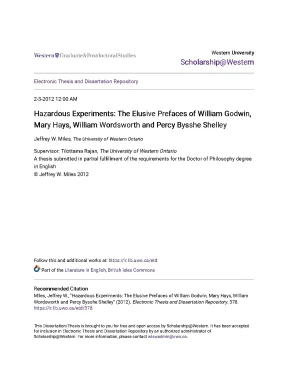
Tải xuống để đọc toàn bộWestern University Scholarship@Western Electronic Thesis and Dissertation Repository 2-3-2012 12:00 AM Hazardous Experiments: The Elusive Prefaces of William Godwin, Mary Hays, William Wordsworth and Percy Bysshe Shelley Jeffrey W. Miles, The University of Western Ontario Supervisor: Tilottama Rajan, The University of Western Ontario A thesis submitted in partial fulfillment of the requirements for the Doctor of Philosophy degree in English © Jeffrey W. Miles 2012 Follow this and additional works at: https://ir.ca/etd Part of the Literature in English, British Isles Commons Recommended Citation Miles, Jeffrey W., "Hazardous Experiments: The Elusive Prefaces of William Godwin, Mary Hays, William Wordsworth and Percy Bysshe Shelley" (2012). Electronic Thesis and Dissertation Repository.ca/etd/378 This Dissertation/Thesis is brought to you for free and open access by Scholarship@Western.
It has been accepted for inclusion in Electronic Thesis and Dissertation Repository by an authorized administrator of Scholarship@Western. For more information, please contact wlswadmin@uwo. Hazardous Experiments: The Elusive Prefaces of William Godwin, Mary Hays, William Wordsworth, and Percy Bysshe Shelley by Jeffrey W. Miles Graduate Program in English A thesis submitted in partial fulfillment of the requirements for the degree of Doctor of Philosophy The School of Graduate and Postdoctoral Studies The University of Western Ontario London, Ontario, Canada © Jeffrey W.
Miles, 2012 THE UNIVERSITY OF WESTERN ONTARIO School of Graduate and Postdoctoral Studies CERTIFICATE OF EXAMINATION Supervisor Examiners __________________________ ____________________________ Dr. Tilottama Rajan Dr. Steven Bruhm ____________________________ Supervisory Committee Dr. Monika Lee ____________________________ __________________________ Dr.
Matthew Rowlinson Dr. Joel Faflak ____________________________ Dr. Jonathan Sachs The thesis by Jeffrey Wright Miles entitled: Hazardous Experiments: The Elusive Prefaces of William Godwin, Mary Hays, William Wordsworth, and Percy Bysshe Shelley is accepted in partial fulfillment of the requirements for the degree of Doctor of Philosophy Date ____________________ _________________________ Chair of the Thesis Examination Board ii —ABSTRACT— This study analyzes the prefaces of four Romantic-period writers: William Godwin, Mary Hays, William Wordsworth, and Percy Bysshe Shelley. Historically, the preface can be traced back to the insinuatio of classical rhetoric, the purpose of which is to evade audience hostility for writers presenting a bad case.
Given the repressive political and cultural atmosphere of the Romantic period, writers like Godwin, Hays, Wordsworth, and Shelley, idealists who seek to disseminate radical ideas in an era of state censorship, must devise a strategy to convey their messages without attracting attention to their subversiveness. Thus, all four writers continually preface their works with ‘elusive’ prefaces, a strategy through which they seek to downplay or elide their radical subject-matter. Chapter One analyzes William Godwin’s prefaces to Enquiry Concerning Political Justice as a prototype of the elusive preface, through which the urgency and force of his prefatory rhetoric contrasts with the message of gradualism he seeks to convey in the treatise. His novel Caleb Williams, whose first edition preface was suppressed by the publisher for its seditious content, incorporates its preface as an extradiegetic layer of the novel, a technique that Mary Hays will also incorporate in her Memoirs of Emma Courtney, a novel that deploys its elusive preface to placate a middle-class reading audience and to address simultaneously a Dissenting public sphere.
Tracing the evolution of Hays’ prefatory author-figure from her early pamphlet Cursory Remarks on an Enquiry into the Expediency and Propriety of Public or Social Worship: Inscribed to Gilbert Wakefield to her last novel, The Victim of Prejudice, Chapter Two demonstrates how Hays’ rhetorical subterfuge allows her to assert her right to philosophy while ostensibly adhering to conventional poses of femininity. Prose writers like Godwin and Hays seek to convey their idealistic messages to a generally prosaic reading public, making their prefatory insinuatio especially significant. But poets like Wordsworth and Shelley face an especially difficult task in establishing themselves as socially relevant in an age during which poetry is becoming an outmoded form of discourse. Thus, Chapter Three demonstrates how Wordsworth in his preface to Lyrical Ballads becomes increasingly absorbed with the task of establishing the poet’s professional autonomy as he argues for his poetry’s power to rouse a degraded nation from its moral and cultural lethargy.
Throughout the four editions of the Lyrical Ballads, Wordsworth continues to expand his preface and his poetic persona. By the time of his 1815 Poems, he has abandoned the mass audience he once sought to enlighten, instead appealing to a future generation of readers whom he calls upon to vindicate him. Shelley also faces audience hostility, and his attempts to convey his radical beliefs are thwarted by a public sphere whose ad hominem attacks against him hinder his ability to achieve his goals. Chapter Four chronicles Shelley’s immersion in romantic irony, through which his prefaces are characterized by a disjunction between his idealism and his dissociation from his given actuality.
Keywords: (1) Godwin, William 1756-1836. Criticism and Interpretation. (2) Hays, Mary 1759 or 60-1843. Criticism and Interpretation.
Criticism and Interpretation. (4) Shelley, Percy Bysshe 1792-1822. Criticism and Interpretation. iii —ACKNOWLEDGEMENTS— First, I wish to thank my advisors Tilottama Rajan and Joel Faflak for their unflagging support.
At every stage throughout the process, from proposal to field study to chapter revisions to the final draft, they generously contributed to the development of the thesis in very significant ways. Even in the midst of difficult and challenging times, they continually kept me focused with their positivity and meticulous attention to the nuances of my argument. Their integrity and high intellectual standards have profoundly affected me in personal ways that go well beyond the boundaries of professional duty. I also wish to thank Fanshawe College for supporting me financially during the final three years of my Ph.
Thanks to the college’s financial support, I was able to finish the thesis without the additional pressures of incurring excess debt. I thank my colleagues in the School of Language and Liberal Studies at Fanshawe for their collegiality, good humour, and intellectual engagement. For always believing in me and persevering with me throughout this lengthy process, I thank my parents and first teachers, Tony and Nancy, who have ardently encouraged me throughout my educational career, and to them I owe a debt of gratitude that I can never repay. My children, Gabriel and Heidi, were babies in the infancy of this thesis, and now they are beautifully flowering children.
I also wish to acknowledge Amy and Jason Winders, Andrew Vivona, Jayne and Steve Simon, Drew White, Harry Gorman, Roger Leavens, and Fraser Nixon. Finally, and mostly, I thank Ann, whose brightness and lightness inspire me every day. This is for you. iv —ABBREVIATIONS— EY: Wordsworth, William.
The Letters of William and Dorothy Wordsworth: The Early Years, 1787-1805. Ernest De Selincourt. LB: Wordsworth, William. Lyrical Ballads, and other Poems, 1797-1800.
James Butler and Karen Green. Ithaca: Cornell UP, 1992. MHI: Hays, Mary. The Idea of Bing Free: A Mary Hays Reader.
Gina Luria Walker. MY: Wordsworth, William. The Letters of William and Dorothy Wordsworth: The Middle Years: Part II, 1812-1820. Ernest de Selincourt.
Mary Moorman and Alan G. PJ: Godwin, William. An Enquiry Concerning Political Justice. Political and Philosophical Writings of William Godwin.
London: William Pickering, 1993. PJV: Godwin, William. An Enquiry Concerning Political Justice. Political And Philosophical Writings of William Godwin.
London: William Pickering, 1993. PBSL: Shelley, Percy Bysshe. The Letters of Percy Bysshe Shelley. PS: Shelley, Percy Bysshe.
The Poems of Shelley. Kelvin Everest and Geoffrey Matthews. New York: Pearson, 2000. v PW: Wordsworth, William.
The Prose Works of William Wordsworth. Owen and Jane Worthington Smyser. Oxford: Oxford UP, 1974. SP: Shelley, Percy Bysshe.
Selected Poetry and Prose. Kenneth Neill Cameron. New York: Rinehart, 1953. SPP: Shelley, Percy Bysshe.
Shelley’s Poetry and Prose. Reiman and Neil Fraistat. New York: Norton, 2002. UH: White, Newman Ivey, ed.
The Unextinguished Hearth: Shelley and his Contemporary Critics. New York: Octagon Books, 1966. WCH: Woof, Robert, ed. Wordsworth: The Critical Heritage.
London and New York: Routledge, 2001. WLC: Wordsworth, William. Wordsworth’s Literary Criticism. London: Routledge & Kegan Paul, 1974.
WPS: Shelley, Percy Bysshe. The Works of Percy Bysshe Shelley. Roger Ingpen and Walter E. New York: Charles Scribner’s Sons, 1927.
vi —CONTENTS— Certificate of Examination………………………………………………………………….ii Abstract……………………………………………………………………………………iii Acknowledgements……………………………………………………………………….iv Abbreviations……………………………………………………………………………v-vi Table of Contents…………………….…vii-viii INTRODUCTION………………………………………………………………………1 But Does a Preface Exist?.1 Insinuatio and the Elusive Preface………………………………………………….11 Context: Anxieties of Reception………………………………………………. WILLIAM GODWIN: THE POLITICS OF THE PREFACE…………….……29 Political Justice’s Radical Gradualism……………………………….30 “A Public That is Panic Struck”……………………………….41 Caleb Williams: The Return of the Repressed Preface…………………………….49 The Preface as Narrative Frame………………………………………………….57 Provoking the “Mob Monster”………………………………………………….64 The Afterlife of Caleb Williams……….73 Fleetwood and the Author-Function. MARY HAYS’S PREFACES OF THE 1790s: RHETORICAL SUBTERFUGE AND THE RISE OF RADICAL FEMINISM………………………………….89 The Face of the Feminine: Cursory Remarks………………………………………93 Professional Hays: Letters and Essays……………………………….…103 Rhetorical Subterfuge: Memoirs of Emma Courtney.113 The Vanished Authoress: Appeal to the Men of Great Britain…….137 The Ends of Radical Feminism: The Victim of Prejudice……………. WORDSWORTH’S PREFACES, PROFESSIONAL AMBITION, AND THE PROBLEM OF PARATEXTUAL DIALOGISM….…157 The Poet in the Prefaces: From 1798 to 1802……………………………….162 The Poet in the Poems: Internal Prefacing and Dialogism………….…………177 The Poet in Posterity: The 1815 Preface and “Essay Supplementary”…….
ROMANTIC IRONY AND THE PREFACES OF P.199 The Ironic Void: Alastor ……….………209 Negative Becoming: Laon and Cythna.220 Unstable Irony: Epipsychidion ……………………………….…………………238 Posthumous Parabasis and a Radical Return: Adonais and Hellas…………….248 The Ends of Irony: Mary Shelley’s Posthumous Prefaces………………….293 viii —INTRODUCTION— “A Preface is written to a public; a thing I cannot help looking on as an Enemy, and which I cannot address without feelings of hostility” (129). — John Keats To John Hamilton Reynolds, 9 April 1818 But Does a Preface Exist? Keats’s remarks, the result of considerable anxiety over his preface to Endymion, embody many of the key aspects of preface writing in the Romantic period. The feelings of hostility towards his “Enemy”—the “public”—are typical of many of the period’s writers, whose unease about presenting their texts to the public is overdetermined by a complex nexus of institutional, ideological, and demographic factors. Keats’s remarks also perpetuate a facet of the Romantic poet myth, classifying him as a sensitive plant who loathes deigning to present his works to the public, a sentiment revealed elsewhere in his letter to Reynolds: “among Multitudes of Men—I have no feel of stooping, I hate the idea of humility to them” (129).
And the fact that Keats cathects this anxiety onto the preface reveals its significance as a mediating device, the site within which the ‘author’ steps out to plead his or her case with the reader in an effort to influence interpretation. The liminality of Endymion’s preface, foregrounded by the stark juxtaposition between the preface’s prosaic terseness and the poem’s lavish versification, embodies the paradoxes of the prefatory figure constructed by Keats. The preface is separate from the poem, yet inextricably linked to it: having encountered the ‘Keats’ of the preface, the reader identifies the ‘I’ of the poem with the hesitant prefatory figure, who has admitted to “a feeling of regret” for publishing a poem 1 characterized by its “great inexperience, immaturity, and every error denoting a feverish attempt” (11). Paradoxically, however, the very presence of Endymion’s preface undermines Keats’s desire to construct the figure of a chameleon poet within its space.
The original, unpublished, preface expresses Keats’s disdain for prefaces generally: the work of an individual is so insignificant that a preface “seems a sort of impertinent bow to strangers who care nothing about it” (13). The function of a preface, according to Keats, is to “catch an idea of an Author’s modesty, and non opinion of himself” (13). Ironically, then, Keats crafts two versions of a preface whose purpose is self-negation, to present a version of himself characterized, negatively, by his “non opinion.” As if to recognize the rhetorical potential of prosopopoeia, etymologically defined by Paul de Man as the “giving and taking away of faces” (“Autobiography” 76), Keats gives himself a face through his prefatory persona while simultaneously de-facing himself through repeated reference to the poet’s lack of identity. Revealed through Keats’s elaborate prefatory attempts to posit his (non) identity are the factors that generate his anxiety about publishing.
Nội dung được bảo vệ bản quyền — Tải xuống đầy đủ
Trích dẫn luận án này
Jeffrey W. Miles (2012). Hazardous experiments the elusive preface in the romantic er [Luận án tiến sĩ, The University of Western Ontario]. LuanAn.net. https://luanan.net/van-hoc/hazardous-experiments-the-elusive-preface-in-the-romantic-era
Câu hỏi thường gặp
Luận án "Hazardous experiments the elusive preface in the romantic er" nghiên cứu về vấn đề gì?
Khám phá những thí nghiệm nguy hiểm và lời mở đầu khó nắm bắt trong thế giới lãng mạn. Tình yêu và rủi ro đan xen tạo nên câu chuyện hấp dẫn.
Luận án "Hazardous experiments the elusive preface in the romantic er" được bảo vệ tại trường nào?
Luận án này được bảo vệ tại The University of Western Ontario. Năm bảo vệ: 2012.
Luận án "Hazardous experiments the elusive preface in the romantic er" thuộc chuyên ngành gì?
Luận án "Hazardous experiments the elusive preface in the romantic er" thuộc chuyên ngành English. Danh mục: Văn Học.
Luận án "Hazardous experiments the elusive preface in the romantic er" có bao nhiêu trang?
Luận án "Hazardous experiments the elusive preface in the romantic er" có 302 trang. Bạn có thể xem trước một phần tài liệu ngay trên trang web trước khi tải về.
Cách tải luận án "Hazardous experiments the elusive preface in the romantic er" về máy như thế nào?
Để tải luận án về máy, bạn nhấn nút "Tải xuống ngay" trên trang này, sau đó hoàn tất thanh toán phí lưu trữ. File sẽ được tải xuống ngay sau khi thanh toán thành công. Hỗ trợ qua Zalo: 0559 297 239.