Luận án: Đọc, Viết, Huyền Bí & Hiện Diện trong Thơ Tôn Giáo của John Donne (Mark O'Donnell)
Khám phá thơ tôn giáo của John Donne: sự hòa quyện giữa đọc, viết, huyền bí và hiện diện tâm linh sâu sắc.
Universiteit Leiden
Văn học / Nghiên cứu tôn giáo
Luan An
Luận án tiến sĩ
Năm xuất bản
Số trang
200
Thời gian đọc
30 phút
Lượt xem
0
Lượt tải
0
Phí lưu trữ
50 Point
Tổng quan nhanh
- Chủ đề:
- Thơ siêu hình John Donne: Đọc, viết & Hiện diện thần thánh
- Số trang:
- 200 trang
- Trường:
- Universiteit Leiden
- Chuyên ngành:
- Văn học / Nghiên cứu tôn giáo
- Tác giả:
- Mark O'Donnell
- Năm:
- 2019
Tóm tắt nội dung luận án
I.Thơ siêu hình John Donne Đọc viết Hiện diện thần thánh
Luận án khám phá sự theo đuổi hiện diện thông qua việc đọc. Trọng tâm là Thơ siêu hình John Donne. Nghiên cứu sự gắn kết của thơ với truyền thống huyền bí. Truyền thống này hướng độc giả chú tâm đến sự hiện diện trực tiếp của Chúa. Giá trị của việc đọc là kinh nghiệm nội tại. Độc giả không chỉ thu nhận thông tin. Độc giả trải nghiệm toàn diện văn bản. Đây là nỗ lực chuyển từ "những thứ đã tạo ra" đến chính "Thiên Chúa". Các nhà tu hành đã tiên phong thực hành này. Họ không suy luận về Chúa từ các tác phẩm. Họ gặp gỡ Chúa trực tiếp trong các bài đọc. Thần học Anh giáo được khảo sát kỹ lưỡng.
1.1. Mục tiêu nghiên cứu thơ John Donne
Nghiên cứu tập trung vào Thơ siêu hình John Donne. Phân tích các tác phẩm tôn giáo nhỏ. Mục tiêu là làm rõ cách Donne tương tác với truyền thống huyền bí. Truyền thống này nhấn mạnh kinh nghiệm tâm linh. Nó dẫn độc giả đến sự hiện diện trực tiếp của Thần thánh. Luận án đi sâu vào các khía cạnh đọc, viết, huyền bí và hiện diện. Nó xem xét các yếu tố này trong bối cảnh Thế kỷ 17.
1.2. Giá trị của việc đọc theo truyền thống huyền bí
Truyền thống huyền bí đề cao việc đọc như một hoạt động mang giá trị nội tại. Điều quan trọng không phải kiến thức độc giả thu được. Quan trọng hơn là trải nghiệm toàn diện khi đọc. Việc đọc trở thành con đường dẫn đến Hợp nhất thần thánh. Độc giả không chỉ giải mã văn bản. Độc giả sống trong văn bản. Sự siêu việt được tìm thấy qua sự nhập tâm. Đây là một dạng Tính nội tại của Thần thánh trong trải nghiệm cá nhân.
1.3. Bối cảnh Thần học Anh giáo và Kinh nghiệm tâm linh
Luận án đặt Thơ sùng kính của Donne vào bối cảnh Thần học Anh giáo Thế kỷ 17. Thời kỳ này chứng kiến những thay đổi sâu sắc. Tuy nhiên, khả năng đọc huyền bí vẫn tiếp tục. Các Sonnet Thần Thánh và các bài thơ khác của Donne phản ánh điều này. Chúng thể hiện một sự pha trộn độc đáo. Đó là sự pha trộn giữa học thuật trí tuệ và khao khát kinh nghiệm tâm linh trực tiếp. Sự hiện diện thần thánh là trọng tâm của khao khát này.
II.Phân tích Hiện diện Đã mất trong Thơ John Donne
Phần này khảo sát khái niệm "Hiện diện Đã mất". Điều này xuất hiện trong 'The Anniversaries' của John Donne. Các bài thơ này là một sự phê phán mạnh mẽ. Chúng nhắm vào kiến thức trần tục và sự gắn bó vật chất. Thế giới được miêu tả như đã chết, thiếu sự sống thiêng liêng. Donne tìm kiếm một mô hình sống và chết. Ông tìm kiếm điều này trong bối cảnh một thế giới sa sút.
2.1. The Anniversaries Phê phán kiến thức trần tục
'The Anniversaries' thể hiện sự hoài nghi sâu sắc. Nó nghi ngờ khả năng của kiến thức trần tục. Kiến thức này không thể hiểu được bản chất của thực tại thiêng liêng. Các bài thơ chỉ trích việc dựa dẫm vào các giác quan. Chúng phê phán việc tập trung vào những điều tạm bợ. Thay vào đó, Donne gợi ý một cách tiếp cận khác. Đó là cách tiếp cận hướng đến sự siêu việt. Thơ siêu hình John Donne đặt câu hỏi về các giả định thông thường. Nó thách thức cách con người nhận thức thế giới.
2.2. Tìm kiếm sự sống trong một thế giới vật chất
Trong bối cảnh một thế giới được mô tả là "đã chết", Donne tìm kiếm sự sống. Sự sống này không được tìm thấy trong vật chất. Nó không được tìm thấy trong những điều trần tục. Thay vào đó, sự sống phải đến từ nguồn gốc thần thánh. Các bài thơ khám phá sự từ chối thế giới vật chất. Tuy nhiên, chúng cũng tiết lộ sự gắn bó liên tục với nó. Sự giằng xé này tạo nên sự phức tạp. Nó là một đặc điểm của Thơ sùng kính Donne. Sự hiện diện thần thánh dường như đã rút lui.
2.3. Elizabeth Drury và Kinh nghiệm tâm linh
Cái chết của Elizabeth Drury trở thành một điểm tựa. Donne sử dụng cái chết này làm biểu tượng. Nó đại diện cho sự sụp đổ của một trật tự lý tưởng. Tuy nhiên, thông qua việc đọc Drury, Donne tìm thấy "nghệ thuật biết Thiên đàng". Điều này gợi ý một kinh nghiệm tâm linh. Đó là kinh nghiệm vượt ra ngoài sự hiểu biết thông thường. Nó nhấn mạnh việc đọc như một con đường đến sự siêu việt. Độc giả được khuyến khích trải nghiệm trực tiếp. Tính nội tại của Chúa có thể được cảm nhận.
III.Tìm kiếm Hiện diện thần thánh La Corona Thơ sùng kính
Phần này chuyển sang "Hiện diện Được tìm kiếm". Nó tập trung vào tập Sonnet Thần Thánh "La Corona" của Donne. Các sonnet này viết về cuộc đời Chúa Kitô. Chúng khám phá vai trò của độc giả trong việc trải nghiệm Chúa. "La Corona" là một ví dụ nổi bật. Nó minh họa nỗ lực đạt đến kinh nghiệm tâm linh. Nó nằm trong truyền thống huyền bí trung cổ. Bài thơ tìm kiếm sự hiện diện thần thánh.
3.1. La Corona Viết cuộc đời Chúa Kitô
"La Corona" là một chuỗi sonnet độc đáo. Nó tường thuật lại các giai đoạn chính trong cuộc đời Chúa Kitô. Từ sự thụ thai đến phục sinh. Việc viết này không chỉ là một sự kể lại. Nó là một hành động sùng kính. Nó mời gọi sự tham gia của độc giả. Thơ sùng kính của Donne ở đây tạo ra một không gian. Trong không gian đó, độc giả có thể tương tác với các sự kiện thiêng liêng. Mục tiêu là đạt được Hợp nhất thần thánh.
3.2. Vai trò độc giả trong việc trải nghiệm Chúa
"La Corona" nhấn mạnh vai trò "độc giả biết nói". Độc giả không thụ động. Độc giả được khuyến khích tự mình trải nghiệm Chúa. Điều này phù hợp với truyền thống thiền định trung cổ. Các bài đọc tập trung vào cảm xúc. Chúng tập trung vào sự nhập tâm. Mục đích là để cảm nhận sự hiện diện thần thánh. Kinh nghiệm tâm linh này vượt xa việc chỉ đọc để kiến thức. Nó là một con đường dẫn đến sự siêu việt.
3.3. Cải cách Anh giáo Thơ sùng kính Donne
"La Corona" được viết trong bối cảnh Cải cách Anh giáo. Thời kỳ này chứng kiến sự thay đổi trong thực hành sùng kính. Tuy nhiên, Donne vẫn duy trì khả năng của một loại đọc huyền bí. Loại đọc này cho phép độc giả tiếp cận Chúa. Bài thơ cho thấy một "con đường cải cách". Nó vẫn mở ra cơ hội cho kinh nghiệm trực tiếp. Điều này khác với sự nhấn mạnh vào lời giảng. Đây là một đóng góp độc đáo của Thơ siêu hình John Donne.
IV.Kinh nghiệm tâm linh Goodfriday Hợp nhất thần thánh
Phần này khám phá "Hiện diện Được cải cách". Nó tập trung vào bài thơ "Goodfriday, 1613. Riding Westward". Bài thơ này đánh dấu sự chuyển đổi. Đó là sự chuyển từ đọc sang viết. Nó ủng hộ truyền thống cataphatic. Điều này liên quan đến việc miêu tả Chúa thông qua những gì có thể nói. Bài thơ xem xét sự thành công của thiền định. Nó cũng đề cập đến sự do dự của người cưỡi.
4.1. Goodfriday Đọc sang viết Truyền thống cataphatic
"Goodfriday" minh họa một sự thay đổi. Đó là sự thay đổi từ việc thụ động đọc sang chủ động viết. Điều này phản ánh sự phát triển trong kinh nghiệm tâm linh của Donne. Bài thơ ủng hộ truyền thống cataphatic. Truyền thống này sử dụng hình ảnh và ngôn ngữ. Nó mô tả những gì có thể hiểu được về Chúa. Thay vì theo con đường apophatic (không thể nói), Donne tìm kiếm sự thể hiện. Đây là một khía cạnh quan trọng của Thần học Anh giáo trong tác phẩm của ông.
4.2. Thành công thiền định Hesitancy của người cưỡi
Bài thơ đặt ra câu hỏi về thành công thiền định. Người cưỡi thể hiện sự do dự. Người đó đối mặt với hình ảnh Chúa bị đóng đinh. Sự cân bằng tinh thần là cần thiết. Điều này được gợi ý bởi các lập luận của Ignatian. Kinh nghiệm tâm linh không phải lúc nào cũng dễ dàng. Nó thường đi kèm với đấu tranh và suy tư. Đây là một minh chứng cho tính nội tại của cuộc đấu tranh này.
4.3. Lý thuyết trữ tình Hợp nhất thần thánh
"Goodfriday" cũng đóng góp vào lý thuyết trữ tình. Bài thơ xử lý thời gian và không gian. Nó tạo ra sự cân bằng giữa độc giả và người cưỡi. Thông qua hình ảnh và suy tư, độc giả được mời gọi. Độc giả được mời gọi chia sẻ kinh nghiệm tâm linh. Mục tiêu cuối cùng là Hợp nhất thần thánh. Sự siêu việt không chỉ là một khái niệm. Nó trở thành một khả năng có thể đạt được.
V.Siêu việt Tính nội tại Thần học Anh giáo Thế kỷ 17
Phần kết luận tổng hợp những thách thức. Nó tổng hợp các khả năng của Thơ sùng kính. Đặc biệt là trong bối cảnh Thế kỷ 17. Nghiên cứu nhấn mạnh khả năng của việc đọc trải nghiệm. Nó cho thấy sự liên tục của truyền thống huyền bí. Mặc dù có những thay đổi trong thực hành tôn giáo. Thơ siêu hình John Donne tiếp tục là một cầu nối. Nó nối liền những khao khát kinh nghiệm tâm linh trực tiếp.
5.1. Huyền bí trung cổ Đọc để trải nghiệm
Luận án hồi tưởng về huyền bí trung cổ. Truyền thống này nhấn mạnh việc đọc để trải nghiệm. Giá trị không phải là kiến thức thu được. Giá trị nằm ở sự hòa nhập toàn diện. Các nhà tu hành đã tiên phong cách tiếp cận này. Họ tìm kiếm sự hiện diện thần thánh trực tiếp. Họ không tìm kiếm sự suy luận. Điều này tạo nền tảng cho sự phân tích của Donne.
5.2. Thiền định Thế kỷ 17 Đọc để kiến thức
Tuy nhiên, Thế kỷ 17 cũng chứng kiến sự chuyển dịch. Thiền định tập trung hơn vào kiến thức. Nó tập trung vào sự hiểu biết trí tuệ. Điều này tạo ra sự căng thẳng. Đó là sự căng thẳng giữa kinh nghiệm và kiến thức. Thần học Anh giáo tìm cách cân bằng. Thơ sùng kính của Donne là một minh chứng. Nó là bằng chứng cho sự phức tạp của thời đại.
5.3. Thơ tôn giáo Thử thách viết Đọc trải nghiệm
Viết thơ tôn giáo trong thời đại của Donne là một thử thách. Nó đòi hỏi sự khéo léo. Nó đòi hỏi sự nhạy cảm. Donne đã thành công trong việc tạo ra những bài thơ. Những bài thơ này mời gọi độc giả trải nghiệm. Chúng không chỉ cung cấp thông tin. Chúng cung cấp một con đường đến sự siêu việt. Khả năng đọc trải nghiệm vẫn là cốt lõi. Nó là con đường dẫn đến Tính nội tại của Chúa.
Tải xuống file đầy đủ để xem toàn bộ nội dung
Tải đầy đủ (200 trang)Trích đoạn nội dung luận án
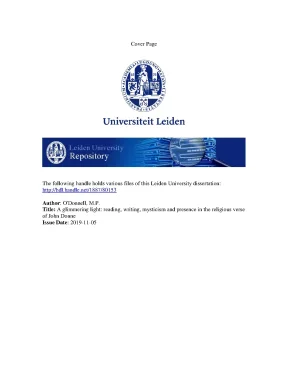
Tải xuống để đọc toàn bộCover Page The following handle holds various files of this Leiden University dissertation: http://hdl.net/1887/80153 Author: O'Donnell, M. Title: A glimmering light: reading, writing, mysticism and presence in the religious verse of John Donne Issue Date: 2019-11-05 ‘A Glimmering Light’ Reading, Writing, Mysticism and Presence in the Religious Verse of John Donne a thesis for the degree of Ph. by Mark O’Donnell ‘A Glimmering Light’ Reading, Writing, Mysticism and Presence in the Religious Verse of John Donne Proefschrift ter verkrijging van de graad van Doctor aan de Universiteit Leiden, op gezag van Rector Magnificus prof. Stolker, volgens besluit van het College voor Promoties te verdedigen op 5 november 2019 klokke 13.45 uur door Mark O’Donnell geboren te Londen in 1979 2 Promotor: Prof.
Frans-Willem Korsten Copromotores: Dr. Jan Frans van Dijkhuizen Dr. Madeleine Kasten Promotiecommissie: Prof. Peter Liebregts Prof.
Jürgen Pieters (University of Ghent) Prof. Paul Smith Dr. Lieke Stelling (University of Utrecht) 3 for Dieuw 4 Through the veile of his flesh, Such beames he cast, as behind those clouds, they might know, there was a sunne Lancelot Andrewes1 1 XCVI Sermons p. 49 5 A Note on the Text The typology and spelling of quoted texts have been preserved throughout.
Where appropriate I have used English translations of Latin texts that were available in seventeenth-century England, e. Nicholas Love’s translation of the Vitae Christi rather than Bonaventure’s original (for details please see bibliography). In cases where texts would have been read in the Latin I have used more recent academic translations. The exception to this rule is the work of Bernard of Clairvaux whose work was potentially read in the seventeenth century in both languages.
As no English complete works exists, I have used a number of different translations and, where necessary, referred to the Latin in footnotes; all sources are clearly indicated in the text. All biblical quotations are taken from the King James Bible. 6 Contents Introduction Reading, Writing, Mysticism and Presence in the Religious Verse of John Donne p. 8 What Follows: Presence Lost, Sought and Reformed p.
Preamble Medieval Mysticism and ‘Reading to Experience’ p. 13 Early Seventeenth-Century Meditation and ‘Reading for Knowledge’ p. 22 Devotional Plurality and the Continued Possibility of Mystical Reading p. Presence Lost The Anniversaries and the Reading of Creation p.
35 The Rejection of the World and a Continuing Attachment to Materiality p. 38 The Precise Nature of The Anniversaries’ Critique of Worldly Knowledge p. 44 Looking for Life in a World that is Dead p. 51 “Thou shouldest for life, and death, a patterne bee”: the Source of Donne’s Authority p.
58 Donne’s Reading of Elizabeth Drury p. 63 “Th'Art of knowing Heauen”: Reading Experientially p. 67 Presenting Presence Lost p. Presence Sought Writing the Life of Christ in “La Corona” p.
81 “La Corona’s” Voicing p. 84 The ‘Speaking’ Reader and the Issue of Intent p. 91 Experiencing Christ in ‘La Corona’ in the Light of the Medieval Tradition p. 95 The ‘Meditative Lives’, English Passion Poetry and “La Corona” p.
102 “La Corona” and the Path of Reform in Reformation England p. 108 “La Corona” and the Non-Description of Christ p. 113 Caught between Preacher and Poet: Donne’s Absence and the Reader’s task p. Presence Reformed From Reading to Writing in “Goodfriday, 1613.
127 “Goodfriday’s” Endorsement of the Cataphatic Tradition p. 130 The Issue of Meditative Success: Ignatian Arguments for Mental Balance p. 136 The Issue of Meditative Success: the Rider’s Hesitancy in the Face of the Crucifixion p. 139 Meditative Reading and Lyric Theory: “Goodfriday’s” Treatment of Time p.
144 Meditative Reading and Lyric Theory: the Balance between Reader and Rider p. 156 Conclusion The Challenge of Writing Religious Verse and the Possibilities of Experiential Reading p. 161 Bibliography Primary Texts p. 198 8 Introduction Reading, Writing, Mysticism and Presence in the Religious Verse of John Donne Burn with desire not so much to know as to experience Bernard of Clairvaux2 This thesis is concerned with the pursuit of presence through reading.
Concentrating upon a small corpus of John Donne’s religious verse, I investigate its engagement with a venerable and essentially mystical tradition that sought to deliver the appropriately attentive reader directly into the presence of God.3 At the heart of this tradition was a conception of reading as an activity whose value was fundamentally intrinsic to its pursuit; what mattered was not what a reader might derive from a text, but the more holistically registered experience of that text’s reading. Striving, in the words of Saint Paul, to move from “the things that are made” to “the Godhead” itself (Romans 1:20), the monastics who pioneered these practices sought not to deduce God from his works, but to directly encounter him within their readings of them. Written in the years leading up to Donne’s ordination and professed renunciation of poetry in 1614,4 the poems discussed in this thesis are preoccupied with both the possibilities of religious verse and its limitations. While the sheer fact of these poems’ existence argues for Donne having had at least some faith in their usefulness, any such faith is consistently mixed in the texts with hesitations and disquiet.
There is, therefore, a reticence in all the poems covered that questions the project to which they 2 Taken from the first sermon of Bernard’s cycle on the Song of Songs (translation is from Leclercq’s, The Love of Learning and the Desire for God 5). 3 Though the mystical reading approach which interests me here still retains some importance within the Catholic monastic communities where it first developed, I am principally concerned with its manifestation from the close of antiquity through to the early seventeenth century and it is consequently discussed in the past tense throughout what follows. 4 On the express request of James I, Donne finally opted to take Holy orders in late 1614 and wrote to his friend Henry Goodyer declaring his intention to quit verse in connection with this step (Gosse ii. Donne’s professed abandonment of verse after his eventual ordination in January 1615 has not typically been taken entirely seriously (see Oliver 194), and there is clear evidence that a small number of poems were written after this date.
Some of these issues will be revisited in my text. 9 would otherwise seem to belong. While the monastic tradition sought colloquy through reading – a direct and essentially mystical meeting with the divine – such a state is never unambiguously secured in the works I discuss. The divine’s legibility is maintained – and these works may thus be seen to be about reading the divine – yet the monastic tradition had not restricted itself to the maintenance of reading’s effectiveness.
Presence in medieval monasticism was not something stated but something read, an experience involving both mental and physical components which happened to a reader in the moment of a text’s unfolding. Maintaining that Donne’s own verse could be utilised in this way is problematic, and, as I go on to suggest, there are reasons to believe that he himself harboured doubts in relation to the suitability of this procedure in respect to his own poems. What is much clearer, however, is that Donne never doubted his own ability to read in this manner, and it is thus with the unpacking and engineering of such apprehension that I see him to be concerned in all the verse discussed in this thesis. My investigation begins from a point of relative confidence.
Donne in The Anniversaries claims to have experienced the divine’s “glimmering light” (FirAn 70) and sets out in his verse to reciprocally provide this experience to his readership. It is in the completion of this task, however, that I see The Anniversaries – and all the other works I discuss – to struggle. On the one hand, the parallels I outline between these poems and monastic practice clearly suggest Donne to have harboured what might be characterised as a medieval faith in reading’s possibilities; on the other, however, these poems also suggest that Donne repeatedly struggles to avoid a series of more potentially reformed doubts regarding writing. In documenting Donne’s striving to reconcile the roles of reader and writer, this thesis ultimately investigates the implications that I see these poems to hold for both religious verse more generally and for wider issues related to textual connection.
As discussed in each of my three chapters, it is Donne’s authorship model which most evidently hampers his engagement with an earlier tradition. Monastic authors had typically shown scant concern for originality. Entwining scriptural quotation with the works of their predecessors, they created texts grounded within not only authorial subjectivity but a broader unbroken tradition that stretched back towards Scripture itself. 5 The contrast between this practice and Donne’s largely coterie model of 5 See Duncan Robertson’s discussion in Lectio Divina (105), but also the whole thrust of Jean Leclercq’s The Love of Learning and the Desire for God.
10 authorship is stark. Donne’s verse was initially read within a context of which he himself was part, a situation even more evident in regard to his religious verse, which, circulating among a tighter circle than his secular works, 6 was often personally addressed.7 Writing for fame, but also sustenance, Donne, unlike monastic authors, had no call upon or duty of care for his readers, who, on receiving a ‘Donne poem’, were presented not with monasticism’s timeless tradition and direct revelation, but a missive from the author himself, a known and evidently fallen hand which lacked any obvious claim to divine inspiration.8 While works of devotion from non-ordained sources had also been composed in the medieval period, these works typically rested on claims of revelation, or – in a more literary mode – an appeal to some form of heavenly muse.9 None of the Donne poems discussed in this thesis fit either of these models, however, and all are thus at risk of being judged under-determined. Apparently writing under only the fiat of his own wit, Donne’s ability – and even right – to produce divine verse neither was, nor is, entirely obvious. Given that the monastic tradition’s concern was principally with origins (Scripture ultimately came from God), formalist arguments that demand verse be interpreted without reference to its authorship would have been beside the point for his initial readership.
Whether ‘John Donne’ stood as a friend, a petitioner, or an (in)famous poet, he was – and still is – a figure singularly lacking the kind of divine authority which many would have sought. Bridging the gap between Donne, a coterie poet seeking patronage, and the inspired monks of medieval practice is a challenge which looms over all the verse I 6 The precise circulation of most Donne poems is hard to accurately recreate, but the relative dearth of surviving manuscript copies of Donne’s religious poems (in comparison to the ‘Songs and Sonnets’) suggests they were “kept quite close” (Freiman & Marroti 73). 7 The two Anniversary poems, openly published in 1611/1612, are the exception among Donne’s work, yet their status as works explicitly commissioned by the Drury family – which Donne himself had reservations about distributing more widely – clearly places their author and initial readership into a direct relationship (these issues will be further discussed in Chapter Two). “La Corona” – it has been strongly suggested (see Novar, Gardner and Walton) – was initially addressed directly to ‘Lady’ Magdalen Herbert (see Chapter Three).
In the case of “Goodfriday” Stubbs claims (287), following other biographers (e.25), that the poem was first addressed to either Edward Herbert (to whom Donne was travelling on Good Friday 1613) or Henry Goodyer (whose house he had left that day at dawn). 8 While it is true that works within the kind of the mystical tradition to which I point were also on occasion personally addressed, these works can be seen as originating from the wider monastic tradition and not purely from their addressors.
Nội dung được bảo vệ bản quyền — Tải xuống đầy đủ
Trích dẫn luận án này
Mark O'Donnell (2019). Đọc, Viết, Huyền Bí & Hiện Diện trong Thơ Tôn Giáo John Donne [Luận án tiến sĩ, Universiteit Leiden]. LuanAn.net. https://luanan.net/van-hoc/doc-viet-huyen-bi-hien-dien-tho-ton-giao-john-donne
Câu hỏi thường gặp
Luận án "Đọc, Viết, Huyền Bí & Hiện Diện trong Thơ Tôn Giáo John Donne" nghiên cứu về vấn đề gì?
Khám phá thơ tôn giáo của John Donne: sự hòa quyện giữa đọc, viết, huyền bí và hiện diện tâm linh sâu sắc.
Luận án "Đọc, Viết, Huyền Bí & Hiện Diện trong Thơ Tôn Giáo John Donne" được bảo vệ tại trường nào?
Luận án này được bảo vệ tại Universiteit Leiden. Năm bảo vệ: 2019.
Luận án "Đọc, Viết, Huyền Bí & Hiện Diện trong Thơ Tôn Giáo John Donne" thuộc chuyên ngành gì?
Luận án "Đọc, Viết, Huyền Bí & Hiện Diện trong Thơ Tôn Giáo John Donne" thuộc chuyên ngành Văn học / Nghiên cứu tôn giáo. Danh mục: Văn Học.
Luận án "Đọc, Viết, Huyền Bí & Hiện Diện trong Thơ Tôn Giáo John Donne" có bao nhiêu trang?
Luận án "Đọc, Viết, Huyền Bí & Hiện Diện trong Thơ Tôn Giáo John Donne" có 200 trang. Bạn có thể xem trước một phần tài liệu ngay trên trang web trước khi tải về.
Cách tải luận án "Đọc, Viết, Huyền Bí & Hiện Diện trong Thơ Tôn Giáo John Donne" về máy như thế nào?
Để tải luận án về máy, bạn nhấn nút "Tải xuống ngay" trên trang này, sau đó hoàn tất thanh toán phí lưu trữ. File sẽ được tải xuống ngay sau khi thanh toán thành công. Hỗ trợ qua Zalo: 0559 297 239.