Chiến tranh, Giới và Nhà nước: Truyện Latina từ Cách mạng Mexico đến Cuộc chiến chống khủng bố
Khám phá vai trò của chiến tranh, giới và nhà nước trong văn học Mỹ Latinh. Phân tích sâu sắc các tác phẩm kinh điển và hiện đại.
Năm xuất bản
Số trang
287
Thời gian đọc
44 phút
Lượt xem
1
Lượt tải
0
Phí lưu trữ
50 Point
Tổng quan nhanh
- Chủ đề:
- Chiến tranh, Giới & Quyền lực Nhà nước trong Văn học Latinh
- Số trang:
- 287 trang
- Trường:
- Cornell University
- Chuyên ngành:
- English
- Tác giả:
- Belinda Linn Rincón
- Năm:
- 2009
Tóm tắt nội dung luận án
I.Chiến tranh Giới Quyền lực Nhà nước trong Văn học Latinh
Tài liệu này định nghĩa chiến tranh. Đó là một hình thức bạo lực nhà nước. Chiến tranh tự nhiên hóa sự đàn áp chủng tộc. Nó củng cố các chuẩn mực giới hạn hẹp. Nghiên cứu này hiểu rõ tác động của chiến tranh. Nó ảnh hưởng đến văn hóa Chicana/o và Mexico. Nó định hình các cấu trúc giới. Hầu hết các nghiên cứu về văn hóa chiến tranh bỏ qua kinh nghiệm của phụ nữ. Chúng không xem xét vai trò của phụ nữ trong xã hội quân sự hóa. Nghiên cứu này đi ngược lại xu hướng đó. Nó kiểm tra cách các tác giả nữ Mỹ Latinh can thiệp. Họ phá vỡ các diễn ngôn tự hợp pháp hóa chiến tranh của nhà nước. Họ tạo ra các câu chuyện đối kháng, nêu bật bạo lực chính trị và bất bình đẳng giới.
1.1. Định nghĩa lại Chiến tranh và Bạo lực Nhà nước
Chiến tranh được hiểu là công cụ của nhà nước. Nó dùng để duy trì quyền lực nhà nước. Nó thiết lập các khuôn khổ xã hội. Các khuôn khổ này thường loại trừ. Nó tác động sâu sắc đến cộng đồng. Đặc biệt là phụ nữ trong chiến tranh phải chịu nhiều gánh nặng. Văn học Mỹ Latinh thường phản ánh điều này. Các câu chuyện khám phá sự phức tạp của xung đột vũ trang. Nó làm rõ cách các vai trò giới bị ảnh hưởng. Các khuôn khổ này được củng cố hoặc bị thách thức bởi xung đột. Nghiên cứu này đặt câu hỏi về các cấu trúc quyền lực.
1.2. Phụ nữ can thiệp vào Diễn ngôn Chiến tranh
Phân tích tập trung vào mối quan hệ. Đó là giữa sự hình thành nhà nước, văn hóa và chiến tranh. Các câu hỏi chính được đặt ra. Làm thế nào các cấu trúc nhà nước tự nhiên hóa chiến tranh? Làm thế nào phụ nữ can thiệp vào các hình thức diễn ngôn của chiến tranh? Chiến tranh và giới được thể hiện rõ ràng như thế nào? Chủ nghĩa nữ quyền Mỹ Latinh cung cấp một lăng kính. Nó cho phép xem xét các vấn đề này. Nó thách thức các quan điểm truyền thống. Nó đưa ra các góc nhìn mới về bạo lực chính trị và quyền lực nhà nước.
II.Tiếng nói Nữ quyền Phá vỡ Kể chuyện Chiến tranh Mexico
Chương này kiểm tra các diễn ngôn dân tộc Mexico. Nó cũng phân tích chủ nghĩa dân tộc văn hóa Chicano. Nó làm nổi bật các biểu tượng hồi sinh. Đó là Pancho Villa và Emiliano Zapata. Các tác phẩm của các tác giả nữ Mỹ Latinh được nghiên cứu sâu. Các tác phẩm bao gồm "Entre Villa y una mujer desnuda" của Sabina Berman. "Eyes of Zapata" của Sandra Cisneros cũng được xem xét. Và "The Long Reconciliation" của Helena María Viramontes. Các tác phẩm này đưa ra những phê bình văn học nữ quyền mạnh mẽ. Chúng đối lại những sự lặp lại của lịch sử gia trưởng. Các tác phẩm thách thức các khuôn mẫu cũ về vai trò giới. Chúng đưa ra góc nhìn mới về phụ nữ trong chiến tranh.
2.1. Phê phán Chủ nghĩa Dân tộc trong Văn học Mỹ Latinh
Các tác giả tái tập trung khát vọng nữ giới. Điều này trong lịch sử cách mạng. Họ tạo ra những phân tích phê phán. Đó là về các câu chuyện chủ đạo gia trưởng. Các câu chuyện này thường bỏ qua kinh nghiệm của phụ nữ. Chúng cũng bỏ qua sự bất bình đẳng giới. Chủ nghĩa nữ quyền Mỹ Latinh nổi bật. Nó cung cấp công cụ để thách thức các diễn ngôn này. Nó chỉ ra cách quyền lực nhà nước củng cố một số vai trò giới. Nó cũng chỉ ra cách nó đàn áp những người khác. Văn học Mỹ Latinh thể hiện rõ điều đó.
2.2. Tái định nghĩa Vai trò Giới và Nữ quyền Mỹ Latinh
Phân tích này làm nổi bật sự bất bình đẳng giới. Nó tồn tại trong các câu chuyện chiến tranh truyền thống. Phụ nữ trong chiến tranh thường bị coi nhẹ. Các tác giả nữ Mỹ Latinh cho thấy điều này. Họ khẳng định vai trò giới phức tạp hơn. Chủ nghĩa nữ quyền Mỹ Latinh là trọng tâm. Nó thách thức các chuẩn mực xã hội. Nó phá vỡ quyền lực nhà nước gia trưởng. Nó mang lại góc nhìn mới. Đó là về xung đột vũ trang và bạo lực chính trị. Nó tái định hình hiểu biết về các sự kiện lịch sử.
III.Phê phán Quốc gia Văn học Latinh từ Hậu Cách mạng
Chương này phân tích María Cristina Mena. Cô phê phán chủ nghĩa dân tộc hậu cách mạng. Tác phẩm "The Water-Carrier’s Secret" được mổ xẻ. Mena bác bỏ các câu chuyện chính thức. Đó là về tiến bộ cách mạng. Cô bác bỏ chủ nghĩa chống giáo sĩ. Cô cũng bác bỏ sự đồng hóa người da đỏ. Các lý thuyết phát triển kinh tế được sử dụng. Chúng minh họa sự từ chối của Mena. Cô chỉ ra những thiếu sót. Đó là trong diễn ngôn nhà nước. Văn học Mỹ Latinh qua tác phẩm của Mena cung cấp cái nhìn sâu sắc. Nó về quyền lực nhà nước và bạo lực chính trị trong giai đoạn này.
3.1. Thách thức Diễn ngôn Cách mạng Chính thức
Mena đưa ra một tiếng nói đối kháng. Nó chống lại các kể chuyện chính thống. Các kể chuyện này thường được chính phủ bảo trợ. Chúng nhằm mục đích hợp pháp hóa quyền lực của mình. Tác phẩm của cô nhấn mạnh bất bình đẳng giới. Nó cũng nhấn mạnh vấn đề chủng tộc. Chúng tiếp tục tồn tại sau cách mạng. Quyền lực nhà nước được xem xét kỹ lưỡng. Nó cho thấy cách nó định hình nhận thức lịch sử. Cô cung cấp một phê bình sắc bén. Đó là về những lời hứa của cách mạng. Cô cho thấy sự thất bại của nó.
3.2. Văn học Latinh và Bối cảnh Chiến tranh Lạnh
Nghiên cứu đặt "Boy Heroes of Chapultepec" của Mena. Nó nằm trong diễn ngôn Good Neighborism. Nó cũng nằm trong bối cảnh Chiến tranh Lạnh. Văn bản của Mena bác bỏ chủ nghĩa xét lại lịch sử. Nó diễn ra vào những năm 1950. Nó cố gắng định hình lại Chiến tranh Mỹ-Mexico năm 1848. Điều này trong bối cảnh chống cộng sản. Mena khẳng định quyền tự chủ. Cô bảo vệ sự thật lịch sử. Quyền lực nhà nước bị đặt câu hỏi. Các tác giả nữ Mỹ Latinh đã sử dụng văn học. Họ đã thách thức các diễn ngôn bạo lực chính trị và xung đột vũ trang.
IV.Latinas trong Quân đội Giới Công dân và Xung đột Hiện đại
Chương này xem xét vai trò của Latinas/os. Họ tham gia quân đội Mỹ hiện đại. Nó phân tích các tác động khác nhau của chủ nghĩa tân tự do. Điều này lên quy trình quân sự. Các phương pháp tuyển dụng được xem xét. Quảng cáo quân sự và chủ nghĩa tình nguyện cũng vậy. Nghiên cứu kiểm tra cách quân đội nhắm mục tiêu. Đó là các tân binh Latina/o. Bất bình đẳng giới và sắc tộc vẫn tồn tại. Phụ nữ trong chiến tranh hiện đại đối mặt với những thách thức mới. Nó đặt ra câu hỏi về quyền lực nhà nước và vai trò giới trong bối cảnh xung đột vũ trang toàn cầu.
4.1. Mục tiêu Tuyển dụng và Ảnh hưởng của Tân Tự do
Nghiên cứu xem xét chiến lược tuyển dụng. Nó được thiết kế để thu hút Latinas/os. Nó khai thác các yếu tố văn hóa và kinh tế xã hội. Chủ nghĩa tân tự do đã thay đổi quân đội. Nó khiến nó trở thành một con đường khả thi. Điều này dành cho nhiều cộng đồng. Đặc biệt là những người có ít cơ hội kinh tế. Nó làm nổi bật sự phức tạp của lòng yêu nước. Nó cũng làm nổi bật sự lựa chọn cá nhân. Điều này trong bối cảnh bạo lực chính trị và kỳ vọng nhà nước. Vai trò giới cũng bị tác động. Quyền lực nhà nước định hình các quyết định này.
4.2. Công dân và Chuẩn mực Giới trong Thời chiến
Nghiên cứu đọc "Peacetime" của Elena Rodriguez. Đây là tiểu thuyết về một nữ binh Chicana. Nó cũng bao gồm các tường thuật về Latinas. Họ tham gia Chiến tranh Iraq. Nó xem xét vai trò phức tạp. Đó là những người nhập cư Latina/o. Họ là binh sĩ không phải công dân. Phân tích các câu chuyện chiến tranh của Latina. Đó là về cuộc sống trong huấn luyện. Nó cũng về cuộc sống trên tiền tuyến. Điều này cho thấy ý nghĩa sâu sắc. Đó là về khái niệm công dân. Nó liên quan đến chủ nghĩa dân tộc. Nó cũng liên quan đến các chuẩn mực giới quân sự hóa. Phụ nữ trong chiến tranh thách thức quyền lực nhà nước.
Tải xuống file đầy đủ để xem toàn bộ nội dung
Tải đầy đủ (287 trang)Trích đoạn nội dung luận án
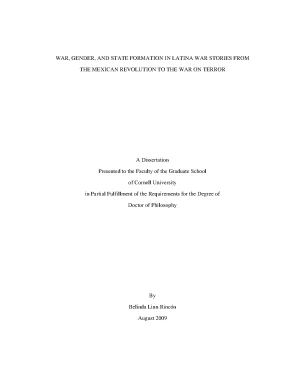
Tải xuống để đọc toàn bộWAR, GENDER, AND STATE FORMATION IN LATINA WAR STORIES FROM THE MEXICAN REVOLUTION TO THE WAR ON TERROR A Dissertation Presented to the Faculty of the Graduate School of Cornell University in Partial Fulfillment of the Requirements for the Degree of Doctor of Philosophy By Belinda Linn Rincón August 2009 © 2009 Belinda Linn Rincón WAR, GENDER, AND STATE FORMATION IN LATINA WAR STORIES FROM THE MEXICAN REVOLUTION TO THE WAR ON TERROR Belinda Linn Rincón, Ph. Cornell University 2009 By defining war as a form of state violence that naturalizes racial oppression and restrictive gender norms, my dissertation renders an understanding of war’s effects on Chicana/o and Mexican culture and gender formation. Whereas most studies of war culture bypass a consideration of women’s experiences within militarized societies, I examine how Latina writers disrupt the state’s self-legitimizing war discourses with counternarratives of their own. In Chapter 1, I study the relationship between state formations, culture, and war.
Focusing on Latina writers, my dissertation asks: How do state formations naturalize war? How do women intervene in war’s discursive formations? How are war and gender articulated? In Chapter 2, I examine Mexican nationalist and Chicano cultural nationalist discourses that feature revenant icons like Pancho Villa and Emiliano Zapata. Sabina Berman’s Entre Villa y una mujer desnuda (1994), Sandra Cisneros’s “Eyes of Zapata” (1991), and Helena María Viramontes’s “The Long Reconciliation” (1985) present feminist literary critiques that counter these reiterations. By re-centering female desire in revolutionary historiography, the authors generate critical analyses of patriarchal master narratives. In Chapter 3, I analyze María Cristina Mena’s critique of postrevolutionary nationalism in The Water-Carrier’s Secret (1942).
Drawing on economic development theories, I show how Mena rejects official narratives of revolutionary progress, anticlericalism, and Indian assimilation. Next, I situate Mena’s Boy Heroes of Chapultepec (1953) within discourses of Good Neighborism and the Cold War. Mena’s text repudiates the historical revisionism during the 1950s that attempted to reframe the US-Mexico War of 1848 within an anti-communist context. Chapter 4 examines the role of Latinas/os in the modern US military.
I analyze the various effects of neoliberalism on military protocol – recruitment methodologies, military advertising, and voluntarism – to examine how the military targets Latina/o recruits. I read Elena Rodriguez’s Peacetime (1997), a novel about a Chicana soldier, along with published accounts of Latinas in the Iraq War. I further consider the complex role of Latina/o immigrants as non-citizen soldiers. Analyzing Latina war stories of life in boot camp and on the front lines, shows how Latina soldiering has profound implications for conceptions of citizenship, nationalism, and militarized gender norms.
BIOGRAPHICAL SKETCH Belinda Linn Rincón earned her B. in English and Women’s Studies from Vassar College. After graduating, she returned to her hometown to teach English at Fontana High School while earning a teaching credential in secondary education at California State University at San Bernardino. She later received an M.
in English from Boston College before entering the Ph. program in English at Cornell University. iii Para mi esposo Rodrigo Rodríguez quien tiene todo mi corazón iv ACKNOWLEDGEMENTS In the opening pages of his novel La Maravilla (1993), Alfredo Véa Jr. writes: “Hay gente en esta página conmigo.
There are people with me on this page.” For me, those people include Pablo and Socorro Linn from Nogales, Sonora, Mexico, and Gilberto and Victoria Rincón from El Paso, Texas, and Las Cruces, New Mexico, respectively. Both sets of my fronterizo abuelos were born during the waning years of the Mexican Revolution. This study has been a genealogical project that attempts to imagine how their lives and those of my bisabuelos – Pablo and Rosa Linn and Santos and Hipolita Rincón – were shaped by a war that raged in the northern Mexican deserts of Sonora and Chihuahua. Their memories and experiences are inscribed in my heart and in my name where I carry them proudly.
Hay gente en estas páginas conmigo. I wish to thank Mary Pat Brady, Committee Chair, for her wise counsel, encouraging words, and unfailing support. From the moment I began attending Cornell, I always knew I had someone on my side, and that has made all the difference in my success. It has been an honor to work with such an amazing mentor who literally read every word of every draft of every chapter that I ever gave her as if she did not have more pressing concerns.
She always says, “It’s my job.” Everybody has a job, but not everybody does it as well. Thank you, Mary Pat. I also owe a great debt of appreciation to the other esteemed members of my committee whose guidance, encouragement, and suggestions helped direct my thinking beyond the disciplinary boundaries of English. I sincerely thank Helena María Viramontes for showing such great enthusiasm for my work and for sharing her teaching and writing wisdom with me.
Also, thank you, Helena, for giving me the greatest compliment ever: that you have faith in me. To Raymond Craib, thank you for guiding me into Mexican history and historiography and for reminding me to think of history as more than just background information. My chapter on the Mexican v revolution would have been seriously deficient without your input and your reading list. Finally, to Debra Castillo, thank you for your encouragement, your suggestions on how to expand my thinking on transnationalism, and for telling me about which Mexican women writers I should absolutely read.
I feel extremely fortunate to have had such distinguished intellectuals guide my way. But there are also other consummate professors who have given generously of their time and have contributed to my education in US literature. Here, I want to thank three individuals who were extremely helpful in my early years in the program. First, thank you, Kate McCullough, for opening up your home, for teaching an amazing class, and for being part of my support system.
Thank you, Eric Cheyfitz, for pushing me to think more critically about indigeneity and the law. Thirdly, thank you, Shirley Samuels, for supporting and encouraging me in so many ways. It has been an honor to learn from you about 19th century literature and about how to be a successful academic. I sincerely appreciate everything you have done for me.
Finally, I would like to thank all of the amazing professors I have had during my time here. They all shaped my intellectual growth and have served as inspirational figures and gracious individuals. In particular, I would like to acknowledge Ronald Mize and María Cristina García for their encouraging words. I also take pleasure in thanking Marti Dense and the Latino Studies Program for providing so much help over the years.
Two generous grants from the LSP funded much of my travel and research. Similarly, I would like to thank the English Department and the Graduate School for much needed conference travel grants. I also owe a debt of gratitude to Michele Mannella for helping me in so many ways. Finally, I thank the Provost’s Office for providing a one-year Diversity Fellowship which was critical to my academic development.
vi Hay familia en estas páginas conmigo. The subject of this dissertation was inspired by the ways in which militarism has insinuated itself in small and significant ways into my family’s life. The military marks my family in the way my father, Sobel, still carries his dog tags in his wallet to this day. He is a proud yet unpretentious man who rarely talks about his years in the war, but when he does, his stories help me imagine the experience of young Chicanos in Viet Nam.
As a child, I remember that while his hands were always calloused and cut from working with machinery and greasy moving metal parts, my dad was always happy. After coming home tired from work, he would drive my sister and me to the public library and fall asleep in the parking lot as we spent hours choosing and checking out books. I think about my mother, Rosa, and what her life must have been like during the 1960s and 70s as a recent immigrant living amidst anti-war protests and school blowouts in East L. Growing up, I remember how my mother would work all day in stuffy offices, endure torturous commutes on congested freeways, and then do extra chores on the weekends rather than tell me to stop reading from my stack of Agatha Christie mysteries.
of the Rincón family, she made sure we had what we needed and usually what we wanted. My mother is an intelligent woman who was not given the opportunities that she gave to me and Irene. I also think about my sister Irene’s struggle to finish her college education as she shuttled around from base to base as the wife of a Navy seaman. Eventually, my hard-working sister would raise three amazing children virtually single-handedly while working full time as a teacher and going to night school to earn her Masters.
Renee, Robert, and Ryan inherited their beauty, charm, humor, and intelligence from Irene. These Chicanitos represent the next generation. I love them deeply. My family taught me how to work hard, and those skills have served me well.
Their sacrifices and love are written on the pages you are about to read. vii Hay una persona muy especial en estas páginas conmigo. There is one person, above all others, who deserves and receives my greatest love, respect, and appreciation. Even though my doctoral degree selfishly displays my name only, it is more accurately a jointly-held degree that I share with Rodrigo.
I thank him for putting his needs and goals secondary to mine as we bounced around the country in pursuit of my education. I thank him for all the things he did to help me endure graduate school. He planted a beautiful garden for me to meditate on and made sure I had a warm casita to work in during frigid Ithaca winters. He drove me to conferences, sat in the audience, and attended lectures with me.
He fixed stubborn computers and printers that refused to work. He took care of me when I was sick. He did all of this and more while earning his own degree and, in the process, inspiring me with his own thirst for knowledge and his drive for self-improvement. I take great pride in inscribing his name, Rodrigo Rodríguez, within this institution of higher learning because this degree is the cumulative result of the mundane acts and magnanimous sacrifices he has made throughout the years to contribute to my education.
viii TABLE OF CONTENTS Biographical Sketch iii Dedication iv Acknowledgments v Chapter 1: War, Gender, and State Formation in Latina War Stories 1 Chapter 2: Desiring History in Sabina Berman’s, Sandra Cisneros’s, and 20 Helena María Viramontes’s Narratives of the Mexican Revolution Chapter 3: Heroic Boys and Good Neighbors: U.-Mexico Relations in 101 María Cristina Mena’s Young Adult Fiction Chapter 4: Representing the Nation: Latinas/os and Neoliberal Militarism 168 Conclusion 239 Works Cited 255 ix CHAPTER 1: WAR, GENDER, AND STATE FORMATION IN LATINA WAR STORIES Reflecting on his military experience, former Lieutenant General Ricardo Sanchez notes that “the ethics and the value system of the military profession fit almost perfectly with my own heritage” (Mariscal “Homeland” 39). For Sanchez, both his Mexican heritage and his military service complement each other for the purported notions of duty they espouse, the culture of pride they instill, and the normative masculinities they support. In her statement about her Mexican heritage, Brigadier General Angela Salinas describes a similar cultural affinity for military service: “The Marine Corps is much like my Hispanic culture. It’s about family.
The family is the core held together by tradition, pride, honor, and commitment” (qtd. in Young and Corvino).
Nội dung được bảo vệ bản quyền — Tải xuống đầy đủ
Trích dẫn luận án này
Belinda Linn Rincón (2009). Chiến tranh, Giới và Nhà nước trong truyện Latina [Luận án tiến sĩ, Cornell University]. LuanAn.net. https://luanan.net/van-hoc/chien-tranh-gioi-nha-nuoc-truyen-latina-mexico-war-on-terror
Câu hỏi thường gặp
Luận án "Chiến tranh, Giới và Nhà nước trong truyện Latina" nghiên cứu về vấn đề gì?
Khám phá vai trò của chiến tranh, giới và nhà nước trong văn học Mỹ Latinh. Phân tích sâu sắc các tác phẩm kinh điển và hiện đại.
Luận án "Chiến tranh, Giới và Nhà nước trong truyện Latina" được bảo vệ tại trường nào?
Luận án này được bảo vệ tại Cornell University. Năm bảo vệ: 2009.
Luận án "Chiến tranh, Giới và Nhà nước trong truyện Latina" thuộc chuyên ngành gì?
Luận án "Chiến tranh, Giới và Nhà nước trong truyện Latina" thuộc chuyên ngành English. Danh mục: Văn Học.
Luận án "Chiến tranh, Giới và Nhà nước trong truyện Latina" có bao nhiêu trang?
Luận án "Chiến tranh, Giới và Nhà nước trong truyện Latina" có 287 trang. Bạn có thể xem trước một phần tài liệu ngay trên trang web trước khi tải về.
Cách tải luận án "Chiến tranh, Giới và Nhà nước trong truyện Latina" về máy như thế nào?
Để tải luận án về máy, bạn nhấn nút "Tải xuống ngay" trên trang này, sau đó hoàn tất thanh toán phí lưu trữ. File sẽ được tải xuống ngay sau khi thanh toán thành công. Hỗ trợ qua Zalo: 0559 297 239.