Hoyles anna journalism january 2021
Anna Hoyles journalism, tháng 1 năm 2021. Khám phá các bài viết, phân tích và tin tức báo chí từ đầu năm 2021 bởi Anna Hoyles.
University of Lincoln
English and Journalism
Luan An
Luận án tiến sĩ
Năm xuất bản
Số trang
257
Thời gian đọc
39 phút
Lượt xem
0
Lượt tải
0
Phí lưu trữ
50 Point
Tổng quan nhanh
- Chủ đề:
- Anna Hoyles Research Uncovers Martinson's Journalism Legacy
- Số trang:
- 257 trang
- Trường:
- University of Lincoln
- Chuyên ngành:
- English and Journalism
- Tác giả:
- Anna Hoyles
- Năm:
- 2021
Tóm tắt nội dung luận án
I.Anna Hoyles Research Uncovers Martinson s Journalism Legacy
Anna Hoyles's PhD thesis, submitted in January 2021, brings to light the largely unknown journalism of Swedish novelist Moa Martinson (1890–1964). This Anna Hoyles research meticulously examines 253 articles by Martinson, published between 1922 and 1960. The study explores Martinson’s strategic use of her working-class background. It reveals how Martinson articulated her political and social ideas through her journalistic writings. Many articles appeared in syndicalist, anarchist, socialist, and feminist newspapers. This work contributes significantly to media studies by highlighting an underrepresented voice. Martinson represents working-class women writers from Scandinavian countries, groups often overlooked in journalism history. The thesis emphasizes Martinson's exceptional narrative and descriptive capabilities. It particularly focuses on her distinctive journalistic voice, offering a fresh perspective for journalism education programs.
1.1. Thesis Focus Moa Martinson s Journalistic Work
The central aim of this thesis is to understand how Martinson utilized literary journalism to express her political convictions. Her extensive journalistic output, though substantial, remains largely unstudied in Sweden and unknown to the English-speaking world. This gap in knowledge is significant. Martinson's work offers invaluable insights into the lives of individuals rarely heard from directly in historical contexts. The research employs close reading of Martinson's articles. This method allows for deep textual analysis of her unique style and message.
1.2. Underrepresented Voices in Journalism Studies
Martinson's identity as a Swedish, working-class woman places her in a category severely underrepresented in both journalism and literary journalism studies. The thesis argues for the inclusion of such diverse voices. It challenges the conventional canon of literary journalism, often dominated by elite figures. Discovering and studying these alternative voices is crucial. It reshapes the historical understanding of journalism. This approach promotes a more inclusive and nuanced view of journalistic practices and contributions. It also helps in understanding the historical context of press freedom for marginalized groups.
1.3. Anna Hoyles Publications Expanding Media History
This academic contribution by Anna Hoyles expands the existing body of Anna Hoyles publications. It enriches the field of literary journalism by presenting a detailed analysis of Martinson’s work. The thesis helps to integrate previously overlooked figures into mainstream academic discourse. Its findings inform ongoing discussions in media studies about authorship, representation, and historical narratives. This research provides a foundation for future studies on diverse journalistic voices. It highlights the importance of historical context in understanding contemporary media landscapes.
II.Moa Martinson s Literary Journalism Class Politics Voice
Moa Martinson's work is definitively framed as literary journalism. This categorization is crucial for understanding her contributions. The thesis meticulously analyzes her articles, placing them within their rich social and historical contexts. Martinson's writing is characterized by her ability to merge personal experience with political commentary. This approach provides a unique perspective on journalism ethics and social responsibility. The close reading methodology employed uncovers the nuances of her narrative and descriptive skills. It reveals how she crafted a compelling and consistent journalistic voice. Her articles served as a platform for expressing her class-based knowledge. They translated into powerful political and social ideas. This makes her work a significant case study for media literacy education.
2.1. Martinson s Political and Social Commentary
Martinson’s journalism was a direct vehicle for her political activism. Her articles were not just reports; they were carefully constructed arguments for social change. She critiqued societal norms and advocated for marginalized communities. This engagement highlights a historical dimension of journalism ethics. It demonstrates how personal beliefs informed public discourse. Her commentary provides a valuable lens through which to examine social and political movements of her era. Understanding this connection enriches modern analyses of activist journalism.
2.2. Defining Martinson s Distinctive Journalistic Voice
A key finding of the thesis is the distinctive nature of Martinson's journalistic voice. This voice is characterized by authenticity and directness. It resonates with her personal experiences and political convictions. Her narratives are engaging, drawing readers into her world. This skillful storytelling is a hallmark of literary journalism. It distinguishes her work from more conventional reporting. Her unique voice is a testament to her narrative and descriptive abilities. It showcases how a powerful individual voice can shape public opinion, which is relevant to discussions about misinformation in journalism today.
2.3. The Context of Swedish Proletarian Journalism
Martinson operated within the burgeoning field of Swedish proletarian journalism. This context is vital for understanding her work's significance. Proletarian fiction, including journalism, held a recognized place in the Swedish literary canon. Martinson often stood as the sole female representative within this movement. Her influence on subsequent Swedish writers is undeniable. This historical perspective is essential for journalism education. It demonstrates how different national and social contexts shape journalistic traditions. It also provides a foundational understanding for media studies on the evolution of journalistic styles.
III.Martinson s Unique Journalistic Authority and Immersion
The thesis identifies two pivotal contributions of Martinson's work to the theory of literary journalism. First, her adept use of the oral tradition. Martinson integrates techniques of orality into her writing. This approach authenticates her narratives and enhances reader engagement. It suggests new avenues for literary journalism to embrace diverse storytelling methods. Second, her unconventional yet powerful strategy of immersion stands out. Martinson writes from a world she experienced since birth. This makes personal experience a profound form of immersion. It becomes her primary source of authority, shaping her credibility. Her life events transform into rhetorical tools. They provide undeniable authority for her as a writer and as a political activist. This perspective offers an alternative to traditional fact-checking methods, emphasizing lived truth. It underscores the power of personal narrative in shaping public understanding and combating misinformation in journalism.
3.1. Oral Tradition and Authenticity in Journalism
Martinson’s deployment of oral tradition techniques is a remarkable aspect of her journalism. She skillfully weaves storytelling elements common in spoken narratives into her written work. This method imbues her articles with a sense of authenticity. It directly connects with readers on an emotional and personal level. This highlights the potential for literary journalism to draw from diverse cultural forms of communication. It offers valuable lessons for contemporary digital journalism on engaging audiences with credible, compelling narratives.
3.2. Personal Experience as Journalistic Immersion
Martinson’s form of immersion is unique. Unlike journalists who enter a new world for a story, Martinson writes from a lifelong submersion in her subject matter. Her personal experiences are not just observations; they are foundational to her insights. This perspective provides an inherent authority to her narratives. It challenges conventional notions of journalistic objectivity. It demonstrates how deep personal connection can enrich reportage, offering profound insights relevant to media literacy and critical consumption of news.
3.3. Martinson s Authority in Reporting Life Events
Martinson transforms her own life events into powerful rhetorical tools. Her lived experiences serve as the basis for her authority. This makes her arguments compelling and her voice credible. This approach is vital for understanding how personal narratives can establish truth and legitimacy in journalism. It offers a historical precedent for journalists today seeking to establish trust. This strategy provides a counterpoint to more detached journalistic styles, emphasizing the impact of personal truth, especially pertinent in discussions about misinformation in journalism.
IV.Key Themes in Martinson s Journalism for Media Studies
The thesis meticulously focuses on several major themes present in Martinson’s journalism. These themes offer profound insights into her social and political thought. They also provide rich material for media studies and journalism education. A significant theme is the importance of maternal love and authority. Martinson consistently champions the role of mothers in society. Another prominent theme is her strong rejection of corporal punishment. She advocates for more humane disciplinary practices. Furthermore, Martinson delivers a damning indictment of charity practices. She critiques its often paternalistic nature. In contrast, she firmly believes in the power of solidarity and mutual aid. These themes resonate strongly with contemporary social justice movements. They provide historical context for ongoing debates about social welfare and community support. Her reporting on these issues exemplifies a commitment to journalism ethics and social advocacy.
4.1. Maternal Love and Authority in Martinson s Work
Martinson frequently highlights the significance of maternal love and authority within her journalism. She portrays mothers not only as caregivers but as crucial figures of moral and social guidance. This focus underscores the societal importance of women’s roles, particularly within working-class communities. Her work offers a unique feminist perspective on family dynamics and community strength, making it valuable for media studies on gender representation.
4.2. Advocating Against Corporal Punishment
Martinson consistently expresses her strong disapproval of corporal punishment. She uses practical examples and compelling narratives to argue against its use. Her journalistic efforts contributed to social discussions about child welfare and ethical upbringing. This aspect of her work reflects a progressive stance on human rights for her era. It is relevant to modern journalism ethics debates about advocacy and social responsibility. This advocacy for children's rights can be seen as an early form of social impact journalism.
4.3. Rejecting Charity Embracing Mutual Aid
A central tenet of Martinson's journalism is her rejection of traditional charity. She viewed charity as often demeaning and insufficient. Instead, she passionately advocates for solidarity and mutual aid as superior forms of community support. This highlights her socialist and syndicalist leanings. Her arguments provide a historical critique of social welfare systems. This theme is highly pertinent for contemporary discussions in media studies on social justice, community activism, and alternative economic models. It also informs understanding of press freedom in advocating for systemic change versus temporary relief.
V.Expanding Journalism History Martinson s Underrepresented Voice
Martinson's work profoundly contributes to a more inclusive understanding of literary journalism history. Her identity—Swedish, working-class, and a woman—positions her as a crucial figure. She challenges the traditional canon, often dominated by 'usual suspects' like Capote or Wolfe. This Anna Hoyles publication argues for a broader historical understanding of the field. Martinson's influence on subsequent Swedish writers, up to the present day, is undeniable. Proletarian fiction holds a firm place in the Swedish literary canon. Martinson is often the sole female representative within this significant movement. Her enduring impact should not be underestimated. This makes her work vital for journalism education seeking to diversify curricula. It offers valuable insights into media literacy by showcasing how marginalized voices create lasting cultural legacies. Her struggles and successes reflect historical challenges to press freedom for non-elite journalists.
5.1. Challenging the Traditional Literary Journalism Canon
The thesis directly addresses the need to expand the established canon of literary journalism. It moves beyond commonly recognized figures to uncover original visions. Martinson's journalistic abilities and unique perspective demonstrate that important voices exist outside mainstream narratives. This critical re-evaluation enriches the academic discourse on literary forms. It encourages a more diverse and globally informed approach to media studies and journalism ethics.
5.2. Martinson s Influence on Swedish Literature
Martinson's position within Swedish proletarian fiction is significant. Her work has left a lasting legacy on the nation's literary landscape. She serves as an inspiration for many subsequent writers. Her impact on the cultural and political consciousness of Sweden is profound. This historical influence is essential for any comprehensive journalism education program that aims to cover global media histories. It underscores the power of a single voice to shape national identity and artistic movements.
5.3. Valuing Diverse Voices in Journalism History
The study champions the recovery and analysis of diverse voices in journalism history. It highlights how uncovering such figures can evolve understanding of the field. Martinson's story illustrates the importance of inclusive scholarship. It ensures that the contributions of women, working-class writers, and non-Western figures are recognized. This promotes a richer, more accurate historical record for media studies. It also emphasizes the ongoing relevance of diverse perspectives for contemporary debates on digital journalism and misinformation in journalism.
Tải xuống file đầy đủ để xem toàn bộ nội dung
Tải đầy đủ (257 trang)Trích đoạn nội dung luận án
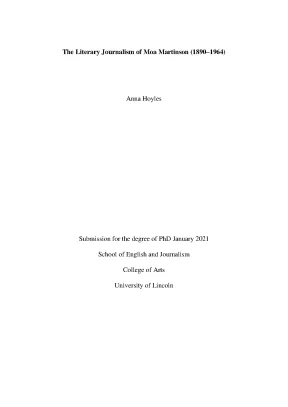
Tải xuống để đọc toàn bộThe Literary Journalism of Moa Martinson (1890–1964) Anna Hoyles Submission for the degree of PhD January 2021 School of English and Journalism College of Arts University of Lincoln Abstract This thesis brings to the fore the little-known journalism of the Swedish novelist Moa Martinson (1890–1964). Using a sample of 253 articles, spanning the years 1922–1960, it explores Martinson’s use of her class-based knowledge to expound her political and social ideas through her journalism. The articles, mainly published in syndicalist, anarchist, socialist and feminist newspapers, are analysed using close reading. Placing Martinson within her social and historical contexts, this study argues that Martinson’s work is literary journalism, a field where women, working-class writers (Roberts, 2012) and the Scandinavian countries (Tulloch and Keeble, 2012) are all underrepresented.
In doing so, it highlights her narrative and descriptive skills, and in particular her distinctive journalistic voice. The thesis draws attention to two key aspects where the study of Martinson’s work may contribute to the theory of literary journalism. Firstly, in her deployment of the oral tradition she shows the potential for literary journalism to incorporate many of orality’s techniques as authenticating and reader-engagement approaches. Secondly, she exhibits an unusual, but powerful, attitude to literary journalism’s strategy of immersion.
She writes from a world in which she has been submerged since birth: in doing so, personal experience becomes a form of immersion and her primary source of authority. In her hands, life events become a rhetorical tool to provide authority for her both as a writer and as a political activist. To illustrate these points, the thesis focuses on several major themes in Martinson’s journalism: the importance of maternal love and authority; a rejection of corporal punishment; and a damming indictment of the practice of charity, complemented by a belief in solidarity and mutual aid. Acknowledgements With huge thanks: to my parents, Gun-Britt and David Hoyles, who put up with an awful lot and gave a great deal, and without whom I could never have completed this thesis; to Peter Hickman for his patience, support, proofreading, and provision of beans on toast; to Jane Chapman for motivating me to do a PhD and for giving me opportunities that opened up a whole new world; to Amy Culley for her encouragement and excellent advice; to Moa Holmqvist for generously sharing her research data; to John and Thomas Hoyles, Alice Davis, Amara Crozier, Chris Blake, Jayne Davies, Lioba Suchenwirth, Rosalyn Spencer and Sally Cook for years of encouragement and of generosity in subsidising a perpetual student; to Rosalyn and Jayne also for all our study sessions and to Chris for providing me with the opportunity to do the MA which led to the PhD.
Contents Abstract Acknowledgements Contents Chapter 1: Introduction. 1 Chapter 2: Locating Martinson: Archives and Translation. 23 Chapter 3: Literature review: Oral traditions, Literary Journalism, and Martinson’s Recovery. 35 Chapter 4: Martinson’s Voice, Persona, and the Use of Experience.
83 Chapter 5: Martinson’s use of Maternal Identity in the Political Struggle. 125 Chapter 6: Martinson’s Rejection of Corporal Punishment by the Use of Practical Example. 159 Chapter 7: ‘Real People Hate Philanthropy’ – Martinson’s Rejection of Charity in Favour of Mutual Aid. 216 Chapter 1: Introduction […] we shouldn’t overlook other, less elite sources – where we may find not the ‘usual suspects’ (Truman Capote, Tom Wolfe, Joan Didion, et al.) but others with original visions of literary journalism and the requisite abilities to realise them.
Who knows how our historical understanding of literary journalism might evolve, when we uncover such voices and study them? (Roberts, 2012, 82) This thesis discusses the literary journalism of the Swedish ‘proletarian’ writer Moa Martinson (1890–1964). Although she wrote over 250 articles, Martinson’s journalism is relatively unstudied in Sweden, and is unknown in the English-speaking world. In posing the question ‘how did Martinson use her literary journalism to articulate her political ideas?’, this thesis sets Martinson’s work within literary journalism, where it has not previously been considered. Martinson’s voice deserves to be heard for several reasons, not least of all because of whom she was.
Swedish, working class and a woman – all categories severely underrepresented in journalism and literary journalism studies; through Martinson, we gain an insight into lives rarely heard from in the first person. Martinson also deserves recognition for her influence on subsequent Swedish writers leading up to the present day. Proletarian fiction is part of the literary canon in Sweden, and, as she is often the sole female representative within this, her impact should not be underestimated. 1 In this way, the thesis aims to contribute to the more inclusive history of literary journalism in the early 20th century, called for by Roberts above.
Once women such as Martinson are taken into account, the result will be, as Roberts points out, ‘a different history of literary journalism, one much more nuanced than we know now’ (ibid. This will include new outlooks on the world and its problems, and new stylistic dimensions to literary journalism. 1 Martinson has received acknowledgment from the labour movement in the form the annual Moa Martinson prize, which is awarded to those who, in the view of Arbetarnas Bildningsförbund (the Swedish Workers’ Educational Association) and the literary society Moas Vänner (Moa’s Friends), write ‘in the spirit of’ Martinson. 1 This thesis argues that Martinson contributes fresh perspectives to the field of literary journalism in the form of her particular authorial voice, with its deployment of the oral tradition and the rhetorical use of personal experience (particularly in relation to motherhood), both of which provided authority in her work when countering political arguments.
By bringing theoretical issues down to a practical level with examples from everyday life, Martinson employed her own experiences, and those of her friends’ and neighbours, to illustrate the veracity of her arguments, thus melding the personal and the political. Lived experience here became a form of ‘immersion’, a concept integral to literary journalism but rarely seen in the mode adopted by Martinson. This study examines Martinson’s ‘factual’ journalism, but draws on her fiction, both articles and books, at times to shed further light on her journalism. It adopts a critical empathetic approach using close reading and contextual analysis.
Previous work on Martinson has had a primarily feminist outlook, and, whilst acknowledging the importance of this viewpoint, this thesis does not offer an in-depth feminist analysis nor one of class analysis. Martinson’s use of personal experience in her writing as an overarching trope means that the practical details of her life, and the socio-economic and political context within which she lived and worked, are of particular importance to readers. As she is, in addition, little known to English speakers, this introductory chapter sets out her background, before her writing is discussed in detail in subsequent chapters. Firstly, however, the Introduction takes a closer look at the relevance of studying Martinson’s work today, but with the aspects pertaining to the theory of literary journalism being primarily discussed in the literature review.
Why is Martinson’s literary journalism of importance? Firstly, and most importantly, Martinson’s newspaper work is (mostly) a joy to read and merits reaching a broader audience – including non-Swedish speakers, for whom her articles are currently inaccessible. Almost a century since its publication, her writing is often funny, 2 empathetic, gripping and principled, despite, at times, also being contradictory, erratic in quality and lacking in nuance. Appearing predominately in the radical media, Martinson’s work managed to be both highly political and eminently readable, with an informal and commonsensical manner that made her a controversial, but popular figure.2 Secondly, there has been no study, longer than a chapter, on Martinson in English at all and no recognition of her as a literary journalist in any language. In Sweden, Martinson’s 15 novels have been studied, but her journalism has primarily been perceived as a stepping stone to her fiction and has been examined, when at all, predominantly in this context.
As is often the case with journalism, Martinson’s writing in newspapers and magazines has been considered the less developed precursor to her fiction and has not been identified as literary journalism. The latter is a hitherto nascent area of research in Sweden. Consequently, this thesis is the first to recognise parts of Martinson’s writing as literary journalism and to focus on it, and her journalism as a whole, as a significant body of work in itself. It also explores themes within her writing that either have been noted but left undeveloped in other studies or are completely new.
The latter include Martinson’s objections to charity and her defence of the ‘outsider’. For the purposes of this study, journalism is identified as non-fiction writing published in newspapers and magazines. The definition of literary journalism is discussed in the following two chapters; however, as a working explanation for this introduction, it can be said to be a branch of journalism where as much attention is paid to how one writes as to the subject matter. The text is not only factual but also uses tropes commonly associated with literature to engage the reader, most importantly narrative and description.
For Greenberg, ‘If there is a single thing that distinguishes literary journalism from other forms of reporting it is the use of narrative rather than expository prose’ (Greenberg, 2014, 517). The journalist Gay Talese 2 Radical media is defined by John D. Downing as ‘generally small-scale and in many different forms, that express an alternative vision to hegemonic policies, priorities, and perspectives’ (Downing, 2001, v). 3 calls this ‘the literature of reality’ (Talese, 1996, 4).
Max Weber puts it succinctly as ‘literary non-fiction’ (Weber, 1980, 1). Another of many alternative, and telling, labels is therefore ‘creative non-fiction’. In establishing much of Martinson’s writing in newspapers and magazines as literary journalism attention is drawn, in this thesis, to her use of the first person and acknowledged subjectivity, her descriptive language, her narrative techniques, and her use of details and dialogue – all signs of literary journalism, as is discussed in the next chapter. These were not serendipitous flourishes: Martinson was well read and particularly enjoyed the work of Fyodor Dostoevsky, George Sand and William Somerset Maugham.
The breadth of her reading is evident in one 1942 article alone, in which she references Zoroaster, Catullus, Homer, the Phoenicians, Brueghel, Dostoevsky, St Francis, Timon of Athens, Spinoza and Einstein (Martinson, 1942). In so doing she is claiming a literary status for journalism, just as the current day literary journalist Svetlana Alexievich does with her ‘unremitting’ (Hartsock, 2016, 89) literary references in Boys in Zinc (2017). Notwithstanding her literary influences Martinson’s press articles and novels also show the impact of oral sources, which she acknowledged several times. Many of the tropes of literary journalism are also those of preliterate storytelling, and Chapters 2 and 3 explore the overlap between the two.
Thirdly, Martinson’s work is of importance in that it gives a voice and sheds light on the thought processes and life of a Swedish working-class woman, albeit an exceptional one, in the first half of the 20th century. Women are underrepresented, of course, in many areas, but not least in journalism and literary journalism. Martinson’s gender made her unusual enough in this area without her socio-economic status, but working-class women have, in particular, ‘left such a meagre body of literary material about themselves’ (Tebbutt, 1995, 26) that to hear such a literary voice is rare indeed. 4 The North American writer and activist Tillie Olsen is at present the literary journalist who comes closest to Martinson in both word and deed.
For Olsen, Martinson is ‘a writer of international stature and significance – in her life as well as her work’ (Olsen, n. A generation younger than the Swede Olsen was instrumental in the publication of the English translations of two of Martinson’s novels through the Feminist Press in New York, the first in 1973.
Nội dung được bảo vệ bản quyền — Tải xuống đầy đủ
Trích dẫn luận án này
Anna Hoyles (2021). Hoyles anna journalism january 2021 [Luận án tiến sĩ, University of Lincoln]. LuanAn.net. https://luanan.net/truyen-thong-bao-chi/hoyles-anna-journalism-january-2021
Câu hỏi thường gặp
Luận án "Hoyles anna journalism january 2021" nghiên cứu về vấn đề gì?
Anna Hoyles journalism, tháng 1 năm 2021. Khám phá các bài viết, phân tích và tin tức báo chí từ đầu năm 2021 bởi Anna Hoyles.
Luận án "Hoyles anna journalism january 2021" được bảo vệ tại trường nào?
Luận án này được bảo vệ tại University of Lincoln. Năm bảo vệ: 2021.
Luận án "Hoyles anna journalism january 2021" thuộc chuyên ngành gì?
Luận án "Hoyles anna journalism january 2021" thuộc chuyên ngành English and Journalism. Danh mục: Truyền Thông - Báo Chí.
Luận án "Hoyles anna journalism january 2021" có bao nhiêu trang?
Luận án "Hoyles anna journalism january 2021" có 257 trang. Bạn có thể xem trước một phần tài liệu ngay trên trang web trước khi tải về.
Cách tải luận án "Hoyles anna journalism january 2021" về máy như thế nào?
Để tải luận án về máy, bạn nhấn nút "Tải xuống ngay" trên trang này, sau đó hoàn tất thanh toán phí lưu trữ. File sẽ được tải xuống ngay sau khi thanh toán thành công. Hỗ trợ qua Zalo: 0559 297 239.