The impact of power status on gender stereotypes sexism and gen
Khám phá tác động của địa vị quyền lực đến định kiến giới, phân biệt đối xử và bất bình đẳng. Phân tích sâu sắc mối liên hệ này.
Counseling Psychology
Luan An
Luận án
Năm xuất bản
Số trang
161
Thời gian đọc
25 phút
Lượt xem
0
Lượt tải
0
Phí lưu trữ
50 Point
Tổng quan nhanh
- Chủ đề:
- Power Status, Gender Stereotypes, and Workplace Sexism Impact
- Số trang:
- 161 trang
- Trường:
- University of North Dakota
- Chuyên ngành:
- Counseling Psychology
- Tác giả:
- Juemei Yang
- Năm:
- 2016
Tóm tắt nội dung luận án
I.Power Status Gender Stereotypes and Workplace Sexism Impact
This document explores the significant influence of power status on gender stereotypes and sexism. It investigates gender discrimination faced by women in the workplace. The research also examines how these factors affect women's career identity development. Understanding the power dynamics is crucial. Persistent barriers hinder women's professional advancement. The study delves into both historical contexts and modern workplace challenges. It highlights how the social hierarchy often perpetuates inequalities. This comprehensive analysis aims to shed light on deeply rooted issues. It provides a foundation for effective interventions.
1.1. Examining the Persistent Barriers for Women in Careers
Women encounter significant barriers in their professional lives. These obstacles often stem from their power status within organizations. Gender stereotypes contribute to unfair perceptions. Sexism manifests as discriminatory practices. This creates a challenging environment for career identity development. Gender discrimination limits opportunities. It impacts advancement and recognition. The workplace social hierarchy frequently marginalizes women. Addressing these issues is crucial for equity. Understanding the power dynamics is a first step.
1.2. Tracing the Historical Evolution of Women s Career Identity
Women's career paths have a complex history. Periods like the Revolutionary War saw women taking on new roles. Industrialization further shifted labor needs. The Civil War era presented challenges and opportunities for women. Post-World War I prosperity and the Great Depression redefined economic landscapes. World War II significantly increased women's participation in the workforce. Despite these shifts, traditional gender roles persisted. Sex role stereotypes often confined women to specific occupations. This historical context shaped career identity development. It influenced perceptions of leadership power.
1.3. Factors Hindering Women s Professional Development
Numerous factors impede women's career progress. Entrenched gender roles often dictate expectations. Implicit bias affects hiring and promotion decisions. A lack of mentorship and sponsorship can limit growth. Misogyny, both overt and subtle, creates hostile environments. The prevailing social hierarchy assigns lesser value to women's contributions. Authority influence is often concentrated among men. This perpetuates a cycle of gender discrimination. Workplace sexism remains a significant hurdle. These elements collectively hinder women from achieving their full potential.
II.Investigating Power Dynamics Study Purpose and Methodology
The research outlined a clear purpose: to meticulously investigate the interplay between power status and gender-related workplace issues. It detailed a rigorous methodology to achieve its objectives. The study aimed to quantify the impact of power dynamics on gender stereotypes and sexism. It also sought to understand its implications for women's career identity. Experimental conditions were carefully designed. This ensured robust data collection and analysis. The methodological framework allowed for an in-depth examination of gender bias.
2.1. Defining the Research Objectives and Key Hypotheses
This study aimed to understand a critical issue. It investigated the impact of power status. Specifically, its influence on gender stereotypes and sexism. The research also explored gender discrimination toward women in the workplace. A key focus was women's career identity development. Hypotheses were formulated to predict these relationships. The research sought to clarify how authority influence shapes perceptions. It explored the mechanisms behind workplace sexism.
2.2. Design of the Experimental Conditions and Participant Groups
The methodology involved a structured design. Participants were divided into conditions. These included high power status and low power status groups. Data was collected from diverse demographics. The study utilized vignettes. These presented scenarios involving a male or female character. This allowed for measuring reactions to different gender roles. The design facilitated a nuanced analysis of power dynamics. It provided a framework to observe gender bias.
2.3. Analytical Approaches for Assessing Gender Bias
Several statistical methods analyzed the collected data. Analysis of Variance (ANOVA) was a primary tool. It examined how different factors interacted. Descriptive statistics provided initial insights. Measures included the ASI, GDPI, and BSRI scales. BSRI assessed femininity, masculinity, and neutral traits. These instruments quantified gender stereotypes and sexism. They helped detect instances of gender discrimination. The analysis illuminated the complex interplay of power and perception. It offered quantitative evidence of social hierarchy effects.
III.Unpacking Key Findings on Gender Roles and Discrimination
The study's findings provide critical insights into gender roles and discrimination in the workplace. It reveals how power status significantly influences the prevalence and perception of gender stereotypes and sexism. Detailed analyses illuminated nuanced interactions between various factors. Insights from an international sample offered a broader perspective on these pervasive issues. The results demonstrate the complex nature of power dynamics and their impact on gender equity. They underscore the need for targeted interventions against gender discrimination.
3.1. Main Effects of Power Status on Stereotypes and Sexism
The study revealed significant main effects. Power status directly influenced perceptions of gender stereotypes. It also affected the manifestation of sexism. Individuals in high power positions sometimes perpetuated more bias. This showed how authority influence can reinforce existing gender roles. The findings indicated a clear link. Power dynamics play a crucial role in shaping workplace interactions. These dynamics can lead to increased gender discrimination.
3.2. Post Hoc Analyses Revealing Nuances of Gender Bias
Further, more detailed analyses provided deeper understanding. Post-hoc tests explored specific interactions. Differences between power statuses were clarified for men and women. The gender of the person in the vignette also mattered. These analyses highlighted subtle forms of gender bias. They showed how sex role stereotypes operate in various contexts. The findings illuminated the complexity of social hierarchy. They detailed how gender discrimination can vary.
3.3. International Sample Insights into Power Influence
The research extended its scope to an international sample. This provided valuable comparative data. Main effects analysis was conducted for this group. The international findings offered unique insights. They showed how power dynamics transcend cultural boundaries. However, cultural nuances might modify expressions of leadership power. The cross-cultural perspective reinforced the pervasive nature of gender stereotypes. It also underscored challenges in combating workplace sexism globally.
IV.Practical Implications for Addressing Workplace Sexism
The study offers vital practical implications for tackling workplace sexism and gender discrimination. It suggests actionable strategies to mitigate gender bias and foster equitable power dynamics. Creating a supportive environment is paramount for women's career identity development. Organizations must focus on transforming their social hierarchy. This involves promoting inclusive leadership power and challenging existing gender roles. The goal is to cultivate workplaces free from sexism and misogyny, ensuring equal opportunities for all.
4.1. Strategies to Mitigate Gender Bias and Authority Influence
Addressing workplace sexism requires deliberate action. Organizations must implement targeted training programs. These programs challenge unconscious gender bias. They educate on the impact of authority influence. Promoting awareness of gender stereotypes is vital. Policies must actively counter gender discrimination. Creating clear reporting mechanisms for misogyny helps. Leaders must model equitable behavior. These strategies foster a more inclusive environment.
4.2. Fostering Equitable Power Dynamics in Organizations
Achieving true equity demands structural changes. Re-evaluating existing social hierarchy is essential. Promoting women into leadership power positions creates role models. Mentorship and sponsorship programs support women's advancement. Ensuring transparent promotion processes reduces bias. Balancing power dynamics benefits all employees. It moves away from traditional, restrictive gender roles. Organizations become more innovative and fair.
4.3. Supporting Women s Career Identity and Leadership Potential
Investment in women's professional growth is critical. Programs focused on career identity development empower women. These initiatives build confidence and leadership skills. They help women navigate challenges posed by sex role stereotypes. Providing equal access to challenging projects is important. Recognition of achievements helps counter gender discrimination. A supportive culture encourages women to aspire to leadership power. This ensures a diverse and strong future workforce.
Mục lục chi tiết luận án
Tải xuống file đầy đủ để xem toàn bộ nội dung
Tải đầy đủ (161 trang)Trích đoạn nội dung luận án
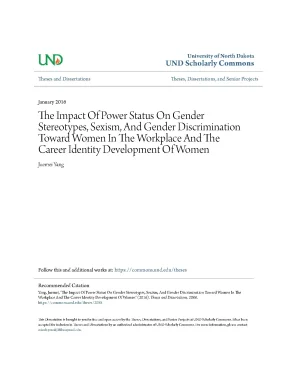
Tải xuống để đọc toàn bộUniversity of North Dakota UND Scholarly Commons Theses and Dissertations Theses, Dissertations, and Senior Projects January 2016 The Impact Of Power Status On Gender Stereotypes, Sexism, And Gender Discrimination Toward Women In The Workplace And The Career Identity Development Of Women Juemei Yang Follow this and additional works at: https://commons.edu/theses Recommended Citation Yang, Juemei, "The Impact Of Power Status On Gender Stereotypes, Sexism, And Gender Discrimination Toward Women In The Workplace And The Career Identity Development Of Women" (2016). Theses and Dissertations.edu/theses/2088 This Dissertation is brought to you for free and open access by the Theses, Dissertations, and Senior Projects at UND Scholarly Commons. It has been accepted for inclusion in Theses and Dissertations by an authorized administrator of UND Scholarly Commons. For more information, please contact zeineb.
THE IMPACT OF POWER STATUS ON GENDER STEREOTYPES, SEXISM, AND GENDER DISCRIMINATION TOWARD WOMEN IN THE WORKPLACE AND THE CAREER IDENTITY DEVELOPMENT OF WOMEN by Juemei Yang BA, University of Conneticut, 2008 MA, Boston College, 2010 A Dissertation Submitted to the Graduate Faculty of the University of North Dakota In partial fulfillment of the requirements for the degree of Doctor of Philosophy Grand Forks, North Dakota December 2016 ii PERMISSION Title: The Impact of Power Status on Gender Stereotypes, Sexism, and Gender Discrimination toward Women in the Workplace and the Career Identity Development of Women Department: Counseling Psychology Degree: Doctor of Philosophy In presenting this dissertation in partial fulfillment of the requirements for a graduate degree from the University of North Dakota, I agree that the library of this University shall make it freely available for inspection. I further agree that permission for extensive copying for scholarly purposes may be granted by the professor who supervised my dissertation work or, in her absence, by the Chairperson of the department or the dean of the School of Graduate Studies. It is understood that any copying or publication or other use of this dissertation or part thereof for financial gain shall not be allowed without my written permission. It is also understood that due recognition shall be given to me and to the University of North Dakota in any scholarly use which may be made of any material in my dissertation.
Juemei Yang November 29, 2016 iii TABLE OF CONTENTS LIST OF TABLES. 6 History of Women’s Career Development and Identity. 7 The Revolutionary War (1775-1783) and Industrialization. 9 Civil War (1861-1865) and its Aftermath.
12 Post-World War I Prosperity and the Great Depression (1900-1930). 13 World War II (1939-1945). 16 Factors Impeding Career Development for Women in the United States. 46 iv Purpose of the Study.
71 Preliminary Analysis Section. 80 Post Hoc Analyses. 88 Main Effects Analysis of International Sample. 88 Post Hoc Analysis of Hypothesis 5-Using Non- International Sample.
91 Discussion of the Results. 102 Post Hoc Analyses. 104 Summary of Results Discussion. 107 Design of Methodology.
116 Practical Implications at the Workplace. 135 vi LIST OF TABLES Table Page 1. Participants Demographics – Combined and for Each Conditions. Means and Standard Deviations of Scores on the ASI, GDPI, BSRI- Femininity, BSRI-Masculinity, and BSRI-Neutral for High Power Status (N = 46), and Low Power Status (N = 40).
Means and Standard Deviations of Scores on the ASI, GDPI, BSRI- Femininity, BSRI-Masculinity, and BSRI-Neutral for Male Participants (N = 41) and Female Participants (N = 45). Means and Standard Deviations of Scores on the ASI, GDPI, BSRI- Femininity, BSRI-Masculinity, and BSRI-Neutral for Male Vignette (N = 90), and Female Vignette (N = 86). ANOVA Results and Descriptive Statistics for ASI by Gender and Power Status of Participants. ANOVA Results and Descriptive Statistics for GDPI by Gender and Power Status of Participants.
ANOVA Results and Descriptive Statistics for BSRI-Femininity by Gender and Power Status of Participants. Simple Main Effect Results for Differences between Power Status for Men, and Power Status for Women. ANOVA Results and Descriptive Statistics for ASI by Power Status of Participants and Gender of the Person in Vignette. ANOVA Results and Descriptive Statistics for GDPI by Power of Participants and Gender of the Person in Vignette.
ANOVA Results and Descriptive Statistics for BSRI-Femininity by Power of Participants and Gender of the Person in the Vignette. Simple Main Effect Results for Differences between Power Status Over Male Vignette, and Power Status over Female Vignette. ANOVA Results and Descriptive Statistics for BSRI-Masculinity by Gender of Participants and Gender of the Person in the Vignette. ANOVA Results and Descriptive Statistics for BSRI-Neutral by Gender of Participants and Gender of the Person in Vignette.
87 viii ABSTRACT Women often experience unique barriers at workplace that hinder their career development (Whitley & Kite, 2010). In this study I focused on several of the barriers: gender stereotypes, sexism, and gender discrimination. Specifically, I examined the impact of career-related power, the gender of the perceiver, and the gender of the perceived on the endorsement of gender stereotypes, of sexist attitudes, and of gender discrimination. Significant results indicated that gender stereotypes and sexist attitude are most strongly endorsed by men with high power and women with low power.
The largely insignificant results of discrimination also suggested that a climate change might be taking place at workplace, where hostile working environments against women are less tolerated. The insignificant results prompted reflection on future research implications and suggested the need of different research designs and measures. In addition, this study offered clinical implications including educational information to be included in career counseling trainings. Finally, I offered practical implications in creating a more inclusive and just workplace.
ix CHAPTER I INTRODUCTION There is currently a significant presence of women in the U. workforce, and the number continues to increase every year (Whitley & Kite, 2010). Today, the majority of U. undergraduates are women, and these women are more likely than men to earn a baccalaureate degree and a graduate degree (National Center for Education Statistics, 2007; Syverson, 2003).
In the United States, 46 percent of all workers are women, and women are achieving higher-level positions in the workplace (U. Department of Labor, 2008). Women's roles have changed and there are many models of successful women in all occupational fields (Pew Research Center, 2010- 2011). Research shows that young women now surpass young men in believing that achieving success in a high-paying career or profession is important in their lives (Pew Research Center, 2010-2011).
Despite these facts, expectations about women have not kept pace with women's changing roles (Whitley & Kite, 2010). There are discrepancies between the ways women value themselves at work and the ways women are valued by others. For example, women in nontraditional roles are still expected to behave like "women," such as to present themselves submissively or fulfill the roles of being wives and mothers (Whitley & Kite, 2010). Because women and men are treated differently in the workplace, women in the United States today face some unique barriers in developing their career identities.
It is important to note that many jobs still remain gender-segregated even decades after the women's rights movement (Betz, 2008). Occupations such as secretaries, speech therapists, and elementary school teachers are predominantly women, whereas 1 occupations such as engineers, dentists, and physicians are predominantly men (Betz, 2008). For women, this job segregation often leads to a “sticky floor,” which describes the idea of an invisible force that keeps women at the bottom of career positions (Gutek, 2001). Many of the traditionally female occupations do not offer avenues for promotion or advancement, and Gutek calls them “dead-end jobs.” Men, on the other hand, indisputably dominate the highest professional level (Fassinger, 2001).
In the mid-1990s, men comprised 85 percent of tenured professors, 89 percent of the membership in the U. House of Representatives, 90 percent of the U. Senate, 95 percent of Fortune 500 corporate executive officers, and 99.9 percent of athletic team owners (Fassinger, 2001). Zula (2014) provided more up-to-date data and found that working women have largely remained in nonprofessional occupations (73%), whereas gains in nontraditional occupations have been minimal.
For instance, the number of women entering nontraditional occupations had declined to 4. After four decades of efforts to fully involve women in the academic workforce, only 42 percent of all full-time faculty members were women (Francine, 2014).3 percent) served in the United States House of Representatives, and 20 women (20 percent) served in the United States Senate (Center for American Women and Politics, 2016). In addition, in 2010, only 19 percent of chefs and head cooks, 5.2 percent of aircraft pilots and flight engineers, 4.4 percent of Fortune 500 corporate executive officers, and 1 percent of athletic team owners were women (Zula, 2014). These numbers support the claim that even women who gain entry into professional jobs often reach what is known as the “glass ceiling,” an invisible barrier that prevents women from reaching the highest levels of an organization (Thomas, 2005).
Additionally, evidence suggests that men have an 2 advantage even when they work in female-dominated professions, and that they are on a fast track to management positions (Williams, 1992). Besides job segregation, women and men do not receive equal pay at the workplace. In 2010, women who were full-time workers had median weekly earnings of $669, compared with $824 for their male counterparts. While women continue to earn less than men, it is important to acknowledge that there have been some improvements since the collection of statistical data on this topic began in 1979.
Up to 2004, the average of what women earned steadily rose from 62% of what men earned to 81%. However, the women's-to-men's earnings ratio has settled, and no further growth has been observed since then (Pew Research Center, 2010-2011). It is also important to note that women are not as successful in the workplace as compared with men, not because they are less capable than men, but because systematic gender oppression exists in our society (Whitley & Kite, 2010). It is important to understand the factors that discourage girls and women from pursuing careers, prohibit their entry into professional positions, and further limit success for those who do gain entry.
Through this understanding, we hope to support women's career identity development and increase women's career success. More specifically, women's career identity development is impacted by gender stereotypes, sexism, and gender discrimination (Ruble, Cohen & Ruble, 1984). Additionally, higher status people control most resources (i., decision making) that are necessary for people to advance in their careers, such as the decision making of hiring, promoting, and allocating training resources (Melamed, 1995). It is also clear that gender stereotypes, sexism and gender discrimination toward women have an impact on such decision making for women (Melamed, 1995).
And such decision 3 making, in turn, has an impact on women's career identity formation and development. More specifically, Ruble, Cohen, and Ruble (1984) have suggested that gender stereotypes include the belief that women possess personality characteristics that are considered inappropriate and inadequate for performing effectively in high-level positions. These stereotypes operate at various stages in women's career development, and they set a series of barriers for women who are aspiring to positions traditionally dominated by men (Ruble et al. In addition, as women move into higher career positions, they face increased pressure to comply with traditional gender roles.
Finally, Melamed (1995) provided evidence that although factors such as personality characteristics and career choices do have some impact on women's career success, gender discrimination accounted for, astonishingly, over 55% of the gender gap between men and women in career success. Since gender stereotypes, sexism, and gender discrimination make a tremendous negative impact on the career development of women, it is important to discuss three key factors that contribute to these barriers. First, studies show that differences in physical appearance of men and women result in perceptions of personal traits associated with each sex (Friedman, Putman, Hamberger, & Berman, 1992).
Nội dung được bảo vệ bản quyền — Tải xuống đầy đủ
Trích dẫn luận án này
Juemei Yang (2016). The impact of power status on gender stereotypes sexism and [Luận án tiến sĩ, University of North Dakota]. LuanAn.net. https://luanan.net/tam-ly-hoc/the-impact-of-power-status-on-gender-stereotypes-sexism-and-gen
Câu hỏi thường gặp
Luận án "The impact of power status on gender stereotypes sexism and" nghiên cứu về vấn đề gì?
Khám phá tác động của địa vị quyền lực đến định kiến giới, phân biệt đối xử và bất bình đẳng. Phân tích sâu sắc mối liên hệ này.
Luận án "The impact of power status on gender stereotypes sexism and" được bảo vệ tại trường nào?
Luận án này được bảo vệ tại University of North Dakota. Năm bảo vệ: 2016.
Luận án "The impact of power status on gender stereotypes sexism and" thuộc chuyên ngành gì?
Luận án "The impact of power status on gender stereotypes sexism and" thuộc chuyên ngành Counseling Psychology. Danh mục: Tâm Lý Học.
Luận án "The impact of power status on gender stereotypes sexism and" có bao nhiêu trang?
Luận án "The impact of power status on gender stereotypes sexism and" có 161 trang. Bạn có thể xem trước một phần tài liệu ngay trên trang web trước khi tải về.
Cách tải luận án "The impact of power status on gender stereotypes sexism and" về máy như thế nào?
Để tải luận án về máy, bạn nhấn nút "Tải xuống ngay" trên trang này, sau đó hoàn tất thanh toán phí lưu trữ. File sẽ được tải xuống ngay sau khi thanh toán thành công. Hỗ trợ qua Zalo: 0559 297 239.